Tuesday, 30 March 2010

Top level bridge

Monday night, the ballroom in Warsaw's Radisson hotel. There's 36 bridge tables set out, four players at each; on each table 18 decks of cards, each identically shuffled and stacked in exactly the same order. Automated scoring machines link each table wirelessly to a central computer, flashing results from the top ten pairs on to two large screens on the ballroom walls.

This is the 8th RBS Coutts Friendly Bridge Tournament, a pro-am event supported by the BPCC, hence my participation. I'm playing in a pair with one of the world's best bridge players, Tom Townsend (above), a World International Master. Having played bridge since my teenage years but only as a casual player, seeing the game at such an elevated level was amazing.

It was intense to the point where I felt as nervous as though I were making a presentation of the year's financial results to the board. Tom was tolerant of my numerous slip-ups and good-natured throughout. His story was extremely interesting. He is a professional bridge player, earning his money from playing the game and writing about it. Unlike poker, there's no prize money in bridge. It is all about honour, about being the best. Tom and his regular partner are paid by extremely wealthy enthusiasts to partner them in international tournaments. Last week, for example, he was playing in the US Summer Nationals in Reno. He finds poker intrinsically boring compared to bridge, where the 52 cards that form the four hands can come in such a myriad of permutations that each one holds a quite different challenge.

What does it take to reach success at this level of bridge? Obviously getting in your 10,000 hours as early as possible. Total focus. Educational background: Cambridge. "Maths?" I asked. "Classics", replies Tom. Language is as important as maths, if not more, in bridge, he says. And, what made most people playing on Monday night different from the people we usually play bridge with socially - utter competitiveness, the will to win.

And why was Tom in Warsaw? He has a Polish girlfriend!

Poland is, according to Tom, one of the stronger bridge nations. Moni tells me that at her school many of her classmates play bridge, and take it seriously (to the detriment of their studies).

Sunday, 28 March 2010

First long bike ride of 2010

Well, as planned (see previous post). I made it. 50km (exactly) from home to Pilawa station, in one hour 53 minutes. Average speed, 26.5 km/h, 16.5 mph. Not brilliant, but OK for a first long run after the winter break.

The road from Jeziorki to Pilawa runs down ul. Puławska through Piaseczno (traffic and traffic lights), the woefully inadequate stretch of the DK 79 between Piaseczno and Góra Kalwaria (too narrow, potholed, lots of traffic), down to the Vistula bridge along the DK 50 (international heavy goods traffic), then, at last, on the other side I turn off the main roads finding a charming little road, the DW 799, that runs through Ostrówek and Kosumce. This leads to the start of the DW 805 through Warszawice, Pogorzel, Osieck, Grabianka, Jażwiny and Pilawa. The 805 (above) is an ideal cycling road; very little traffic and in relatively good condition, pot-hole wise. (Road bikes hate pot holes.) One day, I'd like to cycle the 805 all the way to Wilchta, another 17km beyond Pilawa.

I reach Pilawa station just as a Warsaw-bound train is about to depart. With my weekly season ticket valid across all of Warsaw's Zone 1, it only cost me 13.16 zł to travel from Pilawa all the way back to W-wa Zachodnia. Rather than wait three quarters of an hour for a train back to Jeziorki, I cycled home from Zachodnia - an extra 16.75 km. Total weekend riding including yesterday's shakedown - 84 km. No signs of soreness, from saddle or otherwise. There is, however, something squeaking on the bike, which is annoying - bottom bracket? head tube? pedals? I shall return it to the shop for some more lubrication.

Observations from the road: There's still a significant civilisational difference between Warsaw and the surrounding countryside. Today was Palm Sunday; the village churches were packed with worshippers turned out in their finest, holding their palemki. In Warszowice, I saw a procession led by a robed boy on a donkey, playing the part of Jesus Christ. Yet these scenes contrasted with the vacant-eyed problem drinkers, staggering about the villages in the early afternoon; they must have been drinking all night long.

UPDATE: Monday, 29 March. I'm feeling uncommonly good today. Lesson: this is the result of making a plan and achieving it.

UPDATE: Wednesday, 31 March. Whatever was squeaking, it's stopped. A liberal application of WD40 just about anywhere with bearings has sorted it out.

Saturday, 27 March 2010

Bike's back in action

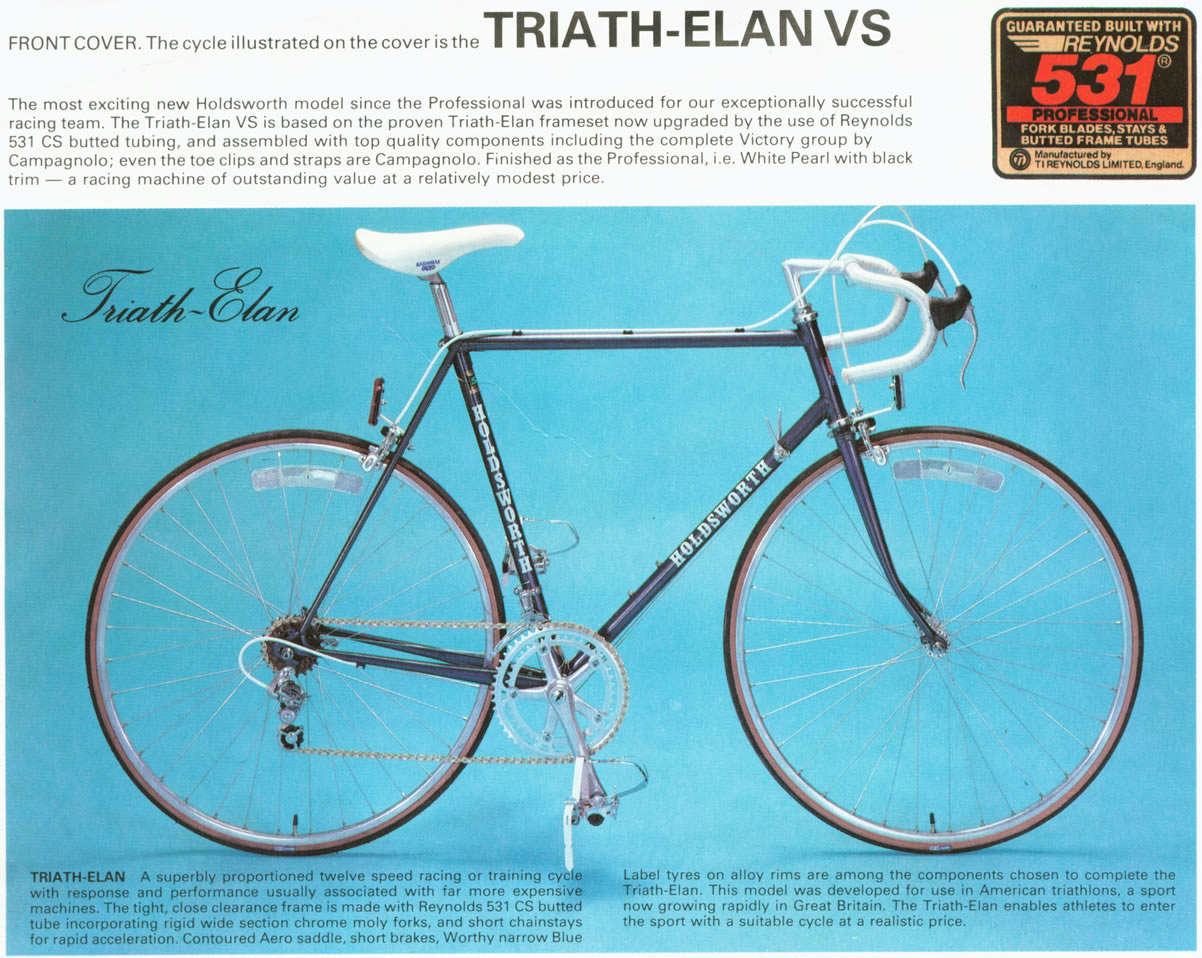
Behold! The bike on which I achieved my greatest feats of road cycling: two journeys of over 200km (Ealing - Bristol and Jeziorki - Belarusian border, both within a day) and covering 75km in under three hours. Of late, this bike's been standing idle in the garage, but as the cycling season gets underway, I decided to get it professionally overhauled and roadworthy. Sporting new tyres, new brake and gear cables, greased axles with new ball-bearings, my Holdsworth Triath-Elan is ready.

It is very satisfying to get a mid 1980s bike back into perfect condition; something that cost less than a fifth of buying a new road bike of similar upper-middle range specifications (frame and groupset). Well-maintained, bikes can last as long as spares are obtainable.

My shakedown ride today consisted of 17.5km (average speed 20km/h, pedestrian really), around Zgorzała, Nowa Wola, Jancewicze, Podolszyn, Nowy Podolszyn, Łady (pron. 'WUDDy'), Dawidy Bankowe and Zamienie, getting the new cables to bed in.

A ride I fancy would be Jeziorki - Góra Kalwaria - Warszowice - Osieck - Pilawa and back by train. A mere 50km, good practice for a season's cycling.

Incidentally, as I've been writing about loanwords of late, the Polish for 'bicycle' is rower (pron. ROVVerr). The word comes from... Rover, the British manufacturer which introduced the safety cycle (chain driven rear wheel, tubular metal frame, two wheels of similar size) in 1886. Anything else would have been a welocyped (velocipede).

Pre-war train times - faster than today?

This timetable (below), showing special services for Easter 1939 between Warsaw and Kraków via Radom and Kielce, is on display at the Dworce Kolejowe Galicji Wschodniej exhibition at Warsaw's railway museum. Since the line is so familiar to me, I thought it would be worth a separate post to show what's changed. Click on image to enlarge.

Most significantly, the main Warsaw to Kraków service today goes along the Centralna Magistrala Kolejowa (Central Trunk Line), from south of Grodzisk Maz. to Psary, bypassing Radom and Kielce. From Psary, the CMK continues to Katowice via Zawiercie, while another goes south-east to Kraków via Tunel. But if you did want to take a train from W-wa Zachodnia to Kraks via Radom and Kielce, the journey today would take 5h 01m, just 32 minutes less than in 1939, which of course would have been steam-hauled.

W-wa Jeziorki did not exist in those days, neither did any other station between Okęcie and Piaseczno. There were, you will notice, stations called Lotnisko and Wyczółki. My guess is that Lotnisko ('airport') is roughly where today's W-wa Żwirki i Wigury station is, though Wyczółki...

Notice too, the lack of a station at Czachówek. That station was built when the Skierniewice-Łuków line was built after the war.

W-wa Zachodnia to Radom by express train (pospieszny)used to take one hour and 29 minutes non-stop. Today's pospieszny takes anywhere between 1h 46m and 1h 55m, although it does stop at W-wa Służewiec, Piaseczno and Warka along the way.

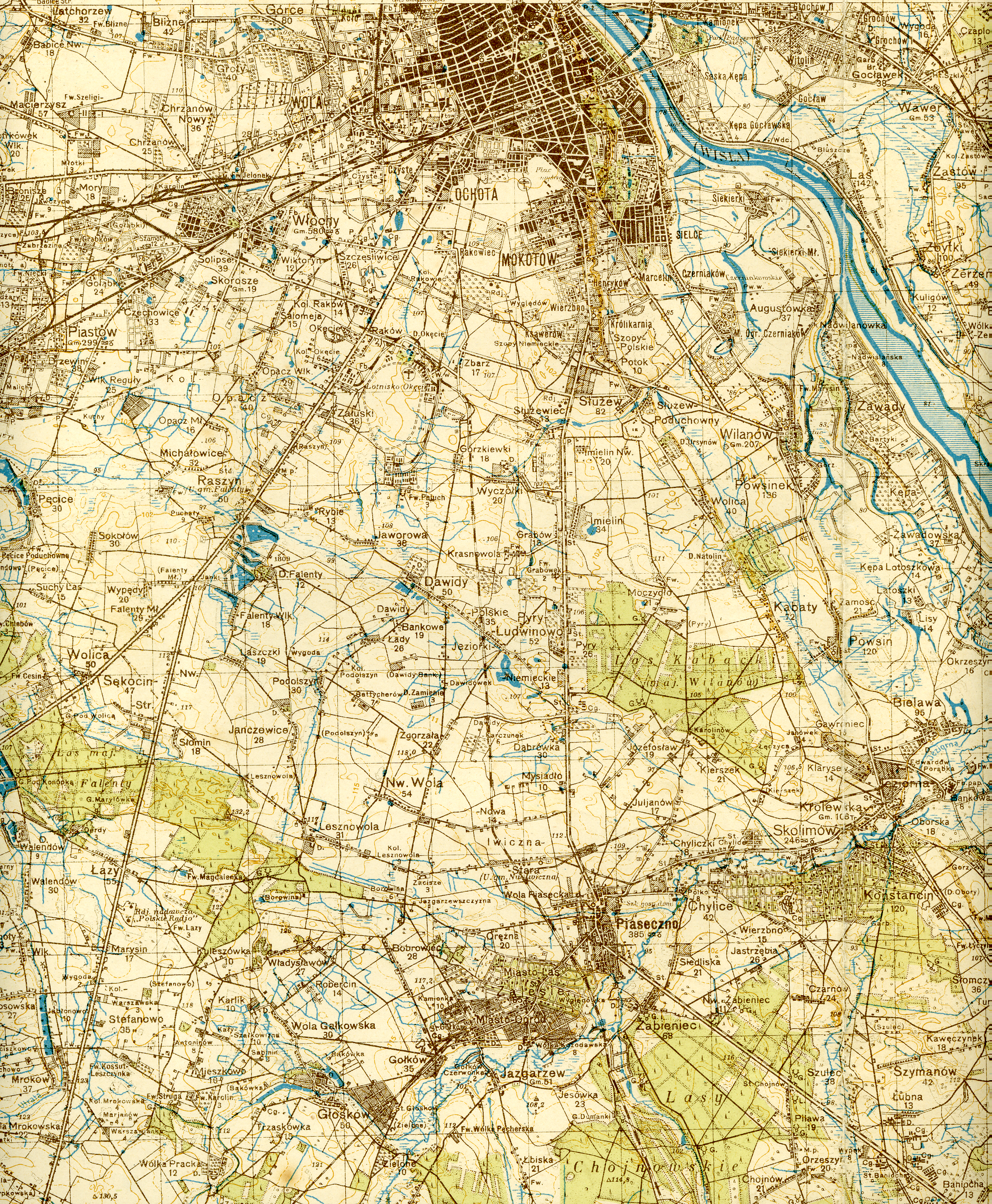
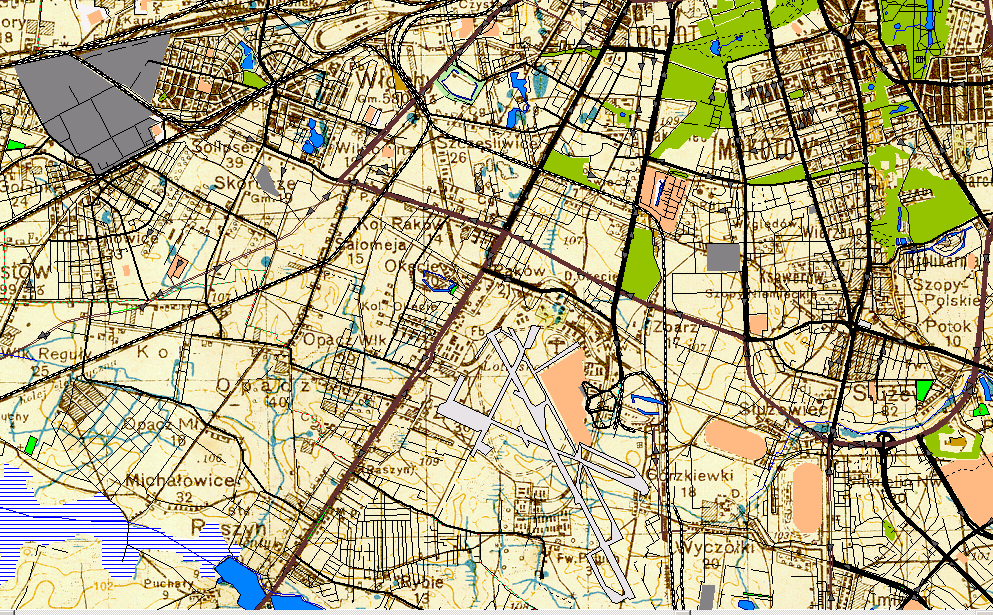
UPDATE: A big thanks to Michał Jankowski for this link to an excellent pre-war map of Warsaw and its southern suburbs, found here, usefully overlaid with modern roads and rails here. As he points out, the tracks ran further south than they do today, which is apparent on the maps. He also says that the fastest pre-war trains between Warsaw and Radom could do the journey in 1h 14m with a stop at Warka. More than half an hour faster than today!

Railway history of former south-east Poland

To Warsaw's Railway Museum for the opening of the exhibition Dworce Kolejowe Galicji Wschodniej. (Now there's a word missing in English - wernisaż - 'private view', or 'opening of an exhibition'; OK it's a loanword from French, but still it's a Polish word that doesn't have a direct single-word equivalent in English.) The exhibition* is of photos taken by Marta Czerwieniec of stations in Western Ukraine, which were previously in Poland before WW2 and before WW1, in the Austro-Hungarian Empire**.

Above: Not just anoraks! I met a man in his early 80s (though you'd not believe it looking at him) who was staring at the photos of Sambor station. 'The last time I was here was 70 years ago - on my way to gimnazium (lower secondary school), just after the Soviets occupied us,' he told me. Galicja as a region was the southernmost part of Poland's Kresy or eastern borderlands, the rest being ruled by Russia during the Partitions. After independence, Poland gained large swathes of land from Austro-Hungary and Russia in which Poles were an ethnic minority.

My mother came from the Kresy, though further north than Galicja. And here's where she was from, on a 1939 railway map of Poland (click to enlarge). West of Sarny, there's a station called Antonówka. Just south of there, a place called Horodziec, some 70km (40 miles) from the Soviet border. When the Soviets invaded, my mother and her family were taken from Antonówka by train to Sarny, and then on to the far north of Russia, to a lumber camp.

Above: a map I've never seen before. Published in 1919/1920, before the Bolshevik invasion, it is a map of 'Polish lands' rather than of Poland. While the western borders are as they would be (give and take a few risings and plebiscites), the eastern and north-eastern borders have yet to be established by force of arms. The lady on the left was looking for where her family was from.

"Further east than on this map," she told me.

Below: The museum has some great models. All hand-made from metal, in the museum's own model-making workshop in Jelenia Góra which I visited with the children back in 2001. The museum is a subject I could go on for ages - how it's sited on prime real estate worth a fortune and the political battles to wrest control of the place, and how some priceless exhibits (unique examples of Polish rail technology from the inter-war years) are rusting away exposed to the elements, and how no one in authority seems to care. But I won't (I shall let Dyspozytor do it).

* The exhibition is open to general viewing from today. Click here for details. If this page is not about Dworce Kolejowe Galicji Wschodniej - too late, you've missed it.

** The Austrian Empire (from 1867 to 1918 the Austro-Hungarian Empire) was one of three powers that swallowed up Poland as a result of the Partitions of the late 18th Century. Unlike Russia and Prussia (Germany after 1871), Austro-Hungarian occupation of Poland was less repressive. The empire was exceeding bureaucratic and had 12 official languages.

And thanks to Tomek for getting me an invite!

Wednesday, 24 March 2010

What's the Polish for "commuter"?

Now that the snow and frosts have gone, I no longer have to scurry to the warmth of W-wa Śródmieście to await my Jeziorki-bound train. Today I popped by W-wa Ochota for a change, from where I took the photo (above) looking west towards W-wa Zachodnia, which as you can see, is at the top of a rise. This slope was formed to enable the railway line to run under the very centre of Warsaw; W-wa Ochota is not in a tunnel but it is below street level. The line runs into the tunnel 400m east of the platform's end. The tunnel, just over 2km long, ends at W-wa Powiśle station, which like Ochota is exposed to the elements.

Incidentally, while looking for the gaps that exist in the linguistic space between English and Polish, I find it quite remarkable that there's no word in Polish for 'commuter'. Getionary gives osoba dojeżdzająca do pracy, and 'commuting' is dojeżdzać [z daleka] do pracy i z pracy. As a language, Polish has been adept at incorporating loanwords into the vocabulary, from dach (German for 'roof') and abażur (from the French, abât-jour, or 'lampshade') to everyday words from English such as biznes and komputer. Yet 'commuter' finds itself without a simple one-word equivalent. Osoba dojeżdzająca do pracy is not a word, but a clunky 11-syllable phrase that explains an everyday word. Could it that commuting is a relative novelty in Poland? Surely not?

Could any reader furnish a better term than osoba dojeżdzająca do pracy? Or suggest a neologism?

And as good a place as any to paste this link to an excellent and thought-provoking article on linguistics in Wall Street Journal.

Tuesday, 23 March 2010

Stalinist downtown, dusk

Not yet six in the evening, this, the last week before the clocks go forward. They day had been bright, top temperature +15C, spring in the air. But by the evening, dark clouds gathered. The Palace of Culture takes on an oppressive character. Newer skyscrapers to its right and neons on buildings opposite remind us who won the Cold War.

Returning geese

What a sight. Seventy geese in arrowhead formation. Grey body, black neck and head... but dark underwing. Are these Canada Geese? If so, they are quite a way east of their usual summering grounds of North West Europe. I caught this flock as it flew over Dawidy this morning.

Sunday's swan conjecture (post below) proved accurate; the children saw one of the four on the reedbeds at the end of our road this morning, standing on ice, not happy with the situation. Still, they arrived a week earlier than they did last year or the year before.