Showing posts with label Siekierki. Show all posts

Tuesday, 3 May 2022

Return to Konstancin-Jeziorna coal sidings

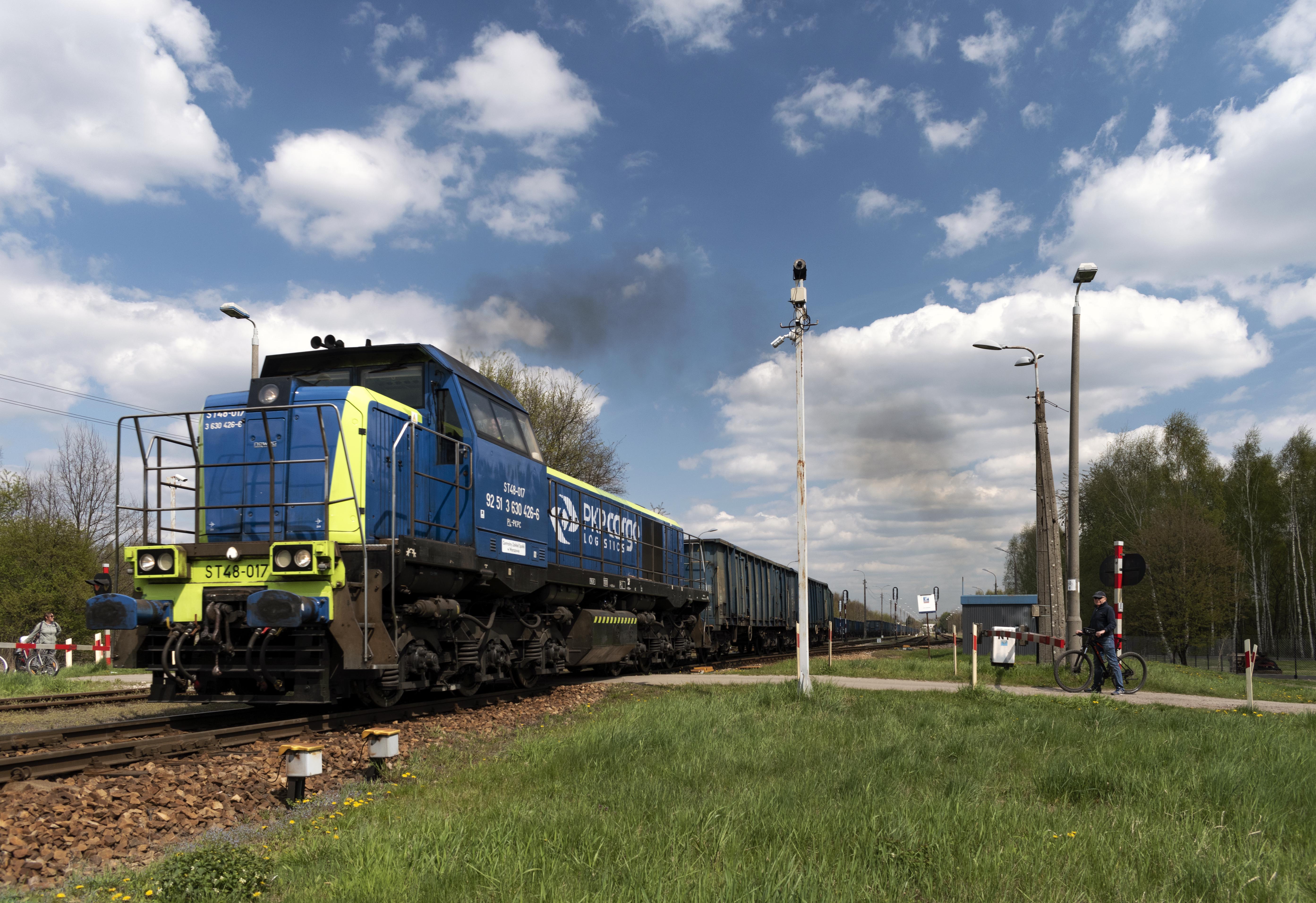
Hunting the railway vibe, the klimaty kolejowe; going where the coal trains go. A long walk across the southern edge of the Las Kabacki, then on to the railway sidings at Konstancin-Jeziorna

Below: looking down at the sidings from the slight rise at the western end. The middle line runs straight through with two set of sidings on either side, all of them long enough to accommodate the longest rake of coal wagons (typically 40 in one set). Full trains (2,000 tonnes of coal) go from here to Siekierki power station; empties come here from Siekierki to be picked up and returned to the sidings south of W-wa Okęcie station, 14km away. 

Below: a rake of empties has just arrived on the second track, the engine the brought them in has been uncoupled, it ran forward, changed onto the middle track to run back to Siekierki. With summer on the way, there's fewer full coal trains heading to the power station. The manoeuvre done, the level crossing gates rise, and many cyclists crosses the tracks, heading to Konstancin (right of pic) or Powsin and Las Kabacki (left of pic). Click to enlarge.

Below: the train standing on the first track in the pic above is pulling out of the sidings and onto the single track towards Okęcie via Piaseczno and Nowa Iwiczna. Level crossing with barriers on ulica Wąska ('Narrow Street') and on the other side of the tracks - ul. Saneczkowa ('Toboggan Street).

Below: heading up hill, a gentle ten-metre rise over 1.7km as the line approaches - but does not enter - the Las Kabacki forest. The level crossing on ul. Głowackiego in Kierszek is close to the border of Warsaw and the forest. Foreshortening effect of telephoto lens zoomed out to 300mm makes the hill look steeper than it is .


Below: looking back towards the sidings from the end of the disused siding, that can be seen on the right of the photo above.


Below: the way things were, April 2008. View from the other end of the sidings, from the level crossing on ul. Warszawska. The train on the middle track is moving away; it has one engine at the back, pushing, and another at the front, pulling. These days, the modernised SM48 locos can pull a whole loaded train unassisted.


There are plans to upgrade this line to a passenger line, which I must say would be a splendid idea (offering a new connection across Warsaw's southern suburbs). It's been talked about for ages (usually just before local elections - see this PR visit), but at last there's a master plan being drawn up, which in February last year was said to be three and half years away. So a reality by 2030? One can but hope... The line won't be a part of the government's Kolei Plus programme, which will be restoring 34 disused and partially disused lines to passenger service, rather this line will be part of a metropolitan project devised by the City of Warsaw. 

I returned by 710 bus from Klarysew, mainly to see the new route linking Konstancin and Kabaty - ul. Stefana Korbońskiego, a sorely needed thoroughfare for local residents. When I say 'new', it opened to traffic in December 2017 (!) this was my first visit here! Below: before boarding the bus - busy scene in Konstancin. Flags out for the 3 May public holiday, the red-and-white repeated on the level crossing barriers and road signs. In the absence of a direct Jeziorki-Konstancin train, I took the 710 bus to Kabaty, Metro to Stokłosy, then 715 bus home. Total walking today: 18,500 paces.


This time three years ago:
A review of the second part of Hillier's Betjeman biog.

This time four years ago:
New roads and rails

This time six years ago:
The Gold Train shoot - lessons learned

This time eight years ago:
Digbeth, Birmingham 5

This time nine years ago:
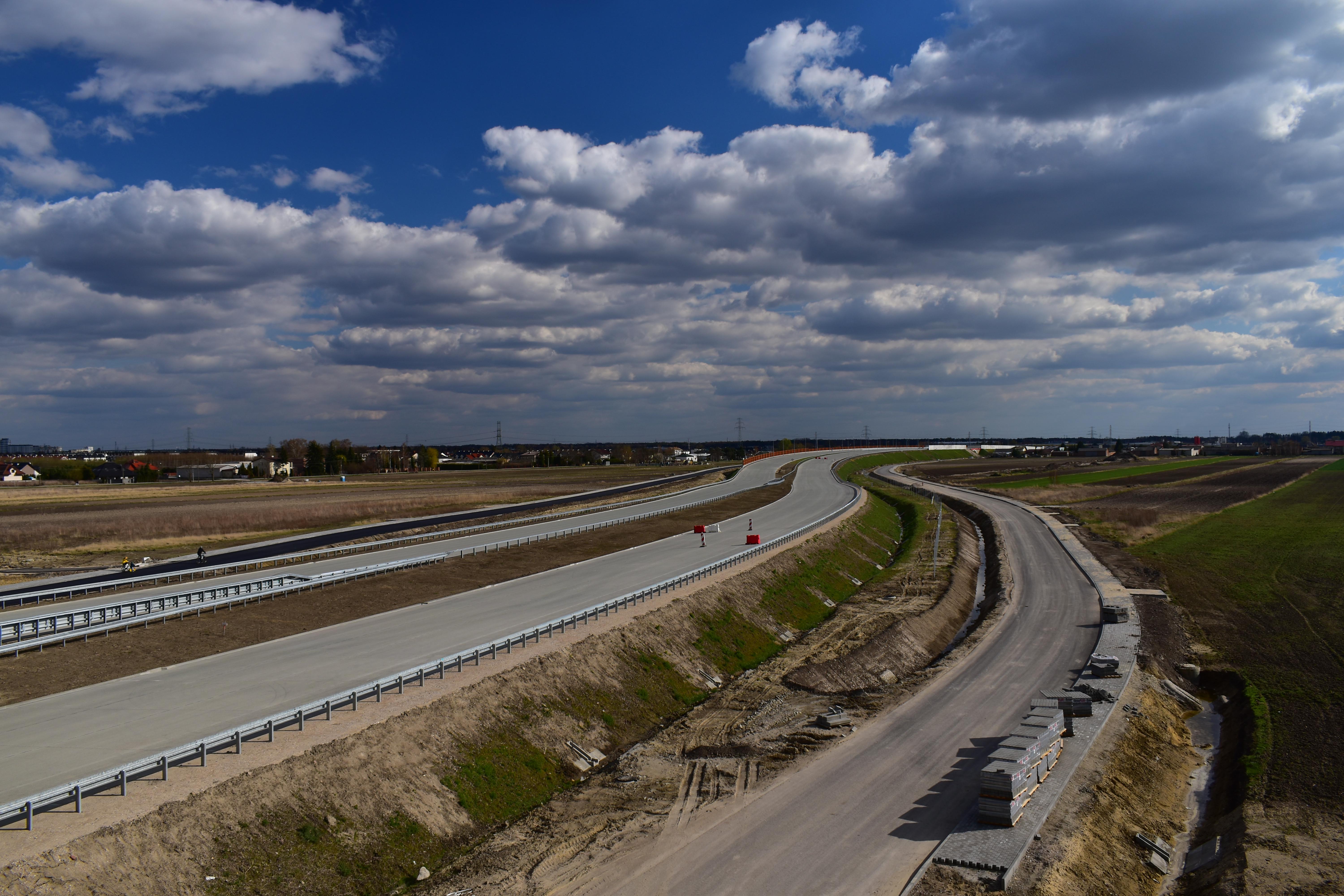
Still months away from the opening of the S2/S79 

This time ten years ago: 
Looking at progress along the S79  

This time 11 years ago:
Snow on 3 May

This time 12 years ago:
Two Polands

This time 13 years ago:
A delightful weekend in the country

This time 14 years ago:
The dismantling of the Rampa

This time 15 years ago:
Flag day


Sunday, 17 April 2022

Horizons

Good photography weather - brisk wind moves scattered clouds across the sky, dappling the landscape with patches of sun that will either illuminate the foreground or the horizon, or neither, or both, the sky itself capable of turning in some drama. Photos from three recent walks, all three being at least 16,000 paces (12km+). Of late, I've been catching a bus, buying a 20-minute ticket (3.40zł/ 60p)and walking home, extending my range and opening new vistas.

Below: lit by strong sunshine, the chimneys of Siekierki, 13km to the north-east. In the foreground farm buildings along ulica Złota, Nowy Podolszyn.


Below: Looking north-east from Podolszyn, sunlit blocks of flats in Ursynów; on the horizon, the chimneys of the Siekierki power station.


Below: looking at Zamienie from the west; four cranes suggest more high-rise developments on the edge of town. Nearest to the camera, Osiedle wśród pól, ('the estate among the fields') which will soon be engulfed by other estates. Note the distant airliner - it's approaching the airport from over Ursynów on RWY 29 as the usual RWY 33 (flying in over Jeziorki) is closed for maintenance.


Below: looking at Nowa Wola from the ulica Polna, which runs from Lesznowola through the fields of Podolszyn to Nowy Podolszyn.


Below: looking north from the fields between Nowa Wola and Podolszyn towards Warsaw, a LOT Embraer ERJ 175 departs from RWY 11, Okęcie airport. Note the shimmering heat haze - which surprised me, because there was a cold wind blowing in from the north.


Below: looking south from the new viaduct that connects Nowa Wola and Zgorzała; the S7 extension, flanked by service roads runs on the next junction, Węzeł Lesznowola.


Below: looking east from the new viaduct towards Piaseczno, housing estates of Nowa Wola and Nowa Iwiczna in between.


Below: sunset in the fields between Dawidy Bankowe, Zamienie and Łady


Below: ploughed field between Podolszyn and the Novisa Modern estate, under construction at the northern end of Nowa Wola, in the English style.


Below: Warsaw's skyline stretches out along the horizon - looking north along ulica Polna as it makes its way from Lesznowola via Podolszyn to Nowy Podolszyn. Asphalted at either end, there's still an 850m gap; this stretch at least is hardened, the next bit is little more than a muddy track.


Below: ulica Gryczna (lit. 'Buckwheat Street'), s dirt-track road leading from Podolszyn towards Zamienie 


For some topical perspective - wayside shrine, Nowy Podolszyn, a banner in Ukrainian colours, and on it the supplication from the Trisagion - 'From air [ie tempests], hunger, fire and wars, rescue us, O Lord'. On the notice board there's a leaflet in Ukrainian with information for refugees; next to in, in Polish, a leaflet explaining how local people can help.


Below: bonus horizon in the snow, taken on 2 April. A train of empty coal wagons heads back south along the electrified main line, between W-wa Dawidy and W-wa Jeziorki. Unusually heavy snowfall for April.


This time three years ago:
Helping others? Couldn't hurt

This time five years ago:
Local ornithology

This time nine years ago:
A hare in Wyczółki

This time ten years ago:
Warsaw by night

This time 11 years ago:
Tales of the Riverbank

This time 12 years ago:
Okęcie before the funerals

This time 13 years ago:
At the General's house

Monday, 27 December 2021

Wintery Gorgeousness Tinged with Filth

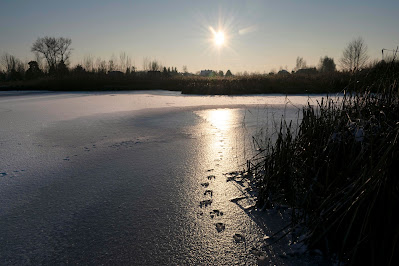
When the temperature falls below -10C, the main task of the power grid is to keep homes warm. Overnight low was -13C, warming to -11C at 11:00 this morning. Below: out on the ice, ul. Dumki.

The ponds have frozen over again; a short thaw turned the surface to slush, which over the past three nights has solidified utterly. No worries about traversing this ice sheet.

Below: despite the day's beauty, the air quality is execrable. To the left a panorama of Warsaw taken on Christmas Day (-4C); not the best visibility in any case (compare the acuity of the foreground with the horizon). But just look at the picture on the right - taken today.  Varso tower, the tallest in Warsaw (and indeed the EU) is just about visible in the right-hand photo.

The filth belching out of homes (typically older, single-family houses), car exhaust pipes do the damage. Warsaw's coal-fired power stations don't contribute much to the smog, but lots of carbon dioxide. Below: Siekierki power station; with all the sliders maxed out on Photoshop to extract the image of the chimneys out of the smog.

And still they come: another full train-load of coal on its way from the Silesian coalfields hauled by a pair of Newag Dragon 2 locos on the electrified mainline. Trains are typically 40 wagons long, each one capable of carrying 60 tonnes of coal. This train is heading toward Okęcie sidings, from where a diesel loco will take the wagons to the power station back down along the parallel, non-electrified, track swinging off to Siekierki beyond Nowa Iwiczna station. The chimneys of the power station are visible on the horizon, as is a band of filthy air.


Below: a Soviet-built M62 diesel loco with a full rake of coal wagons heading to Siekierki. Photo taken from the other side of the tracks to the photo above with a much wider-angle lens.

Back towards the warmth of home - two hours outside at minus 10C holds no terrors if you're warmly dressed. Below: birch trees along ul. Dumki.


This time last year:
Jakubowizna - moonrise kingdom

This time four years ago:

This time seven years ago:
Derbyshire in the snow

This time eight years ago:
Is Britain over-golfed?

This time ten years:
Everybody's out on the road today

This time 11 years ago:
50% off and nothing to pay till June 2016

Wednesday, 20 January 2021

Snow turns to slush

Within just over 48 hours, the temperature rose from -18C to +4C, the equivalent of a rise from -1C to +21C. Although the pond ice was still thick in general, by this afternoon there were already patches where slush was forming on the surface and where good sense told one to stay clear. The cause - bubbles of methane created by rotting vegetation on the pond's bed. I observed a tiny hole with water bubbling from beneath. Further on, the holes were bigger, the dark, slushy patches spreading across the width of the pond.


The previous evening, I went out in the evening as the working day was too busy for a daylight stroll. It was still -4C and snowing gently. Below: ulica Dumki. The Nikon Coolpix A working admirably.


Today's walk took me around Jeziorki from the south; here's one of my favourite views, among the scrubland where at this time of year only hares' pawprints can be seen in the snow.


Below: work on the S7 continues at an exemplary pace, although on the photo below one can only see a solitary excavator. Tipper trucks were in constant motion, though none in this shot.


Below: not easy working in these conditions; because the culvert under the east service road (in the foreground) has not yet been completed, road traffic is diverted onto the carriageway of the S7 for the duration. There is a steep slope to get from the service road to the S7; this flatbed semi-trailer had great difficulty making it - three attempts were needed. The first two ended with the combo slipping all the way back down. There isn't the space for a long run-up!


Below: just before crossing the tracks to get back to Jeziorki, a biomass train passes on its way to Siekierki power station. Co-firing wood chips with coal is a cheap (and in my mind ineffective) way for Poland to reduce its fossil-fuel dependence. 


This time last year:
London in its legal finery

This time two years ago:
Winter walk through the Las Kabacki

This time four years ago:

This time seven years ago:
Rain on a freezing day (-7C)

This time eight years ago:
Jeziorki in the snow

This time ten years ago:
Winter's slight return

This time 11 years ago:
Unacceptable

This time 12 years ago:
Pieniny in winter

This time 13 years ago:
Wetlands in a wet winter

Saturday, 11 May 2019

Another rail bridge over Puławska for renewal

If you're going to Piaseczno by road, be sure to arm yourself with patience. This spring and summer (and most likely autumn too), ul. Puławska, notoriously jammed at the best of times, has become even more clogged up where the coal train line goes over the road. A week ago, demolition of the railway viaduct that carries coal trains from the sidings at W-wa Okęcie to the Siekierki power station via Konstancin-Jeziorna began. The purpose is to widen this choke-point, where Puławska narrows from three lanes to two. By rebuilding the bridge with a narrower central pillar, three lanes of traffic can pass under in each direction.

Below: looking north - the railway bridge has been dismantled entirely. Beyond it, a smaller structure that used to carry pipes across Puławska. It too will go, but won't be replaced.


Below: looking south: both spans of the railway bridge are down, but the offending central pillar remains; it won't be here much longer!


Below: to the west of Puławska there's a two-hectare patch of waste ground used only for dumping domestic rubbish. From here a view looking east under the bridge that used to carry pipes across the road (long since removed). Note the heaps of ballast removed from the railway track.


Below: view along the railway line looking towards the chasm left by the missing bridge. You can see one of the diggers in the distance. No chance of being hit from behind by a train! Siekierki has been well-stocked with coal; in the past weeks I could hear far more coal trains rumbling through the night than is usual; there's enough for summer months, but will the new bridge be ready for the winter?


I hope once the new bridge is up and Puławska's widened it will be time for a bus lane for the road - all the way from Piaseczno to Wilanowska.

Bonus shots - now and then; May 2019, May 2007; looking along ul. Karczunkowska towards W-wa Jeziorki and the railway line. How much change; new bus shelter, tennis school, garden centre, pedestrian crossing - but above all, the viaduct (another 'opening date' - end of May - will come and go). On the horizon of the 2012 photo, the radio mast of the old air traffic control radar base.


The old bus stop used to welcome the 319 (to PKP Jeziorki) and the 715 (to P+R Al. Krakowska). The 319 has been replaced by the 209 (which goes to Ursynów rather than Wilanowska); night buses no longer call at Jeziorki.


This time six years ago:
Thoughts about life occasioned by the birth of kittens

This time seven years ago:
Waiting for the footbridge on Puławska

This time eight years ago:
Lost in the wonder of it all

This time nine years ago:
Bicycle review

This time ten years ago:
A Celebration of the Garden

Sunday, 21 September 2014

By train from Warsaw to Konstancin and Siekierki

Local elections must be just around the corner, as this public transport suggestion is being raised once more, as it has done every four years. Yet - could it be different this time? pociąg

The idea is to use part of the coal train line from W-wa Okęcie to Siekierki power station to provide a passenger service between Konstancin and the city centre, calling at Piaseczno on the way. To promote the concept, SSKS, an association of friends of the railway, have put on two special trains from W-wa Zachodnia to Siekierki.

Once on board, passengers had the chance to lend their support for the idea, which had fallen flat after past local government elections. Why could this idea happen this time after having failed previously? Several reasons.

Firstly, the coal line has been re-nationalised; four years ago Swedish utility operator Vattenfall owned Siekierki and its railway line. Today it's owned by PGNiG Termika. It is undoubtedly easier to make the case for the public good when the railway operator Koleje Mazowieckie (owned by the voivodship) talks to state-owned PGNiG under the auspices of the Ministry of Infrastructure and Regional Development. Secondly, over the past four years there's been a large increase in the number of people living in Piaseczno and (to a lesser extent) in Konstancin, while places such as Julianów and Józefosław have burgeoned into veritable suburban dormitories. Most of the residents have jobs in Warsaw - which leads to Point Three - the growth of the office district around Służewiec in recent years. The new line, passing W-wa Służewiec, would be an ideal way to get people from Warsaw's southern exurbs into work. Fourthly - the opening of the spur from W-wa Służewiec to W-wa Lotnisko Chopina station makes it convenient for those wanting to fly from the airport to use a railway connection.

Below: the light green line shows the route of the coal train once it branches away from the main Warsaw-Radom line at Nowa Iwiczna. The proposition is that the line terminates at Mirków, a little to the east of Konstancin. New stations would serve Konstancin-Jeziorna, Kierszek, Julianów, Piaseczno Puławska and Piaseczno Mleczarska; 29 services each way would run daily between Mirków and W-wa Służewiec (in the top-left corner of this map, courtesy of Google Earth. Click to enlarge).


So - on to the photos of today's journey. Below: an opportunity for a press conference to discuss the potential of running passenger trains over the coal line from Nowa Iwiczna to Mirków.


Below: here's the train between W-wa Jeziorki (it is unlikely Jeziorki will be served by these trains as the station has no platform on the coal train line) and Nowa Iwiczna. The train has to be diesel, as there's no electrical traction on this line - in the foreground is the electrified Warsaw-Radom line.


Below: the two-car diesel multiple unit, which usually serves the eastern fringes of the Koleje Mazowieckie network, seen today between Julianów and Kierszek.


Below: looking down towards the sidings at Konstancin-Jeziorna. Two rakes of coal trucks await collection in the two left-hand sidings; the diesel railcar takes a break on the right hand track.


Below: photo opportunity by the bridge at Bielawa. Passenger trains pass this way once every four years, so it's worth recording this event. The plan does not foresee passenger trains going beyond here onwards to Siekierki.


Below: view from the cab, approaching Okrzeszyn (city każdy obcy będzi bity). Out here, between Konstancin and Siekierki, development is sparse, with the occasional new housing estate and scattered farmsteads. Quiet, surprisingly close to the centre of Warsaw, yet the threat of flooding is ever-present.


Below: 500km from where the Vistula rises in the mountains, snapped from the train. The railway line runs parallel to the Wał Zawadowski, the flood protection wall that lines the Vistula's west bank between Siekierki and Konstancin. Ideal for gentle off-road cycling.


Below: not far from Siekierki. We are just a few kilometres from the centre of Warsaw, yet the landscape is quite rural. Passenger trains out here will always be a total rarity.


Below: approaching the power station - chimneys and coal heaps. Passing under the rail bridge a 163 bus heading for Sadyba. The surrounding area has the klimat of the Zone in Tarkovsky's Stalker.


Below:  end of the line, Siekierki, and time for another photo opportunity. Here we are, 29km from W-wa Okęcie, having completed a 'U'-shaped journey.


Below: time to re-board the train at Siekierki and head back towards town. I get off the train on its return journey at Konstancin and walk back alongside the track to W-wa Jeziorki - exactly 10km.


I hope this time the plan prevails. Having this rail infrastructure and keeping it for just a few coal trains a day, while ul. Puławska is choked with traffic, is nonsensical. These rails should be serving commuters as well as the power station. If you live in Konstancin or Piaseczno, or anywhere in between, and wish to get into town quickly and without jams - here's the solution.

This time last year:
Summer's end, Jeziorki

This time three years ago:
Ząbowska, Praga's newly-hip thoroughfare

This time five years ago:
Catching the klimat

This time seven years ago:
Road to Łuków - a road trip into the sublime