Showing posts with label Lublin. Show all posts

Tuesday, 19 December 2017

Snapshots of Lublin before Christmas

Enter the magic of Lublin's old town as snowflakes fall, with Solstice approaching.


Let's step through the Trinitarian Gate (Wieża Trynitarska) and explore, making the Most of the atmosphere...


Dusk descends upon the town, as it would have done in centuries past, time to settle in for a late lunch after four business meetings... The building to the left is the old town hall.


And then explore the back streets...


Before returning to the main square... Here is the house of the 16th century poet, Sebastian Klonowicz.


Evidence of Christmas festivities in the square, more people...


Brama Krakowska, the Kraków gate, the westerly entrance the old town.


Passing out of the old town, across the way from Brama Krakowska is the new town hall. Beyond is Krakowskie Przedmieście, which leads to Plac Litewski.


Final photo - the facade of the Archcathedral of St John the Baptist and St John the Evangelist. And the Glory of God Shone Around.


Click here for more Lublin photos across the seasons of the year (starting with this post again).

This time last year:
The best of Warsaw's Christmas illuminations

This time two years ago:
Changes on ul. Baletowa
[A year later, the 715 and 737 bus routes would  start to serve this street]

This time four years ago:
UK migration - don't blame the Poles

This time fiveyears ago:
Jacek Hugo Bader's Biała Gorączka reviewed

This time six years ago:
Thoughts upon the death of the Dear Leader

This time seven years ago:
Global warming or climate change?

This time eight years ago:
Progress along the S79

Friday, 22 May 2015

Three days - three Polish cities

Back to Lublin - second visit within one month. Great! And two hours between the end of the event and my train, so lots of time to wander through an Athens of the er... north. Below: this is a reverse view of this photo taken a month ago.


Back to the Old Town. Here's the entrance to ul. Rybna, below. this time taken from back in the square. Compare to pic taken last month.


Below: I had a burger and a Spitfire ale (from Kent's Shepherds Neame brewery) at U szewca ('at the cobbler's')' and here is the view from outside the pub, looking across at Pl. Po Farze.


Below: time to make my way down the hill to the station, to catch the night train to Wrocław. On one side of the street, the splendour of the Old Town, on the other, early industry and workers' tenements.


All aboard the night train! I love Poland's night trains - I get into my berth in Lublin at quarter past eight in the evening and wake up nine hours later in Wrocław's beautifully restored station. Interestingly, looking at a map of Poland, I notice that Wrocław's only a teeny bit further south than Lublin. The two cities are 385 km apart as the crow flies, but the train does it 660 km in a giant serpentine route going as far north as Warsaw and as far south as Katowice. Still, nine hours from station to station means there's plenty of time for a good night's sleep.

Are you ready for the Night Train?

Puławy Miasto... Warszawa Wschodnia... Opoczno Południe... Dąbrowa Górnicza... Sosnowiec Główny... Kędzierzyn Koźle... Opole Główne... Night Train, Night Train, NIGHT... TRAIN!


Below: quarter past five in the morning, looking up from the passage linking the platforms.


Below: looking at the original platforms, now the booking hall (the tracks are to the left). I'm picked up by car and driven to Oleśnica for an excellent manufacturing event at GKN Driveline's factory.


Below: heading back to Wrocław along the S8 expressway, over the Odra river. A vast amount of new infrastructure has emerged in an around the city.


Below: back at Wrocław station to catch the evening Pendolino service to Warsaw. Third time I've caught this train since the Warsaw-Wrocław service was launched. And each journey was on time.


Back in Warsaw, meetings, preparing more meetings. E-mails by the score. An intensive week's work. Nighttime skyline below shows Poland's progress. Just before the cisza wyborcza, let me make an appeal to vote to secure stability and predictability on Sunday.


Morning, Jeziorki. Below: On my way to the station, dandelions in seed. Less than eight miles from the scene above, Warsaw is a compact capital compared to London. I much prefer living in Warsaw to London!


Half an hour by train from W-wa Jeziorki to W-wa Śródmieście and I'm walking past the Palace of Culture again on my way to the office. A long week made all the more interesting by the change of scenery.


This time three years ago:
Part two of short story The Devil Is In Doubt

This time four years ago:
"A helpful, friendly people"

This time five years ago:
A familiar shape in the skies

This time six years ago:
Feel like going home

This time seven years ago:
Mr Hare comes to call

Sunday, 19 April 2015

Lublin - Pearl of Poland's East

Poland has many fine cities worth visiting; for those not in the know, Lublin, some 100miles/165km south-east of Warsaw, is a bit off the beaten track. Tucked away in eastern Poland, along with Białystok and Rzeszów, it's less visited than Krakow, Gdańsk, Wrocław or Warsaw, yet each repeat visit continues to provide me with delight.

Yesterday I was in Lublin to address a translators' congress - very interesting (maybe a few thoughts on the subject at a later date if there's demand). As I had three hours to kill before my train back to Warsaw, there was a great opportunity to visit Lublin's Old Town.

Below: like Warsaw, Lublin has a Krakowskie Przedmieście, this street running from west to east and ending at the City Hall (right) and the gates to the Old Town (centre).


Below: at every turn, a tower. It was a cold day (+4C) with a strong wind; blue skies would alternate with dark clouds and showers. In the distance, the Trinitarian Tower.


Below: ul. Arcydiekańska, the Dom społecznej pomocy (lit. House of Social Help). On the wall, in white lettering, the Latin inscription Bene merentibus pax - 'Peace unto the well-deserving'


Below: some of the kamienice have been restored, others are still in a poor state, while renovation work continues at a leisurely pace. Sharing an idea from Warsaw's Ul. Próżna and Pl. Grzybowski, black & white photos of former residents grace the windows of buildings in the course of remont.


Below: view from Plac Po Farze* across to the Royal Castle. Note the trees in blossom and the threatening clouds, which thankfully moved north-eastward away from the city.


The Old Town has an abundance of restaurants and bars; having time, I looked around for what I fancied. U szewca ('at the cobbler's') is still the finest, but I was put off by the staid choice of beers. Indeed everywhere into which I popped my head had the same insipid line-up, with the occasional 'unpasteurised', 'unfiltered' or 'regional' beer that typically comes from one of the big industrial brewers. The craft ale renaissance is nowhere to be seen in Lublin's Old Town.

Similarly with food. I ordered a 10oz burger in a pub on the market square. A lovely place, tastefully - intriguingly even - decorated, good friendly service, busy with foreign tourists... the burger comes. High quality of meat - like you'd expect from a trendy burger place in Warsaw. And the price? About 6zł less than in the capital. But a square slice of processed cheese on top of the meat? Ketchup? Get out of town! Would it not be too much to ask for some Roquefort, a slice of fresh pear and some ruccola? And beer-wise, the most exotic departure from the ubiquitous Lech/Tyskie was a pint of Guinness. Where are the craft ales?

Here's a huge opportunity for business development. My children tell me of all the hip places going on in Łódź; now, Lublin - a city where 23% of the term-time population is students - should be at the cutting edge of hip. It isn't - it feels about six or seven years behind Warsaw when it comes to gastronomy and interesting beers. Below: the Old Town gate at the Royal Castle end.


When I first visited Lublin's Old Town in 1999 it was completely run-down and full of dilapidated alleyways (like the one below, ul. Ku Farze*) and crumbling tenements. Since then, it has slowly established its place on the must-see list of any tourist visiting Poland. Yesterday I saw scores of tourists - and indeed students - from the US, Germany, France, Spain, Russia, the Far East and the Middle East.


Below: the archway from the Old Town market square leading into ul. Rybna (lit. ' Fish Street' or 'Fishy Street'). Some more of the old charm of Lublin - catch it before it gets too Disneyfied.


Below: looking down ul. Złota ('Gold Street') towards the Dominican Basilica.


Below: the Trinitarian Tower, as seen from the Old Town market place.


Below: the Old Town Hall and Crown Tribunal building, surrounded on all sides by the cobbled market place. I don't think many of the tourists strolling around during this low-season weekend were expecting that it could be this cold in mid-April. This time last week it was 22C outside Warsaw.


In August 2013, I wrote a short story in five parts about the reported miracle that occurred in Lublin's cathedral (below). As this is my first visit to the city since writing it, I took the opportunity to see the arch-cathedral of St John the Baptist and St John the Evangelist (below). The Miracle of Lublin happened on 3 July 1949, while Poland was suffering the worst phase of Stalinism.


Many worshippers reported seeing tears of blood streaming down the face of the painting of the Madonna (below), a replica of the more famous one in Częstochowa. The communist authorities, wishing to stifle the crowds streaming into Lublin to see the miracle, had a provocateur throw a brick (or a plank according to some sources) from the top of the bell-tower to the left of the photo above, which killed an 18 year-old girl, and caused a stampede in the crowd queueing outside the cathedral.


Below: looking down from the square in front of the cathedral.


On my way down the hill from the Old Town towards the railway station, quite a way from the city centre. I pass the Diocesan Museum illuminated by strong late-evening sunshine.


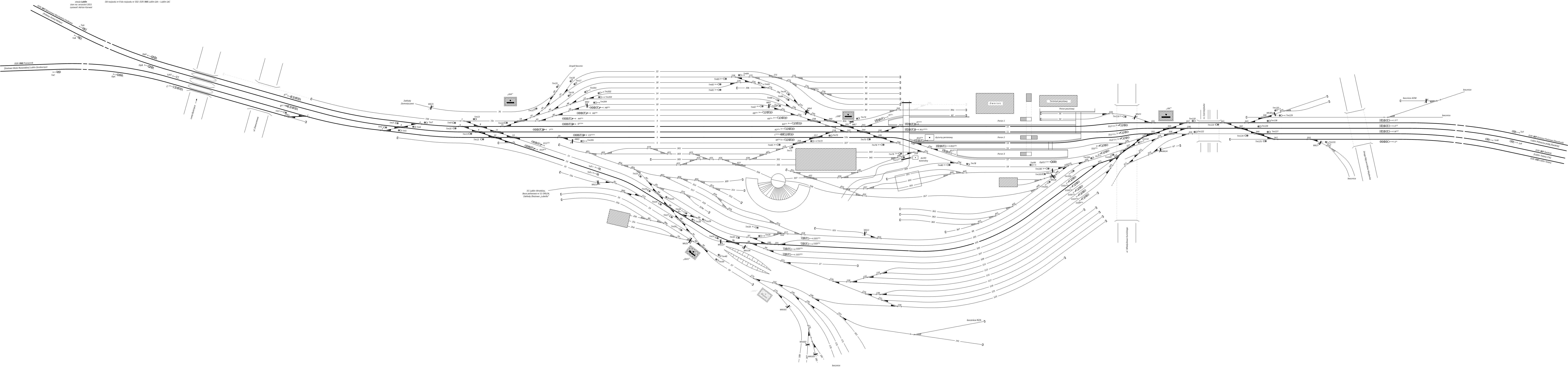
The station is remarkable for having a vast amount of tracks. "The train for Szklarska Poręba calling at Warsaw is standing on Platform 1, Track 52. The train from Warsaw arrives at Platform 3, Track 57." Gulp! Apparently, many tracks are now defunct, ripped up or for freight only, but from the passenger's point of view, this numeration system is madness.Click on the scheme below to see just how complex Lublin station is - but surely there's a better way of numbering tracks? [click here to see the whole picture]. Plus, it's a long walk from the station to town. 


Lublin is well worth a visit. It's cheaper than Warsaw and easy to get to. Now it has its own (and remarkably busy) airport with connections to London Stansted and London Luton, and later this year to Sheffield-Doncaster and Glasgow. The rail journey to Warsaw takes a little over two hours and there's also a good PolskiBus.com service.


* Fara or Farna - archaic term for 'parish'. Kościół farny = Parish church. Ul. Ku Farze = Towards the Parish (Church) Street; Pl. Po Farze = After (or the Remains of) the Parish (Church) Square (or Place).

This time two years ago:
70th anniversary of the Warsaw Ghetto Uprising

This time three years ago:
Tarkovsky's Stalker: a zone of my own

This time four years ago:
Warsaw's big billboards

This time five years ago:
Pace of development falters

This time eight years ago:
Strange days indeed

Friday, 17 October 2008

Lublin continues to work its charm

What a contrast to Białystok. Lublin - busy, interesting, friendly. The presence of four big universities means plenty of students who need plenty of bars, located in a picturesque old town, driving business outside of the out-of-tourist-season, which in turn means more investment. Above: it may be autumn, but when the sun shines, it brings out the beauty in the old town.

Above: The Czech restaurant in the old town, where the speakers and organisers of today's conference on public-private partnerships had their post-event lunch. Part of its appeal (apart from a huge variety of Czech and Slovak specialty beers, gut-filling knedliki, deep fried cheeses and French fries with mayo) is the running gag about how funny Czech sounds to the Polish ear. The menu, for instance, contains kurcakove pofrudelka (chicken wings). Probably made up (like drevny kocur = squirrel), but guaranteed to make Poles laugh.

Crashing change of gear. Bits of Lublin are still unrestored and evoke the atmosphere of this tragic city from the time of the Holocaust. But building by building, the heart of the old town is being made jollier, more tourist friendly, but, as I said on earlier visits, something is being lost. Before it goes, it needs to be recorded.

This time last year:
First frost [not had one yet in 2008]

Thursday, 26 June 2008

Return to Lublin

In Lublin today to chair an investment seminar. Weather perfect. Arrive 90 minutes early and take in the Old Town before getting down to work. I was last in Lublin a year ago. Make your way down Lublin's main thoroughfare, Krakowskie Przedmieście (left). We're still in university term time, though before the main holiday season. So the town's quite busy, but not overcrowed. No endless crocodiles of guided tourist parties that spoilt Prague for me when I visited it in 2005. Through the gate (below)... And into the Old Town. Which ten years ago was empty, eerie, crumbling, yet intensely atmospheric. Today, it's been (partially) renovated, and it's thriving. The city's marketing campaign is encouraging Poles to take a look at this once-neglected tourist attraction. A city of 355,000 people, Lublin's five universities have a total of 100,000 students - the highest student/population ratio of any Polish city. In terms of economic development it's quite some way behind Poland's more westerly cities - Wrocław, Katowice, Poznań, Kraków, Gdańsk, Łódź and Warsaw - mainly because of poor transport links (no motorway or airport connections). The city's authorities have recognised the Old Town's tourist potential and have invested sensitively in ensuring that its charm is not lost after the restoration process has been finished. The horse and cart is the ecologically-friendly refuse removal vehicle. Note too the friezes painted onto the newly-plastered walls. Beer gardens extending onto the cobbled squares abound; there's a huge variety of bars and restaurants. Some buildings are crumbling, while others have been restored. Aesthetically, the restoration looks good, but the Old Town is starting to lose its original character. Left: The left-hand building is a Jewish restaurant, a reminder of Lublin's pre-Holocaust history. Part of the Old Town's appeal is the large number of arched passageways that dive off between buildings. The cobblestones are hard work for buggies, wheelchairs and stiletto heels, but are essential for the place's character. On my first visit, in February 1999, the town was deserted; there was melting snow on the cobbles, and one could sense the ghosts of the past everywhere. That evocative, haunting atmosphere has now gone; the town's happier, vibrant. You gain, you lose. That's progress. The gate at the eastern end of the Old Town, that leads across to Lublin's castle. Yet again work prevented me from visiting it. I've been to Lublin ten or twelve times, always on business, and have yet to pop in. Below: My favourite pub in Lublin's Old Town, U Szewca ("At the Cobbler's"). Here, one can actually buy draft Bishop's Finger ale from Kentish brewery Shepherd Neame. Place looks empty, but all the tables outside were occupied.
   

This time last year: The perfect rainbow over Jeziorki

Thursday, 5 July 2007

Lublin and The Road

Went to Lublin on business today, a drive of 100 miles (160 km) from Warsaw. Lublin's Old Town is still relatively unmodernised and its old tenements, arched passageways and cobbled squares exude a strong, though sad, historic atmosphere that you'll be hard pushed to match elsewhere in Poland. Kraków's Kazimierz had it but has become too developed in recent years.

The Road beckons. The Road is my Muse. Since early adulthood, road movies have been a favourite cinematic genre of mine. So load up with good music and a camera, and capture the spirit of the road. Above all, take your soul. (Below) Somewhere between Ryki and Garwolin. An avenue of trees, beyond them, ripening fields of wheat, tobacco and maize.


July has started wet and stormy. (I got utterly soaked cycling home from work on Tuesday.) The sky continues to be pregnant with rainclouds. As Warsaw got closer on the run home in the early evening, the sky turned darker, brooding and more threatening. (Below:) Near Kolbiel.