Truly the workhorse of Western armed forces, the Lockheed C-130 Hercules has had an amazingly long-lived career as a military transport aircraft. The prototype flew almost 60 years ago (August 1954), while the C-130E variant (of which Poland has five) entered service over half a century ago (1962). In use with 71 air forces around the world of which 15 are European, the C-130 is a hugely successful and long-lived design.
This one (below, serial number 1504) was in use with the USAF since 1971. With the USAF serial number 70-1276, it saw service in the UK, based in Mildenhall in the late 1970s. Good to see the szachownica (red-and-white chequerboard) gracing it today, coming into land over Jeziorki.
Last week Warsaw's Okęcie airport celebrated its 80th birthday; the C-130 has been around for three-quarters of that period! Makes you appreciate the huge leap forward in aviation between 1934 (Douglas DC-2, forerunner of the famous Dakota first flew in that year) and 1954 (B-52, C-130 still in active service).
This time last year:
Looking for The Zone, in and around Jeziorki
This time three years ago:
I awake to snow, on 4 May
This time seven years ago:
This is not America. No?
Showing posts with label Hercules. Show all posts
Sunday, 4 May 2014
Monday, 26 August 2013
More photos from Radom Air Show 2013
![]() |
| Royal Netherlands Air Force AH-64 Apache and F-16: Most unusual to see a fast jet so close to a helicopter in flight. |
![]() |
| Tiger on the tail: artistic embellishment on a Czech Air Force JAS-39 Gripen |
![]() |
| The Baltic Bees - Latvia's aerobatic team, flying Czech-built Aero L-39 Albatros trainers |
![]() |
| The Dutch AH-64 turns upside down (remarkable for a helicopter!) after deploying flares |
![]() |
| The new-style London Routemaster drew a great deal of interest from the Radom crowd, estimated to be between 80,000 and 100,000 strong. Inside the bus, my collection of model aircraft... |
![]() |
| It was satisfying to see so much interest in my collection of model aircraft representing RAF types flown by Polish squadrons in WW2. "Like displaying a stamp collection at a Miss World contest". |
![]() |
| Polish Air Force PZL SW-4s in formation |
Poles - stretch your facial muscles!
Friday, 26 July 2013
Scaling the highest peak in Wales
Yr Wyddfa (or if you insist on being an English-language imperialist, Snowdon) is the highest peak in Wales, 1,085m above sea level. It's also the highest peak in the UK minus Scotland, so if the Scots vote for independence next year, Ben Nevis (1,344m) will no longer claim that distinction.
Said to be Britain's busiest mountain, it does get crowded as you reach the summit, but that's helped by the fact that a train can take the laziest of people to the very top. Having been up Giewont, I can say it's a long way from that level of crowdedness.
Eddie and I left the car at Rhyd Ddu station car park [pron. 'Ryd Thee'] and walked up the Rhyd Ddu path to the summit, and walked down the less-challenging Snowdon Ranger path. We were hoping to catch the Welsh Highland Railway back to Rhyd Ddu, but the 16:40 service doesn't run on a Friday, so we walked back from Snowdon Ranger.
It took us two and half hours to get to the top from the car park. Much of the walk was straight forward, but here and there we needed the aid of our hands to scramble up some of the steeper parts of the track. From the bottom we could not see the summit, as it was wreathed by clouds. As we ascended, the clouds blew past, yielding a view of the top (below).
Below: along the way, we see some mountain goats. The one on the left is gazing at the shadow of his head on a rock. In the distance, the Llanberis path, longest but easiest way up (I cycled up that way in 1991).
It's quite an unusual experience to behold a large aircraft flying below you while you're standing on terra firma. We spot an RAF Hercules C-130K Hercules weaving between the mountain tops.
Below: looking up at the summit, it appears to be teeming with humans. Just below the summit, the restaurant and mountain railway centre, opened in 2006.
Below: the view from the very top. Very busy. Everyone's taking selfies with their iPhones and uploading to Instagram. Signum temporis!
Below: the Snowdon Mountain Railway, steam hauled for this trip. Loco No. 2, Enid, pushes the single carriage up the rack-and-pinion tracks. It is wonderful that this little railway is still in regular use after 117 years.
Below: looking down the track toward Llanberis and the island of Anglesey beyond. We didn't have perfect meteorological conditions; they were good enough to see much of North Wales, but there was no sign of Ireland, the Isle of Man or indeed Scotland. It is said that on a clear day the line of sight from the top of Yr Wyddfa extends 140 miles (215 km).
The views from the climb captivate. We had the optimal day for climbing; dry, not too hot, with a light wind to wick away the sweat. This is my third ascent of the peak, the first for over twenty years. Eddie was a star, utterly tireless.
This time last year:
Beaches of the north coast of the Llyn Peninsula
This time two years ago:
The Accursed Soldiers - a short story
This time three years ago:
Driving impressions of the Toyota Yaris
[Three years on - still no imperfections to report whatsoever]
This time five years ago:
Poland's dry summer
This time six years ago:
The UK's wettest summer ever
Said to be Britain's busiest mountain, it does get crowded as you reach the summit, but that's helped by the fact that a train can take the laziest of people to the very top. Having been up Giewont, I can say it's a long way from that level of crowdedness.
Eddie and I left the car at Rhyd Ddu station car park [pron. 'Ryd Thee'] and walked up the Rhyd Ddu path to the summit, and walked down the less-challenging Snowdon Ranger path. We were hoping to catch the Welsh Highland Railway back to Rhyd Ddu, but the 16:40 service doesn't run on a Friday, so we walked back from Snowdon Ranger.
It took us two and half hours to get to the top from the car park. Much of the walk was straight forward, but here and there we needed the aid of our hands to scramble up some of the steeper parts of the track. From the bottom we could not see the summit, as it was wreathed by clouds. As we ascended, the clouds blew past, yielding a view of the top (below).
Below: along the way, we see some mountain goats. The one on the left is gazing at the shadow of his head on a rock. In the distance, the Llanberis path, longest but easiest way up (I cycled up that way in 1991).
It's quite an unusual experience to behold a large aircraft flying below you while you're standing on terra firma. We spot an RAF Hercules C-130K Hercules weaving between the mountain tops.
Below: looking up at the summit, it appears to be teeming with humans. Just below the summit, the restaurant and mountain railway centre, opened in 2006.
Below: the view from the very top. Very busy. Everyone's taking selfies with their iPhones and uploading to Instagram. Signum temporis!
Below: the Snowdon Mountain Railway, steam hauled for this trip. Loco No. 2, Enid, pushes the single carriage up the rack-and-pinion tracks. It is wonderful that this little railway is still in regular use after 117 years.
Below: looking down the track toward Llanberis and the island of Anglesey beyond. We didn't have perfect meteorological conditions; they were good enough to see much of North Wales, but there was no sign of Ireland, the Isle of Man or indeed Scotland. It is said that on a clear day the line of sight from the top of Yr Wyddfa extends 140 miles (215 km).
The views from the climb captivate. We had the optimal day for climbing; dry, not too hot, with a light wind to wick away the sweat. This is my third ascent of the peak, the first for over twenty years. Eddie was a star, utterly tireless.
This time last year:
Beaches of the north coast of the Llyn Peninsula
This time two years ago:
The Accursed Soldiers - a short story
This time three years ago:
Driving impressions of the Toyota Yaris
[Three years on - still no imperfections to report whatsoever]
This time five years ago:
Poland's dry summer
This time six years ago:
The UK's wettest summer ever
Monday, 1 August 2011
'W'-Hour, 67 years on
For my father, Bohdan Dembiński, 88, and mother-in- law, Wanda Lesisz, 86, veterans of the Warsaw Uprising.
Since the 65th anniversary of the outbreak of the Warsaw Uprising (post here), the commemorations have become increasingly well-participated. This year, I was pleasantly surprised by the number of flags on display - not just the official ones on public buildings, buses and trams - but on private flats, on t-shirts, and held in children's hands.
The city and its people are taking increasing pride in the Uprising. The old communist line - that it was a provocation needlessly brought about by the Polish Government in Exile in London - is not something most Varsovians would accept today.
It was the product of anger - four years of the most brutal occupation (and don't let's forget the Warsaw Ghetto Uprising of April 1943) - and the result was to hold back Stalin's steamroller advance towards Western Europe by at least three months.
Ten minutes or so before the sirens sounded for 'W'-Hour, a Polish Air Force C-130E Hercules flew the length of ul. Marszałkowska dropping leaflets, urging citizens to oddaj hołd ('pay homage', 'pay tribute') to those who gave their lives fighting to free Warsaw.
Above: the side doors are opening; the first batch of leaflets are just coming out. Like the B-24 Liberator that flew supply missions over Warsaw, the C-130 Hercules has four propeller-driven engines and is US-built (its first flight was just ten years after the Uprising started!)
Below: The leaflets filled the sky directly over our heads, but sadly the westerly wind blew them away from Marszałkowska, towards the Vistula. The air drop was a tribute to the Polish, British, South African and American aircrews who gave their lives flying over the burning city dropping supplies to the Home Army insurgents.
Below: At exactly 17:00, the time the Uprising started, all the city's air raid sirens sounded. Traffic came to a halt. People stood at attention. Quite something. And the weather. This morning started wet and dull - like most of July. By the early afternoon, the clouds had parted, the sun shone in a bright blue sky.
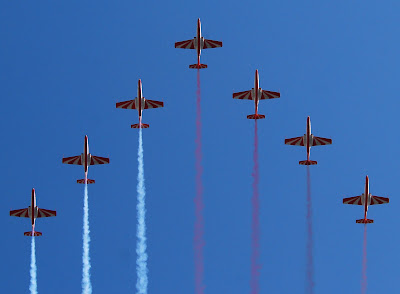
At 17:05, seven PZL TS-11 Iskra trainers of the Polish Air Force's Biało-Czerwone Iskry aerobatic team flew overhead, trailing red and white smoke. The Iskra, a purely Polish design, first flew in 1960 and was introduced to the Polish Air Force in 1964 and is still in service today.
Below: around the city, the numerous plaques and monuments to the Uprising were decorated with flowers, garlands and votive candles. At the power station in Powiśle, a plaque explains how 107 Home Army soldiers, employees at the power station, fought a battle lasting several hours to wrest control of the building. They held on to it from 1 August until 7 September, providing electricity to the insurgent-held parts of the city. 25 of their number died in the fighting. (Polish readers can click to enlarge photo to read text of the plaque.)
Was it all worth it? Bear this in mind. In the two months between 22 June and 19 August 1944, the Soviet Army advanced more than 300 miles between Vitebsk and the Vistula, taking Minsk, Vilnius, Lviv, Grodno, Białystok, Brest, Lublin and Przemyśl from the Germans. Between 19 August 1944 and 17 January 1945, when the Red Army captured Warsaw from the Germans, Stalin's tanks hardly budged.
Stalin let Hitler sort out the belligerent Poles, but Stalin did so at the expense of his westward expansion. Maybe the good citizens of West Germany, who lived so much better than their eastern neighbours, should give thanks every year on 1 August that they did not have to suffer 45 years of communism - because of the valiant fighters of the Warsaw Uprising.
This time two years ago:
'W'-Hour - five pm
Since the 65th anniversary of the outbreak of the Warsaw Uprising (post here), the commemorations have become increasingly well-participated. This year, I was pleasantly surprised by the number of flags on display - not just the official ones on public buildings, buses and trams - but on private flats, on t-shirts, and held in children's hands.
The city and its people are taking increasing pride in the Uprising. The old communist line - that it was a provocation needlessly brought about by the Polish Government in Exile in London - is not something most Varsovians would accept today.It was the product of anger - four years of the most brutal occupation (and don't let's forget the Warsaw Ghetto Uprising of April 1943) - and the result was to hold back Stalin's steamroller advance towards Western Europe by at least three months.
Ten minutes or so before the sirens sounded for 'W'-Hour, a Polish Air Force C-130E Hercules flew the length of ul. Marszałkowska dropping leaflets, urging citizens to oddaj hołd ('pay homage', 'pay tribute') to those who gave their lives fighting to free Warsaw.
Above: the side doors are opening; the first batch of leaflets are just coming out. Like the B-24 Liberator that flew supply missions over Warsaw, the C-130 Hercules has four propeller-driven engines and is US-built (its first flight was just ten years after the Uprising started!)
Below: The leaflets filled the sky directly over our heads, but sadly the westerly wind blew them away from Marszałkowska, towards the Vistula. The air drop was a tribute to the Polish, British, South African and American aircrews who gave their lives flying over the burning city dropping supplies to the Home Army insurgents.
Below: At exactly 17:00, the time the Uprising started, all the city's air raid sirens sounded. Traffic came to a halt. People stood at attention. Quite something. And the weather. This morning started wet and dull - like most of July. By the early afternoon, the clouds had parted, the sun shone in a bright blue sky.
At 17:05, seven PZL TS-11 Iskra trainers of the Polish Air Force's Biało-Czerwone Iskry aerobatic team flew overhead, trailing red and white smoke. The Iskra, a purely Polish design, first flew in 1960 and was introduced to the Polish Air Force in 1964 and is still in service today.
Below: around the city, the numerous plaques and monuments to the Uprising were decorated with flowers, garlands and votive candles. At the power station in Powiśle, a plaque explains how 107 Home Army soldiers, employees at the power station, fought a battle lasting several hours to wrest control of the building. They held on to it from 1 August until 7 September, providing electricity to the insurgent-held parts of the city. 25 of their number died in the fighting. (Polish readers can click to enlarge photo to read text of the plaque.)
Was it all worth it? Bear this in mind. In the two months between 22 June and 19 August 1944, the Soviet Army advanced more than 300 miles between Vitebsk and the Vistula, taking Minsk, Vilnius, Lviv, Grodno, Białystok, Brest, Lublin and Przemyśl from the Germans. Between 19 August 1944 and 17 January 1945, when the Red Army captured Warsaw from the Germans, Stalin's tanks hardly budged.Stalin let Hitler sort out the belligerent Poles, but Stalin did so at the expense of his westward expansion. Maybe the good citizens of West Germany, who lived so much better than their eastern neighbours, should give thanks every year on 1 August that they did not have to suffer 45 years of communism - because of the valiant fighters of the Warsaw Uprising.
This time two years ago:
'W'-Hour - five pm
Sunday, 31 July 2011
Getting ready for 'W'-hour flypast
Dropping Eddie off at Okęcie today, I spotted this Polish Air Force Hercules C-130E transport plane (serial no. 1501, below) on the military apron. It is being prepared for tomorrow's commemorations of the 67th anniversary of the outbreak of the Warsaw Uprising. If you click to enlarge, you'll see by the front door of the plane, a black and white photograph of some Home Army (AK) soldiers.
According to press reports, at 'W'-hour (17:00), the plane will fly at a height of 600m above Warsaw, parallel to ul. Marszałkowska, from Pl. Konstytucji to the Ogród Krasińskich park, dropping leaflets. The Hercules will be escorted by smaller aircraft.
This time last year:
A century of Polish scouting
This time two years ago:
The Warsaw they fought and died for?
This time four years ago:
Stained glass, rainbows and memory
According to press reports, at 'W'-hour (17:00), the plane will fly at a height of 600m above Warsaw, parallel to ul. Marszałkowska, from Pl. Konstytucji to the Ogród Krasińskich park, dropping leaflets. The Hercules will be escorted by smaller aircraft.This time last year:
A century of Polish scouting
This time two years ago:
The Warsaw they fought and died for?
This time four years ago:
Stained glass, rainbows and memory
Tuesday, 11 May 2010
Unusual Hercules over Warsaw

A grainy photo taken this evening of a C-130 Hercules over Piaseczno, just after eight. I saw a Hercules over western Warsaw as I waited at W-wa Zachodnia for my train home at around ten to seven. I checked with EPWA spottaz forum; the plane had been seen yesterday evening too. Apparently, it took off from Minsk Mazowiecki military airport and belongs to the USAF.
To my trained eye, that nose looks bigger than the usual Herc nose. The fuselage does not look long enough to be a C-130K (as used by the RAF), nor does it have an air-to-air refuelling probe above the cockpit. Seems to have four- rather than six-blade propellers (so not a C-130J then). Is it an electronic countermeasures or special forces aircraft? EC-130 or MC-130?
UPDATE: Thanks for the tip-off, Anon!
UPDATE 2: I'm convinced it's an MC-130 after seeing this pic by Michał Franczyk. Look at the characteristic shape of the nose, the bubble under it and the blister on the rear fuselage.
Saturday, 4 April 2009
Fat Albert over Warsaw
Well I never! I'm a good enough plane spotter to tell a Lockheed Hercules from an Antonov An-12 a long way off, so I was very surprised to see a 'Fat Albert' inbound to land at Okęcie's runway 33. What surprised me more was to see that it was an RAF rather than a USAF aircraft. I can't say I've ever seen an RAF type flying into Okęcie; USAF planes do show up from time to time. The aircraft above is C130K XV305/305.A bit of research and I discover that another RAF Hercules (XV197/197) had visited Warsaw less than two weeks ago. And click here to see one I photographed flying over Matlock Bath in Derbyshire last August. Below: the Herc goes over the fence to land at Okęcie.
Thursday, 7 August 2008
Buzzed by Fat Albert
While visiting Matlock Bath with Moni, Eddie and Cousin Hoavis, we were buzzed by a low-altitude flypast from an RAF Hercules ('Fat Albert') flying down the Derwent Valley at what looked like treetop level. It must have skimmed over the cable car linking Matlock Bath station with the Heights of Abraham that we've just been on. I'm not entirely sure of the purpose of this flypast - might have been something to do with a military reenactment held nearby. Note the trails of smoke left by the Herc's four turboprops (below). It's worth comparing the Lockheed C-130 Hercules with its Soviet counterpart, the Antonov An-12.
Subscribe to:
Posts (Atom)


