Showing posts with label Warka. Show all posts

Sunday, 1 February 2026

Warka in winter

Frosty morning! Minus 17.7°C, but the sun is shining, the air is crisp and dry. On a whim, I decide I'll take a train to Warka and go for a stroll along the banks of the Pilica river. Has it frozen over?

I get off at Warka (rather than Warka Miasto, closer to the town centre), to get a photograph of the war memorial 'to Polish airmen who died fighting all all fronts of WW2' (below) in a wintery setting. Am rewarded.


Below: passing the town square – entirely empty at half past eleven on a Sunday morning.


Below: looking down ulica Mostowa ('bridge street') towards the Pilica.


Below: further down along ul. Mostowa, with a wider angle lens. The buildings on the left appear in pre-war photos of this view.


Below: I reach the Pilica. Looking east. In the foreground, the river adjacent to the left bank has frozen solid, but midstream there's plenty of open water. This view gave me a profound blast of anomalous qualia memory or exomnesia. 


Below: from further downstream, looking southwest towards the road bridge (just visible on the horizon).


Below: approaching Winiary, the eastern end of Warka, I cross a bridge taking the footpath over a minor tributary just before its confluence with the Pilica.


Below: in Winiary itself, I visit the Savannah Café in the grounds of the Kazimierz Pułaski museum; here (having covered over 10,000 paces in temperatures below -10C), I warm myself up with a spiced tea and large slice of apple charlotte before moving on. (Pułaski, the 'father of American cavalry' was fatally wounded at the Battle of Savannah in 1779. He grew up in the house below.)


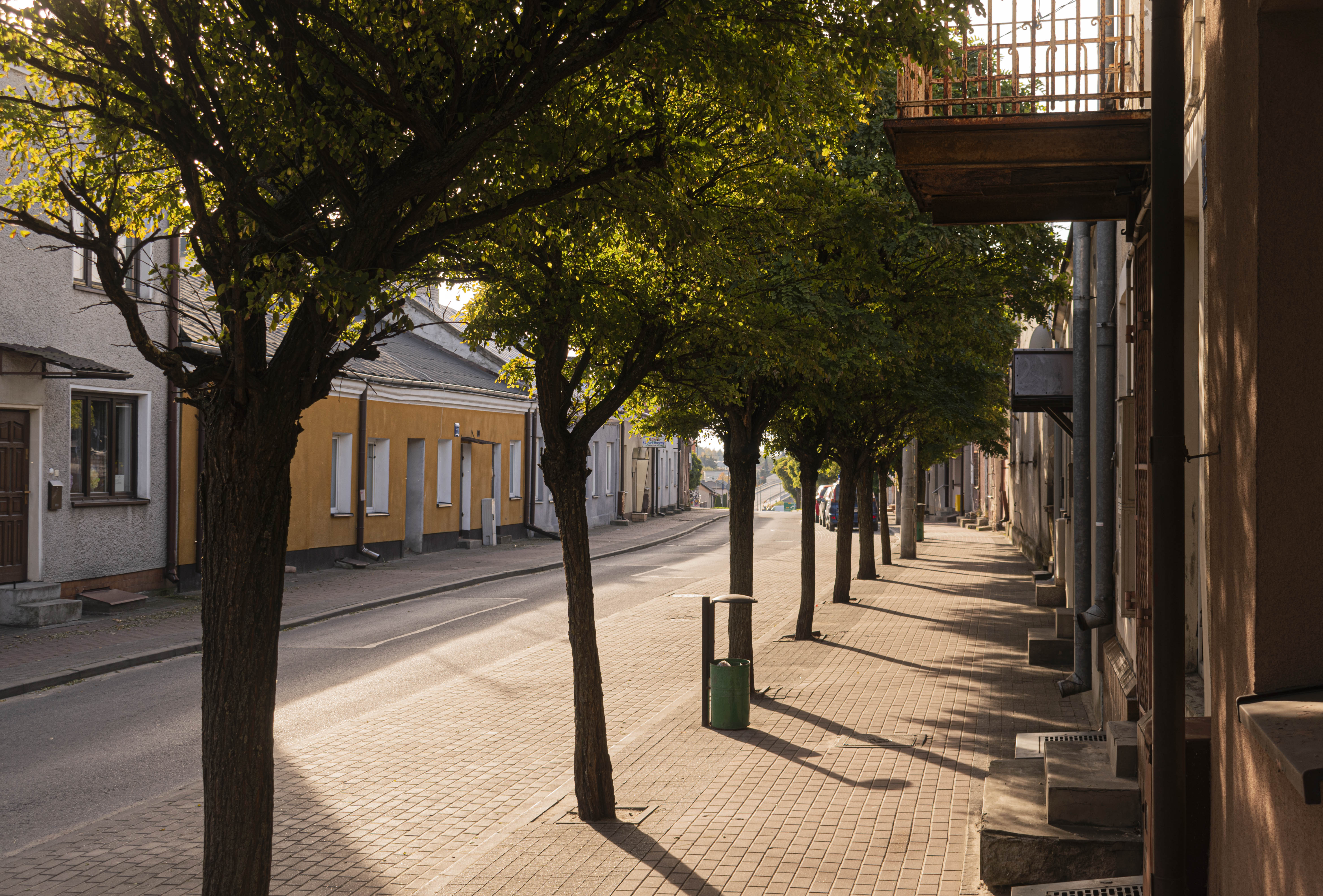
Below: my favourite street in Warka, ul. Lotników, which in summer, with all the trees in leaf, looks quite Mediterranean. Not quite so today!


Left: Warka Miasto station, three hours after my arrival at Warka station one stop up the line. "Real-time digital arrivals indicator? Why doesn't Chynów get a real-time digital arrivals indicator?" Answer: despite only being opened in 2022, it is already seeing 25% more passenger traffic a day than Chynów. (According to rail regulator UTK, Warka Miasto sees around 2,000 passengers a day, whilst Chynów sees only 1,400. Data from 2024.)

Below: a rare selfie, taken at -12C, an hour into my winter trek. All equipment functioning perfectly! My USAF N3B parka is so warm that beneath it I'm wearing no more than a cotton shirt and cotton cardigan; and my Lowa Renegade boots are performing flawlessly. Winter lined trousers from Lidl and all's good. Two and half hours and 17.5k paces, I felt no discomfort from the cold at all. And my Nikon D3500 performed perfectly too


This time last year:
Cold, gloomy start to February

This time two years ago:
In the run-up to Lent

This time three years ago:
Born between nuclear disasters

This time five years ago:
Yo-yo winter

This time seven years ago:

This time eight years ago:
What happened at the Railway Hotel?

This time nine years ago:
How to annoy the passengers

This time ten years ago:
Zloty symbol - your suggestions 

This time 11 years ago:
The future of Warsaw's public transport
[interesting to see how much of that has come true!]

This time 15 years ago: 

This time 15 years ago:
(on the superiority of Polish schools to British ones)

This time 16 years ago:

This time 17 years ago:

This time 18 years ago:


Saturday, 2 November 2024

To Warka, again

The nearness by train of Warka makes it an attractive destination for a short day out. Today's excursion takes me to the park at the eastern edge of the town, which houses the Kazimierz Pułaski museum. This (below) was his family home, Winiary, before he set off for America to become the brigadier-general and founder of the Continental Army cavalry fighting against the British for American independence.


Pułaski was fatally wounded while leading a charge at Savannah in October 1779, dying soon after. His leadership of his Cavalry Legion in the revolutionary army led to him being remembered as a hero who fought for independence and freedom in the US. Pułaski's name lives on in many American towns, counties, parks, highways. Warka sees Kazimierz Pułaski as the town's most famous son. Right: Pułaski's statue in the park by the family home, Winiary; his date of birth in 1747 and death in Savannah in 1779 are noted.


Basking in the autumnal sun, a terracotta pair outside the Pułaski museum. Round the base, translated lines from T.S. Eliot's The Hollow Men: "Waking alone/At the hour when we are/Trembling with tenderness/Lips that would kiss/Form prayers to broken stone."

Incidentally, The Hollow Men begins with a famous quote from Joseph Conrad's The Heart of Darkness: "Mistah Kurtz – he dead." a neat circular nod to another Polish legend.

The museum parklands slope down towards the banks of the Pilica, from where I continued my stroll upstream back towards the town. Despite the gorgeous day (once again entirely cloudless), there were few people out and about, though the town's newly opened pump track attracted a goodly number of mountain-bike racers.


Crossing Warka, I passed the town's other significant producer of alcoholic beverages (the first being the Warka brewery owned by Żywiec/Heineken); this is Warwin SA (below), producer of not-from-concentrate apple juices, ciders and fruit wines. Like several other businesses I passed, there are signs outside saying that the firm requires employees. The Grójec poviat or district, of which the gmina or municipality of Warka is part, currently has an unemployment rate of 2.6%, compared to 5.0% for Poland overall. Shops and restaurants are also finding difficulty recruiting employees.


Having fallen on harder times, Warka's flour mill stands abandoned. I daresay it would make for an attractive block of post-industrial loft spaces.


Back to my favourite thoroughfare in Warka, ulica Lotników, below. There's some universally pan-European feel about the place – it's like it could be a somnolent village in rural Spain, France, Portugal or Italy rather than half an hour by InterCity train from Warsaw.


The sun, even at its zenith, is low in the sky, casting long shadows. On the short train journey back to Chynów, the fields and forests and orchards were stunningly gorgeous, setting me adrift on those familiar moments of exomnesia; recognition that consciousness spans more than a lifetime.

This time last year:
Early-November reflections

Sunday, 20 October 2024

To Warka, to the river

After yesterday's long walk, a somewhat shorter one was in order today. Train assisted. So off I set to the station, to catch whichever train would come first – northbound or southbound. The timetable said it would be the southbound service to Radom, so I decided to take it down to Warka and spend some time down by the river. And so, 45 minutes after leaving home, I'm on the banks of the Pilica river, which demarcates the southern boundary of the Grójec apple-growing district.


Below: the Pilica has become a centre for canoeing, with several centres along this stretch of river. In season, flotillas of boats would be paddling along with the stream.


The banks of the Pilica witnessed the ebb and flow of war several times during the course of history. In April 1656 the Polish army defeated the Swedes at the Battle of Warka. Below: the fording of the Pilica by the Polish army, by Franciszek Smuglewicz (1745-1807). This would have been somewhere between where the road and rail bridges cross the river today.


Below: statue of Stefan Czarniecki, hetman of the victorious Polish army, in Warka's town square (the town hall in the background).


Below: tourist flights are quite the thing on days like today. The sky is not as pure as it was yesterday, with wispy clouds taking the brightness out of the light, but even so, from 1,000ft up, the Pilica valley must look gorgeous in its autumnal colours.


Left: looking across the escarpment on the north bank of the Pilica, with the rail bridge in the distance. Photo taken from the steps leading down from the town square to the river.

Below: Sunday siesta time in southern Spain? This is Ulica Lotników in Warka which links the town square to the recently opened Warka Miasto railway station. The neat row of trees and the yellow ochre facade of the single-story house across the road, plus total lack of people in the street give that sleepy-time-down-south vibe.


Below: my train home approaching the Pilica river. 


Below: (click to expand) map of my part of the world from the Polish government geoportal site, showing land use. Green is forestry; yellow is orchard. Mazovia's orchardland is centred around the town of Grójec, the Pilica being the southern boundary, the Vistula to the east, extending slightly beyond to the DW801, the road to Puławy. To the north, orchardland is bounded by the Skierniewice-Łuków railway line, and to the west, the S8 expressway.


A mere 13,000 paces walked today!

This time five years ago:
Homeward from the demo

Saturday, 13 July 2024

To Warka, the back way

I've walked from Michalczew to Warka twice – along the main road from Chynów – not pleasant. The road's dead straight, there's no pavement and drivers tend to drive too fast. So, a different way is called for. Open Street Maps provides much better online mapping of local terrain than Google Maps (though the latter is better in town). I come across Szlak Turystyczny (tourist trail) MZ-5153-y, running from Chynów down to Warka, though I'll only be walking the lower half of it.

From Michalczew station I follow an unasphalted track running parallel to the railway line to its east, which connects several działki to the main road. This has been modernised, and the level crossing moved 100m north of the old location. The new profile includes tight bends on either side of the tracks to slow down road traffic. Below:the old approach to the level crossing. Hexagonal paving slabs were used to warn drivers of the crossing. Having ridden on this many times on a motorbike, I can say it was bone-shakingly bad. My route off into the forest starts to the left beyond the bushes. Then a 4km walk to the village of Laski, and the centre of Warka another 4km beyond that.

Below: more evidence of the wildlife-bothering community, though judging by the ladder leading up to this hunters' pulpit, overgrown with bindweed and ivy, it seems not to have been used over the last winter. Progress.

Below: clumps of tall pines rising high above the general treeline characterise this forest that lies between Michalczew and Gośniewice to the west of the railway line.


Below:
interesting. I am walking over railway ballast – yet this is a forest track. I suspect that the forestry workers struck some kind of a deal with railway workers when the Radom line was being modernised. After the last two downpours, there were a couple of stretches of this path where edge-to-edge puddles meant I got my socks wet. But where the ballast had been laid down, the path was dry.

Below: Warka brewery, shimmering in a heat-haze. In the foreground, fields of barley. I'd like to think the local produce goes into the brewing process.

Below: the best part of the trip. A traditional tree-lined, unasphalted rural road, from half-remembered summer holidays in Poland. Big fields on either sides; beyond them to my left, the Warsaw-Radom railway line, to my right, the main road from Warka to Grójec. No one around, not even distant tractors. Flocks of pigeons scatter from the trees as I pass by. Ahead of me, the village of Laski.


Laski (pop. 151) used to be the settlement for a state collective farm (PGR), long since privatised and doing OK. I walked through the centre, many people out and about, everything in order. Left: this wayside chapel stands at the edge of Laski where it meets Warka on the road to Grójec. Unusual structure – I've seen a similar cylindrical pillar in Czarny Las.

For my non-Polish readers, the word 'Laski' can mean 'little forests (las = forest, lasek = little forest, laski, plural); it can mean 'walking sticks', it can mean 'hazel trees' (as in orzech laskowy = hazelnut). But it's also slang for 'attractive women', 'erect penises' or 'acts of fellatio'. So take care. Incidentally, this is one of 45 places across Poland named 'Laski'.

Below: on the edge of Warka, the new bridge over the railway line. Further roads are intended to radiate out from the roundabout ahead. I am catching one of those "this is not America, no?" moments.


I have this thought, about how American this scene appears, the road, the sky, the lamp posts, the electricity cables, and then just happen to look down and to my left, to see this American flag lying on the grass. A synchronicity. 

[Postscript from the morning Sunday 14 July: I dreamt of Donald Trump, a few hours after the assassination attempt which occurred as I slept. Although there was no shooting in my dream, the setting with eerily congruent with the footage of the rally up to that point.]

Below: I enter Warka, I see this old bus turning from ulica Wysockiego into ul. Warszawska. Is this an enthusiasts' special for fans of old buses? Or just the superannuated junk that PKS is still using? I can't tell looking at PKS Grójec's Facebook page. The .pdf-format timetable on the town of Warka's website for the one bus service circulating around the town says it runs Mondays to Fridays only. I've written about this before, but Poland's rural bus services are crap when it comes to communicating with passengers. Koleje Mazowieckie I use regularly. But PKS I've yet to travel on around here. Can any bus enthusiast tell me more about this vehicle and what it's doing in Warka (scheduled service or a special)? 

Below: hey Warka! Why so empty? It's a sunny Saturday afternoon, and the main square should be crammed. Everyone on holiday or what? A few minutes of strolling around the side streets reveals what could be the reason. In Warka, most shops shut at 14:00 and it's already ten past. (Note the Warka brewery parasols)


So – back to Chynów then, so much closer now that Warka Miasto station has opened, a whole kilometre nearer the square than Warka station itself. I stroll down ulica Lotników, which, in the sunshine has a Mediterranean vibe to it.


At Warka Miasto, the platform is quite busy. I recognise several people who took the southbound 11:30 train from Chynów, the one I got off at Michalczew to start my walk into Warka. Below: the northbound Koleje Mazowieckie train from Radom to Warsaw approaches the bridge over the Pilica river. photo taken from the end of the platform at Warka Miasto station.


The train takes less than a quarter of an hour to get me back to Chynów, 5.72 złotys with my 30% senior's discount (£1.12). Best of all, 19,900 paces walked (making up from those two heatwave days earlier in the week when I couldn't be arsed to go for a walk). Wore a short-sleeved shirt today (a polo shirt with breast pocket inherited from my father). Big mistake. My lower arms are red from the sun, I have an insect bite on my left elbow. There's a reason why I don't buy short-sleeved shirts.

This time last year:
A year with panels

This time two years ago:
Powered by the Sun

This time four years ago:
Poland's town/country divide explored

This time eight years ago:

This time ten years ago:
Half a mile under central Warsaw, on foot

This time 11 years ago:
Dzienniki Kołymskie reviewed

This time 12 years ago
Russia-Poland in Warsaw: the worst day of Euro 2012

This time 14 years ago:
Thirty-one and sixty-three - a short story

This time 15 years ago:
Warsaw rail circumnavigation

This time 16 years ago:
Classic Polish vehicles

This time 17 years ago:
South Warsaw sunsets


Monday, 5 February 2024

Another Dream of the Future

And a pleasant dream it was too... I am addressing a small class of students and am turning to leave. I make my farewells, and have a senior moment. To one, a chap in his early 20s of Middle-Eastern appearance, I say: "See you next Thursday." He says, "We have a lesson next Thursday, but we also have one tomorrow too – tomorrow's Thursday, remember?" And I there I was thinking that today was Thursday! Still, I am 85.  The small lecture room looks out over Warka and the water-meadows of the Pilica beyond; this is the 20-story building I dreamt of last week. (Incidentally, I teach English and Life.)

I go up to grab a coffee. A spiral staircase takes me up to the top floors. Young waiters and waitresses (to me, everybody's young!) are making coffees; I look around. The décor is wood-finished, light and airy; the windows are curved, floor to ceiling, the view is stunning. To the north I can see a similar tower being completed in Chynów, 12km away. I moved here rather than wait for its completion because I wanted the view; looking south-east I can see the confluence of the Pilica and Vistula rivers, and the forests stretching south towards Radom, the railway line running north towards Warsaw's urban sprawl as it spills out beyond Czachówek.

The building in which I live and work (writing, teaching) was designed by Skip Wrenford (the name came through clear in my dream!). The highest building by far (at 65 metres) in Warka gmina (municipality), it has an oval footprint, with a glass façade all the way up and all the way round, clad in photovoltaic Perovskite. Aerodynamic, with the pointy end of the ellipse aligned north-west toward the prevailing wind, the tower is  Twenty floors with communal coffee/dining area on the top two, lecture halls, hotel rooms, office space, residential accommodation, and nearer street level, restaurants and shopping. Most of the shops offer used/recycled products, clothes, tools etc.

It's 2043, and Poland is a happy place, in a continent – in a world – that is far less troubled than it had been. My precognitive dream the other night suggested that I'd be living here for 18 years, dying at the age of 103 – that is, in 2060.

Now here's the thing. Before dropping off to sleep, I consciously willed myself to have an interesting dream. I wanted a memorable dream – and I got it.

This time nine years ago:
Białystok fails to impress

This time ten years ago:
Sadness at the death of Tadeusz Mosz

This time 11 years ago:
Interpreting vs. translating vs. explaining

This time 12 years ago:
More than just an Iluzjon

This time 13 years ago:
Oldschool photochallenge

This time 14 years ago:
Warsaw's wonderful nooks and crannies

This time 16 years ago:
Viaduct to the airport at ul. Poleczki almost ready

Saturday, 25 November 2023

Encouraging more cycle-railway journeys

Dear PKP PLK [PKP Polskie Linie Kolejowe - Poland's rail infrastructure operator] - this is not how to do things: 

Attention!
The fastening of bicycles to barriers is prohibited.
Vehicles left will be removed at the owner's costs.

More and more of these signs are appearing on Polish stations. Two are posted at Warka station, to which an ever-increasing number of passengers cycle each day to catch their trains. These signs are precisely the wrong reaction. Don't limit the place where people can't chain their bikes - increase they places where they can!

The correct response to a phenomenon that should be encouraged would be to put up more stands and put a small roof over them. At Warka there are two lots of bicycle stands - a group of five next to the station building and a group of four on the other side of the tracks by the entrance to the pedestrian underpass. Here we are in late November. It's snowing. And yet each stand has a bicycle attached to it. 

Now, the stands are designed and spaced so that two bikes can be attached to each one, but even so, that's space for a mere 18 bicycles. At a station that sees 68 trains a day passing through. And the bike stands leave the bikes exposed to the elements. So some cyclists attach their bikes to the railings in the space dedicated for wheelchair users inside the shelters on the platforms or other spaces under a roof. This behaviour indeed should not be tolerated, bikes left here need to be removed. But in general, there are more bicycle users than the number of stands provided for them. And as the number of cycle-using passengers grow, so PKP PLK should plan to provide more and more stands, while discouraging local people from driving a few hundred metres to the station.

Below: in the distance, we can see five bicycle stands, to which eight bicycles are attached; it's 24 November. Imagine the scene on a warmer day. Now, the bike in the foreground is attached to a barrier. But it's not in anyone's way...


...unlike this bike (below). This is absolutely unacceptable, the cycling equivalent of parking on a pavement. Imagine a partially-sighted person hurrying down to the stairs to catch a train on the other platform.


In the meanwhile, car parking space outside stations continues to grow. Wrong priorities, people! Unless there's a good reason, walking or cycling to the station should be the norm. Not mindlessly driving there. PKP PLK should do everything in its power to increase the numbers of cyclists riding their bikes to the station - and not to discourage them with unthinking prohibitions. Cycle stands (professional type) cost around 400zł with another 50zł for installation, each which won't break the bank at PKP PLK, but would send the right signals to commuters.

This time last year:

This time two years ago:
Justify the buy: Nikon D5600
[2,990zł two year ago, 4,849zł now]

This time three years ago:
First frost, 2020

This time five years ago:
Edinburgh, again and again

This time nine years ago:
Ahead of the opening of Warsaw's second Metro line

This time ten years ago:
Keep an eye on Ukraine...

This time 11 years ago:
Płock by day, Płock by night 

This time 13 years ago:
Warning ahead of railway timetable change

This time 16 years ago:
Some thoughts on recycling


Saturday, 29 April 2023

Landscapes around Warka

The start of a five-day weekend. I decide to pop down to Warka by train to visit the new Lidl which opened last month. A Lidl bigger and grander than I'd ever seen anywhere in Poland or the UK. My main aim was cheeses of quality and taste at a good price. A 200g presentation of Gran Padano, for example, sells at Lidl for 14.49 złotys, whilst my local Top Market sells 150g of the same cheese for 30zł. Anyway, shopping done (a 17-minute stroll from Warka station), I decided to walk one station close to Chynów - Gośniewice - to snap some landscapes.

Below: Warka's 'gate guardian' as you enter from the north, a Lim-2 (Polish licence-built MiG-15 bis) from a different angle. It could do with a polish-up! (two earlier shots from a different angle here)
 

Below: heading out of Warka along ulica Puławska towards Piaseczno. Not that ul. Puławska - and not that Piaseczno! A new development of about 50 new homes is being built here. Incidentally, the conductor on my train down to Warka was full of its joys and spoke of how the town is smartening up all the while and newcomers are moving in. With the fastest train times now down to 48 minutes to W-wa Gdańska and a remarkable 29 minutes to W-wa Służewiec, Warka is now within easy commuting distance of Warsaw, the more so if you only need to go in to the office two or three days a week. 

Below: this is what I came for - the gently rolling landscape as orchards are coming into blossom. Monoculture is dominating the land, with much new infrastructure for weighing, storing and packaging apples appearing, and many very smart new homes attached to the new warehouses.

Below: that 1950s rural U.S. vibe once again - on the skyline, the DW731 road between Warka and Potycz, where it joins the DK50 for Góra Kalwaria. O to be able to pop into Deke's place for a beer and a burger!


Below: the village of Prusy, just north of Warka. From here, I will turn left and take an unasphalted farm track west towards Gośniewice. 


Below: a distant wayside shrine. Note the farm buildings on the horizon - all part of the apple industry.


Below: a closer look. Still waiting for apple blossom, a profusion of dandelions.


Below: I reach Gośniewice for al fresco lunch (bread, cheese, blueberries and mineral water). A Radom-bound Koleje Mazowieckie train is just departing - next stop Warka. Note the staggered platforms at Gośniewice station. This station is one of the quietest on the Radom line - I was the only passenger here. I like the rural character of the place. Despite the lack of traffic, Gośniewice station was built to the same standard as every other piece of infrastructure along the line, such as the gated level crossing that only serves a farm track. More trains pass over than road traffic - I saw four trains and one tractor in half an hour.


Below: back at Chynów, that was my train rushing off northwards to Warsaw. Normally, I tend to go down the level-access ramp rather than the stairs (to get more paces in!), but today I'd already managed 15K, so I didn't need the bonus here. Note the sign at the foot of the stairs for Jakubowizna (click to enlarge). Incidentally, ramps are so much better than lifts, which are prone to break down.


Below: Jakubowizna. The mobile-telephony relay tower on the horizon marking the DK50. Back to the działka to do some gardening!


This time two years ago:
Anatomy of a nightmare