Sunday, 10 January 2016

Work on the tracks continues apace, disruption widespread

It's a Saturday, time to pop down to W-wa Jeziorki station check out how the modernisation of the railway line's getting on. I'm delighted to be able to report that it's going well.

Below: looking north along the platform towards ul. Karczunkowska and onwards to W-wa Dawidy beyond. Tracks are being lifted, the trackbed will be prepared for new concrete sleepers and rails. Note - the traction cables have been removed from the catenaries. They came down before Christmas.


Below: trees between the platform and ul. Gogolińska have been marked for removal. This is where the new platform will be built. The idea is to allow the 'up' and 'down' tracks to run straight without the 'up' track having to be routed round the island platform. This will allow faster running times for through trains. The new 'up' platform (for town) will be situated north of Karczunkowska.


Below: looking south from the end of the platform towards Nowa Iwiczna. With the 'down' track lifted, both up and down services are forced to use this one line. Note how the 'up' line bends to accommodate the island platform. Because of the single-track working working Piaseczno up to W-wa Okęcie, services have been reduced. More about this later. To the left of the photo, the coal-train line, unelectrified, which swings off east to Jeziorna and Siekierki past Nowa Iwiczna station.


Photos taken on Three Kings public holiday at W-wa Dawidy. Below: a fence has been erected to keep passengers away from the now-disused 'down' platform. Photo taken from the level crossing on ul. Baletowa. Plans to build a viaduct over the tracks here have come to nought (for the time being at least). In the distance the lights of a semi-fast train to Radom hoves into view - the RE8 service does not stop at W-wa Dawidy or W-wa Jeziorki.


Below: a coal train to Siekierki awaits the signal at the exit from the Okęcie sidings. This photo also shows the amount of bend in the 'up' track required to swing around W-wa Dawidy's island platform.


The modernisation work has hit services from W-wa Śródmieście (below, photo taken on Friday evening). Trains are usually delayed in both directions. The 10km of track currently under single-line working means that any slight delay in services in either direction has massive knock-on effects. And today, Koleje Mazowieckie announced that a cracked rail on this stretch meant a 90 minute delay to services.
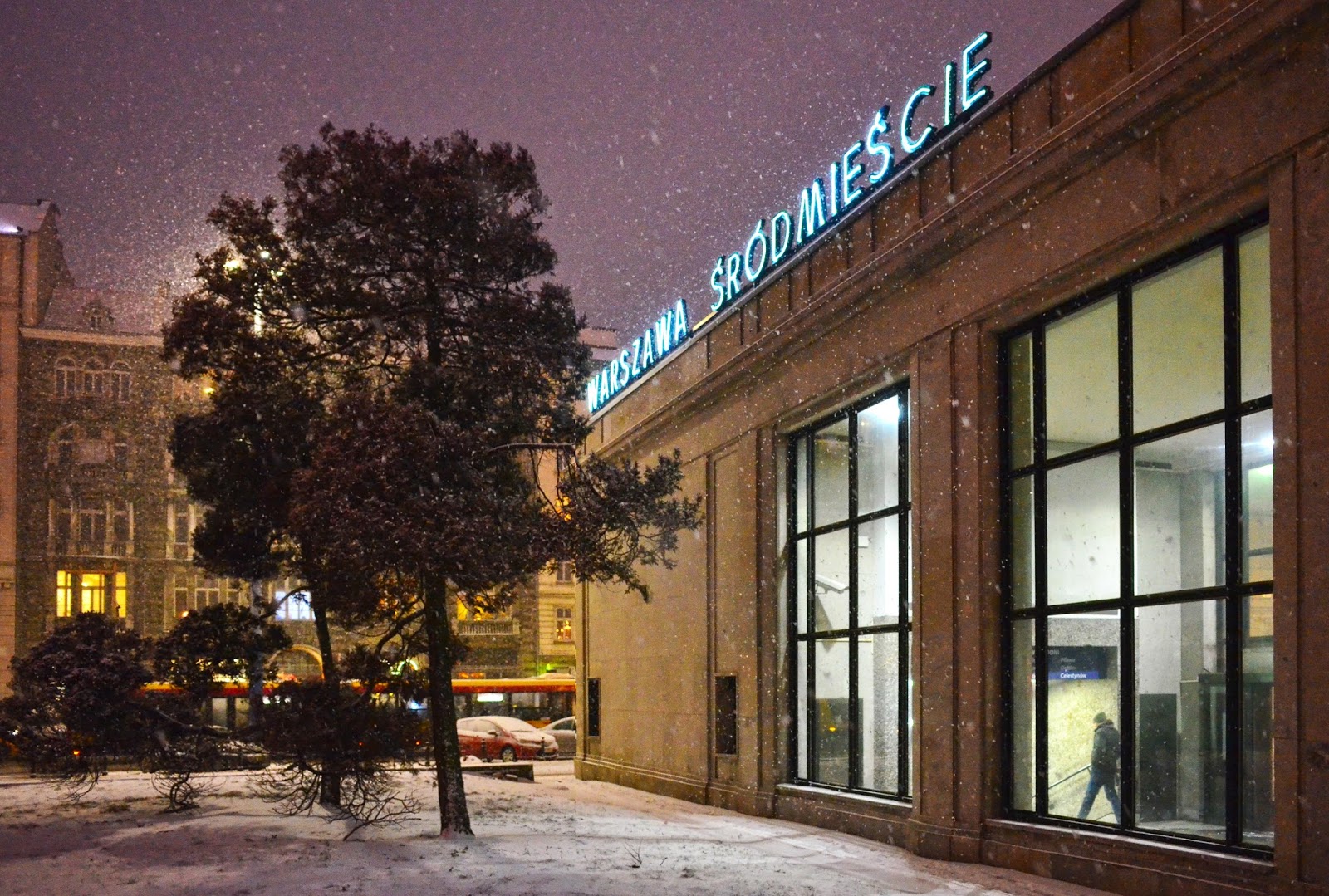

This means massive dislocation for all commuters between Warsaw and Piaseczno and all points south. Because the number of services has been reduced, there's more road traffic down ul. Puławska, private car and bus. [Rather than one train every 30 minutes, there's a 75-minute interval between services to W-wa Jeziorki during the evening rush hour.] Puławska as a result gets even more jammed. Having found on Friday that I have a 45-minute wait for the train to Jeziorki, I decided to take the Metro to Wilanowska, boarded a 715 to Karczunkowska - which took 45 minutes rather than the 25 minutes in the timetables. Having said that, there are 19 (yes, nineteen) bus departures between 17:00 and 18:00 from Wilanowska to Karczunkowska.

I hope that when the work is completed (it will go on well into next year - demolishing four platforms and building seven new ones between Okęcie and Piaseczno, and laying the new tracks) we'll see the SKM trains running through Jeziorki and the number of trains increased five-fold.

This time two years ago:
In which I get started on Twitter

This time three years ago:
London Underground is 150 years old

This time four years ago:
My enemy's enemy is my...?

This time five years ago:
Some thoughts upon the Nature of Warfare

This time six years ago:
Snow so deep it needs a plough

This time seven years ago:
A fieldfare in midwinter

Saturday, 9 January 2016

Public media? State media? National media?

In Britain, the British Broadcasting Corporation (BBC) is a national institution. It has its critics on the left and the right. Arch-Thatcherites would have had it shut down and replaced by 14 commissioning editors. Meanwhile the Corbynite left is currently spitting venom at the Beeb.

Around for 93 years, established under a Royal Charter, the Corporation's mission as being to "inform, educate and entertain... to serve the public interest and to promote its public purposes: sustaining citizenship and civil society, promoting education and learning, stimulating creativity and cultural excellence, representing the UK, its nations, regions and communities, bringing the UK to the world and the world to the UK."

Now, the UK, with its 160 year-long tradition of a professional, apolitical public administration, treats the BBC in a similar way to the way it treats its civil service. When governments change as a result of the will of the people, there will be a change of emphasis in certain policies, reflecting the political manifestos. Yet in general, people working in the ministries and agencies and state-owned corporations such as the BBC mainly carry on as if nothing had happened - continuity and stability is maintained.

Here in Poland, where democracy is but 26 years old, the notion of 'apolitical' is not something an incoming government - any incoming government - can get its head around. The spoils of state are seen to belong to the party(s) that won the election. Out go the old department directors - and in come the new government's people. All of whom need to learn the business of governing. As I wrote, some are complete amateurs, novices to their domain.

A British observer watching the current fuss around Polish public broadcasters TVP and Polskie Radio couldn't possibly imagine a situation in which, by Act of Parliament, the Chancellor of the Exchequer becomes responsible for replacing the director-general, the executive board and the management board of the BBC. And that the new director-general would have powers to sack everyone and replace the BBC's newsreaders and weather presenters with new faces. This is what's happening in Poland right now.

In the BBC's long history there have been scraps with the government; notably the sacking in 1987 of Alasdair Milne by Marmaduke Hussey, chairman of the board of governors, who had close links with the Conservative Party. Compared to what's going on at Polish state broadcaster TVP now, 1) the Conservatives had been in power for over seven years at the time, 2) Milne's departure (and replacement by the accountant Michael Checkland) was not accompanied by mass sackings of well-known broadcasters and 3) there had not been the need for a special Act of Parliament to have been voted through to ensure party-political control over the BBC.

And by way of balance and irony, right now, Alasdair Milne's son Seumas, the Labour Party's head of communications, is engaged in a war with the BBC over the way he sees the corporation favouring the Conservatives, in particular the way BBC News covered the resignation of a shadow cabinet minister live on air. If you're getting knocked by both right and left you know you're getting it broadly right.

The BBC, long considered the world's least-bad public broadcaster, holds a position of trust in the hearts and minds of the British people that is the envy of broadcasters around the world. A compulsory licence fee means there are no commercials on BBC TV or radio (at least in the UK). Having spent time during my journalism training covering court cases in which egregious non-payment of TV licence fees led to imprisonment, I can tell you the system's fairly water-tight.

Here in Poland, only a minority bother paying. The majority don't bother because 1) they know they can get away with it, 2) they have low regard for TVP and 3) they know there are ads being broadcast, so let the advertisers pay for it. The third point is valid; commercial broadcasters TVN, Polsat and others, must exist from ad revenue, they know what their cost base is and how much revenue they must raise to survive. TVP brings in revenue from both ad money and licence fees. Messy.

I believe Poland should chose one of two roads - turn TVP (and indeed Polskie Radio) into quality, trusted, apolitical broadcasters like the BBC - or, if Polish politicians are insufficiently wise and high-minded to leave the public media to its own devices - shut it down and leave the media to the private sector, like in the US.

One way or another, for me it's rather academic - I don't watch TVP nor listen to Polskie Radio. Indeed my boast that I spend more time in front of TV cameras than actually watching the box is no exaggeration - I do around 50-60 TV and radio appearances a year on average, commenting in Polish about events taking place in the UK. Everything from David Cameron's recent visit to Warsaw to royal babies. My internal observations is that TVN is extremely slick and well-run, on a tight budget, while TVP isn't. When the public broadcaster sends a crew round to interview me, it despatches one VW van with driver, a reporter, a cameraman, a sound man, a chap with reflective screen, and a Pan Heniek type who just hangs round smoking a cigarette. The private stations just send round reporter + cameraman in a taxi. Their studios are at the edge of town, built to a budget. TVP's studios are palatial and in more expensive parts of Warsaw.

Mobile internet has changed the way I consume news. No longer (as of November 2013) do I buy a Gazeta Wyborcza daily. These days I get my news through my many and varied Twitter feeds. Comment has become free; news must be gathered impartially and from a trusted source. Other than the Economist, I don't subscribe to what's behind the paywall, but the few free articles a week we're allowed from papers like Rzeczpospolita, Gazeta Wyborcza,  the Daily Telegraph, the Financial Times and others (mainly Polish business titles) - plus the free news sources - is enough to fill my commuting time.

So - on to today's demo in Warsaw (photos below). I was amazed by how many people turned out (20,000 by one account, though the police claims 8-9,000). I was amazed at how good natured the demonstration was. And the cross-section of society taking part. But at the end of the day, the best slogan shouted by the crowds was "wasza telewizja, nasze piloty" - "Your television, our remote controls". The best way not to get irritated by the tendentious, pro-PiS stuff being emitted by the public broadcasters in future is simply not to watch it. There is an alternative. Now, if TVN or Polsat were to be threatened, I'd be there to defend them to the hilt.


This time last year:
Beer, consumer choice and the Meaning of Life

This time two years ago:
What's Cameron got against us Poles?

The time four years ago:
Anyone still remember the Przybyl case?

This time five years ago:
Wetlands midwinter meltdown

This time six years ago:
Jeziorki rail scenes, winter

This time seven years ago:
Winter drivetime, Jeziorki

This time eight years ago:
Kraków, a bit of winter sunshine

Friday, 8 January 2016

Globalisation and its part in PiS's return to power

Six months ago, I'd not have given the scene below a second thought. That's just the way it is. A Thai restaurant embedded into the very structure of the Polish Teatr Narodowy - the national theatre.


But today? I mean, does Thailand's national theatre have on its premises a restaurant called Pol-Pol offering authentic Polish cuisine? Does Poland's new Minister of Culture and National Heritage have a view on this? Has the director of the National Theatre had a wyzwanie na dywanik from Minister Gliński to explain this? Of course, I jest.

A Thai restaurant in such a spot is testament to Poland's cosmopolitan openness thus far. It bears witness to all those Poles who've spent their holidays in the Far East and returned with a taste for the exotic. It's not just expensive South East Asian restaurants in Warsaw. All over Poland, Poles are becoming more adventurous in their tastes, straying ever-wider outside their traditional schabowy with zaśmieżana kapusta and ziemniaki z koperkiem. In the smallest town, you're far more likely to find pizza and/or kebab than a place offering traditional bigos.

Globalisation is a fact of life. I've seen it creeping up upon us ever since the 1960s. American shows on our TV; French yogurts delivered by our milkman; Japanese transistor radios and toys from Hong Kong. Since the opening up of China to the West, more and more factories moved to the Far East; Western factory workers lost their jobs as their neighbours working in the services sector suddenly became able to afford things once out of their price range. Deregulation and liberalisation - winners and losers.

Anti-globalists of the right tend to play on fears of the other. Foreigners, people of different races, cultures. Diversity is a problem for the right.

Marine Le Pen has spelt it out - "Globalisation is a barbarity." Her villains are multinationals, which use "slaves to manufacture things to sell to the rich world's unemployed." Globalisation is also tending to homogenise the planet; we all wear similar brands, go to the same movies, eat at the same fast-food chains.

But then there are multinationals and multinationals. Some do things that any small business can do - brew beer for example. Brewed without passion, by accountants, homogenised by focus groups from different markets, bereft of character, the products of multinational brewers are in all honesty something we can all of us live without.

But life-saving cancer drugs or safe, efficient jet airliners or complex electronic gadgets like smartphones are not something that can be cobbled together in a garage. When it comes to certain categories of product, globalisation cannot be replaced.

Poland has generally done well out of globalisation, doing things cheaper for other countries. Manufacturing, shared services and business process outsourcing, even research and development. But it's still doing things for other countries. But then no country can do it all by itself. Poland's aviation industry is booming - but Poland makes no aircraft other than gliders and ultra-lights. Poland makes parts for Boeing, for Airbus, for Bombardier, for Alenia. Poland does make helicopters - but for AgustaWestland and Sikorsky.

On the day that the government published its proposals for imposing a turnover tax on foreign-owned supermarkets, it's worth asking: cannot Poland do things for itself? Is Poland condemned to be nothing more than a low labour-cost destination for foreign investment? [One answer of course is innovation - Polish start-ups have the potential to challenge in areas such as Internet of Things, 3D printing, healthcare apps, advanced construction materials and synthetic biology, to name a few areas.]

Let's compare two larger EU economies - France and the UK. France defends its national industries and what it perceives to be its national interests. The state intervened when Pepsi wanted to buy Danone. When French corporates invest in other countries, their businesses use French vehicles, French banks, French law firms and French accountants.

Britain has, critics argue, sold its family silver and along with it, its soul. Rolls-Royce Motors, Bentley, Jaguar, Cadbury's, the Financial Times, British Oxygen, Pilkington Glass - all foreign owned. And, critics say, when the new owner buys the brand, they chop British jobs and shift them abroad (look at Cadbury's). And avoid UK corporation tax (look at Cadbury's).

Yet, all in all, the UK has stronger economic growth (2.4% compared to France's 1.1%), lower unemployment (5.2% and falling, compared to France's 10.6% and rising) and attracts more foreign investment than France (over twice as much in 2015). And in 2014, the UK overtook France to be the world's fifth-largest economy (see link below).

But the French would say, "we have our pride". The British, their price. Britain has globalised better than France. It has rolled with the punches and adapted to the new world rather than maintain a Canute-like battle against inevitability. There are losers - but the anti-globalisation parties, Labour under Corbyn and UKIP, are doing poorly. David Cameron's government understands the nature of globalisation, and has focused on projecting 'soft power', which it does well. 'Like us', Britain asks of the world. 'Like us', rather than 'fear us'.

Here in Poland, PO lost the election because it ran out of drive, it failed to explain what the real issues were, and because it failed to regulate globalisation better. Too many foreign investors using tax dodges like transfer pricing to reduce taxable profits by shifting them via invoices for fictitious services to subsidiaries located in tax havens. Too many foreign investors underpaid their Polish employees. There were winners (former BZ WBK CEO, now development minister Mateusz Morawiecki who we learned today earned 33.5m zł since 2004) but there were many sore losers.

 In Poland, the losers have been bought with promises of greater social benefits and a bit of nationalist flag-waving, into voting for party keen on imposing its rather awkward worldview on the rest of the country. But where is PiS's strategy for dealing with the forces of globalisation, that bring both benefit and woe to people across the developed world?

The real winner in all of this is Putin - who's leveraging anti-globalisation instincts, on both the left and right, to sow division and discord between the West, between countries, between communities. Divide and conquer - we must stay vigilant and stand united.

The answer lies not in knee-jerk legislation but in careful regulation of corporates that wield power globally, based on detailed analysis of the issues. Regulation carried out by conscientious specialists, well remunerated by the state, hired for their experience and expertise - not on the basis of party loyalty.

This time last year:
UK overtakes France as the world's fifth-largest economy

This time five years ago:
Wetlands winter meltdown

This time six years ago:
Winter's walk to work

This time seven years ago:
Winter drivetime, Jeziorki North

Tuesday, 5 January 2016

Road safety in Poland - the trend improves, too slowly

Yesterday's press release from the Polish police with the road accident statistics for 2015 was moderately heartening - the downward trend in numbers killed continues to fall. For the first time since proper records were kept, the death toll fell below 3,000 (2,904). This headline figure is some 10% less than in 2014 (3,202). These are provisional figures; no doubt there are people in hospital today seriously injured in crashes who will succumb to those injuries. The 10% improvement is better than the 4.2% fall between 2015 and 2013.

The latest improvement is welcome, but it needs to be placed alongside the UK figure (for 2014, as the stats for last year will not be published for a few months yet). This is 1,775 - in a country of 64 million people and 32 million cars.

As a pedestrian walking the streets of Warsaw, I can see mercifully fewer examples of outright stupidity among motorists, while measures to stay safe (such as the obligation to wear reflective clothing at night on unlit roads) are contributing to a fall in numbers killed on the streets.

But if Poland were to have the same road deaths per million citizens ratio as the UK, the numbers killed on Polish roads each year would have to fall to below 1,400 - more than half of last year's toll. In 1991, as soon as Poles managed to shake off the shackles of communism and the wealthier ones acquired fast cars, the number of people killed on Polish roads was a staggering 7,900. So progress has been made.

Even so. Two thousand nine hundred and four human lives have been needlessly destroyed on Poland's roads last year. This is still entirely unacceptable.

A parliamentary bill to improve road safety by imposing a UK-style obligation to stop for pedestrians standing by zebra crossings was overturned by the Senate. Had this become law, this would have helped towards reducing the death toll among pedestrians. In 2013, 248 people were killed on Poland's zebra crossings. On British zebra crossings? Eight. That's right - eight (a 60% increase on 2012, when it was just five).

Senator Aleksander Pociej (PO) was the leading figure in overturning the lower house's road safety bill. His main concern was not with slaughtered pedestrians but with poor motorists sitting in urban traffic jams of their own making.

To make Polish zebra crossings as safe as British ones. huge investment in lighting (Belisha beacons), road markings (zig-zag lines) and public information campaigns would also be needed as well as a simple change to the letter of the law.

Below: overtaking on zebra crossings is totally and utterly unacceptable. It is incredibly dangerous. I saw the dead body of a woman killed on a zebra crossing round the corner on Puławska, killed by a driver overtaking a stream of slower-moving traffic on the right. Drivers caught doing something like this should be banned from driving for a few months, to help them reflect on the errors of their ways.


Meanwhile Warsaw's speed cameras have been shut down as responsibility for their operation passes from local authorities to the police.

Our local one on ul. Puławska (Dąbrówka, Kuropatwy) has been covered in black plastic sheeting since the end of last month, yet I notice (to my delight) that most drivers rather than blasting down Puławska at 80-90km/h do actually slow down, aware of the fact that there's a zebra crossing and a tricky road junction there.

Incidentally, while black BMWs remain number one in the headlines when it comes to cars driven by the perpetrators of road accidents, elderly Honda Civics from the 1990s are involved in more than their fair share of egregious driving.

Wishing all my readers - and indeed everyone in Poland - a safe 2016 on the roads.

This time last year:
Convenience and the economics of bottled water

This time two years ago:
Locally, it's the little things...

This time last three years ago:
Warsaw bids farewell to its old trams

This time eight years ago:
Five departures from Okęcie

Monday, 4 January 2016

Anger and hejt have no place in political discourse


For Krzysztof

It's coming up to the tenth anniversary of the birth of Twitter. A faster, more direct yet far less measured form of social media that blogging, the 140 character-long tweet has become a powerful tool in the armoury of political parties. The general elections in the UK and Poland last year were the first in which Twitter and Facebook* - the most powerful of the social media - were visibly making a difference to the outcome. It was clear in Poland that PiS was better at Twitter than PO - and so was able to convince younger voters that it had somehow changed its 'wąsy i berety' image. And .Nowoczesna was far better at Twitter than PO. And in the UK, the Tories' grasp of social media helped the edge to win an outright majority.

However, in Poland as in other countries, online hejt (hate) is poured out into the social media by the bucketload. Users' kneejerk reactions - typing the first obscenity that comes to mind - is understandable. Because social media users are reasonably anonymous behind the web, using foul language or threats of violence come easily.

Tweeters - and bloggers - have a responsibility to their readers and to society to weigh their words carefully, to avoid empty slogans, obscenities and inflammatory, aggressive language.

I am prey to this instinct myself, having just now seen a picture of a politician I've come to dislike in recent months on Twitter - the first reaction is to press the 'reply' or 'retweet' button and write something amusingly spiteful. I must restrain myself... not doing so is bad.

This, of course, is the reptilian brain at work, an instinct that we must all learn to curb. It is juvenile behaviour, it adds nothing to the substantive discourse of social dialogue. Calling someone you take issue with a rude name, or telling them to go away in no uncertain terms, is a waste of time and creates an atmosphere of aggression that spills into other aspects of human life. Heightened levels of cortisol. Bad for the heart. Bad for the brain. Chill - let's discuss, in a polite and constructive manner, seeking consensus. Political hatred and aggression led to the bloodbath that was the Spanish Civil War. Quarter of a million people slain by both sides for the worldview they held.

It is difficult when a new government comes to power that you disagree with, especially when it commits faux pas after faux pas to sit silent. Some people will turn out in the streets. Others will blog or Tweet. Will it change anything? The next election is not scheduled until October 2019. For the next three years and ten months then, Poland has to continue moving forward, its government must keep the running the country, growing it economically.

I sincerely wish this government well in getting to grips with the complexity of the task ahead of it. For Poland to be prosperous, strong and safe, many difficult decisions need to be taken, ones that will require meticulous analysis rather than ideologically inspired solutions that are (to quote H.L. Mencken) 'clear, simple and wrong'. And getting it wrong has awful economic consequences - see Argentina, Brazil and Venezuela for text-book examples.

The nitty-gritty detail of government, issues of governance and public policy, boring stuff like taxation, public procurement, healthcare and infrastructure, are far more complex than the 140 characters that Twitter allows. Which is why I see Twitter merely as an adjunct to blogging and a signpost to meatier articles.

Talking things through over a beer and setting out the complex arguments with the goal or reaching a shared view (thesis, antithesis, synthesis) is far better than a ping-pong of increasingly aggressive tweets that only serve to entrench both parties as to the rightness of their argument.

I have to rein in my reptilian brain, pull back from that first 'fight-or-flight' reaction, and return to the high-minded civilised tone that gets things done. Finally to quote Margaret Thatcher, on the steps of 10 Downing Street on 4 May 1979: "And I would just like to remember some words of St. Francis of Assisi which I think are really just particularly apt at the moment. ‘Where there is discord, may we bring harmony... " Hejt is bad, we should all try hard to avoid it.

*I'm not returning to Facebook until it publishes on its Investor Relations page what its policy is towards the payment (or not) of corporate tax in the various jurisdictions in which it operates.

This time two years ago:
Is Conservatism rural or urban in its nature?

This time three years ago:
Poland's roads get slightly less deadly

This time four years ago:
It's expensive being rich in Warsaw

This time six years:
Winter commuting in colour and black & white

This time seven years ago:
Zamienie in winter

This time eight years ago:
Really cold (-12C at night)


Life at 14 below zero

Not the coldest I've experienced (my record - a two-hour walk at -20C). Today, an hour and quarter walk at -14C, good for the constitution, and testing out kit.

Footwear - my so-called 'Biedronka boots' (actually bought u Deichmanna) performed perfectly as ever. Despite walking on ice, my feet felt no discomfort whatsoever. Lambswool lined leather ankle boots, as long as the laces are tightly fastened, these are excellent for whatever winter can throw at them - mud included.

Overcoat - my US Army M-65 Parka, now nearly five years old - is unbeatable. It's best features are the massive hood and its deep, wool-lined pockets. Bury your hands in the pockets and they're soon warm as toast. And the parka, being longer than the M-65 field jacket, keeps your upper thighs warm too. Under the parka, a cable-knit Aran sweater and regular office shirt - just three layers and no cold problems whatever! Headwear - a Timberland lumberjack hat; under this and the parka hood my head is totally insulated against the biting frost. My face - despite beard - feels the cold, however.

Regular Levi's jeans - no long-johns needed for this temperature as long as I'm walking all the time. Gloves - suede with knitted sides - thin enough to operate camera, between shots hands are deep in the parka pockets, so again no problem.

So - well kitted out, I step out into the cold. As I left the house at 15:20, it was actually snowing lightly from a cloudless sky (below)!


Once again, I made the Most of the opportunity offered by the ponds being solidly frozen over, walking from one end to the other. Below: between the ponds, a narrow isthmus, which is usually under water.


Below: today I took my 55mm f3.5 macro Nikkor lens, to get a sharper image of the frozen swan feathers on the ice.


The sun, low in the sky, hovers over the middle section of the pond nearest ul. Trombity.


Local skaters have been benefiting from the massive rink on their doorstep. Below: the lightest dusting of snow on the icy surface of the pond shows their traces.


The row of trees towards the end of ul. Trombity (below). In the foreground the new gabion installed after the middle pond was dredged this summer when water levels fell due to lack of rain.


Below: ice crystals on seeds and twigs on the frozen pond surface.


Below: another photo that would normally be impossible - deep in the wetland, the dead forest where the herons and marsh harriers perch.


I was impressed by both my cameras' battery stamina - despite the manuals saying that they should not be used when the temperature falls below -10C. They kept snapping reliably, the D3300 and the Coolpix A.

Having got home, I put on the sauna and spent 15 mins at 90C, followed by a few minutes on the balcony at -14C (in towel and sheepskin slipper), admiring the night time sky, and then another 15 minutes back in the sauna. On days like this, a priceless experience.

This time last year:
Scenarios for Russia

This time four years ago:
Light show at the Presidential Palace

This time six years ago:
About juice - and empty supermarket shelves

This time seven years ago:
That's what I call Winter Vol. 12

This time eight years ago:
When the days start getting a little longer...

Saturday, 2 January 2016

Works between W-wa Okęcie and W-wa Dawidy

I wrote about the track works going on between W-wa Okęcie and W-wa Jeziorki the day before yesterday. Taking advantage of the New Year's Day holiday (and the fact that no security guard would be on duty anywhere), I took a train to W-wa Okęcie and walked the line along the ripped-up trackbed back to Dawidy.

First I took a look around W-wa Okęcie (below). Work is progressing here at a good pace. I blogged a few months ago about the demolition of the old island platform. While the new one was being built, passenger services in both directions stopped at the old goods platform to the right of this photo. The tracks there have now been lifted, while waiting for the new modernised trackbed.


The photo above was taken from the steps of the new footbridge (under construction) that will link the platforms to the footbridge over the S79. When the 'Elka' was being built, the highways authority GDDKiA didn't extend the footbridge to the railway station. Now passengers will be able to walk safely from the platform to the bus stop (called 'PKP Okęcie') over a third of a kilometer away.

Below: walking south from W-wa Okęcie station, there's a plethora of points and sidings, many of which are disused. In the distance, the lights of the S79, lowered for the flight-path of the airport.


A few hundred metres south of W-wa Okęcie stands (just) this abandoned plate-layers' hut (below). A Radom-bound Koleje Mazowieckie service passes by on the single track...


Below ...I watch it disappear into the distance, having passed under ul. Poleczki viaduct. To the left the coal sidings.


Below: a nice new shunter in the services of Trakcja PRKiI takes a day off. The website has interesting information (in English) about the Radom line modernisation. The loco, a Newag 6Dg, is a Polish-built shunter based on the chassis and bogies of the SM42, workhorse of Polish railways.


Below: looking northwards towards W-wa Okęcie station. The line on the left has been lifted; all trains use the 'down' line for the time being. In the distance the Wola skyline is dominated by the Warsaw Spire (centre) and to the left of it, the Warsaw Trade Tower (formerly Daewoo Tower).


At the northern set of points to the coal sidings, an ex-EWS Class 66 loco (now DB Schenker) stands empty, awaiting the end of the public holiday. A common sight in the UK, these engines are now increasingly being seen in Poland, used by freight operators for hauling minerals and ballast. A Class 66 can haul a 40-wagon coal train on its own. In the past two engines (typically a ST44 'Gagar' assisted by a SM48 (TEM-2) 'Tamara' or SM42 'Stonka') were needed to take such a train from Okęcie to Siekierki power station.


I walk on past the coal sidings; the shot below is taken looking at them from the south. The S2 passes under the lines somewhere between me and the red DB freight engine in the sidings. The amazing telephoto compression of my 55-300mm zoom can be seen looking at the white marker-posts to the right; they are 100m apart!


Below: back at W-wa Dawidy, a town-bound Koleje Mazowieckie train heads north along the single track. To the right, track-lifting work stops for New Year's Day.


Below: the digger waits for work to begin again... Today's lay-up is a rarity. I've seen work going on here late into the evening; the pressure is on to reach Piaseczno and Czachówek as soon as possible.


The tender for successive phases of the Radom line modernisation is being decided soon, with eight companies bidding for the work. It's been a long time coming!

This time two years ago:
The benefits of extending the human lifespan 

This time four years ago:
New Year's stocktaking

This time last five years ago:
A walk in the wild winter woods

This time seven years ago:
Now that's what I call winter vol. 12

This time eight years ago:
When the day starts getting longer

Friday, 1 January 2016

Walking on (frozen) water

The temperature here in Jeziorki has been below zero for three and half days, with a night-time low of -10C. Having seen whole families wandering out onto the frozen pond yesterday, I decided that today would be more than safe to do likewise. And indeed it was. The ice beneath my feet was three-four inches (75-100mm) thick.

On my walk yesterday afternoon, I snapped our swans on what would be their last day on the pond. The final hole in the ice closed over in the night, plus the barrage of New Year's fireworks, would have persuaded the swans to finally quit Jeziorki and head south for the winter.


Below: by this morning the ice hole had frozen over totally, there were no swans - just feathers and down remain to remind us of their presence.


Below: swans and ice do not go well together. Swans can get frostbite if forced to stand on ice for any length of time. I hope to see our swans back in late March.


Below: the solid ice allows me to explore on foot parts of the wetlands that are normally inaccessible. In past years when I've been here, there's been snow cover. This year, the drought conditions persist.


Below: here, where the reeds are tallest, the wetlands are bone-dry; mud that was too spongy to walk on has frozen over. The reeds are up to 2.5m tall. Here in spring, birds will mate, lay eggs, raise chicks, away from human interference.


Back on the ice, I look down to examine it in detail (below). Trapped in it are methane bubbles, rising from the rotting vegetation on the pond's bed. And often I'd see small fish darting ahead of my shadow as it crossed the surface of the ice. Anglers like fishing here, but the fish I saw today were not much bigger than sticklebacks.


Low water levels are visible at the retention ponds by ul. Kórnicka (below). The usual water level is seen by looking at the gabions - where the dried-out algae clogs the steel netting.


Below: the sun, low in the sky, sunset soon and the temperature will start falling from its daytime high of -6C.


Below: back at the southern end of the pond, having walked over 2km across ice today. Low sun, blue sky and ice hit the Sublime Aesthetic button for me every time!


This time last year:
Fireworks herald 2015 in Jeziorki

This time two years ago
Jeziorki welcomes 2014

This time three years ago:
LOT's second Dreamliner over Jeziorki

This time four years ago:
New Year's coal train
