Brexit has meant a sharp uptick in the number of my television and radio appearances. In a typical year, I can expect to make around 50-60 media appearances, commenting on various aspects of life in Britain, from international trade to politics to royal babies. One visit to the studios per week has been my average for the past six or seven years. Yet since the beginning of June I've appeared 30 times on Polish TV and radio to talk about Brexit and its aftermath. Five times more often than usual.
It's been my proud boast that for the past few years, I've spent more time in front of TV cameras than I do watching TV in Poland.
Over the past six weeks, I've been invited to appear to the following TV studios - Polsat, TVN, TVP Info and SuperStacja.
What's it like, being on television?
Fear of public speaking? Not at all. Not nervous, confident - I know my stuff. My biggest worry is that my Polish will trip me up - missing bits of vocabulary or case endings. But I'm enough of a seasoned trooper to talk my way out of a jam.
And the experience itself?
Depends where you go.
The TVP building in ul. Woronicza is a spectacular shambles and a classic example of the ills of state broadcasting. Kilometres of narrow labyrinthine corridors wind through the building on several floors, linking studios, cubby-hole offices and editing suites. The corridors are lined with perforated hardboard, presumably for acoustic reasons. Broken furniture and empty boxes are left abandoned hither and yon. Outside nearly all the editing suites stand a couple of pot-bellied men of late middle age with ponytails and t-shirts bearing the name of some death-metal band or other, smoking cigarettes in blatant disregard of the law. The combination of narrow corridors, perforated hardboard walls and cigarettes makes for a potential death-trap; that and the various unmarked trip hazards would have the place closed down in minutes by any British health and safety inspector.
The corridors seem endless, the impression of people milling around aimlessly suggests massive over-employment - why so many studios? Why so many editing suites? Why so many offices? And yet, TVP needed even more studios, so a brand new building was opened in 2009 at huge cost next door to the existing one, both are in use. Who audits these people?
Since Jarosław Kaczyński put his people into TVP after last autumn's elections, viewership figures of TVP's main evening new programme have fallen by a fifth, with 750,000 regular viewers switching off. TVN and Polsat have overtaken TVP in viewership ratings of their main news programmes.
Transport to and from the studio
When I'm contacted by production staff to arrange an appearance, the logistics of getting me to and from the studio are worked out. Some stations (TVN, TVP Info) will send a marked car to collect me - which is kind of cool especially when it's waiting outside the gates of our estate. Superstacja uses an unmarked car, while Polsat picks me up in taxis, and gives me a card for my return journey. The taxi solution seems the best, as it means lower staff and capital expenditure costs, plus greater flexibility. All guarantee punctuality.
Security: front desk impressions
TVP on Woronicza employs old geezers with few social graces to insult and belittle guests. "Kim Pan jest, Panie?" Name not on list. Ten phone calls later, someone comes down to fetch you.
TVP Info on Plac Powstańców: this is well organised. You give your name, they check the guest list, then direct you smartly to the make-up room. Security guards here are politer.
TVN: you announce yourself at the front desk, have your bag scanned and walk through an airport-style metal detector gate. A studio runner comes to pick you up and escort you to make-up, and then to the studio. [TVN's studio in the Warsaw Stock Exchange building - just stroll in. No make-up.]
Polsat: you give your name at the front desk (security guards after office hours, receptionists during office hours), they phone to the studio, a runner comes to lead you through the gates to the studio.
Superstacja: the security guards do not even look up as you walk in from the street and head to the studio.
Make-up: impressions
All TV appearances are preceded by a quick visit to the charakterizja - make-up. An application of cream and powder to my head ensures my bald head does not reflect light into the camera. As I learnt from observing my mother's reactions to current affairs programme on TV - many viewers spot something unbecoming in a speaker's looks and cease listening to the message and start commenting on what they see, rather than what they hear. Hence the need to reduce glare off the face.
Now some make-up artists go to town with every available lotion and cream, others just apply a light touch of powder. Can't say anyone notices the difference; public or private, the time spent in the make-up studio is directly proportional to the time left before you're due to go on air. They can do it in 10 seconds just as effectively as in two minutes. Afterwards, the difference is in how many wet-wipes are needed to remove the make-up. It ranges from two to five.
Studio impressions:
Best equipped: TVN. Shabbiest: TVP Info.
As to the quality of the interviewers (forgive me, I have a bad memory for faces and names, and not watching TV, I don't know who's more and who's less recognisable), they are uniformly good - well-informed, intelligent, polite. Only once in recent months did I experience a dobra zmiana moment, when I was asked at TVP Info: "As of today, London has a Muslim mayor. Now what?"
Why do I keep being asked back? I know the subject very well, and my British-accented Polish gives an air of authenticity and hence authority.
This time last year:
Eating cheaply and well in Warsaw - bary mleczne
This time two years ago:
In which I warn of the MH17 tragedy a day before it happened
This time four years ago:
Who should pay for railways?
[A good question to pose would-be politicians]
This time six years ago:
Grunwald - the big picture
This time eight years ago:
"Take me right back to the track, Jack"
This time nine years ago:
The summer sublime
Friday, 15 July 2016


Sunday, 10 July 2016
Warsaw-Radom railway line modernisation, Czachówek
Today I went to have a look at how work on the Warsaw-Radom railway line is progressing at Czachówek, an important junction, a village with three (formerly four) stations. Although there was no sign of any work going on today, a Sunday, it was clear that much is happening here.
By Czachówek Południowy station stood a ballast train, hauled by a Pol-Miedź Trans 6Dg diesel shunter (a Newag-refurbished SM42), below.

Right at the southern end of the platform stood another train, this one carrying long lengths of rail, with a TEM-2 shunter in CTL Logistics livery, below. Overhead, a pair of PZL W-3 Sokół helicopters fly across the tracks, as a southbound Koleje Mazowieckie services sets off towards Radom. A little earlier, I'd seen a pair of Mil Mi-8 helicopters flying in the same direction - likely to have been a redeployment following the end of the NATO summit.

At Czachówek Południowy station, the 'up' line has been lifted in anticipation of new track. The platform itself has been dug up - a pedestrian tunnel is being built under the trackbed at this point.

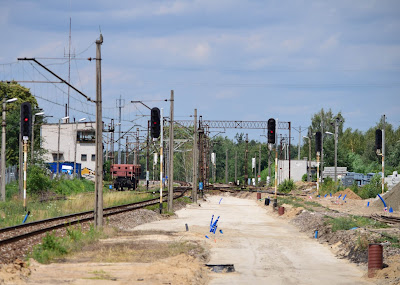
Below: looking north from Czachówek Południowy towards Czachówek Górny station. The 'up' line trackbed stands naked awaiting modernisation. To the right, the 'down' line is now the only way in and out. Beyond the signal box, one spur runs off the the right, another to the left, to join the Skierniewice to Łuków line that crosses the Warsaw-Radom line at right angles just north of Czachówek Górny station.
Below: looking west from the bridge that carries the Warsaw-Radom line over the Skierniewice-Łuków line. Orange-jacketed workers are working on the northern end of the spur that leads off from the left, just beyond the signal box in the photo above. Czachówek has four signal boxes; another can be seen below.

Below: looking up the line towards Ustanówek station. Only one track, all the way up the hill. A third signal box controls the points for the spurs connecting the Skierniewice-Łuków line.

Below: Czachówek Górny has a new 'down' platform, which currently functions for both Warsaw and Radom-bound services. In time, a second platform, parallel to this one, will replace the old island platform. It will be more accessible, with a ramp, from both sides of the track. The old platform was accessible only by steep steps from the east side of the station. Passengers wanting to access the station from the west side would have to cross the tracks and haul themselves up onto the platform.

Looking towards Czachówek from a level crossing (one of many) west of the station. Below: the digger is working on upgrading the next level crossing along, in the meanwhile, a freight train heads west towards Skierniewice.

Below: bonus shot - this freight train of containers has come all the way from Chongqing Logistics City in China to Łódź. And maybe to Duisburg beyond. For the Polish stretch of the journey, the train is hauled by a PKP Cargo ET22.

It will still be at least a year to 18 months before work on the railway line down to Czachówek is complete. In the meantime, chaos continues. Last Thursday, trains on the line were delayed by over three and half hours (219 minutes in one case). Reason - an unexploded bomb was found somewhere between Warsaw and Czachówek.
This time six years ago:
Ćwilin, conquered
This time seven years ago:
Sunset across the tracks, Nowa Iwiczna
This time eight years ago:
The storm the forecasters missed
This time nine years ago:
Peacocks in the Park
By Czachówek Południowy station stood a ballast train, hauled by a Pol-Miedź Trans 6Dg diesel shunter (a Newag-refurbished SM42), below.

Right at the southern end of the platform stood another train, this one carrying long lengths of rail, with a TEM-2 shunter in CTL Logistics livery, below. Overhead, a pair of PZL W-3 Sokół helicopters fly across the tracks, as a southbound Koleje Mazowieckie services sets off towards Radom. A little earlier, I'd seen a pair of Mil Mi-8 helicopters flying in the same direction - likely to have been a redeployment following the end of the NATO summit.

At Czachówek Południowy station, the 'up' line has been lifted in anticipation of new track. The platform itself has been dug up - a pedestrian tunnel is being built under the trackbed at this point.

Below: looking north from Czachówek Południowy towards Czachówek Górny station. The 'up' line trackbed stands naked awaiting modernisation. To the right, the 'down' line is now the only way in and out. Beyond the signal box, one spur runs off the the right, another to the left, to join the Skierniewice to Łuków line that crosses the Warsaw-Radom line at right angles just north of Czachówek Górny station.

Below: looking west from the bridge that carries the Warsaw-Radom line over the Skierniewice-Łuków line. Orange-jacketed workers are working on the northern end of the spur that leads off from the left, just beyond the signal box in the photo above. Czachówek has four signal boxes; another can be seen below.

Below: looking up the line towards Ustanówek station. Only one track, all the way up the hill. A third signal box controls the points for the spurs connecting the Skierniewice-Łuków line.

Below: Czachówek Górny has a new 'down' platform, which currently functions for both Warsaw and Radom-bound services. In time, a second platform, parallel to this one, will replace the old island platform. It will be more accessible, with a ramp, from both sides of the track. The old platform was accessible only by steep steps from the east side of the station. Passengers wanting to access the station from the west side would have to cross the tracks and haul themselves up onto the platform.

Looking towards Czachówek from a level crossing (one of many) west of the station. Below: the digger is working on upgrading the next level crossing along, in the meanwhile, a freight train heads west towards Skierniewice.

Below: bonus shot - this freight train of containers has come all the way from Chongqing Logistics City in China to Łódź. And maybe to Duisburg beyond. For the Polish stretch of the journey, the train is hauled by a PKP Cargo ET22.

It will still be at least a year to 18 months before work on the railway line down to Czachówek is complete. In the meantime, chaos continues. Last Thursday, trains on the line were delayed by over three and half hours (219 minutes in one case). Reason - an unexploded bomb was found somewhere between Warsaw and Czachówek.
This time six years ago:
Ćwilin, conquered
This time seven years ago:
Sunset across the tracks, Nowa Iwiczna
This time eight years ago:
The storm the forecasters missed
This time nine years ago:
Peacocks in the Park
Saturday, 9 July 2016
Getting out of Mordor
If you're going to work in Warsaw, a place best avoided is Służewiec Przemysłowy, known these days as Mordor. What's wrong with the place? Best expressed in numbers. 83,000 people work there. And because public transport links to this part of town are poor, a staggering 30,000 cars are driven in every day. What's worse, 87% of those cars convey no one but the driver.
While 36.1% of Mordor's office workers come to work by car, only 3.4% of workers in the City of London travel in by car.
The City of London - one square mile - is well-served by Underground and main line rail services and bus routes. Mordor isn't. This sad state of affairs came to pass because developers and the city authorities have failed to work together to sort this out.
Because it lies outside the paid parking zone, Służewiec is a messy free-for-all. Leave your car by the kerb, on the pavement, on the grass verge - anywhere you can. Anarchy. Below: looking west along ul. Konstruktorska.

And, as I wrote earlier, neither town planners nor architects nor developers took sufficient attention of the needs of those who don't wish to drive to work.
Mordor now has such a poor reputation as a place to work (and in a particular a place to get to work) that companies are beginning to relocate their businesses to more sought-after locations.
Below: a billboard at Metro Wilanowska station, announcing the imminent departure of UK insurance giant Aviva to new premises near Dworzec Gdański, three stops north of the city centre. JRR Tolkien would be amused at how his literary inventions have entered the vocabulary of Polish corporate employees.

Below: a billboard at Metro Wierzbno (the nearest Metro station to Mordor) announcing the imminent departure of Stanley Black & Decker to Rondo Daszyńskiego, three stops west of the city centre. Now, Metro Wierzbno is only four stops from Metro Centrum, but a further five tram stops from Domaniewska, Mordor's heartland.

The two Google Earth satellite maps below compare Mordor with the City of London (both set at 2.5km above ground level). The City of London is more concentrated, narrower roads, higher buildings with smaller footprints. But a dense network of public transport ensures that 400,000 people can get to their offices without the horrors that face those getting into Mordor. Incidentally, parking in the City of London (assuming you can find a meter) costs £1.20 per 15 minutes. And the Congestion Charge, which you need to pay to enter central London by car, is a further £11.50 a day. Tot the two up and you'll be paying around £50 a day or £1,000 (5,300 złotys) a month just to enter and park in the City of London. Just to be clear - four times as many people work in the area in the lower photo as do in the upper photo.

Last week, I was talking to a guy who works for a company fitting out office blocks for new tenants. He told me that these days, smart Polish investors are no longer buying and developing land in Służewiec - they're aware that employees don't fancy working there, and that the labour market in Warsaw today is being shaped by employees. Especially the younger ones - the Millennials. The smart money is on Wola - just west of the city centre, and connected by good Metro, tram, bus and rail routes. Meanwhile, the new office blocks going up in Mordor are being erected by foreign investors who doing a 'me too'; seeing the cranes all over the place, they assume that this is the place to be.
I've written about ul. Poleczki and the development around the extreme southern end of Mordor, some 3km south of Służewiec. Things here are really bad. Poleczki Business Park is about to open a further three new office buildings - meanwhile, outside of rush hours, there are only three buses an hour serving this part of town. No trams, no trains. And one of the car parks is about to become yet another office block.
What will happen to the buildings that Aviva and Stanley Black & Decker are leaving? They will no doubt find tenants - but at lower rents. Warsaw has high office vacancy rates, but the best office space in the best locations finds quality tenants quickly.
If I were a developer or a landlord or a property investment fund with a stake in Mordor, I'd be putting maximum pressure on Warsaw's authorities to dramatically improve public transport links to my real estate - more trams, more buses, better interconnection at PKP Służewiec with the tram terminus, a new PKP station south of Okęcie (PKP W-wa Wyczółki/ W-wa Poleczki), and bring in parking meters to discourage the short-distance one-per-car commuters.
More about civilising Mordor (in Polish) here and escaping from Mordor (in English) here.
This time two years ago:
Democratic budget decisions at the local level
This time last year:
Rustic retreat rained off
This time four years ago:
Thunderstorm over Jeziorki
This time five years ago:
Getting lost on top of Łopień
This five seven years ago:
Regulatory absurdities in Poland
This time eight years ago:
Czachówek and Alignment
This time nine years ago:
Joy, pain, sunshine, rain
While 36.1% of Mordor's office workers come to work by car, only 3.4% of workers in the City of London travel in by car.
The City of London - one square mile - is well-served by Underground and main line rail services and bus routes. Mordor isn't. This sad state of affairs came to pass because developers and the city authorities have failed to work together to sort this out.
Because it lies outside the paid parking zone, Służewiec is a messy free-for-all. Leave your car by the kerb, on the pavement, on the grass verge - anywhere you can. Anarchy. Below: looking west along ul. Konstruktorska.

And, as I wrote earlier, neither town planners nor architects nor developers took sufficient attention of the needs of those who don't wish to drive to work.
Mordor now has such a poor reputation as a place to work (and in a particular a place to get to work) that companies are beginning to relocate their businesses to more sought-after locations.
Below: a billboard at Metro Wilanowska station, announcing the imminent departure of UK insurance giant Aviva to new premises near Dworzec Gdański, three stops north of the city centre. JRR Tolkien would be amused at how his literary inventions have entered the vocabulary of Polish corporate employees.

Below: a billboard at Metro Wierzbno (the nearest Metro station to Mordor) announcing the imminent departure of Stanley Black & Decker to Rondo Daszyńskiego, three stops west of the city centre. Now, Metro Wierzbno is only four stops from Metro Centrum, but a further five tram stops from Domaniewska, Mordor's heartland.

The two Google Earth satellite maps below compare Mordor with the City of London (both set at 2.5km above ground level). The City of London is more concentrated, narrower roads, higher buildings with smaller footprints. But a dense network of public transport ensures that 400,000 people can get to their offices without the horrors that face those getting into Mordor. Incidentally, parking in the City of London (assuming you can find a meter) costs £1.20 per 15 minutes. And the Congestion Charge, which you need to pay to enter central London by car, is a further £11.50 a day. Tot the two up and you'll be paying around £50 a day or £1,000 (5,300 złotys) a month just to enter and park in the City of London. Just to be clear - four times as many people work in the area in the lower photo as do in the upper photo.

Last week, I was talking to a guy who works for a company fitting out office blocks for new tenants. He told me that these days, smart Polish investors are no longer buying and developing land in Służewiec - they're aware that employees don't fancy working there, and that the labour market in Warsaw today is being shaped by employees. Especially the younger ones - the Millennials. The smart money is on Wola - just west of the city centre, and connected by good Metro, tram, bus and rail routes. Meanwhile, the new office blocks going up in Mordor are being erected by foreign investors who doing a 'me too'; seeing the cranes all over the place, they assume that this is the place to be.
I've written about ul. Poleczki and the development around the extreme southern end of Mordor, some 3km south of Służewiec. Things here are really bad. Poleczki Business Park is about to open a further three new office buildings - meanwhile, outside of rush hours, there are only three buses an hour serving this part of town. No trams, no trains. And one of the car parks is about to become yet another office block.
What will happen to the buildings that Aviva and Stanley Black & Decker are leaving? They will no doubt find tenants - but at lower rents. Warsaw has high office vacancy rates, but the best office space in the best locations finds quality tenants quickly.
If I were a developer or a landlord or a property investment fund with a stake in Mordor, I'd be putting maximum pressure on Warsaw's authorities to dramatically improve public transport links to my real estate - more trams, more buses, better interconnection at PKP Służewiec with the tram terminus, a new PKP station south of Okęcie (PKP W-wa Wyczółki/ W-wa Poleczki), and bring in parking meters to discourage the short-distance one-per-car commuters.
More about civilising Mordor (in Polish) here and escaping from Mordor (in English) here.
This time two years ago:
Democratic budget decisions at the local level
This time last year:
Rustic retreat rained off
This time four years ago:
Thunderstorm over Jeziorki
This time five years ago:
Getting lost on top of Łopień
This five seven years ago:
Regulatory absurdities in Poland
This time eight years ago:
Czachówek and Alignment
This time nine years ago:
Joy, pain, sunshine, rain
Friday, 8 July 2016
NATO summit and aerial cavalcade
A busy day in the skies over Jeziorki!
Yesterday evening, Thursday 7 July, saw the arrival of the big boys from America. Living so close to an international airport for so many years, I have developed a good ear for the sound of aircraft engines. So, pottering around my bedroom I knew that something big was drawing in, and so I readied myself with camera by the bedroom window...
First in at quarter to nine was this unique aircraft - the Boeing E-4B, below. The mobile command-and-control centre for the President of the United States, equipped with nuclear button and protected against the electromagnetic pulse from a nuclear explosion that would render the electronics of most aircraft useless. Just after midnight, Barack Obama flew in on Air Force One. Eddie and I watched it fly over our house from the balcony, but it was too dark to snap. Eddie remarked how many of the world's leaders have passed just a few hundred metres from our house over the years. Built in 1975, the E-4B Nightwatch is a Cold War survivor still doing its job after four decades' in service.

Today things got busy. Below is a selection of some of the planes I did manage to snap flying into Okęcie... Below: Czech Air Force Airbus A319 CJ (CJ = Corporate Jet).

Below: Danish Air Force Canadair CL-604 Challenger. When not ferrying VIPs, it also serves in a surveillance role.

Below: my personal favourite from today's aerial cavalcade, an Alenia C-27J Spartan 'Blue 6' from the Lithuanian Air Force. I photographed one of these planes looping the loop at the Radom Air Show in 2013. Portlier than the Polish Air Force's CASA C-295s, the Spartan can carry two and quarter tonnes more payload.

Below: new acquired by the Slovakian government, another Airbus A319 CJ. Coming into service last month, it replaces the Tupolev Tu-154 used hitherto. Can't work out the sense of that comic face painted on the rear fuselage...

Below: Spain has a much bigger Airbus for VIP use - the A310. Note the red-yellow-red roundel and diagonal black-cross fin flash - the insignia of Franco's Nationalist air force during the Civil War that survives in use until this day. But then Russia's air force still uses red stars.

Below: the King of Sweden might have at his disposal a diamond car with the platinum wheels, but aloft he prefers the svelte silhouette of a Grumman Gulfstream IV. Note: Sweden is not a member of NATO. Yet.

Below: the Italian government representatives flew in, like the Czechs and Slovaks, in an Airbus A319CJ. The A319 is a short-fuselage version of the A320 that I fly regularly to England.

Below: an RAF KC3 Voyager, converted from an Airbus A330. On board, Prime Minister (still) David Cameron.

I also saw (but didn't manage to snap) the Luftwaffe's Airbus A340, and two French Air Force Dassault Falcons, that flew in one after the other.
The increased interest on the aviation forums brought out new information. I discovered an alternative to FlightRadar24, one that allows you to filter for military aircraft. This website is ADS-B Exchange (http://www.adsbexchange.com/). Click on Global Radar View, click on the Menu in top left hand corner of the map, then select Filters (on the right). From the drop-down menu, select Military. And all the commercial traffic disappears... Marvellous for occasions like this (although of course for operational reasons military pilots toggle their ADS-B transponders on or off).
Below: screenshot from adsbexchange.com, showing a KC-135 circling just north of Częstochowa, allowing aerial refuelling of AWACS airborne early warning aircraft (click to enlarge).

Looking at the map in real time, I can see that Air Force Two has just taken off from Okęcie.
The big flypast of military jets along the Vistula was sadly not visible from Jeziorki. Still, it was a good show today, I hope for some more over the weekend!
This time two years ago:
Ukraine: still an important foreign policy problem for the West
This time four years ago:
More about Modlin airport
This time seven years ago:
Get on your bike and RIDE!
Yesterday evening, Thursday 7 July, saw the arrival of the big boys from America. Living so close to an international airport for so many years, I have developed a good ear for the sound of aircraft engines. So, pottering around my bedroom I knew that something big was drawing in, and so I readied myself with camera by the bedroom window...
First in at quarter to nine was this unique aircraft - the Boeing E-4B, below. The mobile command-and-control centre for the President of the United States, equipped with nuclear button and protected against the electromagnetic pulse from a nuclear explosion that would render the electronics of most aircraft useless. Just after midnight, Barack Obama flew in on Air Force One. Eddie and I watched it fly over our house from the balcony, but it was too dark to snap. Eddie remarked how many of the world's leaders have passed just a few hundred metres from our house over the years. Built in 1975, the E-4B Nightwatch is a Cold War survivor still doing its job after four decades' in service.

Today things got busy. Below is a selection of some of the planes I did manage to snap flying into Okęcie... Below: Czech Air Force Airbus A319 CJ (CJ = Corporate Jet).

Below: Danish Air Force Canadair CL-604 Challenger. When not ferrying VIPs, it also serves in a surveillance role.

Below: my personal favourite from today's aerial cavalcade, an Alenia C-27J Spartan 'Blue 6' from the Lithuanian Air Force. I photographed one of these planes looping the loop at the Radom Air Show in 2013. Portlier than the Polish Air Force's CASA C-295s, the Spartan can carry two and quarter tonnes more payload.

Below: new acquired by the Slovakian government, another Airbus A319 CJ. Coming into service last month, it replaces the Tupolev Tu-154 used hitherto. Can't work out the sense of that comic face painted on the rear fuselage...

Below: Spain has a much bigger Airbus for VIP use - the A310. Note the red-yellow-red roundel and diagonal black-cross fin flash - the insignia of Franco's Nationalist air force during the Civil War that survives in use until this day. But then Russia's air force still uses red stars.

Below: the King of Sweden might have at his disposal a diamond car with the platinum wheels, but aloft he prefers the svelte silhouette of a Grumman Gulfstream IV. Note: Sweden is not a member of NATO. Yet.

Below: the Italian government representatives flew in, like the Czechs and Slovaks, in an Airbus A319CJ. The A319 is a short-fuselage version of the A320 that I fly regularly to England.

Below: an RAF KC3 Voyager, converted from an Airbus A330. On board, Prime Minister (still) David Cameron.

I also saw (but didn't manage to snap) the Luftwaffe's Airbus A340, and two French Air Force Dassault Falcons, that flew in one after the other.
The increased interest on the aviation forums brought out new information. I discovered an alternative to FlightRadar24, one that allows you to filter for military aircraft. This website is ADS-B Exchange (http://www.adsbexchange.com/). Click on Global Radar View, click on the Menu in top left hand corner of the map, then select Filters (on the right). From the drop-down menu, select Military. And all the commercial traffic disappears... Marvellous for occasions like this (although of course for operational reasons military pilots toggle their ADS-B transponders on or off).
Below: screenshot from adsbexchange.com, showing a KC-135 circling just north of Częstochowa, allowing aerial refuelling of AWACS airborne early warning aircraft (click to enlarge).

Looking at the map in real time, I can see that Air Force Two has just taken off from Okęcie.
The big flypast of military jets along the Vistula was sadly not visible from Jeziorki. Still, it was a good show today, I hope for some more over the weekend!
This time two years ago:
Ukraine: still an important foreign policy problem for the West
This time four years ago:
More about Modlin airport
This time seven years ago:
Get on your bike and RIDE!
Thursday, 7 July 2016
Laughin' just to keep from cryin'
The girl sitting opposite me on the Metro was Eddie's age or younger. She was wearing a Led Zeppelin t-shirt. Led Zeppelin... A popular recording quartet formed in the late 1960s, some three decades before her birth... [pause for reflection] Wow.
This would be like me, some time around the late 1970s, wearing a t-shirt bearing the image of musicians from the late 1920s.
How implausible would that be, I pondered for a moment before getting off the train.
The answer came to me the following morning. "Laughin' just to keep from cryin'," I thought when observing the overnight comments on Twitter concerning Brexit. The situation is so ridiculous, yet so tragic, that morbid humour is the only answer.
"Laughin' just to keep from cryin'..." Where do I know that quote from...? My mind goes into search mode.
It's a line from the song Bullfrog Blues. Which I know because it used to be a staple of Ricky Cool and the Icebergs' set, played live at the Barrel Organ, Digbeth. The year would have been 1977 or '78... The Icebergs covered songs first popular in America in the late 1940s and 50s. However, Bullfrog Blues - that's a Rory Gallagher number, explained Mr Cool. But Rory Gallagher's version was itself a cover (recorded in 1972) of Canned Heat's version recorded in 1967 (and credited to the band).
Yet Canned Heat did not write the song, they merely added a few verses to the original, including the line "Laughin' just to keep from cryin'". I came across the original Bull Frog Blues on a CD given to me by Krzysztof Osiejuk several years ago (a great compilation of 1920s and '30s blues music). It was recorded in 1928 by William Harris. The CD contained the song, along with other classics that were recorded and re-recorded over the decades.
Listen to William Harris with Buddy Boy Hawkins, from 88 years ago. Still fresh!
We are back in the late 1920s, thirty years before my birth. The Mississippi Delta, home of the Blues, which migrated up to Chicago, went electric, got picked up by hip white young people who turned it into Rock'n'Roll; it went global, in the late 1960s the British iteration of rock music spawned Led Zeppelin. Full circle.
And the headline on the front cover of this week's issue of The Economist - Anarchy in the UK - references a punk rock song originally recorded by the Sex Pistols in 1976 that aptly describes the conditions of the country post-Brexit vote 40 years on.
Full circle indeed.
This time four years ago:
Modlin Airport open day, just ahead of its inauguration
This time five years ago:
Along Austro-Hungary's strategic railway
This time six years ago:
Gone is the threat of Państwo Smoleńskie
This time seven years ago:
Get on your bike and RIDE!
This time eight years ago:
Moles in my own garden
This would be like me, some time around the late 1970s, wearing a t-shirt bearing the image of musicians from the late 1920s.
How implausible would that be, I pondered for a moment before getting off the train.
The answer came to me the following morning. "Laughin' just to keep from cryin'," I thought when observing the overnight comments on Twitter concerning Brexit. The situation is so ridiculous, yet so tragic, that morbid humour is the only answer.
"Laughin' just to keep from cryin'..." Where do I know that quote from...? My mind goes into search mode.
It's a line from the song Bullfrog Blues. Which I know because it used to be a staple of Ricky Cool and the Icebergs' set, played live at the Barrel Organ, Digbeth. The year would have been 1977 or '78... The Icebergs covered songs first popular in America in the late 1940s and 50s. However, Bullfrog Blues - that's a Rory Gallagher number, explained Mr Cool. But Rory Gallagher's version was itself a cover (recorded in 1972) of Canned Heat's version recorded in 1967 (and credited to the band).
Yet Canned Heat did not write the song, they merely added a few verses to the original, including the line "Laughin' just to keep from cryin'". I came across the original Bull Frog Blues on a CD given to me by Krzysztof Osiejuk several years ago (a great compilation of 1920s and '30s blues music). It was recorded in 1928 by William Harris. The CD contained the song, along with other classics that were recorded and re-recorded over the decades.
Listen to William Harris with Buddy Boy Hawkins, from 88 years ago. Still fresh!
We are back in the late 1920s, thirty years before my birth. The Mississippi Delta, home of the Blues, which migrated up to Chicago, went electric, got picked up by hip white young people who turned it into Rock'n'Roll; it went global, in the late 1960s the British iteration of rock music spawned Led Zeppelin. Full circle.
And the headline on the front cover of this week's issue of The Economist - Anarchy in the UK - references a punk rock song originally recorded by the Sex Pistols in 1976 that aptly describes the conditions of the country post-Brexit vote 40 years on.
Full circle indeed.
This time four years ago:
Modlin Airport open day, just ahead of its inauguration
This time five years ago:
Along Austro-Hungary's strategic railway
This time six years ago:
Gone is the threat of Państwo Smoleńskie
This time seven years ago:
Get on your bike and RIDE!
This time eight years ago:
Moles in my own garden
Wednesday, 6 July 2016
I am environmentally ILLIBERAL.
"Wolność Tomku w swoim domku," so goes the old Polish saying. The equivalent of Live and Let Live. As long as your freedom does not impinge on my freedom, get on with your life. Economically and socially...
...But not environmentally.
The older I get, the more record-breakingly warm winters and record-breakingly hot summers I experience, the more I worry about the world our children and grandchildren will inherit. Another drought threatens Polish agriculture. At what stage will we stop pumping out more and more carbon dioxide into the atmosphere, raising global temperatures, melting the ice caps, and setting in train ever more anomalous weather events?
One can take the approach that each individual, nudged into action by some well-informed reflection, will come to their own conclusion and take a more environmentally-enlightened path. Give up the car. Cut meat consumption dramatically. Insulate the home better to spend less money heating it. Be aware of one's carbon footprint - and the carbon footprint of consumer decisions (flying asparagus in from Chile in midwinter).
Nudge only works so far. As a policy tool, nudging citizens into caring for our planet is an unobtrusive and mild palliative; it helps - but only a bit. I'd go further. Much further.
Were I Dictator of Poland, I'd be closing down the coal mines and replacing coal-fired power stations with wind farms, solar farms, bio-mass and bio-gas heat and energy plants at local level, with nuclear power to deliver the core energy needs. Zero fossil fuels.
Cars: I'd ban cars with engines that emit more than 100g of carbon dioxide per kilometre. Get them off the roads in five years time, and have them recycled. Then reduce the 100g down to zero. Force the motor industry to research and develop zero-fossil fuel cars. If everyone drove a small electric car (not an utterly pointless 2-tonne electric SUV), the price would go down, and R&D would keep coming up with constant improvements at a much faster rate.
Recycling: I'd have you segregating waste into six or seven separate bins - but then I'd work out a mechanism for paying households for effective separation of waste streams. Throwing rubbish into fields and forests - I'd have miscreants put in stocks and pelted with rotten eggs and tomatoes.
I'd need dictatorial powers, because sadly, in a democracy, the majority would fail to see the sense of these measures and would never vote for them.
The presentations made at the Paris COP21 conference last December should have made mankind sit up and take notice. The inexorable rise in global air temperatures since 1850 leaves no room for doubt; the planet is warming up. But no - there are more important things on the agenda - Brexit and football.
Last month I moderated a conference at the British Embassy at which Małgorzata Liszewska from the Interdisciplinary Centre for Mathematical and Computer Modelling (ICM) at Warsaw University, gave a presentation about Warsaw's climate up to the end of this century. Readers may be familiar with ICM - it is best known for the www.meteo.pl website. It is reckoned to have the best weather forecasts for Poland.
Dr Liszweska presented likely scenarios for different concentrations of CO2 in the atmosphere compared to pre-industrial times, going up to 2100. Unless we take steps now to curb CO2 emissions, she forecasts that Januaries in Warsaw could be seven degrees celsius warmer by 2071 than they were between 1981-2010 (average then was -1C; by 2071 it could be +6C). She showed simulated observations for the weather stations across Warsaw - Bielany, Okęcie, Ursynów and Świder as well as the city centre.
The number of days in which the temperature fell below zero degrees C between 1981-2010 in Ursynów, for example, was 95. By 2061-2100, it is forecast to be just 40. And summer days in which the temperature rose above 25C in Ursynów between 1981-2010 was 40, while by 2061-2100 it is forecast to be 70.
Why worry, you may ask. Warmer winters, hotter summers - great! But in another presentation, climate change scientist David Viner shows a map of the world and how different countries will be affected. New climatic risks arise, as witnessed by the continuing floods in the UK (a geography threatened by increases in storms lashing in from the North Atlantic, a result of the greater energies generated by the warmer ocean; sea-level rise and coastal flooding, and river flooding, as well as heatwaves and droughts in the south.) Now, according to Dr Viner, Poland (along with Canada, Scandinavia, Russia, Mongolia, Chile and New Zealand) will be among the countries not too badly affected. [You can download the presentations from britishembassy.pl/ukti/klimat]
But where will it end? The purpose of last month's conference was to focus on how this would affect water in Poland - droughts and floods - and what needs to be done now to protect towns and fields.
The situation can be averted - but only if mankind takes steps now.
Do YOU want to help avert climatic catastrophe? It calls for a conscious change in lifestyle. Cutting back on waste - wasted energy, unnecessary purchases, driving everywhere in a heavy car with an oversized engine...
But is nudge enough? I'd argue no.
I would argue that to keep the planet habitable for future generations, drastic, illiberal steps need to be taken - steps would not be in the least bit popular with the voters. Familiar freedoms would be curtailed. We'd be paying more for energy that's less secure. But in the long term, our grandchildren and great grandchildren would be granted a planet on which they could live without the existentialist stress of climatic uncertainty.
We have seen the socially and economically illiberal trash whole economies with their democratic vote. I'd be prepared to countenance economic slowdown, recession even, if I knew we'd have an environmentally sustainable system at the end of it.
This time two years ago:
Thoughts on brewing and investing
[Two years on, King of Hop by Ale Browar is available at Auchan!!!]
This time three years ago:
Cruisers and low-riders - cycle fashion
This time This time six years ago:
Gone is the threat of Państwo Smoleńskie
This time eight years ago:
Bike ride to Święty Krzyż
...But not environmentally.
The older I get, the more record-breakingly warm winters and record-breakingly hot summers I experience, the more I worry about the world our children and grandchildren will inherit. Another drought threatens Polish agriculture. At what stage will we stop pumping out more and more carbon dioxide into the atmosphere, raising global temperatures, melting the ice caps, and setting in train ever more anomalous weather events?
One can take the approach that each individual, nudged into action by some well-informed reflection, will come to their own conclusion and take a more environmentally-enlightened path. Give up the car. Cut meat consumption dramatically. Insulate the home better to spend less money heating it. Be aware of one's carbon footprint - and the carbon footprint of consumer decisions (flying asparagus in from Chile in midwinter).
Nudge only works so far. As a policy tool, nudging citizens into caring for our planet is an unobtrusive and mild palliative; it helps - but only a bit. I'd go further. Much further.
Were I Dictator of Poland, I'd be closing down the coal mines and replacing coal-fired power stations with wind farms, solar farms, bio-mass and bio-gas heat and energy plants at local level, with nuclear power to deliver the core energy needs. Zero fossil fuels.
Cars: I'd ban cars with engines that emit more than 100g of carbon dioxide per kilometre. Get them off the roads in five years time, and have them recycled. Then reduce the 100g down to zero. Force the motor industry to research and develop zero-fossil fuel cars. If everyone drove a small electric car (not an utterly pointless 2-tonne electric SUV), the price would go down, and R&D would keep coming up with constant improvements at a much faster rate.
Recycling: I'd have you segregating waste into six or seven separate bins - but then I'd work out a mechanism for paying households for effective separation of waste streams. Throwing rubbish into fields and forests - I'd have miscreants put in stocks and pelted with rotten eggs and tomatoes.
I'd need dictatorial powers, because sadly, in a democracy, the majority would fail to see the sense of these measures and would never vote for them.
The presentations made at the Paris COP21 conference last December should have made mankind sit up and take notice. The inexorable rise in global air temperatures since 1850 leaves no room for doubt; the planet is warming up. But no - there are more important things on the agenda - Brexit and football.
Last month I moderated a conference at the British Embassy at which Małgorzata Liszewska from the Interdisciplinary Centre for Mathematical and Computer Modelling (ICM) at Warsaw University, gave a presentation about Warsaw's climate up to the end of this century. Readers may be familiar with ICM - it is best known for the www.meteo.pl website. It is reckoned to have the best weather forecasts for Poland.
Dr Liszweska presented likely scenarios for different concentrations of CO2 in the atmosphere compared to pre-industrial times, going up to 2100. Unless we take steps now to curb CO2 emissions, she forecasts that Januaries in Warsaw could be seven degrees celsius warmer by 2071 than they were between 1981-2010 (average then was -1C; by 2071 it could be +6C). She showed simulated observations for the weather stations across Warsaw - Bielany, Okęcie, Ursynów and Świder as well as the city centre.
The number of days in which the temperature fell below zero degrees C between 1981-2010 in Ursynów, for example, was 95. By 2061-2100, it is forecast to be just 40. And summer days in which the temperature rose above 25C in Ursynów between 1981-2010 was 40, while by 2061-2100 it is forecast to be 70.
Why worry, you may ask. Warmer winters, hotter summers - great! But in another presentation, climate change scientist David Viner shows a map of the world and how different countries will be affected. New climatic risks arise, as witnessed by the continuing floods in the UK (a geography threatened by increases in storms lashing in from the North Atlantic, a result of the greater energies generated by the warmer ocean; sea-level rise and coastal flooding, and river flooding, as well as heatwaves and droughts in the south.) Now, according to Dr Viner, Poland (along with Canada, Scandinavia, Russia, Mongolia, Chile and New Zealand) will be among the countries not too badly affected. [You can download the presentations from britishembassy.pl/ukti/klimat]
But where will it end? The purpose of last month's conference was to focus on how this would affect water in Poland - droughts and floods - and what needs to be done now to protect towns and fields.
The situation can be averted - but only if mankind takes steps now.
Do YOU want to help avert climatic catastrophe? It calls for a conscious change in lifestyle. Cutting back on waste - wasted energy, unnecessary purchases, driving everywhere in a heavy car with an oversized engine...
But is nudge enough? I'd argue no.
I would argue that to keep the planet habitable for future generations, drastic, illiberal steps need to be taken - steps would not be in the least bit popular with the voters. Familiar freedoms would be curtailed. We'd be paying more for energy that's less secure. But in the long term, our grandchildren and great grandchildren would be granted a planet on which they could live without the existentialist stress of climatic uncertainty.
We have seen the socially and economically illiberal trash whole economies with their democratic vote. I'd be prepared to countenance economic slowdown, recession even, if I knew we'd have an environmentally sustainable system at the end of it.
This time two years ago:
Thoughts on brewing and investing
[Two years on, King of Hop by Ale Browar is available at Auchan!!!]
This time three years ago:
Cruisers and low-riders - cycle fashion
This time This time six years ago:
Gone is the threat of Państwo Smoleńskie
This time eight years ago:
Bike ride to Święty Krzyż
Sunday, 3 July 2016
Getting ready for NATO summit
Warsaw takes centre stage this week as NATO leaders fly in to discuss transatlantic security issues. Towards the end of this week, the area around Okęcie airport will be a spotter's heaven, with all sorts of aircraft flying in, including a repeat visit of Air Force One, which I've snapped in Warsaw a few times already.
Last month I spotted one of four Sikorsky UH-60 Black Hawk helicopters heading for the airport. A few days later, when flying out of Okęcie, I saw all four on the tarmac by the military part of the airport. Here for the NATO Anakonda '16 exercises.

Today I watched this marvellous monster flying over Jeziorki - a Lockheed C-5M Super Galaxy. A modernised version of the C-5A/B, it struck me with how quiet it was as it flew over. Nothing out of the ordinary, noise-wise. But what a sight. Slightly smaller than the largest cargo plane to be seen from time to time around these parts, the Antonov An-124 Ruslan, the C-5M is nevertheless a fabulous and rare beast. I last saw one fly in to collect Barack Obama's car after his first visit to Warsaw.

Following it along the flightpath, over the buildings by W-wa Dawidy station. Really quite something. Massive.

I hope for some more interesting aircraft pics this week!
This time two years ago:
Jeziorki's new Biedronka store
This time three years ago:
In the highways and the hedges
This time four years ago
How Warsaw's public transport authority communicates with passengers
This time five years ago:
Farewell to separate alcohol tills at Polish supermarkets
This time six years ago:
Twin turboprop cargo planes at Okęcie
This time seven years ago:
To the countryside, Czachówek
This time eight years ago:
Why I feel freer in Poland than in the UK
This time nine years ago:
Stormy summer night
Last month I spotted one of four Sikorsky UH-60 Black Hawk helicopters heading for the airport. A few days later, when flying out of Okęcie, I saw all four on the tarmac by the military part of the airport. Here for the NATO Anakonda '16 exercises.

Today I watched this marvellous monster flying over Jeziorki - a Lockheed C-5M Super Galaxy. A modernised version of the C-5A/B, it struck me with how quiet it was as it flew over. Nothing out of the ordinary, noise-wise. But what a sight. Slightly smaller than the largest cargo plane to be seen from time to time around these parts, the Antonov An-124 Ruslan, the C-5M is nevertheless a fabulous and rare beast. I last saw one fly in to collect Barack Obama's car after his first visit to Warsaw.

Following it along the flightpath, over the buildings by W-wa Dawidy station. Really quite something. Massive.

I hope for some more interesting aircraft pics this week!
This time two years ago:
Jeziorki's new Biedronka store
This time three years ago:
In the highways and the hedges
This time four years ago
How Warsaw's public transport authority communicates with passengers
This time five years ago:
Farewell to separate alcohol tills at Polish supermarkets
This time six years ago:
Twin turboprop cargo planes at Okęcie
This time seven years ago:
To the countryside, Czachówek
This time eight years ago:
Why I feel freer in Poland than in the UK
This time nine years ago:
Stormy summer night
Saturday, 2 July 2016
Brexit - where next for Mankind?
It was clear that Britain's EU referendum marked a tipping point in world history, as will November's presidential election in the US.
Future generations will learn that from 2016 onwards, Things Changed. This year will go down in history as a year like 1914, 1939, 1945 or 1989.
1989 was the year that Poland held the (semi) free elections that ushered in the end of communism, setting in train events that culminated in the fall of the Berlin Wall. 1989 was also the year in which the Washington Consensus was presented - ten tenets of liberal economic policy intended to boost economic growth and lift billions out of poverty. The idea of a 'consensus' is in itself interesting. Beforehand, 'if you put all the world's economists end to end, they wouldn't reach a conclusion'. Now, they could; and all this as Francis Fukuyama famously published his essay The End of History?.
Communism has fallen, economists have worked out how to get economies to work - that's that. Work done, Mankind!
The world we have known since 1989 has seen social and economic liberalism as the two dominant ideologies. To quote radical centrist thinker Professor Alan Wolfe, "The right won the economic war, the left won the cultural war." Free-market economics became the norm, while women's and minority rights, and political correctness permeated all levels of society.
What we saw in Britain last Thursday week was a massive correction to the above. The pro-Brexit vote was a reaction against economic and social liberalism, made most manifest in migration. "We need to be nice to people less fortunate than ourselves while giving employers unlimited access to cheap labour."
Analysis of those who voted 'Leave' showed that there was a greater correlation between having an authoritarian disposition (agreeing that 'children should obey' and 'capital punishment should be brought back' for example) than being rich or poor. Regions that voted 'Leave' included those that experienced massive influxes of Central and Eastern European migrants - and those that saw hardly any. What they had in common was summed up in the slogan 'Let's Take Back Control' - roll back economic and social liberalism. The 'control' that they believed had been taken away from the English people by do-gooding socialist councillors, grasping global corporations, self-interested elites living in the London 'bubble' and of course Brussels.
Brexit is but the same phenomenon happening in the UK as happened with the victory of PiS in last year's presidential and parliamentary elections in Poland; a rejection of social and economic liberalism.
This is a point made by Jacek Koba in a comment on my post of 22 June 2016. He mentioned a debate he was having with his students about European values being at risk: "In my book: liberalism, separation of church and state, democracy, freedom of expression, tolerance." Yet many of his students offered different values to those that he had cited: "Christianity, patriotism, tradition, loyalty, purity".
I believe that social liberalism is something for each voter to decide for themselves on the basis of their own individual conscience. But economic liberalism... Is there any alternative to the free market? Examples from around the world suggest there isn't. Look at Venezuela, Zimbabwe, North Korea. From populism to autarky, steering an economy from the president's desk is doomed to failure, hyperinflation, chronic shortages of goods, famine.
Is there an alternative to free-market liberal economics?
Yes. Free-market liberal economics subject to BETTER regulation. But who should regulate? Where is it best to draw up those regulations? Wherever it makes most sense to. Some a local level, some nationally, some at the level of the single market (be that Europe or the US). But above all, self-regulation. Corporations, greedy bosses, need to apply the brakes to their own egregious excesses, realising that they do not endear them to society, to their customers, to their suppliers, to their employees. Wisely-guided businesses will sustain, grow more slowly, but will not burn up in a blaze of destroyed value.
The idea of a Single European Market, to which businesses from all EU member states shall have open access, is predicated on that Market being subject to a single set of rules - social standards (such as working conditions), environmental standards (manufacturers of cheap electronics can't make them even cheaper by pouring cadmium into rivers) and consumer protection standards (cooling-off periods).
Now, if the Brexiteers are to have their way, the UK's (England's?) departure from the EU would be total. No common standards, no acceptance of Brussels regulation. So what will happen in the UK? Would the economy carry on being regulated? Working time, holiday pay, zero-hours contracts, bankers' bonuses, rent caps? Or would - as some Brexiteers want - the UK become a totally free-market neo-liberal haven, a Panama, where capital can screw down the worker without recourse to Brussels?
Without decent regulation (and indeed self-regulation), employees, consumers, citizens will get trampled on, inequality will rise, and unchecked inequality contains within it the seeds of backlash. Which is never pretty - as the Bourbons and the Romanovs discovered.
I fear that post-Brexit, neither the UK nor the rest of the EU will suddenly get their act together and become more effective, more innovative or more competitive.
Who then, shall be the driver of future economic growth?
The United States of America - whether or not it elects Trump. It will be people with a similar mindset to Elon Musk, Jeff Bezos, Larry Page and the late Steve Jobs who will lift the global economy into a new paradigm of growth, by inventing stuff that's unimaginable today and scaling it up. These miracles will not happen in sclerotic Europe or short-termist England. The Far East isn't yet innovative enough - and it's held back by collectivism.
The can-do, think-big mindset and sheer entrepreneurialism of America will sooner or later devise the next wave of technologically driven improvements to human lives that all consumers will need to have, and will be prepared to pay money to have. It may be in the field of healthcare, it may be further advances in IT. It may be, as happened in the post-war years, driven by technology emerging from the military, which made massive advances thanks to WW2 and the Cold War.
That is something I do not wish for.
This time last year:
Three hundred kilometres in a suburban train
This time three years ago:
Serious cycling
This time five years ago:
Outlets for creativity
This time seven years ago:
The day I stopped commuting to work by car
This time eight years ago:
Look up at the Towers of London
This time nine years ago:
Wild deer in the Las Kabacki forest
Future generations will learn that from 2016 onwards, Things Changed. This year will go down in history as a year like 1914, 1939, 1945 or 1989.
1989 was the year that Poland held the (semi) free elections that ushered in the end of communism, setting in train events that culminated in the fall of the Berlin Wall. 1989 was also the year in which the Washington Consensus was presented - ten tenets of liberal economic policy intended to boost economic growth and lift billions out of poverty. The idea of a 'consensus' is in itself interesting. Beforehand, 'if you put all the world's economists end to end, they wouldn't reach a conclusion'. Now, they could; and all this as Francis Fukuyama famously published his essay The End of History?.
Communism has fallen, economists have worked out how to get economies to work - that's that. Work done, Mankind!
The world we have known since 1989 has seen social and economic liberalism as the two dominant ideologies. To quote radical centrist thinker Professor Alan Wolfe, "The right won the economic war, the left won the cultural war." Free-market economics became the norm, while women's and minority rights, and political correctness permeated all levels of society.
What we saw in Britain last Thursday week was a massive correction to the above. The pro-Brexit vote was a reaction against economic and social liberalism, made most manifest in migration. "We need to be nice to people less fortunate than ourselves while giving employers unlimited access to cheap labour."
Analysis of those who voted 'Leave' showed that there was a greater correlation between having an authoritarian disposition (agreeing that 'children should obey' and 'capital punishment should be brought back' for example) than being rich or poor. Regions that voted 'Leave' included those that experienced massive influxes of Central and Eastern European migrants - and those that saw hardly any. What they had in common was summed up in the slogan 'Let's Take Back Control' - roll back economic and social liberalism. The 'control' that they believed had been taken away from the English people by do-gooding socialist councillors, grasping global corporations, self-interested elites living in the London 'bubble' and of course Brussels.
Brexit is but the same phenomenon happening in the UK as happened with the victory of PiS in last year's presidential and parliamentary elections in Poland; a rejection of social and economic liberalism.
This is a point made by Jacek Koba in a comment on my post of 22 June 2016. He mentioned a debate he was having with his students about European values being at risk: "In my book: liberalism, separation of church and state, democracy, freedom of expression, tolerance." Yet many of his students offered different values to those that he had cited: "Christianity, patriotism, tradition, loyalty, purity".
I believe that social liberalism is something for each voter to decide for themselves on the basis of their own individual conscience. But economic liberalism... Is there any alternative to the free market? Examples from around the world suggest there isn't. Look at Venezuela, Zimbabwe, North Korea. From populism to autarky, steering an economy from the president's desk is doomed to failure, hyperinflation, chronic shortages of goods, famine.
Is there an alternative to free-market liberal economics?
Yes. Free-market liberal economics subject to BETTER regulation. But who should regulate? Where is it best to draw up those regulations? Wherever it makes most sense to. Some a local level, some nationally, some at the level of the single market (be that Europe or the US). But above all, self-regulation. Corporations, greedy bosses, need to apply the brakes to their own egregious excesses, realising that they do not endear them to society, to their customers, to their suppliers, to their employees. Wisely-guided businesses will sustain, grow more slowly, but will not burn up in a blaze of destroyed value.
The idea of a Single European Market, to which businesses from all EU member states shall have open access, is predicated on that Market being subject to a single set of rules - social standards (such as working conditions), environmental standards (manufacturers of cheap electronics can't make them even cheaper by pouring cadmium into rivers) and consumer protection standards (cooling-off periods).
Now, if the Brexiteers are to have their way, the UK's (England's?) departure from the EU would be total. No common standards, no acceptance of Brussels regulation. So what will happen in the UK? Would the economy carry on being regulated? Working time, holiday pay, zero-hours contracts, bankers' bonuses, rent caps? Or would - as some Brexiteers want - the UK become a totally free-market neo-liberal haven, a Panama, where capital can screw down the worker without recourse to Brussels?
Without decent regulation (and indeed self-regulation), employees, consumers, citizens will get trampled on, inequality will rise, and unchecked inequality contains within it the seeds of backlash. Which is never pretty - as the Bourbons and the Romanovs discovered.
I fear that post-Brexit, neither the UK nor the rest of the EU will suddenly get their act together and become more effective, more innovative or more competitive.
Who then, shall be the driver of future economic growth?
The United States of America - whether or not it elects Trump. It will be people with a similar mindset to Elon Musk, Jeff Bezos, Larry Page and the late Steve Jobs who will lift the global economy into a new paradigm of growth, by inventing stuff that's unimaginable today and scaling it up. These miracles will not happen in sclerotic Europe or short-termist England. The Far East isn't yet innovative enough - and it's held back by collectivism.
The can-do, think-big mindset and sheer entrepreneurialism of America will sooner or later devise the next wave of technologically driven improvements to human lives that all consumers will need to have, and will be prepared to pay money to have. It may be in the field of healthcare, it may be further advances in IT. It may be, as happened in the post-war years, driven by technology emerging from the military, which made massive advances thanks to WW2 and the Cold War.
That is something I do not wish for.
This time last year:
Three hundred kilometres in a suburban train
This time three years ago:
Serious cycling
This time five years ago:
Outlets for creativity
This time seven years ago:
The day I stopped commuting to work by car
This time eight years ago:
Look up at the Towers of London
This time nine years ago:
Wild deer in the Las Kabacki forest
Subscribe to:
Posts (Atom)


 Posts
Posts


