Scene at the Blue Ocean fish and chip shop on Pitshanger Lane last night. An English couple in their 70s are seated in the restaurant section, waiting for their meal. I take a small table by the window, one other table (for four) has a reservation, there are a few more tables for two.
It's a long wait at the Blue Ocean as everything is freshly cooked. The Greek-Cypriot waiter (who's also manning the fish fryer) takes a phone call and comes over to the couple. Apparently, there's a large group coming, and would they mind moving over to one of the tables for two. They move, but he's not happy. I can tell by the way he slams his half-empty Coke can on the ledge. Soon a group come in, to take the vacated table for four; two adjacent tables for two are pushed together to make a single long table for eight. The group settles in. They are Italian, stereotypically voluble. Hugs, kisses, ciao, bellissimas and all at vocal volume ten.
The English couple are served their fish and chips, and eat in silence. Grumpy is not the word. Then another, smaller, party arrive. Four of them. Portuguese. Not as loud as the Italians, but also speaking in forrin. Add the Greek-Cypriot waiter and myself, in from Poland though born and raised locally, and the English are outnumbered seven to one.
Pitshanger Lane is very European - French is often heard along with other languages. There's a French primary school across the railway line in Hanwell, preparing pupils for the long-established Lycée in South Kensington. The influx of well-heeled foreigners into the area has benefited the look and feel of Pitshanger village; it is a delightful place to live, but property prices are high.
But for people who were born and grew up here, the changes have made Ealing unrecognisable compared to how things were half a century ago.
Migrants work harder than the native community; these are people ready to leave home for new opportunities. Leave a wealthy country like any EU member state of Western Europe, and you'll be coming over for a very well-paid job. But migrants from poorer countries will settle into service-sector jobs, work hard, ensure their children are equipped with the education to rise into better employment.
Japan, an economy that's been virtually flat for the past three decades, has continued excluding migrants from its economy. It faces demographic challenges that are a harbinger of what the Western world can expect in the near future. Migrants fill ever-increasing gaps in labour markets; the challenge is a cultural one. Migrants need to be sensitive to the feelings of the indigenous population and adapt to their new environment - which does not mean abandoning their culture.
The UK economy is currently growing at a far slower rate than Poland. Many Poles I know in the UK are moving back to Poland or considering such a move. When I think back over the excellent healthcare my father was afforded in his final years, I struggle to remember any doctor or nurse or pharmacist that was English or British. They were nearly all migrants or children of migrants.
People get lazy as they get older and more comfortable. The will to get out and work hard dissipates as the need to keep the wolf from the door abates. When the Brexit issue is sorted out, one way or another, and the dust settles, will migrants keep coming to the UK? Where will they work? Will there be enough labour to keep the economy from stagnating, as the Japanese one did from 1991 onward?
[I miss my father. While writing this blog over the past 12 and half years - one eighth of a century! - I was always conscious that my father was my most loyal reader. Every now and then as I wrote this piece, I was thinking about him, how he'd respond to my points... he's gone now. I do miss him.]
This time last year:
Socialist-realist Tychy
This time four years ago:
Face to face with the UK retailing scene
This time five years ago:
Bricktorian Birmingham
This time seven years ago:
Welcome to Lemmingrad
This time nine years ago:
Dream highway
This time 11 years ago:
The Days are Marching
This time 12 years ago:
First snow, 2007
Friday, 15 November 2019


Wednesday, 13 November 2019
Beating the bus
To the funeral directors' yesterday to pick up my father's ashes and take them home to be reunited with the ashes of my mother. Again, a big thank-you to Artur Galla, whose services in respect of the funeral were faultless. The modest receptacle fitted into my rucksack and soon I was on my way home. There were two large bottles of left-over medication to be disposed of responsibly at a pharmacy round the corner on South Ealing Road.
From there it was two and a quarter miles (3.6km) home. But two buses are needed for the journey: an E3 (six stops from South Ealing Road to Dean Gardens), then a hop across the Uxbridge Road and an E7 (five stops from Drayton Green Road to Cleveland Road).
It was around half past five, dark, drizzling and peak rush hour. Roadworks on Little Ealing Lane and the traffic is standing still. I start walking. I reach Northfields station, the second stop, pass the third and fourth, then at the penultimate stop (Occupation Lane), an E3 finally catches up with me. No point of boarding just for one stop... in any case up at the end of Northfields Avenue the E3 grinds to a halt at the traffic lights. Every now and then I am conscious that I, a man of 62, am a thousand miles from home, walking the streets of my childhood with the physical remains of my dead father's body in a wooden box strapped to my back. By the time I reach the Uxbridge Road, the E3 pulls away and turns right towards Hanwell and Greenford.
Crossing the road, I glance left and there's the E7 I need about to turn into Drayton Green Road. But there's roadworks ahead, more stationary traffic. Maybe I can beat the bus on foot to the next stop? I pass West Ealing station. I reach the second stop - no sign of the bus (or any other northbound traffic - still stuck at the lights). I pass the third stop, looking round, no E7 in sight. The fourth stop comes and goes; just as I approach the Cleveland Road roundabout the bus finally passes me. But I'm home already, having covered the equivalent of 11 bus stops on foot in exactly the same time it would have taken me by bus.
London is getting so congested that road-based public transport moves at walking pace. My regular journey to Ealing Broadway station during the rush hour is more predictable on foot than waiting for a bus that in any case grinds to a halt for the last two stops approaching the motorised morass of Haven Green.
London transport is so expensive. The capped daily fare is £8 or 40 złoty; in Warsaw, that's good for two week's travel across both zones. OK, I'm not comparing like with like as that's my quarterly travel card, but I'm in London irregularly, so the contactless capped daily fare is my best option.
Health matters too - I walked over 15,000 paces, with 78 minutes of moderate- to high-intensity walking. Sitting trapped in a stationary bus fuming at the fact that it's going nowhere fast is stressful. Walking past stationary buses is a good feeling. Incidentally, the 'moderate- to high-intensity walking' is a feature I recently discovered on my Huawei Health app. It breaks the day into hours, so I can see that this two- and-a-quarter mile walk took 42 minutes, a pace of over 3mph. This is how fast buses go in rush-hour London.
London's narrow streets preclude the provision of bus lanes on all but the most important thoroughfares. Frequent roadworks, gas pipe repairs and burst water mains with single-lane traffic held in contraflows frustrates road uses.
Cities should be planned around pedestrians and rail transport - trams, Metros and suburban rail. London has become dysfunctional because of the ubiquity of the car. The car has significantly impaired the quality of city life. Nudge yourself away from using it. It can be done.
Less than two weeks before he died, my father and I attended the funeral of a fellow Batalion Odwet soldier, Jerzy Kowalski. We did the journey to the church in Hammersmith and back from the wake by public transport with wheelchair; walk - bus - walk, return walk - Tube - walk. If we could make such trips without the use of a car, I'm sure many other journeys could also be car-free if more minds were put to it.
This time last year:
Magic day in and around Jakubowizna
This time two years ago:
Warsaw-London-Ealing
This time four years ago:
With my father and brother in Derbyshire
This time seven years ago:
In praise of Warsaw's trams
This time nine years ago:
Setting sun in the mountains
This time ten years ago:
That learning moment
From there it was two and a quarter miles (3.6km) home. But two buses are needed for the journey: an E3 (six stops from South Ealing Road to Dean Gardens), then a hop across the Uxbridge Road and an E7 (five stops from Drayton Green Road to Cleveland Road).
It was around half past five, dark, drizzling and peak rush hour. Roadworks on Little Ealing Lane and the traffic is standing still. I start walking. I reach Northfields station, the second stop, pass the third and fourth, then at the penultimate stop (Occupation Lane), an E3 finally catches up with me. No point of boarding just for one stop... in any case up at the end of Northfields Avenue the E3 grinds to a halt at the traffic lights. Every now and then I am conscious that I, a man of 62, am a thousand miles from home, walking the streets of my childhood with the physical remains of my dead father's body in a wooden box strapped to my back. By the time I reach the Uxbridge Road, the E3 pulls away and turns right towards Hanwell and Greenford.
Crossing the road, I glance left and there's the E7 I need about to turn into Drayton Green Road. But there's roadworks ahead, more stationary traffic. Maybe I can beat the bus on foot to the next stop? I pass West Ealing station. I reach the second stop - no sign of the bus (or any other northbound traffic - still stuck at the lights). I pass the third stop, looking round, no E7 in sight. The fourth stop comes and goes; just as I approach the Cleveland Road roundabout the bus finally passes me. But I'm home already, having covered the equivalent of 11 bus stops on foot in exactly the same time it would have taken me by bus.
London is getting so congested that road-based public transport moves at walking pace. My regular journey to Ealing Broadway station during the rush hour is more predictable on foot than waiting for a bus that in any case grinds to a halt for the last two stops approaching the motorised morass of Haven Green.
London transport is so expensive. The capped daily fare is £8 or 40 złoty; in Warsaw, that's good for two week's travel across both zones. OK, I'm not comparing like with like as that's my quarterly travel card, but I'm in London irregularly, so the contactless capped daily fare is my best option.
Health matters too - I walked over 15,000 paces, with 78 minutes of moderate- to high-intensity walking. Sitting trapped in a stationary bus fuming at the fact that it's going nowhere fast is stressful. Walking past stationary buses is a good feeling. Incidentally, the 'moderate- to high-intensity walking' is a feature I recently discovered on my Huawei Health app. It breaks the day into hours, so I can see that this two- and-a-quarter mile walk took 42 minutes, a pace of over 3mph. This is how fast buses go in rush-hour London.
London's narrow streets preclude the provision of bus lanes on all but the most important thoroughfares. Frequent roadworks, gas pipe repairs and burst water mains with single-lane traffic held in contraflows frustrates road uses.
Cities should be planned around pedestrians and rail transport - trams, Metros and suburban rail. London has become dysfunctional because of the ubiquity of the car. The car has significantly impaired the quality of city life. Nudge yourself away from using it. It can be done.
Less than two weeks before he died, my father and I attended the funeral of a fellow Batalion Odwet soldier, Jerzy Kowalski. We did the journey to the church in Hammersmith and back from the wake by public transport with wheelchair; walk - bus - walk, return walk - Tube - walk. If we could make such trips without the use of a car, I'm sure many other journeys could also be car-free if more minds were put to it.
This time last year:
Magic day in and around Jakubowizna
This time two years ago:
Warsaw-London-Ealing
This time four years ago:
With my father and brother in Derbyshire
This time seven years ago:
In praise of Warsaw's trams
This time nine years ago:
Setting sun in the mountains
This time ten years ago:
That learning moment
Saturday, 9 November 2019
Bohdan Dembinski - peace and gratitude
Such a lovely funeral and wake - so many friends, so much genuine warmth, heartfelt celebration of a life that was long and lucky. The occasion could not have gone better, it was so well handled by the funeral director, Artur Galla, and the Polish church of Św. Andrzeja Boboli in Hammersmith was the best possible venue.

My connection (and even more so in the case of my brother) to Boboli is much stronger than to the Polish church in Windsor Road in Ealing; we'd go to Boboli as boys for Sunday Mass, preceded by Polish scout cubs, then Polish scouts; I'd go to the Polish youth club here in the mid-1970s. Windsor Road, where my mother's funeral mass was held four years ago, became the parish church for the Polish community in Ealing in the late 1980s; my parents hardly even went there, going rather to the more local chapel at Courtfield Gardens for the best part of half a century. However, Courtfield Gardens is too small for funerals, being little more than a large detached family house.
So many people came for my father's funeral - yet so few now of his generation - a tiny handful. I am grateful to everyone who came, who wanted to pay their final respects to my father. It was wonderful that as at the last two funerals I attended, there was a goodly turnout of former Polish scouts from the Third London Scout Troop - 3. Londyńska Drużyna Harcerska Błękitna Trójka - ten of us, including my brother and myself. More than 45 years have passed since then, yet the old ties remain.
The wake at the Łowiczanka restaurant in the POSK Polish centre in Hammersmith was excellent - great food and wine, a wonderful atmosphere - had my father looked down upon us, he'd have been exceedingly happy that he had been remembered, and laid to rest, in such warm and friendly circumstances. He outlived nearly all his male contemporaries who had fought during the war, his life had been long and szczęśliwe - that useful Polish word that means both 'lucky' and 'happy'.
This time last year:
Foggy day in Chynów
This time two years ago:
Trump, Brexit and the Missing Middle
This time eight years ago:
Bad news for Jeziorki's rat runners
This time nine years ago:
Death on the tracks
This time ten years ago:
From Łady to Falenty

My connection (and even more so in the case of my brother) to Boboli is much stronger than to the Polish church in Windsor Road in Ealing; we'd go to Boboli as boys for Sunday Mass, preceded by Polish scout cubs, then Polish scouts; I'd go to the Polish youth club here in the mid-1970s. Windsor Road, where my mother's funeral mass was held four years ago, became the parish church for the Polish community in Ealing in the late 1980s; my parents hardly even went there, going rather to the more local chapel at Courtfield Gardens for the best part of half a century. However, Courtfield Gardens is too small for funerals, being little more than a large detached family house.
So many people came for my father's funeral - yet so few now of his generation - a tiny handful. I am grateful to everyone who came, who wanted to pay their final respects to my father. It was wonderful that as at the last two funerals I attended, there was a goodly turnout of former Polish scouts from the Third London Scout Troop - 3. Londyńska Drużyna Harcerska Błękitna Trójka - ten of us, including my brother and myself. More than 45 years have passed since then, yet the old ties remain.
The wake at the Łowiczanka restaurant in the POSK Polish centre in Hammersmith was excellent - great food and wine, a wonderful atmosphere - had my father looked down upon us, he'd have been exceedingly happy that he had been remembered, and laid to rest, in such warm and friendly circumstances. He outlived nearly all his male contemporaries who had fought during the war, his life had been long and szczęśliwe - that useful Polish word that means both 'lucky' and 'happy'.
This time last year:
Foggy day in Chynów
This time two years ago:
Trump, Brexit and the Missing Middle
This time eight years ago:
Bad news for Jeziorki's rat runners
This time nine years ago:
Death on the tracks
This time ten years ago:
From Łady to Falenty
Thursday, 7 November 2019
Professional advice
Following the death of my mother, administrative matters were straightforward - her will essentially said 'all to husband'. This time the situation is only slightly more complicated - my father's estate is left to my brother and me. The bulk is the house, the three-bedroom detached house in West Ealing into which our family moved nearly half a century ago. The cash in the bank and other assets will probably cover the inheritance tax due. Leaving us with a house.
Sell or rent? Develop or leave as is? If develop - how? Split into two self-contained maisonettes? If so, how? Can the garden be developed? Can the loft be turned into living space? If so, how big?
How much is the house worth? Really difficult, as this may be one of tiny handful of three-bedroom detached houses in Ealing. Almost all detached houses have four or five bedrooms. And almost all three-bedroom houses in Ealing are semi-detached or terraced/end-terrace. There's a big garden - but what about that access?
How much can the whole house be rented for? Families rarely rent. Most want to buy. Expats rent, but the steady flow of EU-nationals moving to London to work in the City or in European HQs is drying up because of Brexit uncertainty. Renting each floor separately brings in much more money than renting the whole house. But the downstairs would need a new bathroom installing, the upstairs a new kitchen, self-contained gas, water and electricity would be needed.
How much would this cost to do? How quickly would that investment pay off?
I live in Warsaw, my brother in Derbyshire. Family members need a London pied a terre for work purposes. Could we keep one part of the house and rent the ground floor (with new bathroom) as a garden flat? Would than pay enough to keep the whole thing together (and pay off any loans for the conversion work)? And the garden - should we divide it and sell it to a developer - or develop it ourselves?
One thing is certain - my brother and I are very attached to the property, to the area, and we don't want to sell. To keep the house, it needs to earn money.
The local authority is very happy to see large properties divided into smaller units, easing the housing shortage. Ealing is a popular place - the parklands, proximity to good schools, excellent public transport, close (but not too close) to Heathrow. So permission to divide and expand outward into the back garden patio and upward into the attic should be easy. But the garden will be harder - especially the issue of access.
This is all mind-boggling stuff. This all needs careful analysis, spreadsheet models which look at building costs and rental income with long-term projections. I intend to retire (or at least slow down) in four years, so having a UK basic state pension, a tiny bit of a Polish state pension, a modest UK private pension plus revenue from rental will all add up to a comfortable if not rich old age in Poland.
The value of the pound expressed in zloty terms will be crucial; hence the UK's future relationship with the EU is of intense interest to me.
All these variables are incredibly complex and yet important to me. It seems bewildering at first.
But help is at hand - Britain has very good professional advisers. One phone call to our solicitors and two visits from estate agents has reassured me immensely. I can see many people with the knowledge and experience to offer first-class advice. Obviously, one has to pay for advice, but before that stage, there's much to be learned including the questions that need answering. I feel in good hands.
A bad decision at this stage is the difference between an old age living from month to month to one in which I feel financially secure.
This time two years ago:
Gliwice's new station
This time four years ago:
Reanimated - my father's car
[Anyone want to buy it? 63K on the clock, one driver from new...]
This time five years ago:
Defending Poland against hybrid warfare
This time six years ago:
Another office move
This time eight years ago:
PiS splits again - Solidarna Polska formed
This time nine years ago:
Tesco vs. Auchan
This time 12 years ago:
My father's house
Sell or rent? Develop or leave as is? If develop - how? Split into two self-contained maisonettes? If so, how? Can the garden be developed? Can the loft be turned into living space? If so, how big?
How much is the house worth? Really difficult, as this may be one of tiny handful of three-bedroom detached houses in Ealing. Almost all detached houses have four or five bedrooms. And almost all three-bedroom houses in Ealing are semi-detached or terraced/end-terrace. There's a big garden - but what about that access?
How much can the whole house be rented for? Families rarely rent. Most want to buy. Expats rent, but the steady flow of EU-nationals moving to London to work in the City or in European HQs is drying up because of Brexit uncertainty. Renting each floor separately brings in much more money than renting the whole house. But the downstairs would need a new bathroom installing, the upstairs a new kitchen, self-contained gas, water and electricity would be needed.
How much would this cost to do? How quickly would that investment pay off?
I live in Warsaw, my brother in Derbyshire. Family members need a London pied a terre for work purposes. Could we keep one part of the house and rent the ground floor (with new bathroom) as a garden flat? Would than pay enough to keep the whole thing together (and pay off any loans for the conversion work)? And the garden - should we divide it and sell it to a developer - or develop it ourselves?
One thing is certain - my brother and I are very attached to the property, to the area, and we don't want to sell. To keep the house, it needs to earn money.
The local authority is very happy to see large properties divided into smaller units, easing the housing shortage. Ealing is a popular place - the parklands, proximity to good schools, excellent public transport, close (but not too close) to Heathrow. So permission to divide and expand outward into the back garden patio and upward into the attic should be easy. But the garden will be harder - especially the issue of access.
This is all mind-boggling stuff. This all needs careful analysis, spreadsheet models which look at building costs and rental income with long-term projections. I intend to retire (or at least slow down) in four years, so having a UK basic state pension, a tiny bit of a Polish state pension, a modest UK private pension plus revenue from rental will all add up to a comfortable if not rich old age in Poland.
The value of the pound expressed in zloty terms will be crucial; hence the UK's future relationship with the EU is of intense interest to me.
All these variables are incredibly complex and yet important to me. It seems bewildering at first.
But help is at hand - Britain has very good professional advisers. One phone call to our solicitors and two visits from estate agents has reassured me immensely. I can see many people with the knowledge and experience to offer first-class advice. Obviously, one has to pay for advice, but before that stage, there's much to be learned including the questions that need answering. I feel in good hands.
A bad decision at this stage is the difference between an old age living from month to month to one in which I feel financially secure.
This time two years ago:
Gliwice's new station
This time four years ago:
Reanimated - my father's car
[Anyone want to buy it? 63K on the clock, one driver from new...]
This time five years ago:
Defending Poland against hybrid warfare
This time six years ago:
Another office move
This time eight years ago:
PiS splits again - Solidarna Polska formed
This time nine years ago:
Tesco vs. Auchan
This time 12 years ago:
My father's house
Tuesday, 5 November 2019
Recycling a life's possessions
Shirts time. My father accumulated more shirts than me, now they must be passed on. All spotlessly clean and ironed, thanks to his carers, I spent a couple hours folding them neatly and placing them into bags. Below: the first lot, delivered to the Children's Society charity shop on Pitshanger Lane. A second lot followed. Mostly Marks & Spencers, some finer brands like Van Heusen too.

My father's shirts were too large around the neck for me (16 inch/41cm); although he'd shrunk dramatically in later life, he insisted that 'his' neck size was as it always was. And many shirts have short sleeves (I shun short sleeves, wanting my arms protected from UV light and ticks), and few have breast pockets (which I find necessary for mobile phone, reading glasses and ballpoint pen).
Several suits went to charity too. The inside leg at 29" is way too short for either son or grandsons. But all clean and pressed and well-looked after. The only things that went into the rubbish bin (along with the recycling) were his gardening clothes.
A day spent sifting with Cousin Hoavis, looking through Dziadzio's belongings - dozens of pencil stubs (an inch and half, yellow, with an eraser at one end), old wristwatches, alarm clocks, torches, radios, the stuff that is all in your phone these days. Much got taken up to Derbyshire, but there's still so much to go through. Books mostly. And ornaments. African airport art, chipped porcelain, things. Things were once more valuable than they are today, commodities. People are less attached to things than they were. My mother considered herself a collector rather than a hoarder, and the result of that self-applied term is that the attic is full of very dusty boxes full of 'pieces' wrapped in old newspapers from the 1990s; what value they have now is questionable.
Up in the attic there were boxes of my stuff too - in particular analogue photography bits and bobs. Old cameras and lens, film processing and print-making equipment. All useless today. Totally superseded by digital photography. Almost any effect that you can get from a film camera can be replicated digitally. The value of these old cameras, once considered 'classics', is a fraction of what it once was. "The value of anything is only that which a given person is prepared to pay at a given time," the mantra of camera collectors in the 1980s. But Cousin Hoavis has a sneaking admiration for the time-consuming manual way of making images back them, so he has taken my photo stuff up north.
Photography should be about the end, not the means. The image, not the camera. Vast, then, was my joy at finding a 'lost' photo album of my parents from the early years of their marriage and indeed - prewar and wartime pictures of my father's family. Below: photo of my father, dated 11 April 1941, After the death of his father, my father along with his elder brother Ździch would earn money by playing at weddings and dances, busking in courtyards.

And here is the only known photo of my father's younger brother, Józio - the one who died during the Warsaw Uprising, at whose grave my father laid a single red flower each year.
 Looking at Józio's face, I can see both Eddie and his Cousin Hoavis's feature. The photo is undated. Józio was 19 when he died, already promoted to senior sergeant (starszy sierżant). He fought in Batalion Miotła, in the bloodbath that was Wola, into the Old Town, escaping before it fell via the sewers to Czerniaków, and it was here he died in early September 1944, succumbing to wounds received five days earlier in heavy fighting.
There's so much still to go through, so many books. My greatest happiness at this sad time is that I get on so well with my brother; we have fought over nothing. "You want this? Have it. I want this - " "OK". May it ever be thus!
This time last year:
You can always go downtown
This time three years ago:
Opinions vs facts - our media today
This time four years ago:
Judging PO's eight years in power
This time five years ago
Cloudless, 18C - the beauty of Polish autumn
This time six years ago:
Call 19115: Warsaw Fix-my-Street
This time eight years ago:
Vapour trails at sunset
This time nine years ago:
Autumnal blues

My father's shirts were too large around the neck for me (16 inch/41cm); although he'd shrunk dramatically in later life, he insisted that 'his' neck size was as it always was. And many shirts have short sleeves (I shun short sleeves, wanting my arms protected from UV light and ticks), and few have breast pockets (which I find necessary for mobile phone, reading glasses and ballpoint pen).
Several suits went to charity too. The inside leg at 29" is way too short for either son or grandsons. But all clean and pressed and well-looked after. The only things that went into the rubbish bin (along with the recycling) were his gardening clothes.
A day spent sifting with Cousin Hoavis, looking through Dziadzio's belongings - dozens of pencil stubs (an inch and half, yellow, with an eraser at one end), old wristwatches, alarm clocks, torches, radios, the stuff that is all in your phone these days. Much got taken up to Derbyshire, but there's still so much to go through. Books mostly. And ornaments. African airport art, chipped porcelain, things. Things were once more valuable than they are today, commodities. People are less attached to things than they were. My mother considered herself a collector rather than a hoarder, and the result of that self-applied term is that the attic is full of very dusty boxes full of 'pieces' wrapped in old newspapers from the 1990s; what value they have now is questionable.
Up in the attic there were boxes of my stuff too - in particular analogue photography bits and bobs. Old cameras and lens, film processing and print-making equipment. All useless today. Totally superseded by digital photography. Almost any effect that you can get from a film camera can be replicated digitally. The value of these old cameras, once considered 'classics', is a fraction of what it once was. "The value of anything is only that which a given person is prepared to pay at a given time," the mantra of camera collectors in the 1980s. But Cousin Hoavis has a sneaking admiration for the time-consuming manual way of making images back them, so he has taken my photo stuff up north.
Photography should be about the end, not the means. The image, not the camera. Vast, then, was my joy at finding a 'lost' photo album of my parents from the early years of their marriage and indeed - prewar and wartime pictures of my father's family. Below: photo of my father, dated 11 April 1941, After the death of his father, my father along with his elder brother Ździch would earn money by playing at weddings and dances, busking in courtyards.

And here is the only known photo of my father's younger brother, Józio - the one who died during the Warsaw Uprising, at whose grave my father laid a single red flower each year.

There's so much still to go through, so many books. My greatest happiness at this sad time is that I get on so well with my brother; we have fought over nothing. "You want this? Have it. I want this - " "OK". May it ever be thus!
This time last year:
You can always go downtown
This time three years ago:
Opinions vs facts - our media today
This time four years ago:
Judging PO's eight years in power
This time five years ago
Cloudless, 18C - the beauty of Polish autumn
This time six years ago:
Call 19115: Warsaw Fix-my-Street
This time eight years ago:
Vapour trails at sunset
This time nine years ago:
Autumnal blues
Saturday, 2 November 2019
Autumnal moods, Ealing
A reflective season, time to consider intimations of mortality, the passing of parents (my mother died on 1 November, my father on 29 October). Ealing at this time of year has a smell that brings back so many memories, the smell of wet foliage and bonfires. A strong wind tore across southern England today, bringing down trees. At my father's house all day preparing the Order of Service for the funeral mass which takes place next Saturday (9 November). As the evening started to draw in, it was time for a walk; 10,000 paces takes an hour and half; eight km, five miles.
Along Cleveland Road, familiar topography. Below: looking down North Avenue towards St Stephen's church, turned into flats in the 1980s.

Below: corner of Cleveland Road and Edgehill Road. The turreted house in the background (left) is a regular location for films and TV series.

Below: once an ear, nose and throat clinic, this building is now an annex to an old people's home.
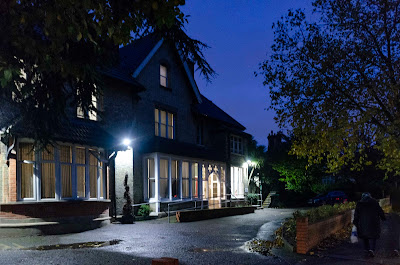
Up towards Hanger Hill. This is Fox Lane, leading down towards Sandall Road, with Hanger Hill Park on either side.

I find a fallen bough has come down over the footpath...
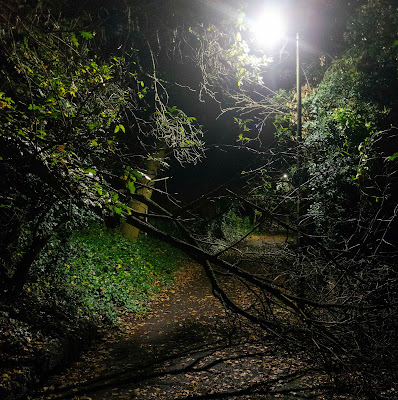
Back in Cleveland Park on my homeward journey. I hope a bus comes. I love watching the red double-deckers, mostly empty, at night taking a handful of passengers towards the bright lights of Ealing Broadway...

Here's one - a 297. No longer a 273 or 65 like in the old days, the street lighting's different too - and yet the klimat is unmistakable.

"Hold tight!" would call the conductor, giving the starting signal. "Ding-ding!" Today, a computer-generated voice says "This is a two-nine-seven, for Ealing Broadway. Next stop - Kent Gardens".

Across the road from my father's house, the sound of chainsaws. Two trees have been blown down by the gales and are being chopped up.

This time last year:
Walks in the early-November sun
This time four years ago:
Foggy evening, London
This time five year:
Kraków - Europe's top short-break destination
This time seven years ago:
Rzeczpospolita publishes infamous 'trotyl' Smolensk story
This time eight years ago:
Wilanowska - south Warsaw transport hub
This time ten years ago:
Powiśle on a cold, clear autumn morning
This time 11 years ago:
Okęcie "to remain Warsaw's only airport"
This time 12 years ago:
Searching for autumnal perfection
Along Cleveland Road, familiar topography. Below: looking down North Avenue towards St Stephen's church, turned into flats in the 1980s.

Below: corner of Cleveland Road and Edgehill Road. The turreted house in the background (left) is a regular location for films and TV series.

Below: once an ear, nose and throat clinic, this building is now an annex to an old people's home.

Up towards Hanger Hill. This is Fox Lane, leading down towards Sandall Road, with Hanger Hill Park on either side.

I find a fallen bough has come down over the footpath...

Back in Cleveland Park on my homeward journey. I hope a bus comes. I love watching the red double-deckers, mostly empty, at night taking a handful of passengers towards the bright lights of Ealing Broadway...

Here's one - a 297. No longer a 273 or 65 like in the old days, the street lighting's different too - and yet the klimat is unmistakable.

"Hold tight!" would call the conductor, giving the starting signal. "Ding-ding!" Today, a computer-generated voice says "This is a two-nine-seven, for Ealing Broadway. Next stop - Kent Gardens".

Across the road from my father's house, the sound of chainsaws. Two trees have been blown down by the gales and are being chopped up.

This time last year:
Walks in the early-November sun
This time four years ago:
Foggy evening, London
This time five year:
Kraków - Europe's top short-break destination
This time seven years ago:
Rzeczpospolita publishes infamous 'trotyl' Smolensk story
This time eight years ago:
Wilanowska - south Warsaw transport hub
This time ten years ago:
Powiśle on a cold, clear autumn morning
This time 11 years ago:
Okęcie "to remain Warsaw's only airport"
This time 12 years ago:
Searching for autumnal perfection
Friday, 1 November 2019
Obit
Born in Warsaw less than five years after Poland had regained its independence at the end of WW1, Bohdan Dembiński was 16 when WW2 broke out. He experienced the horrors of the Nazi occupation of Warsaw, witnessing street executions carried out by the Germans, the death of his father, the constant hunger and humiliation. He joined the Home Army (AK) along with many young Poles of his generation. Neither of his brothers knew he was in the konspiracja, nor did he know that they were in it, such was the secrecy. And none of them knew that another flat in their building served as the HQ of Colonel Antoni Chruściel, ‘Monter’, commander of the Uprising.
Bohdan Dembiński fought in the Uprising, initially with Battalion ‘Odwet’. After its unsuccessful assault on the SS barracks at Kolonia Staszica, he crossed Pole Mokotowskie fields to join Battalion ‘Golski’ with which he continued fighting in the Politechnika region, on the front line, until the end of the Uprising.
He was taken by the Germans to Stalag X B, a prisoner-of-war camp in Sandbostel, north-west Germany. Liberated in April 1945 by the British Army, Bohdan eventually made it, via Munich and Italy, to London.
After arriving in Britain, Bohdan resumed his studies at the Civil Engineering Department of Polish University College at Battersea Polytechnic. Inspired by the desire to build bridges, he had started a course in civil engineering at Warsaw’s Politechnika. It was cut short by the outbreak of the Uprising.
Bohdan Dembiński married Marysia Bortnik in 1952.

For three years they rented a garret flat on Sinclair Road in West Kensington, saving hard for a deposit for their own home, which they bought in Hanwell in 1955. Marysia had been deported to northern Russia along with her family from their home in eastern Poland in 1940, she had made it out of the USSR with the Polish army of Gen. Anders, via the Middle East.
Having settled in London, Bohdan found his calling in soil mechanics, designing foundations for buildings. Working for over 40 years for one employer, West’s Piling, he was responsible for many projects large and small, the most notable being the Llanwern steelworks in South Wales in the early 1960s, expansion of the Shell Haven refinery in the 1970s, and, towards the end of his career, he designed the foundations under the iconic 1 Canada Square building in Canary Wharf. A Member of the Institution of Civil Engineers, he was also involved for many years with Stowarzyszenie Techników Polskich w Wlk. Brytanii – the Association of Polish Engineers in Great Britain.
Though a free Poland seemed an improbable dream at the time, Bohdan raised me and my brother in the Polish spirit – Polish Saturday school, Polish cubs then scouts, coming each Sunday to this church throughout the 1960s. In 1970, the family moved to Ealing, but the boys continued going to polska szkoła in Chiswick, remaining in the Błękitna Trójka scout troop that would meet in this church hall each Saturday.
Bohdan had an early interest in computing. Responsible for digitising West’s Piling design processes from the early 1980s onwards, he became irreplaceable to the firm. He retired in his 70th year, in time for the birth of his first grandchild.
As an engineer he disliked waste; even in late life he was always looking to improve things around the house, putting discarded items to new use. A rubber wine cork sliced diagonally to serve as a doorstop.
It was only after the death of Marysia in 2015 that he began returning to Warsaw for the commemorations of the outbreak of the Uprising; he visited in August 2016 and each subsequent year until this August, the 75th anniversary. He loved to see how Warsaw has flourished in recent years – the skyline of new office buildings, the modern public transport, the restaurants and cafes. And yet there was so much he remembered, the streets of Ochota around the Filtry district where he grew up, Pole Mokotowskie fields, where he’d watch hot-air balloon races with his brothers.
Bohdan Dembiński lived a long life spanning ten decades. He was part of a generation displaced by war which sought to build the world anew. Active to the very end of his life, he had been to Mass on the Sunday before his death. The last two years of his life were made easier and livelier thanks to the presence of his wonderful carers, in particular Violetta and Basia, both of whom he adored. Bohdan’s family would also like to thank his close friends, his neighbours and his fellow parishioners who were always so supportive and helpful. Bohdan’s death brought about an amazing show of sympathy of those who knew him – the few survivors from his generation, and many from his sons’ generation who remembered a kindly, gentle, modest man, a loving husband, exemplary father and doting grandfather to his four grandchildren.
Bohdan Dembiński fought in the Uprising, initially with Battalion ‘Odwet’. After its unsuccessful assault on the SS barracks at Kolonia Staszica, he crossed Pole Mokotowskie fields to join Battalion ‘Golski’ with which he continued fighting in the Politechnika region, on the front line, until the end of the Uprising.
He was taken by the Germans to Stalag X B, a prisoner-of-war camp in Sandbostel, north-west Germany. Liberated in April 1945 by the British Army, Bohdan eventually made it, via Munich and Italy, to London.
After arriving in Britain, Bohdan resumed his studies at the Civil Engineering Department of Polish University College at Battersea Polytechnic. Inspired by the desire to build bridges, he had started a course in civil engineering at Warsaw’s Politechnika. It was cut short by the outbreak of the Uprising.
Bohdan Dembiński married Marysia Bortnik in 1952.

For three years they rented a garret flat on Sinclair Road in West Kensington, saving hard for a deposit for their own home, which they bought in Hanwell in 1955. Marysia had been deported to northern Russia along with her family from their home in eastern Poland in 1940, she had made it out of the USSR with the Polish army of Gen. Anders, via the Middle East.
Having settled in London, Bohdan found his calling in soil mechanics, designing foundations for buildings. Working for over 40 years for one employer, West’s Piling, he was responsible for many projects large and small, the most notable being the Llanwern steelworks in South Wales in the early 1960s, expansion of the Shell Haven refinery in the 1970s, and, towards the end of his career, he designed the foundations under the iconic 1 Canada Square building in Canary Wharf. A Member of the Institution of Civil Engineers, he was also involved for many years with Stowarzyszenie Techników Polskich w Wlk. Brytanii – the Association of Polish Engineers in Great Britain.
Though a free Poland seemed an improbable dream at the time, Bohdan raised me and my brother in the Polish spirit – Polish Saturday school, Polish cubs then scouts, coming each Sunday to this church throughout the 1960s. In 1970, the family moved to Ealing, but the boys continued going to polska szkoła in Chiswick, remaining in the Błękitna Trójka scout troop that would meet in this church hall each Saturday.
Bohdan had an early interest in computing. Responsible for digitising West’s Piling design processes from the early 1980s onwards, he became irreplaceable to the firm. He retired in his 70th year, in time for the birth of his first grandchild.
As an engineer he disliked waste; even in late life he was always looking to improve things around the house, putting discarded items to new use. A rubber wine cork sliced diagonally to serve as a doorstop.
It was only after the death of Marysia in 2015 that he began returning to Warsaw for the commemorations of the outbreak of the Uprising; he visited in August 2016 and each subsequent year until this August, the 75th anniversary. He loved to see how Warsaw has flourished in recent years – the skyline of new office buildings, the modern public transport, the restaurants and cafes. And yet there was so much he remembered, the streets of Ochota around the Filtry district where he grew up, Pole Mokotowskie fields, where he’d watch hot-air balloon races with his brothers.
Bohdan Dembiński lived a long life spanning ten decades. He was part of a generation displaced by war which sought to build the world anew. Active to the very end of his life, he had been to Mass on the Sunday before his death. The last two years of his life were made easier and livelier thanks to the presence of his wonderful carers, in particular Violetta and Basia, both of whom he adored. Bohdan’s family would also like to thank his close friends, his neighbours and his fellow parishioners who were always so supportive and helpful. Bohdan’s death brought about an amazing show of sympathy of those who knew him – the few survivors from his generation, and many from his sons’ generation who remembered a kindly, gentle, modest man, a loving husband, exemplary father and doting grandfather to his four grandchildren.
Thursday, 31 October 2019
Cause of Death
I popped into the Bereavement Office at Ealing Hospital to collect the medical certificate; armed with this I set off to Ealing Town Hall to register my father's death.
The medical certificate gave the cause of death as 'ischaemic heart disease' and secondary cause as 'chronic kidney disease'. My father had indeed suffered a heart attack on Tuesday morning and died at 16:40 that same day in hospital.
At Ealing Town Hall, things have changed since I registered the births of my children and the death of my mother. No longer high-vaulted Victorian corridors resounding the the echoes of footsteps along marbled floors, no oak-panelled offices or antique desks - the Registrar has moved next door into the relative modernity of Perceval House, built in the 1980s. Here, I'm surprised that the system for being seen is identical to that in use at Urząd Dzielnicy Ursynów in Warsaw! You get a ticket with a number and queue up for a multiplicity of services and someone will pop out and collect you from the relevant cubicle.
After a wait of no more than about 20 minutes, I'm ushered into a tiny glass-sided room by the Deputy Registrar, and we go through the formalities. One slight shock - each certified copy of the entry into the register, which cost £4 when my mother died four years ago (and according to the leaflet What to do when someone close to you dies, given to us at the hospital still costs £4), now costs £11. And you need lots of these for various institutions - the Grant of Representation from the Probate Service, for example. Plus most of the private-sector institutions with which the deceased had a relationship - shareholdings, banking, insurance.
But somethings have become simpler. The UK government's wonderful Tell Us Once service allows you to enter into one webpage all of the government services used by the deceased and cancel them with one click - passport, council tax, driving licence, NHS, National Insurance - really easy. Compare this to Poland where the bereaved need to set off on a trek around various government offices in person.
Once I had the green form from the Registrar's Office, I could arrange the funeral. Here I must warmly praise funeral director Artur Galla, who arranged my mother's funeral as well as those of many of my friends' parents' funerals. Everything sorted out with efficiency and decorum.
One thing we discovered from the hospital about the circumstances of my father's death was that in February this year, he had had a heart attack - but he didn't tell us! A few months later, when he received an appointment to see a consulting cardiologist, he told us that there had been some mistake, and that really he should be seeing a dermatologist for some minor skin condition rather than a heart specialist.
His final visit to the OPRAC (Old People's Rapid Assessment Centre) last month was very positive. The swelling of his feet had subsided, he had a higher blood iron count, he reported less trouble with swallowing (indeed, this was much better) - overall he was in far better shape in the summer than he had been in early spring. But he didn't tell the OPRAC doctor about any heart attack in February... [I suspect it was because he knew it would curtail his trip to Warsaw for the 75th anniversary of the Uprising. He went, his wish fulfilled; he died three months later.]
The upbeat OPRAC report and his overall improvement in health over the summer had led us to believe that he could indeed make it to a hundred - his stated goal. His recent feats were legion. In September, he pushed his wheelchair all the way home from Lidl in Hanwell, a distance of a mile and half (2.5km). Without stopping. He filled two wheelie bins of garden waste with leaves and twigs. His mind was active to the end too. Looking at his browsing history, I could see that three days before he died he'd spent the evening reading about the latest discoveries in quantum computing.
The medical certificate gave the cause of death as 'ischaemic heart disease' and secondary cause as 'chronic kidney disease'. My father had indeed suffered a heart attack on Tuesday morning and died at 16:40 that same day in hospital.
At Ealing Town Hall, things have changed since I registered the births of my children and the death of my mother. No longer high-vaulted Victorian corridors resounding the the echoes of footsteps along marbled floors, no oak-panelled offices or antique desks - the Registrar has moved next door into the relative modernity of Perceval House, built in the 1980s. Here, I'm surprised that the system for being seen is identical to that in use at Urząd Dzielnicy Ursynów in Warsaw! You get a ticket with a number and queue up for a multiplicity of services and someone will pop out and collect you from the relevant cubicle.
After a wait of no more than about 20 minutes, I'm ushered into a tiny glass-sided room by the Deputy Registrar, and we go through the formalities. One slight shock - each certified copy of the entry into the register, which cost £4 when my mother died four years ago (and according to the leaflet What to do when someone close to you dies, given to us at the hospital still costs £4), now costs £11. And you need lots of these for various institutions - the Grant of Representation from the Probate Service, for example. Plus most of the private-sector institutions with which the deceased had a relationship - shareholdings, banking, insurance.
But somethings have become simpler. The UK government's wonderful Tell Us Once service allows you to enter into one webpage all of the government services used by the deceased and cancel them with one click - passport, council tax, driving licence, NHS, National Insurance - really easy. Compare this to Poland where the bereaved need to set off on a trek around various government offices in person.
Once I had the green form from the Registrar's Office, I could arrange the funeral. Here I must warmly praise funeral director Artur Galla, who arranged my mother's funeral as well as those of many of my friends' parents' funerals. Everything sorted out with efficiency and decorum.
One thing we discovered from the hospital about the circumstances of my father's death was that in February this year, he had had a heart attack - but he didn't tell us! A few months later, when he received an appointment to see a consulting cardiologist, he told us that there had been some mistake, and that really he should be seeing a dermatologist for some minor skin condition rather than a heart specialist.
His final visit to the OPRAC (Old People's Rapid Assessment Centre) last month was very positive. The swelling of his feet had subsided, he had a higher blood iron count, he reported less trouble with swallowing (indeed, this was much better) - overall he was in far better shape in the summer than he had been in early spring. But he didn't tell the OPRAC doctor about any heart attack in February... [I suspect it was because he knew it would curtail his trip to Warsaw for the 75th anniversary of the Uprising. He went, his wish fulfilled; he died three months later.]
The upbeat OPRAC report and his overall improvement in health over the summer had led us to believe that he could indeed make it to a hundred - his stated goal. His recent feats were legion. In September, he pushed his wheelchair all the way home from Lidl in Hanwell, a distance of a mile and half (2.5km). Without stopping. He filled two wheelie bins of garden waste with leaves and twigs. His mind was active to the end too. Looking at his browsing history, I could see that three days before he died he'd spent the evening reading about the latest discoveries in quantum computing.
I found two PostIt notes on his desk bearing his last written words: one said 'Quantum supremacy'. The other was the name of a Primitivo wine from Puglia that he'd recently enjoyed.
The funeral will take place on Saturday 9 November at Św. Andrzeja Boboli church, Leysfield Road, Hammersmith, at 11:15, followed by cremation at Mortlake.
This time last year:
Opole in the late-October sunshine
This time two years ago:
Work begins in earnest on the Karczunkowska viaduct
This time four years ago:
Sublime autumn day in Jeziorki
This time five years ago:
CitytoCity, MalltoMall
This time six years ago:
(Internet) Radio Days
This time seven years ago:
Another office move
This time eight years ago:
Manufacturing a City of Culture
This time nine years ago:
My thousandth post
This time ten years ago:
Closure of ul. Poloneza
This time 11 years ago:
Scenes from a suburban petrol station
The funeral will take place on Saturday 9 November at Św. Andrzeja Boboli church, Leysfield Road, Hammersmith, at 11:15, followed by cremation at Mortlake.
This time last year:
Opole in the late-October sunshine
This time two years ago:
Work begins in earnest on the Karczunkowska viaduct
This time four years ago:
Sublime autumn day in Jeziorki
This time five years ago:
CitytoCity, MalltoMall
This time six years ago:
(Internet) Radio Days
This time seven years ago:
Another office move
This time eight years ago:
Manufacturing a City of Culture
This time nine years ago:
My thousandth post
This time ten years ago:
Closure of ul. Poloneza
This time 11 years ago:
Scenes from a suburban petrol station
Subscribe to:
Posts (Atom)


 Posts
Posts


