Friday, 12 June 2020

Michalczew, Gośniewice and Warka

Last week I wrote about the progress at Krężel and Chynów stations; this weekend I travel down the line to Warka, taking in Michalczew and Gośniewice stations on the way. It's taken a long time to get where we are, but that's understandable given the Covid-19 hiatus. One can see that the line from Warsaw to Warka - in particular the stretch between Czachówek Południowy and Warka - is getting ever closer to completion. But onwards from Warka to Radom - that's another story.

Below: Michalczew, like Krężel, will have staggered platforms; the 'up' platform was completed last summer and serves passengers in both directions while the 'down' platform and 'down' line (to the north) take shape. The original 1930s station building will remain. Note the temporary pedestrian crossing over the as-yet unopened 'down' line, photo taken from the as-yet unopened 'down' platform. Overhead power lines are in place, as is all the platform signage, lighting and other fittings. Won't be too long now.


Below: just south of the end of the 'up' platform, what must be the one of the last ungated road level crossings left open along the line between Warsaw and Warka.


I have a soft spot for Gośniewice station; plonked down between fields and orchards, serving a village of a hundred souls, more than half a kilometre away - it's one of those Polish Adlestrops that can't really justify their existence commercially. And yet this station - a post-war after-thought - is being comprehensively rebuilt to the same standard as the others on the line. Below: the view west from the as yet unopened 'down' platform. Note the ungated level crossing road sign; this refers to one that's been closed for good. A new one will be built, a hundred metres or so south of the old crossing; it will lie between the two staggered platforms.


Below: Gośniewice, the new 'up' platform. As at Michalczew, the overhead cables on the 'down' line are already in place.


Below: Warka station, the (current) end of the line. The new platforms near completion; as at Chynów, there are canopies to protect waiting passengers from the elements. The train pulling in has Radom as its destination, but it will stop here and passengers wishing to travel on south will have to board replacement buses waiting outside in the station forecourt.


Warka station is still very much a building site, as evidenced by this photo of duckboards made of pallets, laid down between the one functioning platform and the forecourt. The replacement bus for all stations to Radom is visible to the left of the station building. Much inconvenience for passengers travelling on.


Below: south of Warka station, there are no tracks. The new bridge over the river Pilica has been completed, the old single-track bridge having been dismantled.


Looking north-east from this spot, somewhere around here in the undetermined future (planning permissions etc) there will be a new station, Warka Miasto, a station that will actually serve the town of Warka rather than its western outskirts. But that's all in the future.


Below: a setting sun in my motorcycle mirror; between Warka and Chynów.


[A reminder of how this stretch of the line looked in June 2019 here.]

This time three years ago:
Jeziorki birdlife update

This time five years ago:
Inside Okęcie airport's new old terminal

This time nine years ago:
Thirty-One and Sixty-Three (short story about 19th century Polish uprisings)

This time 11 years ago:
Jeziorki to Jeziorki - the big rail loop

This time 12 years ago:
Automotive miscellany

This time 13 years ago:
South Warsaw sunsets

Wednesday, 10 June 2020

The 13th Thirteenth


I woke at ten to seven this morning after a dream in which I was reading a new book entitled The 13th Thirteenth.

Part occult, part current affairs, the book sought to explain today's events in terms of entangled quantum uncertainties, chaotically steered by a grid of clashing human wills. An uprising of hitherto unrecognised wills, too small to pick out individually, but lashed together by social media, into a historically unprecedented force. Billions of frightened egos, large and small but all of them fragile, cornered by manufactured fears, rear up to take on imagined foes. Across the world our early-human superstitions have been re-awakening to cross fingers, knock on wood, turn three times and recite magic spells. The rational reassurance once heard in our televisual talking heads has evaporated; the timbre has changed - to one of distrust and anger. There is a sense of urgency but lack of direction. But which way? Never mind! We must act! How? Doesn't matter - we must act, and act now! Fear breeds hate.

I pondered the preceding 12 thirteenths. Me, I don't like 13. 

My father didn't like 22. We talked about this on the phone one evening in May 2017. "Tomorrow's the 22nd," said my father. "Not a good number. I don't like it.". The next day we spoke again. It was the day after the Manchester Arena bombing. "I told you," said my father. "On the 22nd, 22 people were killed by a 22-year-old suicide bomber." [The Crocus City Hall attack in Russia also happened on the 22nd, March 2024.]

Coincidences that run through dreams, coincidences that can be written off as meaningless by the rational mind. The physics of dreams is entirely different to that experienced in our waking state. Much like the physics in a Tom & Jerry or Roadrunner cartoon is different, but instinctively relatable. When dreaming, reality is perceived in a different way. The rational mind is suppressed while we dream. Once asleep, our imagination seizes control of the cerebral cortex. But is it just imagination? Could it not portend something more... real?

In the early hours of 2 June this year, I had the following dream: On a USAAF airbase in England, summer 1944, and I'm training as an air gunner. We were being trained on the ground in the use of .50 cal and twin .30 cal machine guns on board bombers' waist positions. There was a camera crew over from the States filming us for a documentary; with them was a woman called Gerarda Battna (exactly this spelling - I jotted this down at 02:35; 'Battna'  with a double 't'), who was composing the score for the film. As we were firing the guns from the planes, on the ground at distant targets, we were being filmed. Just then, a P-51D Mustang flew in; it had a 500lb bomb just about attached to the port wing; there was a malfunction - the bomb wouldn't drop off. It was dangling half-on. The pilot had to force-land at our base. There was great danger that should the bomb detach on touch-down, it would explode. We all had to take cover... He landed safely, and taxi'd gingerly to a blast-proof revetment some distance away from us. Fortunately all ended well. The bomb didn't dislodge, the pilot walked away, and the bomb-disposal team came and carefully removed the bomb from the plane's wing.

But who's Gerarda Battna...? I googled. Two hits!

     "...z osebno izjavo o govoru Gerarda Battna..."  [note the 100% match on spelling] 

Both results linked to the Slovak transcript of a European Parliamentary debate in which the MEP and former UKIP leader Gerard Batten took part - 'Gerarda Battna' being his name in the genitive form in Slovakian. I've never read any transcript of any European Parliament debate, let alone in Slovakian! (And not a language I know at all.) Coincidence? Or some quantum leakage happening in the universe?

And the same goes for this intriguing dream from five years ago; was my sleeping self observing something happening to an Italian-American voice coach at another time in another place?

Weird things are happening, yet on an insignificant scale; a phenomenon "too weak to even recognise", but if you are sensitive to it - you'll know it's real.

This time last year:

Monday, 8 June 2020

Monochrome moods

I promised some black and white treatments of recent photos, so here they are. Click to enlarge.

A return to my photographic roots - my black-and-white darkroom at Ribchester Avenue, Perivale; my four semesters of photography evening classes at Central St Martin's, printing high-quality 16" x 20" bromide prints from my negatives; many hours poring over Ansel Adams' textbooks - The Camera, The Negative and The Print. But the big question - the only question - is about emotional response. Does the monochromatic image convey more or less than a colour image? Can it be said to represent the subject conscious experience of what I saw and felt better than colour? In landscape photography, where is B&W best suited?

Below: Sierra da Vidy, where the S7 is being built


Below: Oak leaves and rain drops, ulica Dawidowska


Below: culvert under the tracks, between W-wa Dawidy and W-wa Jeziorki


Below: abandoned electricity generation plant, Jeziorki. [Four months later, it was finally demolished.]


Below: trees by W-wa Jeziorki station, dusk.


Below: an estate of new houses nears completion, ulica Kórnicka


Below: the road to Chynów station, from Jakubowizna.


This time two years ago:

This time four years ago:
Street art, Piotrków Trybunalski

This time seven years ago:
Quality engineering from half a century ago

This time eight years ago:
Fans fly in to Warsaw for Euro 2012

This time nine years ago:
Cara al Sol - part II

This time ten years ago:
Still struggling with the floodwaters

This time 11 years ago:
European elections - and I buy used D40

The time 12 years ago:
To the Vistula, by bike

This time 13 years ago:
Poppy profusion

Rail remont progress - Krężel to Chynów

It's been over seven months since I ventured south of Chynów, so this morning I made my way on foot to the next station south - Krężel - to document the progress of the modernisation work along the line to Radom.

Below: all but ready to go - just needs the overhead power lines, the 'down' platform is where the old island platform used to stand - but on the other side of the track, which has been straightened out so that fast through-trains don't have to slow down for the kinks in the line. Note the poppies growing along the verge on the other side other of the tracks.


Below: a southbound train approaches the new 'up' platform that was built south of the original island platform, so the two platforms will be staggered. A pedestrian level crossing connects the two. There will not be an underground passage nor footbridge, as passenger traffic here is light. The train itself is a four-car EN71 set, a beefed-up version of the still-ubiquitous three-car EN57 sets. Operator Koleje Mazowieckie bought four such sets from Croatian railways, and modernised them.

The passenger shelter at Krężel is identical in design to the one at Sułkowice, two stops up the line. And like the one at Sułkowice, it will also lose its reason to exist. However, at the moment, there are neither plans to demolish it, nor to modernise it.


Below: looking across at the 'up' platform from the old shelter.


Just when I'm starting to hope that the line to Warka will be ready soon, I note that track-laying is still going on. Officially, the Czachówek Południowy - Warka stretch will be open "sometime in the fourth quarter". Below: looking south from Krężel towards Michalczew. Clouds of dust rise from the ballast being laid onto the trackbed.


Below: walking back towards Chynów, the next southbound train passes me. It's another EN71, with the ribbed sides. Note the drainage ditch running alongside the track. This will have concrete gully at the bottom. There are three transverse culverts crossing under the track on the stretch between Krężel and Chynów. Drainage is as issue in these days of extreme climate events; the ability to get rid of waste water efficiently without it threatening rail movement is an important factor when modernising lines.


Below: approaching Chynów station, this time from the east side. PKP PLK's contractors have literally taken zero notice of passengers living in Jakubowizna or Widok, the villages on this side of the line, as well as pedestrians and cyclists wanting to cross the line or walk/cycle parallel to it. Note the ballast train in the goods siding - it is taking ballast from the stockpile here to where it's needed, south of Krężel.


I got home to my działka, made lunch - and the heavens opened. The rains kept falling with varying intensity for the next four hours. I'm back at Chynów for the train to W-wa Jeziorki, which is pulling into the platform. The train standing on the other platform has come from Warsaw, and is waiting for the northbound service to clear the single operational line before heading on to Warka. There's still a replacement bus service between Warka and Radom - it will continue taking passengers onward to Radom until December, when one line will open between the two towns. The second is expected to become operational in the "second half of 2021" (four years after work started.)


This time six years ago:

This time eight years ago:
Fans fly in for the football

This time nine years ago:
Cara al Sol - part II

This time ten years ago:
Still struggling with the floodwaters

This time 11 years ago:
European elections - and I buy used D40

The time 12 years ago:
To the Vistula, by bike

This time 13 years ago:
Poppy profusion

Saturday, 6 June 2020

Homage to Americana

Jakubowizna puts me in mind of the big skies of the Great Plains illuminated by a midsummer sun, snapped on Kodachrome through a polarising filter, the aesthetic of mid-century America. Home to GIs, who grew up in the Depression, then fought in the Pacific or in Europe, and returned to a land of plenty. They grew into maturity in Technicolor to a stereophonic soundtrack in hi-fi.


The land south of Warsaw at this time of year resonates with that feel, especially with a polarising filter on the lens to accentuate the contrast between the blueness of the sky and the whiteness of the clouds.

Below: Scrub land between Chynów station and the orchards of Jakubowizna. Ranks upon ranks of clouds file back all the way north to Warsaw and up towards the Baltic. The days are long, and at long last - warm. Warm enough to ride a motorbike.


Below: although nowhere to be seen on the municipal development map, it looks like a new road is being built parallel to the the tracks. The 'up' line still functions for trains to and from Warsaw, while the 'down' line is nearly ready, with just a short stretch between Chynów and Sułkowice awaiting new rails and final electrification.


Below: on my way to W-wa Jeziorki station, passing along ul. Dawidowska, the blue skies giving more of a Mediterranean air to the place. The road has been widened slightly as work on new sewage pipe running the length of this stretch has just been completed.


Left: my brother Marek referred me to the black & white American Road photography of Robert Adams, so here's a Robert Adams-inspired snap of my motorbike outside the J&B snack-bar in Chynów. I had my first hamburger since the start of Lent on 26 February.

Today was also my first proper motorbike ride since last October; not a particularly long one, but enough to instil confidence in both my skills - my seventh season - and my machine. Note: the level crossing between Chynów and Jakubowizna is closed for the new track laying; the detour around Grobice via a string of villages is long and convoluted, and requires riding along the DK50 (Warsaw's de facto southern bypass, below).


Below: the działka's looking good. The geodeta (legal or sworn land surveyor) is booked for next week; he will formally demarcate the eastern edge of my land so I can fence off the entire plot (see the post from this time last year, below, for details). My father's passing, winter and Covid-19 have put back formalities somewhat.


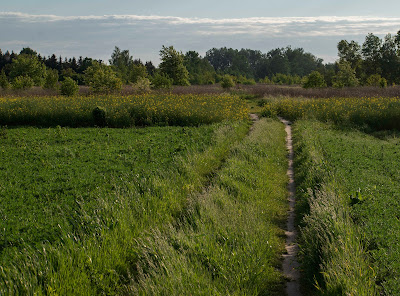
Below: just down the road a piece from my działka, walking through a charming wood.


This time last year:
This land is my land

This time five years ago:
The day, seized.

This time eight years ago:
Classic British cars for British week

This time nine years ago:
Cara al Sol - a short story

This time ten years ago:
Pumping out the floodwater

This time 11 years ago:
To Góra Kalwaria and beyond

This time 12 years ago:
Developments in Warsaw's exurbs

Thursday, 4 June 2020

Moonrise

A good evening to capture a moonrise; I head off towards Nowa Wola to snap the fields as they fill with houses. Suburban living is suddenly becoming in vogue again as citizens seen lower housing density, associated with lower epidemiological risk. Look at the moon (click to enlarge) - I'm lucky enough to catch a plane flying across it - though the lens is too short to do it justice.


This development has sprung up very quickly; these structures have appeared in the last few weeks.


The electrification of the suburbs. All that's missing is the shops, the schools, the hospital, the cinema, the park, the church, the local railway station, bus routes - it's just houses, houses, houses right now - the infrastructure for civilised living will arrive later, spontaneously, believe the developers. I sure hope it will.


Below: rainbow over the new viaduct - sunshine and rain at the golden time of day.


The last rays of sunlight catch the golden hills of soil that have emerged by the S7 extension site


Back to the tracks, where an evening train sets off from W-wa Jeziorki towards town...


...and as it passes, a chance to snap the new houses being build privately on the Jeziorki side.


Below: ulica Nawłocka looking towards ul. Karczunkowska and the eastern ramp onto the viaduct. Beyond that, the giant Biedronka sign that brings this fair suburb light. 


My brother recently mentioned the American photographer Robert Adams in connection with my photographs, while commentator White Horse Pilgrim mentioned the American photographer Ansel Adams in connection with a monochrome shot I posted the other day. Glad my snaps spark off such associations!

This time last year:

Monday, 1 June 2020

I'm from the south - the south of Warsaw

The southernmost street in Jeziorki, ulica Katarynki (lit. 'Barrel-Organ Street'). On the corner a house with a tall hedge outside. That dark shape you see on the hedge is the opening in which is the gate to the house - it reminds me of the Great Hedge of India! On examination, it turns out that there's one street in Warsaw that extends even further south than ul. Katarynki, and that's ul. Prawdziwka (lit. 'Boletus Street'), to the south-east of Las Kabacki forest.


Fields run south from ul. Katarynki to the border, marked with a long, straight drainage ditch running east-west. The rooftops on the horizon are in Mysiadło (which is not Warsaw).


Below: looking west along ul. Katarynki. As rural a scene as one can imagine in Poland, with a cart-track running between fields; we are still actually within Warsaw's boundaries.


Below: looking east towards the last houses on ul. Katarynki. Note the proliferation of solar panels - a subject I intend to return to.


Below: drainage ditch running between ul. Katarynki (to the right) and ul. Żmijewska (to the left). Neither street has asphalt, both end up in a dead end surrounded by fields. On the horizon to the left, three large piles of builder's sand, stored by Falbruk, a road-building and repair company headquartered on ul. Karczunkowska.


Left: another pile of construction material, across the tracks on the S7 construction site. Rendered in black and white, this heap of soil  gives the impression of a high mountain somewhere in the Rockies. Note the waxing gibbous moon up top and vapour trail.

Scramble up to the top of the hill  for some good views. Below: looking west towards Jeziorki and the railway line, between W-wa Dawidy station to the left and W-wa Jeziorki station to the right. Beyond, on the horizon, the Las Kabacki forest. Zielony (Green) Ursynów at its greenest.


I turn 90 degrees to the left for an even more stunning than ever panorama of central Warsaw, getting better as the hill I photograph from rises ever higher. Work on the S7 is progressing at a rapid pace.


Below: the sun has set over the horizon, its afterglow still visible, reflected from the pond and from the clouds. The Sublime Aesthetic; the sensual and the spiritual, merging.


This time last year:

Friday, 29 May 2020

Sunset's trip

As the world turns at the edge of night... a sunset stroll around my other manor - Jakubowizna. 


Ain't that something? Look at the size of the sky... takes me elsewhere. Didn't have this in West London.


Extinguished flame, the globe's horizon has spun back, leaving traces of fire under the clouds sweeping down inexorably from the north. 


The sun has set; it's getting dark. Your journey lies ahead - you must enter the forest. Atavistic fears well up inside - fears of brigandry, wild animals - and supernatural creatures too...? European travellers in the Middle Ages would have known such fears. Today, I can enter this forest fearlessly; I know it holds no terrors by day, nor by night.

Below: safely back to my działka, my first night's sleep here awaits me now.


This time six years ago

This time nine years ago:
How I almost saved Barrack Obama

This time 11 years ago:
Some anniversaries missed

This time 13 years ago:
Hissing of the summer lawns
