Wednesday, 10 February 2016

Sensitivity to spiritual evolution


ASH WEDNESDAY

Just as there is biological evolution, so the spiritual nature of all around us evolves too. We grow in awareness, our consciousness becomes more fine-tuned to all that surrounds us. Much as we strive for those spiritual goals, reaching towards the sublime infinite, we are but human, easily distracted. Builders of religious buildings have striven to create spaces in which we can focus on the numinous, but often things get in the way. Other worshipers, incongruous objects, bad architecture, uninspiring music. We know we should pray, meditate, contemplate - but we do it all too rarely.

Hence those times in the spiritual calendar that impose upon us an obligation to turn towards the infinite.

And then what?

My principal belief is that human spirituality is a lifelong quest for ever-greater awareness. It should not be mere acceptance of nostrums handed down over the centuries - "there, quest no more, for all the answers are here." That approach dullens our spiritual evolution. The quest is imposed upon us by our own motivation to fulfil our human potential. To make the very most of that with which we were born.

The story of Adam and Eve is, in a way, a warning by our ancient forefathers in the Middle East not to question too much, nor to seek knowledge. Refusal to heed this warning resulted in the Fall of Man.

Now, I don't subscribe to the notion of a fall from grace, a past state of perfection in which all that was expected of Man was obedience. Rather, I see history, progress, being a slow journey from Imperfection towards Perfection, as a wrote last year, a long journey from Zero to One. From spiritual emptiness to spiritual fulfilment. 

To be open to the evolution of our spirituality, we must strive to be more sensitive to the calling. And here, I find myself on the one hand disagreeing with religious fundamentalists as much as I disagree with scientific rationalists. The voice of the infinite calls to us - you may wish to call this 'God' - but the voice is neither shrill nor obvious.

And - here I base my beliefs on observations made throughout my life - the presence of the infinite in our lives is there, but we can tap into this presence only if we seek, and listen.

It is necessary to take a balanced approach to the way we interpret that which is around us. We should neither obsessively seek out coincidences and then contrive to find meaning in them - nor should we ignore those flashes of numinous insight which befall us from time to time.

The rationalist would not stray into a world so intangible, full of that which cannot be empirically recorded and explained. Yet if we are open to a universe of possibility, our spirit - can indeed feel a heightened degree of awareness and understanding. But, for now, these moments are few and far between and their intensity limited. Enough to be noticed, and built on.

For the key question that all of us - every single human being ponders on - is the existence of our consciousness after our bodies' physical demise. My personal belief - but it is one I can challenge, question or even reject should new insight arise - is that from lifetime to lifetime, that consciousness does indeed move on from being to being, each time rising in spiritual awareness, evolving away from the beastly and towards the angelic.

How do I know this? Sensitivity to those moments that I've been recalling and reporting for many years, those flashbacks, those moments of anomalous familiarity, which I firmly believe are from beyond my lifetime, from before my birth, a sense of connection with a spiritual phenomenon larger than my mere ego. Was that 'me' in a life before? Don't know. Will there be a future 'me'? Doubt it. I am assuming spiritual evolution, and greater sensitivity to such phenomena.

As I wrote last year, the Universal Singularity is that to which I believe everything is tending towards. Billions of galaxies, billions of stars. More universes than just one? Who knows. As a species we will know more. But only if we genuinely seek, strive, and grow in spirit as we live and experience life - consciously.

This time last year:
'Peak car' - in Western Europe, at least

This time three years ago:
Pavement for Karczunkowska NOW!
[We still don't have one... I walk home in fear of my life.]

This time four years ago:
Until the Vistula freezes over

This time five year:
Of sunshine, birdsong and wet socks

This time eight years ago:
Dziadzio Tadeusz at 90

Tuesday, 9 February 2016

Lent, a time to cleanse and reflect


SHROVE TUESDAY

Well, this is it! Once again - for me, the 25th Lent in a row when I deny myself the pleasure of drink. And also meat, fast food, added salt, sugar, soft drinks, cakes, biscuits, confectionery, salt snacks... What's left? Fish, dairy, fruit, veg, bread, rice, pasta. And water.

This is the time of year to eschew the physical presence and focus on the Infinite, to ask the Big Questions regarding the human condition, the spirit, the consciousness. Why we live, what it's all for. To put under scrutiny that infinitesimally tiny chance that we exist at all. That we are aware of it as it passes.

Why? Time to step back, for 46 days, one eighth of the time it takes for our planet to orbit its star - time to contemplate. In awe, and in mystery. And to consider the how and why of our existence. Here we all are - busying away at our lives, getting on with it, facing the challenges of bank account and dentist and washing up and shopping - but what's it all for?

Over the next six and half weeks, between now and Easter Sunday, I intend, as I've done over the past years, to get serious about the nature of existence and the Universe. From the subatomic to the pangalactic. Here we all are, worrying about Brexit and Zika and Putin and Isis - and yet, out there, and in here, there is a Universe that we need to get to grips with.

Will it keep expanding for ever? Or will its expansion slow, will it begin to contract in upon itself? What is Dark Matter, that makes up the bulk of the Universe? Mere mathematics?

And - Most importantly - what is the purpose of it all? Why does the Universe exist at all? Does it have an aim? A goal? And what part in all of this does our own consciousness play?

There is a quest. A purpose. We strive to discover. And for me - brought up as a Catholic - the period of Lent is as good as any to concentrate on these questions, while at the same time going on a fast, a time of self-denial, that is linked to deeper focus on what matters most.

Touching the spiritual - if genuine, not a going-through-the-motions ritual, but a real experience of being in the presence of the Eternal - is not an everyday experience for most of us.

To do so requires a sensitivity, a yearning, an awareness that there is a quest going on; the aim is to make those moments more frequent in our lives, and that from them, we may learn and grow.

And that really big question is - what next. What happens after we die. We can only have an inkling, but what we feel, what we believe, does, I think, play a part in the outcome.

Join me then, in another 46-day pilgrimage in which I try to get a step or two nearer the Infinite, the Universal Singularity, a step further on the journey from Zero to One, a step closer (though we are far, far, away) to an understanding of God.

Click on the Human Spirituality and Lent labels for a rich back-catalogue of musings upon our condition.

This time last year:
It was 50 years ago today... Beatles arrive in New York

This time three years ago:
Adventures in the Screen Trade - the truth about Hollywood

This time four years ago:
Drifting home

This time six years ago:
Today's dose of wintery gorgeousness

This time eight years ago:
First intimations of spring

Monday, 8 February 2016

Deconstructing political graffiti: London and Warsaw

Exhibit One, below: photographed on the wall on the overpass as ul. Złota passes under ul. Marszałkowska, across the road from those temples of consumerism, Domy Handlowe Centrum. To all orthodox economists, this logan is heresy, anathema. Yet I can see some sense in the slogan - it alludes to posts I wrote recently (here and here). Much of what passes as 'growth' is merely the sale of a thing to a person that can't quite afford and doesn't actually need. And this is not good for our planet.

However, economists - and indeed politicians - would recoil from this sentiment as it would inevitably lead to a growth in unemployment and with it social unrest. Left and right, politicians would agree that it's better that the economy ticks over (even if only barely) than begins to contract.

I must say, graphically, this would make a wonderful album cover for a 1976-vintage punk band.


Exhibit two, below: on the bridge taking the A40 Western Avenue over the Grand Union Canal Paddington Arm at Greenford. Again, I have alluded to this thought in recent posts (here and here). This is the slogan of populists the world over, from Trump to Le Pen. Until they get into power. And then just look at Venezuela.

The thing with this slogan is the person voicing it is not in any position to offer any alternative 'game'. Nor is he even aware of how complex the 'game' is, and how, when attempting to implement ill-conceived ideas, often gets its quite wrong. Even when an intellectual like Karl Marx devises a new game, the result is so botched, so murderously awful, that the detached observer has to admit - OK, let's leave the game as is, let's stick to changing the players.


Other political graffiti I have snapped in recent months in Warsaw does not bear propagating, suffice to say that graffiti featuring crude unpleasantness directed at the new Polish government outnumbers that aimed that the old government by a ratio of three to one.

Having said that, maybe I wasn't looking hard enough, or looking in the wrong boroughs, but I've not seen any rude epithets directed at Mr Cameron sprayed on the walls of London.

This time two years ago:
Europe's peripheral woes

This time three years ago:
Winter returns to Warsaw

This time four years ago:
Babcia vs. Roma action, Centrum
[A classic bit of photo-reportage, if you don't mind me boasting]

This time five years ago:
Reasons to be cheerful

This time six years ago:
Skiing in the Beskid Wyspowy

This time seven years ago:
What's to be done about Warsaw's unmade roads?

This time eight years ago:
Jeziorki in the fog
[some lovely photos]

Sunday, 7 February 2016

Make do and mend - Polak nadal potrafi?

My father (92, Warsaw Uprising veteran) never fails to surprise me. Yesterday he fixed the lid of a saucepan. The wooden knob had come off the stainless steel lid. He spent an hour or two finding a stainless steel screw from the many jars of old screws kept in the garage for such a purpose, finding a matching hexagonal nut that could be inserted into the wooden knob, inserting it into the hole properly, packing it with filler, then filing it flush before solidly screwing the whole ensemble together. Other than a visible screw-head in the knob, the saucepan looks as new.

Today's generation, not having lived through the wartime privations and post-war rationing, would merely throw out the lidless saucepan and buy a new one from Saucepan World on the high street. Or more likely these days - from saucepan.com.

Having finished a pot of Herr Lidl's most excellent wild boar paté, my father decided, before putting the empty glass jar into the recycling box, to check whether it couldn't serve purpose as an egg cup. Sadly no - the jar's diameter was slightly too wide for an egg, so the jar was reluctantly put out with the rest of the glass for recycling. My father hates waste. He will use steam rising from the kettle to warm his mug to keep his tea hot for longer.

I watched the first part of the new BBC2 series Back in Time for the Weekend, which transports a modern-day family back to 1950 for a journey through the leisure-time revolution that befell Britain since post-war austerity, and it resonated deeply with me. For the picture of the 1950s British family, in which mum slaved away at the housework while dad did DIY, was eminently correct.

Like the father in the TV show, making pelmets, coffee tables and electric doorbells, my father would - and still does - do it himself. The programme explained that in post-war Britain, tradesmen were scarce and their services expensive, so people had to made do and mend themselves. My father - a civil engineer by profession - installed the gas central heating system in his house - and then did it all over again in my first house. Fixing things is in his blood, his first instinct being to see whether or not something can be fixed oneself before reaching for the Yellow Pages or buying a new replacement.

Today's male (me included here) would rather call a specialist than try to do it himself*. The gulf between what I'd attempt to fix and what my father can actually do is extremely broad. I see tinkering as a waste of time, but admire his ability - and determination - to get the job done.

This is a generational thing and is alluded to in the BBC series. As society has become wealthier, so the skills of individuals living within it have become more specialised.

There are differences between the UK and Poland, however. When I was in my mid- to late 20s, I got to know many Solidarity-era Poles who had ended up in the UK after Martial Law. They settled here at first as students, found work and got on with it. They amazed me in that they were far more like my father than me when it came to making do. Janusz, Marek or Darek - my age or a couple of years younger - could, unlike me, fix boilers, change the fan-belt on their cars, install bath taps and insulate a loft on their own. Why? Because like 1950s Britain, 1980s Poland was a country in which tradesmen were scarce and their services expensive.

So the can-do approach that was lost in Britain as it became prosperous in the 1960s, 70s and 80s can still be found in the generation of Poles that grew up around the time of Martial Law. The term Polak potrafi, or 'the Pole can'/'the Pole is able to' suggests a Jack-of-all-trades, but there's something here of a practical problem-solver, who circumstances have forced to tackle challenges and see them through to the end. And having said that, whether in Poland or in the UK, this generation of Polish entrepreneur who experienced the hardships of life under communism shows greater resourcefulness, can-do attitude and - dare I say it - determination - than their peers brought up in the West.

Is the generation of young Polish males any different? I'd hazard a guess and say that making do and mend is no longer de rigeur among today's urban 20-30 year-olds. Have we seen the passing of the last generation of Handy Man? The trend to specialise is shaping up, albeit one generation later than in the UK. Let us hope that the will to succeed is not fading too.

Has prosperity made us soft? Have we lost sight of the value of things as their price has plummeted in real terms? If everyone in the rich world had retained the make-do-and-mend attitude, would economic growth splutter to a halt as factories failed to find new markets? It is amazing to look at Cuba, how those amazing American cars from before the Revolution (which happened in 1959) are still going. The youngest will be have been driving around for 57 years. If the world's automotive industry suddenly stopped churning out cars, the billion vehicles on our planet's roads could be kept going for centuries before the last one finally ran its last mile.

* From the book of verse, A Cautionary Tale by Hilaire Belloc (1931):
Lord Finchley 
Lord Finchley tried to mend the Electric Light
Himself. It struck him dead: And serve him right!
It is the business of the wealthy man
To give employment to the artisan. 
Now, Hilaire Belloc was wealthy enough not to have to trouble himself with fixing electrical faults. And in encouraging his privileged readership to follow his example as the Great Depression began to make itself felt, he was doing society a service.

This time two years ago:
The A-Z of my online world

This time four years ago:
Life and Death in the Shadow of the El - A short story, part I

This time five years ago:
Transwersalka in midwinter

This time six years ago:
Work starts on the S79/S2 (completed autumn 2013)

This time eight years ago:
Crazy customised Skoda

Saturday, 6 February 2016

London, Warsaw, governance.

Capital cities. Where I lived all but four years (while away at university) of my life. Capital cities are the seat of government, head offices, the media - it's where decisions that affect us all get made. Working in close proximity to the corridors of power (16 years in London, 13 in Warsaw), I realise how complex the business of government is. And the dangers of getting the detail wrong, and the dangers of not taking difficult decisions, and the danger of missing the Big Picture.

Power is wielded by insiders; outsiders win elections and quickly become insiders. Treading the stairs of the Palace of Westminster last night, I was minded of the decisions taken within this very building, decisions that literally touched the lives of billions of human beings.

The Head must take precedence over the Heart when considering policy issues that affect us all. But the Heart still beats and yearns - and this can be exploited by populist politicians. Some are unscrupulous manipulators of human emotions - some are but loud simpletons.

Engineers have a curiosity as to how things work. Physicists want to know what's inside an atom. I'm interested in how governments and societies work - what pushes us to take choices at the ballot box, and the consequences of those choices. At the detail level - how governments govern, how regulators regulate, and how societies influence them to do as they do.

Being close to the inside, I can see what works and what can be improved. Public procurement in Poland, for example, is sub-optimal not because the law is badly worded, but because the people responsible for spending public money are poorly trained. The way to improve the way things work in this regard is to professionalise procurement. Another example - why does it take 129 days on average to get all the permissions needed to start a clinical trial in Poland, while in the UK it only takes 21 days? Answer - because the process in the UK is carried out in parallel (applications are made for all the permissions simultaneously rather than waiting to get one before applying for the next, as happens in Poland).

Outsiders don't see this up close, so populists' talk about 'rigged systems' and 'corruption' resonates with them because they know no better. It is easier to believe that the system can be fixed by changing the people running it (civil servants, administrators, functionaries, what have you) than by focusing hard on problem solving, based on best practice from other countries. And there is much to learn from those states that have managed better.

Of course, Britain has a massive advantage over most countries in the European Union in that it hasn't been invaded in nearly 1,000 years. (Bear in mind that Britain was one of only five EU member states not to have been invaded during WW2. The others being Spain, Portugal, Sweden and Ireland - which all stayed neutral.) Britain was the only one actively at war with Nazi Germany.

So Britain has continuity but it also engages internationally. It actively supports other governments that are keen to listen and learn in shaping better regulations.

The danger facing much of the Western world right now is populism, be it of the right or left. The answer is not tearing down 'the system' but rather to focus on improving regulation and governance. But this does not make headlines. It does not rouse the masses. Consensus and diligent committee work does not play as well as 'strong leadership'.

Poland, as I've written before, has but one word for politics and policy - polityka. This means that commentators mistake ad hominem attacks on politicians they don't like as policy. It also means that matters of individual conscience such as in vitro fertilisation or gay marriage, take precedence over far more important but harder to work out matters such as environmental protection, infrastructure investment or financing healthcare.

Populist politicians do their utmost to strip away complexity from the issues, attempting to persuade voters that the choice they face is simple. In today's interconnected world, choices are far from simple and require detailed analysis from highly trained, non-partisan professionals.

Being in London I can sense that the British government and British electorate can see this.

This time last year:
Białystok: Ipswich of the East 

This time two years ago:
Sadness at the death of Tadeusz Mosz

This time three years ago:
Interpreting vs. translating vs. explaining

This time four years ago:
More than just an Iluzjon

This time five years ago:
Oldschool photochallenge

This time six years ago:
Warsaw's wonderful nooks and crannies

This time eight years ago:
Viaduct to the airport at ul. Poleczki almost ready

Monday, 1 February 2016

Zloty symbol - your suggestions...

My post from last Friday, in which I suggested that Poland's currency, the złoty, should have its own symbol rather as the pound, the dollar, the euro or the yen have, has attracted a number of ideas from readers and Twitter followers (and family members). The best contributions are displayed below:

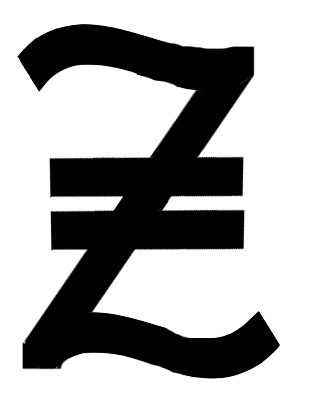
Left: Tomasz Majewski (@tomaszmajewski) from Minneapolis suggests a pair of wavy lines intersecting the diagonal of the 'Z'. So far, Tomasz is the only person to skillfully use vectors to provide a decently curve on the wavy lines.

Left: in answer that an overly geometric design smacks of fascism, the novelist B.E. Andre (@B_E_Andre) has suggested wavy top and bottom horizontal lines of the letter 'Z'. Then two parallel bars can intersect the diagonal line of the 'Z', being shorter than the wavy lines. Alludes to a hand-written upper-case Z.
Left: here's my father's idea - use the diagonal of the 'Z' and use it as the line turning the 'l' into an 'ł'. The relative sizes of the 'Z' and the 'ł' indicate the first and second letter of the word 'Złoty'. Key thing is the right proportion between them.


Left: Ross Humphrey's idea is to take the regular alphabetic designator 'zł', and merge the two letters into one symbol using a wavy line linking the 'z' and 'ł'. Typeface - Calibri. This didn't work on my version of Photoshop - this font came out small (despite a 72pt setting).


Left: tongue-in-cheek concept from my brother Marek; a 'Z' and an 'ł' within an 'O'. Spelling 'zło', a reference to Radix malorum est cupiditas -  "love of money is the root of all evil" (Timothy 1 6:10).

The design somehow suggests to me motifs from the Coen Brothers' film, The Hudsucker Proxy.

Any more suggestions?

This time last year:
The future of Warsaw's public transport

This time two years ago:

This time four years ago:
(on the superiority of Polish schools to British ones)

This time six years ago:

This time seven years ago:

This time eight years ago:

Sunday, 31 January 2016

Ealing in bloom. In January (Part 2).

It's not just crocuses and daffodils - trees are flowering too across Ealing. And January has not yet come to an end. In Warsaw, we'll have to wait another ten weeks to see spring bursting forth in flower. Still, here are some more pics of Ealing in bloom for my readers located in Poland!

Below: St Stephen's Avenue, the church spire in the background.


Below: Gordon Road, three houses obscured by flowers from a single tree


Below: The Avenue, another riot of blossom


Below: close up of apple blossom on Cleveland Road, drops of rain still clinging to the flowers.


I wonder how long this floral feast will last? The climate is sending misleading cues to plant life.

This time last year:
Keeping warm in January

This time two years ago:
If you can't measure it, you can't manage it (health, that is)

This time four year:
Sten guns in Knightsbridge (well, Śródmieście Południowe, actually)

This time five years ago:
To The Catch - a short story (Part II)

This time six years ago:
Greed, fear, fight and flight - and the economy

This time seven years ago:
Is there an economic crisis going on in Poland?

Saturday, 30 January 2016

Ealing in bloom. In January.

I flew to London yesterday, and arriving at my father's house I was surprised to see that the crocuses had already come into flower in the back garden. This suggests that spring will be three weeks early this year. After the warmest and wettest December ever recorded, January continues the spell of anomalous weather.

Daffodils are associated in Britain with St David's Day - the patron saint of Wales, which is 1 March. And here we are, late January, and the first daffs have come into flower.


Below: crocuses on the lawn. Usually, a sight seen in early March (see this post from 2014).


Below: bright yellow flowers against a bright blue sky.


Below: yellow crocuses in Pitshanger Park.


Frost may yet come and claim it all back for winter, but not next week - the Met Office forecasts a temperature range of 2C (nighttime low) to 14C (daytime high) between now and Friday. Which is a similar range to what Warsaw can expect.

It will be windy in Britain - in particular up north, with another named storm (Henry) due, the eighth to hit the UK since November.

This time last year:
Populist start to election campaign

This time two years ago:
Straż Ochrony Kolei explained

This time three years ago:
The end of winter? So early?

This time four years ago:
How much education for the nation?

This time five years ago:
To the Catch - short story

This time six years ago:
Eternal Warsaw

This time eight years ago:
From the family archives