If you like food to be strong in flavour, here's an easy-to-make sandwich which may well be the most pungent thing you've ever eaten.
Ingredients:
1) Terminally ripe Camembert (I favour the Le Rustique brand, fait à coeur or 'well runny'), ponging to high heaven; something that has to be kept in a Tupperware box in the garage with four closed doors between it and the kitchen if it its not to make its noisome presence felt.
2) Anchovy fillets. From small jars of flat tins, they are salty and fishy in the extreme. Not often available, when they are, I buy as many as I can, they have a long storage life (up to two years). Avoid those wrapped around capers etc. Mari de Sud brand I can recommend, and from Lidl, the Filetti di acciughe in the Italiamo range.
3) Spring onion. Cut with scissors or break off with fingers, but don't apply sparingly. Coriander, shown below, is more subtle greenery, but if you want ooomph, spring onion is better. Chives are another alternative.
4) Butter - unsalted (given all the salt in the anchovies, additional salt would not be advisable!)
Bread - here, I've used a large, fresh (still slightly warm) baguette, although most breads will do. I've also plastered the Camembert on crisply toasted rye bread - equally satisfying. Slather on the ingredients generously!
"Pungent smells they consummate my home
Beyond the black horizon
Trying to take control"
- Spaceman, Babylon Zoo [1995]
I stake my claim to this sandwich. It is called the Jeziorki Reeker. Who says it's a Jeziorki Reeker? I do. I invented it in Jeziorki and it reeks. May all those who combine Camembert, anchovies and fresh spring onion (or coriander or chives) on buttered bread name it nothing else. It is mine. Copyright me, September 2019.
To wash it back, I recommend my favourite red wine these past few years - Primitivo. One large glass. The combination of flavours is just bound to delight anyone who enjoys good food.
Just writing this post late at night has left me salivating!
This time last year:
Pictures of Warsaw
This time four years ago:
Scotland's independence referendum looms
This time seven years ago:
Summer comes crashing to a halt
This time eight years ago:
The atmosphere of impending autumn - Mono no aware
This time nine years ago:
Time to recycle.
This time 12 years ago:
Coal train running
Sunday, 8 September 2019
Thursday, 5 September 2019
Defending one's nation is a costly business
To Kielce for the MSPO defence exhibition - my third visit (first was in 2005, second in 2010). A chance to see the latest trends in the sector. First general impression - the US military presence was highly visible, the biggest nation exhibiting, with plenty of big-ticket hardware on display.
"Probe with bayonets. If you encounter mush, proceed; if you encounter steel, withdraw." Vladimir Lenin. Deterrence means having the will - and the kit - to keep the enemy out. Eighty years ago Poland showed the will, but lacked the modern equipment to protect itself against the combined might of the Wehrmacht, Luftwaffe and Red Army. A lesson to be learnt. Ukraine has been defending itself against Russia for five years; an ageing Vladimir Putin, losing popular support at home may seek to lash out, annexing Belarus and forcing a land corridor to Kaliningrad. Or organise incursions into the Baltic countries.
Poland must stand ready, but having properly equipped armed forces - air, land and sea - is not cheap.
Below: Boeing AH-64 Apache Longbow, unit cost $33m/129 million złoty.
Below: Abrams M1A2 main battle tank. Unit cost: $9m/35million złoty.
Below: CH-47 Chinook transport helicopter - can carry up to 53 fully-equipped soldiers into combat. In service for 57 years now! Unit cost: $39m/152 million złotys.
Below: the star of the 2019 show - the Lockheed-Martin F-35 Lightning II stealth fighter. Although this is but a 1:1 scale mock-up, it attracted crowds willing to wait up to 40 minutes to sit in the cockpit. Russia has nothing comparable. These would replace the old Soviet-era fighters in the Polish Air Force. Unit cost: $80m/312 million złotys.
Below: the Polish police have just bought three Polish-assembled Sikorsky S70i Black Hawk helicopters. But look at that fearsome armament - in particular, the six-barrel rotary machine gun in the front side-window. Needed by the police?
Below: the prototype Borsuk armoured personnel carrier - Poland needs these to replace its fleet of ageing and vulnerable Soviet-era BWP-1s.
Below: the Leopard tank, mainstay of Poland's armoured forces - behind it the PT-91 Twardy tank. Poland has around 230 of each type of tank in its fleet - one of Europe's largest. But then Russia boasts 20,000 tanks.
Tough choices face politicians making costly promises to voters. I'm delighted that Poland maintains its 2% of GDP budget commitment for defence.
This time four years ago:
Low water level - Jeziorki lakes
This time five years ago:
Around the Czachówek diamond, again
This time eight years ago:
Second line of the Metro runs into delays
This time nine years ago
Army helicopters in action at Kielce defence show
This time ten years ago:
World's largest helicopter over Jeziorki
"Probe with bayonets. If you encounter mush, proceed; if you encounter steel, withdraw." Vladimir Lenin. Deterrence means having the will - and the kit - to keep the enemy out. Eighty years ago Poland showed the will, but lacked the modern equipment to protect itself against the combined might of the Wehrmacht, Luftwaffe and Red Army. A lesson to be learnt. Ukraine has been defending itself against Russia for five years; an ageing Vladimir Putin, losing popular support at home may seek to lash out, annexing Belarus and forcing a land corridor to Kaliningrad. Or organise incursions into the Baltic countries.
Poland must stand ready, but having properly equipped armed forces - air, land and sea - is not cheap.
Below: Boeing AH-64 Apache Longbow, unit cost $33m/129 million złoty.
Below: Abrams M1A2 main battle tank. Unit cost: $9m/35million złoty.
Below: CH-47 Chinook transport helicopter - can carry up to 53 fully-equipped soldiers into combat. In service for 57 years now! Unit cost: $39m/152 million złotys.
Below: the star of the 2019 show - the Lockheed-Martin F-35 Lightning II stealth fighter. Although this is but a 1:1 scale mock-up, it attracted crowds willing to wait up to 40 minutes to sit in the cockpit. Russia has nothing comparable. These would replace the old Soviet-era fighters in the Polish Air Force. Unit cost: $80m/312 million złotys.
Below: the Polish police have just bought three Polish-assembled Sikorsky S70i Black Hawk helicopters. But look at that fearsome armament - in particular, the six-barrel rotary machine gun in the front side-window. Needed by the police?
Below: the prototype Borsuk armoured personnel carrier - Poland needs these to replace its fleet of ageing and vulnerable Soviet-era BWP-1s.
Below: the Leopard tank, mainstay of Poland's armoured forces - behind it the PT-91 Twardy tank. Poland has around 230 of each type of tank in its fleet - one of Europe's largest. But then Russia boasts 20,000 tanks.
This time four years ago:
Low water level - Jeziorki lakes
This time five years ago:
Around the Czachówek diamond, again
This time eight years ago:
Second line of the Metro runs into delays
This time nine years ago
Army helicopters in action at Kielce defence show
This time ten years ago:
World's largest helicopter over Jeziorki
Wednesday, 4 September 2019
The Long Dark Half-Hour of the Consumerist Soul
"Welcome to Heathrow Terminal 2 & 3. Your all-stations to London Paddington TfL Rail train will be here in 26 minutes. We apologise for what seems an unduly long wait, this is due to priority being given to the non-stop Heathrow Express service which had just transferred you here from Terminal 5, before whizzing the profitable passengers straight through to Central London. Change here for plebeian Hayes, Southall, Hanwell, West Ealing, Ealing Broadway and Acton Mainline. This is where airport workers live, not destinations for our well-heeled target group. In the meanwhile, please take a second to acquaint yourself with the facilities on the platforms. There are none. You will find here complete rest from consumerism. There are no adverts to gaze at, feeding your desire to purchase. Just the grey concrete tunnel walls of beton brut. And in the passageways, regular admonishments to Use the Lift.
While you wait for your train, you may smile and wave at any one of a number of CCTV cameras.
Or you may imagine yourself being on the set of a 1960s episode of Dr Who.
Or you may walk to the end of the long tunnel and peer through gratings into an even longer tunnel, even more devoid of anything. And ponder on why Heathrow has train stations called 'Terminals 2 & 3', 'Terminal 4' and 'Terminal 5', but not one called 'Terminal 1'.
And then realise that there is no Terminal 1 at Heathrow.
You may have been in a rush to get off your plane, through Border Control and Terminal 5 to catch the next Heathrow Express to Terminals 2 & 3 and change here for TfL Rail, hungry and thirsty, not wishing to waste time hanging around the airport. Too bad, loser! You missed your chance for any food or drink for the next hour, as there are no facilities at Terminals 2 & 3. No cafes, no bars, no vending machines. Nothing. Toilets? There are none on TfL Rail trains (pronounced 'Tee Eff Ell Rao chranes' in the vernacular). There are no toilet facilities at Terminals 2 & 3. You are entirely at the mercy of station staff. If it's off-peak and there's no one around, they may permit you to use their staff toilet and graciously unlock the door for you.
If you are stuck here for nearly half an hour, use the time to contemplate a world without ads, snacks, entertainment or any consumerist pleasures. And mind the gap between the train and the platform edge."
This time last year:
Early-September travel news
This time two years ago:
Fields filling up with houses
[The phantom bus stops are still not connected to bus routes!]
This time nine years ago:
Battle of Britain: Poland's contribution
This time ten years ago:
Sewer under ul. Karczunkowska
Monday, 2 September 2019
Fifty years on - Old Boys Reunion
(thoughts on selective education)
Fifty years to the day after starting at Gunnersbury Grammar, our year got back together to commemorate the event. Seventeen old boys from my class (1/13) and five boys from the other class in the year (1/14) turned up out of 72 that started school on 1 September 1969. Here we all are then...
The genesis of this event occurred on 23 May, when Michael P picked up on my tweet about my father going to vote in the European elections. Michael asked whether he'd sent his son to Gunnersbury; I then twigged that 1 September would be the fiftieth anniversary of us starting there, and so we got the ball rolling. Social media proved (LinkedIn particularly) invaluable in finding classmates. The result - almost 50% of our class - was far greater than either of us could have imagined as we mooted such a get-together.
The four Polish boys - Adam, Andy, Stan and myself, were all present, as were five out six of the Applied Mathematics A-Level class! A totally brilliant event - we met at 1pm and carried on drinking and eating until last orders - ten hours of solid catching up. In many cases, we'd not seen each other for 43 years; for some of us (who didn't stay on for A-levels) it was 45 years, so a lot of water under the bridge. We're all the same age (born in 1957-58); some of us have retired, quite a few grandfathers. Two have passed away (both from class 1/14).
Andy P. organised the venue, pulled the kitty together and got us all to do a potted history (in 100 seconds) of what we'd been up to since leaving school. A big thanks to Andy! So many different life stories after our paths diverged on leaving school in July 1976. Teachers (headmasters even), entrepreneurs, IT and pharma execs, accountants, a broad spectrum of professions.
And who was the mystery man in the trilby hat, quite a bit older than us... turns out it's Mr Crook, our English teacher in the fifth and sixth forms! An excellent surprise organised by Paul T. and David C.
A ton of emails from participants suggests that this reunion might well be the first of many in years to come - it should not be too long before the next one!
This time two years ago:
All things visible and invisible
This time four years ago:
Work starts on Warsaw-Radom rail modernisation
This time five years ago:
Won't be long 'til summertime is through
This time seven years ago:
It was a good year for the apples
This time nine years ago:
Early-September moan about the commuting
The genesis of this event occurred on 23 May, when Michael P picked up on my tweet about my father going to vote in the European elections. Michael asked whether he'd sent his son to Gunnersbury; I then twigged that 1 September would be the fiftieth anniversary of us starting there, and so we got the ball rolling. Social media proved (LinkedIn particularly) invaluable in finding classmates. The result - almost 50% of our class - was far greater than either of us could have imagined as we mooted such a get-together.
The four Polish boys - Adam, Andy, Stan and myself, were all present, as were five out six of the Applied Mathematics A-Level class! A totally brilliant event - we met at 1pm and carried on drinking and eating until last orders - ten hours of solid catching up. In many cases, we'd not seen each other for 43 years; for some of us (who didn't stay on for A-levels) it was 45 years, so a lot of water under the bridge. We're all the same age (born in 1957-58); some of us have retired, quite a few grandfathers. Two have passed away (both from class 1/14).
Andy P. organised the venue, pulled the kitty together and got us all to do a potted history (in 100 seconds) of what we'd been up to since leaving school. A big thanks to Andy! So many different life stories after our paths diverged on leaving school in July 1976. Teachers (headmasters even), entrepreneurs, IT and pharma execs, accountants, a broad spectrum of professions.
What we all had in common was that we'd all had to pass the 11-plus exam, taken at the end of our time at primary school, which selected the brighter children for grammar school education. Grammar schools were coming to an end - the selective system that sent those with academic aptitude to different schools to those without (secondary modern schools) - was under reform. Selective secondary education would be replaced by comprehensive schools.
I think the verdict on comps is clear - it's a better outcome for society than an education system in which a single exam taken at the age of 11 decides your place in life. My brother, who started Gunnersbury five years after me, once it had become a comp, said that three boys from his year got into Oxbridge, compared to just one from my (grammar-school) year. Granted, there were bigger intakes per year at Gunnersbury Comprehensive, but even so, that's impressive. The selective system was introduced in England in 1945; by 1975 all but a few grammar schools had been converted into comprehensives. Some grammar schools survive to this day in a couple of dozen local education authorities that have held onto the old system.
It was great to get back together. A bit confusing at first, trying to identify 61 year-old men on the basis of how you remembered them from well over four decades ago; I couldn't recognise Lawrence D. who was sat next to me! Once the first pints had been downed, it was non-stop chat and lively banter.
One thing about selective grammar schools - we were all bright boys from relatively humble backgrounds; families that could not afford private-school fees. Thanks to grammar schools, most of us managed to make it on to university and fulfil our potential. So among us there were no privileged toffs. As a result, in none of the political conversations that I struck up over ten hours did I come across anyone that remotely supported Brexit.
So many memories - someone might remember something that I didn't; I'd remember a detail they didn't - but then there were those memories that everyone remembered. Like when the entire Upper Sixth was expelled from school just weeks before our A-Levels because none of us had attended some religious ceremony that we'd all understood as being voluntary. The school authorities were convinced that there had been a plot - there hadn't; each boy on his own decided to make better use of the time.
We could all recite Wordsworth's The Daffodils. And indeed, we did, bawling it out in the pub garden with no regard to the poem's aesthetic sensitivity, but word-perfectly nevertheless. However, I forgot that the next Wordsworth poem we were terrorised in to learning by heart was The Reaper. Not one line of that could I recall!
Below: Martyn J. runs the inter-house pub quiz. Four teams, one for each of the 1969 school houses, Bourne, Pole, Roche and Warren. Delighted that my team - Roche House - won (22 out of 25 questions right). Questions spanned current affairs, popular culture and sport from the early 1970s. Big thanks to the quizmaster!
"There was a real sense of close friendship and unity," wrote one participant, and I think that everyone present would echo that sentiment. The fact that so many of the Old Boys had come so far (from the USA even!) to be here yesterday suggested that there had been a strong latent need to gather and celebrate.
And who was the mystery man in the trilby hat, quite a bit older than us... turns out it's Mr Crook, our English teacher in the fifth and sixth forms! An excellent surprise organised by Paul T. and David C.
A ton of emails from participants suggests that this reunion might well be the first of many in years to come - it should not be too long before the next one!
This time two years ago:
All things visible and invisible
This time four years ago:
Work starts on Warsaw-Radom rail modernisation
This time five years ago:
Won't be long 'til summertime is through
This time seven years ago:
It was a good year for the apples
This time nine years ago:
Early-September moan about the commuting
Sunday, 1 September 2019
First day at Big School - Fifty years ago today
Below: photo of me taken by my father on the morning of Monday, 1 September 1969. My first day at Gunnersbury Catholic Grammar School for Boys. School cap, blazer with badge and school tie. In the garage, my father's dove-grey Morris 1100, EKX 604 B.
I'd spend the next seven years at Gunnersbury, between two sites, Gunnersbury Avenue (on the A406 North Circular, now housing the International School of London), and The Ride, Brentford, the school's current site. I was in one of the last years of grammar school; by the time my brother started at Gunnersbury five years later, it had become a comprehensive. The better for it? From my year, only one out of 72 boys made it to Oxbridge; in my brother's year (albeit more classes), three boys did. More thoughts about selective education tomorrow.
It only occurred to me today that my first day at school overshadowed the 30th anniversary of the outbreak of WW2. On this day, my father, then 46, might have recalled the German bombardment of Warsaw when he was just 16, followed by its capture and occupation, the Uprising, his time in a German prisoner-of-war camp, his postwar experiences as a refugee prior to arriving in London, his studies, his wedding, his career as a civil engineer, bringing up two boys - all in the space of three decades; since then a further five have passed. Today, I am 15 years older than my father was when he took the photo above; how time flies.
This time last year:
Two films about the legendary Polish 303 Sqn
This time three years ago:
Kępno's intriguing station
This time five years ago:
Thoughts occasioned by the 75th anniversary of the outbreak of WW2
This time six years ago:
A green light for consumer spending
This time eight years ago:
Procrastination - is it the same as laziness?
This time ten years ago:
Remembering the outbreak of WW2
Saturday, 31 August 2019
If you're really concerned about global warming - rein in your consumption
The UK's chief environment scientist last week suggested that to halt climate changing emissions, we need to change our lifestyles dramatically. We need to use less transport, reduce our red meat consumption and buy fewer clothes. I entirely agree.
Lifestyle changes must be made according to Professor Sir Ian Boyd, who gave an interview on the BBC, suggesting that every consumer has a part to play to avoid the climate change situation worsening. This graphic (below), prepared by the UK government, shows how CO2 emissions have changed over the past 28 years. It's clear that the two biggest producers of CO2 - industry and energy generation - have made significant progress. Government action - the drive for renewable energy sources and environmental regulation aimed at manufacturers - has had an impact. Buildings are greener too, as is waste - again, regulation has worked.
But look at 'surface transport'. Even though more Britons are taking the train than ever before (1.8 billion passenger journeys in 2018-19 compared to 1.1 billion in 2002-03), CO2 emissions from surface transport have been rising. The passenger car and the delivery truck are the culprits.
[F-gases = Fluorinated gases that stay in the atmosphere for centuries and contribute to the greenhouse effect.]
During the interview, Sir Ian said that polluting activities should be taxed further, and that the government should nudge citizens towards a lower-emission lifestyle by offering rewards to those who go for low-carbon choices. He said: "The way we live our lives is generally not good for the environment…We like to consume things, but the more we consume the more we absorb the resources of the planet. That means we have to grow those resources, or we have to mine them - and in doing that we generate waste. And consumption is going up all the time."
Technology is part of the solution towards reaching the goal: "We need to make major technological advances in the way we use and reuse materials but we ... need to reduce demand overall - and that means we need to change our behaviours and change our lifestyles."
Are you ready to do that?
Well, I have not owned a car for six years, use public transport and walk a lot; I buy used clothing from charity shops; my appetite for consumer goods is low. But one area where I am an above-average emitter of CO2 is in my frequent flying between Warsaw and London to visit my father. A single return flight is responsible for half a tonne of CO2 put into the atmosphere, so my flying (including the occasional business flight) generates some six or seven tonnes of CO2 a year - the equivalent of driving myself around in a petrol car consuming 7.7l/100lm (37mpg) for 24,000km (16,000 miles).
So I should not feel so smug about foregoing a car - my flights generate more CO2 each year than driving an average car over above-average annual mileage. But going by train from Warsaw to London is totally impractical requiring changes at Berlin, Cologne and Brussels, a journey of 20 hours and 39 minutes, as well as being hideously expensive. The Warsaw-Berlin leg alone (2nd class) costs the same as a Warsaw-London flight.
Governments have been effective in reducing greenhouse gas emissions from energy generation, industry, construction and waste disposal, but tacking aviation is a bigger challenge. Massive investment in high-speed rail is needed to shift short- and medium-haul airline passengers to less polluting forms of transport.
A useful (if continental European) website with CO2 calculator can be found here.
We are in a free-rider or 'tragedy of the commons' situation vis-a-vis our less environmentally aware friends, neighbours and colleagues - we all share a common resource - our planet - and where's the individual benefit of acting responsibly towards it if others don't? How can I fly less right now?
This time last year:
The balance between the spiritual and the material
This time two years ago:
End of August, end of summer?
This time three years ago:
Pavement for Karczunkowska... a bit at least
This time four years ago:
Gold Train update (the hope! the expectations!)
This time six years ago:
Poland post the Rubbish Revolution
This time seven years ago:
Poland's most beautiful street
This time eight years ago:
Getting to grips with phrasal verbs
This time ten years ago:
What Putin wrote about Molotov-Ribbentrop
This time 11 years ago:
Summer Sunday in the city
This time 12 years ago:
Last bike-ride to work of the summer
Friday, 30 August 2019
Let's stop spitting at the other tribe
If you're in Poland today and you don't like PiS, you will be revelling in the fact that Trump won't be coming to Warsaw to commemorate the 80th anniversary of the start of WW2. If you're in Poland today and you don't like PO, you will be revelling in the discomfort caused to Warsaw's local authorities by the sewage leak into the Vistula.
I don't like Trump and I don't like Kaczyński, but the reason given for Trump staying stateside this weekend seems plausible. This, from the BBC..."Hurricane Dorian has maximum sustained winds of 130mph (215km/h) and is expected to grow stronger before making landfall in Florida... A state of emergency has been declared in Florida, where residents have been urged to stock enough food, water and medicine to last at least a week. Forecasters warn Dorian could be the state's worst storm since Hurricane Andrew killed 65 people and destroyed 63,000 homes in 1992." Anti-PiS commentators see Trump's excuse as a sign that the US doesn't take the Polish government seriously.
Meanwhile, the sewage leak from the Czajka ['Lapwing'] water treatment works is being used by anti-PO commentators to attack the PO-led city hall, in particular, Warsaw's recently elected mayor Rafał Trzaskowski. The sewage plant was massively extended in 2012, and on Wednesday this week a pipe under the Vistula bringing sewage from the left bank to the Czajka plant for treatment sprang a leak. The ensuing fuss was not so much about engineering as about mud slinging. Cue someone who worked on the plant extension in 2012 and said (on the pro-PiS media) that it was an environmental disaster waiting to happen. "Why did you stay silent for seven years then?" replied pro-PO commentators.
Turning events into triggers for splitting society, by dishing out the hate, is not the way forward. Rather, one should acknowledge the positive aspects of the other side whenever it merits doing so.
I don't like Kaczyński, but I absolutely see the improvement in the Polish labour market during the time of the PiS government. Unemployment is down to 5.2% (registered unemployed) or 3.3% (economically inactive). When PiS took office in the autumn of 2015, it stood at 9.8% (registered unemployed) or 7.1% (economically inactive). GDP growth (4.5% in the second quarter of this year) remains strong by the standards of western economies. This is a positive achievement for Poland and should not be ignored or belittled. Part of the praise here must be directed at prime minister and former finance minister, Mateusz Morawiecki, who understands economics and is careful not to unduly worry investors. However, much remains to be done with Poland's economy, not least making doing business easier for the entrepreneur.
We are getting more tribal. We can see the mechanisms for stirring up division at work - be they politicians at home, geopolitics, social media amplifying voices from far left and far right, making it seem more acceptable to deploy extreme language and outright lies in the pursuit of political goals. And it is all too easy to slip that way, towards the barbarian, away from truth and light.
Sometimes its difficult, when facing an existential threat from people who don't even know why it is that they are threatening you - Brexit being my chief worry at this time. But let us not descent into barbarism, even if it is to defend that which one holds dear.
This time last year:
Progress on the Działka
This time five years ago:
Changes to Poland's traffic regulations
This time eight years ago:
Teasers in the Polish-English linguistic space
This time nine years ago:
Summer slipping away
This time ten years ago:
To the airport by bike
This time 11 years ago:
My translation of Tuwim's Lokomotywa
Flying into Heathrow
A lovely day for flying - clear skies over Warsaw, clear skies over London. And a nice window seat, right at the back. BA into Heathrow - so much better than WizzAir to Luton.
Below: PZL W-3 Sokół helicopter configured for flying VIPs, 1st Transport Aviation Base, Warsaw-Okęcie. It was taxiing just as our Airbus was pushing back from the stand.
Below: two USAF C-17 Globemaster II aircraft, in town for the commemorations of the 80th anniversary of the outbreak of WW2. Trump's not coming, so the hardware that these transport giants have brought along will be for the use of the vice-president, Pence.
Below: take off, and immediately visible to the east is the path of the S2 expressway, crossing Ursynów on its way to cross the Vistula. Eventually, the S2/A2 will continue on to the Belarusian border. But just for it to cross the river would be useful.
A thousand miles fly past, under the wings of our plane.
Left; estuarine Essex - this is Foulness. where England meets the North Sea and the highest elevations are two metres above sea level. Will this be under water in fifty years' time?
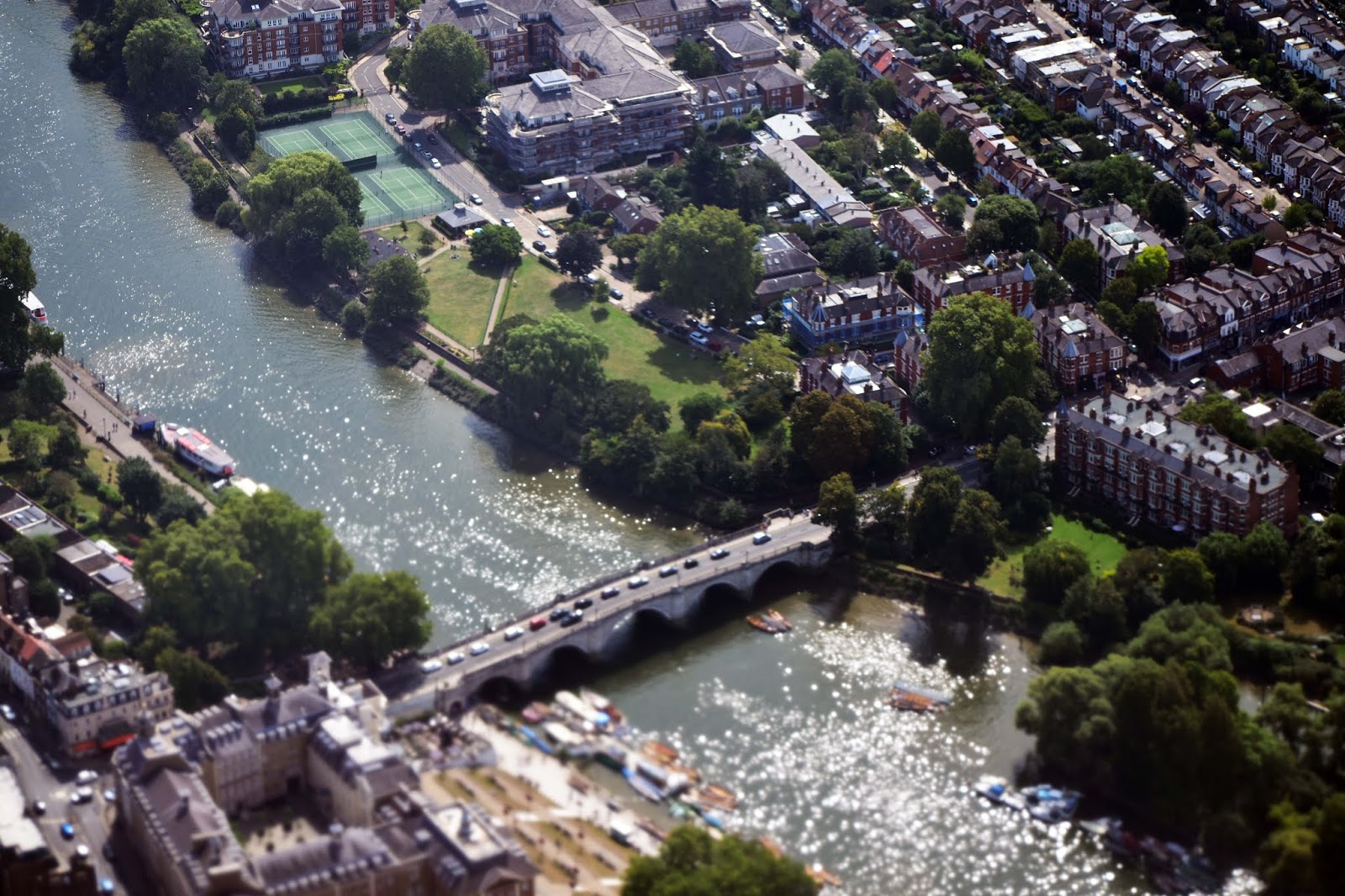
Flying into London in the early afternoon, sun still high in a cloudless sky, gives good opportunities for photos.
Below: the new Tottenham Hotspurs football stadium, opened four months ago.
Below: Richmond Bridge, catching the sparkle of the River Thames.
Below: homage to 1969, Heathrow, today. This is British Airways' retro-liveried Airbus A320, G-EUPJ, sporting the colours of British European Airlines from the 1960s. A bit of manual de-focus to get a softer image, run through VintageJS software (available free on vintage.js.com) to give that old-timey look, capturing the excitement of the start of a childhood continental summer holiday.
This time four years ago:
The search for the Gold Train intensifies
This time five years ago:
The Vistula from on high
This time eight years ago:
Bad car day
This time nine years ago:
Dragonfly summer
This time 11 years ago:
"What do we want?" "Early retirement!"
This time 12 years ago:
Greenhouse sunset
Subscribe to:
Posts (Atom)