Showing posts with label Edinburgh. Show all posts

Sunday, 25 November 2018

Edinburgh again and again

My ninth visit to Edinburgh since I began blogging in 2007. A city that I'm very fond of aesthetically; it has so much to give. From the commanding views from Arthur's Seat and Calton Hill to the majesty of the Castle, the architecture of the New Town, the Old Town that's straight out of a Harry Potter film set, the soaring bridges, the narrow passages diving down steep staircases - a city that's been more engineered than built.

This time I felt a need to see more of the Water of Leith Walk; it was not pouring with rain and I was armed with my 10-24mm Nikkor zoom, better for architecture. Below: looking down Young Street, in Edinburgh's New Town. I'm a great fan of cobblestones. What also makes this shot a 'publisher' is that there are no huge gaily coloured plastic wheelie bins nor scaffolding visible. These two rank high in my list of visual annoyances in Edinburgh.


Left: on the corner of Leith Bridge, Queensferry Road and Bell Brae a neo-Gothic turreted residential folly... what imagination, what engineering prowess to build something like this. Dean Bridge, designed by the great Scottish civil engineer Thomas Telford rises high above the Water of Leith.

Below: looking up at Dean Bridge from the Water of Leith, the 10-24mm Nikkor zoom set to its widest, no attempt at parallax correction.

On my last visit, I mentioned the classic series of illustrated children's books by Miroslav Sasek, in particular This is Edinburgh (1961); here's Sasek's take on Dean Bridge...


...and this is my best attempt at getting his view. It entailed me clambering atop a huge millstone in the middle of a small park on Miller Row, and using various distorting tricks in Photoshop, but still I couldn't get the exaggerated perspective that Sasek presents.


Below: from the top of Dean Bridge looking down onto Dean Village and the Water of Leith.


Below: stone steps running down steep hills between tenements, and the views in between, are a beguiling feature of Edinburgh.


Looking up steep hills too yields rewarding views; here's Gloucester Street; at the summit lies Edinburgh's New Town, laid out in a neat rectangle, along the ridge of the hill.


As dusk begins to fall, I cross Princes Street to enter the Old Town. To many younger people, its similarity to the sets of the Harry Potter movie franchise are a major attraction, one the city has not been slow to capitalise on.


Below: imagery that resonates with anyone feeling a sense of history. Just behind me on Cockburn Street is the Arcade Bar, which serves excellent haggis, neaps and tatties. As I tucked in, I had this magnificent view in front of me (though through a plate-glass window).


Below: back to Princes Street; to the right the National Gallery of Scotland, in the distance the Walter Scott Memorial. Time to return to get some rest after a second day's early start in a row.

This time four years ago:
Ahead of the opening of Warsaw's second Metro line

This time five years ago:
Keep an eye on Ukraine...
(Portents of troubles to come)

This time six years ago:
Płock by day, Płock by night 

This time seven years ago:
Warning ahead of railway timetable change

This time ten years ago:
Some thoughts on recycling

Saturday, 24 November 2018

Tram tips for Edinburgh

Edinburgh's tram network resembles Warsaw's Metro system prior to March 2015 - just one single line. It is a boon to tourists arriving at Edinburgh Airport, whisking them into the city centre without being bogged down in the heavy traffic of the A8 Corstorphine Road. The modern stock is comfortable, has free (and fast) wi-fi, and as befits a line serving an airport, plenty of luggage space.

Below: the tram terminus at Edinburgh Airport. Trams to town every seven minutes (every ten minutes in the early morning and evening).


However, there are points to be aware of, especially when using the tram for the first time. The fare structure is designed to ensure that tourists pay more their fair share for using the system, in effect subsidising local users. Nothing wrong with that, but if you travel light as I do, and want to save money, heed my tip. There are but two zones in Edinburgh's tram network. The Airport Zone - and the rest of the line. A ticket from the airport into town costs £6.00*. The next stop - Ingliston P&R - is less than a mile away (1.4km or 1,750 paces/15 minutes walk). And from Ingliston P&R, the ticket costs not £6.00 but £1.70 - a saving of £4.30.

BUT! There is a catch... If you want to pay cash, the ticket machines will not give you change. Drop a £2 coin in, and you've lost 30p of your £4.30 saving. And if you want to pay by card, there's a minimum payment of £3.00. So here you lose £1.30 of your £4.30 saving. Unless you buy a return ticket (£3.20) or an all-day ticket (£4.00). Now, given that the all-day ticket including the Airport zone costs £8.50, that's an even greater bargain.

Below: alight at Ingliston P&R and take a walk from there to the airport to get some exercise and save money.


Below: the in-scale map displayed at the airport terminus puts the whole network into perspective.


Below: Gogarburn, the next stop after Ingliston P&R, alight here for Royal Bank of Scotland's HQ. One advantage of trams and light railways over a main line is that the track radii can be short to accommodate tight curves, as seen here. The curve here is so tight I couldn't fit the whole thing into one shot (even with a 10mm lens) so a panorama had to be stitched together - and hence two trams within a short distance of one another - actually the same tram.


I have another tip. You cannot buy your ticket on the tram; you can buy from ticket machines which are located at each tram stop. Remember to have the exact fare - no change. And be ready to select the ticket you need in advance - no time for umming and ahhing when there's a queue of people behind you and the next tram's due any minute.

The problem I had this year and indeed last year is that the touch-sensitive screens are not very sensitive. You touch and nothing happens. The tram conductor on the tram I (finally) caught - after missing one because I couldn't buy a ticket in time - told be to be hit the screen hard with my finger. Which I did the next two times I was buying tram tickets. Two sharp jabs - one to hit the '+' button by your choice of ticket, and one for the 'confirm' button. Contactless card payment doesn't confirm immediately - you have to wait a couple of seconds before you get the message that your ticket(s) are being printed.

All in all, the system is clunky and no longer state-of-the-art. For that, visit Wrocław. The trams there have the simplest system of all; no cash, no tickets, only card payments - the virtual 'ticket' stored in the chip of your credit/debit card, which you present to the ticket inspector.

Without doubt the best way from the Edinburgh Airport to the city centre is the tram; my tips will save you money and spare you frustration at the ticket machine.

[2022 update: tram price fare rise since last year: £6.50 for airport zone, £1.80 for the rest of the line, so the 20-minute walk from the airport to Ingliston P+R will save now you £3.70! Have the right coins ready...]

This time last year:
Warsaw to Edinburgh made easier

Thursday, 22 November 2018

Edinburgh's second Polish statue

Unveiled this month, the statue of General Stanisław Maczek in Edinburgh cements the bonds between Poland and Scotland deeper still. Three years ago, the statue of Wojtek the Bear was unveiled in Princes Street Gardens; the Maczek statue, in the quadrangle of Edinburgh City Chambers on the Royal Mile, stands close to the Great War Stone that commemorates the Scottish capital's war dead from both world wars. Both statues' prime locations reflect the importance to the city of its relationship with Poles and Poland.


Look to the right of the bench - note the dates. Yes, General Maczek lived 102 years; a life that spanned the British premierships of William Gladstone and John Major. He fought during the First World War in the Imperial Austro-Hungarian army (against the Italians in the Alps); he died when Lech Wałęsa was president of an independent Poland. What a life - what military campaigns - he fought the Ukrainians in 1918, the Bolsheviks in 1920, the Germans in 1939, and in France the following year; he led Poland's 1st Armoured Division at the Battle of Falaise and liberated Breda in Holland, as well as the PoW camp at Oberlangen*, where many female soldiers of the Polish Home Army, Warsaw Uprising insurgents, had been incarcerated.

Unable to return home to Poland after the war, he lived in Edinburgh. Despite his stirling war record, he was denied a general's war pension by the British government, and worked as a barman.

It is fitting that General Maczek is remembered in this way in the city in which he spent nearly half of his long life.

Below: a wide-angle shot of Edinburgh's Wojtek the Bear memorial.


* This was the only camp for female prisoners of war, the first ever established.

This time last year:
Edinburgh - walking the Water of Leith

This time two years ago:
Poland's north-west frontier

This time three years ago:
Cars must fade from our cities

This time five years ago:
Unnecessary street lighting wastes money

This time six years ago:
Warsaw's heros on the walls 

This time seven years ago:
Tax dodge or public service? 

This time nine years ago:
Warsaw's woodlands in autumn

This time ten years ago:
Still here, the early snow

This time 11 years ago:
Another point of view

Friday, 24 November 2017

Edinburgh from Warsaw made easier

For the first time in my eight trips to Edinburgh, I managed to fly direct from Warsaw (if one can consider a flight from Modlin 'direct'). To get to Modlin, I took the Metro from the office to Dworzec Gdański, from there a Koleje Mazowieckie train to Modlin station, and from there a bus to the airport. Now that I'm over 60, I can get a 35% discount on the KM tickets, and with my Zone 1 quarterly pass, my travel to W-wa Choszczówka is free. And so I end up paying 12.82zł (£2.70) for the journey.

From Modlin to Edinburgh, and that's Edinburgh Airport, in the city of Edinburgh and not 50km away as some low-cost airports can be. The flight is entirely in hours of darkness, so I have an aisle seat for a quick getaway. Tickets from Warsaw to Edinburgh can be bought for peanuts if booked well in advance and outside of school holidays. Below: boarding the flight.


Arriving in Edinburgh, I take the opportunity to take the tram into town. Opened three years ago, it is now fully operational and has become an integral part of Edinburgh's public transport. Now, the fare structure of the tram system (just one line - airport to York Place in the centre) is controversial. You can travel nearly the entire route, from York Place to Ingliston Park+Ride (one stop short of the airport), for just £1.60. But go that one stop further, and you pay £5.50. Clearly a mechanism to get the tourists to pay more than their fair share towards the upkeep of the tramway. If you want to save £3.90, you can walk from the airport terminal to Ingliston P+R, it's around 1.5km (1 mile or around 1,800 paces).

The trams were built in Spain specially for the Edinburgh contract to meet the city's specific requirements. They are bi-directional, with a driver cab at either end and doors on both sides.


Below: Gogarburn tram stop, for the huge Royal Bank of Scotland campus. At the edge of town. Trams during the rush hours are frequent, one every seven minutes, and heavily used.


Left: West End Princes Street tram stop, with the Charlotte Chapel in the background.

Another point to note with the tram fares; you need to buy your ticket before boarding; there are two ticket machines at each stop. Banknotes aren't accepted and change is not given; minimum credit card transaction is £3.00. So if you want to buy a £1.60 ticket, best have that exact amount in cash. I didn't so I ended up paying for an unnecessary £3.20 return ticket just that the transaction would come to over the £3.00 minimum.

Coming back to Warsaw, my flight at 19:25 from Edinburgh left and arrived on time, I was at Modlin groundside at 23:20, the Modlin Bus (33zł) left at 23:40 and arrived outside the Palace of Culture at 00:20; I caught the last Metro from Centrum towards Kabaty at 00:27 and a taxi from Wilanowska home (35zł), where I arrived just before 01:00.

All of which goes to show that Edinburgh and Warsaw now have excellent connections, all the more reason for Varsovians to visit Edinburgh and Edinburgers to visit Warsaw!

This time two years ago:
Stuffocation: the rich-world problem of dealing with too many things

This time five years ago:
Heroes on the wall

This time seven years ago:
Tax dodge or public service? 

This time eight years ago:
Warsaw's woodlands in autumn

This time nine years ago:
Still here, the early snow

This time ten years ago:
Another point of view

Wednesday, 22 November 2017

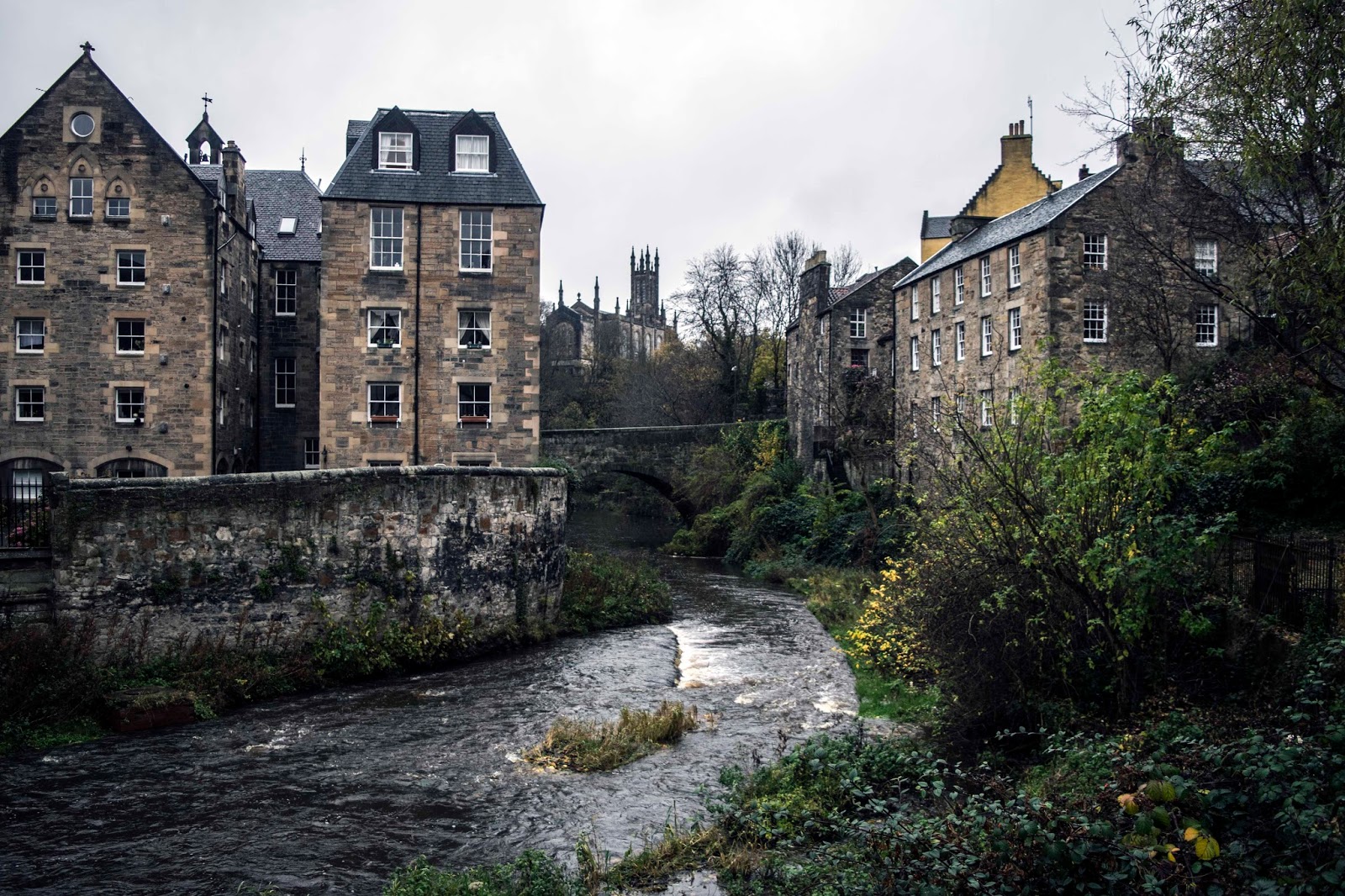
Edinburgh - walking the Water of Leith

My eternal guide to Edinburgh is Miroslav Sasek, the Czech illustrator whose This is... series of travel books for children gave me a grounding in the great cities of the world as a small boy. This is Edinburgh (1961) ranked Scotland's capital alongside London, Paris, Rome, Hong Kong, Venice or New York when it comes to visual amazingness. My father would borrow the large-format picture books from Ealing public library and I would love to read them.

I have been to Edinburgh eight times over the past ten (blogged) years; the city never fails to appeal to my aesthetic sensibilities; it's certainly a place everyone with an interest in history, culture and architecture should see at least once.

Squeezing in some sightseeing around business trips as I do, however, Edinburgh requires repeat visits to get in all of its main attractions. I've already been to the castle, seen Holyrood Palace and the Scottish Parliament, walked down the Royal Mile, climbed Arthur's Seat and Calton Hill, and explored the New Town. But I haven't yet done the Water of Leith walk, which my childhood memories of Sasek focus on a picture of a spectacularly high, arched brick bridge with double-decker buses on it. This is the Dean Bridge, carrying the Queensferry Road over the Water of Leith.

So with two afternoon meetings ahead of me, I set off on a rainy morning to take in that corner of Edinburgh that I've never yet been to. And seeing it in late November, there were few tourist and only a handful of hardy local dog-walkers and strollers out and about in this weather.

The Water of Leith is the river that rushes tumultously through Edinburgh, with many weirs and waterfalls along the way, skirting north of the New Town on its way to the Firth of Forth at Leith. Passing through the Dean Village, the river is at its most picturesque, adding yet another must-see area to the agenda of anyone visiting Scotland's capital.


The Water of Leith disappears over a waterfall. One thing I'm not too keen on is the mustard-and-custard colour schemes of non stone-faced houses.


Classic MGB GT, echoing this picture from another capital city's riverside...


Dean Bridge; not as spectacularly tall as Sasek had led us to imagine, but with a bus on top.


Dean Bridge, seen from Miller Row. According to Sasek, the bridge is 106ft over the river.


Here's Sasek's take on the views above - a slight exaggeration of vertical scale, though I guess he'd have set up his easel higher up than my camera's eyepoint.


And his view (turned some 30 degrees to the left of my photo below).

Stone tenements, church tower, bridge and rushing waters.


And maybe sweep to the left to bring in that courtyard...


Below: on through the next section of the Water of Leith, where I espy St Bernard's Well. Risking a slip. I edge out over exposed rocks to get this shot from (almost) midstream.


Below: St Bernard's Well, this time from the footpath.


Below: the bridge linking India Place and Dean Terrace; note the solid and ornate construction of the steps from the riverside up to the bridge.


Below: looking west along the Water of Leith from the bridge above. Rain on the cobblestones adds the appeal.


Below: a curious clock tower perched on a building on the north side of the bridge taking Kerr St over the Water of Leith.


Left: flights of steps, a stone-clad retaining wall, a pillar-box, and umbrellas in the rain. North West Circus Place at the junction of India St.

It rained solidly all day; after walking for the best part of two hours, I was drenched and had to return to my hotel (the eminently reasonable Frederick House Hotel) to dry my outerwear with a hair dryer! I cannot remember having been so wet in many decades!

This time last year:
Poland's north-west frontier

This time two years ago:
Cars must fade from our cities

This time four years ago:
Unnecessary street lighting wastes money

This time five years ago:
Warsaw's heros on the walls 

This time six years ago:
Tax dodge or public service? 

This time eight years ago:
Warsaw's woodlands in autumn

This time nine years ago:
Still here, the early snow

This time ten years ago:
Another point of view

Saturday, 28 November 2015

Wojtek the Bear in the heart of Edinburgh

As soon as I'd broken fast at the Scottish Restaurant (they don't do Sausage McMuffin Deluxe in the UK, the one with tomato in place of the egg), I set off to Edinburgh's Princes Street Gardens to see the newly-unveiled statue commemorating the legendary Wojtek the Bear. I first heard about the soldier-bear, who fought alongside the Polish II Corps in the Middle East and Italy, in Saturday Polish school (can't remember if it was Pani Wolańska's class or Pani Skąpska's). Did we read about Wojtek in Razem Młodzi Przyjaciele? The story is a lovely one - the orphaned bear cub who is taken along with General Anders' army out of Persia, where he was found, via Monte Cassino (during the battle, Wojtek carried crates of shells for the artillery) to Edinburgh zoo, where he died in 1963.

A symbol of Polish-Scottish relations, Wojtek the warrior bear has now been immortalised in one of the most prestigious parts of Edinburgh; in the shadow of the castle, in the park that separates the Royal Mile from the New Town.

Below: the statue - the bear and a Polish soldier, the castle looming over the Gardens. The orange netting protects newly planted grass (presumably after the official unveiling on 7 November, witnessed by crowds and media from Poland and Scotland, despite the rain).


Front view of the statue, behind it a frieze depicting Wojtek being found as a cub, his adventures with the soldiers, his role as artillery shell carrier at Monte Cassino, through to his post-war years as an attraction at Edinburgh Zoo.


Below: the plaque - short and simple, in both languages. Za Waszą Wolność i Naszą.


Princes Street Gardens has just become an obligatory point for all Poles (and friends of Poland) to come and visit when in the Scottish capital. I felt deep pride at seeing the long-awaited statue in such a highly visible place, and would like to express my profound gratitude to those who came up with the idea, funded it and realised it.

Friday, 27 November 2015

London to Edinburgh by night bus

The challenge was as follows: I had to be at the Polish Embassy in London for a real-estate event that ends at 9pm. The next morning, at 9am, I had to be in Edinburgh for the first Scottish congress for Polish entrepreneurs. How to get there? All the early-morning flights from London would mean a 3:30am wake-up call. No way. And all the late-evening flights from London would mean leaving the Embassy event early (impossible, since I was chairing it).

There is a canny answer: MegabusGold.com now run night buses between the two capitals, with full sleeper facilities. Being a fan of Polish night trains, which offer transport and accommodation in one ticket, I decided to go for it. Booking ahead, the ticket cost £20 - amazing value, since a hotel plus flight, even if booked ahead, would easily cost £150-plus.

I walked from Portland Place to Victoria Coach Station (nearly 4,000 paces), arriving at 22:30, in good time for the 23:00 departure of the S20 sleeper service to Falkirk via Edinburgh. At 22:40, the bus arrived, and boarding began. First impressions - positive. The bus itself, brand new, according to the conductor/steward, a £500,000 investment.


Inside - it's cramped. Three types of berth - lower/single, lower/double and upper/single. The lower berths have very limited headroom compared to night trains. You have to be a contortionist to get ready for sleep. Remove shoes, outer garments - I found myself sleeping in suit trousers (jeans are better) - and shirt. A light blanket is provided, as is a eye-mask, small bottle of water and muffin.

As I observed about night trains - this is like being on board the International Space Station with the added disadvantage of gravity. Stowage of stuff is the trickiest thing. Emptying pockets for sleep (reading glasses, mobile phones, pens, wallet, notebook, keys, etc) and putting things where they can be easily found is a high art, and must be mastered with extremely limited room to move.

The driver and conductor were both called Kevin and were unfailingly polite, helpful and cheery. Safety instructions (you sleep feet facing direction of travel, put on seat belt round your middle) were read out, and the route - bizarrely - rather than straight up the London-Edinburgh A1, took the bus northwestward along the M40, then through Birmingham, M69... what happened next I don't know as I'd dropped off mid-announcement. Something about roadworks. Lights dimmed. First half-hour or so I was vaguely aware of stopping and starting at numerous traffic lights.

By virtue of the means of transport, a sleeper bus is much bumpier than a sleeper train. I woke up a few times, but nodded off soon after. The berths themselves are not soft, after sleeping on my side for a while I found my bones telling me to change position. Having downed four glasses of wine and a glass of orange juice at the Embassy, I knew that a night visit to the loo would be inevitable. It was clean, pleasant-smelling - and the reason was that men are asked to micturate in a seated position!

But generally, the night journey passed smoothly. Before 7am, the conductor woke everyone up, switching on the cabin lighting gradually. The bus arrived on time. Before disembarking, passengers were invited to help themselves to a carton of orange juice and a croissant.

To sum up - for £20 if booked early, £45 if booked earlier the same week, MegabusGold.com's sleeper service from London to Scotland is a great answer to expensive capital hotels and inconvenient flight times. Ideal for tourists and business travellers!

This time two years ago:
The Regent's Canal, London

This time four years ago:
An end to the entitlement way of thinking

This time five year:
West Ealing - drab and sad suburb

This time six years ago:
To Poznań by train

This time eight years ago:
Late autumn drive-time

Sunday, 30 March 2014

Edinburgh - more photos from this trip

Just to finish off from this visit to Edinburgh (may there be many, many more!), here are come more photos conveying the diverse splendour of the Scottish capital.

For those who've never been - Edinburgh's historic centre is divided into a mediaeval old town (Auld Toun) and a Regency new town. The main thoroughfare of the former is the Royal Mile, which connects the Castle Hill with Holyrood Palace. The Royal Mile itself is divided into five stretches; Castlehill, Lawn Market, High Street, Canonsgate and Abbey Strand leading to the palace. Below: looking up the hill from Lawn Market. Like mediaeval Gdansk, Edinburgh's old geographic constraints forced its builders to construct ever-higher buildings.


Left: 'Scotland's oldest independent whisky bottler', Cadenhead's Whisky Shop on Canonsgate represents the acceptable face of tourism-oriented commerce. Yet for every decent shop like this one there are several selling 'tartan tat', something the city council wishes to deal with.

This is the optimal time of year for visiting Edinburgh, as tourist numbers are still comfortably low and hotel rooms plentiful and cheap.

Below: Holyrood Palace, former home of the kings and queens of Scotland, before the Union of the Crowns (1603) which saw King James VI of Scotland becoming James I of England upon the death of Queen Elizabeth I. The Palace in its present configuration dates back to the late 17th Century, being rebuilt by James's grandson, Charles II.


Below: back up at the other end of the Royal Mile, the castle rises spectacularly over Edinburgh's centre. Over the centuries the castle has both protected and threatened the city. I have yet to visit it - to give such a visit the attention and time it deserves requires the best part of a full day. The entrance fee is £16, or 80 zlotys, nearly four times as much as a ticket to Warsaw's Royal Castle. However, given the size and scale of Edinburgh Castle, it's worth the price - as long as you have the time to do justice to your visit. Whizzing around in one hour is not an option here.


Edinburgh, built on seven hills, is a multi-layered city of viaducts and long flights of steps and steep slopes, adding to its visual attractiveness. Below: Calton Road, linking Holyrood Palace and the New Town, runs under the Regent's Bridge, which carries the A1 as it begins its 410-mile (660km) mile journey to London.


Below: the Governor's House is all that's left of the Felons' Prison or Calton Gaol (1817-1927). Overlooking Waverley Valley, the building is currently empty, having been home to the Scottish Government's multimedia unit.


Waverley Steps - which as a child I came across in Miroslav Sasek's enchanting book This is Edinburgh. Today, the steps are protected from the elements and an escalator takes the less energetic from platform level up to Princes St. There's also a new pair of lifts that do the same, offering a fine view over the station's roof towards the Old Town.


Edinburgh by night: apart from the Royal Mile, the other place worth visiting after dark is Rose St, which runs parallel to Princes St. It's little more than a glorified back alley, a service street for the city's main shopping thoroughfare. Today Rose St has been pedestrianised and boasts a huge number of bars, cafes, pubs and restaurants. Below: looking up Rose Street North Lane.


Below: a display of... light bulbs on St Andrew Square. This is the Field of Light installation by artist Bruce Munro - 9,500 glass spheres connected by optic fibre. It's on display through to 27 April this year.


Below: cast iron and stone - the former entrance to Edinburgh's Princes Street Station (closed in 1965 and demolished in 1970). To the left, the Caledonian Hotel still stands, apart from the arch, the only remnant of the old station complex.


This time last year:
Edinburgh continues to fascinate

This time two years ago:
Ealing in bloom - early spring

This time six years ago:
Swans pay us a visit