Showing posts with label sunrise. Show all posts

Thursday, 23 April 2026

The joys of an early start

Once upon a time, I'd have bluntly refused the proposition of an 7:50am appointment for a blood test. "Offer me a slot at some civilised time," I would have said. The clinic is 40km (25 miles) away in Wola, a district to the north-west of central Warsaw. 

But having shifted my sleep routine ahead the spring time-change, I thanked the clinic's receptionist for the chance of an early visit, knowing that getting up before sunrise no longer poses a challenge.

And so indeed it proved to turn out. 

I went to bed at nine pm, woke up at 05:07, had a shower, made a thermos of coffee and a packed lunch (or more accurately packed breakfast, as the blood and urine samples had to be on an empty stomach). I fed the cats, and was ready to leave home at six. I caught the train from Chynów to town at 06:18 (below), reaching W-wa Wola station just after seven. Then I took an eastbound tram four stops and walked a bit to the clinic, arriving there at 07:25. 

No one around except the receptionist and the nurse. I got everything done within a few minutes, beating the queues. Beating the queues? Thrashing the queues. Soon I was back on the tram to W-wa Wola and the train back to Chynów. Home before ten (below), with nine thousand paces on the clock.

The sun was shining brightly throughout. A brisk northerly wind put a light chill into the air as I set off to the station, but the sense of aliveness was all-powerful. Sleeping in is no longer an option for the summer months. Grab that dawn!

Think about the terms 'midday' and 'midnight'. The original meanings have slipped, distorted by modern life. 'Midday' is the time when the sun is at its zenith, its highest position in the sky on a given day. Midday is midway between sunrise and sunset. And 'midnight' is halfway between sunset and sunrise. Yet for nowadays, 'midnight' is a time shortly after most folk go to bed. 

Modern humans have been around for 300,000 years give or take, but it's only in the past 100 or so of those years that we've had universal access to electrical lighting. Radio and television have been entertaining our species for slightly shorter, clocks and wristwatches have been informing us of the time for slightly longer. This is the tiniest slither of time in terms of mammalian evolution. 

Our circadian rhythms – our body clocks – have suddenly been thrown out of kilter. The  result is all manner of psychiatric disorders which our rationalist, materialist paradigm says need pharmacological treatment.

But how about changing your sleep patterns instead? Make midnight the middle of your night?

Granted, it can be hard when you're in the nine-to-five. Assuming your midday (sun overhead) is at 12:00, an eight-to-four working day makes more sense... and then there's the whole issue of time change. Clocks going back in the autumn exacerbate the psychiatric effects of seasonal affective disorder (SAD), while the clocks going forward in spring lead to a huge spike in heart attacks and strokes (a 24% jump in cardiac-ward admissions in the week after the time change). 

However, our legislators have shown unwillingness to tackle the issue of daylight-saving time changes. We seem stuck where we were; an overwhelming majority of people across the EU  want to see an end to the spring and autumn time changes, yet the legislators seem unable to act. The European Commission proposed abolishing clock changes in 2018. The European Parliament voted in 2019 to end them (originally by 2021). But the crucial body, the Council of the European Union, has never agreed a common position. And so an indefinite delay is entirely plausible under current conditions. Countries disagree on permanent summer time vs winter time. If countries choose differently, Europe risks a patchwork of time zones, which is politically and economically awkward. Covid, the war in Ukraine and now in Iran have all pushed the issue down the agenda. And so, the EU is not waiting on science or public opinion – it’s waiting on member states to agree with each other. Until that happens, the system persists by default.

So it's up to us as individuals to deal with this each in their own way. In a working world of flexitime and hybrid work, we should be able to get around this.  Of course, much depends how far from the equator and how close to the poles you are. Daylength is the same (just over 12 hours) all year round at the equator, while the two cities nearest the North Pole (Tromsø and Murmansk) have almost no daylight in midwinter and almost no night in midsummer. Warsaw, London and Berlin have (to the nearest hour) seven hours of daylight in midwinter and 17 hours of daylight in midsummer.

The way we sleep depends not only on the time of year, but how far north/south we live. Human sleep timing is governed by the circadian system, centred on the suprachiasmatic nucleus, and the hormone melatonin. Darkness lengthens the melatonin secretion window; light shortens it. Longer nights mean a longer biological 'night signal'. People living close to the equator will tend to sleep the same number of hours all year round, whereas by the time you get as far north as Warsaw, people should be sleeping half an hour more in winter (roughly eight and half hours) and get by with half an hour less in summer (roughly seven and half hours).

The key thing is to aim to keep midday at the middle of your day, and keep symmetrical the times between waking up and sunrise and sunset and going to bed. Ideally, this would mean (for Warsaw, 52° North, 21° East) in summer time (solar noon at 12:30) waking up at 4:45 am and going to bed at 8:45 pm, awake for 16 and half hours of the day, with seven and half hours of sleep, and in winter time (solar noon at 11:30) waking up at 3:45 am and going to bed at 7:15 pm for eight and half hours of sleep. 

This might sound extreme when considering one's social calendar (and the TV schedule for those who still watch), but the above times reflect how things were for the whole of human history until the recent past. Not practical today, to be sure, but a target to keep in mind. An ambition.

Overcome the owl, be more like the lark, for that is our biology. Ah yes. Teenagers and young adults are exempt – their body clocks have been biologically tweaked for a more nocturnal bias, at least until they have found a mate.   

Having said all that – would I readily accept a 7:50 appointment in Wola in midwinter? Not readily, no. It would mean waking up nearly two hours before sunrise. Still, by spreading my eight-and-half hours of winter sleep between quarter to eight in the evening and quarter past four in the morning, straddling the midnight hour equally, it could theoretically be doable...

This time nine years ago:
Changes in Nowa Iwiczna

This time ten years ago:
Tracks to Tarczyn

This time 11 years ago:
Translation and cultural differences

This time 13 years ago:
The demand for Park + Ride keeps growing

This time 14 years ago:
Cycle-friendly London

This time 15 years ago:
The end of the Azure Week

Sunday, 12 April 2026

Up early for the wonders

'Midday' should be the middle of your day, not a few hours after waking up. And 'midnight' should be the middle of the night, not an hour or less after going to bed. 

Those of us not shackled by the tyranny of having to be at a place of work for an allotted time should aim to live within natural rhythms set for us by nature, with sunrise and sunset the reference points, rather than the workplace clock and TV schedules.

With the change to summer time two weeks ago, I've continued in my habit of rising before sunrise. Because it's getting earlier and earlier, I'm going to bed earlier and earlier. Last night I was in bed at half past nine, and up this morning at half past five. Sunrise was at quarter to six. I fed the cats, made myself a coffee, and by half past six I was on the doorstep, dressed for sub-zero temperature (-3.1°C on the outside thermometer), ready for an hour's pre-breakfast walk. 

Opening the front door and stepping outside, I became aware of a low, continuous hum to the north. Intriguing. I shall find out what it could be... Once I'd passed the forest and entered the orchards, I discovered what was going on. Automated spraying of apple trees, to protect them against the frost. And I'd soon see that this was happening in all the big commercial orchards across the neighbourhood.

It seems counterintuitive to spray water on a plant when it’s freezing outside; the apple growers are using the latent heat of fusion to protect the delicate buds of their trees. When water changes state from liquid to ice, it releases a small amount of energy in the form of heat. As long as water is continuously being sprayed onto the tree and that water is turning into ice, it releases enough thermal energy to keep the temperature of the plant tissue underneath at exactly 0°C. This is just above the critical temperature that kills fruit buds. Depending on the stage of development (bud vs. full bloom), a fruit tree might not suffer damage until the internal temperature drops to -5°C. By encasing the branch in ice and water, the temperature is locked at 0°C, preventing it from falling to the much lower ambient air temperature, especially if its windy. The ice acts as a thermal buffer and as insulation. Once the bud's encased, it's protected from the evaporative cooling effect of the wind, which can strip heat away from plants much faster than still air. 


This method is a high-stakes balancing act for the farmers. The sprinklers must stay on until the ice starts to melt naturally. If they stop while the air is still below 0°C, the ice begins to evaporate. Evaporation brings on a rapid drop the temperature of the bud well below the air temperature, killing it instantly. And then bear in mind that ice is heavy. If the frost lasts too long or the water application is too intensive, the weight of the ice can snap branches and destroy the very trees the farmers are trying to save. 

At this time of year in Mazovia, the critical targets are the apple blossoms (kwiaty) and young fruitlets (zawiązki). These tissues are extremely vulnerable. Damage can begin around -2°C to -3°C. Without protection, an overnight frost can wipe out a large proportion of the crop. The ice looks destructive, with branches encased in ice, icicles hanging (below) – but the plant tissue itself is held at around 0°C, not the colder ambient air temperature. Crucially, ice forms outside the cells, not inside them. Cellular damage occurs mainly when internal water freezes, which this method prevents. Looks weird though, seeing all these icicles dangling off the apple buds.


The sprinklers require a massive amount of water. Apple growers have to ensure their reservoirs can store enough water for hours of constant spraying. Fortunately, this winter's long weeks of snow cover has helped.

It’s a beautiful but stressful sight; a race to keep the ice 'wet' until the morning sun takes over. [Update: by mid-afternoon, the thermometer was showing 16.3°C outside.]


Below: Grobice, orchard, transformer. Power and water needed to keep the trees safe from the potential ravages of frost.


Below: earlier, half an hour after sunrise, on my front doorstep, just as I was about to set off.


By quarter to eight, I'm back in my house; the outdoor thermometer now shows +3.2°C. The growers have made it through the night; the 14-day weather forecast suggest that this would have been the last frost for this crucial period (blossom time).

My morning walk today was filled with beauty and wonder, and I learned a lot. It really is worth foregoing late nights and making the most of the morning sunshine.

This time three years ago:
The Lie of the Land (short story)

This time four years ago:
A Future Like This

This time five years ago:
Qualia memories: rural Gloucestershire, 1973

This time six years ago:
Lent 2020 - the summing up

This time seven years ago:
Strength in numbers

This time eight years ago:
Cultural differences: distance to power

This time 14 years ago:
Painting the Forum Orange

This time 17 years ago:
That's what I like about the North

Saturday, 1 November 2025

Death comes to mind

Today is All Saints' Day (Wszystkich Świętych), tomorrow is All Souls' Day (Zaduszki). Falling this year on a weekend, the two days draw all of Poland to its cemeteries to remember the departed. The time of year coincides with the death of both of my parents; my mother on the night of 31 October to 1 November (2015), my father on 28 October (2019).

Poland's cemeteries are ablaze with candles; this is a beautiful and meaningful tradition that is taken seriously by most and ignored by few. I find the best time to go is just after sunset, in the fading light of day. My walk today took me to the cemetery in Chynów. 

As I have noted in past years, I am struck by how young men used to die in rural Poland. I walked along one row of graves and counted 16 belonging to men; ten died younger than my current age (68), only six died at the age of 68 or older. Having said that, the newest graves do show a marked tendency for greater male longevity than the historical average. Having said that, the wójt (mayor) of the gmina (municipality) of Chynów, Tadeusz Zakrzewski, died on 19 September – aged 66. The election for a new mayor takes place on Sunday 7 December; candidates' posters are up all over the gmina.

Below: the nearest grave is of father and son; both died at the age of 67.


I walked home the long way, down the (recently asphalted) ulica Spokojna, as far as the railway tracks. Left: an impressionist view looking towards the forest. The moon might look full, but it is only 81% waxing gibbous. Will be full just before midnight on the fifth (fireworks night in the UK). Note the reflection of the moon at the bottom of the image; this is an artefact of the lens rather than a puddle. 

Below: the San InterCity express from Warsaw to Przemyśl hustles through Chynów station, exactly on time. Stopping at Warka, Radom, Sandomierz and Rzeszów on the way.


Below: gratuitous cat photo – Arcturus on the doorstep to see me off on my walk. "Don't be too long, human, cats will be wanting to eat." Looking very grown up at four and half months old. About the same size as his mother, Wenusia.


I am still adhering to my SAD-busting routine, waking up half an hour before sunrise. Below: view from my kitchen window of dawn breaking through the trees of the forest next door to my działka.

The sight of a sunrise is powerfully uplifting; it sets me off for the day and is a signal that one has to make the most of the day – and one's life.

This time last year:
All Saints' Day, Chynów

This time three years ago:
Thoughts on the occasion of Allhallowtide 

This time four years ago:
Four days of sublime Golden Autumn

This time six years ago:
Obit

This time seven years ago:
The Good News

This time nine years ago:

Thursday, 30 October 2025

Cherish the Morning Light

Five days into the time change, and my strategy is paying off handsomely. I am still going to sleep four and half hours after sunset and waking up an hour before sunrise. Society, however, has combined to move its activities an hour back. This causes humans to go to bed and rise an hour later than hitherto; this did not happen to cats. Their circadian rhythm goes on as it has done, dictated by dawn and dusk. You may wish to benefit from a lie-in, but animals need feeding at the regular time.

The main reason I ignore the time change is to make the most of the shrinking day. Less than ten hours today, and by 21 December, the shortest day, we'll have less than eight hours of daylight. Missing the dawn because you've been told that it's acceptable to have a lie-in is bad for mental health, as is staying up that extra hour later in the evening. My bedroom clock remains set to summertime, keeping me grounded in solar realities.

And so, I went to bed yesterday at 10pm (11pm summertime) and woke up at 5:30am (6:30am summertime). Eight and half hours in bed, waking up twice for a wee (and dropping off straight after). A good night's sleep. Out of bed, I feed the kittens, make myself a coffee, open the laptop, click on BBC Radio 4 expecting to hear Farming Today to find that it's not even 5am in London yet. But I have gained an hour's daylight, and having eaten breakfast, the sun rises. So around half past six I am ready to go out for my first walk of the day. I get 8.000 paces in before returning home in good time for the morning call with the office.


Below: round the corner from my działka on the unpaved road that winds its way towards Grobice. Three new houses are currently being built along this stretch.


Below: back home and the kittens are out in the front garden. Right-click to open the image in a new tab, then expand it to see them – all five together (from l to r: Czestuś, Pacio, Arkcio, Céleste and Scrapper).


Below: zooming on them. A good breakfast, then out in the open air. What more could growing kittens require?


Having done the bulk of the day's paces in the morning, I can focus on work until the mid-afternoon, and then get ready to chase the sunset. Should be a good one! Below: looking at the DK50 at Nowe Grobice.


Below: a double-decker Koleje Mazowieckie train approaches Chynów station against a dramatic sky.


Two walks, total over 13,000 paces; daily average across the first ten months of this year is just over 12,500 paces every day since 1 January.

This time last year:
Post-consumerist hygiene

This time last year:
October's benign end

This time two years ago:
Disclosure day tomorrow?
[Next congressional UFO hearing: 13 November 2024]

This time three years ago:
Coping with time change (go to bed an hour earlier!)

This time four years ago:
A sustainable food system for rural Poland

This time five years ago:
Sifting through a life

This time seven years ago:
Throwing It All Away

This time nine years ago:
Hammer of Darkness falls on us again
[This is what going to be early in winter protects us from!]

This time ten years ago:
The working week with the clocks gone back

This time 12 years:
Slowly on the mend after calf injury

This time 13 years ago:
Thorunium the Gothick

This time 14 years ago:
Łódź Widzew or Widź Łódzew 

This time 16 years ago:
A touch of frost in the garden

Monday, 3 February 2025

Up with the weather! Fine, frosty morn

Sunday night, family calls – Zooming with my brother, Skyping with my daughter – and Wenusia the kitten wants outta the house. As usual, to do her business outside before bedtime. But on this occasion, she did not return... Never did this before... I waited up as long as could, but with Monday morning being the start of the working week – reluctantly in the end, I had to go to bed, having drunk a second large tea to ensure that I'd be waking up all through the night. I moved my pillow to the other end of my bed so I could see the kitchen window, and having left the roller blinds open and a lit table lamp on the windowsill, I dropped off to sleep. 

I dreamt about my lost cat being in London and befriending a small dog, then woke up at 1:30. Checked outside – no sign of. Temperature was -4.8°C. Woke again at 3am, then again at 4:30, checking each time. Calling out into the darkness. Nothing. Finally woke and got out of bed at 7am, just before sunrise, again checking for Wenusia, again nothing, so I got dressed, made my coffee, had a light breakfast, and got ready to venture out into the frost to look for my missing kitten. I laced up my stout winter boots, put on my warm parka, hat and scarf, ready to brave the elements, opened the door – and who should stroll in nonchalantly as though nothing had ever happened but Wenusia.

Seize the day! I thought. So I filled her bowl with cat food and set off with camera to make the most of the opportunity. An hour before the Monday office Zoom call, time for a lap around the manor to photograph a most splendid morning that, had it not been for Wenusia's night out, I would have missed to routine.

So then we are having. The sun now rises half an hour after the latest sunrise (07:43 between 27 Dec and 3 Jan). The ground is covered with yesterday evening's snow, turned crispy by the overnight frost.


Below: the sun rises over the forest between Jakubowizna and Adamów Rososki. Fallow fields of tansy and goldenrod touched by frost. It is absolutely beautiful outside! 


Below: rows of apple trees between Jakubowizna and Grobice. Time for some gratitude!

Below: abandoned farm buildings, Nowe Grobice. Or 1930s Kentucky.

Below: looking east from Nowe Grobice. All photos in this session taken with my Nikkor 35mm f/1.8 lens, which gives a nice approximation of the field of view of the human eye. To zoom in, walk forward. To zoom out, walk back.


Below: frost-covered tansy (Tanacetum vulgare, in Polish wrotycz). Bright yellow when in bloom.


Below: more fallow fields between Jakubowizna and Nowe Grobice.


Below: just around the corner from Jakubowizna, a nicely-kept back garden in Nowe Grobice.


Below: back in Jakubowizna and in good time for our Monday-morning office call. A useful 4,000 paces in just over half an hour.


Below: safe and sound, warm and dry, fed and watered, cared for and loved. Could a kitten wish for more?


This time last year:
To Krężel via Wygodne

This time three years ago:
Another canonical dream fits the picture

This time five years ago:
Knowing what 'good' looks like

This six years ago:
Sewer system extended up Trombity

This time seven years ago:
What Happened at the Railway Inn (Part II)

This time ten years ago:
Demand and inequality in the global economy

This time 11 years ago:
Sorry, takie mamy koleje

This time 12 years ago:
Visit to Warsaw's Jewish Cemetery

This time 13 years ago:
Under Rondo Dmowskiego 

This time 14 years ago:
My most favourite bridge

This time 15 years ago:
Street lighting under the snow

This time 16 years ago:
Ul. Poloneza - archival video before the S2 was built

This time 17 years ago:
Aerial juxtaposition over Jeziorki

Wednesday, 25 September 2024

Equilux, and the struggle between Light and Dark

Equinox (from the Latin, meaning 'equal night') is an astronomical notion referring to the moment when the sun crosses the equator. After that moment during the autumnal equinox (falling either on 22 or 23 September), the sun sheds more light on the Southern Hemisphere; after the vernal equinox (which occurs on 20 or 21 March), the sun sheds more light on the Northern Hemisphere.

We have been led to believe that on those two days of the year, every point on earth receives exactly 12 hours of daylight, and night is exactly 12 hours long.

This is not so. At our latitude, this actually happens a few days after the autumnal equinox and a few days before the vernal equinox. Looking at Warsaw, for example, the day on which we get nearest to a 12/12 split is today, the 25th of September, when the sun rose this morning at 06:27 and will set at 18:26. On Sunday, the day of the autumnal equinox, there was still 11 minutes more day than night. We have the same situation in spring; equilux occurs three days before the vernal equinox (sunrise at quarter to six am, sunset quarter to six pm). On the day of the vernal equinox, there's already 11 minutes more day than night.

So on the scale of a year, we have 27 weeks with more day than night, and 25 weeks with less day than night. Which is quite a good deal given that in theory it should be exactly half and half. A reminder that in the cosmic scheme of things, Light triumphs over Darkness.

Below: the evening before Equilux, between Chynów and Węszelówka.


Below: awaiting the last sunset to be separated by less than 12 hours from the next sunrise until 18 March 2025.

Out of interest: in Macapá, Brazil, a town which straddles the equator, the year's longest day is 12 hours, 7 minutes and 28 seconds (on 21 June); on the year's shortest day it is but 12 hours, 6 minutes and 27 seconds (between 18 and 30 September).  Meanwhile, in Longyearbyen on the island of Svalbard, the town nearest the North Pole, the longest day lasts five months and six days – from sunrise on the morning of 19 April until the sun finally sets on the evening of 25 September. And the sun never rises above the horizon here between 26 October and 15 February. These disparities occur because the Earth is tilted at 23 degrees to the sun; the North Pole is closest to the sun on 22 June, the South Pole on 21 December, and on 20 March and 22 September, the earth faces the sun side-on.

This time three years ago:
S7 construction update

Thursday, 2 November 2023

Early-November reflections

I decided that my cemetery visit yesterday wouldn't be to Chynów, but to Rososz - a longer (14,000 paces there and back) walk, but to a smaller, quieter and newer cemetery, surrounded by forest. The parish church was built in 1985, the earliest graves in this cemetery dates back to the late 1980s. Time to come to reflect in the stillness, upon life and death. I set off at half past three, planning to arrive shortly after sunset.


These two photos represent the whole cemetery, with one row of graves behind me. Rososz itself has a population of 75 residents (2018 data), surrounding villages (Rososzka, Dobiecin, Jurandów and Zbyszków) maybe another 300 more. There is a third of a century's worth of graves here right now - I wonder how the cemetery will look in ten, in twenty years' time.


Below: from the edge of Adamów Rososki, looking west towards Jakubowizna and a setting sun. On the outward leg of my walk - I returned in total darkness, much of the way through the forest.


Below: the same place, across the street, a day later. Machcin II to the left, Jakubowizna straight on, Adamów Rososki to the right.


It's that time of year when apple traffic is at its most intensive. Below: tractor hauling two trailers loaded with fruit heading south from Adamów Rososki to the nearest punkt skupu (point of purchase). 


I have been getting into the habit of going to bed at 10pm and rising at 6am. This gives me back that hour of daylight that the weekend's time-change has stolen from us all. So a morning walk is all the more pleasurable. Below: the trackside road, Chynów, one of the XII Canonical prospects, half an hour or so after sunrise...


...and half an hour or so after sunset. I love this place.


Further walk in the forest. In the distance I see some red discs - my immediate assumption was that these were discarded children's toys. As I got closer - I see large toadstools. The white 'warts' are are remnants of the membrane that enclosed the entire mushroom when young.


This time four years ago:

Saturday, 10 June 2023

The Smells of Summer

Sitting at my kitchen table on this sunny morning, I note that there's no longer any sunshine streaming into the house between the trees, as there was earlier in the year. The luxuriant foliage of trees in full leaf now blocks the rays until the sun finally ascends above the tree tops.

With trees, bushes and plants preparing to fruit, the country air has a specific summer smell. One that is always particularly magical to me, resonating with being on holiday, in a pine forest on a hot day,  caused by sunlight on conifers, rich in resins. The other is noted around sunset - and (far more rarely for me!) before sunrise.

The scent of a summer dawn or a summer dusk is quite different to what you'd sense in late autumn or early spring - the reversal of the photosynthesis cycle, as the stomata on leaves open for the day and close for the night, brings about a change in the smell of the air.

During daylight hours, plants are actively engaged in photosynthesis, through which they convert sunlight, carbon dioxide and water into energy-rich sugars. As a by-product of this process, plants release oxygen into the atmosphere as well as producing and emitting volatile organic compounds (VOCs), which serve to attract pollinators, repel herbivores, or communicate with other plants. Because VOCs evaporate more easily in warm temperatures, they are more noticeable in summer.

These olfactory difference are subtle but if you are attuned to them, you will observe how the smell of the country air changes over the day, and over the year.

Then of course there is petrichor - the smell that often accompanies the first rain after a dry spell, particularly when raindrops fall on dry soil or rocks. I felt this strongly this evening, when I was caught out by a sudden shower by Krężel station. 'Petrichor' comes from the Greek ('petra' = stone, and 'ichor', the fluid in the veins of the gods). It is a powerfully evocative smell arising a heavy raindrops hit dry ground, releasing plant oils, bacteria and VOCs. The moisture in the rain carries the scent through the air. Our noses are highly sensitive to these aromatic compounds; petrichor is earthy, fresh, and soothing. It is associated with a sense of renewal and nostalgia, familiarity, comfort and a connection with the natural world.

The seaside has its own associations, though I am far from the coast. Above all, the smell of damp towels, suntan lotion and salt water. I haven't been to the seaside for many years, but these smells I can conjure up quite easily. And associated smells from the French seaside: pommes frites and gaufres. As well as assorted confectionery that didn't exist in Britain, smells of anise and vanilla wafting from the market stands selling sweets by weight. And the smell of a café tabac – newsprint, fresh coffee, and of course the smell of Gauloise cigarette smoke. Barbequing meat; now there's a near-universal emotional smell trigger that evokes the summer.

These olfactory processes are all-important to the creation of qualia - the conscious experiences of being there. And they flash back - sometimes unbidden, but more usually prompted by a similar smell. And here, we are in Proustian territory - the smell of the madeleine biscuit which set off recollections of childhood in the author.

I am out in the garden with scissors and a colander, picking me some stinging nettles for lunch. The leaves are cut into strips for blanching on the pan. As I wander about the nettle patch, I take a long, deep sniff of the leaves in the colander. A sudden rush of memory - Northwick Park, Blockley, Gloucestershire. Polish scout-cub camp, mid 1960s. A walk to a nearby abandoned quarry. I'm seven at the time, away from my parents and enjoying it thoroughly. Along the path to the quarry, I experience stinging nettles in profusion for the first time; and yes - they do sting, you know about it for days (especially if wearing short trousers). The young brain quickly encodes the look of the plant - and the smell. It's not a particularly specific smell, but with my nose in the colander, I get that exact sensory flashback to that time and place. (I wrote about another olfactory flashback relating to Northwick Park back in 2010.)

Another one which grabs me every now and then is the smell of a plant (which sadly I can't identify), but whenever I do, it brings to mind a summer's day in the early 1960s.

I have just been given a die-cast Corgi toy (a Bedford van, in green Auxiliary Fire Service livery, with a ladder on the roof) by my parents. I am in the back garden of our Hanwell home, spinning around, the toy in my outstretched hand, racing to put out an imaginary fire. I can recall the sharp texture of the metal ladder on my fingertips. On the left hand side of the garden, looking from the house, is a bush, in flower, emitting a strong smell in the early evening, and I associate this smell with this toy van.

Another olfactory memory trigger is fennel (koper włoski) which I associate with our garden on Cleveland Road shortly after we've moved in.

Qualia memories are an intrinsic part of who I am; I feel them, I have trained myself to identify them and pin them down to a specific time and place. To me, qualia memories are my answer to the Hard Problem of Consciousness, and the reason why computers will never achieve true consciousness. Every time I have a qualia memory flashback, I am reminded that I am me and no one or nothing else; when those flashbacks come with similar intensity but from beyond my lifetime, I become more deeply convinced that consciousness is eternal. In the past week, I have had two such 'past-life flashbacks' directly generated by the smell of plants that I knew not in childhood, such as grapevines.

Experience summer through your nose, and let smells trigger memories...

Monday, 7 December 2020

The Darkest is upon us...

Today, 7 December, the sun sets in Warsaw at 15:23, the earliest in the year. And for the next nine days, it will also set at 15:23. From 7 December right through to 17 December, each day - 15:23. [Now, if you live in London, the earliest sun set will be tomorrow (at 15:51) and then at the same time for just eight days (until 16 December). There are probably some rounding errors at play here.]

You'd think, in the interests of symmetry that the shortest day of the year (21 December, seven hours, 42 minutes and 10 seconds between sunrise and sunset in Warsaw) would also be when the earliest sunset and the latest sunrise occur. Not so. The year's latest sunrise in Warsaw doesn't happen until 27 December (at 07:45), and it stays there at that time until 3 January. If one wants to be pedantic and seek the earliest sunset down to the second, then it falls either on 12 December or 13 December, while the latest sunrise is either on 29 December or 30 December.

So winter solstice itself - the moment when the North Pole is tilted furthest away from the sun, and we have the shortest day in the Northern Hemisphere - neither corresponds to the earliest sunset (it happens eight/nine days later, by which time sunset occurs two minutes later), nor to the latest sunrise (that happens eight/nine days after solstice, again the difference is two minutes, the other way).

So we have just entered the Plateau of Darkness - a plateau rather than a peak. From today, 7 December, to 3 January. From the first day with Earliest Sunset, to the last day with Latest Sunrise.

There should, therefore,be a Plateau of Light, from the first day with Earliest Sunrise, to the last day with Latest Sunset. This occurs between 11 June and 28 June. Note the asymmetry. The Dark Plateau is 28 days long, while the Light Plateau is only 17 days long. The sun rises in Warsaw at 04:14 for 11 days (from 11 June to 22 June), and sets at 21:01 for seven days (from 21 June to 28 June). And unlike the Winter Solstice, there is an overlap here - and thus there is an actual peak, occurring on 21 or 22 June. And then the slow shortening of the day, bearable into early autumn, but mentally painful after the clocks go back at the end of October. That pain is now easing.

Because of Covid, I'm working from home, so I have no need to wake up in darkness! I can be at my workstation at 9am, come what may. As I result, the time at which the sun rises is entirely academic. Gone (and not mourned) are the days when I'd wake at 03:30 to leave home at 04:30 to catch a train at W-wa Jeziorki so I could catch at train around 05:15 from W-wa Zachodnia to, say, Poznań, Katowice or Kraków in time for the start of a conference there at 09:00. Zoom meetings have said goodbye to all that. [Today's event for Polish exporters about Brexit linked Warsaw, Lublin, London and the Midlands; I took part from home. There were 200 participants. Can't do that in face-to-face format!]

Quarter of an hour after sunrise, 1 December, Jeziorki

The photo above shows that the arc drawn in the sky by the winter sun is less steep than in midsummer. The photo was taken at 07:40, sunrise that day was at 07:23.

Sunrise may have become a theoretical concept for me, but sunset most definitely is not. I strive to break up my working day to ensure I get my walk in before it gets dark. Sunset, therefore, is a natural part of my daily activity, a measure, a benchmark.

The fact that we've already hit that day when we know that sunset is not going to keep on getting earlier and earlier is the moment we can begin to celebrate the start of the Sol Invictus festival of the Unconquered Sun. By 25 December it is clear (later sunrises notwithstanding) that the day is getting longer; by the New Year the sun in Warsaw sets a noticeable ten minutes later than it does between 7-17 December.

The Hammer of Darkness is lifting; some sunny days of late have helped. However, it is the subconscious knowledge that a) things are not getting any worse and b) that soon things will start getting better that lifts the spirit.

The Darkness is upon us now, but we can see reason for hope.

This time last year:
The Body - A Guide for Occupants

This time five years ago:
Extreme weather and the British climate

This time seven years ago:
Cheaper public transport for Varsovians

This time eight years ago:
Swans on ice

This time nine years ago:
Cars

This time ten years year:
What's the English for kombinować?

This time 12 years ago:
The demographics of jazz

This time 13 years ago:
A day in Poznań

Saturday, 21 January 2017

The magic of a dawn flight

A strange flight this morning, racing the sun from Warsaw to London. I took the 6am WizzAir to Luton, which parted company with the runway at 06:11 in darkness. After an hour-long doze I woke to see a slither or orange on an otherwise dark horizon when looking as far back behind the plane as I could. By the time the plane landed at 07:19, the bright orange slither had grown, but there was still no sun to be seen in the sky. The dawn had been approaching, but at a far slower pace than what an observer on the ground would perceive.

My plane took off 1hr 21 mins before the sun rose over Warsaw, and landed 37 mins before the sun rose over Luton - despite being airborne for 2hrs 8mins. The earth spins at 360 degrees every 24 hours, or 15 degrees per hour. Warsaw to London Luton is around 20 degrees, which my plane covered in a little over two hours, or about 10 degrees per hour.

Flying west slows down the rising and setting of the sun; flying east accelerates it. In midwinter, the early-afternoon flight from Luton to Warsaw takes off in broad daylight, dusk falls quickly, and by the time the plane lands, it's been dark in Warsaw for over two hours.

Disembarking from the plane this morning at Luton, I crossed the tarmac to reach the Arrivals terminal, and found lots of passengers turned around, looking at the sky and photographing it with their phones. Why? This...


On the morning after the inauguration of Donald Trump as the 45th President of the USA, what can such a sign... mean? Compass and set-square... a Masonic plot... Helping others? Couldn't hurt.

A beautiful day in London; clear sky from dawn to dusk, for the third day in a row, and with more to come. Good thing that I came with my Nikon CoolPix P900 - it's definitely a clear-weather camera; when the sky's clear it is at its best. So - some aviation shots, capturing the sublime aesthetic of travelling in the stratosphere.

Below: a Canadian Boeing 787 Dreamliner flies over Pitshanger Park, Ealing, minutes after taking off to the east from Heathrow Airport.


Eight miles high - at cruising altitude, on its way to North America from continental Europe. Below: a Lufthansa Airbus A380


Below: heading east - a Cargolux Boeing 747-400ERF overflies North London


Below: An Airbus A340 in Star Alliance livery heads west.


Below: A KLM Boeing 777 in Sky Team colours over North London.


Below: different camera/lens, different spot: Turkish Airline's Boeing 777 over Jeziorki (Nikon D3300 with 55-300mm lens zoomed out (450mm equivalent).


Musical bonus: Eight Miles High, by the Byrds, recorded 51 years ago (alluding to yesterday's post). Click and enjoy.


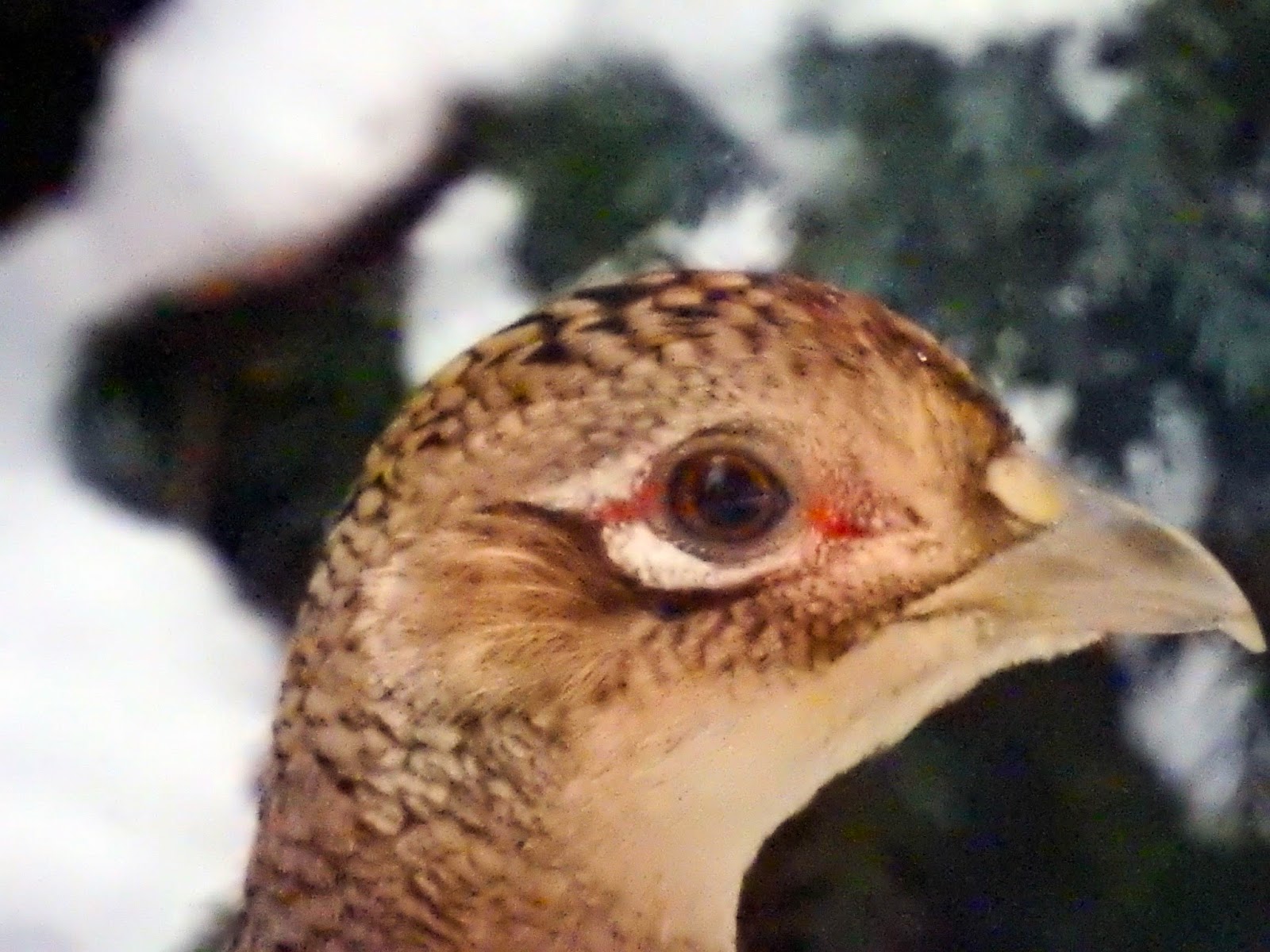
Below: bonus photo - also taken with the P900 with lens zoomed out - portrait of a young female pheasant in my garden, this Thursday morning.


This time last year:
Warsaw as a voivodship (a good idea PiS has forgotten about)

This time four years ago:
Around town in the snow

This time five years ago:
Reference books are dead

This time six years ago:
A winter walk to work, and wet socks