Showing posts with label solstice. Show all posts

Sunday, 21 December 2025

Solstice, and the metaphysical meaning of Christmas

Today marks Winter Solstice, the shortest day, the longest night of the year in the Northern Hemisphere (home to 87% of humans). But, as with Equinox and Equilux, the story is complex. The year's earliest sunsets are already behind us, whilst the year's latest sunrises are still to come. Sunset today was already two minutes later than the earliest ones; but the next sunrise will be two minutes earlier than the latest ones. 

Here in Chynów, the earliest that the sun set was 15:24. It had set at this time for eight days in a row, from 9–16 December. The latest that the sun will rise is 07:43, and it will rise at this time for seven days in a row, from 27 December to 2 January. So today, Winter Solstice, is indeed the shortest day – but only because of net daylight length, and not (as most people tend to think) because the earliest sunset coincides with the latest sunrise.

The word 'solstice' comes from the Latin meaning 'the sun is standing'; the difference in day length being minimal from one day to the next, both at this time of year and in late June at the Summer Solstice. Here we have the earliest sunrise over several days (at 04:15 for eight days in a row). From then on, day-length change accelerates towards its maximum at the Spring (or Vernal) Equinox. At this time of year, each day is around four minutes longer than the previous one.  And having passed the equinox, the acceleration of day-length slows back down to negligible with the Summer Solstice. The latest sunset of the year in Chynów is at 20:59 for six days in a row. Source: TimeAndDate.com

Below: I ask ChatGPT to whip up a graphic to illustrate the above...


[AI gets it wrong with dates of earliest sunset and latest sunrise]

Now, let's go back to prehistory, when early hominids first gazed up at the heavens and began to be aware of the progression of the sun through the heavens and making the connection with the seasons. The turning of the year is a miraculous time. Darkness begins to encroach, starting imperceptibly at first after the Summer Solstice, then accelerating around Equinox, before slowing to a halt at the Winter Solstice. And at that point – again, imperceptibly at first – Light begins to prevail. By 25 December, sunset is already five minutes later than at its earliest. That's noticeable, even to people without clocks. Time for celebration! 

The Twelve Days of Christmas, ending on the Twelfth Night (5 January), which preceded the Three Kings feast on 6 January, coincided in north-west Europe with agriculture's dead season, when there was no work in the fields and in any case the ground was usually frozen solid. By the time Christmas was therefore officially over, sunset was quarter of an hour later than the earliest.

It makes me think how lucky we are here on our planet. Take a rocky exoplanet like 82 G. Eridani d. Located 19 light years from earth, it takes 650 days (1.8 years) to orbit around its sun. It is located at an average orbital distance that puts it within the habitable zone, with liquid water. However, due to its eccentric orbit, its distance from its sun varies greatly. At its longest separation from its sun, 82 G. Eridani d finds itself beyond the habitable zone, and the irradiation received decreases sevenfold compared to when it is closest. Although well over a half of its orbit is spent within the comfortably habitable zone, 3% of its orbit (around 20 days) is at a distance where water on the surface would freeze solid. Imagine Christmas there, celebrating the thaw as the planet begins to get nearer to its sun.

The metaphysical meaning of Christmas is the triumph of light over darkness. A temporary victory in the eternal struggle between entropy (the second law of thermodynamics, which states that all things tend to disorder, that energy dissipates, that matter decays) and syntropy (life, consciousness and the unfolding of the Cosmos). And this relates to the metaphysical meaning of Easter – the triumph of life over death.

[Postscript: I found this excellent discussion on the Religion for Breakfast podcast with Dr Tom Schmitt, in which he postulates that the early Christian church may well have settled the date of Jesus's birth on 25 December after marking the conception of Jesus as 25 March, which was calculated to coincide with both Passover and the Vernal Equinox. These 'cosmic signposts' meant that the nine months gestation of Jesus would result in a 25 December birth date.] 

This time two years ago:
At the nadir
(Covid, day eight)

This time three years ago
Last good day of 2022

This time four years ago:
The Year of the Phenomenon

This time six years ago:
Sentimental stroll – streets of my childhood

This time seven years ago:
Streets of my childhood
[I did the same walk exactly a year earlier]

This time eight years ago:
Jeziorki – swans and bonus shots

This time ten years ago:
A conspiracy to celebrate

This time 11 years ago:
The Mythos and the Logos in Russia

This time 12 years ago:
Going mobile – my first smartphone

This time 13 years ago:
The world was meant to end today 
[It may not have ended, but it was a tipping point in history.]

This time 14 years ago:
First snow – but proper snow?

The time 15 years ago: 
Dense, wet, rush hour snow

This time 16 years ago:
Evening photography, Powiśle

This time 17 years ago:
The shortest day of the year

This time 18 years ago:
Bye bye borders – Poland joins Schengen

Friday, 5 December 2025

Early-December moods

Still sticking with the early-to-bed-early-to-rise routine and finding it extremely beneficial in terms of mood. Well, that and cats. My routine continues to be to go to bed before ten and wake before six, catch the sunrise, and go for my walk(s) during the daylight hours, to make the most of the sunlight. Today, the day was eight hours long, we'll lose another 15 minutes by the Winter Solstice (which falls on 21 December this year), and by 7 January the day will be eight hours long again. We are still in astronomical autumn (until the solstice), but as of the beginning of the month, already in climatic winter. Having said that, other than the snowfall on 23/24 November, there's been no snow or frost since then, nor is any forecast for the next seven days.

Below: the view down the lane to Grobice. Usually waterlogged and boggy about a third of the way down, right now acceptably dry. 

Below: "Oak, hazel, hawthorn, gorse and sandy tracks/ Better for sport than farming, I suspect." Echoes of Chorleywood Common, as described by John Betjeman in Metro-land.

Below: the hunting season traditionally kicked off on 3 November (the feast-day of St Hubertus, the hunters' patron); at weekends, I can hear to occasional crack of rifle fire in the forests. Having said that, the hunters' pulpit in Machcin shows no sign of use, no spent cartridges or empty małpki (100ml vodka bottles) in evidence, no tyre tracks in the vicinity.

Below: well, they never did manage to lay down that asphalt before Sunday's election... The road to Gaj Żelechowski and Dąbrowa Duża is due for a proper surface, which will be hugely beneficial for local traffic. It will form a direct route towards Konary and the DK79 south, cutting over 2km from the journey which currently meanders through Machcin, Dobiecin and Rososz.

Below: low sun, leafless trees. Just think – in six months' time, it will be early June! Again!


Below: around the corner from home. A new house is being built along this stretch of farm track, while another is being extended upward with a second floor. Gmina Chynów is on the move. People want to live here.

Below: portraits of my cats as they transition out of kittenhood. From the left – Arcturus, Pacyfik, Scrapper, Céleste and Czester. Everyone a character, conscious and agential. 


This time three years ago:
 Matter, materialism, metaphysics and magic

This time four years ago:
Short roads to nowhere

This time five years ago:
Mole control

This time six years ago:
Poland's education paradox

This time seven years ago:
What I was going to say at COP24 (but didn't)

This time eight years ago:
Milton Keynes

This time nine years ago:
Warsaw by night, early winter

This time 12 years ago:
Burn less gas and do Ukraine a favour

This time 15 years ago:
Early evening atmosphere

This time 17 years ago:
Toponyms 
 how many names has Jeziorki?


This time 18 years ago:
On the road to Białystok

Thursday, 16 June 2022

As I walked out one midsummer's morning

The sun rose over Warsaw today at 04:14, it's earliest in the year (indeed it rises at 04:14 from the 12th to the 23rd of June; the latest sunrise - at 21:01 - is on 21st to the 28th June, making the 22nd the longest day). Making the most of the public holiday (Corpus Christi), I woke up this morning just after 3am, dressed and ate breakfast, leaving the house in Jeziorki bound for Jakubowizna on foot. Temperature was a cool 9C, thin jacket required. 

Below: in case anyone wants to know what quarter past three in the morning looks like in suburban Warsaw in mid-June, here we are - view from my bedroom window. Untweaked in Photoshop - out of the box. Light mist on the meadow behind the house.

Below: end of my street, junction with ulica Karczunkowska. I'm on my way. No traffic - public holiday as well as being really early!


Below: the pond on ul. Pozytywki, ducks and coots still asleep. Nothing stirs. One dog barks nervously.


Below: still incomplete, the new Orthodox church on ul. Puławska catches the rising sun. This is Warsaw's Hagia Sophia, belonging to the Polish Autocephalous Orthodox Church (nothing to do with the war criminal Patriach Kirill). Modelled on the one in Constantinople. It stands just metres from Warsaw's southern border (this side of the treeline).


Onward through Mysiadło to Piaseczno, the Slough of the East. Not my favourite Polish town, though I must say, that like many places right now, it is currently undergoing a thoroughgoing modernisation. Below: work under way, roads closed - an early bus runs empty across (Piaseczno's) ul. Puławska. Photo taken one hour after leaving home. I look forward to seeing Piaseczno when all the work's been finished. Looks promising. Proper provisions for cyclists and pedestrians.


Onward, south to the edge of Piaseczno, over the footbridge crossing the river Jeziorka (nothing to do with Jeziorki) and into Żabieniec, still noted for its fishponds (farmed carp) and the freshwater fish institute (Instytut Rybactwa Śródlądowego). The ponds are a landmark when flying into Warsaw Okęcie airport, to the left of the flightpath.


Having passed through Żabieniec, I enter the Chojnów landscape park (Chojnowski Park Krajobrazowy) - the best part of the trip. After a while, the footpath joins the Gościniec Wareki (the archaic word gościniec is akin to the English 'highway' in the historical context - think of 'highwaymen'). The road runs south; to the west the fishponds, and the Warsaw-Radom railway line - audible but not visible. Below: bliss - two hours' walk from home. About one-third of the way.


Having crossed the road to Zalesie Górne, the Gościniec Warecki becomes asphalted. Cars are mercifully rare - on this seven-kilometre stretch, I saw just two (and two cyclists, two dog walkers and one deer). Below: the curious settlement of Nowinki (lit. 'Little Tidings' or 'Little Novelties').


What makes Nowinki (at least its northern end) unusual is the character of the buildings - działki set back from the road, modest wooden shacks mostly, neglected, yet fenced off with concrete posts and barbed wire, surrounded by tall trees. The hallmarks of a communist-era enclave - a rural retreat for middle-ranking apparatchiks. Having retired and or died off, their działki have become terminally  shabby. No one claiming them. Further on up the road, new houses are appearing - brick-built and without the paranoid fencing.

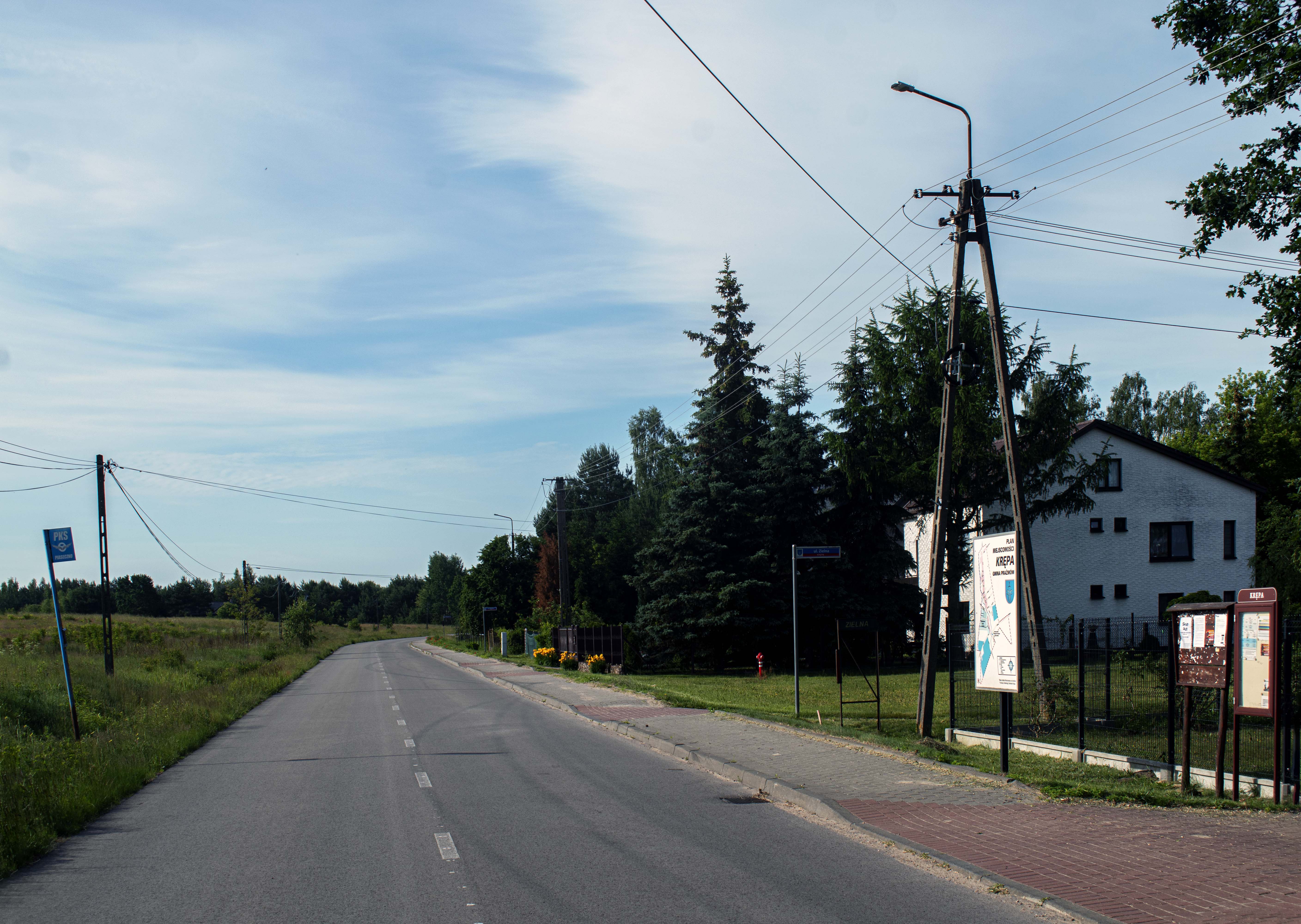
Time for a second breakfast and a ten-minute rest at the three-hour mark between Nowinki and the next village along - Krępa, at the southern edge of the forest. The Gościniec Warecki gives way to ul. Długa. Krępa was much prettier, brighter and better looked-after than Nowinki - pavements, notice-board, well-kept houses. 


Leaving the forest behind, my next waypoint is the Skierniewice-Łuków railway line, which crosses the main Warsaw-Radom line at Czachówek. Like the locals, I avoid a half-kilometre detour via a road tunnel under the tracks by using an unofficial but well-worn path over them. Having just seen (in the distance) two passing container trains heading east-west and west-east, I knew the coast would be clear for a long while. In the distance, the Czachówek diamond.


South of the line, I feel I'm almost home in Jakubowizna. But it's still a long walk to Sułkowice. On one side of the road flows the Czarna river, floodbanks on either side protecting adjacent lands. Coming up to 9am, but still very few cars on the road. Below: a footbridge over the Czarna, leading to Czachówek Południowy station.


Below: another curiously named settlement along my route - Kiełbaska (lit. 'Little Sausage'). Untouched by progress.


Soon, I arrive in Sułkowice - famous for being home to Poland's police-dog training school. Past the village and station, the DK50 viaduct on the horizon means I'm no more than 20 minutes from home on the działka. Rushing through (non-stop between Warka and Piaseczno) is the 'San' express.


It's good to know that I can get to the działka under my own steam - ended up spending no money today (all shops along the way firmly shut) - walking 26.4 kilometres (16.4 miles) with six or seven kilo on my back.


Arriving on the działka, time for a wash, a beer - and a nap (which ended up being two hours long!). But then I only slept five hours, so I needed it. A total over over walked 36,500 paces today.

This time seven years ago:
Central Warsaw rail update

This time ten years ago:
Poland's night train network

This time 11 years ago:
On a musical note

This time 12 years ago:
Standing stones

This time 15 years ago:
The year nears its zenith

Sunday, 20 June 2021

Wild food in Midsummer

Midsummer on the działka - the joy of sunshine, nature is just beginning to bring forth its bounty. By the roadside grows the sorrel, a leafy weed familiar to all Poles as szczaw, the acidic tang that gives zupa szczawiowa its character. Sorrel has a short picking season, from late-May to mid-June, it needs to be harvested before it grows too high and goes to seed; the leaves then become tough and fibrous. Sorrel has arrowhead-shaped leaves that are easy to spot among other roadside weeds, it grows in clumps and is easy to harvest.  [Note the ox-eye daisies in the background.]

As well as being the basis for one of Poland's classic soups, it also tastes good in salads. For me, however, it goes into a lentil curry. Rinsed thoroughly of dust, cut width-wise into strips, it goes into a shallow pan with pre-boiled lentils, it soon turns into an olive-drab khaki colour after a minute or two boiling. I add piri-piri chili peppers for heat, some Indian spices, goats cheese, Halloumi or chickpeas for protein, and serve with Basmati rice. Sorrel has high amounts of oxalic acid, which can give rise to kidney stones if eaten in large amounts. And this is why dairy products (cream or cheese - or indeed egg) are used to whiten the soup or stew or salad - to take the edge off the acid.

Below: a plate of lentil and sorrel curry with chickpeas and rice. Takes about 25 minutes to prepare.

This is also the time for poziomki (Fragaria vesca, wild or woodland strawberries). These are tiny and require intensive work to harvest. They have a specific perfume and taste, and simply guzzling them by the handful after spending an age picking them makes little sense.

I am making nalewka poziomkowa. Fill a jar with the tiny berries, pour in 95% spirytus rektyfikowany to cover the fruit, screw lid on tight, leave for four to six months, pour off the liquid into bottles, add sugar to the berries (sparingly - 10% sugar/90% drained fruit) and leave to ferment for another couple of months. Drain the berries again, add the fermented liquid to that bottled from the first fermentation. Ready(ish) to drink around Christmas, but better to leave for another month or two after unifying the results of the first and second fermentation. Easy really. The result should be sublime in taste, smell and colour (a rosé pink). And about 55% alcohol by volume. The hard part is picking them. There's about 150g collected in the punnet below - it was about half an hour's work.

The results of the first harvest in the cellar. Five jars, none of them large; I expect to make around two half-litre bottles of the finished liqueur from the contents, once the fruit has been drained for secondary fermentation with sugar added. Unlike the sorrel, which has now gone to seed, the wild strawberries will still be pickable for a week, maybe two, so I hope to step up production of wild strawberry liqueur.

While picking the sorrel and the wild strawberries, I listen to the birdsong. They're clearly not just signalling readiness to mate or warning their flock of some impending threat - these are conscious beings communicating. I rather fancy that they are commenting the local events of the moment to each other, sharing the qualia, the subjective conscious experience. One burst of song suddenly and acutely reminded me of the garden in our family house in West Ealing in the summer of 1970 or '71, just after we'd moved in - a species of bird, I figured, that has long disappeared from the suburban gardens of London, but is still here in rural Mazovia.

This time last year:
Summer Solstice at a Time of Pandemic

This time six years ago:

This time eight years ago:
Fashionable bicycles for Warsaw's hipsters

This time nine years ago:
On Jarosław Gowin and leadership in Polish politics

This time ten years ago:
Death of a Polish pilot

This time 11 years ago:
Doesn't anyone want to recycle my rubbish?

This time 12 years ago:
End of the school year

This time 13 years ago:
Midsummer scenes, Jeziorki

Saturday, 20 June 2020

Summer solstice at a time of pandemic

Covid lockdown was announced in Poland towards the end of astronomical winter, a fortnight into meteorological spring. On 16 March, the first working day of lockdown, the sun set at 17:42, less than three-quarters of an hour after my laptop lid went down. I'd return from my 90-minute long walk in the dark. Lockdown was a depressing, worrying moment, but at least spring was coming. The days were getting longer, warmer, brighter, and the clocks would soon be going forward, giving that welcome extra hour of daylight in the evenings.

Three months on, the pandemic is still very much with us, but the year has reached its zenith. From tomorrow, the days will start to get shorter - imperceptibly at first, but accelerating as we approach the autumn equinox. Then in late-October the clocks go back, and then the Hammer of Darkness comes down. All of us who experience seasonal affective disorder fear those dismal November days in the Northern Hemisphere as daylight is squeezed out little by little, leaving Warsaw with a mere seven hours and 42 minutes at the winter solstice. This year, it is likely that those days of dread will be accompanied by a second, possibly more deadly, wave of Covid-19.

But for the time being, make hay while the sun shines - even if it's not shining! Last week saw the spread-rate of Covid-19 in Poland fall to its lowest since the pandemic began.

Out into the countryside, then. Darkness falls late, the blending of day into night takes longer than in winter.


After yesterday's storms, the land was still warm long after sunset, the clouds interesting.


What do 'noon' and 'midnight' mean to us today? Since the late 19th century, electric light has brightened city nights; today all network-connected devices show exactly the same time, expressed as 'UTC'. To this (also known as Greenwich Mean Time), one adds or subtracts hours dependent on longitude and adjusts for daylight length (summer time). 

Historically, however, 'noon' had a specific meaning - it was that moment when the sun was exactly at its zenith, when (in the northern hemisphere), your shadow would point due north. Depending on what latitude you stood, noon occurred at a slightly different time. Noon occurred in London eight minutes before the sun reached that same angle in Bristol - a problem for the early railways, quickly solved by the introduction of 'railway time', facilitated by the telegraph.

Warsaw is 20 degrees east of London. One hour is 15 degrees of longitude (360 degrees of the globe divided by 24 hours of the day). Warsaw is one time zone east of London, so accounting for that, the sun rises, reaches its zenith, and sets in Warsaw around 20 minutes earlier than on London clocks. (That 'around' takes into account the Earth's wobble.)

Now, midday - noon - is literally the middle of the day. The meridian. Equidistant from sunrise and sunset - but take the summer time adjustment into account.

Today is the summer solstice; the sun will be directly over the Tropic of Cancer at 21:43 today, the northernmost line of latitude upon the sun's rays fall at exactly 90 degrees. 

Here in Warsaw, the sun rose at 04:14 and will set at 21:00. Noon in Warsaw - the zenith of the sun's travel from horizon to horizon - is at 12:37 (11:37 if not for the summer time shift). Eight hours and 23 minutes after sunrise, eight hours and 23 minutes before sunset.

Midnight is analogous to midday. For us modern folk, 'midnight' does not seem particularly late; I try to be in bed before 11pm, but when I'm writing or editing photos, bedtime is often past midnight. Yet midnight literally means the middle of the night! It is halfway between sunset and sunrise! For pre-electricity humans, the biological clock was more in tune with the sun. Once the sun had gone down, how long you'd stay awake for depended on how many candles you could afford to burn. Without clocks and the artificial construct of 'summer time', sunrise in mid-summer in Warsaw would be at quarter past three am. That's when one would wake, break fast and begin work in the fields.

Below: orchard under glowering skies.


The weather is typical for high summer. Convection storms build up throughout the day as the sun's rays cause condensation of moisture on the ground. Water vapour rises into the atmosphere consolidating into clouds that hour by hour grow ever higher; once they have the mass and the height to reach altitudes where the air is colder, the vapour turns into rain - often heavy. Watching the weather-radar maps on Meteo.pl, I often see the Vistula acting as a corridor along which storms build and move north-westward. Today will be rainy, but warm.

This time five years:

This time seven years ago:
Fashionable bicycles for Warsaw's hipsters

This time eighte years ago:
On Jarosław Gowin and leadership in Polish politics

This time nine years ago:
Death of a Polish pilot

This time ten years ago:
Doesn't anyone want to recycle my rubbish?

This time 11 years ago:
End of the school year

This time 12 years ago:
Midsummer scenes, Jeziorki

Friday, 29 May 2020

Evening elegy across the tracks

Join me as dusk falls, for a virtual stroll through the fields between Jeziorki, Dawidy Bankowe and Zamienie, as Change and Progress will change their nature forever. Idyllic scenes soon to be lost, like the one below...
 

...and this view across to a solitary farmhouse in Dawidy Bankowe - before long, six lanes of expressway and a service road will be driven in between.


Farm tracks between wheatfields, where a final season's crop is being grown.


The service road runs parallel to the S7 extension; the topsoil has been scraped away the main carriageways to the right, running through the fields, the Action computer warehouse in the distance, while to the left mounds of earth will be turned into embankments and viaduct ramps.


The Action warehouse. This will be Węzeł (junction) Zamienie, the first interchange to the south of Warsaw.


The newly-built hills, getting ever taller, offer entirely new views in all directions...


...like this one, across to Warsaw on the horizon (the towers look tiny because this is a very wide-angle lens)


Looking east towards the railway line...


Looking west towards a setting sun, less than a month to the summer solstice, when sunset in Warsaw will be at 21:01, just 18 minutes later than today.


Back across the tracks, on the Jeziorki side. At least here there won't be an expressway driven through these fields.


This time four years ago:

This time five years ago:
Making sense of Andrzej Duda

This time eight years ago:
Work starts on ul. Gogolińska

This time nine years ago:
Waiting for The Man

This time ten years ago:
The Flavour of Parallel reviewed

This time 12 years ago:
Twilight in the garden

This time 13 years ago:
Late May reflections

Sunday, 28 October 2018

Hammer of Darkness descends one last time

It's quarter to four in the afternoon. I ate a hot lunch less than two hours ago - and I'm ravenously hungry. It's gloomy and wet outside - in half an hour it will be dark. Yesterday, the sun set at 17:16; today it sets at 16:14. An hour has been stolen from my evening and I won't get it back until the end of March. This whole business of clocks going backwards and forwards is disturbing - the autumn time-change gives us an hour's more sleep but plunges us into darkness an hour earlier. The spring time-changes returns to us that precious hour of evening daylights, but robs us of an hour's sleep.

I am delighted that the EU has - after widespread consultations - decided to do away with this time-change nonsense. For those who suffer (however mildly) from seasonal affective disorder, the continuation of Summer Time into the autumn and winter will be a blessed relief.

Our planet is inclined at 23 degrees to the sun; were it upright to the sun, the entire planet would get 12 hours of day and 12 of night right across the year - equinox would be the norm. Like a stop clock, we get two equinoxes a year, for us here in the Northern Hemisphere, day length varies. From Winter Solstice to Summer Solstice, the day in Warsaw length between a couple of seconds (after and before each solstice) and over four minutes (around the Spring Equinox) a day. From the Summer Solstice to the Winter Solstice, the day in Warsaw shortens, again much more noticeably around the Autumn Equinox than around the time of the solstices.

Below: sunrise and sunset chart for Warsaw (timeanddate.com). Click to enlarge.


The loss of a couple of minutes a day I can deal with - it's the loss of a whole hour that hurts, especially during the first two working weeks after the time change. The sun sets three quarters of an hour before the end of the working day, rather than shortly after it. Warsaw's earliest sunset is at 15:23, between 8 and 18 December (not the shortest days, because the latest sunrise is not until 27 Dec - 2 Jan, at 07:45). The shortest days of the year (21 and 22 Dec) are just over 7hrs 42mins long. The longest days of the year (18-24 Jun) are over 16hrs 46mins long - a difference of over nine hours, (more or less) equally split between sunrise and sunset.

One way or another, here at 52°, we are condemned during the late autumn and winter to leave home and go to work in darkness, and to leave work and go home in darkness.

Is there a better way? I have postulated using technology to change the time of sunset each day, just slightly, by no more than four minutes at equinox, so that at a given latitude we can all enjoy the same amount of after-work daylight the whole year round. How would this work? Let's take 9pm as an arbitrary time (coinciding with the latest sunsets in Warsaw in midsummer). We'd agree that sunset is 21:00 exactly, each day of the year. And adjust sunrise each day in line with that.

Nine pm is four hours after most people finish work - four hours for walking, jogging, cafes etc. It's two hours before most people go to sleep. All year round, we'd have a 9pm (21:00) sunset. But whereas in midsummer, the sun would rise at quarter past four am, in midwinter, it would rise in the early afternoon (around 13:15). Our smartphones, smartwatches and laptops would compensate automatically. Our winter journeys to work would be in the darkness - but they are anyway. All we'd lose is daylight hours while we sit at our desks on winter mornings. But those winter evenings would be long and light!

This time last year:
Big news for Jeziorki
[the housing estate for 8,000 people. Still pie in sky.]

This time two years ago:
Autumn in Warsaw

This time three years ago:
Inside the Norblin factory 

This time five years ago:
Sadness at the death of Tadeusz Mazowiecki

This time seven years ago:
More hipster mounts (Warsaw fixieism)

This time eight years ago:
Welcome to Warsaw

This time nine years ago:
Just like the old days

Thursday, 22 December 2016

Solstice sunset, ul. Gogolińska, Jeziorki

The shortest day of the year is behind us. From now on, the days will be getting longer, the sun will set slightly later - although it is not until 5 January that the sun will rise earlier. Today, the time from sunrise to sunset in Warsaw was seven hours and 43 minutes. And 12 seconds. Four seconds more than yesterday

Out to catch that setting sun. Below: from the platform of W-wa Jeziorki station. In the foreground, the muddy pool churned up by the contractor's vehicles is freezing over; today's daytime high was +2C, and as the sun sets, the temperature at ground level falls below zero.


Across ul. Karczunkowska, down ul. Gogolinska to take the photo (below) from the top of one of the ballast mountains by the tracks. The sun sets through the trees... Let me change perspective and zoom in a bit...


The trees - silver birches without leaves and various conifers - lining ul. Gogolińska are now brought in closer...


And I zoom in again (to 600mm equivalent) to catch the sun through the branches of the fir trees.


Turning south, a Lufthansa Airbus A380 cross the heavens, the condensation trails from its four giant turbofan engines still lit by the sun that's already dipped below the horizon for those of us down at ground level.


Below: my brother has rendered my photo (seen originally here) in the style of German artist Anselm Kiefer, catching the atmosphere of the late afternoon in winter with a light frost and a dusting of snow.


Three more months of gloom before the clocks go forward at the end of March. But even the gloomiest days of the year can yield artistic inspiration.

Tomorrow sees the beginning of the annual Yuletide pilgrimage (Luton-Ealing-Duffield-Stockport-Duffield-Ealing-Luton).

This time last year:
Conspiracy to celebrate

This time two years ago:
The Mythos and the Logos in Russia

This time three years ago:
Going mobile - I get a smartofon

This time four years ago:
The end was meant to end today (remember?)

This time five years ago:
First snow - but proper snow?

The time six years ago:
Dense, wet, rush hour snow

This time seven years ago:
Evening photography, Powiśle

This time eight years ago:
The shortest day of the year

This time nine years ago:
Bye bye borders - Poland joins Schengen
Monday, 19 December 2016

Christmas illuminations in Warsaw - the champion

At this, the darkest time of year in the Northern Hemisphere, we crave light and warmth; and so religion steps in to organise a feast that coincides with the passing of the Winter Solstice and the start of the process of the lengthening day. To celebrate, lights. The lights of Christmas, Hanukkah, Diwali, Yuletide... the night sky, the darkness must be kept at bay until the sun begins to return.

Warsaw is splendidly illuminated this year. The substitution of high-wattage lightbulbs for energy-saving LEDs has allowed those responsible for lighting Our City at this festive time to go full-on creative, allowing ever-greater flights of fancy.

This particular example reached me via the internet a few days earlier; a dinner at the Amber Room at the Pałac Sobańskich on Al. Ujazdowskie gave me an opportunity to check out this particular piece of art. WOW. This is an illuminated tribute to the legendary Jelcz ogórek ('cucumber') bus that served Warsaw in the 1960s and '70s.


Warsaw's main thoroughfares are ablaze with illuminations at this time of year; the Royal Route (Trakt Królewski) has more lights along its length than ever before. This is Plac Na Rozdrożu.


The lights will be on until early February; just what's needed to lift the spirits while the nights are long.


The subliminal message from the City of Warsaw here - love your public transport, and use it.

This time last year:
Changes on ul. Baletowa
[A year on, the 715 and 737 bus routes serve this street]

This time three years ago:
UK migration - don't blame the Poles

This time four years ago:
Jacek Hugo Bader's Biała Gorączka reviewed

This time five years ago:
Thoughts upon the death of the Dear Leader

This time sixe years ago:
Global warming or climate change?

This time seven years ago:
Progress along the S79
