Showing posts with label science. Show all posts

Sunday, 19 July 2026

Water Which Does Not Wet Hands revisited (Pt II)

Part I of the review here.

It is the nature of Homo sapiens to be curious – to ask the most fundamental questions regarding the nature of reality. Why is there something rather than nothing? What are we made of? Why do we think and feel? If a tree falls in a forest and there's no one there, does it make a sound?

As humanity evolved from hunter-gatherer to settled communities, more time became available for asking those questions and making observations from which hypotheses could be created, putative answers to those questions that have gnawed at us from our birth as a separate species.

Our first attempts at defining the nature of reality were coded as myths and legends; supernatural beings whose actions defined the paths of celestial objects across the sky, good or bad harvests, and phenomena such as volcanoes and thunderstorms. Telling these stories was the job of shamen, not scientists.

Systematic scientific thinking and practice began in Ancient Egypt and Mesopotamia during the third and second millennia BC. These first steps in what would become mathematics, astronomy and medicine went on to influence Ancient Greek natural philosophy, who attempted to explain physical phenomena by natural, rather than supernatural, causes. Knowledge of these Greek concepts deteriorated in Latin-speaking Western Europe during the early Middle Ages, but lived on in the Byzantine Empire. The Hellenistic worldview was preserved and absorbed into the Arabic-speaking Muslim world during the Islamic Golden Age. The recovery and assimilation of Greek works and Islamic inquiries into Western Europe from the 10th to 13th century revived the learning of natural philosophy in the West.

The Scientific Revolution of the 16th and 17th centuries in Europe marked a break with the natural philosophy that had preceded it. The scientific method that emerged departed from previous Greek conceptions and traditions. It was more mechanistic in its worldview, nudging out the supernatural explanations, it was more integrated with mathematics, and focused on acquiring and interpreting  evidence. Proof became the ultimate goal, proving conjectures, experimentally or mathematically. Science became separate from philosophy; matter… from spirit.

Alchemy served as the bridge between Mediaeval thought and the birth of the scientific method in the Enlightenment. Dr Szydło’s book examines the links between alchemical thinking and practice and the first true scientists. In particular, the author sets out a number of Sendivogius’s accounts of processes, comparing them to modern chemistry. The book follows on with the work of pioneers of today’s scientific method, as they worked on identifying oxygen as an element.

Dr Szydło separates practical alchemy from philosophical alchemy in Sendivogius’s writings. The philosophical includes musings on “the spirit of the Earth”, the practical includes observations made while heating lead oxide, for example. Sendivogius’s central-nitre theory was instrumental in stimulating experimental investigation into the vital constituent of air and influenced Robert Boyle and John Mayow, whose work in isolating oxygen as a constituent of air were crucial in the shift from alchemy to chemistry.

Post-Enlightenment science took the path of reductionism, stripping away all of alchemy’s arcane trappings of mysticism, replacing it with empiricism. Yet four centuries on, scientists acknowledge many more gaps in their knowledge than was the case a hundred years ago. Reductionism is giving way to complexity. The acknowledgement of what we don’t know leads to new ways of thinking about the ultimate nature of reality. Consciousness and the conscious observer take on a new primacy. Thirty years on from when Water Which Does Not Wet Hands was published, new parallels can be sought between how alchemy viewed ultimate reality and how it is seen today.

Rereading the book today through the lens of contemporary consciousness studies reveals new congruences. Sendivogius's universe is alive, filled with purpose and permeated by a principle that appears simultaneously as spirit, matter and life. His worldview contrasted profoundly with the dead, clockwork universe of the materialist reductionism that would follow. 

Whilst Sendivogius's 'central nitre' is not consciousness, it is a vital force with formative causation, a fundamental property of the Universe.

Were Sendivogius to walk out of a time machine into today's world and to have the chance to talk to our leading scientific theoreticians and philosophers, I think he would rather side with Donald Hoffman, Phillip Goff or Rupert Sheldrake than with Richard Dawkins or Sean Carroll. Or, were he still alive, Daniel Dennett.

Is the pendulum of philosophy swinging back, or was materialist reductionism an aberration from more intuitive thinking about the nature of reality? Time will tell, I need more lives to assuage my curiosity.

This time last year:
A better tomorrow – science and technology

This time ten years ago:
Memory, place and experience

This time 11 years ago:
UK Number One in world Soft Power rankings

This time 14 years ago:
First flight from Modlin

This time 15 years ago:
Another cycle route to work

This time 18 years ago:
PZL M-28 and Piaggio Avanti – Okęcie regulars

Saturday, 18 July 2026

Water Which Does Not Wet Hands revisited (Pt I)

Zbigniew Szydło's book about the alchemical times of Michał Sędziwoj (1566-1636), known across Europe by his Latinised name, Sendivogius, requires a re-read in light of developments in science and philosophy since its publication, as well as my own evolved understanding of how we describe reality. How is alchemy perceived today? How does it fare when viewed from a perspective of panpsychism, dual-aspect monism and the stagnation in fundamental physics?

Author Zbigniew Szydło is better known to the English-speaking world as Andrew Szydło, famous for his (literally) explosive chemistry demonstrations at numerous Royal Institution lectures. His 1994 book looks at the life and works of one of Europe's greatest alchemists, he asks whether Sendivogius discovered oxygen in the practical sense – the heating of potassium nitrate is thought to have provided the oxygen need to keep rowers alive as they propelled the first documented submarine down the Thames in 1621. The book's main aim is to establish Sendivogius as an important figure in the transition from alchemy to modern chemistry – above all through his ideas about nitre, air, combustion and respiration.

Sendivogius was a Polish nobleman and diplomat; he served in the courts of Polish king Sigismund III Vasa and Holy Roman Emperor Rudolf II as an advisor on metallurgy and mining, as well as alchemy. He travelled extensively across Poland, Bohemia, Moravia and the German-speaking lands, and authored several significant alchemical works that were widely printed and reprinted in different language-versions across Europe in the 17th century. 

When I first read the book in the mid 1990s, my worldview tended towards the physicalist and the rational; I paid scant regard to the metaphysical. At the time, I read Dr Szydło's book primarily as a narrative intended to overturn the myth that mediaeval alchemists were mere charlatans who claimed that they could turn base metals into gold. Instead, Dr Szydło presents a stage in the history human thought before the development of the scientific method during the Enlightenment. Alchemy was an entire philosophical system attempting to describe reality in a hermetic language known only to adepts. 

It is known that Sendivogius's works were studied by both Antoine Lavoisier and Isaac Newton. "If I have seen further it is by standing on the shoulders of giants" – indeed.

Sendivogius recognised that air was not chemically uniform, identifying within it a particular life-giving and combustion-supporting component. His writings influenced later investigators, helping prepare the conceptual ground from which oxygen chemistry eventually emerged. The book does not present Sendivogius as the discoverer of oxygen, but as a remarkable early investigator of the phenomenon later understood as oxygen. 

Today I am re-reading the book in the context of Philosophy of Mind, of the increasingly held view that consciousness is fundamental, and comparing the thoughts of Sendivogius to those of contemporary philosophers and scientists such as David Chalmers, Donald Hoffman, Bernard Carr, Philip Goff, Bernardo Kastrup and Rupert Sheldrake. But more on that in my next post. I am also re-reading the book in the age of AI and Wikipedia, which allow instant dives down rabbit-holes for greater detail and wider context.

The book goes into much detail about the importance of salt to alchemy. Today, every school pupil knows that salt is NaCl; one atom of sodium bonded to one atom of chlorine. A highly reactive metal that burns in air and a poisonous gas; combine the two and you get something that's indispensable to life. To a modern chemist, a salt is something more; it's "an ionic compound formed by neutralising an acid with a base". But to Sendivogius and his contemporaries, salt was one of the three fundamental pillars of reality (tria prima), along with sulphur and mercury. When the alchemists considered salt, they were looking at the processes of fixation and crystallisation – grounding spirit into form.

Another salt is worthy of note in terms of how it was viewed by alchemy: gunpowder. Saltpetre (potassium nitrate or nitre), when mixed with sulphur and charcoal, has explosive properties. The sudden release of violent energy has its analogy in the heavens; thunder and lightning must be caused by similar processes. Hence the concept of 'aerial nitre'; heavenly gunpowder.

Reading about the theories of alchemists as they attempted to define reality in their terms of makes me think that science today is somewhat arrogant, believing that it's so close to grasping reality on one neat theory of everything, an equation you can wear on a t-shirt. 


["Lagrangian of the Standard Model of particle physics – this equation sums up our current understanding of fundamental particles and forces. It represents the Standard Model of particle physics. The top line describes the forces: electromagnetism and the strong and weak nuclear forces. The second line describes how these forces act on the fundamental particles of matter – quarks and leptons. The last two lines describe the Higgs boson and the mechanism by which particles acquire their mass" – from the CERN merch shop.]

As the language of myths and legends gave way to the language of alchemy, which in turn gave way to the language of science as the way humans describe reality, so the language of science will inevitably evolve and move on. Does not string theory and quantum gravity – attempts to frame a theory of everything in a mathematical framework – not hold something of the arcane language of alchemy? I am certain that humans in four centuries' time will look back at the beliefs that science holds true today with the same patronising smirk that is on our faces as we read about the alchemists.

[Co]incidentally, my youngest kitten, fifth-born of the fifth-born, is named Kwintesensja ('Quintessence'). Or Kwincia for short. Dr Szydło points out that "Aristotle introduced the idea of a fifth element – the quinta essentia – from which the heavens were made. The quintessence was linked to ideas of perfection and eternal life. It became the basis of the idea of a universal spirit or ether, or 'world soul', which was to play an important part in alchemical theory."

More in the next post.

This time last year:
Out of the box: exploratory kittens

This time two years ago:
Do you think in a language?


This time four years ago:
A better tomorrow – geodiversity
This time six years ago:

This time seven years ago:

This time eight years ago:
New Nikons on the way!

This time 14 years ago:
Work continues on S2, going under the railway lines

This time 15 years ago:
Stand Easy! – a short story

This time 18 years ago:
God Save The Queen - I mean it, Ma'am

This time 19 years ago:
On the Road Again

Sunday, 5 April 2026

Easter Sunday – triumph of Life over Death

Waking up to witness the sun rising through the trees in the forest next door, I fed the cats, made myself a coffee, and sat down to start writing these words.

As a child, I used to wonder why the two main religious festivals of Christianity were spaced across the year as they are. Christmas falls just after the Winter Solstice, while Easter falls at or shortly after the Spring Equinox. But there is no major festival around either the Summer Solstice or the Autumn Equinox. Easter is around three months after Christmas, and  then it's eight or nine months until Christmas comes round again, with summer holidays in between.

Why the asymmetry? 

If one looks symbolically – metaphysically – and at Church history – it becomes clear.

Christmas is the celebration of the triumph of light over darkness. It is celebrated ten days after the year's earliest sunset. By 25 December, people across the Northern Hemisphere, even without sophisticated measuring instruments, could tell that the sun had stopped retreating and had started its return.

This year's earliest sunset will occur here in Chynów on 13 December at 15:24. By Christmas Day, it will set at 15:28. a full four minutes later. [However, due to the Earth's 'wobble', the latest sunrise won't happen until 31 December, at 07:43. Equinox – the crossing of the Sun back into the Northern Hemisphere is on 21 December, which also happens to be the year's shortest day, balanced as it is between the earliest sunset and the latest sunrise].

The Feast of Christmas, then, can be seen as the triumph of Light over Darkness. In the beginning was the Word (John 1:1)? No, in the beginning was Consciousness. From Consciousness emerged Thought, the Thought was communicated via the Word. Consciousness and Light. The spiritual, metaphysical nature of Light...

The ins and outs and what-have-yous of the date of Easter is way too complicated to even begin to explain (other than its historical relation to the Jewish feast of Passover). Suffice to say, it can fall as early as 22 March or as late as 25 April. This year's Easter is somewhere around the middle of that spread. And typically here in Poland, this means that Lent began with snow on the ground (left, 18 February) and ended with trees starting to come into leaf (right, 5 April) in the forest next door.

Life has returned. The sap is rising; birdsong fills the sky. The Earth is waking up, a powerful force, a natural resurrection. The dead, dry vegetation that lies on the ground is jostled aside by fresh green shoots pushing up towards the sun. In the year's cycle, this is a turning point. We can look ahead to warmth and plenty. Christmas marked the first, fixed, turning point. Darkness retreats, light advances. At the same time every year – it is astronomical. Easter, however, marks a moving turning point. Because of weather, spring can be early, or late. It is imprecise, biological. Hence a moveable feast, to remind us that nature's bounty is not to be taken for granted. 

We live in a Cosmos fine-tuned for life. The 31 physical constants are all just so, each to within orders of magnitude with many zeroes – indicating non-random or finely adjusted values. A small change in several of the physical constants would make the universe radically different. Matter might not even exist. The laws of science contain fundamental numbers, such as the size of the electric charge of the electron and the ratio of the masses of the proton and the electron, which seem to have been very finely adjusted to make possible the development of life.

Life is material. Life hosts consciousness, the immaterial. You might be able to find the neural correlates of thought, but not of consciousness. You can't calculate or weigh qualia.

********

I am entitled to nothing, but am grateful for everything good that comes my way. I don't have a need for a caring God, but I do need a purposeful God. A direction with which to align, a direction away from chaos and barbarism, and towards order and love.

To me, Easter is a strong argument against a random, purposeless Universe that just somehow exists. It serves as a reminder that it is unfolding towards something, and that we should strive to get close to that flow.

********

On this day last year, I had my heart attack, and was rushed to hospital by ambulance, wheeled into the operating theatre and given three stents. One year on, I feel fine. I give thanks.


Today is my father's birthday; he would have been 103. I still dream of him often, and feel convinced that his consciousness abides, perhaps in the body of a boy living in Ursynów.

In the bright Easter sunshine, I set off for a walk shortly before 7am today, a walk in gratitude and joy.


Easter Sunday 2025:
Jesus and me

Easter Sunday 2024:
Triumph

Easter Sunday 2023:
Easter and photo catch-up 

Easter Sunday 2019:
Easter in Ealing (my last as it happens)

Easter Sunday 2013:
Easter Sunday in the snow

Easter Sunday 2008:
Snowy Easter in England

Monday, 9 March 2026

Lent 2026: day 20 – music, physics and metaphysics

One note, plucked on an acoustic guitar. A single chord, strummed. Three chords in quick succession. Another three. A bass guitar joins in, and percussion provides a beat. Add a piano, woodwind, density, variety... We have music, it resonates with us emotionally. 

There's something magical about music, isn't there? The ability to conjure up a mood, a feeling, a memory – qualia – with a run of notes, a succession of vibrations at different frequencies, is hard to pin down rationally. The rollercoaster of emotions experienced while listening to, for example, Bohemian Rhapsody, is impossible to quantify in a mathematical equation.

We all recognise a minor key in music (sad). And a major key (happy). Why do we  respond this way, rather than the other way around?

Science tells us that the way our brains process music is all about dopamine activated by the mesolimbic reward pathway, the activation of structures such as the amygdala, hippocampus and anterior cingulate cortex, and our cultural expectations. 

I'd say this this physicalist explanation overlooks the metaphysical mystery at the heart of our emotional response to music.

Earlier this year, I posited the possibility that music operates on the same substrate as our consciousness. We experience music rather than think about it (unless we are trained musicians). The notion of music literally belonging to the ages is important. I would guess that the conscious response to a Mozart minuet in a human is the same today as it was when it was first played. (I might have to add 'to a European human', conditioned to Western tonalities.)

Familiarity is important; you may hear a piece for the first time and like it – this may be because it's derivative, sounding similar to another piece you know and love, or it may use familiar musical devices or tropes that work on you emotionally such as a crescendo, choir entry, shift from major into minor etc. (Somehow, this doesn't happen with AI-generated music.)  

But then there is that 'click' of instant familiarity when you 'know' a tune you've never heard before. Was it there in the background while you were in your earliest infancy? Do you associate it the tune with childhood? Or some vague time before you were born – how could that be? Two months ago, I had the insight that maybe music plays some role in assigning consciousness to its biological container.

Two and half thousand years ago, Pythagoras posited that the Cosmos is structured according to harmonic ratios analogous to musical intervals, and that the motion of heavenly bodies form a cosmic harmony, inaudible, yet fundamental to the structure of reality. Plato developed this idea further. He suggested that the World Soul is built from harmonic mathematics. according to musical ratios which structure the Cosmos. 

These ancient intuitions resonate with our current understanding of the physical substrate of reality.

Modern physics has uncovered parallels to the Pythagorean view of 'the music of the spheres': stable structures, from atoms all the way up to galaxies, emerge as resonant patterns in dynamic systems. In this profound sense, the universe does indeed behave like an enormous hierarchy of vibrating systems across countless frequencies. 

Vibration may be a fundamental organising principle of reality, maybe even bridging the divide between the realms of matter and consciousness. Maybe.  

Lent 2025: day 20
Why I keep blogging these Lenten posts

Lent 2024: day 20
Do we have Free Will? (Pt IV)

Lent 2023, day 20
Practical uses of intuition

Lent 2022: day 20
Free will, consciousness and determinism

Lent 2021: day 20
No, but who are you really?

Lent 2020: day 20
Applying Occam's Razor to your religion
 

Friday, 6 March 2026

Lent 2026: day 17 – Do we need to invoke spiritual explanations to fully describe reality?

Scene: the present. A secret military intelligence facility, somewhere in the continental USA. In the centre of a room with blank walls, a desk and sitting behind it, a man; he is finely balanced between total relaxation and maximum concentration. A voice from a speaker tells him he may begin. On the desk, a blank piece of paper. He starts to doodle. Lines. A mountain ridge. A road ending in a circular flat space – like, a car park – some 70, 80 meters across... ringed on three sides by rock; in the north-west of this, a tunnel entrance. Down into the tunnel, men moving equipment, long tubes – missiles.

[Image by Google Gemini, prompted by the above paragraph]

"I got it!" The man dictates an alphanumeric sequence. Coordinates. "Four-Zero-Romeo-Uniform-November-Zero-Six-Six-Three-Seven-Niner-One-Two-Two-Five."

The latest satellite imagery for the area is brought up on big screens in the adjacent room, along with geological maps. The rock formations look right. Older satellite photos confirm that the road was built sometime in the last two years. Bingo. Another question from the control booth.

"December Twelfth, 2027. How does the place look now?"

"Ruins, debris, no signs of a clear-up. Dust. Blast damage. Blackened tubes, twisted pipes. No one around. No signs of recent human activity. No footprints. Charred posters on the wall – the Ayatollah."

The Stargate Project into military applications of remote viewing was initiated by the U.S. Army in 1977, and officially terminated in 1995. However, many believe that the project wasn't really cancelled; it just 'went dark', having been moved from the military into private defence contractors, away from Congressional oversight. Remote viewers might well be putting their psychic skills into practice right now, scouring Iran for hidden ballistic missile launchers and factories making rocket components.

An intriguing point of view is espoused by Dr Edwin C. May, who headed the Stargate Project from 1991 to 1995. Dr May continues to believes in the existence of psi phenomena, pointing to proven successes of Stargate Project in uncovering Soviet secrets. And yet, he holds that the explanation for these mysterious powers lies entirely in rational – though as yet undiscovered – material causes. Dr May dismisses supernatural or metaphysical explanations. In interviews, he claims to be a rational atheist with an interest in phenomena at the edges of scientific knowledge. For Dr May, anomalous phenomena such as remote viewing and precognition are absolutely, undeniably real – and yet there's no need to seek answers in the metaphysical realm. No need for divine intervention.

So. Another of my recurring Lenten questions is – how far can the physicalist position be pushed before it becomes idealism? At what point does a spiritual explanation need to be invoked? Here we run into the God of the Gaps argument, the 'gap' in this case being psi phenomena. Most rational physicalists would dismiss serious studies into the paranormal as pseudoscience. Yet there are those who, having studied psi effects such as precognition and remote viewing, conclude without a shadow of a doubt that while weak and rare, such phenomena are real – beyond chance, more than random. The evidence, they say, is statistically significant, the only thing missing is a solid scientific theory to underpin the observations.

But while science is our preferred language to describe reality, some philosophers are prepared to accept that psi phenomena are the result of people tapping into a cosmic consciousness.

And if we do accept a Big-C Cosmic Consciousness, a Universal mind, an Eternal Purpose – can that be ultimately explained in physical terms? Can God be boiled down to a formula that can fit onto a T-shirt? Will we ever be able to describe qualia of conscious experience through a mathematical formula? Will we ever be able to define the human spirit in scientific terms? My intuition suggests to me "probably not".

Lent 2025: day 17
Science, spirituality and religion (Pt I)

Lent 2024: day 17
Do we have Free Will (Pt I)

Lent 2023, day 17
Intuition, Precognition, Divination

Saturday, 21 February 2026

Lent 2026: day four – is the Universe conscious? Pt II: God in all, or God above all?

You are conscious. I am conscious. My cats are conscious (pet guardians would be the last to deny the consciousness of their cats or dogs!). Rats, mice... conscious. Octopuses and squid? Certainly. I'd posit that all life forms, even the simplest, even those without a brain and sense organs with which to process sensations from the environment, are conscious. Nematodes, tardigrades, rotifers, amoeba – I intuit that they all have some primitive form of consciousness. Plants – entirely possible that they too are conscious in some simple way. It's just that we can't detect it. But why not? Is biological life per se conscious... or does biological life serve as a host to consciousness?

An illustration suggesting that all life is conscious: Google Gemini Nanobanana

Next question: what about non-life? Rocks, water? The sun? Atoms? Are subatomic particles conscious? Aware of their own existence? Even to the teeny-weeniest degree? And, given that electromagnetic and gravitational fields fill the universe, pushing, pulling and rippling particles, connecting matter across space and time, one could argue that the whole Universe is conscious – entangled. (Science – the language with which to explain reality: quantum entanglement).

So we can consider the notion of consciousness everywhere. But is this consciousness agential? Does it have a desire, a direction, a will? Or is proto-consciousness (if atoms, subatomic particles and fields are indeed conscious) just a property of the Universe, along with mass and charge?

If we are to slip back from the language of science to the language of theology: is God part of the scene, or is God behind the scene? Is God present within every atom, or does God transcend spacetime and matter, or both at the same time?

This is the question of panentheism (an extraneous God looking in from the outside, which is what Gemini AI sees, above) vs pantheism – all is God, God in all. This then leads us to the dualism vs monism dichotomy; the Cartesian view that the physical and spiritual realms are entirely separate, as opposed to the far more ancient Eastern (Hindu and Buddhist) conviction that matter and spirit are in essence one. I'd hold to the notion of dual-aspect monism; the spiritual and the material are two sides of the same coin rather than two coins. [Then of course there is physicalist monism, which holds that all is matter, and that nothing exists outside of the physical realm.]

I tend to see 'God' more as a process than a person; a process of spiritual evolution, a work-in-progress; God as the Flow, running ever in one direction – from chaos towards perfection, a tendency and not a state. I see God as syntropy, the opposite of entropy; building ever-higher levels of quality as the Universe unfolds. God as a building block of the Universe, and its ultimate goal. And we should align ourselves with that direction. But along that journey from Zero to One, we are not even halfway there. And along this Lenten journey, there's still so much more to discuss.

Lent 2025: Day four
Where is God? Inside or outside the Universe?

Lent 2024: Day four
Metaphysical powers: woo-woo or fact?

Lent 2023: Day four
The Nature of Reality (Pt III)

Lent 2022: Day four
The Ego: what is it good for?

Lent 2020: Day four
Conscious life after death?

Friday, 20 February 2026

Lent 2026: day three – is the Universe conscious? Pt I: Does God play dice?

So the Universe started with the Big Bang. But why did the Big Bang happen? What caused it? Atheists/physicalists/materialists put forward several arguments that try to get around the need for a metaphysical ('beyond physics') answer, but ultimately each one can be tripped over by the question "and what happened before?". 

Some physicists suggest that 'nothing' is unstable at a quantum level. In this view, the universe could have emerged from a vacuum fluctuation where particles and energy pop into existence and expand. Right. So where does that fluctuation come from, ditto particles and energy? The Cyclic Model posits that the universe undergoes infinite cycles of expansion (Big Bang) and contraction (Big Crunch), meaning there was no 'first' cause because the system is eternal. Then explain where that eternity started. The Multiverse hypothesis puts forth that our universe is just one 'bubble' in a much larger foaming sea of universes. The cause of our Big Bang would be a physical process occurring in a parent universe. Which was formed how? Stephen Hawking famously proposed that asking "what happened before the Big Bang" is like asking "what is north of the North Pole." If time itself began at the Big Bang, there is no 'before' for a cause to exist in. OK, but what kick-started the whole process?

The established scientific paradigm tells us that every physical effect has a physical cause. Cause precedes effect. Scientists tell us that there are no unseen, indetectable, forces acting upon our reality from outside of our physical reality. 

Everything can be described in terms of atoms and the forces acting upon them; there is no explanatory need for intercession from the supernatural. This way of looking at the world has been wildly successful since the days of Newton and Leibniz – billiard balls in motion, striking each other and bouncing off with predictable speed in predictable directions. 

From the birth ot the Enlightenment, well into the 20th century, the scientific paradigm has forced supernatural worldviews into retreat. The unfolding of the universe is an entirely predictable process, claimed French polymath Pierre-Simon Laplace in 1814. He posited that an intelligence ('Laplace's demon') with sufficient processing capacity, knowing the location and momentum of every atom in existence, can foresee every possible atomic interaction until the end of time. A beautiful model, and one that is held dearly by causal determinists to this day. It is a model that implies no room for free will or ethics, no good, no bad – just that, which has been determined.

But then, a hundred years ago, along came quantum mechanics. By the early 20th century, the inner workings of the atom were shown to have strange, random qualities that classical mechanics could not account for. A sceptical Albert Einstein famously remarked "God does not play dice", bridling at the notion of a probabilistic Universe. 

Above: God playing dice, as imagined by ChatGPT

How does quantum mechanics differ from classical mechanics? Consider, for example, one atom of an unstable radioactive element with a half-life of one day. This means that there is a 50/50 chance that in that time, the atom's nucleus will decay. Whether it does so or not is entirely stochastic (random; an effect without a cause). One day later you ask – has that atomic nucleus decayed yet? You know the statistical probability; half and half. But you don't know for certain. You need to make an observation to find out. Without an observer present to open the box and check on the experiment, there can be no certainty. The atom is said to remain in 'superposition' until the outcome is observed.

The observer principle is crucial to the quantum world. If a tree falls in a forest, and there's no one there, has it made a sound? No – because 'sound' needs somebody to receive the pressure disturbances propagated through air, someone equipped with a brain to receive the waves and interpret them as sound. Similarly, if there was no consciousness present in the Universe – would it exist?

Is the Universe conscious of itself, of its own awareness, in the sense that we are conscious of our consciousness? Is that consciousness distributed, atom by atom, across the Cosmos, dwelling within the very fabric of Creation? Or does a Universal consciousness reside outside of matter, in an aetherial realm?

Tomorrow I will consider the question of Big 'C' Consciousness and small 'c' consciousness, and where we conscious humans fit into the scheme of things

Lent 2025: Day three
Is God a person or a force?

Lent 2024: Day three
On spiritual evolution

Lent 2023: Day three
The Nature of Reality, Pt II

Lent 2022: Day three
Gratitude and Consciousness

Lent 2021: Day three
Would the Universe exist without us?

Lent 2020: Day three
Define your Deity

Saturday, 28 June 2025

Winding down or growing up?

 All around us, the battle between entropy (everything breaking down, winding down, decline, contraction, things coming to and end) and syntropy (creation, expansion, birth, growth). Old friends get ill, things that were once good turn less good, then bad, then disappear altogether. At the same time, babies are born, new ideas arise, things become more complex, systems organise – either spontaneously or with human intervention – and a purpose appears to be fulfilled. 

Entropy is a measure of the disorder, randomness, or uncertainty within a system. The core principle associated with entropy is the Second Law of Thermodynamics, which states that the total entropy of an  system can only increase over time. Everything turns to shit, literally and metaphorically. Our food gets pooped out, strawberries left on a plate for a few days turn to slime, hot drinks cool, cold drinks warm up, atoms decay. 

Entropy marks the direction of time; from low entropy to high entropy, the only way it can go. A drop of ink disperses in water, but inky water never recoalesces itself back into the drop. A melted ice cube on a kitchen table will never regain its form. Time marks the direction of movement from a state of lower entropy (more order, concentrated energy) to higher entropy (more disorder, dispersed energy). The implication of the Second Law is that the universe as a whole is moving towards a state of maximum entropy, (the so-called heat death, at which point the last atom in the cosmos ceases to vibrate).

Our lives are part of that. Accept entropy with openness. You cannot defeat it in the material realm.

While we all observe entropy, reality is not all a one-way slide into oblivion. 

The concept of syntropy was proposed in 1941 by Italian mathematician Luigi Fantappiè as a complementary force to entropy. He posited that negative entropy has qualities associated with life: the cause of processes driven by negative energy lies in the future, in the same way that living beings work for a better day tomorrow. Fantappiè defined syntropy as the tendency towards energy concentration, increasing order, organisation, and complexity. Syntropy can be described as a 'converging' energy, as opposed to entropy's 'diverging' nature.

You can see it in biological system. Life itself seems to defy entropy. I am witnessing this in the form of Wenusia's kittens; living organisms that 11 weeks ago were a bunch of unfertilised eggs in her womb, that now have internal order, and grow and develop, and contradict the general tendency towards disorder. Syntropy suggests a 'pull' from future attractors or final causes – teleology; purpose; causality.

At first glance, the universe seems to be a battle between between entropy and syntropy, in which one is trying to dominate the other. Rather, it is about a dynamic balance between the two. Entropy and syntropy are essential – universal complementary behaviours of energy in space-time. Entropy pushes systems towards decay and disorder, while syntropy pulls them towards organisation and complexity.

Living systems are examples of this. They are constantly battling entropy by using energy to build and maintain their complex structures and functions (syntropy). However, this localised increase in order always comes at the cost of an even greater increase in entropy in their surroundings (cat food gets turned to cat milk, which gets turned into kitten mass, while the empty cat food tins pile up outside).

I would argue that syntropy strays into the metaphysical realm, beyond classical physics into the phenomenon of consciousness. And this, now, is a question of belief, an unfalsifiable proposition that consciousness is the fundamental property of the universe.

Syntropy is linked to consciousness in the opposite way to how entropy is linked to matter, energy and spacetime.

Syntropy gives us cause for hope. It simply isn't true to say "everything is turning to shit".

This time last year:
Tadeusz Lesisz – the exhibition

This time six years ago:
Jakubowizna in high summer

This time seven years ago:
Warsaw's Raffles Hotel opens

This time 10 years ago:
The ballad of Heniek and Ziutek

This time 11 years ago:
Yorkshire's yellow bicycles

This time 16 years ago:
Horse-drawn in the Tatras

This time 17 years ago:
Rain, wind and fire

This time 18 years ago:
The Road beckons

Wednesday, 4 June 2025

Farewell, beloved grapefruit.

I love grapefruit – specifically the pink variety; for the past few years I've been eating half a grapefruit daily and using the peel to brew me up my favourite tea. [Peel from half a grapefruit, two bags of Herbapol wild-cherry infusion, two bags of Herbapol raspberry-and-cranberry infusion, spiced up with a touch of ground cinnamon and ground cloves, in a large 660ml glass.

This has now stopped, given the nine-pills-a-day regime I'm on after my heart attack.

Grapefruit, eh? The first I heard of grapefruit and meds was at our school reunion; one of our classmates went on to be a part of the team that developed Viagra. He confided to us that half a pill is as effective as a whole one, and that a quarter of a pill washed down with grapefruit juice is also as effective as a whole one. I am also hearing from people on medication for diverse medical conditions that grapefruit is to be avoided.

So I asked Google Gemini: "Taking the following pills, should I be eating grapefruit?" 

I listed the nine drugs one by one and received the following reply: "The most significant and potentially dangerous interaction for you is with Inspra (eplerenone). Consuming grapefruit with Inspra can lead to dangerously high levels of the medication in your blood, increasing your risk of hyperkalemia. Additionally, grapefruit consumption may significantly reduce the effectiveness of two other vital cardiovascular medications: Efient (prasugrel) and Roswera (rosuvastatin). These drugs are crucial for preventing blood clots and managing cholesterol, respectively. A reduction in their effectiveness could lead to suboptimal treatment outcomes and an increased risk of adverse cardiovascular events."

The recommendation was unambiguous.

"Given the strong interaction with Inspra, the following actions are strongly recommended: Immediately Cease Grapefruit Consumption: Given the critical and contraindicated interaction with Inspra (eplerenone) and the significant potential for reduced efficacy of Efient (prasugrel) and Roswera (rosuvastatin), the safest course of action is to immediately and completely stop consuming grapefruit or grapefruit juice."

So – given that the most significant and potentially dangerous interaction with grapefruit is Inspra, I re-read the leaflet enclosed in the box. No, not a single mention of grapefruit.

I ask Google to produce me a research paper about grapefruit and Inspra. The result is thorough and enlightening. In a nutshell:  "The primary mechanism underlying many grapefruit-drug interactions involves the inhibition of the CYP3A4 enzyme. Grapefruit contains specific compounds called furanocoumarins, such as bergamottin and 6′,7′-dihydroxybergamottin, which are potent inhibitors of the cytochrome P450 3A4 (CYP3A4) enzyme system." And: "CYP3A4 inhibition is potent and irreversible" Gulp! I've been taking Inspra and eating grapefruit for seven weeks! I am told to also avoid pomelos and Seville oranges (the bitter ones that often feature in marmalade, and citrus peel in general, and to limit lime consumption. Sweet oranges and lemons are OK. And bergamot oranges*

Then I asked the AI to look at the Polish-language leaflet that comes with Inspra. It replies: "An examination of the Polish leaflet accompanying Inspra 25mg confirms that it does not explicitly mention avoiding grapefruit in its interactions, warnings, or contraindications sections. This can lead to questions for patients who may encounter conflicting information from other sources. Despite the absence of explicit mention of grapefruit, the Polish leaflet and the Summary of Product Characteristics (ChPL) for Inspra 25mg do include several crucial warnings and contraindications that are highly relevant to potential interactions, including those with grapefruit. These include: "The inclusion of 'concomitant use with strong CYP3A4 inhibitors' as a contraindication serves as an implicit warning against grapefruit. Grapefruit is widely recognized in pharmacological literature as a potent inhibitor of CYP3A4. Therefore, while not explicitly named, the leaflet's directive against strong CYP3A4 inhibitors encompasses the interaction with grapefruit. This approach suggests that the manufacturer may assume a certain level of pharmacological knowledge among prescribing healthcare professionals. However, for patients, this implicit warning may not be apparent, highlighting a potential gap between professional prescribing information and patient-facing materials."

Alarm bells here. The leaflet, if telling me nothing else about Inspra (eplerenon) should clearly say AVOID GRAPEFRUIT! I look for whom I should contact. Inspra is branded as an Upjohn product. The leaflet says I should contact Mylan Healthcare Sp. z o.o., and gives a Warsaw telephone number. I am put through to Viatris Trade (ul. Postępu, Warsaw). I get through to an automated message, which tells me to press '3' for enquiries about adverse medical effects. I do so. An American woman's voice informs me "I'm sorry, but the number you dialed has not been recognised." 

So I phone the regulator, the snappily named Urząd Rejestracji Produktów Leczniczych, Wyrobów Medycznych i Produktów Biobójczych**, and get through to an intelligent human to blow the whistle on the bastards. Not only is there no information on the leaflet about avoiding grapefruit, but there's no direct contact with the pharmacovigilance department of the responsible entity for Poland; the leaflet needs to be reprinted with immediate effect.

AI can really useful. No bullshit, no making stuff up, no hallucinations in this case – just the science, with references and notes. 

Moral of the story: this blog post is a matter of record – should I go on to suffer any adverse side-effect resulting from seven weeks of taking Inspra 25mg while consuming 100-150g of grapefruit daily, the world will know why. And I know against whom I should take legal action.

* Bergamot oil is used to flavour Earl Grey tea. Something else I must avoid.

** URPLWMiPB, or Office for Registration of Medicinal Products, Medical Devices and Biocidal Products

This time last year:
Sixty-Six and Two-Thirds

This two years ago:
Marching for Openness and Normality


This time five years ago:
Moonrise, Nowa Wola

Monday, 31 March 2025

End of Time II – Lent 2025: Day 27

Science, for all its emphasis on the objective and the empirical, struggles to answer the fundamental questions about the nature of reality. If 100 years ago, physicists believed they were just several months and a couple of equations away from literally knowing everything, the intervening century had introduced more and more doubt. Today, competing theories regarding the beginning and the end of the Universe differ wildly (before the 1920s, an eternally static universe was generally assumed). 

Any theory that envisages a start-point (once, there was absolutely nothing, and in the far future, there will again be absolutely nothing) should introduce a first-cause that kicked everything off, and some interpretation of the eternal oblivion that will follow. Cyclical theories fudge this question by suggesting that there was never a 'nothing' and the next 'something' will arise from the end of the current 'something'.

Now – let's work with the notion of some overarching Big 'C' Consciousness that's behind, outside of and yet within all of Creation – a purpose, a teleology, a destination, a reason. Big 'C' Consciousness willed the Universe into existence, giving it its laws and its direction. [Physicalists would deny this, saying there's no need for such a construct. But then neither their position nor mine is falsifiable; thus both camps are resting their worldviews on belief.]

I see it this way: small 'c' consciousness evolves from the bottom all the way up, with the intention of a final merging into Big 'C' Consciousness. Atoms are aware of their existence; but have they will? Quantum mechanics does not negate that. A big step up in the evolution of consciousness was abiogenesis – that mysterious leap from non-life to life. A further big step up was the emergence of sentient life, we humans, capable of meta-consciousness – conscious of being conscious. 

But – what's next? Beings that are increasingly angelic? Living in a higher level of consciousness still?

Below: Imagen 3.0, asked to illustrate biological and spiritual evolution. Prophetic? Or a distillation of a billion online images?

I believe that our consciousness shall pass through a myriad of containers, each evolving, learning, observing, rising in understanding, improving ethically, before finally uniting as one in the One.

At the End of Time, or sooner? Religions seem to be in a bit of hurry to reach that end point. Eternal bliss in Heaven after one biological life reasonably well lived. Or after a handful of reincarnations. To me, that's too simple. An admission ticket too cheaply priced. We have imperfections to iron out; improvement comes slowly. One life at a time. 

And how does it all end? And where – on this planet, on some other star system? In this galaxy, or some distant one?And for how long does that end state – that Omega Point – last? I feel as knowledgeable as a cat trying to understand electricity. But the questions need to be asked, and discussed. Hypothesis – thesis – antithesis – synthesis.

Lent 2024: Day 27
Personality and Belief

Lent 2023, Day 27
Being Positive is more than just being Optimistic

Lent 2022: Day 27
God and Nationalism

Lent 2021: Day 27
Consciousness in other creatures

Lent 2020: Day 27
The Physical and the Metaphysical

Sunday, 30 March 2025

The End of Time – Lent 2025: Day 26

Science has no clear answer as to how the Universe (this Universe?) will end. In a Big Crunch (galaxies collapsing into their black holes which then go on to swallow one another in an ever contracting universe that ends up in a singularity)? Or in Heat Death – galaxies flung further and further apart by dark energy at an ever-accelerating pace, over time losing all contact with each other, and then, one by one, their stars go out? And atoms stop spinning until there's nothing with which to measure time? Or in a Big Rip (dark energy becomes stronger and stronger, eventually tearing apart galaxies and indeed all matter)? Or in Vacuum Decay, when the stability of the vacuum of space suddenly decays into a lower energy state, resulting in a bubble of lower-energy vacuum expanding at the speed of light through the universe, destroying everything in its path? We don't know.

Below: Google Gemini Imagen 3.0, prompted to illustrate the four competing theories of how the Universe will end.

And when will this all happen? The first three are due in around 10100 to 10120 years from now, so no immediate worry. Unless it's vacuum decay, which could happen at any time. Though even if it started a billion light years away, it would take a billion years to reach us. And given that we're some  46.5 billion light years in any direction from the edge of the observable universe, we seem to be statistically quite safe.

[Well before then, the Sun's increasing luminosity will make life on Earth impossible somewhere between a billion and 1.2 billion years' time; humanity will need to evolve and move on. This is around 3,000 times longer than Homo sapiens has existed as a species, so there's no great rush.]

But will the end of the Universe (however it happens) mean the beginning of a new one? Certainly, proponents of the Big Crunch theory suggest that after everything comes together in a singularity, it immediately kicks off the next Big Bang. And so on, ad infinitum. Sir Roger Penrose's Conformal Cyclic Cosmology posits that once the last atom ceases to vibrate at the universe's heat death, time runs to an end; without time there is no space – and from that begins, yes, the next Big Bang. So two of the models foresee a universe of infinite duration, with new ones arising from the ashes of the previous ones. Two don't. They envisage a total annihilation of all matter.

But what would happen to consciousness, both small-'c' and the large-'C' ,when space-time runs out? Will we be safely gathered in? Will we be saved? I shall speculate on this tomorrow.

Lent 2024: Day 26
Understanding the esoteric
(In which I dream of the Random Number Veneration Generator)

Lent 2023, Day 26
The Ghost in the Machine

Lent 2022: Day 26
The End of Times

Lent 2021: Day 26
Physical Immortality

Lent 2020: Day 26
Intimations of Immortality


Friday, 28 March 2025

Reality – as we perceive it, and as it is – Lent 2025: Day 24

Into the second half of Lent, downhill towards Easter. Going nicely. Today, I want to turn my attention to what we consider to be our 'reality'. Solid things, people, places, arranged in space and time – we feel we know exactly what reality is. We can sense it all around! But do we truly understand?

We can all agree that everything's made out of molecules, which in turn are made out of atoms. Yet none of us have ever seen an atom – even nuclear physicists will only have seen something that's a representation of an atom. Yet within those atoms exist smaller particles; electrons forming a probability cloud around a nucleus, which scientific consensus assures us is made of protons and neutrons, each made of up quarks and down quarks, though how that works (gauge bosons, gluons, leptons, whatever) is way beyond the understanding of all but the most dedicated specialist. So we end up take the Standard Model on trust, rather like in early times, mediaeval people would take the existence of Jesus Christ as the only begotten son of God on trust. 

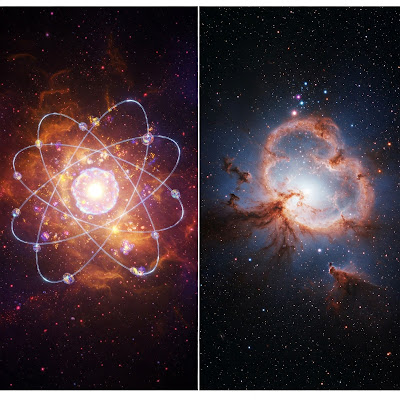
Below: how Google Gemini's Imagen 3.0 pictures the sub-atomic (not very accurately, but try illustrating a cloud of probability) and the pangalactic.

We scarcely give any thought to the fact that the chairs we sit on consist of atoms that are essentially empty space. And yet they are. A hydrogen atom is about 99.9999999999996% empty space. If the nucleus were the size of a pea, the atom would be about the size of the dome of St Paul's Cathedral. Looking out over a landscape we're seeing fields and forests, fences, clouds and sky – what we're really gazing at is unimaginable numbers of atoms.

And the planet on which we live is whizzing around our local star, one of between 100 billion and 400 billion stars in our local galaxy. Which is just one of 200 billion to 2,000 billion (or two trillion) galaxies in the observable universe.

Just as we are unable to grasp the subatomic nature of reality, we cannot grasp the galactic scale either. Yes, we can recite the numbers, how very tiny and how very huge they are, but our imaginations struggle. 

You may try to deny the reality of reality, but to do so would be to question the physicalist model agreed upon by science. No rational thinker in the Middle Ages would question the existence of God either.

As human beings, we have evolved in the meso-scale; that is where we are; what lies above and below is of no evolutionary consequence to us. Finding food, finding a mate, avoiding predators. If you can do that, you are biologically fit. 

Cognitive psychologist Donald Hoffman argues that in the same way as our laptop screens show us, via a graphic user interface, icons, words and images so that we can operate our devices, which are essentially voltages running through silicon, we relate to the world around us via a 3D graphic user interface in our mind. This interface, says Prof. Hoffman, evolved to perceive reality in a way that works best in evolution. Escaping tigers is more useful than seeing inside of an atom or scanning distant galaxies. Natural selection selected the optimal model for us to interface with reality.

Yet despite this, we cannot deny the existence of the subatomic or the innards of a black hole.

I would posit that much the same can be said about the reality of consciousness; all we know of it is what we experience at our own subjective level – qualia; units of the awareness of being. You know what it feels like to be you; you can imagine what it may be like to be me, but we'd both struggle to imagine consciousness at the subatomic or the cosmic level.

We can but intuit; reaching up to try to understand the nature of the Divine Consciousness is akin to gazing at the heavens without a telescope. 

Lent 2024: Day 24
The Ego Alone

Lent 2023, Day 24
We are all Sentinelese? 

Lent 2022: Day 24
Memory, identity and reincarnation

Lent 2021: Day 24
Reconciling science and spirituality

Lent 2020: Day 24
Refutation (II)

Monday, 24 March 2025

Why I keep blogging these Lenten posts – Lent 2025: Day 20

Blimey! Nearly three weeks into Lent and it's occurred to me that I haven't yet explained why I'm doing this series of Lenten posts on my blog! As usual, traffic is falling off (around 71,000 pageviews/month on Ash Wednesday, down to 41,000/month now). Why am I scuppering my regular readership to go off on a spiritual journey to the exclusion of my usual content?

AI generated image. Prompt: 'Preacher with Holy Book and Loaf of Bread'

Am I trying to convert people to my way of thinking? No, not really. You either hold that there's a Divine purpose to our lives, to the Universe, or you don't. If you don't – well, that doesn't make you a bad person per se. I'm not out to turn atheists into believers. Neither do I intend to proselytise Christians or followers of other faiths to abandon them for a different spiritual outlook, one that's couched in language closer to the scientific paradigm. 

{{ Anyone who seeks God shall find God in their own way. }} Since that intuition entered my consciousness one summer's night in 2021, I've made this a central tenet of my faith.

I'm writing these posts primarily for myself. So that once a year at this time I can confront my beliefs, so I can ask myself the questions that I consider fundamental to life, and that over the years I can return to these posts to see how my thinking has shifted, what new factors have influenced the way I see these spiritual matters, and most importantly – how it has become more nuanced over time. 

This is why each day there are links to the same day of Lent over the previous five years. I re-read past posts; they inspire, they suggest, they set off new thoughts and new ways of looking at old questions.

Though the posts are for a future me, they are also intended to spark thoughts and initiate discussion among readers who find this type of content interesting; if you are among them and you find some area of inquiry here worthy of comment, please do so, or drop me an email. Or mention it when we meet.

Counting pageviews is an ego thing. Reviewing my personal philosophy and approach to life on an annual basis is far more worthwhile.

Lent 2024: Day 20
Do we have Free Will? (Pt IV)

Lent 2023, Day 20
Practical uses of intuition

Lent 2022: Day 20
Free will, consciousness and determinism

Lent 2021: Day 20
No, but who are you really?

Lent 2020: Day 20
Applying Occam's Razor to your religion

Saturday, 22 March 2025

Science, spirituality and religion (Pt II) – Lent 2025: Day 18

All religions have their creation myths; their explainers about how the earth, the heavens, and we humans came about. All these myths posit the notion of some creator beings that set the whole process in motion. Religions, like genes, like memes, are subject to evolution, the survival of the fittest. Stronger religions have displaced ones less well adapted to evolving societies. Christianity has evolved and mutated into forms that the founders of the early Church wouldn't recognise. 

Out of many texts written in the first century AD about the life and times of Jesus Christ, many fell by the wayside, dismissed as apocrypha or even as heretical. A canon of 27 books (four Gospels, the Acts of the Apostles, the Epistles of St Paul and the Book of Revelations) constitutes the New Testament of the Christian Bible.

The question is: how should a Christian approach the Bible (Old Testament and New) – as literally being the word of God? As a metaphor? Or viewing the texts through the prism of metaphysics?

Literal interpretation holds that the Bible is the inerrant word of God. It asserts that as such, the texts should only be interpreted according to their plain meaning. This approach stresses the Bible's historical accuracy and scientific precision (the world was indeed created over the space of six days). Metaphorical or symbolic interpretations are rejected as heresies, because the Bible – being the word of God – contains no errors or contradictions. Everything is simple; read, believe – don't question.

Metaphorical interpretation sees the Bible as containing spiritual truths often expressed through metaphors, allegories or symbols. This approach focuses on the deeper religious significance of the texts, rather than their literal meaning. Biblical stories are there for us to interpret them for their moral and theological lessons. This approach allows for greater flexibility in interpreting the Bible, but it can also lead to subjective interpretations (In Monty Python's Life of Brian, the misheard saying "blessed are the cheesemakers" is "not meant to be taken literally, it refers to any manufacturers of dairy products". )

Metaphysical interpretation (and this is my position) is to understand the Bible (and indeed any religion's holy texts) by seeking the deeper spiritual and philosophical implications in a search for universal spiritual truths and commonalities. This approach allows the seeker to explore the nature of God, humanity and the universe by drawing on philosophical and mystical traditions to interpret holy texts. This offers profound insights into their spiritual dimensions, but may also diverge significantly from traditional interpretations. 

Many Christians believe that the Holy Spirit guides their understanding of the Bible, and that the Holy Spirit was there inspiring the original authors, and the church fathers who set the canon and edited subsequent translations and versions of the Bible over time. This notion squares with my view that intuition is of great importance in guiding one's spiritual journey.

Confronting the God of the Gaps

[Cartoon by Google Gemini Imagen 3.0. Prompt: "Confronting the God of the Gaps"]

So. As science unfolded from its cradle, more and more of the phenomena that touch our day-to-day lives became understood. Lightning, volcanism, infectious disease, one by one, these became processes explainable through testable hypotheses, proved through repeatable experiments. The scientific method pushed back the need for God as an explanation for the unexplainable. If, in 1641 Descarte uncoupled the physical world from the spiritual world, by 1882 Nietzsche had declared the spiritual world non-existent. There is nothing but matter. Matter is all, all is matter. And Darwin proved we came from the apes, rather than from Adam. 

In such an intellectual environment, taking the Bible literally is no longer a tenable position. For instance Genesis 1:1 suggests that God created grass and fruit (on the third day) before filling the heavens with stars (on the fourth day). Examples like this are enough to prove to militant atheists that all human spirituality is wrong, rather than just taking the literal approach to religious texts is wrong. Literal interpretation has been discredited by advances in scientific knowledge – human spirituality has not. As one Jewish comedian observed, Leviticus should have written: "Ye shall not eat of the swine – at least, not until ye hath invented the refrigerator".

Sticking to metaphysical interpretation of holy texts, drawing on mystical traditions, cross-referring them in the search for commonalities, common factors that unite rather than divide religions, is far more fruitful than sticking rigidly to the literal interpretations. In stating this, I draw the ire of religious fundamentalists and militant atheists.

Lent 2024: Day 18
Do we have Free Will? (Pt II)

Lent 2023, Day 18
Intuition, Consciousness and the Physical Universe

Lent 2022: Day 18
Zen in the Art of Meditation

Lent 2021: Day 18
Possibilianism

Lent 2020: Day 18
Teetering on the Edge of Chaos


Friday, 21 March 2025

Science, spirituality and religion (Pt I) – Lent 2025: Day 17

How do we explain our world? Today, we do it with science. Rationally. Reality is based on matter – matter, made of atoms, atoms that obey the laws of physics. All can be explained this way. At the base – there's physics. On top of that – chemistry. And then on top of that – biology, with us humans, at the apex. Cause and effect. All neatly packaged, everything explainable.

Yet science as we know it today might not have all the answers; reconciling quantum mechanics with general relativity, or explaining dark matter and dark energy – these increasingly seem like intractable problems. The past 40 years of particle physics has yielded little more than confirming the existence of the Higgs boson. String theory has got nowhere, as have efforts to quantise gravity. And what's beyond the Standard Model? Don't know. What was before Big Bang? We don't know that either. And consciousness remains a deep mystery for science and philosophy. But will we ever know?

Here's AI's attempt to explain what was before the Big Bang. (Quite interesting, if you look closely. Multiverses? Fake universes?)

To paraphrase Stephen Hawking, there are only three scenarios for science: 1) There really is a complete unified theory of everything, which we're bound to discover in due course. 2) There is no one ultimate theory of the universe – just an infinite sequence of theories that will describe the universe ever more accurately. 3) We are destined never to know for certain.

What if it's scenario 3? 

Science has been on a roll since Newton and Leibniz began the process at the end of the 17th century, shaping a deterministic reality in which (in theory) everything can be predicted with mathematical formulae. Yet ever since the discovery of quantum mechanics, doubt has started to creep into the scientistic world view. How can the cat be dead and alive at the same time? How do we interpret wave/particle duality? How do we reconcile classic physics with the quantum world? Cosmology, too, has sown doubt in the minds of science. What is causing the universe to expand at an accelerating rate?  How will the universe end? In heat-death? Or a Big Crunch? Will we ever know?

Maybe we need something more than science to explain the ultimate mysteries at the heart of the existence of the universe. Could it be Consciousness? Could that consciousness be what Homo sapiens has for thousands of years called God? 

Tomorrow: the religious narratives. 

Lent 2024: Day 17
Do we have Free Will (Pt I)

Lent 2023, Day 17
Intuition, Precognition, Divination

Lent 2022: Day 17
Defining God

Lent 2021: Day 17
Karma - more than just social control?

Lent 2020: Day 17
Religion and Feeling Good