Showing posts with label British cities. Show all posts

Thursday, 7 July 2022

Qualia compilation 6 - Coventry

I spent two years living in Coventry as a student, both times in the southern suburb of Earlsdon. My first year at Warwick University - my first time living away from home - was spent off-campus, a more 'authentic' experience than the cloistered island of academia. Coventry at the time (1976) was a fading industrial city, its motor-car factories by then in terminal decline. A city with its mediaeval heart bombed out by the Luftwaffe and replaced by a modern 'precinct', the post-war centre of Coventry interested me not.

Although I rambled far and wide during my four student years (the other two being spent on campus from which I'd roam south into the Warwickshire countryside), there are two specific memories of Coventry that flash back to me from time to time, more strongly than any other memories of the city. [My rural Warwickshire memories are dominated by flashbacks from the area around Catesby, but that's a separate story.]

The first Coventry qualia flashback relates to my discovery of the old gasworks on the Foleshill Road. They have long since been demolished, the site of the Coventry Arena. But in the late 1970s, the place was derelict; production of gas from coal had ceased, and the site, sprawling over many acres, was largely abandoned. There were some Gas Board offices still functioning, I recall. But - as was common at the time - nothing was closed off, there were no security guard patrols, I could just wander in and stroll around. The site was criss-crossed with railway sidings, above them high towers made of steel frames that once held aloft powerful lights to enable night-time operations. It was an overcast and cold day in early spring 1977 (or possibly '79); I decided to climb up one of these towers, all of which still had ladders attached to them. The structure was rusty, and creaking as I climbed ever higher; as I got nearer the top, the wind strengthened, and the tower began to sway gently, groaning as it did so. I caught fright and decided to climb back down as quickly as possible!

That industrial atmosphere, late afternoon, early evening, the gloomy sky, deserted railway sidings, a complex of abandoned brick buildings at the edge of the site; chimney stacks that no longer belched smoke - the atmosphere was there. Urbex before its time.

That atmosphere comes back to me unbidden every now and then. At the time I was there, it felt so familiar - but why? There's a link to the Hanwell flashbacks that I wrote about in my previous post; Bricktorian Britain, industry at the city's edge, steam and steel, iron and coal, grime and rust under leaden skies. 

The other memory I can put a more precise time - it was just before Easter in 1977, which Google informs me was on 10 April that year. I had at that time a large Scalextric model racing track (bought second-hand); in the western suburbs of Coventry there was a shop that supplied accessories for slot-cars, so off I went. It was one of those days when spring was in the air, bright with single clouds hurrying across the sky, although it was still quite cold. Unlike my gas works visit, where I could identify the place on an old map but don't remember the precise time, here I can't quite identify where it was - Binley Road? Walsgrave Road? I seem to remember a bridge over a railway cutting, but old maps show bridges over both of these roads (the railway's long gone now, replaced by a road, I see). But the atmosphere, I recall in flashbacks of qualia memory. Again - the brickwork, Victorian brick all around, but with tacky 1970s updates - shop facades in orange and purple, with-it fonts, bells that rang when you pushed the door open, streets full of Ford Cortinas, Austin 1100s, Vauxhall Vivas, Hillman Avengers and Triumph Heralds - the latter two locally built. It was the weather that brings back this scene; at least once or twice a year, the sky, the temperature, the wind - conjures up a day - not a special day by any means - but one that stuck in my memory. A time of change.

The role of consciousness in time, and time in consciousness, is something that I shall write about soon.

This time two years ago:
Masterpiece for the digital age
[No wall yet - no builders; solar panels instead]

This time three years ago:

This time five years ago:

This time nine years ago:

This time ten years ago:

This time 11 years ago:

This time 12 years ago:

This time 13 years ago:

Friday, 24 May 2019

Spitalfields and Smithfields - more from the City

Friday in the City and the chance to explore; I am often visiting the City on business and rather than head back to Ealing from the nearest Tube station, I meander westwards on foot, each time choosing a new route. There is so much to see, so much to discover, and such a rich history that is visually and intellectually rewarding.

Below: peak Spitalfields, hipster capital of London, where old brick has been put to new use. A once run-down area within walking distance of the skyscrapers of the City's financial heart has become a Most sought-after location.


Right: here we are, right at the edge. In the background and to the right, the steel and glass of a modern financial hub; the NatWest and RBS buildings on Bishopsgate. In front of them and to the left, the early Victorian brick and cobbles of Spital Yard. The 'Spital' comes from St Mary's Hospital, founded in 1197.

The district was associated with weaving, cloth-making and garment manufacture with successive waves of immigrants since the 17th century - Huguenots, Jews and Bangladeshis - establishing themselves and their businesses around here.

The gatehouse to St Bartholomew-the-Great church. There are two parishes side by side; St Bartholomew-the-Great and St Bartholomew-the-Less, formerly the parish church of Bartholomew's Hospital, ('Barts'), the teaching hospital, founded by the Augustinian Friars in 1123. The entire complex stands between Smithfield Market to the north, the Old Bailey (Central Criminal Court) to the south-west and the Bank of England to the south-east.

London's rich mediaeval history was mostly destroyed in the Great Fire of 1666 but St Barts survived.
Right: the word 'bedlam' comes from the corruption of the word Bethlehem, which by 1460 had become Europe's first psychiatric hospital. This plaque is to be found by the Liverpool Street entrance to Liverpool Street station.

The words 'hospital', 'hostel' and 'hotel' derive their etymology from the same route (the dropped 's' replaced by the circumflex over the 'o' as in the French spelling of hôtel. Originally, "hostels of God," early mediaeval hospitals provided hospitality to guests - pilgrims - and patients alike. Only after the Dissolution of the Monasteries by Henry VIII in the late 1530s did the roles of hospital and pilgrim's rest begin to diverge.

Left: the entrance to the Museum of the Order of St John - the Knights Hospitaller, located in Clerkenwell in the old priory gatehouse, built in 1504. The museum tells the story of how the monastic order was founded in the 11th century during the First Crusade in Jerusalem to look after Christian pilgrims travelling to the Holy Land - and how it subsequently turned into what is now St John Ambulance Brigade. The brigade's logo - the Maltese Cross - seen on the pavement - shows the continuity of the organisation spanning almost one millennium.

Left: Lowndes House, No.1 City Road. Built in 1929 in an imperial style that would already have appeared dated at that time when modernism was the rage, this was the London headquarters of the Singer Sewing Machine Company. Singer's UK manufacturing facility was in Glasgow. Compared to other Singer buildings - such as the one in St Petersburg - quite modest. Singer was one of the first American multinational corporations, with a global reach well before WW1. Today, the Grade II listed building serves as a Travelodge hotel.


Below: O joy! I walked the length of Spitalfields' Elder Street, expecting that a good street landscape would be spoilt by modern cars. But no! A Bentley S1, built between 1955 and '59. And how perfectly placed, at the end of the street...


...standing next to a Morris Minor Series II convertible (1952-56)! A marvellous sight! Both displaying the patina of decades of driving.


Below: onwards from Spitalfields to Smithfields - and another classic, somewhat younger (late 1970s, so only 40 years old) MG MGB Roadster passes the meat market.


Left: at Smithfields, to find the house in which lived Sir John Betjeman. It's here - at 43 Cloth Fair, the entrance being on Cloth Court. This was his London home from 1954 to 1972, with an interlude (1958-59) living at Rotherhithe while the flat was being refurbished following a fire. A fine location from which to explore the City, Those 18 years saw many historic buildings making way for steel-and-glass offices.


Right: blue plaque over the door to Sir John Betjeman's flat. His youthful explorations of the City of London were described in Chapter VI, his autobiographical poem, Summoned by Bells; he would visit the City's churches on Sundays, drawn towards the more obscure ones.

Below: Christ Church, Spitalfields, a Hawksmoor design. It was one of a spate of churches erected as a result of the work of the Commission for Building Fifty New Churches. Not 50 but 12 arose in and around London in the first half of the 18th century; this one in particular to minister to Huguenots who had fled France to England to avoid religious persecution at home. To the left of frame in this photo, Spitalfields Market. Street food and street fashions.


By the 19th century, the mission of Christ Church had changed with the coming of a new influx of immigrants - Jewish refugees from the Russian Pale of Settlement. The London Society for Promoting Christianity Amongst the Jews was active in this parish, as can be seen in many of the plaques inside the vestibule, commemorating Jews who had converted and those who ministered to them (below).


Left: another literary 'JB' - John Bunyan, author of Pilgrim's Progress. Here is his grave, at the Bunhill Fields Burial Ground. As with the works of John Betjeman, I was introduced to Pilgrim's Progress at school. All I can remember of Bunyan's book are the words 'Slough of Despond'. Also buried here are Daniel Defoe, author of Robinson Crusoe, and William Blake.


16,000 paces walked today - a good result.

This time two years ago:
That tune going round your head now...

This time three years ago:
The eyes... the eyes... 

This time four years ago:
New old terminal open at Okęcie airport

This time six years ago:
Arrogance vs. humility 

This time seven years ago:
Warsaw looking good ahead of the football-fan influx

This time ten years ago:
Heron over Jeziorki

This time 12 years ago:
Present rising, future loading

Wednesday, 21 November 2018

Wider-angle London...

I usually travel with my trusty (and really excellent for the money) Nikon D3300 with its kit 18-55mm lens; a mildly wide to (very) mildly telephoto lens. Knowing I'd be in two cities that amaze with their architecture, I elected for this trip Kingdomside to take the superwide 10-24mm Nikkor zoom. So here's a bit of London...

Below: I love every bit of St Pancras station. It has been so beautifully restored; the grimy brick of my childhood also had its charm (I remember when Scammell Scarabs plied the Midland Road). I can imagine Victorian railway officials at work, poring over forms, in those windows to the left, as smoke billowed over the turreted rooftops.


Below: hidden behind London's main streets are the mews - the stables in which rich folks' horses were kept, and above them stables for coachmen, grooms and ostlers. These days mews, with their historic character and cobblestones make for desirable residences for many a million.


Below: Regent Street, looking south. There are 12 days of Christmas, but none of them fall in mid-November. The Xmas lights are up, reminding us to part with our money to buy things we don't need. I mean for Christ's sake, Black Friday's still four days away...


Below: into the City of London, Bishopsgate (one of the Seven Canonical Gates of London - Aldgate, Ludgate, Moorgate are the ones that most readily spring to mind). Bricktorian Britain jostles with the New.


Ah now! This is interesting! The corner of the Old Brompton Road; a grocery store goes out of business, the shopfront is taken down, and a ghost sign appears - and what an interesting one! Borgward was a postwar German car brand that itself went out of business (in 1961), not before producing some nice cars (the Borgward Isabella coupe was particularly attractive). The sole concessionaire for the UK market was Metcalfe & Mundy Ltd. All history now - worthy of note.


This time last year:
First snow. first frost of the year

This time eight years ago
Childhood memories of Warsaw

Wednesday, 4 July 2018

Bristol fashioned

To Bristol, along Isambard Kingdom Brunel’s Great West Railway, calling at Reading, Swindon, Chippenham and Bath, the journey fast and pleasant. A business trip to see a prospective client, four hours’ spare time to have a look around. I’ve not been to Bristol before – certainly not to the city centre, so I made the Most of the chance to see another great British city, historically and economically. As a port, it shares much with Liverpool; built on the transatlantic trade in cotton and slaves. A university city too, the fine buildings located in the centre.

My exploration of Bristol began and finished at Temple Meads station, built in 1843 as (at the time) the western terminal of the GWR. It’s a large station with 15 platforms and an iron and glass roof. The cry of seagulls greeted me as I stepped off the train. Of for my meeting, then a chance to explore the city centre, after which I walked right across town to see the famous Clifton suspension bridge. I must have seen it in early childhood around the time we lived in South Wales. My mother drew a picture of it in pencil on a wooden brick I played with. Along the way, impressive architectural heritage. Unlike Liverpool, there’s no waterfront focal point; the Avon is a much narrower river than the Mersey. And unlike Liverpool, the city is built on steep hills overlooking the river, creating a geography of streets sloping steeply towards the waterfront.

Across the Avon I could see the SS Great Britain, technological marvel of its time, an iron-hulled steamship powered by screws (although the sails were still there). For 1845, a breakthrough. The world's longest passenger ship at the time. Further on, abandoned wooden wharves stand rotting in the shadow of the suspension bridge, a picture of decaying Victorian infrastructure that’s quite unusual in modern Britain.

A massive day’s walking (total over 21,000 paces of which 15,000 were in Bristol). My ticket was purchased via the TrainLine app; this was my very first rail journey in the UK without a piece of paper or card to show to the guard. I’ve been using my phone for plane and train tickets (in Poland) for some time so it’s good to see an alternative to buying online and having to collect the tickets from a machine at the station before departure in the UK.

Below: Temple Meads station. Opened in 1843. That's 175 years ago. Since then, trains have been bringing people here continuously. That's amazing. Gothic Revival, the magnificent roof over the platforms to the right, the main building set at an angle.


Below: the SS Great Britain, along with HMS Victory (Portsmouth), the Cutty Sark and HMS Belfast (London), is one of the famous museum ships that present Britain's glorious maritime past.


Park Street goes up a steep hill from the Cathedral to the Wills Memorial Building, which despite its medieval appearance was opened in 1925 - the last major piece of Gothic  Revival built in Britain. Today it's part of the university . The street itself is testament to the decline of  British retail, with many charity shops and used clothing stores on either side.


The university buildings remind me of Harrow School, but are late-19th century (University College Bristol opened in 1872, the University of Bristol - with royal charter - as late as 1909. Established with money made by selling cigarettes (the Wills family) and chocolate (the Fry family), Bristol is one of the UK's nine 'redbrick' universities, set up at the end of the 19th and beginning of the 20th centuries. Below: the School of Geographical Sciences.


Below: Bristol's very own Wallace Collection - in the 1940s, Bristol was home to the aviation industry (the Blenheim, Beaufighter and Brabazon); today, Bristol is famous for its claymation movies, made by local company, Aardman. Here is Wallace, dressed as a gnome, outside the city's cathedral, established in 1140, though with plenty of Victorian add-ons, including the towers.


Below: I had to wait a few minutes to get this shot of the Foster's Almshouses, there were so many foreign tourists snapping away at it (from France, the US and China). A Victorian building standing on the site of a poorhouse dating back to the 15th century, funded by merchant John Foster.


Below: this waterfront building dates back to 1823; Purifier House was a former gasworks converted into flats. A ground-up rebuild took place (photos on Google Earth Street View show only the left-hand wing standing in 2016).


Below: the Clifton Suspension Bridge, completed in 1864 can rightly be said to be iconic, its image being used so often to promote Bristol and indeed the UK.


South of the bridge, a stretch of waterfront abandoned to the elements; rotting wharves that should have been preserved or demolished, very attractive to the photographer and urban explorer.


The old wharves stretch on and on along Hotwell Road... It's a real surprise to see such dereliction in such a prime location today.


Bristol requires a revisit. A bustling, dynamic city of half a million people, I'd rank it as one of the UK's must-see cities (though Liverpool appeals to me more somehow). Four hours is not enough to explore it. Architecturally, there are many gems to be seen, but the city attracted too many Luftwaffe bombs, losing over 3,000 buildings during WW2. The gaps were filled by much mundane '60s and '70s stuff that creates an overall sense of loss; how the city might have looked with far more of its original architecture intact.

This time last year:
The imminent closure of Marks & Spencer in Warsaw

This time five years ago:
Along mirror'd canyons

This time seven years ago:
Mad about Marmite 

This time eight years ago:
Komorowski wins second round of Presidential elections?

This time nine years ago:
A beautiful summer dusk in Jeziorki

This time ten years ago:
Classic cars, London and Warsaw


Tuesday, 5 December 2017

Milton Keynes

Apologies for not updating sooner, have been very busy in London these past few days. I'd like to share my impressions of Milton Keynes, a town I visited on Monday. It stands as testimony to a bold social-engineering experiment begun half a century ago - to create a brand new modern city around a grid pattern of roads running north-south and east-west, each grid being roughly a square kilometre.

Roads are named 'H' for horizontal (east-west) 'Ways', and 'V' for vertical (north-south) 'Streets'. Built for the car, the Ways and the Streets intersect at roundabouts (no traffic lights on the grid) to allow for high-speed travel. But the cyclist and pedestrian were not ignored at the planning stage; there are plenty of cycle paths augmenting the road network.

An urban area of nearly a quarter of a million population, larger than say, Radom or Częstochowa,  or for that matter Northampton, Norwich or Ipswich, Milton Keynes has a prosperous air about it.

Below: Milton Keynes Central railway station (to the left), one of six stations serving the town, and the only one to have either 'Milton' or 'Keynes' in its name. The station itself is busy and extremely well connected with London, with up to eight trains an hour. Buying an off-peak return ticket on Saturday for a Monday journey cost me a mere £12.


Work to build Milton Keynes - a central business district surrounded by six existing villages - began in the late 1960s, and some of the architecture looks decidedly passé and shabby. The Old Bus Station has now become a car park. Given that the fastest journey time to London Euston is 30 minutes, the average is 38 minutes (48 miles/77 km), Milton Keynes is also an attractive dormitory town for the capital. It would be interesting to know how many people commute into London from here.


Housing in Milton Keynes is rather attractive - a kind of neo-vernacular Brookside Close, with tightly controlled architectural designs ensuring a harmonious visual environment. Features such as gabled dormer windows, decorative brickwork and traditional materials hark back to local history.


The interface between parkland, footpaths and roads. Below: this is H6 Childs Way crossing over a footpath that links Tear Drop Lakes to the housing estate shown in the above photo. Note the exposed concrete (béton brut) used for the ramparts - a very 1960s feature, now disappearing under ivy.


One of the Tear Drop Lakes (below) reminds me of Jeziorki - can you see the grey heron? It allowed me to get far closer to it that ones back home do. The wooden pier has been cordoned off for safety reasons. This tranquil scene is less than 500m from Milton Keynes Central station, and shows how closely nature can sit beside a thriving urban centre.


Back to catch my train, I glimpse the future as it was seen in my childhood; mirrored glass buildings set amid manicured landscapes, intersected by fast roads and railways (this footbridge crosses both).


It would be valuable to spend more time in Milton Keynes (preferably on a day of longer daylight duration) to get a better idea of the town's character; my first impressions were curiously positive; there's already an air of nostalgia about a vision of the future as seen from the not-to-distant past.

This time last year:
Warsaw by night, early winter

This time four years ago:
Burn less gas and do Ukraine a favour

This time seven years ago:
Early evening atmosphere

This time nine years ago:
Toponyms - how many names has Jeziorki?

This time ten years ago:
On the road to Białystok

Wednesday, 22 November 2017

Edinburgh - walking the Water of Leith

My eternal guide to Edinburgh is Miroslav Sasek, the Czech illustrator whose This is... series of travel books for children gave me a grounding in the great cities of the world as a small boy. This is Edinburgh (1961) ranked Scotland's capital alongside London, Paris, Rome, Hong Kong, Venice or New York when it comes to visual amazingness. My father would borrow the large-format picture books from Ealing public library and I would love to read them.

I have been to Edinburgh eight times over the past ten (blogged) years; the city never fails to appeal to my aesthetic sensibilities; it's certainly a place everyone with an interest in history, culture and architecture should see at least once.

Squeezing in some sightseeing around business trips as I do, however, Edinburgh requires repeat visits to get in all of its main attractions. I've already been to the castle, seen Holyrood Palace and the Scottish Parliament, walked down the Royal Mile, climbed Arthur's Seat and Calton Hill, and explored the New Town. But I haven't yet done the Water of Leith walk, which my childhood memories of Sasek focus on a picture of a spectacularly high, arched brick bridge with double-decker buses on it. This is the Dean Bridge, carrying the Queensferry Road over the Water of Leith.

So with two afternoon meetings ahead of me, I set off on a rainy morning to take in that corner of Edinburgh that I've never yet been to. And seeing it in late November, there were few tourist and only a handful of hardy local dog-walkers and strollers out and about in this weather.

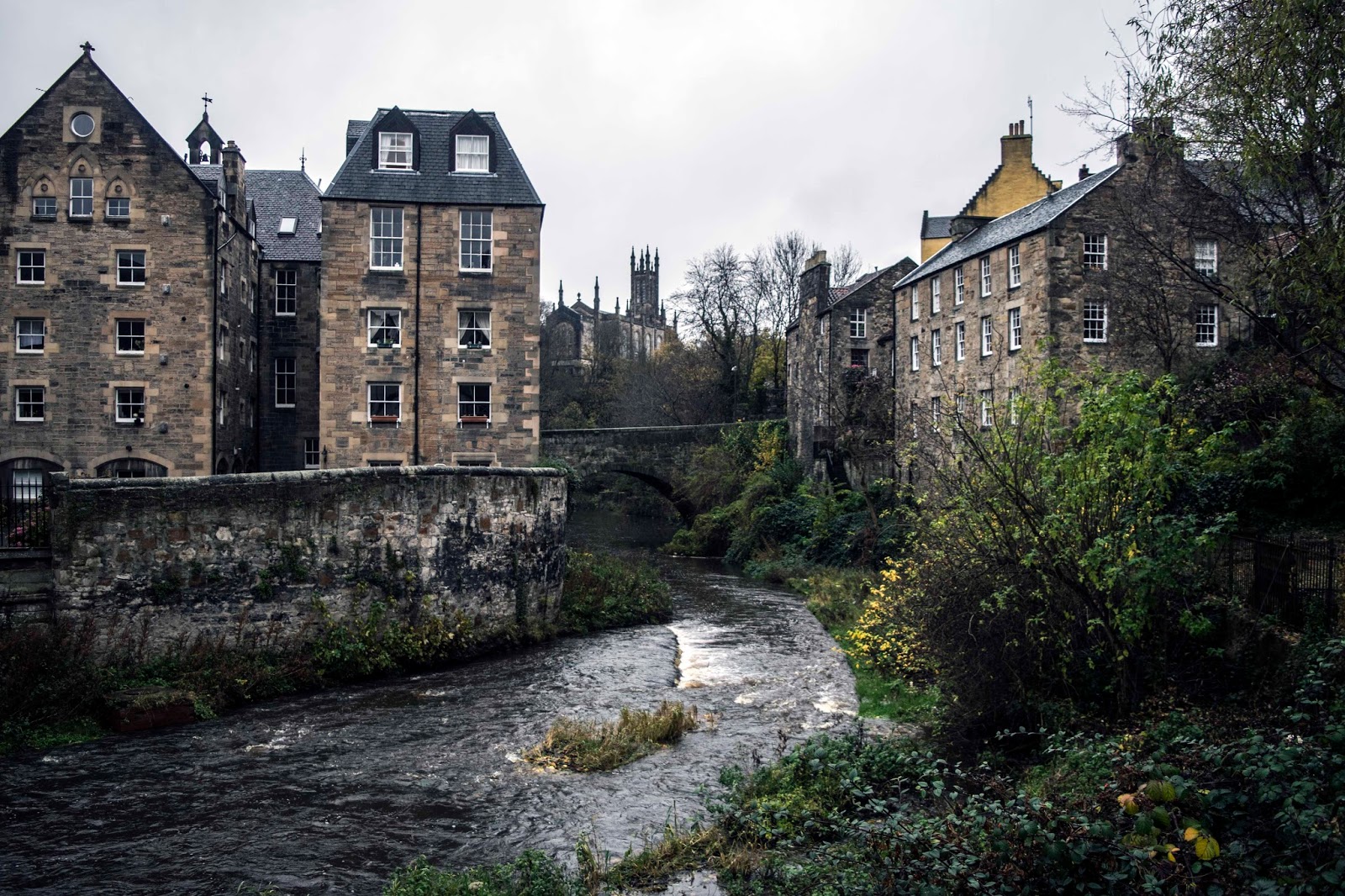
The Water of Leith is the river that rushes tumultously through Edinburgh, with many weirs and waterfalls along the way, skirting north of the New Town on its way to the Firth of Forth at Leith. Passing through the Dean Village, the river is at its most picturesque, adding yet another must-see area to the agenda of anyone visiting Scotland's capital.


The Water of Leith disappears over a waterfall. One thing I'm not too keen on is the mustard-and-custard colour schemes of non stone-faced houses.


Classic MGB GT, echoing this picture from another capital city's riverside...


Dean Bridge; not as spectacularly tall as Sasek had led us to imagine, but with a bus on top.


Dean Bridge, seen from Miller Row. According to Sasek, the bridge is 106ft over the river.


Here's Sasek's take on the views above - a slight exaggeration of vertical scale, though I guess he'd have set up his easel higher up than my camera's eyepoint.


And his view (turned some 30 degrees to the left of my photo below).

Stone tenements, church tower, bridge and rushing waters.


And maybe sweep to the left to bring in that courtyard...


Below: on through the next section of the Water of Leith, where I espy St Bernard's Well. Risking a slip. I edge out over exposed rocks to get this shot from (almost) midstream.


Below: St Bernard's Well, this time from the footpath.


Below: the bridge linking India Place and Dean Terrace; note the solid and ornate construction of the steps from the riverside up to the bridge.


Below: looking west along the Water of Leith from the bridge above. Rain on the cobblestones adds the appeal.


Below: a curious clock tower perched on a building on the north side of the bridge taking Kerr St over the Water of Leith.


Left: flights of steps, a stone-clad retaining wall, a pillar-box, and umbrellas in the rain. North West Circus Place at the junction of India St.

It rained solidly all day; after walking for the best part of two hours, I was drenched and had to return to my hotel (the eminently reasonable Frederick House Hotel) to dry my outerwear with a hair dryer! I cannot remember having been so wet in many decades!

This time last year:
Poland's north-west frontier

This time two years ago:
Cars must fade from our cities

This time four years ago:
Unnecessary street lighting wastes money

This time five years ago:
Warsaw's heros on the walls 

This time six years ago:
Tax dodge or public service? 

This time eight years ago:
Warsaw's woodlands in autumn

This time nine years ago:
Still here, the early snow

This time ten years ago:
Another point of view