Showing posts with label Poland. Show all posts

Monday, 28 September 2026

Some thoughts about blogs and blogging

Yesterday, I met up with my fellow-bloggers from While not null (over from Australia, whose splendid initiative it was to meet) and Politics, Economy, Society to chat about the future of blogs and blogging in the current age.

Blogging has gone through several changes since we got started many years ago. In the early years, just about everyone had a blog, but within two years (on average, according to Google), 90% of those blogs had fizzled out. The next phase was the monetisation of blogs, search-engine optimisation. This led to square kilometres of slop being (manually at this stage) produced with the commercial aim of driving online traffic to advertisers.

At the same time, other forms of social media began to expand, elbowing attention away from a form requiring more attention to read and indeed to produce. Blogging began to ebb. 

Twitter was originally categorised as a 'microblog'; Facebook moved in that direction when it added status updates. Indeed, I see my own blogging output fell sharply as I signed up for those two. It fell (from 250-300 posts a year to around 170-200 posts a year), but has stayed consistently at that level since around 2014. Since then, I've remained on Facebook but have quit Twitter after Musk deformed it.

My posts today tend to be longer and more considered than in the early days, but over the nearly 20 years since I started, there's a consistent thread running through the blog.

My blog aims to show over time the passage of time. That's the purpose of the 'This time x years ago' feature at the bottom of each post. Searchable memory of ordinary things – how they looked before they changed; the ever-shifting  texture of reality. What the railway used to look like, when the snow arrived, what local shops existed, what people drove, how the landscape changed, how a road looked like before all those new houses came. What seems mundane now won't in 2046.

I can now see just how far Poland has progressed since I started blogging, less than three years after joining the EU. Today, I can identify the tipping point at which Poland ceased being a post-communist hardship posting and became a normal country. It was the day I travelled from Warsaw to Kraków in a day and everything worked out fine – November 2014 ('Poland – it works!')

My blog is an authentic voice, increasingly rare on an internet in which so much prose has been professionalised, optimised, monetised or, now, AI-smoothed. My photography is there to prevent the blog becoming merely a diary of opinions. Over the years, thousands of photographs build up a visual record of Warsaw and southern Mazowsze which would be difficult to reconstruct retrospectively.

My old question about 'am I a generalist or specialist' is being settled; over the years a pattern is emerging; the topics I like to write about, those I tend to steer clear of (politics being one). 

In an age of AI-generated content, where writing style is becoming samey ("Not this. Not this. Not this. But this. And this is quietly important"), authenticity is all important. Today, synthetic, auto-generated text has led to the collapse of commercially driven blogs. This has cleared the ground for blogging to re-emerge purely on aesthetic, essayistic and archival terms. And this is where this blog fits.

Having been freed from the expectation of being mass-market commerce, I hope that the blog has established its place as a distinct literary and visual format and will survive into the future in the way that radio and cinema survived TV and TV has survived the internet.

Today I noticed that next year, Easter falls on 28 March. This means my Lenten cycle of blog posts will be finished before 1 April, being the 20th anniversary of this blog. The event will be marked with a very special post and a revamp with some new features.

This time last year:
Last evening in shirt sleeves?

This time two years ago:
Anomalous landscapes amid local forest

This time six years ago:

This time seven years ago:
A change in the weather

This time eight years ago:
Zamek Topacz classic car museum

This time 11 years ago:
Curry comes to Jeziorki
[It didn't stay long. Decor matters!]

This time 13 years ago:
Why we should all try to use less gas

This time 13 years ago:
Polish supermarket chain advertises on London buses

This time 18 years ago:
Well-shot pheasants


Monday, 20 July 2026

Fifty years on

Today is the fiftieth anniversary of my departure on a holiday that would significantly shape my identity, as well as the future course of my life. I wrote about it ten years ago, link here.

My three holidays to Poland organised by the Polish priests in Ealing for their young parishioners took place in the summers of 1976, 1977 and 1979, and proved extremely formative for me. Certainly these visits were a key factor in my moving to Poland.

The 1976 trip occurred just after I had finished grammar school. While on that holiday, I was awaiting a telegram from my parents informing me how my A-level exams had gone – and which university (if any) would accept me. I got that telegram in Poland (Gdańsk, I seem to recall) – the news was good. My grades were sufficient to get me into Warwick, my first choice.

As our coaches crossed the border from East Germany, we were driving into a country that a month earlier had seen significant workers' protests at rising living costs in Radom, Ursus and Płock. No official news, of course, only word-of-mouth rumours. From the windows of the coach, I saw a high-tension pylon lying on its side in a field outside Radom. Had it been brought down by protesters? Or was it waiting to be erected? Who knew? These protests would ultimately lead to the birth of Solidarity four years later.

I wrote ten years ago about the religious nature of the holiday. As well as the daily masses and rosary, there was also plenty of time for philosophical discussions, about religion, ethics, life, the universe and everything. Not to any great degree of sophistication, but enough to engender a lifelong interest in 'small-p' philosophy.

This was also the last summer before the punk-rock revolution – but more about that in a post on this blog this autumn, on the 50th anniversary of me catching a gig by two bands entirely unknown to me at the time – the Sex Pistols, supported by the Clash. That, plus a year of living away from home as a student, completely changed my attitude to church-going and authority in general, so when setting off on Montserrat 1977, it was with a radically different world-view. Yet Poland was still Poland. eternal, drawing me back.

Who'd have thought, fifty years ago, that I'd be sat here on my own little acre, surrounded by 12 cats, living in a free, peaceful and prosperous Poland? 

This time last year:
Letters to an Imaginary Grandson (VI)

This time five years ago:
Memory, collective memory and proof of memory

This time eight years ago:
And did Her feet...?

This time 11 years ago:
Last night's storm

This time 12 years ago:
Drifting south with the sun – bicycle hobo
[On this trip I would first encounter Jakubowizna...]

This time 14 years ago
The Royal Parks in the rain

This time 17 years ago:
Conservatism – Polish or British style?

This time 18 years ago:
Wheat and development

This time 19 years ago:
Waiting for the summer rain

Saturday, 27 December 2025

The Long Review of 2025: Pt I

What a year! Two life-changing events for me (more on both in subsequent posts), namely a heart attack in April and the shift from being pet-free to sharing my small house six cats. Just kind of happened.

But I'd like to start this cycle of posts reviewing 2025 with something else that interests me – Poland's development, as seen from the local, regional and national level. I have now lived 28 years in Poland, and during that time, the national quality of life has gone up and up and up, though it must be said, from a modest base. This blog records 18 of those 28 years, and looking back, I can see numerous tipping points, technological and infrastructural, that make life more comfortable, easier.

This year, that progress has been equally visible. Poland's improvement makes a contrast with the austerity-level stasis that the UK is experiencing since the global financial crisis of 2008. Poles today are on average 50% better off than they were 20 years ago, whilst Britons are earning less in real terms than they were 20 years ago. And unlike the UK, where the nation's wealth remains resolutely concentrated in London, one can see Poland flourishing in every corner.

This year, most of my longer journeys took me to destinations east of the Vistula, which makes up for absence there in recent years. I visited Kazimierz Dolny, Białowieża, Przemyśl, Zamość and Rzeszów, by car and by train and was impressed at the huge improvement in the road network. Two major station remonts were completed this year, Warsaw West (W-wa Zachodnia) and Rzeszów Główny, although the former still awaits its underground tram connection. Warsaw's tram network remains a work-in-progress, although it's now possible to take one down ulica Rakowiecka (finally finished). 

A propos of my travels in 2025, worthy of note is my overnight stay in Wawel Castle ("free to those that can afford it, very expensive to those that can't"). Kraków, south of the river, has also seen big leaps forward in construction and infrastructure, although it does remain the victim of over-tourism.

Locally here in Chynów, many infrastructure improvement projects were carried out and completed this year (for instance here and here and here), with many more in the pipeline for next year. Chynów has a new supermarket (Deko Market, its third), and a second kebab outlet (Amigo Kebab), though unlike the Luxor Kebab, which opened in 2024, there's no indoor seating. Maybe the new retail centre next door to the old retail centre, completed but not yet let out, will see another eaterie. The old BP petrol station, which became a TransOil petrol station in April, has a great little restaurant opening by it, Zajazd u Latoszków. Weekday lunch menu 30zł (soup and generous main course).

I mentioned recently that a new, long, pavement will be built connecting the level crossing in Jakubowizna to Chynów station and then on to ulica Wolska. Below: ul. Kolejowa, Chynów station behind me and to the right. The asphalt is recent (before, the road would flood from edge to edge after any thunderstorm), the posts preventing pavement parking appeared this spring. By next spring the pavement on the other side of the road should be complete too. And parking facilities. As I wrote earlier this month, the number of bicycle stands on the Jakubowizna side of the station has tripled.

The election of a young and dynamic wójt (mayor of a rural municipality) will see greater dialogue and transparency when it comes to choosing priorities for further roll-outs of local infrastructure.

Below: fibre roll-out... optical fibre has been laid along the entire length of my lane. This roll, just outside my front gate (I presume looking at its length) is long enough to stretch to my house, but not to the houses beyond in Grobice. One gigabyte per second here we come!

Meanwhile, back in Jeziorki, ulica Karczunkowska still doesn't have a pavement.

This time last year:|
Jacek Malczewski exhibition, Radom

This time two years ago:
Back out into the open


This time four years ago:
Wintery gorgeousness and filthy air

This time five years ago:
Jakubowizna – moonrise kingdom

This time eight years ago:

This time 11 years ago:
Derbyshire in the snow

This time 12 years ago:
Is Britain over-golfed?

This time 14 years:
Everybody's out on the road today

This time 15 years ago:
50% off and nothing to pay till June 2016

Wednesday, 1 January 2025

Poland's progress

Today is the first day of Poland's six-month presidency of the Council of the European Union, and is an opportunity to look at the country's recent progress and future prospects. This blog post will be a purely subjective big-picture view (after all, if it's macroeconomic data you want, you can look it up online). 

My views are based on observations, anecdotes, countless discussions with people in business, gut feeling (or instinct), as well as something metaphysical – intuition.

You can look at Poland from close up and point to the negatives – stubbornly high inflation, deteriorating current account, demographic collapse, geopolitical threat, and the precarious economic situation of its major export markets. Yet I remain optimistic – as do the analysts. The OECD's latest forecast for Poland's GDP in 2025, published last month, points to a likely outcome of 3.2%, up from the 3.0% expected by economists for the whole of 2024. This puts Poland into the group of best-performing EU economies, and far outstrips the UK, currently struggling to avoid falling into recession (again). Unemployment is historically the lowest it's been since the end of communism (when in effect it was hidden). Poles are wealthier than ever, which is reflected in their tendency to buy new cars and travel on exotic holidays.

Thirty-five years ago, when finance minister Leszek Balcerowicz unveiled his plan to transform Poland's collapsing command economy, there was a joke going around: "There are only two ways in which Poland's economy can be fixed: the normal way, and the miraculous way. In one, the Blessed Virgin Mary descends from the heavens, raises up Her arms – and the economy is working. In the miraculous way, the Poles do it for themselves." 

Looking around Poland today, I see a country growing in self-confidence, increasingly at ease with itself. The new roads and railways, the new office developments, the logistics centres, the data centres, the refurbished buildings, the countless restaurants, cafés and bars, do not fail to impress. 

So how did all this happen? Miracle or Poles' own efforts? A bit of both. Strokes of luck, good macroeconomic judgment and above all, the determination of a people wanting to better themselves through hard work.

Believing strongly in behavioural economics, I sense that determination is a key factor. It is not controversial to rank populations in terms of their height or body-mass index or (more controversially), IQ. But I'd suggest something more radical – ranking countries by the determination of its entrepreneurial and managerial classes. And here, observing two groups, two nations, from close-up, I'd say that Poles tend to show greater determination, more fire-in-the-belly, more get-up-and-go, than contemporary Britons.

This is purely a subjective view. But seeing the ease with which British companies and British shareholders sell up to foreign bidders makes me think that as a nation, Britons are more content to sit on bags of money than to manage businesses. Tesco, Aviva, Sage, W.S. Atkins, Cadbury's, Pilkington, BOC – a few of the UK firms that came to Poland and sold their business units here to their foreign competitors. The collapse of the UK-owned motor industry is another case. Rolls-Royce, Bentley and Mini are now German-owned; Land Rover and Jaguar Indian-owned; MG is now a Chinese car brand. 

Poland, on the other hand, started from a different position. One (miraculous?) reason why Poland's economic transformation – tough as it was at the outset – has largely been successful is the way the state-owned industries were privatised. These did not end up in the hands of thuggish oligarchs who corralled enough share certificates from workers to become owners of factories, mines and refineries, but were sold to foreign investors, most often corporations. The new owners brought in new technologies and new management methods, and while not always successful, new value was created for the Polish economy as a whole. 

One that I visited before Christmas was the Reckitt factory in Nowy Dwór Mazowiecki, which had been a state-owned Pollena soap factory. Today, the plant is five times bigger, and produces detergents for domestic and export markets, while still employing the same number of people (2,250). Reckitt produces several billion dishwasher tablets there, which are sold in 34 countries around the world. Another factory I have visited in Twining's tea factory near Poznań; a marvel of automation that exports tea to over 90 markets. The Polish head of the factory is also responsible for running Twining's tea factory in the UK. Twining's' owner, Associated British Foods, also has its world-foods factory in Poland, near Zielona Góra,, making Patak's, Rajah and Blue Dragon sauces there, again, mainly for export.

My observation on foreign direct investment is that in most cases, the investor is so happy with the way things are working out in Poland that profits are reinvested here, and new jobs are created. The list of companies that keep growing their global-services hubs in Poland includes Shell, HSBC, Standard Chartered Bank, GlaxoSmithKline and AstraZeneca. Managers visiting from London are amazed by what their Polish employees can do. "Can you do this?" "Yes we can!" "Quantitative analysis?" "Yes!" "Can you find another 50 maths PhDs?" "Yes!" And so it grows from year to year. "Can you jump this high?" "Yes we can!" "Can you jump this high?" "Again – we can!"

And here's my fundamental question: Can Poles jump for themselves? 

Can Poles set up their own companies and grow them, rather than merely manage them (well) for someone else? I believe that as Polish businesses mature, they will be increasingly set on foreign expansion. The UK is a target-rich environment for them. Last year saw the acquisition of Thomas Cook (the world's oldest travel agent) by Polish firm eSky, a start-up 20 years ago; fresh-fish distributor Copernus from Hull by Suempol, Andover Trailers by EmTech, and John Menzies News Distribution by InPost. These come on the heels of the acquisition of JDR Cables (factories in Hartlepool, Littleport and now Blyth) by TeleFonika Kable, and of Rawlplug by Koelner.

The further acquisition of British businesses by Polish ones will be a litmus test of the condition of both economies' level of determination. Poland is increasingly seen by the UK media as an economic success story, and its political influence in Europe is growing. 

May's presidential election will be one to watch.

This time last year:
Time, memory and consciousness

This time two years ago:
Hottest New Year's Day in Warsaw ever 

This time four years ago:
Wealth and inequality – an introduction

This time six years ago:
Gratitude for a peaceful 2018

This time eight years ago:
Fighting laziness – a perennial resolution

This time eight years ago:
A Year of Round Anniversaries

This time nine years ago:
Walking on frozen water

This time ten years ago:
Fireworks herald 2015 in Jeziorki

This time 11 years ago
Jeziorki welcomes 2014

This time 12 years ago:
LOT's second Dreamliner over Jeziorki

This time 14 years ago:
New Year's coal train 

This time 16 years ago:
Welcome to 2009!

This time 17 years ago:
Happy 2008!

Tuesday, 1 October 2024

October and the Waning Year

The older I get, the more aware I am of living on the surface of a spinning rocky sphere that orbits a star. And as the sphere progresses around the star, it does tilted at 23.5° from the vertical. As I wrote the other day, this means we spend (just over) half the year with our hemisphere tilted towards the sun (our summer), and (just under) half the year with our hemisphere tilted away from the sun (our winter).

As I wake up on Tuesday 1 October, the temperature outside is 0.3C, although I couldn't see any signs of frost on the ground. For the first time since April, the temperature in the kitchen has fallen below 20C (although it soon warms up as I make coffee). The tipping point is now near, that moment when I have to start heating the house. The thick walls have absorbed summer heat admirably; last year I didn't switch on the underfloor heating or the bedroom radiator until 22 October, but last year broke records in terms of early-autumn temperatures. Colder this year, but still not duvet time, although I've had to take the pyjamas out of the wardrobe.

Even two weeks ago I could leave the house and go into town wearing a shirt, with a lightweight jacket in my rucksack for the cool evening or passing shower. Now, it's back into three-layer weather. The sky is cloudier, but not overcast; the year has been dry – maybe too dry for what farmers need. Climate change won't make Poland unbearably hot, but it will dry the country out. Droughts, punctuated by flash floods with the potential for local devastation as we saw last month.

The temperate climes of this latitude are none too harsh, either in terms of summer heat or winter cold; as the days march inexorably towards the winter solstice I must give thanks for where I live, and indeed how I live.

Below: Warsaw, today. Make a mental note to return to this photo in three years' time; the skyline will have changed even more once the Towarowa 22 (which will rise to the left of the Warsaw Unit tower) and Polfarma developments (behind it) are complete. 


Below: Warsaw, earlier. A view looking towards Rondo Daszyńskiego from the approaches to W-wa Wola station.


Incidentally, I looked up how many people live between 51° and 52° parallels North; it is 45 million people. This band covers London, Berlin and Warsaw, though further east it runs through sparsely populated lands; southern Siberia and northern Canada. The most populous parallel band lies between 29° and 30° North, with around half a billion people – ten times more. This band runs through China, India, Pakistan and Bangladesh, Egypt, Mexico and Texas. 

This time last year
Marching again (ahead of the election)

This time two years ago:
Levels of Detail

This time three years ago:
Droga donikąd by Józef Mackiewicz

This time four years ago:
Words that pop into the mind, unbidden
[This morning's word: contumely]

This time six years ago:
Hops there for the taking

This time seven years ago:
Two weeks and two days of travel

This time eight years ago:
Final end to a local landmark

This time 13 years ago:
Independence Day

This time 14 years:
Out and about in Jeziorki

This time 15 years ago:
Funeral of Lt. Cmdr. Tadeusz Lesisz

This time 16 years ago:
Puławska by night

Saturday, 8 June 2024

Vote for Europe

Poland votes tomorrow in the European parliamentary elections. It's been 20 years since Poland joined the EU, a period of remarkable social and economic progress in Poland. And Poland's governance has improved greatly, at local as well as at national levels, with much best-practice absorbed from other EU states. Tragically, the UK has cut itself off from the EU, to the detriment of its own economy, and for Poland, Brexit has led to the loss of a mentor and a natural ally in Brussels as a counterweight to the Paris-Berlin axis.

We vote tomorrow – but what's at stake? 

One major problem that the EU has when selling itself to the public is its complexity. Complexity is both a feature and a bug. On the one hand, the EU is not a hierarchy led by a single strongman. Billionaires know whom to phone in London or Washington to get things their way. But having distributed centres of power (the Council of the European Union, the European Commission and the European Parliament) makes it harder for corrupt actors to bend the system their way. And harder for the average voter to understand.

This very complexity doesn't sit easily with the uncurious. Simplicity and strongmen is what many crave. Simple answers to intractable problems, simple answers that they can understand; all too often simple answers that are wrong.

Even I, who have travelled to Brussels on business four times to meet with MEPs and lobbyists to get a better understanding of how the EU functions, even I who follow the Politico EU newsletter daily, even I have only the sketchiest understanding of the complex machinery at the heart of the European Union and how it really works. So – question to my Polish readers: do you know (without looking up) your Euro-parliamentary constituency and its boundaries? How many MEPs represent your constituency? Which party are they from? I certainly didn't know, despite having voted in every one of Poland's post-2004 European elections. 

But does it even matter?

Right now, there are three major issues facing Europe; Russian aggression, climate change and the Green Deal, and migration. A further issue is Europe's flagging competitiveness in the global economy.

Russia's military doctrine of using information warfare against the West means that discontent is being weaponised, and social media is proving an ideal conduit. Social media has removed the filter from social discourse. Bad actors can speak directly to the discombobulated, at scale. The result, in terms of democracy, has been that lies can spread through society with devastating economic effects (see Brexit). 

Checks and balances, devolved power, consensus and compromise, may not be sexy, but at the end of the day this form of governance works better than the strongman governance model. By any metric, former USSR republics now in EU membership are wealthier, healthier and happier than those currently under an authoritarian or totalitarian leader. 

We need to learn to look at the big picture, and not focus on the grit in our shoe. Human progress from barbarism and might-is-right towards Western democracy has not been easy or painless. Western democracy could do better. It will evolve, and it will ultimately prove itself superior to totalitarianism.

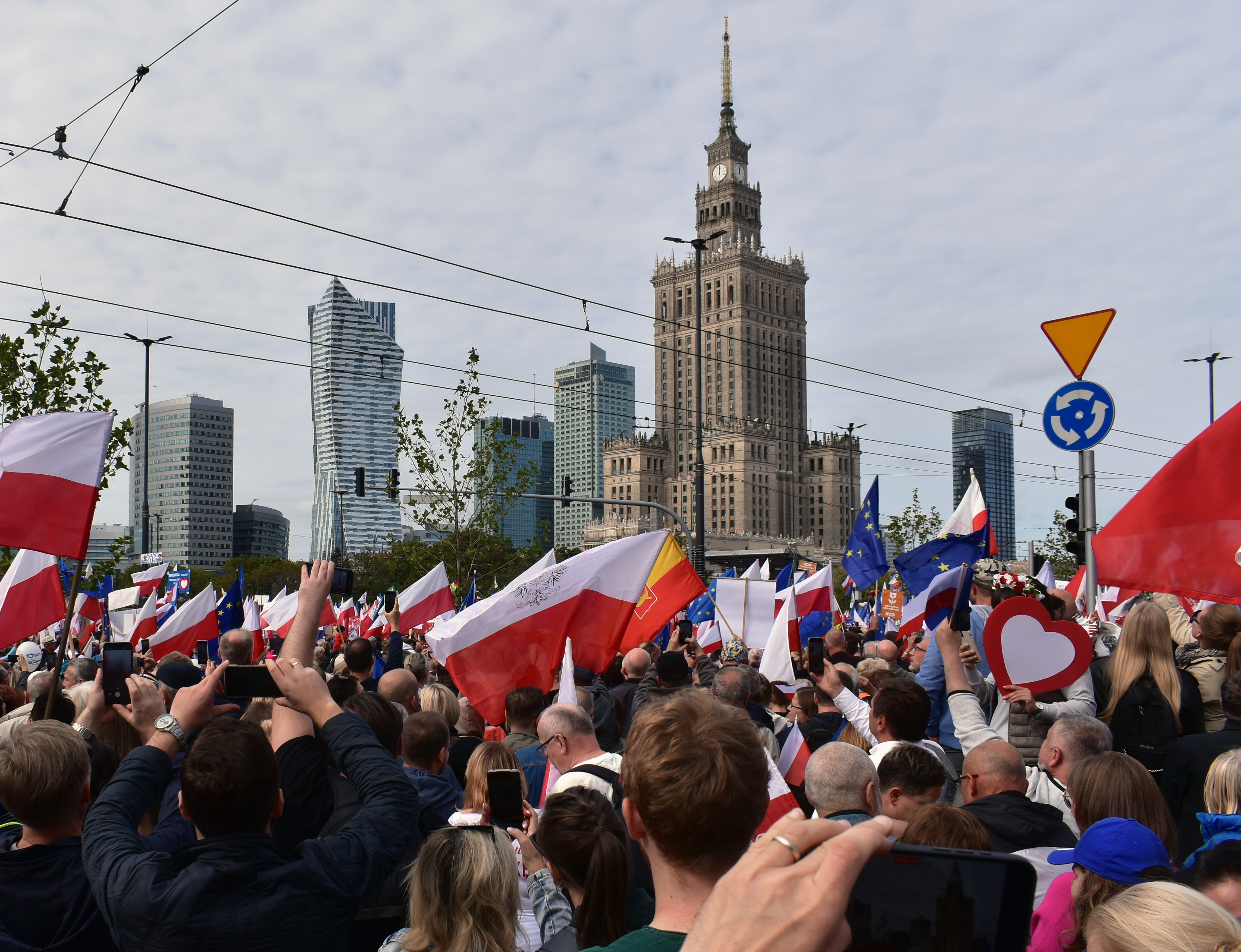
Below: Warsaw, 4 June 2024, on the 35th anniversary of the elections that brought communism to an end in Poland, a rally called by prime minister Donald Tusk. He reminded us that democracy is not a one-way process and can be turned back. Note the singular absence of young people. With no memories of the bad old days of communist dictatorship, they have become complacent. I hope tomorrow's turnout will be higher than the 45.7% in the 2019 European election...

Europe could be governed better. But historically, and looking at its neighbours – and looking at its history – it could also be a whole lot worse. Let's be thankful for what we've got, and vote tomorrow to make sure it gets no worse, by preventing populist wreckers from getting into the European parliament.

This time two years ago:
Savants, UFOs and psychic abilities

This time three years ago:
A proud moment

This time four years ago
Rail progress - Krężel to Chynów

This time nine years ago:

This time 11 years ago:
Fans fly in for the football

This time 13 years ago:
Cara al Sol - part II

This time 14 years ago:
Still struggling with the floodwaters

This time 15 years ago:
European elections - and I buy used D40

The time 16 years ago:
To the Vistula, by bike

This time 17 years ago:
Poppy profusion

Tuesday, 4 June 2024

SIXTY SIX AND TWO THIRDS

A milestone 'birthday', every bit as important as 50 or 75, yet passing unnoticed by most people. Today I* am exactly two-thirds of a century old. Eight months have passed since my 66th birthday; my 67th birthday is four months away. We seem to ignore thirds. Today also happens to be the 35th anniversary of the parliamentary elections in Poland that resulted in the communist government losing power – yet the third-of-a-century anniversary came and went on 4 October 2022, unnoticed. (And yes, that day also happened to be my 65th birthday.)

I was born on the same day as Sputnik 1 was successfully launched into orbit, making me exactly as old as the Space Age. My birth was also bracketed by what was as the time, the world's worst and the world's second-worst nuclear accidents (Kyshtym, USSR a week before and Windscale, UK, a week after). The world has changed, the world hasn't changed. Below: AI-generated image, prompted as a celebration of this milestone that I have accorded to myself.

As I get older, I find myself becoming more and more like my father. Noticing, counting, measuring. filling in spreadsheets. 

New toilet roll today? The last one has lasted me since 26 April. The daily exercise and diet spreadsheet is now in its 11th year. As medical evidence about the importance of muscular strength into old age builds up, I continue fighting on to beat last year. (One thing I can see is if you don't use it, you lose it – quickly. If I drop doing, for example, press-ups or pull-ups for a few days, it's hard to get back up to that same number even after a week or more.) The daily exercises are also important for building resilience against twists, sprains and falls. And crucially, skeletal flexibility, so my vertebrae don't fuse together (my father was bent over double in advanced old age).

And indeed, from today, I have added the countdown to my 100th birthday, it is 12,175 days away. Will I make it? It is my will to do so; whether my will aligns with the Cosmic Purpose is another matter! Genetically, there's hope (my father died at the age of 96, my mother at 88), environmentally too (I exercise more than my parents and eat a far healthier diet than my cake-loving mother). And there's the spiritual aspect too.

Gratitude is all important. I offer that conscious expression of gratitude several times a day, for health, for peace and security, for food, for all the good that surrounds me. I know I must never take any benefit for granted, nor consider myself entitled to anything.

My spiritual views on life are becoming clearer as a grow older. [Note – grow older. One should grow spiritually, gaining wisdom with age.]

All who seek God (however one chooses to define God) shall find God in their own way. There are myriad paths to transcendence.

My own path? The material and spiritual are separate and yet one; science and religion should get ever closer, until both ways of looking at the Cosmos can finally agree on the nature of reality.

* My body and its ego. The consciousness that's subjectively observing from this bodily platform is eternal.

This time last year:
Marching for Openness and Normality
(People – we did it!)


This time four years ago:
Moonrise, Nowa Wola

Monday, 8 April 2024

Local elections, Poland, 2024 (Pt II)

As it happened, despite what I observed at Polling Station No. 626 (primary school on ulica Sarabandy), the overall turnout across Poland was disappointingly low at 51% (far lower than the 74% in last autumn’s parliamentary vote). In Jeziorki, turnout was 64%.

Warsaw's Rafał Trzaskowski won 57.4%, a resounding first-round victory for a popular mayor. He was one of four big-city mayors who won in the first round, along with the incumbents in Łódź, Gdańsk and Katowice. Other than Katowice’s mayor, a local independent, these are all Civic Coalition (KO) members. 

Kraków, Wrocław and Poznań will require a second round of mayoral elections as no candidate received more than 50% of the vote; the second-round mayoral elections will be on Sunday 21 April. 

In a result mirroring October’s parliamentary election, PiS won the largest vote share (34.3%) but lost power overall. KO won 30.6%, Trzecia Droga won 14.3%,  Konfederacja/Bezpartyjni Samorządowcy 7.2% and Lewica 6.3%. Trzecia Droga (including PSL, the agrarian party) really should have done better. The brand, now established as a part of the government coalition, was expected to push PiS aside across rural Poland, but failed to do that. Lewica was the real loser of these elections, maybe because so few young people bothered to vote. This will weaken them within the governing coalition, of which they are the junior party.

The next few days will see deals being made between parties at voivodship level to determine who will have overall control of them. Despite winning a higher vote share, PiS is likely to lose power in two or three voivodships, leaving the party with a majority in six of the 16 local parliaments (sejmiki), in the south-east corner of Poland. 

Once the deals have been made and the constitution of all local councils is known, there will be a clearer picture as to what effect the local elections will have on citizens' lives on a day-to-day level. 

I am a great believer in the influence of local governments in shaping quality of life. Environmental quality (air quality, waste collection and recycling, traffic management, public transport). Poland today has advanced hugely over the country to which I moved in 1997, to the benefit of all in the above regards. I'd like to see better public transport, less dumping of household waste and litter, better air quality (less burning crap to warm houses), and more provision of pavements and footpaths for pedestrians. 

Compared to the UK, where local taxes ('rates') are astronomical, Polish land tax is laughably low, although this is augmented by income tax, which is collected locally and remains with the local authority in which you are registered. Corporation tax and VAT are collected and spent at the national level. 

Next up will be the European parliamentary elections – I hope these are taken seriously by Poles young and old, and that populism will not be given a free hand because of indifference and complacency.

This time seven years ago:
Conscious prayer

This time nine years ago:
History repeating - or is it?

This time 11 years ago:
Sunshine, snow, April

This time 13 years ago:
In vino veritas

This time 14 years ago:
Are we getting more intelligent?

This time 15 years ago:
Lenten recipe No. 6

This time 16 years ago:
Coal trains, Konstancin-Jeziorna

This time 17 years ago:
Jeziorki from the air

Sunday, 1 October 2023

Marching again

I find it impossible how government agencies can claim honestly that number of citizens taking part in today's march was around 200,000. This is the fourth major march I have take part in (the one on 4 June in Warsaw and the two anti-Brexit marches in London in March and October 2019) and today's felt the biggest. I joined from the south around twenty minutes before the midday start; already the whole area around Rondo Dmowskiego was rammed rigid. 

Below: 12 noon, the speeches start. After the speeches, the march will begin, headed north.

After listening to the key speeches, but before the march sets off, I figured that I was in the wrong place, so I dived into the subway under the roundabout - coming out on the northern side, I could see the crowds were thicker still. So trying to get ahead of the march, I took the Metro one stop north to Świętokrzyska. The trains were running at intervals of as little as 1 minute 20 seconds!

From here I walked the route along aleja Jana Pawła II. Both sides of the wide avenue were thronged with flag-waving people - not marching - yet. But column would move very slowly; not so much a march as a shuffle. So I had time to pop into legendary bar Jaś i Małgosia (where my aunt Jadzia worked back in the 1970s!) for a swift IPA. Suitable refreshed, I found I was still way ahead of the front of the march. 

Moving on to Rondo Radosława, the final destination, I took up position in the middle of tram tracks, looking south along al. JP II, watching a slow-motion human tsunami bearing down on where I was standing. 

Below: a rather impressionist image from my phone at 20x zoom...


...and a more conventional photo from my camera. Bear in mind that the crowd was thinnest on the tram tracks, given the ballast being less comfortable to walk on that asphalt or pavement.

Below: the march reaches the end - time for a few more speeches (interestingly, mentions of women's rights drew the most applause), and the national anthem at the end. Then off to catch the train back to Chynów, which was rush-hour full.

However, by the time the train had reached Piaseczno and Zalesie Górne, the flag-bearing passengers were thinning out. In Chynów, PiS banners on fences and walls outnumber PSL banners by three to one and KO banners are nowhere to be seen. It will be a tough race in two weeks' time.

This time last year:
Levels of Detail

This time two years ago:
Droga donikąd by Józef Mackiewicz

This time three years ago:
Words that pop into the mind, unbidden
[This morning's word: contumely]

This time five years ago:
Hops there for the taking

This time six years ago:
Two weeks and two days of travel

This time seven years ago:
Final end to a local landmark

This time 12 years ago:
Independence Day

This time 13 years:
Out and about in Jeziorki

This time 14 years ago:
Funeral of Lt. Cmdr. Tadeusz Lesisz

This time 15 years ago:
Puławska by night

Saturday, 30 September 2023

Hottest September in Poland?

The last week (today excepted - it rained for a while) gives me mixed feelings. On the one hand, who could complain about six unbroken days of cloudless skies and heat (26C - 28C maxes) - dry heat, without mosquitos - at the end of September? Except that it is the end of September. We are a week past Equinox, night is longer than day, and the forecast for Tuesday, 3 October, suggests a daytime high for Warsaw of 26C. (If it exceeds 25.9C - then that will be another temperature record broken this year.)

While we are benefiting from the gorgeous weather in terms of our samopoczucie (perceived mental/ physical wellbeing), we must also be aware that climate change is real and is unfolding before our eyes. Tracking data is one thing, and we must ground our understanding of climate change on scientific data, but the subjective memory - that can play tricks - is important too. Septembers in Warsaw do happen to be sunny. However, yesterday, Poland's meteorological institute announced that September 2023 was 3.9C hotter than the average temperatures for the month. [An excellent breakdown of September temperature this year in Poland here.]

Here in Chynów, the apple harvests are in full swing, trees full of fruit - another good season, despite the relative lack of rainfall. We have also been spared any extreme weather events - no tree-uprooting winds, no flash floods, and no thunderstorms yielding golf-ball-size hailstones. Yet when the weather doesn't play the cosmic trickster, folk keep to their old ways - tractors standing in fields or orchards, engines idling, burning diesel and pumping emissions into the air. The farmer fails to see the need to turn the engine off. Same at the level crossing - when the barriers falls, it's around three minutes until the train passes and the barriers rise. Yet only the newest cars which have engines that automatically cut out when stationary aren't spewing CO2 into the air.

New York City hasn't been so lucky, hit with flash floods that led to a state of emergency being declared yesterday. Yet because Poland has to date escaped the wrath of climate change, the subject is not an issue in the discourse leading up to the parliamentary election in two weeks' time.

The extra days of summer warmth mean I've not had to switch on my heating (last September I first felt uncomfortably cold enough to do so on the 19th); my electricity consumption is down 18% compared to the same period next year. So - the warmer it gets, the less energy we consume? 

Now that we're in the dark half of the year, let me turn my attention to hours of sunlight. Plentiful between the equinoxes, it starts to plummet.

Below: annual sunshine hours, Warsaw. Note the steep falling-off that occurs between October and November - this is the 'hammer of darkness' effect that I've noted (click here on on label below right). October sees more than twice as many hours of sunshine than November; December's the worst by far, followed by January.


Comparing Warsaw to London is interesting (below) - whilst summers in Warsaw see much more sun than London (over 25% across June, July and August), the four months between November and February are sunnier in London, despite only a small difference in latitude. In terms of UV index, a less-precise measure, the two capitals are similar across the year.


It is time to gird myself psychologically for the coming darkness and cold; one hack I have developed in recent years is to ignore the time change, and not to accept that extra hour in bed 'they've' given us - it's a trap. Go to bed at the same time as before (that is, an hour earlier) and wake up an hour earlier. Don't let the time change mess with your body clock. The time change is responsible for many cases of seasonal affective disorder being worse than they could otherwise be, and for a 20% increase in heart attacks in spring when it changes the other way.

Final point from the end of Q3 2023: my food bills (excluding entertainment) for July, August and September this year totalled 3,125.53zł; a 27.7% increase on Q3 2022, when I spent 2,448.44zł. Like for like - I have all till receipts if anyone's nerdy enough to want to check.

UPDATE 13 OCTOBER 2023:

The EU’s earth-observation programme Copernicus found monthly average surface air temperatures of 16.4C, almost 1C over the 30-year average and 0.5C above the previous September record.  Berkeley Earth, an American research group, found that September was the most excessively hot of any month since 1850. This summer’s scorching weather makes it almost inevitable that 2023 will be the hottest year ever. It seems likely, too, that temperatures for 2023 will approach or exceed 1.5C above pre-industrial levels.

This time last year:

This time four years ago:
Parliamentary train at West Ealing station

This time five years ago:
Progress in Jakubowizna

This time seven years ago:
Miedzianka by Filip Springer

This time eight years ago:
Out of the third, into the fourth

This time nine years ago:
Inverted reflections

This time ten years ago:
Observations from London's WC1
and Observations from the City of London

This time 11 years ago:
Civilising Jeziorki's wetlands

This time 12 years ago:
Warsaw's Aleje Jerozolimskie

This time 14 years ago:
Melancholy autumn mood in Łazienki

This time 15 years ago:
Autumn gold, Zamienie

This time 16 years ago:
Flamenco Sketches - Seville

Sunday, 27 August 2023

Dawn tourism - the sights without the crowds

I arrived in Sandomierz on Thursday evening and headed straight to the dinner inaugurating the exporters' conference, which took up the whole of Friday (starting at 8:30am and ending late with another dinner). So to get a chance to see Sandomierz properly, I decided to spend my own money on a second night's stay and check it out on Saturday. This is exactly what I had done on my last visit, this time seven years ago. However, since then, Sandomierz has become a victim of its own success, and like Kraków, it is in danger of becoming over-touristed. Slow death by a million tourists, grazing, gawping, shuffling and being persuaded to part with their money by a thousand garish posters, banners, parasoled pavement tables, cider stalls, post-card stands and fridge-magnet displays.

So to avoid the crowds, which on this, the last weekend of the summer holidays, under cloudless skies, would be huge, I did this. I woke up with the sunrise (05:35), dressed quickly, and without breakfast, I went out to see Sandomierz while there was no one around. And what a visual treat that was.

Below: through the gate and into the old town. Passing through, was one of just three people that I observed over the hour that I was there. The morning light on old bricks and cobbles is beautiful, and the smells of dawn are magical. This is Brama Opatowska, the only one of the four town gates to have survived.


In summer, we're more accustomed to seeing the sun streaming in low between buildings in the evening, when the streets are full of merry throngs on their way to bars, cafes and restaurants. But now - no one at all. It's like wandering around an empty open-air museum.


Below: the old town square with nobody there. It's ten to seven in the morning.


Sandomierz's old town is located on top of an hilly outcrop some 45 metres high overlooking the Vistula. The building below is one overlooking the south-western slopes as they fall away toward a deep ravine. On the far distant horizon, the water meadows of the Vistula.


Below: a prospect towards the south-east - again, the Vistula visible on the horizon (and just about) the bridge linking the town's Zarzekowice district (which is where Sandomierz railway station is inconveniently located). To the left, the vicarage, to the right the cathedral walls.


One of those prospects that creates a double take - isn't this southern Europe? I'd posit that Sandomierz is one of the most northerly located town of southern Europe; climatically it's warm enough for viticulture, and the architecture, when lit by sunshine, isn't dour but joyous.


Although not designed by an Italian architect, like Zamość, 120km to the east, the layout of Sandomierz around the town hall and main square also brings the European south to mind.


Below: a very Tuscan prospect. From here I return to my hotel for breakfast (excellent!) heavily laced with coffee - then a short nap (hence the coffees!) from which I awake to take on the rest of the day.

Below: the Dominican church and convent, and its vineyard. Church and viticulture together - "fruit of the vine and work of human hands". Eight centuries of tradition. Photo taken in the early afternoon.


Climate change has made wine making a more commercially viable proposition for the Sandomierz region; there are now nine vineyards along the local wine trail, one of which is Winnica Św. Jakuba shown above. But local wine-making is a still small scale enterprise (typically a couple of thousand bottles of a single type per year). Destined, however, to expand.

Below: Sandomierz castle, seen from the Vistula's water meadows below the old town. The tourist throng is to be found on the other side of the castle.


Left: two deep ravines run from the heights upon which the main part of Sandomierz stand down to the Vistula river. Note how green the scenery is for late summer. The electric tourist carts stop at the bottom, but few venture up here, preferring instead to buy ice cream and lemonade at the bottom.

Below: peak season, busy with tourists, Sandomierz's entrepreneurial citizens are busy selling krówki (cream fudge), cydr (cider sweetened with honey, with added cinnamon and cloves, and cut with lemonade), and all things themed Ojciec Mateusz, the TV priest-detective series set in Sandomierz. I'd recommend that the local authorities clamp down on the more garish forms of advertising which try to outcompete one another with day-glo colours and shouty fonts. Not visible in any of my photos as my lens tries to avoid such things. They are quite at odds with the town's character.


Cars are banned from the old town, as they should be, but now there are more and more of these electric carts plying their trade around Sandomierz. I noted in 2016 the appearance of faux Model T Fords for taking tourists around the town. These have been joined by fake vintage Rolls-Royces and these things (below), styled after a late-1930s Chevrolet truck; it is quite out of place visually - the Model T Ford replicas are more fitting.


When I was last in Sandomierz in 2016, I was impressed at its progress in establishing its place on the tourist map of Poland. Plenty of new investment, refurbishment, sensitively carried out. However, I fear a tipping point has been reached. There are now so many ice-cream stands and small tourist-tat stalls competing for custom with shrill advertising that it all risks drowning out the visual charm of the old town. 


Below: I thoroughly recommend the hotel in which I stayed, the Sarmata (***). As in 2016, I had one night paid for, the second I paid myself so I could extend my stay and see more of Sandomierz. In 2016 I paid 280zł (then worth £56) for a night, and complained about a poor breakfast. Seven years later, the hotel-night cost 270zł (£52 today) with an excellent breakfast - huge and healthy - lots of fresh fruit, grilled veg, poached eggs, big choice of cheese and cold cuts and fruit juices. And a beautiful hotel complex too, perfectly located for the old town.


So - take my tip, do as much sightseeing as possible around daybreak - before the crowds and the commerce take over. The qualia memories the remain will be that much stronger. And 23,500 paces, the result of two long strolls (and a shorter one back to the bus station).