Showing posts with label Polish history. Show all posts

Saturday, 1 August 2026

Godzina W in the centre of Warsaw

Four four years from 2016 to 2019, I spent the moment of Godzina W ('W'-hour) with my father in the quarter of the Powązki Military Cemetery reserved for Batalion Odwet, the Home Army unit in which he served. While this is where the official commemorations occur, the mass event that draws the real crowds is held at crossroads of ulica Marszałkowska and Aleje Jerozolimskie (Rondo Dmowskiego). I have never been before, so I was curious to see how this would compare.

I arrived at twenty past four, so 40 minutes before the sirens would traditionally start to wail.  A public-address system had been set up; someone announced that before the ceremony begins, that a decade of the Rosary would recited (one Lord's Prayer followed by ten Hail Marys). On cue, 20 or 30 powerful motorbikes arrived at the roundabout, revving up their engines and drowning out the prayers.

At half past four, the police closed both thoroughfares to traffic, a signal for people to start streaming in from behind the pedestrian barriers, moving right up to the roundabout and filling the road space from one end to the other. The minutes ticked down. Every higher vantage point – bus stop, kiosk roof, Metro ventilation shaft – was soon topped by young men, some of whom were holding flares. A half-hearted appeal from the organisers for people to get down went unheeded. At a couple of seconds to five, the flares went off. And then, on the dot of five, the sirens began to wail. This was it. Scores of flares filled the streets with flames and smoke. 

Viscerally emotional. I was still in tears from hearing the last song played over the public address system – a song I associate with this day, and with my father – Warszawskie Dzieci

The two-minute silence ended and Cześć i chwała bohaterom ('Honour and glory to the heroes') was chanted repeatedly by the crowd. The chanting eventually lost its vigour and fizzled out. A voice at the microphone started speaking in nationalist tones and the crowd began turning away, making for the Metro station or bus stops. "The Germans only pretend to be our friends..." Whatever. Time to leave.

Somehow, I much prefer Godzina W at Powązki. My father would have done so too. But one can't be in two places at one time. A time for quiet contemplation, wandering along tree-lined avenues lined with graves of the fallen.

This time seven years ago:
W-hour on the big day
[My father's last visit to Warsaw. He promised to return for the 75th anniversary. He made it. Three months later, he died.]

This time eight years ago:
My father at the 74th anniversary of the Uprising

This time nine years ago:
73rd anniversary of the Warsaw Uprising with my father

This time ten years ago:
Godzina W remembered with my father – a day of emotions

This time 13 years ago:
Godzina W commemorated in a more civilised way

Godzina W 14 years ago (2012)

Godzina W 15  years ago (2011)

Godzina W ten years ago (2009)

Monday, 20 July 2026

Fifty years on

Today is the fiftieth anniversary of my departure on a holiday that would significantly shape my identity, as well as the future course of my life. I wrote about it ten years ago, link here.

My three holidays to Poland organised by the Polish priests in Ealing for their young parishioners took place in the summers of 1976, 1977 and 1979, and proved extremely formative for me. Certainly these visits were a key factor in my moving to Poland.

The 1976 trip occurred just after I had finished grammar school. While on that holiday, I was awaiting a telegram from my parents informing me how my A-level exams had gone – and which university (if any) would accept me. I got that telegram in Poland (Gdańsk, I seem to recall) – the news was good. My grades were sufficient to get me into Warwick, my first choice.

As our coaches crossed the border from East Germany, we were driving into a country that a month earlier had seen significant workers' protests at rising living costs in Radom, Ursus and Płock. No official news, of course, only word-of-mouth rumours. From the windows of the coach, I saw a high-tension pylon lying on its side in a field outside Radom. Had it been brought down by protesters? Or was it waiting to be erected? Who knew? These protests would ultimately lead to the birth of Solidarity four years later.

I wrote ten years ago about the religious nature of the holiday. As well as the daily masses and rosary, there was also plenty of time for philosophical discussions, about religion, ethics, life, the universe and everything. Not to any great degree of sophistication, but enough to engender a lifelong interest in 'small-p' philosophy.

This was also the last summer before the punk-rock revolution – but more about that in a post on this blog this autumn, on the 50th anniversary of me catching a gig by two bands entirely unknown to me at the time – the Sex Pistols, supported by the Clash. That, plus a year of living away from home as a student, completely changed my attitude to church-going and authority in general, so when setting off on Montserrat 1977, it was with a radically different world-view. Yet Poland was still Poland. eternal, drawing me back.

Who'd have thought, fifty years ago, that I'd be sat here on my own little acre, surrounded by 12 cats, living in a free, peaceful and prosperous Poland? 

This time last year:
Letters to an Imaginary Grandson (VI)

This time five years ago:
Memory, collective memory and proof of memory

This time eight years ago:
And did Her feet...?

This time 11 years ago:
Last night's storm

This time 12 years ago:
Drifting south with the sun – bicycle hobo
[On this trip I would first encounter Jakubowizna...]

This time 14 years ago
The Royal Parks in the rain

This time 17 years ago:
Conservatism – Polish or British style?

This time 18 years ago:
Wheat and development

This time 19 years ago:
Waiting for the summer rain

Thursday, 4 June 2026

Politics: An objective assessment of your subjective reality

WRITTEN ON THIS, THE 37TH ANNIVERSARY OF POLAND'S TRANSITION TO DEMOCRACY

So many people today get wound up by things that do not remotely affect their day-to-day lives. Migration is a good example. People living in picturesque English villages that have seen an influx of three foreign workers say they feel “swamped”. Young people with no direct connection to the Middle East drifting into anti-Semitism because of Gaza. The issues may be real enough, but the emotional weight attached to it is often wildly disproportionate to its actual impact on the individual’s actual reality.

This is not to say that migration, war, terrorism or national identity are trivial matters. Of course they're are not! But proportion matters. Russia is an existential threat to Estonians, Latvians, Lithuanians and Poles in a way that Israel is not an existential threat to citizens of South London. Islamic terror is an existential threat across parts of Africa and the Middle East in a way that it is not to people living in rural Poland. 

The closer a threat is, the more materially it constrains daily life, the more rational it is for politics to be organised around it. If you like in Kyiv right now, the prospect of being killed by missiles or drones sent at you by a bloodthirsty madman is very, very real.

National politics should, at root, be about two things: the economy and security, internal and external. Citizens have a right to feel safe. They also have a right to expect that their hard work, thrift and enterprise should be rewarded by growing prosperity. When governments fail on these fundamentals, anger is justified. When anger is transferred instead onto distant symbolic causes over which neither the citizen nor, often, their government has much practical control, politics becomes emotionally satisfying but civically useless.

Sitting here in rural Poland, I see a country on the rise. That rise is not accidental. Macroeconomics are not just a matter of government policy; they're also the aggregate result of habits, incentives and behaviours of millions of people, earning and spending money. If people are entrepreneurial, hard-working and forward-looking, the economy moves in one direction. If too many people become comfortable sitting back on generous welfare benefits, it moves in another.

There is a simple test. If there is something you can do about a situation you dislike, do it. If there is nothing you can do, then moaning is pointless. And 'doing something' does not mean shitposting on social media. It means acting in the real world.

Don’t like massive increases in traffic, density and suburban overdevelopment? Move out to the countryside. That's what I did. Don’t like the direction of your country? Build something, employ someone, stand for office, volunteer, organise, write, teach, invest, persuade. Face to face, not online. [Ditching Twitter/X in November 2024 led to an instant improvement in my mental wellbeing.] Politics should not be a theatre in which people pin their frustration onto remote causes. It should be the practical art of improving the conditions of life where one actually stands. Delivering solutions rather than winning arguments.

We are approaching the tenth anniversary of the Brexit referendum; the UK economy is some 3.5% to 4% smaller than it would have been according to official reckoning. That's a huge difference to the budgets of households on the edge. Diddly-squat to the billionaires who convinced the precariat to vote Leave.

This time last year:
Farewell, beloved grapefruit

This time two years ago:
Sixty-Six and Two-Thirds

This three years ago:
Marching for Openness and Normality
[We have it. Let's not get complacent.]


This time six years ago:
Moonrise, Nowa Wola

Wednesday, 17 September 2025

Flying the flag in Wola

"Pałacyk Michla, Żytnia, Wola, Bronią jej chłopcy od Parasola..." we'd sing this song of the Warsaw Uprising insurgents in Polish scouts; few if any of us back there in 1970s London imagined the street to which the lyrics referred (though the 'pałacyk Michlera' was actually on Ulica Wolska, not on ul. Żytnia, over half a kilometre away). The ongoing diversion of trains from the Radom line to W-wa Gdańska via Wola means I've come to know this western district of Warsaw very well, especially now that my cardiologist is here. A visit was arranged for today, so I went. I decided to walk along ul. Zytnia from one end to the other to catch the Wola vibe. The first thing that struck me – all these Polish flags flying! 

Yes, it's 17 September, the 86th anniversary of the Soviet Union invading eastern Poland, the stab in the back two and half weeks into Poland's defensive war with Hitler. The road to the Wola massacre started here. 

Walking along ul. Żytnia, I am struck by the total lack of pre-war buildings; architecture is uniformly moderne, 1950s and '60s in style. Here and there, memorials pinpoint sites of mass executions. 

The scale of the German massacres of civilian population, conducted by SS and police units, was staggering. Historians today assess the number of civilians killed at around 50,000, far outnumbering the deaths of armed combattants, Polish and German combined, during the 63 days of the Uprising. The Wola massacre happened on 5-12 August.

Right: on the corner of ul. Żytnia and Młynarska, another cross marks the location of the murder of around 150 local residents on 5 August 1944.

Wola will never forget. I found today's display of flags deeply moving. I'd guess, based on my previous walks through Wola, that some people keep national flags flying for the whole 63 days commemorating the Warsaw Uprising.

Below: public buildings also keep the flags flying today. This is the post office on the corner of ul. Plocka and Żytnia.


Well, if there's demand, there must be supply. Below: a shop selling flags and 'propaganda articles' on the corner of ul. Okopowa and Żytnia.


This time last year:
A further step towards energy autonomy

This time two years ago:
Plenitude in the Year's Fruition

This time three years ago:
Behold the wonder of the commonplace

This time four years ago
The force-field of fate

This time five years ago:
Hot in the city

This time six years ago:
Resting with the heroes

This time eight years ago:
Polish employers' demographic challenge

This time 12 years ago:
The rich, the poor, the entrepreneur

This time 13 years ago:
Food: where's the best place to shop in Poland? 
[I'm still boycotting Auchan for remaining in Russia]

This time 14 years ago:
Bittersweet

This time 15 years ago:
Commuting made easy

This time 16 years ago:
Work starts on the S79/S2 

This time 17 years ago:
Warsaw's accident-filled streets

Saturday, 13 September 2025

My night in Wawel Castle

On confirming my presence at the opening of the Children of War exhibition at the Schindler museum, I asked whether the museum could recommend me a reasonable room for an overnight stay. I was offered two choices: the nearby Hotel Normalny (***) for 500 złotys, about £100, or a residence in Wawel Castle for 150 złotys, about £30. Naturally, I dropped everything to book the latter and pay for it online, despite it being over 30 minutes' walk from the museum. And I was warned that there was always the chance that in the case of a surprise state visit by some foreign dignitary and entourage, I might get bumped at the last minute. This did not happen. 

At around 5pm on Thursday, I turned up at the guard house at the castle's Bernardine Gate to be given the key to the apartment, and was shown up by an armed guard. I left my rucksack in my bedroom and set off on foot to the museum for the event, to return later that evening for my night in Wawel Castle.

Below: the castle's residential apartments are in the ivy-clad building to the left; the Sandomierz tower is centre; the Bernardine Gate is just round the corner. The latter is a reminder of Nazi occupation; the gate and guard house were built in 1940 when the notorious Hans Frank, the governor-general of the occupied territories had his residence here. (He was hanged for war crimes in 1946.)

So – what was it like, spending the night in Wawel Castle? Well, the rooms are authentically old-school, sparse, monastic, luxurious in a 1920s kind of a way with polished parquet flooring and period furniture. And a bed that would be uncomfortably short for anyone over six feet tall.


Left: the bathroom in my apartment. The photo, taken with a 10mm lens, cannot quite capture the height of the room – I estimate it to be well over four metres, making it higher than it is long. Plumbing, fittings and fixtures speak of past epochs, but everything worked as it should (except for the kettle in the otherwise well-equipped and spacious kitchen).

Having walked over 19,000 paces, I was quite tired and went to sleep at half past nine, waking up at 7am, so nine and half hours sleep with vivid, but not particularly notable dreams (finding blue plastic badges shaped like sails, dated 1919, in regularly spaced holes in the soil of a Gloucestershire garden). No ghosts.

In the morning, I take the opportunity to look around the castle complex before heading back to the station. Below: view from my bedroom window, overlooking the gardens of the Bernadine Fathers.


Below: the cathedral (Bazylika archikatedralna św. Stanisława i św. Wacława) in its morning glory. Poland's Westminster Abbey. Even at eight am, early tourists are beginning to show up, and the delivery trucks are much in evidence. I spend some time wandering around before I head to the station for my train back to Chynów via Warka.


To quote from Withnail and I, "Free to those who can afford it, very expensive to those who can't".  I guess that the administrators of the Wawel Castle residential apartments have a fine line to tread between commercial reality (I'd estimate the market value of a night like this would be three to five times higher than what I paid) and the need to maintain the building as it is for the sake of posterity and national heritage. I guess my 150 złotys is a charge to cover the costs and no more; this is not something you can book for yourself. You need to be a guest of some public institutions like the Museum of Kraków that administers the Schindler's Factory museum. Or, I'd guess, the City of Kraków, or the Ministry of Something. Yes. I know it's a missed commercial opportunity, but even a tourist-facing city like Kraków has its limits.

(*** not its real name, but you get the picture – nothing out of the ordinary)

This time last year:
Immersed in Dali

This time four years ago:
Pavement comes to Jakubowizna
[Karczunkowska still waits.]

This time five years ago:
My local craft brewery
[Sadly it closed last year.]

This time 15 years ago:
Time to change gear.

This time 16 years ago:

This time 17 years ago:
Early, cold start to autumn

Friday, 12 September 2025

Dzieci wojny – Children of war

To Kraków for the opening of Children of War, a temporary exhibition at the Schindler's Factory museum. It tells the stories, in words and photographs and artefacts, of 13 children, all under the age of 11 when war broke out, explaining how it affected them and how they survived, Jew and gentile alike. 

Since work began on curating this exhibition, six of the 13 have died, unable to finally witness their testimony on display at the museum. Three were present at the opening, the eldest being 96 years old. 

A small but particularly moving exhibition, looking at the horrors of war through the eyes of children. Interest in the opening was such that it was the museum cinema, venue for the official part, was crammed to overflowing, and seeing the exhibition was a tight squeeze.

A part of the exhibition – and the direct reason for my presence – was a part dedicated to the Szkoła Młodszych Ochotniczek (SMO - in English, the Polish Young Women's Auxiliary Service School), home to my mother for most of the war. Her army suitcase, filled with her exercise books were on display, which for me serve as a testament to the focus and hard work expected of the pupils.


Left: uniform jacket as worn by girls at SMO, and some of the diplomas awarded there.

The most moving part of the exhibition for me were the drawings made by Polish children who'd survived the war of what they'd witnessed. These were counterpointed by those made by Ukrainian children from Kharkiv illustrating what they saw in the early days of the full-scale Russian invasion.

Another poignant moment was the testimony of the daughter of two Jews who had been saved by Oskar Schindler by inclusion on his famous list. Mother and father fell in love in the camp, survived the war and settled in Israel. Their daughter, born there, was forthright in her condemnation of what her government was doing to Palestinian children in Gaza.

I would like to acknowledge the splendid work carried out by Alicja Szkuta in keeping alive the memory of the SMO, which educated over 1,000 Polish girls in Nazareth from 1942 to the end of the war. All three of my Saturday Polish school teachers who taught me Polish language, literature, history and geography in the 1960s and early '70s – Pani Skąpska, Pani Szkoda and Pani Wolańska – were alumni of the SMO. The knowledge they passed on to the British-born generation of post-war Poles has been invaluable in maintaining our Polish heritage in the UK.

I would also like to thank Beata Łabno, curator at the Schindler's Factory museum, not only for putting together such an emotionally compelling exhibition, but also for recommending and reserving for me one of the most memorable night's accommodation I've ever enjoyed – in the guest rooms inside Wawel castle itself. But more on that in the next post... 

There are many things that Poland is good at, and running world-class museums is among them, Children of War runs as a temporary exhibition at the Oscar Schindler Factory museum until 30 August 2026. I highly recommend it, a reminder that the youngest suffer the most when two sides go to war.

This time last year:
Ten grand a year

This time two years ago:
The ephemeral pleasures of materialism

This time three years ago:
W-wa Zachodnia modernisation – a long way to go
(Three years on: still not finished)

This time four years ago:

This time five years ago:
Back in Aviation Valley

Sunday, 10 August 2025

Qualia compilation 11: the Roads to Henley-upon-Thames

Henley-upon-Thames is another of those special places that resides in my memory, a place much visited in childhood, adolescence and adulthood. The magnet for us London Poles was Fawley Court, a stately home designed by Sir Christopher Wren, which was for many years after the war a boys' boarding school run by the Polish Marian Fathers. Just north of the town, Fawley Court lies on the Thames, a beautiful setting. The Divine Mercy College closed in 1986 due to falling numbers of Polish boys born in the UK. In 2011 the Marian Fathers sold the Grade I-listed building for £22 million; much of that money being spent on the basilica in Licheń. This transaction remains controversial to this day, not least to the Polish community in the UK who had contributed so generously over the decades towards the upkeep of this historic building.

I must have visited Fawley Court and Henley-on-Thames scores of times. My earliest recollections were of the Zielone Świątki (Whitsuntide) gathering. My parents would go most years, along with thousands of Poles from across the UK. Coaches would bring them from northern towns and cities, London Poles would typically drive; the school's playing fields would turn into a gigantic car park. Open-air Mass and beer tents, walks along the Thames, for our parents, then in their thirties and forties, a chance to meet old friends. Later, in the Polish scouts we'd visit Fawley Court, usually out of term-time for zimowiska (winter camps) or weekend biwaki (bivouacs), which would involve route marches around the nearby countryside. Youth-group visits followed, and then, with my own car, going out to Henley with friends was no longer such a big deal, and trips there – a long walk followed by cream teas at the Old Rope Walk – happened frequently. And then cycling – load the bikes into cars, drive out to Henley, cycle around the countryside (typically to a nice pub), cycle back to the cars.

The town and its surrounding countryside are absolutely charming, the quintessence of rural England. Whilst I have many memories of my many visits to Henley and district, there's one qualia flashback above all that has stuck with me. It is the road to Henley. In the old days, before the M4 or M40 motorways were opened, the route out of West London would be along the A4 – the Great West Road, which would become the Bath Road; through Slough and Maidenhead, then turn off for the A4130, the Henley Road (again, before the A404 dual carriageway was opened). Through Hurley Bottom, and towards Remenham Hill, the Black Boys Inn on the right. And then – down White Hill, over the bridge and into Henley. Alternatively, one could continue along the Bath Road to Twyford, then turn right into the A321 Wargrave Road, and follow the Thames Valley to White Hill and then turn left onto the Henley Road and the bridge, and into town. 

Below: Google Gemini 2.5 rendered this image of Henley Bridge in the early 1960s.

Whichever of these routes we took, I can recall their charms, and that sense of nearing Henley. Then once across the bridge, the hoppy, malty smell of the old Brakspear brewery, the neat, narrow streets. A different world to the terraced sameness of Hanwell, London W7.

[In more recent times, getting there would be along the M40 out of London to Junction 4, then onto the A404 dual carriageway one junction south to Marlow, then along the A4155 to Henley. Quickest way.]

Several journeys stick in my mind. Two by train; on the way to a zimowisko with the Polish scouts, between Twyford and Henley, before Christmas 1972, it was a moonlit night and the Thames had burst its banks, flooding the meadows on either side of the tracks, the full moon reflecting off the waters. And during the hot summer of 1976, I decided to walk along the (live) railway line from Twyford to Henley. I was crossing the Thames by the railway bridge when I saw in the distance an oncoming train. I could neither get out of the way by running forward or running back, so I scaled the cast-iron parapet and dangled over the side until the train passed. Very, very foolish. Earlier journeys by car with my parents, the road bridge into Henley, Zielone Świątki, and a traffic jam mostly consisting of Poles who had motored across from London. And a red and black double-decker Oxfordshire bus.

Above all, the most often flashed-back qualia memories are of the drive through Hurley and Remenham Hill, past the Black Boys Inn (and its questionable pub sign). Be it on a summer Sunday with my parents or later with friends on a minibus excursion of a winter's evening; the atmosphere of the road to Henley stays with me; I recognise those moments when qualia memories of the journey return vividly to me.

This time six years ago:
One man went to mow

This time seven years ago:
Poland's economy: where next?

This time 11 years ago:
Eat Polish apples, drink Polish cider

This time 13 years ago:
Jewish Kraków

This time 15 years ago:
Dismal graffiti yields to street art, W-wa Żwirki i Wigury

This time 17 years ago:
A dove in the house

This time 18 years ago:
Coming in to land from the east

Tuesday, 24 June 2025

Jewish traces in and around Kazimierz Dolny

The long and tragic history of Poland's Jews can be seen in a microcosm in Kazimierz Dolny. From the edict of King Kazimierz III allowing Jews to settle and trade freely, his Jewish mistress Esterka (whose name graces the restaurant of the architecturally marvellous Król Kazimierz hotel), the Jewish shtetl that grew up around the riverside wheat granaries, to the utter horror of the Holocaust – this town saw it all. 

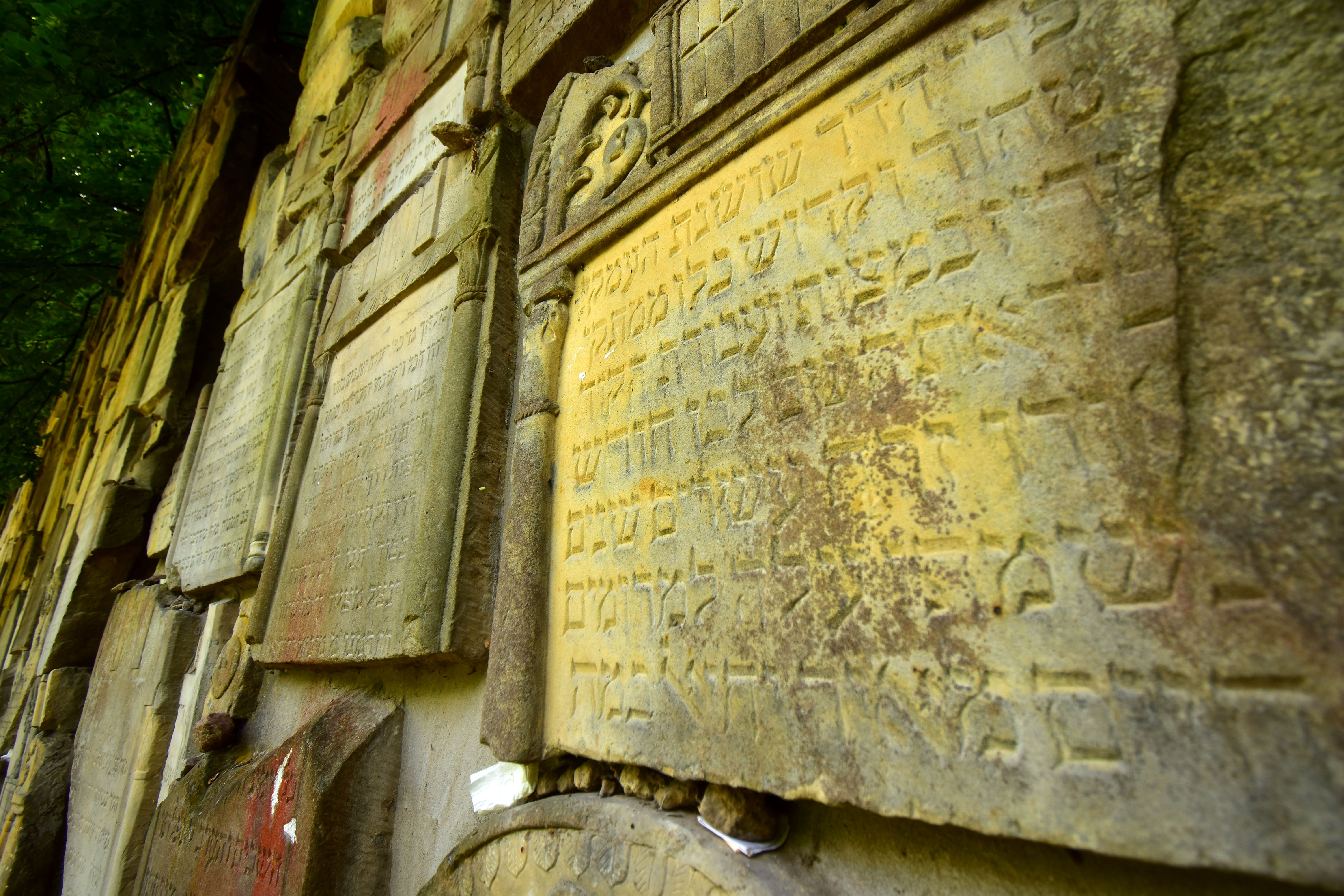
In 1939, the German occupiers began the systematic persecution and mass destruction of the region's Jews. The Jewish cemetery was desecrated; headstones used by the Germans to pave local roads. After the war, these were recovered and formed into a monument to the 3,000 Jews from the Kazimierz Dolny ghetto who perished in the Holocaust. The monument takes the form of a broken wall (fragment below). Through the crack we see a path leading up a steep hill through a wood, at the top of which grow fields of berries.
 

Below: a close-up of the wall of headstones. Note the stones and scraps of paper with prayers that have been left in the interstices.


Below: on the road from the ferry to Janowiec, there's what remains of another, smaller, Jewish cemetery, again marked with a monument – a raw iron slab flanked by stones. As at Kazimierz Dolny, headstones were also used by the Germans for construction purposes; unlike Kazimierz Dolny, none survived the war in a recognisable state.


Below: affixed to the back of the iron slab, the largest fragment that remains from the Jewish cemetery of Janowiec.

Kazimierz Dolny's scenery and atmosphere attracted many artists in the interwar years, Poles and Jews alike, making it an important artistic colony, similar in national importance to Zakopane. Along with the painters and potters came photographers, eager to document the town and its inhabitants and to capture its essence. The Jewish quarter, around the small market square and synagogue, came to represent the stereotypical shtetl, and was used as a filming location for Yiddish films such as The Dybbuk (1937). [Referred to in the opening sequence of my favourite film of all time ever, the Coen brothers' A Serious Man.] 

Below: the former synagogue currently houses an exhibition of photographs of the town taken between the wars by the Jewish photographer Benedykt Jerzy Dorys, one of the founding members of the Polish fine-art photography association set up in 1929. Dorys had a studio in Warsaw, and would often visit Kazimierz Dolny. He escaped from the Ghetto in 1942 and was hidden from the Nazis by his former housekeeper and three Polish families. After the war Dorys resumed his photographic business and died in 1990 at the age of 89. The photographs document the Jewish quarter of Kazimierz Dolny, showing the people and the place, capturing the essence of pre-Holocaust life. A must-see exhibition.


And to cap the day; back at the apartment, the wifi wasn't working. So what's on telly? TVP Kultura had just started airing The Woman in Gold, a 2015 British film about the legal fight for Gustav Klimt's
Portrait of Adele Bloch-Bauer I, which had been stolen from her family by the Nazis after the Anschluss of Austria. The film portrays in flashbacks the country's sudden anti-Semitic turn; how people could behave with such savagery towards their neighbours was all the more upsetting in the context of today's toxic populism. Never again.


This time two years ago:
Blasted!

This time seven years ago:
My new used laptop
[Six years on, it's still fine albeit without a battery; I can no longer source a new one; it still works fine when connected to the mains.]

This time ten years ago:
Face to face with Mr Hare

This time 12 years ago:
Central Warsaw vistas

This time 13 years ago:
Future of urban motoring?
[Sadly not. It proved to be V8-powered two-tonne SUVs for dragging lazy lard-arses into town]

This time 15 years ago:
On foot to Limanowa

This time 17 years ago:
Crumbling neo-classicism in Grabów
[Now the possession of friends from London!]

This time 18 years ago:
Bike ride into deepest Mazovia

Monday, 23 June 2025

Janowiec and Mięćmierz

Crossing the Vistula from Kazimierz to Janowiec entails taking a ferry; not cheap (14 złotys, or about £2.80 per person) each way for the ten-minute journey. The vessel can take up to eight cars plus foot passengers and cyclists. The traffic tends to be east-west in the mornings and west-east in the afternoons; the ferry sails between 08:00 and 18:00 in season.


Below: reminding me of the famous scene in  Fitzcarraldo. On the Kazimierz Dolny side – a riverboat, the Tina, stands motionless on the bank (online I read that the owners need to upgrade the mooring facilities before permission is given to resume sailing up and down the Vistula).


Across the river and up the hill; Janowiec castle (just like the castle in Kazimierz Dolny, destroyed by the Swedes). The castle and museum next door are covered by one ticket. Worth making the effort to come out to see.


A view from Janowiec castle's krużganki (cloisters) on the second floor of the castle ruins.

Polish viticulture is flourishing, not least because of climate change. The wines of Andrzej Dymek are available for sampling (and purchase) in the castle grounds. Having sampled his wares, I can heartily recommend his Chardonnay. Too far south for varietals such as Riesling or Hibernal, the climate around Kazimierz Dolny allows for more mainstream grapes. The Dymek vineyard is some 10km east of Kazimierz Dolny; Andrzej is the fifth generation to be making wine from the family. I was impressed by his professional approach (samples sent to lab to measure acidity; expert-level awareness of soil and climate, and to the knowledgeable client). 

At the other end of the scale are the local vineyards that produce a generic red and a generic white, who offer no possibility of sampling; this is aimed at the less-discerning tourist who merely requires a bottle of something local to take home after visiting.

Below: Dwór z Moniak (the manor house from Moniaki), an 18th century building that had been moved plank by plank in 1974 and rebuilt in the skansen (open-air folk museum) next to the castle in Janowiec. The ground floor is open to visitors as part of the museum; the first floor houses guest rooms that serve as hotel accommodation.

Below: time travel; like going back 50 or 60 years. Authenticity served here. The village of Mięćmierz lies less than 4km from the market square in Kazimierz, but the mainstream tourist does not get this far. People who buy property here are artists, pioneers, individualists. There is one karczma serving traditional food. A steep climb to a hilltop is rewarded by marvellous views over the Vistula gorge.

Below: view of Janowiec castle across the river, from the hill overlooking Mięćmierz.


If you're up for long walks, everything in and around Kazimierz Dolny and Janowiec is walking distance; over three days my health app shows 22k, 29k and 28k paces respectively; doable. 

This time last year:
Big Walk to Zalesie Górne

This time five years ago:
My return to central Warsaw after lockdown

This time six years ago:

Sunday, 22 June 2025

Kazimierz Dolny holds its own

I have reported how over-tourism is becoming a serious plague for any attractive destination, from Sandomierz to Prague. Kazimierz Dolny, a historic town on the Vistula, has bucked the trend, largely by channelling the ice-cream-and-cake crowd in and around the tiny market square, while the more distant parts remain attractive. Much attention is paid to the town's architecture; new houses are being built all over the place but they have a common look.

Below: view from the riverbank looking up the escarpment, with the castle and tower upon it. The town's location on the steeply sloped Vistula gorge. The castle, like so many others I've visited in  Poland (Czersk, Chęciny, Ciechanów to name but three beginning with 'C') had been destroyed by the Swedes during the course of their invasion of Poland (1648-67). According to Wikipedia, the Swedes destroyed 188 towns and cities, 186 villages, 136 churches, 89 palaces, and 81 castles at that time. 


Below: Kazimierz Dolny was an important wheat trading centre in the Middle Ages, a staging post between Kraków and the agriculture of Małopolska, and Warsaw, Gdańsk and the Baltic beyond. At the height of its importance, there were 60 of these granaries along the waterfront in Kazimierz. Those that survived today serve as hotels, apartments or private residences – as well as inspiring generations of architects.


Below: view of the Vistula Gorge from the castle turret. Across the river in the distance, Janowiec (for tomorrow's blog post).

Below: similar view from the Three Crosses Hill, further back and higher up.

Below: ruins of the castle. Damn Charles X Gustav of Sweden.

Below: stunning views from the top. Which to choose for the blog? All of them!

Below: modern houses are above all, tasteful. I suspect the local heritage conservator has a great deal of say as to what gets built and how it all looks. Lots of white- or cream-coloured stone facings, wood and local building material, and a style that strongly reflects the historic architecture of the region. 

Below: new house, old style. There are many such dwellings dotted around the outskirts of Kazimierz Dolny; each individual, and yet conforming with a local traditional architecture. Love it!

One interesting observation: menus in cafés and restaurants are exclusively in Polish; in four days I saw two cars on German plates, one Austrian registration and a motorbike from Finland. Kazimierz Dolny is neither much known nor much frequented by foreign guests, despite being well-known and loved by all of Poland.

Below: a nice bit of old-school photo challenge. Architecture and automobile in sync.

Below: four nuns out on the town.


Below: a herd of goats, and a stall from where absolutely delicious goats' cheese can be bought. Recommended – the one with sun-dried tomatoes and garlic was excellent. Eaten in one go, despite my best intentions to save some for later.


Below: brilliant busking from a youthful six-piece brass ensemble, Calidum, inspired by New York Metro buskers Lucky Chops. Highlight for me was the former's cover of the latter's Funky Town/I Feel Good.

  
Also of note musically was a violinist whose pitch was on the riverside promenade; her renditions of traditional Irish music from the Chieftains and bluegrass in the Down from the Mountains style also drew an appreciative crowd.

More tomorrow.

This time two years ago:
Legnica, south-west Poland


This time five years ago:
Rural rights of way

This time six years ago:
Not a whole lot going on...

This time ten years ago:
Dreamtime supernatural

This time 12 years ago:
Baszta – local legend round these parts

This time 14 years ago:
Downhill all the way to December

This time 15 years ago:
What do I want for Poland

This time 16 years ago:
Summer holiday starts drizzly

This time 17 years ago:
Israeli Air Force Boeing 707 visits Okęcie

Friday, 27 December 2024

Jacek Malczewski exhibition, Radom

An extremely important exhibition from the point of view of Polish art history, and one that could easily have slipped under the radar. Advertised extensively on Koleje Mazowieckie trains' TV screens – but nowhere else – the exhibition, Perspektywy ('Perspectives'), brings together paintings by Jacek Malczewski from 16 museums and from private collections across Poland. His paintings are grouped together alongside those by his contemporaries by theme. 

These include fauns, satyrs and nymphs in clearings and glades, by rivers, often with the artist among them, pan pipes, goats' hooves; allegories of Poland's enslavement and rebirth; many self-portraits with classical allusions, Polish landscapes, and – here and there – fantastical visions. 

The exhibition shows works by artists with whom Malczewski had master-student or friendly relations, but also those whose work could have influenced his painting. The context of the title is provided by the juxtaposition of work by artists such as Jan Matejko, Józef Mehoffer, Julian Fałat, Leon Wyczółkowski Olga Boznańska and others. By displaying works that influenced the development of his art, from his early technical studies to the rich symbolism of his later pieces, the exhibition is a journey through the life and works of a great artist, that explores the main threads appearing in his painting.

For all but the last 11 years of his life (Malczewski died at the age of 75), Poland was partitioned between Russia, Austro-Hungary and Germany; Polish artists straddled those borders. Born in Radom (under Russian occupation), Malczewski studied and later taught in Kraków (under Austro-Hungarian occupation). When the First World War broke out, Poles living under the Tsar had to fight against Poles living under the Austro-Hungarian Emperor and the German Kaiser. This reality is shown in the many paintings inspired by Poland's failed risings in 1831 and 1863, the repressions that followed, and the eternal hope that one day Poland would be free and reunited.

As the exhibition comes to an end, it occurs to me that being able to see all these Malczewski paintings  under one roof again is not something that will happen for a long, long time. And displaying them in the context of his contemporaries may not happen again. It runs until 9 January; normal ticket price is 40 złotys, but if you come by Koleje Mazowieckie train and show your ticket, the price tumbles to 10 złotys.

This time last year:
Back out into the open


This time three years ago:
Wintery gorgeousness and filthy air

This time four years ago:
Jakubowizna – moonrise kingdom

This time seven years ago:

This time 10 years ago:
Derbyshire in the snow

This time 11 years ago:
Is Britain over-golfed?

This time 13 years:
Everybody's out on the road today

This time 14 years ago:
50% off and nothing to pay till June 2016