Showing posts with label motoring. Show all posts

Wednesday, 19 August 2026

Little Victories In The Unending War With Entropy

Time's arrow goes one way, from past through the present (which passes in a tiny fraction of a second) to the future. Unlike other dimensions, if indeed time is a dimension. I can walk forwards, I can walk backwards. I can jump up, I can fall down. I can move left, I can move right. But time has only one direction. The reason? Entropy. It's why you can't unstir cream from coffee or resurrect a rotting strawberry. If you have something – anything – it will break. Just a matter of time.

We cannot make time go backwards, but we can slow it down. Take care of your things and they will serve you better, for longer. And save money. 

My daughter's car (below) has been with me now for over two and half years (she's still the legal owner). She bought it in 2020, just after lockdown (we celebrated its purchase with a curry in Ursynów, being among the restaurant's first customers after it re-opened). Before that, it had one owner, the mother of a boy that Moni was at primary school with. A nice family. Good provenance. This 1.2 litre Micra was built in 2005; it sat unsold in Slovakia for two years, after which it was transferred to the Polish market where it quickly found its first owner.

It currently has 147,000 km on the clock, just 7,000km more than it did when I took it for its first przegląd techniczny (Polish equivalent of the annual MoT test) two years ago. 

The car passed the test with flying colours, the guy running the testing station could not find a fault with it, although he made the following observation... "You drive the car sparingly; you don't thrash the engine. You slow down using the gearbox, and driving steadily on quiet country roads that you know well, you hardly ever have to use the brakes. As a result, the disks have developed a slight bloom of rust. Not enough to fail the test, but enough for me to notice. So next time you go for a drive, apply the brakes hard once or twice just to clear the brake disks of any rust."  Will do! 

I am grateful to the car. After a drive to the shops and back (in Warka, once a week), I pat the roof and say to the car "well done!" and thank it for its reliable and economical service. It's all I need from a car.

Another little victory in the unending war with entropy took place under the sink, which over the past year since a plumber last unblocked it, had once again been taking longer and longer to drain. The cause of the blockage – most probably traces of cat food, remnants left in bowls or tins. Ghastly stuff if you think about it – fatty offal mostly. 

Last year's call to the plumber was about three issues, of which the kitchen sink was the easiest to fix, the others being the garden tap and the hot-water tank in the bathroom. Cost of fixing all three – 800zł. The plumber told me that I'd be condemned to regular sink blockages, because when the house was originally built, the run-off was installed at an insufficiently steep angle. "Do everything you can to avoid solids going down there, however small," he advised.

ChatGPT offered me a simple solution to the blocked sink – sodium hydroxide crystals. Sold in Poland under the Kret brand (unavailable in the UK), this is powerful stuff. Clear the house of cats and kittens! Don thick rubber gloves! Open all windows! Don't breathe the fumes! Following the AI instructions for the use of Kret, I poured 200ml of very hot (but not boiling) water down the sink. Then two and a third capfuls of the sodium hydroxide crystals. Then another 300ml of very hot water. Then wait half an hour, taking care to avoid the fumes emerging from the plug-hole.

At last I filled the sink with hot tap water.... No difference. The water was going down very slowly, if at all. But I was prepared for this. I wielded a sink plunger (which I had previously used to zero effect). But now... after the application of Kret, with a sinkful of water... plunger deployed... a couple of hearty pumps, and then a gratifying 'BLGRGRGRGRGLLL' and sudden drainage: the water disappeared as rightfully it should. All good! The Kret had softened and partly dissolved the greasy obstruction, but did not clear it outright. The plunger then supplied the mechanical pressure needed to dislodge the loosened plug. Neither the plunger nor the Kret on their own could shift the blockage, but the combination did. Result!

UPDATE: my daughter offered me some really useful advice: buy a sink strainer! (sitko do zlewu). I found a nice one, Polish-made by PrimPol AGD, enamelled stainless steel, in the local hardware store, for 6.90zł. ]

This time last year:|
The perpetual search for authenticity

This time three years ago:
A dog day's night walk

This time four years ago:
Old soul, new challenge

This time five year ago:
What happened at Monks Wood

This time seven years ago:
Loss, faith and consolation

This time nine years ago:
Summer's wasting away

This time ten years ago:
Warsaw remembers the PASTa building capture

This time 11 years ago:
Drought. It was a dry summer.

This time 13 years ago:
Warsaw's ski slope at Szczęśliwice

This time 14 years ago:
On the road from Dobra, again

This time 15 years ago:
August storm, ul. Targowa

This time 16 years ago:
Warsaw Central's secret underground kebab factory

This time 17 years ago:
Cheap holidays in other people's misery

This time 18 years ago:
Steam welcomes us to Dobra

This time 19 years ago:
New houses appear in the fields by Zgorzała

Sunday, 24 May 2026

The demand chain and behavioural economics

Not far from home there's a scrapyard; hundreds of cars, piled one on top of another, awaiting final breakdown into reusable parts and eventual smelting. 

If only the planet's automotive companies put as much effort into keeping old cars roadworthy as they do in manufacturing and marketing new ones!

Yesterday, I filled up the Micra for the first time since the 19th of December. Since that day, the 21-year-old car has been driven 724 kilometres (450 miles). I'm getting 18.4km to the litre or 52 miles per (UK) gallon. Other than the big weekly shop in Warka (exactly 18.4km away), I hardly drive the car at all. For the first seven weeks of 2026, the car didn't move because there was too much snow, and the salt used to clear the roads is dreadfully corrosive to the car's undersides. I hope to keep the Micra running for many, many years. Following classic-car Facebook accounts, if cars I remember from childhood are still in regular use today, why can't a 2005 car be around in 2070?

The scrapheap on the DK50 at Nowe Grobice is full of cars that I'm sure could have been repaired and kept going for years had there been a will to do so. Many owners get caught in the following trap: "My car's worth €5,000. It will cost me €3,000 to fix. So I will sell it for five and use the three set aside for fixing it to buy a used car for €8,000." And then they end up buying one for ten. "But it's got all the options." The idea that an old car is beyond economic repair is what fills the scrapyards to the brim.

I was particularly sad to see an Audi A2 up there. It was a car built before the current craze for oversized SUVs, a car with an aluminium space-frame body, light in weight and resistant to corrosion. 

With a diesel engine, it could cover 33.3km on one litre or 94.2 miles per (UK) gallon. Surely, this is the sort of car the world needed? Well, it turns out that – no. After a mere five years in production, the last Audi A2 rolled off the production line in August 2005. Today, Audi produces five saloons (also offered in hatchback/estate versions) and eight SUVs. 

The smallest car in Audi's current line-up, the A3, takes up 22% more roadspace (7.9m² vs. 6.4m²); in its base version, the A3 weighs 35% more than the A2. In stop-start urban traffic, the A2 can cover over 18km on one litre of diesel, while the A3 can only cover 14km, what with having to accelerate that extra bulk every time the lights turn green. And for the gentle, rural driving that I do, an A2 can cover over 26km on a litre – something impossible for even the most feather-footed A3 driver [Data via Google Gemini.]

Meanwhile, I am being bombarded by online ads for new cars. No – I will not buy one. I would rather sink thousands of zlotys into keeping the old Micra roadworthy than to walk into a showroom to buy a brand new car.

We talk of 'supply chains'. What about 'demand chains'? ChatGPT defines demand chain as "the sequence of activities through which customer need is identified, stimulated and converted into profitable orders." Note use of the term 'customer need'. Our needs are for most part simple; our wants are complex and latently profitable. The demand chain is about reframing our desires – often spurious or frivolous – as necessities.

I've been interested by the concept of behavioural economics for a long time. It is the main reason why economists can't predict the future: the infinite complexity of the market behaviour of eight billion individuals. Like the butterfly in your garden whose flapping wings unleash a typhoon in Indonesia, one person's decision not to buy a winter coat can result in the closure of a garment factory in Brazil.

Endless economic growth is predicated by consumers' insatiable appetite for more, stoked by the demand chain.  A consumer may begin with a vague want – comfort, status, convenience, security, belonging, self-expression, relief from anxiety. The market then supplies the narrative machinery that frames that vague want into something harder to resist: a need.

How many times have you caught yourself saying "this is not indulgence; this is self-care," or  "this is not luxury; it is an investment," or "this is not about convenience, it's about productivity." A crucial part of the demand chain is the psychological conversion mechanism: transforming an entirely discretionary desire into a seemingly rational expenditure decision. And this works so well in the clothing industry.

For the good of the planet, for the good of your bank account, doing less is not necessarily the answer; the real answer is wanting less. To quote epigramologist Jacek Koba, "happiness is when the ratio of your expectations to your reality is 1:1".

This time last year:
The pareidolias of smell

[An unbidden memory from 50 years ago unlocks memories from past life.]

This time four years ago:
Interstices (junction of S7 and S2 expressways just ahead of its opening to traffic)

This time five years ago:
Joys of Spring

This time six years ago:
Jeziorki in May

This time seven years ago:

This time nine years ago

Monday, 14 July 2025

The Aesthetic Attention Span, or How Long Before We Need The New?

Life moves in cycles; optimally, these are spirals, we return to where we were but one notch higher up. We learn, we understand, we evolve. Sometimes, however, the cycle spins downwards. History, a series of events that have a tangible effect on our lives, moves erratically, but does tend to echo, repeat, rhyme. Anacyclosis. What goes round comes around.

But the aesthetics of our times? Architecture, design, fashion, literature, music, cars, graphics – yes, things change, the quest for novelty and innovation is limitless and it shapes the spirit of our age, indeed any age. This is the zeitgeist. 

We tend to label the look-and-feel of our built environment, our surroundings, by decades, book-ending them conveniently. In my mind's eye I can scroll through my memories of Britain from the early 1960s, still emerging from postwar austerity, drab colours and clothes, through the colourful '70s to the mid 1980s in distinct phases, each defined by music, clothes, car designs, high-street logos, typefaces and indeed colours. And then, sometime around around the mid-1990s, aesthetic change starts to become change for change's sake, not for the sake of modernity. Form and function, that sort of thing.

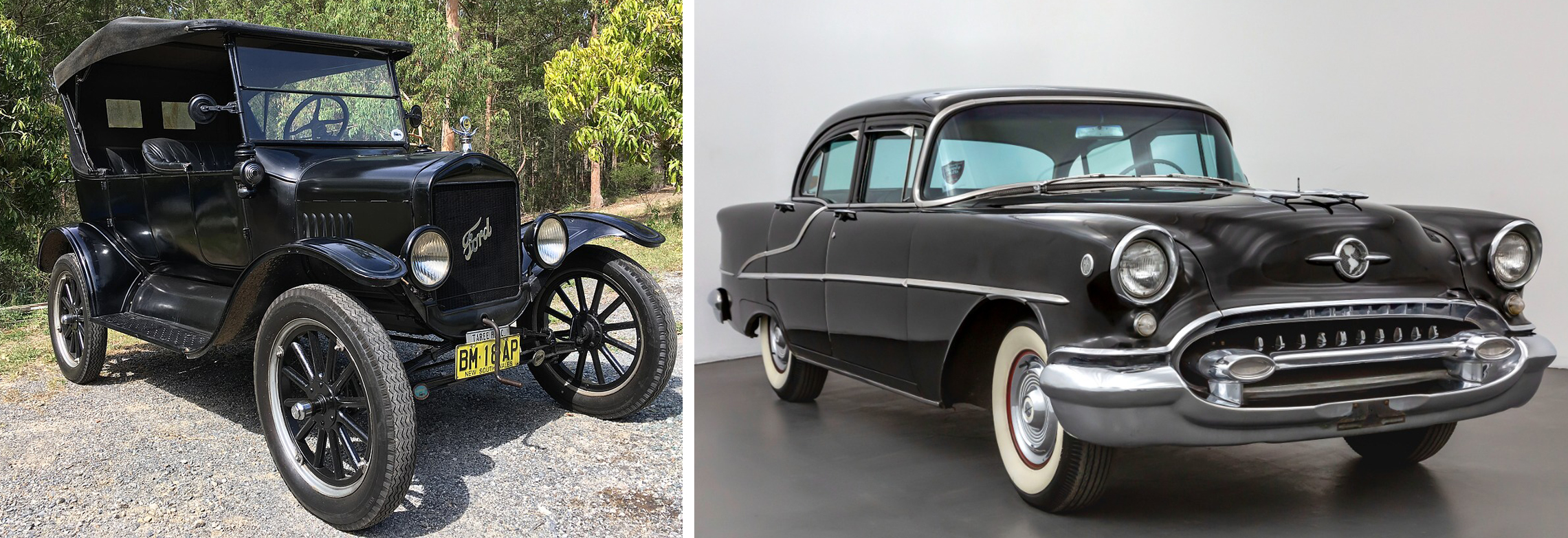
Look at a car from the 1920s, and compare it to one from the 1950s. An infant could tell you which looks more modern. But look at a car from the mid-1990s and compare it to something off the production line today... Does it really look more modern... or just different?

Below: thirty years of automotive design progress, 1925 to 1955.


Below: thirty years of automotive design progress, 1995 to 2025.


If I were to have my pick of the above four, I'd go for the 1955 Oldsmobile. And stay with it until the end of my life. Because I like its looks more than the more recent designs. One reason why the automotive industry has failed to prise any money out of my bank account over the past quarter century has been its inability to design a car I'd actually like. The crumpled-tin look of contemporary car design turns me off. Just look at the grotesque 'face' of the current Toyota Whatsit (above right). It looks like a whale feeding on krill.

Music, clothes, typography – has that much changed since 1995? The technology obviously is quite different, as is the political vibe. But visually, aurally, aesthetically, 1995 is far closer to today than 1955 was to 1925. Aesthetic change for the sake of aesthetic change – built-in obsolescence – is a driver of economic growth and a wasteful one at that. How can you possibly be seen to be driving a 1959 Cadillac in 1962, by which time the fins had shrunk and men wore pleatless slim-line pants and pork-pie hats rather than broad-brimmed trilbies and trousers featuring acres of pleated cloth. Just a few years, and what a difference. From Humphrey Bogart to Steve McQueen. Cool change. But what's changed in men's fashions since the mid-1990s?

One of the first films I watched on my own in the cinema (and the first film I bought on DVD) was American Graffiti (George Lucas, 1973). A film that wallows in nostalgia – the music, the fashion, the trends, the cars – from an era just ten years before it was shot. Do you feel nostalgic about 2015? I could name you a hundred songs from 1975, for example, but not one from 2015. Did we wear different clothes in 2015? Did people go around with different hairstyles?

Access to the tools of design was once hard-won; a draughtsman's drawing board and all the instruments needed to turn a concept into a sketch into plans for a working prototype. Today, software makes possible professional-level design to anyone who has a desire and a knack to do so. The same with music, with movie-making, with any form of creative endeavour. The barriers of entry have fallen. Great, you may say. More democratic. No more closed shops. Everyone can now create.

But what's happened is that the long tail has stretched out towards infinity. A handful of titans dominate each industry at one end, while a vast number of creative people struggle for a handful of page views at the other end. Our blockbuster movies tend to be remakes or franchises, nothing new is breaking out of the underground. Yet surely somewhere in that long tail is a talent or talents that could launch an aesthetic movement to equal Art Nouveau or Art Deco, the New Look or Rock'n'Roll. But it's all too fragmented. That talent needs to be planted in a soil, in a social milieu, aesthetic change does not occur in a vacuum.

While I feel that humanity is indeed in a historical inflexion point, that seismic geopolitical and socio-economic change is afoot, I can't say the same about the arts and culture. Our attention spans, shortening year by year, flick to the default – "I'll stick to what I like". Kitten videos.

The Shock of the New? There are enough shocks out there already, thank you, without introducing any aesthetic shocks.

It will be interesting to return to this post in ten, twenty and thirty years' time. Is an aesthetic revolution around the corner? Or have we emerged out of a particularly creative period in human history, and now have nothing more than algorithm-generated mediocrity and AI slop to look forward to? Are paradigm shifts in aesthetic sensibility caused by the supply side (gifted innovators) or by the demand side (society bored of the old and itching for something new) – or 100% of both? 

I was there in November 1976 when the Sex Pistols, supported by the Clash, visited Coventry with the Anarchy tour. That was one of those aesthetic tipping points. I wait for something similar.

This time two years ago:
Wałbrzych, Książ and Riese


This time 11 years ago:
How the other half lives - a Radomite's tale

This time 12 years ago:
On guard against complacency

This time 13 years ago:
Ready but not open - footbridge over Puławska

This time 14 years ago:
Dusk along the Vistula

This time 15 years ago:
Mediterranean Kraków

This time 15 years ago:
Around Wisełka, Most Łazienkowski, Wilanowska by night

This time 16 years ago:
Summer storms

This time 18 years ago:
Golden time of day

Saturday, 10 May 2025

Campaign for Real Motoring

Since Moni moved to Prague, I've been looking after her Nissan Micra. Built in 2005, its first owner was the mother of a classmate from Moni's school, from whom she bought it in 2020. Living in Warsaw, Moni didn't put many miles on the clock, and since leaving it with me in December 2023, the car is used minimally. One round trip a week to Lidl in Warka, about 40km. As of this morning, 143,106 kilometres on the clock (88,921 miles), of which I did about 3,200 km over the past 12 months. This means I need to fill the car up at the petrol station four or five times a year, once every 750 km.

Electric front windows (rear windows are hand-wound) is the only concession to modern motoring to be found in the car. No air-con, manual gear change, old-school radio. Ah! It does have keyless locking (what happens when the battery expires? Then you prise off the cover of the door handle, and put the key in the lock...)

My social-media feeds bombard me with ads for new cars. But I will not buy a new car. Now, let's consider what would happen if eight billion people were to suddenly say that 1.5 billion cars is enough for our planet and would stop buying new cars. If Europeans were to say that 260 million cars is more than enough for the European Union (of 450 million people). There'd be enough cars to keep us all motoring for a long, long time. Those existing cars could keep going for decades (just look at Cuba). Their value would go up as supplies of new cars begin to run dry. Scrapyards would empty as parts get cannibalised to keep existing cars roadworthy. Job losses in the factories would be replaced by new jobs in remanufacturing.

I don't need a car that's a stuffed full of electronics, with touchscreens, maps and other gizmos that beep. I need a speedometer, odometer/trip meter, petrol gauge and indicator lights. Even a rev counter is optional. Mirrors and seats – manually adjustable. Manual gear change (or course). A simple, basic car with an emphasis on sustainability – extreme long life, modular design so elements that wear out can be easily swapped.

The Micra passed its MOT last summer but with a note of caution that rust is beginning to take hold of the undersides; so 2,000zł-worth of welding had that sorted out. I'd rather keep piling money into an old car than buy a new one. 

Car aesthetics are immensely important to me. The way cars look influence the visual appeal of the built landscape. They are as important as architecture. But a question for myself: do I simply like old cars because they remind me of my childhood? Or was car design intrinsically better in the 1960s than it is today? Safety is important; how much of today's automotive aesthetic is the result ot safety considerations (crash-proof cages, bonnets shaped to minimise injuries to pedestrians etc) and how much is that 'creased-tin' look that car makers consider to be in vogue?

This is what I like. On my way from Kraków Główny yesterday to the Schindler's Factory museum, I passed a superb collection of historic Mercedes-Benz vehicles in the shopping mall by the station. These included replicas of the first Benz motorcycle and car, pre-WW1 Benzes, interwar cars (including the only small, rear-engined Mercedes-Benz, and postwar classics. Don't know whether my favourite was the 'gullwing' 300SL or the 'pagoda' 230 SL (below). Could I see myself owning one and driving to Warka to do the weekly shopping? "Jeez, what a waste of machinery!"

I'm not a mechanic; can't find my way around a screwdriver; under my ownership, entropy would take hold; things would fail, bits would break – and rust never sleeps. I don't dream of owning a classic car, but I do waste an inordinate amount of time ogling CarandClassic.com looking at them and simply imagining what it would be like to own one. It's the same with toy cars. Corgi, Dinky and Matchbox – from my childhood – remembering the qualia of playing with them, opening their little doors, tipping forward the little seats... But while I get the Corgi Club newsletter and read excitedly about the new releases of 1960s toys, complete with replica boxes, perfectly made, I know that actually getting one would disappoint and would not bring back those exact qualia memories. I can conjure them up in my mind better. Same with a classic car. I can smell the interior of a classic British car of the 1950s and 1960s. I can perfectly picture the engine bay under the bonnet, the exact shade of green of a BMC cylinder head, the air filter in black (with rust colouration), and hear the sound of a Morris Minor changing down from third gear to second.

And at the wheel of the Nissan Micra, I can be driving anything I imagine. Sedately. Taking it easy for all the sinners on the roads. Like the chap in the black SUV who overtook me at 90+ km/h in a 50km/h zone with double white lines in the middle of the road today. Below: my 1932 Deuce Coupe, my 1949 Dodge Power Wagon, my 1953 Chevrolet Thriftmaster 1⁄2-ton truck, my 1956 Oldsmobile 88. As I drive from Chynów to Warka through Wygodne, Michalczew and Gośniewice. Orchards, crossroads, warehouses, electricity cables stretched above the road, the two-lane blacktop ahead of me, it's all in the mind.

The automotive industry has lost its way. A good time to turn from making ego-boxes for the insecure to building armoured fighting vehicles to boost Europe's defences in an age of Putin and Trump.

This time last year:
Gdynia

This time two years ago:
Covid is over; what did we learn?
[Covid finally caught up with me seven months later]

This time three years ago:

This time four years ago:
Blossom time in Jakubowizna

This time five years ago:

This time six years ago:
Busy doing nothin'

This time 11 years ago:
Springtime pictorial

This time 12 years ago:
Kitten time!

This time 12 years ago:
Warsaw-Centrum to Jeziorki by train with super-wide lens

This time 14 years ago:
Loose Lips Sink Ships - part II

This time 15 years ago:
Jeziorki in the infra red 
[Photos by the late Rysiek Szydło]

This time 16 years ago:
Some rain, at last!


Saturday, 23 September 2023

It's a competitive world

As mammals, we are born to compete for status within our social hierarchies. Materialism offers a neat way to display one's position in that hierarchy without any longer having to a) beat into submission hundreds or thousands of other men or b) gather a harem of dozens or hundreds of women. 

No - all that's needed today is ownership of a private jet, one's own island, a mass-media outlet to control what people think, and a collection of something collectable - artwork, fine wines, classic cars or rare books. "Look at me! I'm a success!" [The corollary is that everyone else not on this level is a loser.]

Because the communist system was so inefficient at generating wealth, value and innovation, even those at or near the top of the status hierarchy were not actually that well-off when compared to rich folk in the free-market West. And when the Iron Curtain fell, and the baubles of consumerist culture became available in countries like Poland, there was a sudden and largely mindless rush to consume, possess and display one's new-found social status.

I suspect that this is why the car-ownership rate in Poland in the highest in the EU. "Amongst the EU Member States with the highest motorisation rates, i.e. passenger cars per thousand inhabitants, Poland (687 passenger cars per thousand inhabitants) heads the list. In second place follows Luxembourg with 681 cars per thousand inhabitants" - Eurostat, March 2022

It's not just cars. Society around me seems to be in a mad rush to earn, consume and display status. Yet once detached from the metaphysical nature of life, all that remains is matter and materialism. The handbrakes are off; self-reflection fades, and what counts is solely What Others Think Of Me.

In mediaeval times, one's place in the pecking order was ordained to a greater extent than today by birth - there were far fewer escape routes from the rural poverty into which most folk were born into. One, of course, was the Church; bright boys could choose the monastic life or enter the priesthood, and there they could study, and advance up this particular hierarchy, with the brightest and best reaching high rank as abbotts or bishops or cardinals. The whole point of celibacy within the Church was to prevent the cumulation of personal wealth for intergenerational transfer; it had to be retained by the Church.

But whatever the system, mankind's inexorable need to display status through the accumulation of goods considered to be luxurious; gold, gems, ermine and works of art. Even the spiritual hierarchy, that takes vows of holy poverty, would still claim "these luxury goods are not mine, they belong to the Church", while enjoying a lifestyle of luxury known only to kings and feudal lords.

I hold that a middle way must be found; for our own personal sanity, for a healthier, better functioning society, and for our planet that is being steadily warmed by two billion rich people as they consume.

We must be aware of our behaviour and motivation as consumers; we must buy less, make do with what we have, and be conscious of our spending decisions. "Aim to live in comfort, not in luxury", remains a motto of mine; knowing when to get out of the rat-race is crucial. This is when maturity kicks in, overcoming the social creature within us all that's unwittingly guided by the mammalian imperative to show off. Maturity blossoms into enlightenment, which can reach the state of transcendence; but much water must flow first under the bridge. "If you're not married by 30 and made by 40, you're an all-round fool", my mother used to tell me. But external pressure to compete is not a wise counsel. Knowing when to take the foot off the materialist accelerator is a sign of wisdom, a sign that you know that there's more to self than ego. 

The quest for knowledge, understanding and ultimately, serenity, is for me a far greater driver than any material ambition. Yes, I'd like to buy the wood next door someday, but my motivation to enlarge the amount of land I own knowing that under my stewardship, plants and wildlife will come to no harm. No felling, no clearing, no mowing, no pesticides, no herbicides; allowing nature to take its own course as far as possible. 

If I'd wish to engage in competition, it would indeed be a competition to know and to understand - not to display material goods for the admiration of others. But even this competition would be of the good-natured sort, its ultimate aim being the attainment of a higher level of understanding that through cooperation can be disseminated broadly through society.

This time last year:
To Rzeszów and back by rail, Pt. I

This time last year:
To Rzeszów and back by rail, Pt  I

This time two years ago:
Science, Religion, Magic and Consciousness

This time five years ago:
The house on the działka, coming on

This time six years ago:
Autumn comes early

This time seven years ago:
Kriegslok passes through Jeziorki

This time 11 years ago:
A little way west of Jeziorki

This time 12 years ago:
The Old Sailor's Tale - part II 

This time 13 years ago:
Prague-Jeziorki-Moscow

This time 14 years ago:
The passing of Lt. Cmdr. Tadeusz Lesisz 

This time 16 years ago:
Summer ends, autumn begins

Tuesday, 21 January 2020

Car disposal day

A sad, sad parting - my father's car, bought new in December 1992 (via Austin Rover's Journalist Discount Scheme), was finally taken away for scrap. It has been standing outside the house, undriven, since it's last drive out to the Polish War Memorial in Northolt in June 2018, where it failed to start. A rescue van came, the guy said the alternator was no longer charging the battery. And the clutch plate was slipping. Total cost of new clutch plate and a new alternator parts plus labour would have been around £350; you can buy a runner for less. Because my father reversed it into the wall, creasing the boot, right at the end of his driving days, the car was not suitable for restoration - too many bent panels.

Had it become a classic? In my younger days, a car over 20 years old would have been considered one - no vehicle excise duty to pay, cheap insurance - but now, a classic car is recognised by the state as 'historic' if built before January 1979 - 41 years.

It was SORNed (Statutory Off-Road Notice) and left in the drive where it had always stood since new, now as a gate guardian. A part of the landscape.

Below: from space, three views of the family house in West Ealing, the first from 1999, the earliest on Google Earth, the second from the spring of 2015, the third from last summer.


The last photo, 07:10 am, Tuesday 21 January 2020; over 27 years since it first arrived. There was an overnight frost, which made it hard for me to open the doors to place the documents and keys inside. I checked the interior for belongings and found about 65p in the hidey-hole for coins, a tiny leather football, a button, a till receipt, a pay-and-display parking ticket.


I came home from a business meeting in town, and it had gone. On the doormat - a cheque for £165 (exactly as much as the online scrap-car price calculator had quoted me) and the slip that I had to send to the Driver and Vehicle Licencing Agency. By the evening I had received via email a DVLA Certificate of Destruction, to print out and keep. Praise for the scrapping company, Redcorn - very efficient and trustworthy operator.

Below: the sight that greeted me on return home - note the moss, the tyre marks, the condensation drips from the exhaust pipe - and a small oil stain under where the sump would have been.


Gone - but never to be forgotten. In particular the smell of the interior, which reminded me of summer holidays in North Wales when the children were small. It will always be 'Dziadzia-Auto' to us.

An old post here, outlining the car's history with our family.

This time two years ago
Notes from the Arena of the Unwell

This time three years ago:
The magic of a dawn flight

This time four years ago:
Warsaw as a voivodship

This time six years ago:
Around town in the snow

This time eight years ago:
Reference books are dead

This time nine years ago:
A winter walk to work, and wet socks

Sunday, 19 January 2020

Cars: bigger, heavier, more powerful. WHY?

Last month saw the launch of the eighth generation of Volkswagen's best-selling hatchback, the Golf. Positioned above the Polo and below the Passat, the Golf brand has been around for 45 years. With every successive iteration, the Golf gets bigger and heavier - and needing an ever-more powerful engine to drag the whole thing around.

VW Golf   Launch year   Length (m)   Width (m)   Height (m)   Weight (kg)*   Power (BHP)*  
Mk 1 1974 3.705 1.610 1.395 790 44
Mk 2 1982 3.985 1.665 1.415 910 44
Mk 3 1992 4.074 1.694 1.422 960 59
Mk 4 1997 4.148 1.735 1.440 1,050 74
Mk 5 2003 4.205 1.759 1.479 1,155 74
Mk 6 2009 4.199 1.779 1.479 1,217 79
Mk 7 2013 4.255 1.799 1.452 1,205 84
Mk 8 2019 4.284 1.789 1.456 1,315 89

* Weight and power output for base model

Compared to the 1970s Golf, the new one is over half a tonne (525kg) heavier and more than twice as powerful in its basic version. The Mk 8 is also over half a metre (58cm) longer than the Mk 1.

The power-to-weight ratio of the base model Mk1 was 55bhp/tonne; the Mk8's is 67bhp/tonne. A more powerful engine dragging around all that extra weight gives it more kinetic energy to do more damage in collisions, therefore it needs more body armour to protect its driver and occasional passenger(s).

The car industry is in trouble. My children's generation is not interested in car ownership. Once you've Instagrammed your new car - then what? Bore your friends with successive snaps of your car at different petrol stations? Far more impressive to travel the world! More likely is that the young are spending that part of their income that their parents' generation would have spent on cars paying for property that their old folks could far more easily afford (and a car on top of that).

I have no intention of every buying a car again. (Another small motorbike? Maybe.) I am an urban man; I live across two capital cities; a car is nothing but an encumbrance.

This time last year:
Train journey to Chynów
[a year on, one track's been modernised, the other's being done]

This time six years ago:
It's healthier to live in the city than in the suburbs

[Car-driving makes you fatter]

This time seven years:
Ikaria - the island where people forget to die

This time eight years ago
Miserable depths of winter

This time nine years ago:
From - a short story (Part 1)

This time ten years ago:
A month until Lent starts

This time 11 years ago:
World's biggest airliner over Poland

This time 12 years ago:
More pre-Lenten thoughts


Saturday, 31 August 2019

If you're really concerned about global warming - rein in your consumption

The UK's chief environment scientist last week suggested that to halt climate changing emissions, we need to change our lifestyles dramatically. We need to use less transport, reduce our red meat consumption and buy fewer clothes. I entirely agree.

Lifestyle changes must be made according to Professor Sir Ian Boyd, who gave an interview on the BBC, suggesting that every consumer has a part to play to avoid the climate change situation worsening. This graphic (below), prepared by the UK government, shows how CO2 emissions have changed over the past 28 years. It's clear that the two biggest producers of CO2 - industry and energy generation - have made significant progress. Government action - the drive for renewable energy sources and environmental regulation aimed at manufacturers - has had an impact. Buildings are greener too, as is waste - again, regulation has worked.

But look at 'surface transport'. Even though more Britons are taking the train than ever before (1.8 billion passenger journeys in 2018-19 compared to 1.1 billion in 2002-03), CO2 emissions from surface transport have been rising. The passenger car and the delivery truck are the culprits.


[F-gases = Fluorinated gases that stay in the atmosphere for centuries and contribute to the greenhouse effect.]

During the interview, Sir Ian said that polluting activities should be taxed further, and that the government should nudge citizens towards a lower-emission lifestyle by offering rewards to those who go for low-carbon choices. He said: "The way we live our lives is generally not good for the environment…We like to consume things, but the more we consume the more we absorb the resources of the planet. That means we have to grow those resources, or we have to mine them - and in doing that we generate waste. And consumption is going up all the time."

Technology is part of the solution towards reaching the goal: "We need to make major technological advances in the way we use and reuse materials but we ... need to reduce demand overall - and that means we need to change our behaviours and change our lifestyles."

Are you ready to do that?

Well, I have not owned a car for six years, use public transport and walk a lot; I buy used clothing from charity shops; my appetite for consumer goods is low. But one area where I am an above-average emitter of CO2 is in my frequent flying between Warsaw and London to visit my father. A single return flight is responsible for half a tonne of CO2 put into the atmosphere, so my flying (including the occasional business flight) generates some six or seven tonnes of CO2 a year - the equivalent of driving myself around in a petrol car consuming 7.7l/100lm (37mpg) for 24,000km (16,000 miles).

So I should not feel so smug about foregoing a car - my flights generate more CO2 each year than driving an average car over above-average annual mileage. But going by train from Warsaw to London is totally impractical requiring changes at Berlin, Cologne and Brussels, a journey of 20 hours and 39 minutes, as well as being hideously expensive. The Warsaw-Berlin leg alone (2nd class) costs the same as a Warsaw-London flight.

Governments have been effective in reducing greenhouse gas emissions from energy generation, industry, construction and waste disposal, but tacking aviation is a bigger challenge. Massive investment in high-speed rail is needed to shift short- and medium-haul airline passengers to less polluting forms of transport.

A useful (if continental European) website with CO2 calculator can be found here.

We are in a free-rider or 'tragedy of the commons' situation vis-a-vis our less environmentally aware friends, neighbours and colleagues - we all share a common resource - our planet - and where's the individual benefit of acting responsibly towards it if others don't? How can I fly less right now?

This time last year:
The balance between the spiritual and the material

This time two years ago:
End of August, end of summer?

This time three years ago:
Pavement for Karczunkowska... a bit at least

This time four years ago:
Gold Train update (the hope! the expectations!)

This time six years ago:
Poland post the Rubbish Revolution

This time seven years ago:
Poland's most beautiful street

This time eight years ago:
Getting to grips with phrasal verbs

This time ten years ago:
What Putin wrote about Molotov-Ribbentrop

This time 11 years ago:
Summer Sunday in the city

This time 12 years ago:
Last bike-ride to work of the summer

Tuesday, 21 May 2019

Electric cars for hire by the minute

Is this the start of a revolution? Our electricity supplier, Innogy, has launched an electric car-hire scheme in Warsaw, placing a fleet of 500 BMW i3 cars at the disposal of any driver with the Innogy Go! app in their smartphone. Full information (in English) here.


The white-and-lime-green cars are becoming a common sight on the streets, people are getting used to them. By-the-minute car hire has been around in Warsaw for a few years (Panek and Traficar), but having electric ones that can zoom along bus passes is an advantage. And Innogy Go! only charges by the minute, not by the kilometre.

Before going any further, a digression about electric vehicles.

A few years ago, I took a close look at the range-topping Tesla S at an event in Łódź. I was struck by how tinny the doors sounded when they closed. There is a reason (Toyota's hybrids also have doors which make a similar sound). The doors - the entire car body - has to be built as light as possible. With fossil-fuel-engined cars, if you need to put in an extra weighty feature to help make the car more attractive, you add a few cc to engine's capacity. "I want the car door to shut making the sound of a door of a bank vault!" says the car designer. "Yes," replies the car engineer, "to achieve that, the car door will have to have the weight of a bank-vault door." "Quite so. Make the engine bigger to compensate!" Easy enough to do with petrol or diesel, a tough ask on an electric engine - or more accurately, on the battery that powers it.

So electric cars have to be lighter, thus more fragile. And so, the vicious circle will be broken. In this, the automotive industry has been making ever-heavier cars more powerful - therefore kinetically more dangerous to other road users in a crash, leading to heftier safety cages, crash bars and other passive measures, making cars even heavier - therefore needing even more power, and with it more kinetic danger, leading to more defensive measures. A bit like the the naval powers building Dreadnought battleships with ever greater guns and armour. Or the nuclear arms race.

I have sworn never to buy a fossil-fuel engined car ever again. But then, do I really need to own a car - any car? I'm entirely happy pottering around Warsaw on London on public transport and on foot, and hiring a car when necessary.

Will I ever use an auto-na-minuty? On Tuesday after work I went to Ikea in Janki to check out a few things. I went by public transport and was there quick enough (SKM from W-wa Śródmieście to W-wa Rakowiec, from there a 15 tram to P+R Al. Krakowska, and from there a 711 bus to Janki.

Whoever was responsible for planning the shopping centres at Janki assumed that literally no one would want to get there by public transport. The bus stop is over 900m from Ikea! After my retail experience was complete, time to go home. The journey home (a mere 8km as the crow flies) took the best part of 90 minutes because of the vicissitudes of the suburban bus routes weaving around various villages calling at empty bus stops along the way. And it was bucketing down with rain. A good time to use an electric car for a short-distance journey. According to Google Maps, the journey home from Ikea in Janki should take 16 minutes by car (through Falenty, Łady and Dawidy Bankowe); at a rate of 1.19 złoty per minute, that would be under 20zł. Now, the cheapest rate taxi would be around 30zł for this ride. Is this an attractive saving? Your first ride is 1 grosz for the first 15 minutes... Now, that's tempting.

A fair-weather alternative to the electric car is a electric scooter (skuter as opposed to hulajnoga). Operated by Blinkee, these are cheaper, but you need to wear a helmet (in the box at the back). There are 200 of these scattered around Warsaw - find them using the app.


Below: the alternative, in the pouring rain.


Pricing: electric car vs electric scooters in Warsaw


Units Driving
per min
Parking
per min.
Daily
fee
InnogyGo!
(e-car)
500 1,19 zł0.50 zł 236 zł
Blinkee (scooter)200 0.69 zł0.09 zł89 zł

This time last year:
Sunday shopping issue solved
[After a year of doing the Big Grocery Shop online, I won't return to doing it the old way! It's 25 minutes of my time to order, receive and unpack the goods, rather than 90 minutes including the 7.5 km drive there and back.]

This time three years ago:
Mszczonów - another railway junction

This time six years ago:
The Devil is in Doubt - short story, part I

This time seven years ago:
Stormclouds are raging all around my door

This time eight years ago:
Floods endanger Warsaw

This time nine years ago:
Coal line rarity

Wednesday, 5 December 2018

What I was going to say at COP24 in Katowice

Yesterday I was invited to speak at a panel session about the automotive industry at the UN's COP24 conference in Katowice this Saturday. Reluctantly, I had to pass due to pressing matters down on the działka before flying to London on Sunday morning. Very sad to miss such an opportunity... So here's what I was going to say.

*****

Dealing with climate change is everyone's responsibility. We all need to do our bit - citizens, business, government. We need to change the way we live, behave, consume. The alternative is stark - unless we make that change, we will have irreversibly damaged our planet's climate through our own actions.

The transportation sector is one of the two largest sources of greenhouse gas emissions (28%, equal to the 28% from power generation). Of transportation's 28%, half is cars and light trucks, the other half is commercial vehicles, aircraft and ships. All those cars and SUVs and pick-ups - how many of those journeys are really necessary? How many are vanity journeys because 'it's below my dignity to travel on public transport' or 'because I'm too lazy to walk/cycle to the shops'?

The automotive industry is very much to blame. Cars have been getting bigger and heavier all the while. The industry panders to the desire of people to own powerful behemoths that tower over the rest of the traffic, an car-size arms race, leading to the ever-expanding SUV. The very notion of a 'sport' 'utility' vehicle - juxtaposing the notions of competition and usefulness - is dumb, like 'performance broom' or 'racing scissors'. If you live on a farm and need to take straw bales to the top field across a muddy track, then yes, you need four-wheel drive. But if you live in town and want to drive your idle butt to your office car park six kilometres from home, swathed in two tonnes of steel and glass, then you are part of the problem. Our cities are clogged up and private cars need to be taken off urban streets to make our cities function properly.

It's not just SUVs. The enbiggening trend covers all cars. The current VW Golf is half a metre longer, 19cm wider and 415kg heavier than the original 1974 Golf. The output of the entry-level model has gone up from 50 bhp to 84 bhp (a 68% increase!) From 1970 to 2010, the aviation industry has decreased the amount of fuel burnt per passenger by 73%, while the car industry managed a meagre 17% decrease. Why? Cars have been getting bigger and heavier, needing ever more powerful engines to propel them, then they need beefing up to make them safer at those higher speeds, all of which tends to mitigate the efforts to make those engines more efficient. Why? Because the motor industry tells us we want.  Unlike the aviation industry. Only airlines buy airliners, and airlines will always chose the most cost effective product.

The quest for performance is also dumb. Speed limits have not changed in half a century, roads are far more congested and yet horsepower has doubled. Speeding is dangerous. It kills. Yet the car industry continues 'improving' cars' performance. And wider cars in mean that our roads, in effect, have become narrower. More powerful cars, more kinetic energy - mass times velocity. Bigger, heavier cars, more powerful engines - the kinetic energy in a crash is greater - so the car needs to be bigger and heavier to provide more safety (crumple zones, crash cages etc), so they need more powerful engines to drag them around at higher speeds and so it goes on. The current Mini Countryman, at 1,460kg empty weight, is more than double the weight of a 1960 Mini Countryman, at 674kg. It's also over one metre longer!

Companies giving any employee other than sales reps a car is grossly irresponsible. A car to drive a manager to the office so that it can then sit in the car park, unused, for eight hours, depreciating, while the manager sits at their desk is stupid. An asset as expensive as a motor car, sitting unused for all but two hours of the day. What CFO signs that off? (Aha! One that has a company car himself.) The responsible company should by all means ensure that all its employees can easily get into work, but not by buying/leasing them cars. The responsible employer should also be concerned about their employees' well-being - by walking between home and bus, bus and train, train and office, or by cycling, employees are getting valuable exercise.

If you can build a house to last 70, 80 years, why can't you build a car that does the same? You can. Look at the products of the US automotive industry of the 1950s. Look at Cuba. There are cars that have been driven for six decades despite - or rather because of - the US trade embargo. Cubans were forced to keep the things going for a lack of anything else coming onto the market. Now, imagine an automotive industry - rather than facelifting then replacing one model with the next - did what it could to remanufacture cars, rust-proof them, modularise replacement parts - keep them running as long as possible.

Paraphrasing the buyerarchy of needs, I say this: if you don't need to own a car - don't own one. If you really need to own one, buy the smallest, most eco-friendly one to cover your needs - not wants. If you really need a bigger one (three+ children), then buy something practical rather than showy. And then keep the car in good condition, take care of it, drive it sparingly. [My Nissan Micra 1.0L, bought new, lasted me over 20 years.] Over a lifetime you will save hundreds of thousands of zlotys compared to the person who buys a new car every three or four years.

There's a modern Polish saying: "I do a job I can't stand to buy things I don't need to impress people I don't like." There must be a better way!

The business model of building-in obsolescence into cars by tweaking the design every year, making consumers want the latest version has run its course. Compare the timeless beauty of an E-Type Jag or Citroen DS with the brutalist creased-tin ugliness of a contemporary Toyota C-HR or this forgettable piece of hideousity.  The automotive industry has proved, long ago, that it can make inspirational shapes, classics that tick every aesthetic box - and yet it currently chooses to produce cars that are visually insulting.

Below: one design classic and one elephantine waste of space.


My children, in their early 20s, neither have driving licences nor cars nor the inclination to buy a car. When I was their age I obsessed about cars - I could tell you the engine size, power, 0-60 times and price of all the cars I considered buying. Today - I have no desire to waste my money on depreciating tin. In all honesty, I cannot ever seeing myself buying a car again. As a consumer I have no desire, no need to own a car. I live in town, I use public transport to get to work. From time to time, when the need arises, I hire a car for a few days. Mobility is becoming a service. (SaaS = Software as a Service. CaaS = Car as a Service.) I am a happy user of the MyTaxi ride-hailing app (better vehicles and service than Uber, but the same concept).

The sharing economy is here. The average electric drill in American households sees eight minutes' use across its lifetime. Share it - lend it, rent it, but don't buy it unless you're going to optimise its use. Same with cars. BlaBlaCar and similar ride-sharing apps are popular with my children's generation, taking away from them the need to own a car.

Now, would I buy an electric car? No. Again, I'd be happier to rent one than rent a fossil-fuel burning one - but the ownership model is dated. Do not knowingly part with your capital to buy a depreciating asset!

I could, however, see myself owning an autonomous electric vehicle that spends its day driving paying customers from here to there - a money-making investment to top up a future pension. Let's say I spend €50,000 on such a self-driving car, hailed by apps, paid for by its passengers, netting me, say, €100 a day. After 20 months it's paid off and from then on, such a vehicle would be generating significant profit for me. But wait - what car manufacturer in their right mind would sell me such a car? If I can make money out of it, what interest is it of theirs to sell it to me - they'd be making the money themselves!

The automotive industry is a significant player in any economy. In the UK, it directly employs nearly 900,000 people. Brexit may yet damage it beyond repair. But even without Brexit, the industry needs to face up to a different market, new business models and greater responsibility for the environment. and the climate.

Car design must change. To date, it's been focused on building something to impress. Grand image-statements that project power, authority and prestige. By playing on mankind's inherent insecurity, the car industry has been able to sell people something bigger, more powerful and ultimately more wasteful than is necessary. This doesn't happen in the aviation industry - airlines buy the most frugal planes that do the job they need them to do. The sutomotive industry's wastefulness cannot be allowed to continue to change our climate.

Your freedom to spend your money on oversized, overpowered cars to drive your idle arse to work in the big city every day ends where our grandchildren's freedom to enjoy life on a habitable planet begins.

This time last year:
Milton Keynes

This time two years ago:
Warsaw by night, early winter

This time five years ago:
Burn less gas and do Ukraine a favour

This time eight years ago:
Early evening atmosphere

This time ten years ago:
Toponyms - how many names has Jeziorki?

This time 11 years ago:
On the road to Białystok

Friday, 28 September 2018

Zamek Topacz motor museum, Ślęza

Had the opportunity to visit the motor museum in Zamek Topacz, in Ślęza, a village just south of Wrocław. A beautifully restored castle complex, now turned into a hotel with spa, it boasts a fascinating museum with a worthy collection of cars and motorbikes. Owned by the people behind ATM Studio, a collection such as this makes sense as historical productions need cars to lend period feel.

Below: pride of place - a 1959 Buick Electra, tail fins reaching an apogee in General Motors' line-up that model year.


Below: just look at the length of that: 225 inches - that's nearly 19 feet or 5.7 metres of end-to-end chrome. Magnificent...


Oozing glamour...


Meanwhile, in the Polish People's Republic, this Nysa N59 van (below) was doing the rounds. Topacz has a comprehensive collection of Polish post-war vehicles.


And on two wheels, Poland's largest post-war motorbike, the SFM Junak M10 (below, early '60s model with headlamp integrated into the front forks, in the manner of the 1960 Triumph T100 Tiger.


Four wheels you want, towarzyszu? Here's your dream auto - the Mikrus MR-300. A product of Poland's aviation industry, this undersized, underpowered and overpriced car never entered mass production, a mere 1,713 were produced between 1957 and 1960.


Pull over - it's the highway patrol! Below: a Polish milicja East German-made MZ TS250 motorbike. Note the white truncheon fixed to the rear pannier, and the kickstarter.


Below: a collection of WW2-era motorbikes. In the middle, a Harley-Davidson WLA...


Below: the WLA's 'office'. Note the speedometer, which goes up to 120 miles per hour - in practice, WLA owners say they can barely squeeze 60mph out of the bike in standard trim.


Below: pre-war Poland's answer to the Harley-Davidson - the Sokoł 1000, which like the American bike was powered by a large air-cooled v-twin engine. A shame that only 3,400 were built.


Below: a trio of pre-war Rolls-Royces; the one in the middle is a 20/25 sedan.


Below: no automotive collection would be complete without an E-Type Jaguar, said by Enzo Ferrari to be the most beautiful car ever built


Below: one corner of the museum. Second car from the front is a...? My first guess was a Facel Vega, but that's not the right answer.


Below: what's the word? Thunderbird. A second-generation (1958-60) model, with added rear seats and more than two feet longer than the original, sportier, T-bird that first appeared in 1955. Standing behind the Ford is a Soviet GAZ-14 Chaika...


Below: driver's seat of the GAZ-14, produced between 1977 and 1988, replacing the 1950s-styled GAZ-13 Chaika. One up from the GAZ-14 was the ZIL limousine, even bigger, for the very highest in the Soviet hierarchy - the widest car ever built.


Below: sit back and wonder whether the driver has orders to take you to the Kremlin or to the Lubyanka.


The museum is definitely worth a visit, although the exhibits are a bit cramped together, a bit more space around them would allow for better viewing and photography. Still, it's great to see so many vehicles (over 130 in total) from Poland, America, Germany, Italy, Britain and the USSR covering most of the 20th century.

This time three years ago:
Curry comes to Jeziorki
[didn't stay long - but then not a good one]

This time four years ago:
Why we should all try to use less gas

This time five years ago:
Polish supermarket chain advertises on London buses

This time ten years ago:
Well-shot pheasants