Showing posts with label environment. Show all posts

Thursday, 10 July 2025

The benefits of 'place nostalgia'

An interesting academic paper has appeared that suggests people are likely to feel more nostalgic towards the seaside, lakes or rivers than they are towards fields, forests and mountains. Or indeed the built environment. The study, led by the University of Cambridge and conducted in the UK and US, suggests that coastlines may have the optimal visual properties to make us feel positive emotions, and argues that ‘place nostalgia’ offers significant psychological benefits.

Yes. I absolutely agree. The sea, the rhythm of the crashing waves, sea breezes, the sea sparkle, that fresh smell – yes, it's emotionally powerful. Whether a peaceful sunny day by the sea or under dark clouds propelled by a howling gale, it is always a memorable experience (unless you live by the sea and it becomes commonplace). Memories click, connect, get triggered by smells, tastes, sights, sounds or sensations; the seaside offers many. The Daffodils effect (Wordsworth's most famous poem, about a qualia memory of lakeside flowers) tells this to us: "For oft when on my couch I lie/In vacant or in pensive mood/They flash upon that inward eye/That is the bliss of solitude". Place nostalgia can be triggered (by a sensory input) or bidden (conjured up by the mind) or spontaneous, the last being the most mysterious.

I have written many times about the emotional power of nostalgia coupled with spirit of place in my blog; the two are closely linked. [Hence my fondness for the poetry of Sir John Betjeman.] Now, the Cambridge University study,  Searching for Ithaca: The geography and psychological benefits of nostalgic places by Militaru, van Tilburg, Sedikides, Wildschut and Rentfrow, misses out on one crucial word; 'qualia'. 

Qualia are the raw, uninterpreted subjective sensory qualities of experience. They are inherently personal and private. Memories of qualia are key to what drives nostalgia; the longing to relive a moment experienced, a moment that our consciousness holds dear. Memories of such moments, such experiences, shape our personalities, make us who we are. Qualia are strongly associated with place, how we experience place through the sense.

Had I been approached by the researchers, I''d have said that the strongest qualia memories I have are indeed from the seaside; from holidays in the Northern French beach-resort town of Stella-Plage in the 1960s and '70s. I have been there six times; on the other hand I have been to the beaches of the Llyn Peninsula in North Wales maybe 16 times – and yet the nostalgia sparked by thoughts of Stella-Plage are stronger than those of Porth Oer, Porthdinllaen or Llanbedrog (strong those they are). Why should that be? Experiences at a more formative age? Or the fact that France was more exotic and different to me than North Wales?

Both seasides trump another familiar, nostalgia-jogging place for me, Oxshott Common, near Esher in Surrey that I must have visited at least a hundred times. But then it is forest and heath, not open water. "All that's missing is the sea"; that something extra special. The aquatic ape hypothesis fits in nicely with thoughts of atavistic memories of migrating along ocean shores. More about the sharp pangs of nostalgia for Stella-Plage brought on by the smell of suntan oil and cigarette smoke here.

This time last year:

From automatic action to mindful control

This time two years ago:
Keep on keeping on

This time three years ago:
Time and Consciousness

This time four years ago:
Altered states – higher planes

This time eight years ago:
Warsaw-Radom line modernisation – Czachówek

This time 15 years ago:
Climbing Mogielica

This time 16 years ago:
Good graffiti, bad graffiti

Friday, 9 August 2024

Goldenrod – nawłoć – friend or foe?

A casual chat with my colleague Ilona from our Wrocław office led me down this rabbit hole – is the plant I have growing all around my house on my działka good for the environment or bad?

Ilona told me that nawłoć (goldenrod) was an aggressively invasive weed that is threatening biodiversity. I had hitherto understood that this plant, with its bright-yellow flowers, was a native to Mazowsze, as evidenced by the name of the street linking ulica Trombity and ul. Karczunkowska in Jeziorki – ul. Nawłocka. For indeed, nawłoć grows all along the side without houses on it. Maps of Warsaw going back to the 1970s show the street named thus.

This exchange prompts my curiosity. In my youth, a trip to a library to find some books on botany would have been in order; today, all such reference is just a few keyboard taps away. And so I find...

In English: "Goldenrod is a common name for many species of flowering plants in the sunflower family, Asteraceae, commonly in reference to the genus Solidago." And in Polish? Nawłoć (Solidago) – „rodzaj roślin z rodziny astrowatych. Należy do niego ponad 130 gatunków."

OK, the key question is – which species of goldenrod are we talking about? 

Comparing pictures of the flowering plant with the one I have in front of me as I look out from my kitchen window, it turns out that Ilona is right – the nawłoć that's taken over my lawns is indeed of the Canadian variety (Solidago canadiensis, or nawłoć kanadyjska). Is this a good thing or a bad thing? No apologies for copy-pasting a chunk of the Wikipedia article about S. canadiensis...

Ecology and distribution

S. canadiensis is sometimes browsed by deer and is good to fair as food for domestic livestock such as cattle or horses. It is found in a variety of habitats. It typically is one of the first plants to colonise an area after a disturbance (such as fire) and rarely persists once shrubs and trees become established. It is found in dry locations and waterlogged ones.

Canada goldenrod is visited by a wide variety of insects for its pollen and nectar, including bees, wasps, flies, beetles, butterflies, and moths. It is especially strongly favored as a nectar source by bumblebees and wasps, it is also visited frequently by honeybees and some butterflies.

S. canadiensis can be extremely aggressive and tends to form monocultures and near-monocultures. It not only seeds a great deal, but also spreads rapidly via running rhizomes. Its root system is very tough, and plants that have been pulled out of the ground prior to freezing and left exposed atop soil have survived winter temperatures down to -26 °C.

Looking at my działka, I can see that the goldenrod is very attractive to the pollinators. It has effectively replaced the two lawns at the front of my house. Below: one of many bees on one of many goldenrods by my house. Look at how much pollen it has gathered on its legs. I'm not a bee psychologist, but this looks like a happy one.

As well as attracting bees and butterflies, it is also massively out-produces oxygen compared to lawn grass (even if not mown), due to a larger leaf area. Another advantage of S. canadiensis, according to ChatGPT, is that its flowers bloom late in the season, offering a crucial food source when other plants have finished flowering. Google Gemini adds that goldenrod is a "deep-rooted plant that helps improve soil structure, prevent erosion, and increase organic matter content".

It has spread widely across southern Mazowsze; it worries me not.

Overall, I'm happy to have had parts of my działka overrun by Canadian goldenrod. It doesn't compete with my fruit trees ("rarely persists once shrubs and trees become established"). It brings a welcome splash of bright yellow in August and September.

This time last year:
A low-cost future

This time two years ago:
Evolved Consciousness

This time four years ago:
Goodnight Belarus - may God keep you

This time nine years ago:
Motorbike across Poland to buy fine Polish wine

This time ten years ago:
Eat Polish apples, drink Polish cider

This time 11 years ago:
Hottest week ever 

This time 12 years ago:
Progress along the second line of the Warsaw Metro 

This time 13 years ago:
Doric arches, ul. Targowa

This time 14 years ago:
A place in the country, everyone's ideal

This time 17 years ago:
I must go down to the sea again

Friday, 12 July 2024

Two years with solar panels

Two years ago today, my eight photovoltaic panels were connected to the grid, and I could benefit from electricity generated in my own garden. How has it worked over two years? (Incidentally, yesterday evening's deluge gave the panels a thorough cleansing.)

Well, experience now shows that I should have installed more capacity, as the eight panels only managed to generate 78% of the electrical power that I have used over the past 12 months. Having said that, through better management of my electricity use, that's gone up from 72% over the previous 12 month period (12 July 2022 to 11 July 2023). 

The output of my panels – something entirely out of my control – was  up by 3% over the same period a year earlier, and my energy-saving efforts mean I used 16% less power. (Hurrah! Three percent more sunlight over the past year!)

But could I squeeze any more savings? Not without discomfort. In winter, the house is kept heated to 21C when I'm in and 17C when I'm out (to keep mildew and damp at bay). I confess to having inadvertently left the immersion heater switched on a few times overnight, and not defrosting the fridge often enough. Otherwise, I struggle to see how I could use less prąd – a nice, short Polish word, proving that not all Polish word are longer than the English equivalent. (Indeed, why not take 'prond' as a loan-work for electricity – one syllable for five?)

My energy bills (paid every six months) are low; in February I paid 385 złotys (£77) for all the electricity consumed from 12 July to 12 January. This works out at around 65 złotys (£13) a month averaged out across the year. Without the panels, I would have paid 1,136 złotys for six months (£227) or 189 złotys (£38) a month. Connection charges and other fees in this incredibly opaque bill push up the ratio, but in general, the bills are two-thirds lower than they would have been without the panels.

So – was it worth it? I have the spare cash, so yes it was. The payback period for the panels – which the salesman worked out to be eight years – turns out to be nearer to 14 years (at current prices). This is not the really the point. Poland still generates 61% of its electrical power through the burning of coal (both bituminous coal and lignite – that horrible low-grade brown stuff). This is down from 70% in 2020. Much of the rest comes from natural gas, no longer from Russia. The less of those fossil fuels I use the better. Of course, what I generate and sell to the grid in summer from my panels I draw back from the grid in winter, generated by fossil fuels, but while the sun shines – make hay.

This time last year:
Michalczew, south of Krężel

This time three years ago:
High summer in Chynów: storms, fruit and exercise

This time four years ago:
Summer wet and dry

This time six years ago:

This time eight years ago:
Marathon stroll along the Vistula

This time ten years ago:
Complaining about the lack of a river crossing between Siekierki and Góra Kalwaria! 

This time 11 years ago:
S2 update 

This time 12 years ago:
Progress on S2 bypass – photos from the air

This time 14 years ago:
Up Śnieżnica

This time 16 years ago:
July continues glum (16 years on and a week of 30+C heat)

Wednesday, 13 March 2024

Altruism and consciousness: Lent 2024, Day 29

Many years ago at a teenage disco at our local Polish centre, I was chatting up an attractive girl after dancing with her. I asked her what she considered to be the one most important quality she looked for in a boy. I was expecting something like 'determination', 'courage', 'intelligence', or 'energy'. Her reply surprised me. She said: "kindness".

As a teenage male, I was genuinely struck by that unexpected answer, and I have pondered upon it from time to time. There we were, innocently engaged in the ritual of finding a partner, and I receive what was in effect an answer of biological significance; here is a potential mother potentially looking for a mate who's able to empathise and behave altruistically.

Richard Dawkins is famous principally for two books; The Selfish Gene and The God Delusion. Central to the thinking of the British evolutionary biologist and notable atheist is the role of the gene in evolution. The idea he propounds is that replicating one's genes into the future is what matters most in the cold calculus of evolution. If there is altruism in the strict Dawkinsian sense, it is limited to helping carriers of your gene propagate it further. So being a caring, mentoring grandparent, then, or even or an uncle or aunt, fits the model. There are even studies that show that strangers with the same surname are extended more help than a randomly named person would get. 

A panpsychist approach, however, to altruism extends beyond the family, indeed – beyond the human species even. Consideration is shown to the ecosystem as a whole on the basis that it is conscious, we are part of the whole, that the ecosystem is essential to the survival of humanity and everything else on the planet. Including our genes!

Long-term thinking, whether selfish or altruistic, requires an ecosystem within which consciousness can continue to flourish hundreds, thousands, of generations into the future, evolving spiritually. Genes and biology and ego are linked. Consciousness stands above that, on the meta-level, as it were.

Altruism includes, but is not limited to, acts of charity or selfless help to our fellow (non-related) human beings. I see altruism in a broader sense as co-existence in harmony with animals, plants and insects. Removing a spider or two from my shower cubicle before I turn on the hot water. Warding off ants from my doorstep with used coffee grounds rather than ant-killer. (Ticks and gnats/mosquitos –Culex pipiens – are dealt with mercilessly, however.)

On the basis that we are all one or something, I feel an intense, personal responsibility for our environment, stewardship of the land.

Is altruism somehow linked to karma? Here I am stuck, calling for an intuition to steer me towards an answer. If we are to believe the concept that bad deeds bring on bad karma, does altruistic behaviour attract karmic reward? Here I am stepping into purest metaphysical space; for if there is no physical effect without a physical cause, as physicalist reductionists would say, the attribution of random happenings, misfortune or good fortune to one's behaviour is pure magical thinking.  

However, the well-disposed consciousness, benignly wandering through life without any sense of entitlement, receiving with simplicity everything that happens to it, wishing no harm to those of good will, does ultimately bring reward unto itself – hope, and meaning. 

Lent 2023, Day 29
Artificial Intelligence creates a religion

Lent 2022: Day 29
Meditations on travel

Lent 2021: Day 29
The ups and downs of life

Lent 2020: Day 29
Prophetic

Tuesday, 12 March 2024

Spirituality, the Ego and the Environment: Lent 2024, Day 28

Looking back over this blog, the topic of human spirituality is becoming ever-more important to me. This is my 33rd Lent, in the meaning of a conscious effort to change my habits over a continuous 46-day period. My first Lents, back in the early 1990s, were little more than exercises in abstinence – giving up alcohol, meat, confectionary, salt snacks and fast food for the duration. Indeed, it was only in 2011 that I started labelling blog posts about Lent with the tag 'human spirituality'! 

Age, acquired knowledge, wisdom and an increased sense of physical mortality prompts ever-deeper philosophical investigations.

Several threads come together to inform my spirituality and philosophy, including psychology, cosmology, physics and metaphysics, all of which I've touched on. The environment is another thread that I want to discuss today. 

I am concerned by climate change and that concern has led to significant changes in my lifestyle, behaviour and outlook. 

I have come to see materialism (both in the sense of physicalism = belief that there's no more to reality than physical matter, and in the sense of materialism = a way of life focused on consumption) as the path to perdition. For the individual consciousness, for humanity and for our planet. Materialism rids us of hope and replaces it with a vacuous contest to see who can acquire more toys before they die.

Talking to friends and colleagues, I appreciate that most people do understand that the climate is changing, that human activity is foremost in driving that change – and yet they are not showing any willingness to adapt their behaviour accordingly, to help to mitigate the effects. Holiday plans still mean jetting off to exotic destinations! A new car is a must! There's a million and one household gadgets we absolutely need! The acquisition of more and more things, leading to stuffocation. A materialist treadmill from which there is no escape, driven by the ego's desire to be admired. To be socially respected, to be appreciated as top dog in the status hierarchy.

The ego is needed up to a point; it drives you along, but only up to that point when you realise you have achieved material comfort and no longer need to chase the next dollar, thousand or million. But so few people can do that.

Surrounded by the człowiek, który się nie zastanawia, the person that contemplates not, I worry about our fate as a species. 

Surging on in life without pausing to check the map. Where are you going to? What's your aim?  What's your purpose? How does the way you live your life affect other humans, and the animals and plants with which you share your environment? What do you want to achieve and what mark do you ultimately wish to leave on the Earth?

Our unthinking consumption creates a powerful demand, a vacuum that sucks raw materials from out of the earth, and burns fossil fuels to power their processing into the goods that we crave to own. This has been going on for two and half centuries, and over the past half century the greenhouse gas emissions that our consumption creates has escaped our control.

How much of what we buy – including food – do we waste? How much of the money that we earn by working so hard do we spend on what we waste? A life in which we consume less and waste less creates a profoundly virtuous circle; less money worries, less need to work so hard/so long, more time to realise one's potential – and that's what really counts in life.

If we, the two billion people of the rich world, dialled back our consumption, we could quickly reduce the greenhouse-gas emissions that are threatening the stability of the ecosystem on which we depend. In the meanwhile, I'm watching the world around me consume its way to climate catastrophe.


We all really need to re-think our lives and consider the future. I really like Canadian artist Sarah Lazarovic's Buyerarchy of Needs. Scale down, good people, now. For your descendants' sakes. 


Lent 2023, Day 28
Can the future affect our past?

Lent 2022: Day 28
Understanding the Infinite and the Eternal

Lent 2021: Day 28
Higher life forms, imagined

Lent 2020: Day 28
The Secret and the Hidden

Wednesday, 9 August 2023

A low-cost future

Anything that can break down will one day break down. We live in a universe governed by entropy - the Second Law of Thermodynamics. Heat always moves from hotter objects to colder objects, unless energy is supplied to reverse that direction of heat flow. Out of order comes chaos. The Second Law of Thermodynamics asserts that a natural process runs only in one way, and is not reversible. Place a mug of hot tea on your desk, leave it for long enough, and it will cool to room temperature. Energy runs down. We age, we die. A freshly picked strawberry eventually rots. Light bulbs burn out. A car wears down with use. Entropy is a one-way process. 

In practice, in our daily lives, we cannot turn it round or stop it. But we can slow it down.

Buy a cheap pair of shoes and they will wear down quickly. Buy a well-made pair of shoes, using stronger materials, and not only will they last longer, but they can be repaired. 

The more things, however, we possess, the more there is to break down, to wear down, to decay. The more things that break down around us, the more we worry about having to repair or replace them, the more money we need to spend to fight the entropy that is all around us.

So buying fewer, but better things, we can slow down that process - and thereby reduce the cost - of mending or replacing. And the things that we do need to have (rather than just want to have) should be taken good care of, so they last longer.

The other day, while waking up, a spontaneous intuition flashed through my mind unbidden - {{ LoCoFu - Low-Cost Future }}. Wow! I like it! We can all do with getting by on less. So much that surrounds us is unnecessary. Much of what we have is because 'that's the way it's always been'. Dinner service for twelve. A fireplace for burning logs. And above all - a big car. Because our next car just has to be bigger and better than our last car.

This unthinking consumerism is costing us our planet - it also makes us prey to people who play on our insecurities to sell us things we don't need to impress people we don't know. Do we really need to impress our genuine friends with the material niceties we surround ourselves with?

It is our unconscious, unthinking, unreflecting drive to promote ourselves along the status hierarchy that gives rise to much consumerism. Any company car-park in the 1970s would be a place where the pecking order of executives and salesmen was displayed by trim-levels of their cars - the low-grade L, the middle-ranking XL, above it the GXL, and then sportier models. 

If we are to survive as a species, the rich world (us) needs to pedal back on our material aspirations. Fewer things - but better things. By better, I mean not gaudier, but more sustainable. Made to last. Made to withstand the entropy that increases as the result of daily use. 

So - if you can avoid buying something - do so, thinking of the long-term. You will not only be contributing to a more sustainable future - you will be saving yourself money.

This time last year:
Evolved Consciousness

This time three years ago:
Goodnight Belarus - may God keep you

This time eight years ago:
Motorbike across Poland to buy fine Polish wine

This time nine years ago:
Eat Polish apples, drink Polish cider

This time ten years ago:
Hottest week ever 

This time 11 years ago:
Progress along the second line of the Warsaw Metro 

This time 12 years ago:
Doric arches, ul. Targowa

This time 13 years ago:
A place in the country, everyone's ideal

This time 16 years ago:
I must go down to the sea again

Thursday, 13 July 2023

A year with panels

On the morning of 13 July 2022, an electrician from PGE Obrót turned up at my działka to connect the solar panels, installed in June, to the grid. Since then, I have been benefiting from electricity from a renewable source. This post is about the practicalities of panels.

At the end of 12 months' operations, my eight panels covered just 72% of my electricity usage. This includes bleak mid-winter during which the heating was on 24 hours a day. As an experiment, during those 12 months, I have made no effort to conserve electricity. I was interested to see how the numbers would look on maximum load. In midwinter, I had heat inside turned up to a constant - and comfortable 21C. Comfortable for year-round living in the countryside.

The investment was 27,500 złotys (£5,300); I received a cash subsidy from the Polish government of 6,000 złotys (£1,150) which reduced the capital expenditure to 21,500 złotys (£4,150). My annual electricity bill for April 2022-April 2023 was 401 złotys (£77). This could be reduced (as I wrote above) by taking greater care to switch off radiators, lights, immersion heater, laptops etc when not in use.

So: over a 12-month period, I have consumed 3,477 kilowatt hours (kWh) while my eight panels have generated 2,496 kWh, which have been exported to the grid. Without the panels, my consumption would have cost me around 2,700 złotys for the year (£515). So - a saving of 2,300 złotys (£443). A payback time of around nine years - at current prices (0.77zł/kWh). Should electricity prices rise (which they will), the payback time will shorten.

By the way UK readers... UK electricity price  costs 52p per kWh, but with the Energy Price Guarantee, it averages 34p per kWh. Polish households pay around 15p/kWh. Less than half. Me? I'm paying (effectively) 4p/kWh.

How will this look next year? I have no control over hours of sunshine, but I could take a lot more care about using less electricity - learning to live with 19C in the house in winter, for example.

However, there have been are times when the grid is overloaded; I first noticed this on Monday 15 August - a public holiday in Poland; with factories and offices closed and a sunny summer's day, the grid couldn't swallow the load. Too many panels producing too much energy that users were not taking up. There have been more such days since - days when the Solis app on my phone alerts me the grid isn't taking power from my panels. [Solis is the company that manufacturers the inverter.]

Would I make this investment again? Yes indeed - and remember this is already my second investment in panels, the first being in Jeziorki. 

There is an "if not now, when?" argument. Will the price of panels fall - or rise? Will Poland's inadequate grid mean that new solar panels will be discouraged?

This time last year:
Powered by the Sun

This time three years ago:
Poland's town/country divide explored

This time seven years ago:

This time nine years ago:
Half a mile under central Warsaw, on foot

This time ten years ago:
Dzienniki Kołymskie reviewed

This time 11 years ago
Russia-Poland in Warsaw: the worst day of Euro 2012

This time 13 years ago:
Thirty-one and sixty-three - a short story

This time 14 years ago:
Warsaw rail circumnavigation

This time 15 years ago:
Classic Polish vehicles

This time 16 years ago:
South Warsaw sunsets

Wednesday, 5 July 2023

Lawn to meadow, meadow to forest

Lawns are so passé. My działka has been de-lawned and re-wilded. The plants on what used to be the lawn are now my height or taller. Stepping out into the garden, I enter a kingdom of wildflowers, attracting dozens of bees and a smaller number of butterflies. Leaves of green are busy synthesising sunlight and exhaling oxygen. Biodiversity is back. Everything is natural - seeded as it comes. I planted ten blackcurrant bushes in February; five have been harvested (Titania variety), the remaining five (Gofert variety) will be ripe in the next few days. The blackcurrants will be used to make nalewka, like Cassis - but stronger.

Below: thistles tower over me. There are at least four bees in this photo. In the background - my solar panels. [Next week marks the first anniversary of their connection to the grid, so I'll give a full economic and environmental breakdown of my installation.]


Below: a common brimstone butterfly (listkowiec cytrynek, Gonepteryx rhamni


Oxeye daisies in profusion. Somehow less attractive to the bees than the thistles at the moment.


Deeper into the działka, young forest is emerging; verdant and lush. Wild strawberries carpet the ground.


I have two patches of raspberry bushes; one lot is in fruit now, the other, at the far end of the działka bears fruit in November. The two cherry trees are full of ripe fruit - I've eaten all the low-hanging cherries, the rest require tree-climbing...


Welcome to Tomorrow's Garden Aesthetic.

Wildflower meadows are good for the environment; here's a paper from the Journal of Applied Ecology about how King's College Cambridge turned its lawns into meadows. 

Only downside that I can see is for allergy sufferers - plenty of pollens to irritate the nose in springtime.

This time three years ago:
Town and country in summer

This time four years ago:
Across the Pilica to Strzyżyna

This time five years ago:

Wednesday, 1 February 2023

Born under punches

It only struck to me today, while watching a documentary about the Soviet nuclear disaster at Kyshtym, that I was born five days after what was at the time the world's worst-ever nuclear disaster - and six days before what was at the time the second-worst-ever nuclear disaster - the fire at the British nuclear plant at Windscale.

Framed by these two nuclear disasters, my birth on 4 October 1957 actually coincided with the dawn of the Space Age. This was a fact made known to me in earliest childhood, that I was born with the launch of Sputnik I, the world's first satellite to be sent into earth's orbit.

The Kyshtym disaster happened at a nuclear-weapons production plant near Chelyabinsk, in the Urals, on 29 September 1957. It was followed just 11 days later by radioactive fire at the Windscale nuclear site in Cumbria, north-west England, on 10 October 1957, also engaged in the production of fissile material for making atomic bombs. 

Over time, Kyshtym and Windscale have been relegated to third and fourth place respectively after Chernobyl in April 1986 and Fukushima in March 2011 - list of top ten nuclear disasters here

The USSR suppressed all news of the Kyshtym disaster; the truth only leaked out in 1976 to finally be declassified in 1989. Although the Windscale reactor fire did make it into the British media at the time, the news was censored before publication, and the full official report about the disaster was not made public for 30 years.

Momentous times, fraught with danger and anxiety. As a child, my mother would tell me about her worries for my health, how she avoided drinking milk while wet-nursing me, and how we'd stay indoors whenever the wind was blowing from the north-west. 

Yet for Soviet citizens living downwind of Kyshtym, unaware of the hard rain that's gonna fall, prospects were far worse. Localised clusters of leukaemia and lung cancers and birth defects were not connected to the incident for decades - simply because it never officially happened - even though up to 10,000 people had to be hurriedly evacuated from the immediate vicinity of the plant with no reason given for their sudden resettlement.

In the 77 years since the first A-bomb was tested in Trinity, New Mexico, mankind has got used to living with the threat of nuclear war and nuclear disaster. We tend to get blasé about it, until someone (currently Putin, earlier Khrushchev and Kennedy) remind us of the sword of Damocles dangling over our heads.

Just last week, the Bulletin of Atomic Scientists moved the hands of its iconic Doomsday Clock to 90 seconds to midnight - the nearest it's ever come to the witching hour. First created in 1947 when midnight was seven minutes away, the Doomsday Clock has fluctuated to and fro (the furthest from midnight being in 1991 at the end of the Cold War when the Soviet Union collapsed - then it stood at 17 minutes to midnight). It had been 100 seconds away last January...

Our nuclear energy comes exclusively from the fission of heavy atoms such as uranium. We are still - as we were back in the early 1950s and ever since then - still 30 years away from practical nuclear fusion as a source of energy. 

Rather than tearing apart of the nucleus of a heavy atom and converting its mass into energy (E=mc2 - energy being equal to mass times the speed of light), fusion is about combining two hydrogen nuclei to create energy. And with inert helium, rather than radioactive fissile material, as the by-product. Totally clean and green. This is the same reaction that's taking place within the Sun, where the star's gravity creates the force that squeezes the hydrogen atoms so tightly together that they fuse. But here on earth, temperatures in the order of 200,000,000C are needed to achieve this, and the dream of 'cold fusion' (fusing hydrogen nuclei at room temperature and pressure) remains just that.

Mankind needs energy to live. Here in midwinter on my solar-powered działka, I am more aware of this basic fact than ever before in my life. I'm regularly checking my room temperature (19.7C), the temperature outside (1.8C), the energy meter in the garage which tells me how many kilowatt-hours my heating has consumed - and how many my solar panels have generated. This new awareness has had a profound effect on my habits and thinking; energy is so precious, we shouldn't squander it on fripperies. 

Our old consumerist way of life can only truly return to the glory days of guilt-free travel and consumption if we can access energy from sources other than burning fossil fuels. For all its dangers, atomic fission is still far greener than coal, oil or gas. It's not a nice thing to have to do, but adding up all deaths from radiation sickness, cancers and birth defects from all the nuclear accidents that have happened since 1945, it's clear that they are less in number than the coal miners that die in accidents underground every year.

We must be mindful of where we get our energy from if subsequent generations are to enjoy life on a habitable planet.

This time two years ago:
Yo-yo winter

This time four years ago:

This time five years ago:
What happened at the Railway Hotel?

This time six years ago:
How to annoy the passengers

This time seven years ago:
Zloty symbol - your suggestions 

This time eight years ago:
The future of Warsaw's public transport

This time nine years ago: 

This time 11 years ago:
(on the superiority of Polish schools to British ones)

This time 13 years ago:

This time 14 years ago:

This time 15 years ago:

Sunday, 1 January 2023

Hottest New Year Day ever in Warsaw

Climate-change deniers anger me. They are threatening the survival of their DNA - as well as yours or mine. Today, 1 January 2023, has seen the temperature record for Warsaw tumble - and by how much!

Wikipedia had the record high temperature for Warsaw as being 13.8C. Today, the weather station in central Warsaw recorded a high of 18.9C (the station in Reguły, on the other side of Warsaw Okęcie airport from Jeziorki, showed a high of 19.1C). This is 5C hotter than the previous record, which fell in 1993. Since then, we've had eight Januaries that have seen double-digit highs; however, 19.1C is really something. Seven years ago, the daytime high was -6C (see below - I was walking on thick pond ice then!)

On the one hand, it shows that climate change is real, it's here, it's happening. Extreme weather events don't have to be hurricanes or deluges - just unseasonably warm days like today. Putin must be cursing - Poland won't freeze without his wretched gas. Warmer days, less heating needed, less CO2 emitted - there must be an upside. 

Another personal upside is being able to take a motorbike out on New Year's Day - this just doesn't normally happen! [A short ride, 8km; the bike burns 3 litres of fuel over 100km, so less than 250ml of petrol consumed and turned into CO2 today - my first run since early October.]


I have just bought myself a digital thermometer for the działka, which is currently displaying an outside temperature of 10.8C at quarter to ten in the evening. Indoors, it's a balmy 21.7C, even with the heating turned down.

Anyway... You Can Always Depend on the Kindness of Strangers, cont'd. On yesterday's walk, I lost my reading glasses. I realised this as soon as I got home, but by then it was getting dark. I have two spare pairs on the działka, so not really a legal issue, and only 13zł at Rossmann, but I did like that pair, wire-framed, robust, elegant. Nicer than the black-plastic ones. So I set off this morning to retrace my steps - and guess what - I found them! Some kind passer-buy placed them where they could be found - and found they were. Thank you, stranger, whomsoever you may be!


12,000 paces walked today, plus a short motorbike ride around the manor. If it weren't for the eerie feeling that it's too darned hot for the time of year, all would be well! Below: canonical prospect in the midwinter warmth.


Below: selfie with shadow, between track and orchard. Too warm for a jumper - T-shirt, shirt and Harrington jacket, and perspiring. Almost summer heat.


Below: looking towards Nowe Grobice from ulica Słoneczna ('sunny street'), Chynów. Pareidolia time: in the centre of the frame, can you see a silver-grey tractor ploughing a furrow, or a fallen tree stump?


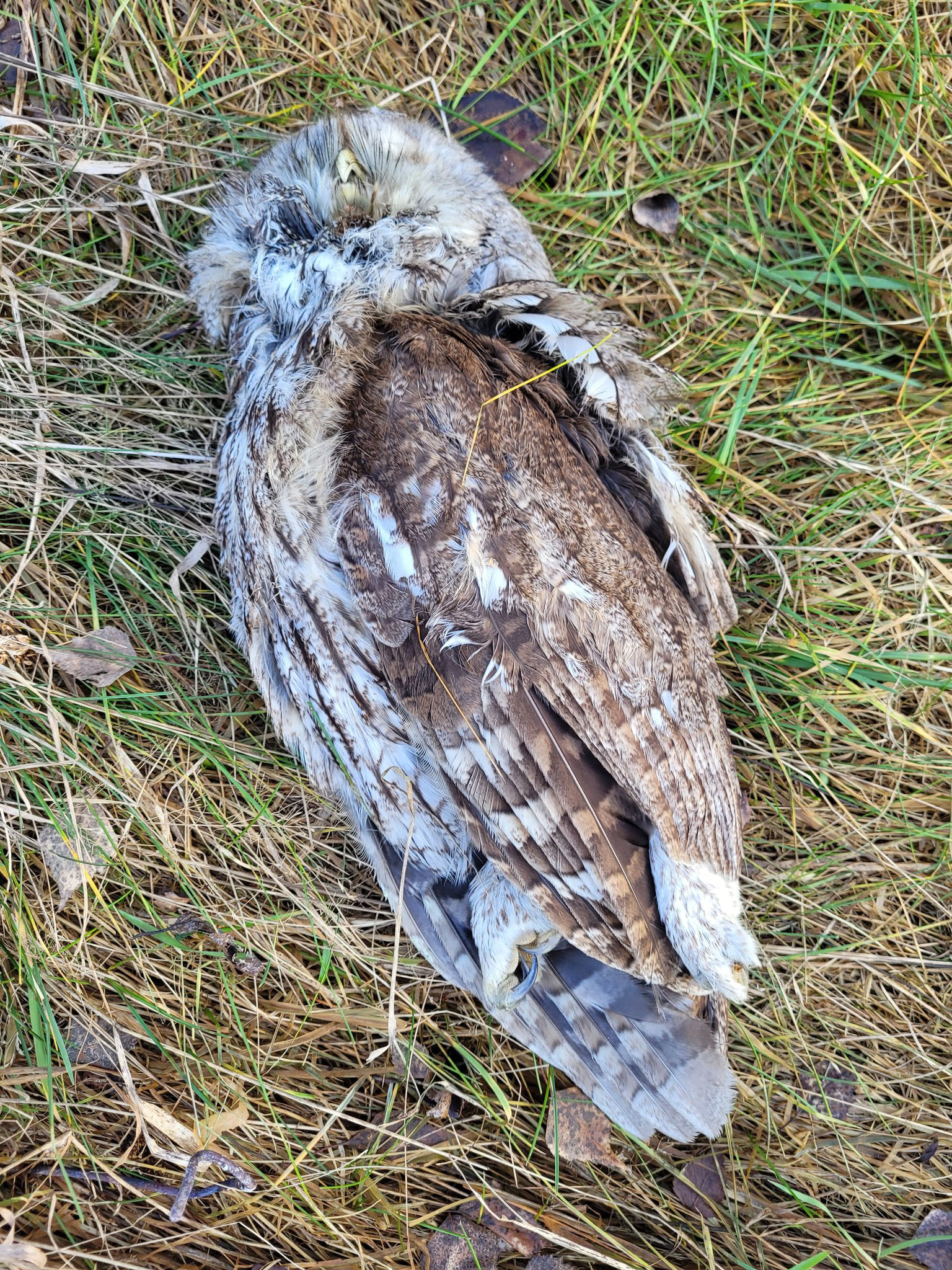
I was saddened to find a dead owl in my back garden. It was not dead long; I wondered whether the prolonged barrage of fireworks that went on for around 20 minutes last night might have been the cause or contributing factor of its demise. I watched after midnight from my rear patio, and was amazed at just how many fireworks were going off from all directions - from Jakubowizna to the south, Chynów to the west, Grobice and Sułkowice to the north-east and north-west. No respite for the wildlife. A few days ago, outside the Top Market in Chynów I witnessed the sight of a chap driving up to the makeshift firework stall in his stereotypical black BMW SUV. He walked up to the woman selling the fireworks and said to her: "Ma być dużo i tanio!" ("It must be many and cheap!"). The poor owl was properly buried.


This time two years ago:
Wealth and inequality - an introduction

This time three years ago:
Gratitude for a peaceful 2018

This time four years ago:
Fighting laziness - a perennial resolution

This time five years ago:
A Year of Round Anniversaries

This time seven years ago:
Walking on frozen water
[Daytime high, 1 January 2016 was -6C]

This time eight years ago:
Fireworks herald 2015 in Jeziorki

This time nine years ago
Jeziorki welcomes 2014

This time ten years ago:
LOT's second Dreamliner over Jeziorki

This time 12 years ago:
New Year's coal train 

This time 14 years ago:
Welcome to 2009!

This time 15 years ago:
Happy 2008!

Sunday, 27 November 2022

Win-win-win-win-win

The title of today's post? I'm talking about charity shops

Win 1: For people whose houses are full of clothes and items they no longer need - they can take them to a charity shop, thus decluttering their houses, freeing up space.

Win 2: People who donate such items to charity shops have the added satisfaction of feeling that they have done good. Giving away items with a fungible value instead of money. Throwing them away (especially if they can have a second use) is morally reprehensible.

Win 3: People who have a need can be buying things cheaper when used versions can be bought,  entirely adequate to their needs.

Win 4: By paying for an item at the charity shop, the buyer's money is giving to a good cause; the money raised through the sale helps society.

Win 5: The environment gains by re-assigning an unused utility rather than unnecessarily wasting natural resources to create a new one. The circular economy in action.

Case study: when pootling around the house or działka in winter, I like wearing a warm cardigan with a zip at the front and two pockets. I have a cotton one and a fleece one. A third would come in handy. I could also do with another warm shirt with breast pocket. So, finding myself across the road from Warsaw's Westfield Arkadia shopping centre the other week, I popped in to the Sue Ryder Foundation charity shop. I knew it was there, having interviewed the foundation's vice-president in April; Westfield have given the charity some prime space as an act of corporate social responsibility, for which I applaud the company. 

Inside, the shop is well-lit, clean and tidy, and well-staffed by friendly and helpful volunteers - and full of shoppers. I ask an assistant about shirts my size with long sleeves and pockets, and he disappears into the stock room and returns with several for me to look at. Meanwhile I'm looking through a rack of cardigans and find a lovely one -  by Pierre Cardin, in 100% Merino wool. Try them on - they fit - I pay 68zł (49zł for the cardigan, 19zł for the shirt). £12.50 in total. Very happy with both. I check the Cardin Cardigan online - cheapest price is 430zł, regular store price 500zł. So Win 3 for me. The Sue Ryder Foundation has my money to carry on its good work in Poland; no resources had to be used up to generate a new product for me, and the donor has more space in his wardrobe along with the warm feeling of having made a contribution to society.


I don't try to find excitement in the labels that I wear, but there is a sense of satisfaction at bagging such a bargain. [The shirt, incidentally, is from Seven Seas Copenhagen - not a brand I'd heard of, but paying 19zł instead of €20 is a snip.]

My late mother would have loved this cardigan (a word that she'd pronounce kadrygan), especially the deep, rich, thick texture of the wool which she'd have described as mięsisty ('meaty' or 'beefy'), though she'd have preferred a lighter colour. She was also a regular shopper at the charity shops of Ealing - which is where all her clothes ended up after her death.

I cannot recommend charity-shop purchases highly enough. In the UK, I'd buy most of my jackets, coats and trousers from the Children's Society shop on Pitshanger Lane; sadly I'll not be back there in a while (the celebrations of the UK rejoining the EU still being a long way off). So it's good that a decent charity shop exists in Warsaw.

This time last year:
Comfort, discomfort and winter cold

This time two years ago:
Frustration as completion of Chynów station draws near

This four three years ago:
London in verticals

This time five years ago:
Roadblock and railfreight

This time six years ago:
Sunny morning, Hyde Park and Kensington Gardens

This time seven years ago:
Brentham Garden Suburb

This time eight years ago:
Ahead of the opening of the second line of the Warsaw Metro 

This time nine years ago:
Keep an eye on Ukraine...

This time ten years ago:
Płock by day, Płock by night 

This time 11 years ago:
Warning ahead of railway timetable change

This time 14 years ago:
Some thoughts on recycling

Sunday, 16 October 2022

Cottagecore typology - a manifesto


[Third in a short series of posts, this one inspired by a conversation with Aga P]

Typology: "In planning and architecture, typology is the classification of characteristics found in buildings and places, according to their association with different categories, such as intensity of development (from natural or rural to highly urban), degrees of formality, and school of thought (for example, modernist or traditional). Individual characteristics form patterns. Patterns relate elements hierarchically across physical scales (from small details to large systems)" - from Wikipedia.

In writing about my ongoing move to a more rural environment, I would like to expand upon the 'why' and the 'where' and how this could be part of a trend that reshapes the way we live. A way of life that rebalances human priorities.

Where

I started looking for a place outside the capital's economic orbit. Beyond the exurbs, beyond what is normally considered commuterland. Two and only two criteria mattered, and mattered equally. One - I had to fall in love with the landscape, the spirit of place. Two - it had to be within easy reach by train to the centre of Warsaw.

Spirit of place is crucial to me - I am highly sensitive to it, to the lie of the land, how it changes across the seasons. I spent three years to November 2017 scouting for a place that would appeal to my emotions. I feel that suburban life in Jeziorki has reached a tipping point - traffic has become unacceptably heavy now that the S7 extension runs through, bisecting my rambles across fields that are in any case filling up with new housing developments and logistics centres. Yearning for peace and quiet beyond the farthest fringes of Warsaw, I began my search.

I found what I was after in Jakubowizna, surrounded by apple orchards and pine-and-beechwood forests, a gently undulating landscape on sandy soil that reminded me of two favourite places from childhood, Oxshott Common, Surrey, and Stella-Plage in northern France.

Proximity to the railway line is key. On Thursday, after our big gala dinner, I left the centre of Warsaw, catching the last train from W-wa Śródmieście to Chynów at 23:34 to be back on my działka at 00:45. An entirely acceptable witching hour. 

Now, W-wa Jeziorki is around halfway from the city centre and Chynów (nine stations from Śródmieście to Jeziorki, eight stations from Jeziorki to Chynów). My search for a działka began closer to home - around Ustanówek, four stations from Jeziorki. Yet the spirit of place at Ustanówek failed to click with me. It's a hugely personal thing, this. You can aesthetically prefer one road home to another, parallel road, choosing it even though it's slightly longer. The lie of the land, the effect a given landscape has on our consciousness, is hard to quantify - but I feel it. It's about wanting to be there. There is a spiritual aspect to this, metaphysical almost - that sense of atavistic familiarity and preference. And it was around Chynów that I deeply felt that sense of place. "All that's missing is the sea" - or indeed any water feature (the Vistula is 10km from my działka - too far for a casual stroll there and back, there are no lakes or even ponds nearby). That's the only aesthetic drawback for me - not a major one. Otherwise - here's a place I won't get bored of, and that's unlikely to be drowned by a wave of development as Warsaw inexorably spreads outward.

How

This is not a return to the land. This is not even the move of a suburban child to the countryside of his father - for my father grew up within a mile and half of the centre of Warsaw. If anything, this is a move to the countryside of my paternal grandmother, who was born some 20 miles south-west from Chynów. 

This is a move enabled by technology. Without the 'information superhighway' (as today's online world was first envisaged), I would not be here in Jakubowizna. In daily life, I am instantly connected to the global pulse; I do 90% of my work online (if I don't have to have a physical meeting I won't); I have typically around ten Teams or Zoom or Skype calls a week. I am in touch, up to date, despite being far from the urban centre. This is revolutionary; I have spent nearly all of my life (with the exception of four student years) within ten miles of a capital city, and have commuted into to its centre every working day for 40 years. Until the pandemic - and that sudden realisation that for many categories of work, physical presence is not a prerequisite. And now - time to take stock.

The online world has transformed many aspects of human life, but the geographic transformation effect will be enormous. Distance no longer has meaning. Full-remote workers take their laptops to the Canary Islands or Tenerife and work from there. For those not tied to a factory, building site or surgery, service-sector work has been liberated from the tyranny of having to show up at the office from nine to five, Monday to Friday.

A crucial aspect of life on the działka is my regular walk to Chynów and back to buy food. Shopping at Top Market means buying what I can carry (in practice up to 11kg in my rucksack). It's a five-kilometre round trip, so there's no food waste, as I don't like carrying stuff all that way that will end up as compost. This means planning meals, keeping tabs on what's in stock, what's about to run out and what's urgently needed. Yes, I could ride into town on one of my motorbikes - but that's not the point. Walking 10,000 paces a day is central to my way of life, and the 8,000 paces or so to buy food is an intrinsic part of my lifestyle.

What

The minimum of house, the maximum of land. A big house means big maintenance and heating costs. So the answer is a small house, powered exclusively by solar-generated electricity. The eight panels (maximum power 3.4kWh) have been calculated to balance out over the year, giving enough power for light, hot water, oven, fridge, laptop, device chargers across the year plus heating from late September to early May. No gas other than an 11kg propane-butane cylinder for cooking. My house is connected to the sewage system, so there's no septic tank. Also important is the fact that my street is paved - I have asphalt all the way to the station, freedom from muddy feet.

Finally, the aesthetics of the land. Here, I'm going wild - literally. I am opposed to the petrol-powered lawnmower, chainsaw or leaf-blower. An entirely organic approach to gardening - let it grow. With the exception of the lawn immediately surrounding the house, the rest of the grassland is returning to meadow; new trees are sowing themselves, giving me the chance to decide which to leave and which to prune back or remove. Meadow means meadow flowers which means bees and butterflies in profusion. Longer grass, greenery, means I am allowing more photosynthesis to occur than had I kept a neatly-mowed lawn. We will all have to get used to this - unkempt gardens will develop as an aesthetic unto themselves.

Surrounded by trees, by nature, I have rebalanced to a calmer existence where focus on spiritual matters can be achieved more readily.

This time last year:
Ego, Consciousness and Soul

This time two years ago:
Samopoczucie, Joy and the Sublime Aesthetic

This time four years ago:
Autumn, with a railway theme

This time five years ago:
A few words about coincidence

This time eight years ago:
Hello, pork pie [my week-long pork-pie diet]

This time ten years ago:
The meaning of class - in England, in Poland

This time 11 years ago: 
First frost 

This time 15 years ago:
First frost 
[no frost forecast for at least the next seven days]

Monday, 10 October 2022

A slower, drabber, greener, more local, way of life may yet save our planet.

It is increasingly clear, looking at the science, that many aspects of our current economic model are entirely unsustainable from the point of view of climate-change threat. Our patterns of consumption have led to a situation where the wealthiest 10% of households on our planet (that's you and me) generate between 34 and 43% of all greenhouse-gas emissions (depending on methodology used to calculate).

The current model is driven to a great extent by our mammalian desire to rise up the status hierarchy, buying objects that project our superior place in the pecking order. Be this over-sized cars or exotic holidays in distant destinations, the biggest emitters of emissions are people who have all their basic human needs in Maslow’s pyramid met – they are neither hungry nor homeless nor cold - but want to flatter their egos. Having attained a life of comfort, they now strive for a life of luxury. 

Passing through the shopping mall by Kraków’s main station the other day, the multiplicity of baubles on offer worried me. So much of what’s on sale in shops today is no longer there to cater for basic human needs, but rather to project status. Clothes to be worn once, gadgets and trinkets.

Had it not been for the escalating climate crisis, I probably would not have worried unduly and gone on my merry way consuming as most folks do, so as to say “look at me, I’m important and worthy of your respect, O lesser mortals!” I am not an enemy of consumerism and capitalism for ideological reasons – we are not born equal, and though equality of opportunity is vital to a healthy society, not everyone is equally hard-working and focused, and those in the workshy community should not expect the same status in society as those who do put in the hours, do add the value and generally contribute. And some people are more intelligent than others – and that’s just a fact.

I’m no egalitarian, but our planet is now in peril, and we are the reason. 

For several years I have been winding back my consumerist footprint. I've not been a car-owner since 2013; many of my clothes are second-hand, I’m a careful shopper; I recycle wherever possible and compost banana-skins, coffee grounds and everything I can't consume (food I don’t waste). I’ve not been on holiday since 2014, not flown since March 2020 (jet-zero). The pandemic has made remote work easier, so less travel (my media appearances are now exclusively remote, as I won’t waste taxi time travelling to studios any more).

At conferences I attend, I am getting the flavour from HR managers and corporate leaders that employees’ priorities (especially the youngest ones) are also changing. Poland’s demographic high was in 1982, with around 700,000 births; by 2002 this had fallen to 350,000. When Poland joined the EU in 2004, it had the highest unemployment among all member states (over 20%). Today it is the second lowest (2.7%). When today’s 40-year-olds entered the labour market, they had to have sharp elbows to get up the career ladder. Today’s graduate entrants are seen as spoilt, choosy and hard to motivate. Their parents are no longer poor; life’s not a struggle.

And yet depression is a bigger problem in society today than ever – even though communist repression ended more than three decades ago and everyone has access to the same range of consumer goods. Have we got too much? Having scaled the heights of Maslow’s pyramid, we’re all looking around and asking ourselves “what should we place at the very top of it?”

I’ve written many a time about the importance of living in comfort but not in luxury – knowing when to stop acquiring. Comfort means freedom from hunger, illness and fear – there is nothing noble about living in a freezing-cold house because you can’t afford to heat it. Or in ill-health because you can't afford doctors' fees or medication. If you can’t afford to eat properly or heat your home because you spend so much money on car that serves little more than a status symbol – then you need to sort out your priorities. Jewellry, flash watches, fancy clothes, things you buy yourself because you feel you 'deserve' them, merely put off the day you can be financially independent.

Cars are a massive contributor to greenhouse-gas emissions. Car ownership in itself is not the problem (even a car with a big engine that spends most of its time depreciating away in a garage) – it’s car use. And buying new cars - ordering one that hadn't yet been made - is not good environmentally, even if that new car is electric. Worst car-use of all is short-distance one-per-car commuting when perfectly good public transport alternatives exist.

My ongoing retreat to Jakubowizna is in part a reaction to all this, my statement; my attempt at living a life with a smaller carbon footprint. Contentment with small joys that are not bought – not flying around the world, ticking off landmarks from my bucket list. A daily walk, meditation, eating healthily, processing produce from my land, exercise. The cottagecore aesthetic, as I wrote yesterday.

But this modern age has its benefits. Above all, it is online access to unlimited resources of knowledge. Watching YouTube videos about science, philosophy and spirituality gives me plenty to contemplate as I go on my strolls. The existence of Wikipedia gives instant access to articles about almost any subject I wish to deepen my knowledge about. I believe that once our current crises have been overcome, we will find ourselves at the dawn of a new set of breakthroughs in human understanding of the Cosmos, of the fundamentals of physics and biology that will rival the Renaissance and the Enlightenment.

A far richer inner life, surrounded by less of the gaudy baubles of consumerism. Things will be built to last longer, the wasteful and ever-changing nature of fashion (particularly in the automotive industry!) will be replaced by standards and classic designs that have stood the test of time, rather than novelties for one season or two and then disposed in landfill.

Capitalism (I don’t like that word – I prefer ‘the free market regulated by a democratic society’) will be battered into a new shape by new consumer behaviours and needs. Would you rather spend €40,000 on a car that will last you five years, which you then sell for €10,000, or €60,000 on a car that will last you fifty years, and will still have a lot of life and value in it when you (or your heirs!) finally come to sell it? 

Business needs to re-localise. Start with brewing. Let a million brewers flourish, each unique to its locality, catering to its own local market. If a product from one town proves to be good in another – excellent! But there's no sense in moving beer from one continent to another. I am delighted that Polish craft brewers are discovering brewing styles from other countries. Brew local - with global recipes, global know-how.

Clothing. Clothes should be practical and hard-wearing, well-designed, well-made and good for decades of use. Not for status display. Bespoke tailoring, alterations and repairs, classic styles, muted colours, dyes made from local natural ingredients. Moving two atoms of hydrogen and one of oxygen in half-litre bottles across continents, driven by slick advertising, is nuts. Drink what's local. (Today I made myself half a litre of juice from my own grapes, and half a litre of juice from my own apples. Satisfying.)

Moving from growth to de-growth without mass unemployment is feasible in the long run, the only question is whether we have enough time left.

{{ Food-shop consciously - walk more – travel less  – conserve water. }}

This time last year:
Warka's bi-weekly market

This time two years ago:
How's your samopoczucie?

This time three years ago:
Pavement for Karczunkowska? What's next?
[a local councillor's newsletter last week claimed we'll have one in 2025-26]