Showing posts with label cider. Show all posts

Thursday, 27 August 2026

Nihil a terra, solum ex arboribus

This is the motto for this year's vintage cider from my działka. I will not be using fallen apples, only those plucked off the tree. “Nothing from the ground, only from the tree.” Today I completed my first demijohn of cider, which will be joined by many more in the next week or so. Because of biennial bearing (apple trees come into fruit every other year if not sprayed and pruned), this will only be my third vintage of cider production here in Jakubowizna (or Jabłkowizna as it is at this time of year). 

The learning process is ongoing; new lessons learned with each successive vintage, augmented this year by tip from ChatGPT and Google Gemini. I learn from both that cider from my apple variety, Antonówka generally lacks tannins, and so adding some crab apples into the mix helps with flavour. I will make a batch to see if that works.

The apples are fully ripe. Many have already fallen to the ground – and there they will stay. Two years ago, I learned the difference between apples lying on the ground and the ones picked off the tree, and my 2024 vintage was a mixture of the two. The former have higher sugar content but are softer in consistency, and there is far more sediment, The latter are crisper, more tart, and produce less sludge, requiring less filtration.

Filtration has hitherto been the choke point in my cider-making. Removing the thick mousse (which, if eaten straight away, on its own or with Greek-style natural yogurt is delicious) takes more time than pretty much all other parts of the production process taken together.

By ignoring fallen apples and using only ones plucked from the tree, things are vastly speeded up. However, less sugar will mean a lower alcohol content, so I shall find how that affects taste. I want tart, I don't want sour.

Below: the first demijohn. The apple juice is still cloudy; the sediment settles; in a couple of days, the fermentation will begin, and carbon dioxide will start to bubble up through the water-trap pipe, which keeps oxygen from turning the juice into vinegar.

The cider will ferment in the demijohns until the autumn, and bottling will begin in early December. The bottles are recycled, having been used in 2022 and 2024; a new batch of bottle-tops will need to be bought.

This time last year:
Fading and resurging Chynów in monochrome and in colour

This time two years ago:
Imminent? I don't think so

This time three years ago:
Dawn tourism – the sights without the crowds

This time four years ago:
Bike ride to the past

This time six years ago:

Saturday, 24 August 2024

Cider-making lessons as the season moves on

One lives and learns. My orchard bears fruit every other year, as it is gloriously untended, unsprayed and otherwise untouched by chemicals or machinery. This year, the bumper crop needs to be brought in and turned to cider quickly. Key takeaways:

 Use smaller demijohns. I've just bought another six of the five-litre sort. They can be filled up to the cork more quickly, so there's less time for the juice to oxidise and go sour. The smaller demijohns can also allow for customised batches (I intend to make one of perry and one of grape wine).

 Picked vs gathered apples. The ones I pick up off the ground (freshly fallen overnight) are ripe. The ones picked off the trees are not quite ripe. There is a difference. The ripe ones have higher sugar content, but produce less juice and more mousse when forced through the juicer.  They have yellow skins.The picked apples are juicier, tarter and crisper – you get that satisfying krahhh sound as the juicer mills them. They have green skins. Getting the balance right between the two is critical. Below: off the tree – crisp, tart and juicy, or off the ground – sweet, ripe and sludgy? Bit of both.

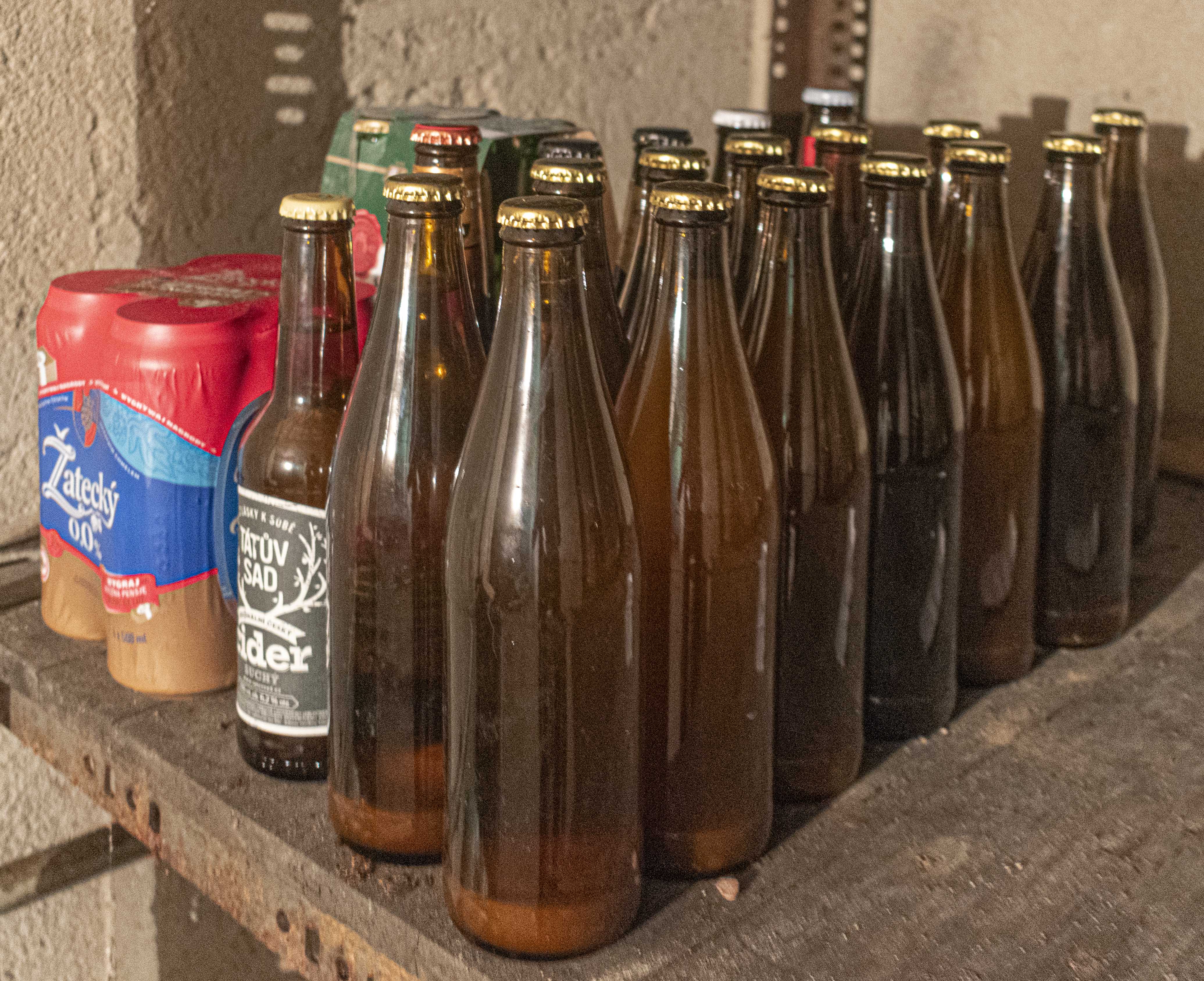
 The constant battle with sediment cannot be underestimated. I am running the juice extracted from the juicer through two sieves before it goes into the demijohn, producing a kilo of mousse for each litre of juice. Even so, the bottom 8% to 10% of what ends up at the bottom of the demijohn is sediment. This year, I have been cutting out the apple cores. Last time, I left them in; not only do they add to the sludginess, but they also introduce tannins that are not necessarily beneficial to the taste. And at the end of primary fermentation, the content of the demijohns will need to be sieved yet again. Below: in my cellar, the last dozen bottles of the 2022 production (to the right) – note the sediment at the bottom of the bottles. And this is after they have been decanted for a second time.

● Rather than leaving them in the cellar, this time I am storing the demijohns in my bedroom so I can keep an eye on them. Two years ago, I had one large demijohn fermenting in such a lively manner that it popped the cork and spilled the froth that rises to the top all over the cellar floor, something I discovered a few days later. Now, when I see a build-up of said froth, I can immediately take out the cork and remove the froth with a straw, lowering the level (and at the same time checking the alcohol content).

Below: this is how many apples go to make five litres of cider. Last time, the cores went in as well; this time they stay out. And count them – I make it at least 75 (or 15 apples to the litre). The ratio of green, picked apples to the yellow, gathered apples is evident.

This year's cider season has started much earlier than in 2022, at least a month earlier. Different apple varieties ripen at different times, but this year's apple harvest is unusual in that in started in July.

This time last year:
Getting to Sandomierz by bus and train

This time two years ago:
Inspiration

This time ten years ago:
Food shopping and dietary update

This time 11 years ago:
Photos from the Radom Air Show, part 1

This time 12 years ago:
Offloading PKP's risk at W-wa Jeziorki

This time 14 years ago:
Time to be stuffing yourself with fresh fruit

This time 15 years ago:
First notes of autumn in the air
[Still highest summer now in 2024! No sense of autumn yet!]

This time 17 years ago:
Large spider catches fly

Sunday, 28 July 2024

A new cider season is under way

According to the Royal Horticultural Society, "biennial bearing is a problem in some apple trees, where they crop heavily in one year and then produce little or nothing the next." Thinning the fruit and pruning the trees can help; I do neither and so my 100% organic apples appear only on even-numbered years.

As in 2022, this year, I will have an embarrassment of apples. The trees are full. Below: the trees nearest the street get the most sunlight, and hence bear the most fruit.


Below: you can see the apples. I, however, see gallons of cider.

Now, the apple you see here is the antonówka, a traditional varietal that's become almost impossible to buy in the shops. Tangy, sharp yet sweet, it is the ideal apple for baking apple charlotte (szarlotka), but it's also the perfect cider apple. However, the antonówka biała, or śmietankowa ('white' or 'creamy') apples that my trees bear don't keep well; a few weeks after picking, the fruit begins to decompose from within. This means that to make cider from them, I have to work fast. In 2022, I managed to make 45 litres. This year, I aim to make more (it has to last two years, after all!).

The limiting factor is my slow juicer, which can only make half a litre of juice at a time. The juice needs to be strained, as the pulp of the antonówka apple is dense. Even running the juice – and later the cider – through a sieve three times still results in a half-centimetre or more (see below) of sediment at the bottom of each half-litre bottle. Still, tastewise, this is an excellent apple from which to make cider. It's sharp and fruity and strong.

Windfall apples need to be rinsed in running water, cut open to check for inhabitants; only clean apple flesh goes into to the juicer. The cider-making process uses a lot of water, for the apples and for keeping all the utensils clean. Rather than cram the cider-making into the last weekends of September, this year I have made an earlier start. Storms and high winds knock apples from the trees prematurely. Today and yesterday, I have been clearing the ground under the trees to make it easier to pick recently fallen apples.

Left: the first five-litre demijohn (removed from its basket). This is a trial batch, in this photo, I'm half-way into the filling process. The finished product will be clear; the sediment settles as the cider ferments. (The juice has already been filtered twice and there will be a third filtration before bottling.) Selection of apples is crucial at this stage; minimum bruising, no wormholes – and the apples must be large – juicing small ones is suboptimal, a waste of time and energy. One innovation this year – I'm cutting the apples to avoid juicing the pips. This both improves flavour and reduces sediment.

The cider remains in the demijohn until the bubbling of carbon dioxide through the water-trap pipe ceases; then it will be filtered once more through a sieve and bottled.

Left: one of my last bottles from 2022. Note the clarity, but also see the amount of sludge at the bottom! It must be said that the amount of sludge depends on the order of bottling, with the last bottles contain the most. However, even the first bottles will have some, however careful I am. 

As with bottle-conditioned beers that have yeast sediment at the bottom, careful storage and pouring results in an optimal drink. Unless you prefer cloudy cider, in which case turn the bottle over a few times before opening.

The bottling process should be complete by mid-December, after which the cider will be kept at a steady +8C in my cellar for bottle-conditioning, and will be ready for drinking in the summer of 2025.

Cider-making every other year means more time to learn from mistakes and hone the process. One way or another, this is a pure product. Unsprayed apples, orchard tended without use of petrol-powered mowers or chainsaws. 100% natural cider.

This time last year:
An eternity in Heaven?

This time two years ago:
Habit or obsession?

This time three years ago:

This time five years ago:

Saturday, 24 June 2023

Blasted

I returned from Legnica and went into my garage and down into the cellar where I made a shocking discovery. The place reeked of ginger. All nine remaining (of ten) bottles of ginger beer that I brewed about six weeks ago had exploded. Totally gone - blasted. The cellar was full of shattered glass. Last autumn's cider, standing on either side, survived the carnage.

Below: the scene as it befell me. The smell of ginger cannot be captured. In the corner, under the rack, is a round sump-hole - it was full of ginger beer (about a litre and half of it)!

Below: close up - between the rows of cider bottles there were two rows of ginger beer - nothing but shattered remnants remained. One cider bottle was destroyed as collateral damage (third bottle in row to the right). And a strong whiff of ginger in the air!

Why? I have heard such stories from my youth (Richard M, for example, from Ealing, had some ginger beer explode explode with such force that glass was embedded in his bedroom wardrobe in which he stored it). But I had taken due precautions - this was a second batch, after all... I thought I knew what I was doing...

I'd bought 1.1kg of root ginger, washed and peeled it, and put it through my slow juicer, which ground out about 500ml of pure ginger juice. The ginger cost 38zł, about £8. To this I added 320g of fine sugar and a tablespoon of brewer's yeast. Topped up to five litres in a small demijohn, with a air-trap neck to allow carbon dioxide out while keeping outside air from entering and turning it all into vinegar. For a week I watched the bubbles in the pipe - 25 a minute as fermentation peaked, then gradually down to 15, ten, five, three, finally one every two minutes... and a day later I filtered the brew and bottled the content, sealing each 500ml bottle with metal bottle tops. 

One bottle I opened on 4 June - on the hot afternoon following the pro-democracy march in Warsaw. The remaining nine were stored in the cool of the cellar. I checked up from time to time - all was good.

So my surprise - and regret - at seeing all of them blasted to smithereens - was intense. Questions - did they all explode around the same time (given that the bottles were identical, from the same factory, and the ginger beer was all from one batch)? Was it a chain reaction (probably not, as the cider, bottled in the same glass, standing on either side, was unscathed)? When did it happen?

Lessons learnt

Just because the fermentation has slowed down, it doesn't mean it has stopped. Don't be in a hurry to bottle. Take the demijohn into the cellar and leave it there for several more days before bottling. My first trial batch (one litre) went down very well with the neighbours (we drank it with Johnny Walker Red Label where the ginger beer was judged to be a far superior accompaniment than Coca-Cola); I suspect it could have done with being sweeter. The recipes call for 100ml of ginger juice to 100g of sugar per litre; I used just over 60g/litre of sugar. But more sugar = more fermentation = more time before it's safe to bottle. Once I have gotten over the loss of this batch, I shall buy more ginger and brew up some more ginger beer. 

Another lesson: beer bottles have an internal pressure resistance of between three to four atmospheres, (3 to 4 bar or around 44 to 59 lbs per square inch). This is the pressure associated with a well-inflated mountain bike tyre. Beer bottles are designed to cope with the carbonation pressure found in beers. Now, champagne bottles are designed to withstand higher pressures due to the higher levels of carbonation in sparkling wines. Champagne bottles are generally built to withstand pressures of 6 to 8 bar (88 to 118 lbs per square inch). That's the kind of pressure you'll find in a road-racing bicycle. 

So to break a beer bottle from within, the pressure of the ginger been must have been at least five times greater than atmospheric pressure, if not more. So - stronger bottles in future! Maybe plastic bottles for a second fermentation before final bottling.

UPDATE: 29 July. Second batch, also five litres, this time left to ferment in the demijohn for longer, more sugar, no yeast. Then I decanted the ginge beer into plastic one-litre bottles for a week; I'd check the pressure, unscrew cap for a second to release carbon dioxide build-up, then re-screw. After two weeks, I decanted the resultant ginger beer into glass bottles for further maturation.

This time five years ago:
My new used laptop
[Five years on, it's still fine - I'm writing on it right now! It was 18 months old when I bought it, (ex-leasing); since then it's had a new battery and a new set of keyboard stickers - original keyboard was German, on first set of stickers, the letters were rubbed off with alcohol - lockdown disinfectant. Otherwise, no faults whatsoever! So much for Student SGH's mockery... "Panie, Wieśwagen od starego Niemca, tyle co do kościoła i z powrotem jeżdżony"]

This time eight years ago:
Face to face with Mr Hare

This time ten years ago:
Central Warsaw vistas

This time 11 years ago:
Future of urban motoring?

This time 14 years ago:
On foot to Limanowa

This time 15 years ago:
Crumbling neo-classicism in Grabów

This time 16 years ago:
Bike ride into deepest Mazovia

Sunday, 9 October 2022

Too busy running around and making cider!

On my 65th birthday, I woke at 4am to be in Gliwice for 9.30 for our HR workshop for the automotive cluster there; I was back in Jakubowizna at 7pm for supper and writing the previous blog post. On Friday I also woke at 4am to be in Kraków for 9.30 for the 3rd Carbon Footprint Summit and was back on the działka at 10pm. I spent all of yesterday engaged in making cider (a demijohn for Moni) and the same today - apples that aren't harvested now will rot by next weekend. Cider-making takes up much time, but hopefully it will all be worth it when bottled for secondary fermentation.

My first demijohn popped its cork some time today, leaving a frothy mess of apple pulp on the cellar floor, fortunately the apple juice hasn't spoiled or developed a vinegary taste. It's dry, and at present about 0.3% alcohol by volume. I have used copper wire to 'cage' the corks shut - all the CO2 goes through the airlock tubes that passed through the corks, as you can see below. In total I've made 40 litres, plus another five litres with Moni, a total of 90 half-litre bottles-worth. And the cellar smells great!

There are still apples left on the trees, hopefully I'll find time to make another five litres. In the meanwhile, no walk today, only a short walk yesterday morning, little time for photography and writing. So - a few local snaps.

Below: path between the apple orchards that leads from Jakubowizna to Grobice. Fruit-picking is in full swing, the sound of apples going into pails is all around. Daytime highs have been around 18C when the sun is out, falling a bit next week.

A propos of sun - the tipping point in the year has been reached at which the shorter hours of daylight and colder temperatures mean that I am now using more electricity than my eight panels generate. I have a large surplus built up since the panels were connected to the grid in July, with August and September producing much more power than I consumed. This should keep me going until mid-winter, after that, I'll be drawing credit from the surplus generated in April, May and June. It's all calculated to balance out precisely over the year.

Below: late afternoon on my rear balcony. Leaves are starting to turn, by mid-November, they'll have all fallen. To the left of this shot is one of my two grapevines; I hesitate to try my hand at wine-making (cider being the main focus now), but I am juicing the grapes daily. They are the Concord variety, known in America in all manner of grape-flavored things. And the taste of Mogen David kosher wine. Not my favourite grape variety (central Poland's too far north for all but the most robust), but the juice is good when drunk fresh - sharp and sweet.


The cottagecore aesthetic is taking off as an antidote to the hectic city grind; a trend that I believe will pick up as more folks choose to cut their carbon emissions and adopt a simpler lifestyle.

Left: Is this Nevada? Are we at a nuclear test site? No. This is where the DK50 crosses the Warsaw-Radom railway line, the tower holding mobile telephony aerials (hence such good reception in Jakubowizna). Across the DK50, still Warsaw's de facto ring-road, despite the opening of the S2 tunnel under Ursynów and the new bridge across the Vistula, is Sułkowice, famous for its police-dog training school. I must say that I cannot discern any reduction in heavy goods-vehicle traffic along the DK50 - I thought that the S2 and sanctions on Russia and Belarus would have led to the road being noticeably quieter - it isn't.

Below: peak apple. By the end of next week, most of the apples will have been harvested, the collection points (punkty skupu) are piled high with large crates of apples. It turned out (after a dry spring) to be another good year for the farmers.


I owe you all, my readers, some photos of Kraków - I walked to the conference venue and back (21,000 paces in one day!) and the weather was perfect. Will post if there's time this week...


This time four years ago:
W-wa Zachodnia Platform 8 to reopen

Monday, 26 September 2022

First steps in cider-making

With so many apple trees, I have been unable to do more than invite friends and neighbours over to pick their own, and still the majority of fruit merely ends up being recycled into the soil. So this year I decided to buy a decent slow juicer and start making my own cider. The juicer is from Kuvings, a South Korean manufacturer. Being a slow juicer, with a powerful motor to grind the fruit, little heat is transferred from the machinery to the fruit, thus maintaining its properties. 

The key to all this is scale. To extract one litre of pure apple juice, I need ten apples. Each needs to be washed, quartered, and have bruising cut out. Very few have inhabitants, but these have to be cut out too. The juicer's magazine can hold 400ml of juice, this is released when full into the juice jug. The dry remains are pumped out of the other side, a dense sludge that goes into the compost. The juice jug holds one litre; once full the juicer is switched off, the juice strained a second time and filtered again. This takes time. The by-product here is an exquisite fruit mousse, wonderful to eat with natural yogurt.

In producing 20 litres of juice, I made three kilos of the mousse, stored in jars, filled to the brim to avoid further oxidation. So - to make 20 litres of juice, I need 200 apples. I select windfall apples, they are ripe; newly fallen ones have little if any bruising. No problem here. The limiting factor, the choke-point, is filtering the juice through a strainer. This takes the most time and effort.

Over six hours work over two days, with two lots of half-hour cleaning sessions at the end of it. The juicer needs to be dismantled and washed by hand to remove all apple particles from it - Kuvings supplies three custom brushes for this purpose. The entire kitchen needs a good scrubbing too, all work surfaces, cutting boards, utensils, washing area and floor.

But when all is done, a beautiful outcome. I bought a 20-litre demijohn (100zł from the local hardware store in Chynów), rubber bung with hole and a plastic 'bubbler' tube that allows carbon dioxide out while preventing the ingress of air, which would turn the juice to vinegar. There was also a 34-litre version on sale, but that would be impossible to carry from the kitchen to the cellar once full. 

Left: the 20-litre demijohn, down in my cellar where it will ferment for several months, before being decanted into bottles for a secondary fermentation - and be ready for next summer.

When the water in the tube ceases to bubble, the primary fermentation process will be complete. The cellar is ideal as it is cool in summer and in winter it is warmer than outside.

My basic guides were this BBC Good Food article and this description of a single-variety cider made without yeast or sugar from Cydrownia Przy Sadzie near Grudziądz.

I was interested to discover that a demijohn is not 'half a john', but comes from the French dame-jeanne, or 'Lady Jane'. I'd long thought that the American term for demijohn, carboy, was a brand-name or something to do with a car and a boy - but again no - it's from the Persian qarābah meaning 'big jug', and from this comes the Arabic qarrāba, which morphed into the Spanish garrafa, and thence into carafe (and indeed into the Polish karafka).

More cider-making in future!


This time four years ago:

This time five years ago:
More about sleep

This time ten years ago:
On behalf of the workshy community

This time 11 years ago:
Classic truck cavalcade

This time 12 years ago
Narrow back-roads clogged with commuters

This time 13 years ago:
Autumn gold, Łazienkowski Park

This time 15 years ago:
Of bishops and bands

Sunday, 24 August 2014

Shopping for food and dietary update

Competition is a wonderful thing. Now we have a Biedronka 'under the nose', a 12-minute stroll from home, and a Lidl a similar distance away, I cannot say that I have ever been so well provided with retail opportunities in my life. But despite the newcomers, I'm still true to Auchan Piaseczno - 15 minutes from home by bicycle, five by car. The pressure on Auchan is on, and Auchan is responding admirably.

At Biedronka yesterday, I was pleasantly surprised to see Lavazza Qualita d'Oro priced at under 19 złotys for 250g - around two less than Auchan was selling it for. Until I visited Auchan today - when I found that the French retailer has responded to the Portuguese retailer's challenge and dropped its price for the product to below 18 złotys.

Same story for apples. Biedronka price for a kilo of excellent Polish apples - 1.75zł. Auchan - a selection of four different varieties of Polish apples all for 1.45zł a kilo.Wherever I look, I can see that products at Auchan are more keenly priced. And there's far more variety. Biedronka has started selling cider - hurray! One type - a brand named Desire. But Auchan now has three bays, each a pallet wide, stacked with around 15 different ciders, domestic and imported. And Auchan has Browar Witnica's staggeringly good Lubuskie IPA, along with over 150 other beers. Lidl, on the other hand, has still to offer a cider among its beverages section, mainly brewed to be cheap and strong.

My recent visits to Lidl have failed to impress; there's now only a handful of things I pop into Lidl for. Its excellent tinned fish, Nixe brand - finest quality mackerel and good tuna at a good price. Unbleached, undyed toilet paper that harms neither your bottom nor the environment. Beefmaster steaks from Biernacki (Biedronka does these too) and superb kiełbasa polska surowa długodojrzewają from Balcerzak.

Biedronka counters with 15-month-old mature cheddar at 4zł less than mature Kerrygold 'cheddar' at Auchan, and a slightly broader range of food products than Lidl. And when it comes to fresh fruit and veg, Biedronka falls behind Auchan. I bought a basket of cherry tomatoes on the vine at Biedronka - they turned out to be Italian and taste-free, nowhere near as good as the organic cherry toms grown by PGO that are the mainstay of Auchan's offering.

Unless an Alma suddenly appears on Karczunkowska, my food shopping needs are well catered for; hugely better than back in 2002 when we moved to Jeziorki.

Meanwhile, a question many people have been asking since January - when will Real supermarkets be rebranded as Auchan? Last week PortalSpożywczy.pl reported that the first Real to open an an Auchan did so in Opole. The rest will follow step by step as Auchan, who have taken over the Real chain from German retail groupMetro AG renegotiate rents with shopping mall operators. It will take a while before the Real in King Cross Ursynów becomes an Auchan. And just seven years ago, the same shop was a Géant, owned by French retail group Casino. Remember?


The Polish food retail scene is consolidating, but it's also moving upmarket. The growing number of small-format deli chains like Piccolo Italia or Kuchnie Świata is encouraging. Polish consumers (urban ones at least) are becoming more discerning and prepared to pay top prices for top products. The single European market is bearing fruit.

Meanwhile, I'm nearly at the end of my short, sharp post-holiday diet. Over the past two weeks, I have been eating only fish, fruit, vegetables, nuts and pulses. No bread, no potatoes, no rice, no pasta. No wheat products whatsoever. No dairy products whatsoever. No meat, no alcohol. It is hard to find variety in such a diet, but shopping at Auchan has allowed me to concoct interesting and tasty meals. I've just had for supper a large bowl of fresh prawns, fried with loads of cherry tomatoes, seasoned with garlic, provençal herbs, chilli peppers, garlic, chives and coriander. Wow. Wonderful stuff.

This has been a tough diet, though nowhere near a tough as the two-week diet that my colleague Marta and her husband Kamil recently underwent. Like mine, though without the fish, pulses, fried foods or coffee. I don't think I could cope with a diet that strict!

Back to normal on Wednesday. Plenty of excellent cheeses await (including a well-aged Pecorino Romano), and a bottle of Weston's Vintage Cider for the evening.

This time last year:
Photos from the Radom Air Show, part 1

This time two years ago:
Offloading PKP's risk at W-wa Jeziorki

This time four years ago:
Time to be stuffing yourself with fresh fruit

This time five years ago:
First notes of autumn in the air

This time seven years ago:
Large spider catches fly

Sunday, 10 August 2014

Eat Polish apples, drink Polish cider

So Putin's pulled down the shutters on Polish food imports - this will hurt those Polish producers and middlemen who thought they could prosper by feeding The Bear. The embargo will reverberate across the Polish economy - GDP growth is likely to slow by a few tenths of a percentage point (outturn for 2014 more likely to be 2.9% than 3.3%), while inflation will fall - maybe even into deflationary territory - as a result of oversupply on the Polish market.

The #JedzJabłka ('eat apples') campaign across the social media is gaining traction; if you want to hit back at Putin, buy Polish apples. Poland is the world's number one exporter of apples and number two producer of apples. Outside in our garden, the apple tree is groaning with apples that come September will start falling to the ground in abundance.


As Poland begins coming to terms with an apple mountain of unprecedented proportions, media pundits have taken up my call for a massive expansion of Polish cider-making, which requires above all a change in absurd excise rules that class cider over 5% as a fruit wine, rather than as a beer equivalent. [I wrote about this last month.]

The absurdity came to a head the other day when Celtic, a Scottish foot-ball club, visited Warsaw to play against Legia, a Polish foot-ball club. Celtic is sponsored by Magners, a cider brand unavailable in Poland, containing 4.5% alcohol by volume. Legia is sponsored by Królewskie, a well-known beer brand containing 5.8% alcohol by volume. Now, because Magners is a cider and the advertising of cider - even on the shirts of visiting foot-ballers is prohibited in Poland - the Celtic players had to change their shirts to ones not bearing the brand. Beer adverts, on the other hand, are fine. And because Poles like the taste, brewers get round the ban by simply adding apple juice to beer (Redds, Warka Radler, Lech etc). This is the type of regulatory madness must be stamped out with extreme prejudice.

If Poland is to soak up the apples that Putin won't buy, it needs to be able to add value to them - by pressing them in local cider-presses and fermenting the resulting juice into high-quality cider. And advertise that cider in the same way that beer is advertised. And exported in quantity to the free world.

In the meanwhile, Polish cider sales are booming. From nearly zero in 2012, Polish consumers drank 2m litres of cider in 2013; this year sales are expected to reach 10m litres (By way of reference, British consumers drank 1,000m litres of cider last year - the UK being the world's no. 1 cider producer and consumer of cider.) And things are looking good at Auchan - the price of Weston's Old Rosie has come down from 17zł to 10zł a half-litre bottle - a benchmark of cider excellence.

Below: Polish cider (Cydr Lubelski) and Polish apples. I bought this cider because it was the only Polish brand available in Auchan today - there was Warka Perry and lots of fruity concoctions from the Baltics - plus of course Weston's Old Rosie and Weston's Vintage.


Mr Finance Minister please - get rid of the requirement for an excise band over the bottle, reduce the excise duty on all ciders to the same level as beer, and scrap the ban on cider advertising. And do so quickly, before Putin's embargo can do any lasting harm to Poland's agricultural economy. Below: the banderola, or excise band. You'll find this on cigarettes and vodka - but why-oh-why on cider? This is plain nuts.


Poland has such a huge potential when it comes to cider. It just needs the ministries to deregulate and liberalise. The market will do the rest.

Additional reading - in Polish
Countdown to Putin's fruit embargo
and
Poles are eating 'Freedom Apples' (and drinking cider in solidarity)
and (thanks for the link Paddy)
Cider ad ban likely to be scrapped

This time last year:
Hottest week ever (37C - that's 9C more than it was today)

This time two years ago:
Progress along the second line of the Warsaw Metro (still no sign of its impending completion as I write)

This time three years ago:
Doric arches, ul. Targowa

This time four years ago:
A place in the country, everyone's ideal

This time seven years ago:
I must go down to the sea again

Monday, 21 July 2014

The second Summer of Cider

Wow - cider is becoming big news in Poland. Last week in Auchan, looking for the cider among all the beers where it used to be, I saw none. "So much for continuity of supply," I thought before spinning round and seeing that amount of shelf space being used for displaying cider had doubled yet again. "Hello - what's this? It's Weston's Old Rosie! And this - what's this one? Why, it's Henry Weston's 2013 Vintage Oak-Aged Herefordshire Cider. And of course Polish ciders - a novelty only last year - Miłosławski, Cydr Lubelski, Warka Cider, Green Mill, Joker.

Cider - as opposed to apple-juice flavoured beer (YEEUCHH!!!) has caught on in Poland at a pace most fast-moving consumer goods companies daren't imagine. Back in January 2013, the Ministry of Finance reduced the excise duty on ciders below 5% alcohol by volume to something approximating the duty on beer (stronger ciders are still being treated as wine, excise-wise). This gave Poland's fruit wine manufacturers like Ambra and Warwin the opportunity to shift their client base from rural alcoholics to urban hipsters. At around the same time, a change in the law was made to encourage the production of artisan ciders by Polish apple-growers, though limiting production to 10,000 litres of farm-produced cider per year. The new law is so complicated in practice that out of Poland's 60,000 apple growers, only two have taken advantage of the new opportunity.

The main problem is the banderola, or excise band. By law, this has to be glued over the bottle top as proof that excise duty has been paid. A 7.8% beer is exempt from the banderola, a 4.5% cider isn't. ABSURDITY! The small, craft-cider makers have to sell their own cider, duty paid, in huge containers, to bottling plants that can affix the banderola, and then buy back their own product, now bottled and banded, for further sale. And a further absurdity is that while it is perfectly legal to advertise a 5.2% beer on a billboard or on TV, it is illegal to advertise a 4.5% cider. Can a government spokesperson explain WHY?

If the Polish government were to liberalise these foolish regulations, cider-making in Poland could take off. Scores of local craft cider makers would spring up, making (as they do in England), fine single-apple variety ciders, creating local employment and developing new skills and new markets. Poland - the world's second biggest apple exporter, and Europe's biggest apple grower, instead of shipping tanker-loads of apple-juice concentrate to England where it is converted to cider, could be making cider here instead. If only the Ministry of Finance* would treat cider exactly as it treats beer.

Please feel free to turn this into a social media campaign!

So then - Mr Dembo's Cider Sensations for the Summer of 2014...

From Poland - Cydr Ignaców. One of the 10,000-litre limited craft ciders. Splendidly balanced, semi-dry, semi-still, this is rated as the best cider made in Poland, made by enthusiasts in Ignaców, some 15km south-west of Grójec, right in the heart of Poland's apple country. Last year's vintage is available (5% abv) in small, 275ml bottles. One to savour. Already becoming available in the UK.

Next up we have Jabcok Maurera (left). Jabcok (pron. 'YUBtsok') is a slang expression for cheap apple wine; a nice touch of self-deprecating humour on this quality product selling for 13zł. I found this one in an organic restaurant in Służewiec Przemysłowy (on ul. Postępu). This one, like Weston's Old Rosie, is cloudy; naturally-occurring carbon dioxide adds slight fizz. Stronger at 7.7%, a fine cider that captures the taste of rural cider-making in England. Maurer is from southern Małopolska, not too far from juice-maker Tymbark.

Turning to English ciders available in Poland - I must say that Old Rosie (not cheap at 17 złotys for 500cl) is excellent. One of the very best I've ever tried. Other Great British ciders you can find in Poland include Sheppy's Single Variety range (Oakwood, Dabinett and Kingston Black are three I tried; all are excellent and as different from one another as a Merlot is from a Shiraz). The Westons' ciders are imported by Kamron s.c.(www.kamron.pl), the Sheppys' ciders by BRN Services (www.ciderhill.pl).

If none of these are available, I go for Cydr Miłosławski, failing that Warka's Cider and Perry are generally available, as is Cydr Lubelski. Both Warka and Lubelski are extending their brands - Warka has launched 'Double' cider and perry (both 8.5%), while Lubelski has broadened its range of one with a honey-sweetened cider.

If Poland's restrictive regulations and excise duties on cider were to be brought into line with those for beer, Poland has the potential a) to become a big importer of excellent English ciders, and b) learn how to made excellent cider for domestic pleasure plus export to all points north, east and south!

* I learn it's not the Ministry of Finance that's against liberalising cider sales further - it's the Ministry of Health, leaned on heavily by PARPA (the state agency for solving alcoholic problems) that says not one step further in the direction of making any alcoholic drink more accessible or socially acceptable.

This time last year:
North Wales in the sun

This time two years ago:
Back at Penrhos

This time four years ago:
A farewell to Dobra

Sunday, 30 June 2013

Cider - available at last in Poland

Arriving in Poland 16 years ago, I was surprised by the lack of cider. A country that's a European leader in apple production, and turns much of that into apple juice; a country that makes alcoholic spirits out of most forms of plant life, seemed incapable of going that step further with the apple juice and fermenting it to make a beverage of beer-like strength*.

And this at a time when a youthful demographic seeking palatable alcoholic drinks would have seemed like the ideal market for cider. And yet the British manufacturers, who'd regularly dip their toes in the water, would never take the plunge here. Year after year, I'd hear newly-arrived expats wondering where the cider was. Poles returning home after a stint in the UK would also express surprise that no entrepreneurial company was bothering to supply the Polish market with cider.

In the meanwhile, the youthful demographic, with its sweet tooth, was being pandered to by brewers adding sugar, fruit syrups and other ghastly flavourings to their beers to appeal to the burgeoning 15-to-25 year-olds. This was the largest age cohort of the Polish market. Stuff like Redds, FreeQ, Gingers. Dog in the Fog (withdrawn from the market in April 2010). To me - absolutely foul concoctions - but they did wean a generation brought up on Frugo and Hipp into the pleasures of alcohol in more gentle way than knocking back vodka shots or quaffing bitter-tasting beers.

But still no cider.

Until 2013. This year, the market has been judged to be ready. I'm not talking about Somersby, an apple-flavoured beer from Carlsberg. (45% beer, 55% apple juice; 4.5% alcohol by volume - sounds hideous - diluting a 10% beer with apple juice!).

Earlier this spring, I chanced upon 330ml bottles of a cider called Joker at Auchan; it was there for a week or two then disappeared. Today, in the same shelf, I found Sherwood Apple Cider Taste of Traditional English Cider (4.5% ABV). On putting on my reading glasses and looking at the small print, I discovered that this is made in Estonia from 'fermented apple juice and natural apple flavours. We tried some with lunch, the pear-flavoured variety too, but it tasted perfumed, lacking in vigour or authenticity.

But what's this? Cydr Lubelski. Again, 4.5% ABV (looks like some kind of limit set by excise law), but now, something more authentic. Made by fermenting apples, this is a real cider. Light, refreshing in taste, medium-dry, none to challenging. Not a great cider by the standards of England's West Country, but for Poland, a start. I guess this will be the moment when cider takes off in Poland; by 2030, cider will have become a 'traditional' Polish beverage.


Above, from the left: two bottles of Estonian 'Sherwood' cider; to the right, Cydr Lubelski. At last, a Polish cider, plain and simple, not apple-flavoured beer. Note the excise bands (banderole) over the bottle tops, something that beers don't need to have, even though they're stronger than these ciders.

And shandy's burst onto the scene. Also known as radler, 50/50 mixes of beer and lemonade are freely available from the Big Three brewers. At between 2% and 2.6% ABV, these do not interfere with the head and, served very cold, are beautifully thirst-quenching. Better than the Top Deck Shandy I grew up with!

Below: while on the subject of alcoholic beverages and their marketing - I'm admiring the current ad campaign for Łomża beer. I've said for a long while that it's advertising copywriters that breathe new life into the Polish language. Pastwing bez krowingu. Simply brilliant.


This ad is not aimed at Pan Heniek or Pan Ziutek, whose tipple of choice must be Argus Strong (6.7% ABV, on offer at 3.59 złotys or around 70p for a one-litre bottle this week at Lidl). No, the Łomżing campaign targets the trendy, educated, urban youth market. 'Łomża. Source of Conscious Łomżing'. Łomżing - Lemming? a source of conscious self-irony?

Another current series of billboards that playfully toys with the Polish language is the re-run of last summer's Bardzo mi Milko campaign, blending English into Polish (MoreLove = morelowe = apricot flavour, or WishNiowe = wiśniowe = cherry flavour). Such plays on words reflect the open-minded, intelligent and fun-loving nature of the target group for these milk drinks.

The Polish market for food and drink is becoming increasingly sophisticated and competitive. This is great news for consumers. It's just a shame that British cider manufacturers did not spot this opportunity a few years ago. Maybe now the market has been opened by local players, they will come over.

* There's always been jabol - a sweet fruit wine made from apples and sold for grosze to the lower echelons of the alcoholic community.

Update, 7 July 2013. The following Sunday I'm back at Auchan for my weekly shop. I'm looking for ciders. Guess what - they've disappeared off the shelves again. None. Not one.

Update, 11 July 2013. I'm looking in the wrong shelf! The ciders - all three mentioned above plus the Joker and a few others (eXcite) - are around one-third of the way down the looooong shelf with beers. On the right as you stand with your back to the check-outs. Such good news I buy a Cydr Lubelski.

This time last year:
Despondency on Puławska
[A year later, still no S2 Southern Bypass]

This time two years ago:
Stalking the stork

This time four years ago:
Late June lightning