Showing posts with label Lady pron. 'Wuddy'. Show all posts

Sunday, 1 May 2022

Łady road works

I hop on a passing 715 bus and get off at Jaworowa for a walk home via Falenty Nowe, Łady and Dawidy Bankowe. The weather - the atmosphere - flashback-perfect. I am transported back to rural America in the early 1950s. Below: ulica Jaworowska, between Jaworowa and Falenty Nowe.


Below: ul. Hrabska Droga (lit. 'Count's Road Street'), looking down ul. Grudzi. 

It's been six weeks since the 715 bus stopped going to Nowy Podolszyn, while the junction in the centre of the village of Łady (pron. 'Wuddy') has been closed for a remont. Now it's nearly done.

Below: looking towards Łady from the west. Note the 'no entry' signs... These are on top of the three further back (behind me). It's quite clear that the road is closed.
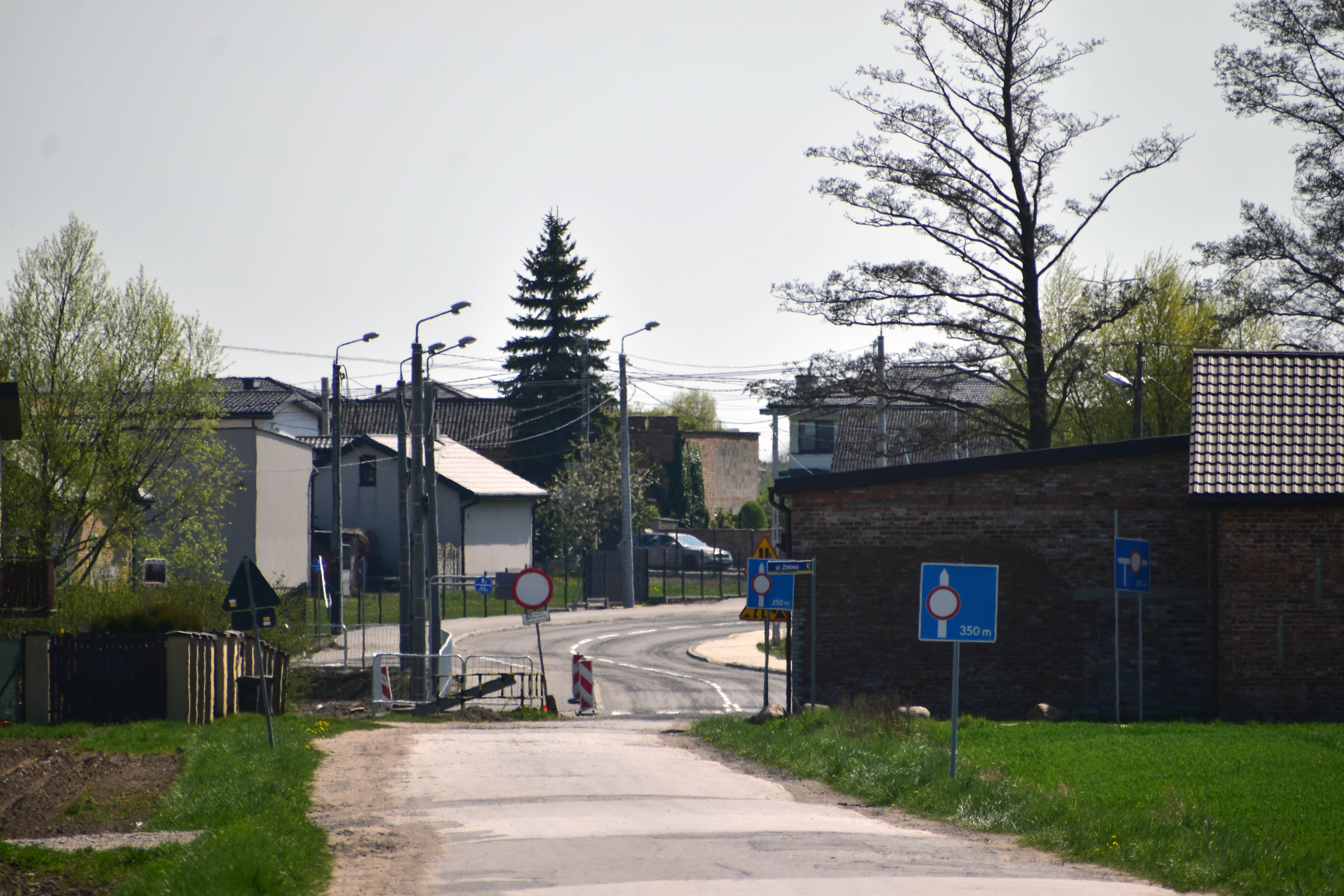
And yet. Yesterday, the driver of this Jaguar has ignored all eight 'no entry' and 'road closed' signs that he passed. Furthermore, he drove over the zebra crossing as it was being painted. The car went around the roundabout and could not leave, as the northern exit was closed off; he did a U-turn, tried the southern exit - also closed off. Another U-turn. Frustrated, with no way out, he had no alternative but to drive back the way he came - once again crossing the freshly-painted zebra crossing. Twat. Cham.

This is where we are; it's nearly ready. New asphalt before the traffic. A lovely warm day, temperature at last hitting 20C.


And here we are back in May 2007 - 15 years ago, the same place. The Marian shrine that formed the centre of the roundabout has gone, there's proper lighting and road markings, pavements and cycle path have been set up. The Ikarus buses - now but a memory - have been replaced by hybrid buses on the 715 route. Good that the little shop is still there

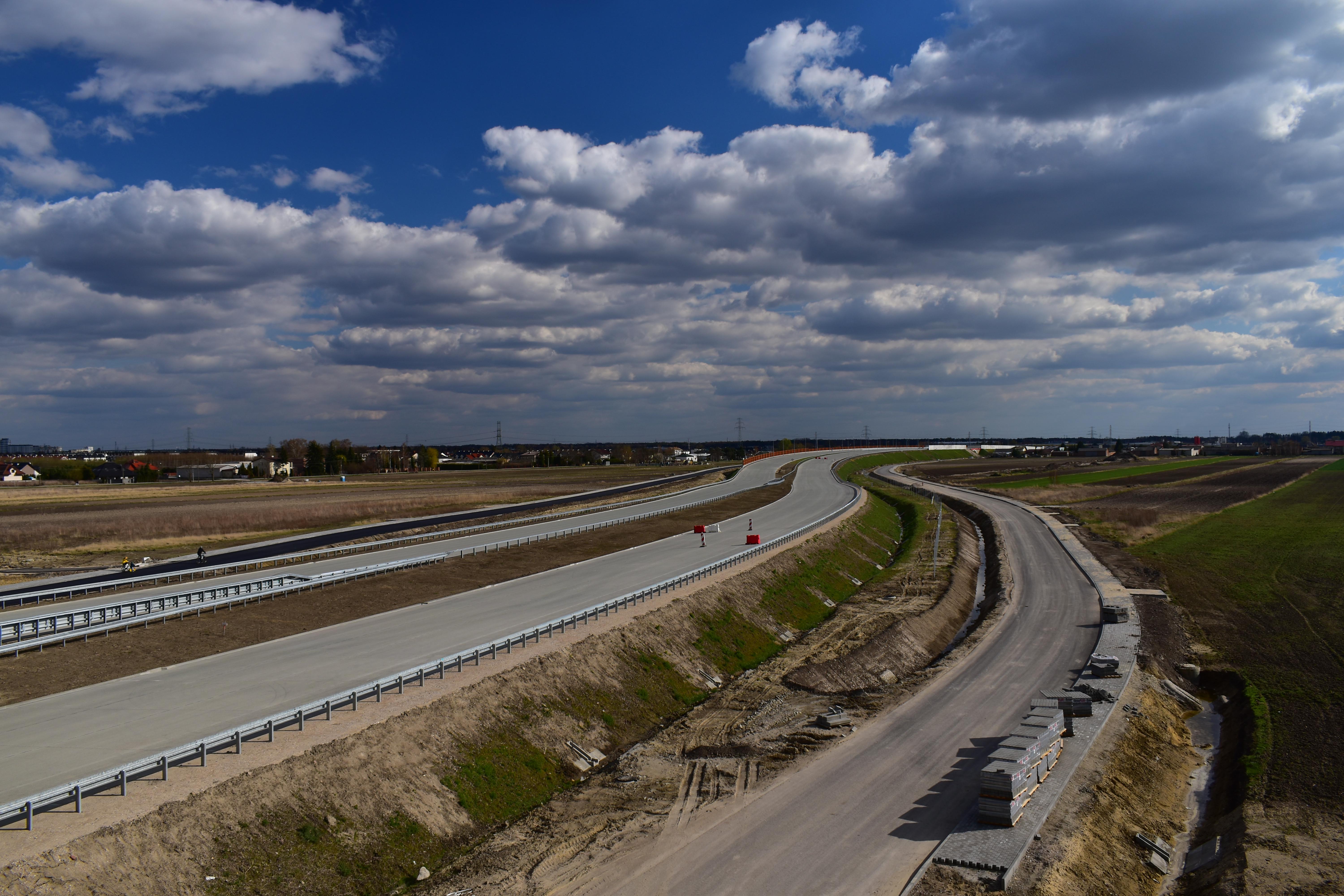
Taking advantage of today being a public holiday and a Sunday, I figured that there'd be no security around the S7 extension today, giving me a chance to cross over the new footpath/cyclepath, still unfinished (needs on-ramps at either end, hand rails, asphalt and marking). Here's the view looking north towards the road viaduct. Note the plastic barrier blocks in red and white; until the footbridge is open, this is the current route for pedestrians and cyclists. To the right, the highways maintenance depot nears completion.

This time last year:
S7 extension works
[Amazing how much progress has been achieved in a year!]

This time two years ago:

This time three years ago:

This time four years ago:
New roads and rails

This time five years ago:
The Gold Train shoot - lessons learned

This time six years ago:
The Network vs The Hierarchy in politics

This time seven years ago:
45 years under one roof

This time eight years ago:
Digbeth, Birmingham 5

This time nine years ago:
Still months away from the opening of the S2/S79 

This time ten years ago: 
Looking at progress along the S79  

This time 11 years ago:
Snow on 3 May

This time 12 years ago:
Two Polands

This time 13 years ago:
A delightful weekend in the country

This time 14 years ago:
The dismantling of the Rampa

This time 15 years ago:
Flag day

Sunday, 17 April 2022

Horizons

Good photography weather - brisk wind moves scattered clouds across the sky, dappling the landscape with patches of sun that will either illuminate the foreground or the horizon, or neither, or both, the sky itself capable of turning in some drama. Photos from three recent walks, all three being at least 16,000 paces (12km+). Of late, I've been catching a bus, buying a 20-minute ticket (3.40zł/ 60p)and walking home, extending my range and opening new vistas.

Below: lit by strong sunshine, the chimneys of Siekierki, 13km to the north-east. In the foreground farm buildings along ulica Złota, Nowy Podolszyn.


Below: Looking north-east from Podolszyn, sunlit blocks of flats in Ursynów; on the horizon, the chimneys of the Siekierki power station.


Below: looking at Zamienie from the west; four cranes suggest more high-rise developments on the edge of town. Nearest to the camera, Osiedle wśród pól, ('the estate among the fields') which will soon be engulfed by other estates. Note the distant airliner - it's approaching the airport from over Ursynów on RWY 29 as the usual RWY 33 (flying in over Jeziorki) is closed for maintenance.


Below: looking at Nowa Wola from the ulica Polna, which runs from Lesznowola through the fields of Podolszyn to Nowy Podolszyn.


Below: looking north from the fields between Nowa Wola and Podolszyn towards Warsaw, a LOT Embraer ERJ 175 departs from RWY 11, Okęcie airport. Note the shimmering heat haze - which surprised me, because there was a cold wind blowing in from the north.


Below: looking south from the new viaduct that connects Nowa Wola and Zgorzała; the S7 extension, flanked by service roads runs on the next junction, Węzeł Lesznowola.


Below: looking east from the new viaduct towards Piaseczno, housing estates of Nowa Wola and Nowa Iwiczna in between.


Below: sunset in the fields between Dawidy Bankowe, Zamienie and Łady


Below: ploughed field between Podolszyn and the Novisa Modern estate, under construction at the northern end of Nowa Wola, in the English style.


Below: Warsaw's skyline stretches out along the horizon - looking north along ulica Polna as it makes its way from Lesznowola via Podolszyn to Nowy Podolszyn. Asphalted at either end, there's still an 850m gap; this stretch at least is hardened, the next bit is little more than a muddy track.


Below: ulica Gryczna (lit. 'Buckwheat Street'), s dirt-track road leading from Podolszyn towards Zamienie 


For some topical perspective - wayside shrine, Nowy Podolszyn, a banner in Ukrainian colours, and on it the supplication from the Trisagion - 'From air [ie tempests], hunger, fire and wars, rescue us, O Lord'. On the notice board there's a leaflet in Ukrainian with information for refugees; next to in, in Polish, a leaflet explaining how local people can help.


Below: bonus horizon in the snow, taken on 2 April. A train of empty coal wagons heads back south along the electrified main line, between W-wa Dawidy and W-wa Jeziorki. Unusually heavy snowfall for April.


This time three years ago:
Helping others? Couldn't hurt

This time five years ago:
Local ornithology

This time nine years ago:
A hare in Wyczółki

This time ten years ago:
Warsaw by night

This time 11 years ago:
Tales of the Riverbank

This time 12 years ago:
Okęcie before the funerals

This time 13 years ago:
At the General's house

Tuesday, 3 November 2020

Nail-biting walk

Waiting for the results to come in. Trump's declared victory. Time for a walk, catch the sunset, detach myself from the news. An hour's daylight before, an hour's walk home in the dark - two hours, 12,000 paces. Below: W-wa Jeziorki station, southbound ('down') platform. The northbound ('up') platform is directly behind me. On the horizon, the Warsaw skyline; it's been over a month since I last ventured into town.


The main part of today's journey is along ul. Dawidowska/ul. Starynkiewicza; the first part is in Zamienie and after crossing into Dawidy Bankowe continues on to Dawidy. Over 2km long, the road runs dead straight. To the right, the fields which are now being carved up by the S7 extension. To the left, a whole lot of new and uncoordinated housing developments running off Starynkiewicza at right angles, generally of between ten and 20 new houses. Below: at the moment a rutted, muddy track with wasteland to one side, within two years another such estate. But what a sunset!


Below: ul. Jana Miklaszewskiego, the road from Dawidy Bankowe to Łady (pron. 'Wuddy'). On the horizon the church of St Matthew the Evangelist, Łady.


Below: The time is right for racing in the streets. The recently-rerouted 715 connects Ursynów with Aleja Krakowska via numerous suburban villages; now it runs down ul. Karczunkowska. However, it's nowhere near as convenient as the old 209 (now rerouted to terminate on ul. Baletowa). The old 209 began its route one stop from our house and was therefore extremely punctual. The 715 and 727 which now run down Karczunkowska have a long route from their respective termini, and punctuality is questionable. If a bus can be 10-12 minutes late, but it only takes eight minutes to walk to Puławska, why bother waiting?


Below: ul. Polnych Kwiatów (lit. 'Flowers of the Field Street') is another poorly-planned estate that runs off Starynkiewicza at right angles. No asphalt further down; five new streets to the right of Polnych Kwiatów bearing such poetic names as 'Forget-me-not Street' (ul. Niezapominajki) and 'Green Meadow Street' (ul. Zielonej Łąki). This is what happens when developers decide street names ('Tulip Corner Street' (ul. Tulipanowy Zakątek) and Water Lily Street (ul Lilii Wodnych) are in the same vicinity.

Below: the new tunnel, through which ul. Baletowa will pass under the S7 extension, which will be built over this steel structure. In the meanwhile, Baletowa does a little semicircular detour around the site. I'm very impressed at the speed with which work on the S7 has been carried out; it is due to open to traffic in the spring of 2022. For once, I think this is feasible - if Section B of the contract (this is Section A, Section C connects with the existing S7 near Grójec) is ready on time (it's running late).


Below: home via the Jeziorki ponds; recent rains have raised the water levels so it's no longer a muddy lake bed here. The backs of the houses that face ul. Trombity are beautifully illuminated, adding a touch of glamour to lakeside living, Jeziorki-style. I once talked to a couple who were looking to buy property along here - their biggest worry was flooding. It's drought they should have concerned them. I hope there will be proper snow and frost this winter.


And who's here to greet me when I get home? It's Felusia (now nearly three months). Below: a bit unsure about the camera... (I'm shooting with it at chest-level, using the screen on the back to compose and focus, so she's staring into the lens.)


Now she's feeling happier. A very lively, intelligent, inquisitive and affectionate cat. 


This time two years ago:

This time two years ago:
Loving Vincent - review

This time seven years ago:
UFO credibility test

This time eight years ago:
Junction ready for road to unbuilt sports centre

This time nine years ago:
Park nad Książecem - Vistula escarpment, beautiful autumn

This time 11 years ago:
Obama wins US presidential election

Sunday, 6 November 2016

Dawidy Bankowe, Łady, Zamienie and back

After two days during which I only managed around an average of 7,000 paces, a good long walk was in order. So I set off through Jeziorki, crossed the tracks and headed to Dawidy Bankowe, thence to Łady (pron. 'Wuddy') to hook round towards Zamienie and Zgorzała before returning home.

Below: ul. Miklaszewskiego snakes around from Dawidy Bankowe to Łady, taking a zigzag route. The road is narrow with hardened verges for passing.


I've commented many a time about how the flatness of the landscape and the overhead cables and wires give Warsaw's exurbs an American Mid-Western feel.


Below: further along ul. Miklaszewskiego, looking towards Łady. I get to the corner and turn left, into the fields.


Below: this is farming country. Many small fields lie fallow, but there are increasing numbers of larger, consolidated fields on which cabbage, potatoes, carrots and beetroots are grown. Sad to see, however, many potatoes dumped by the side of fields - maybe the wrong calibre for the demanding supermarkets. This field is in Łady.


The last few weeks have been very wet. This morning I was awakened by the sound of rain on the roof - which surprised me, as I'd checked the weather forecast on Meteo.pl before going to sleep - no rain was meant to fall today. The fields are sodden and this kind of walk can only be done in wellies.


Below: looking south-west towards Podolszyn and Janczewice on the horizon. It's around here that Warsaw gives up the ghost in trying to develop; it's still solidly agricultural, with pockets of exurbia like Lesznowola and Magdalenka between here and the deep Mazovian wieś that lies beyond.


Below: looking from the fields of Podolszyn towards Zamienie, and the new housing developments that have sprung up around the old BioMed vaccine plant that closed in 2004. The new streets are named after spices and flavourings; ul. Arakowa, ul. Waniliowa, ul. Bakaliowa, ul. Szafranowa, ul. Karmelowa.


Below: the white building is a block of flats, almost empty. If you're going to move out of town, you might as well live in a house. This development is not my cup of tea - neither architecturally, nor in terms of its town planning.


Below: the path that leads from the new housing estate into Zakłady Zamienie. Note the hexagonal paving slabs. Very little remains of the plant, to see it two years after it closed (in a scandalous state, given the biologically hazardous materials inside) click here.


Below: the abandoned checkpoint at the entrance, on ul. Zakładowa. A strange atmosphere pervades the place; to the west and north of it, new housing estates, but inside - silence, emptiness.


Below: the same checkpoint back in January 2009, five years after the vaccine plant had closed. There was still a guard on duty here.


Left: a drainage ditch runs right around Zamienie, like a moat. This is the section from ul. Dawidowska marking the southern boundary of Zakłady Zamienie. The house in the distance and everything to the left of the ditch lie in Zgorzała. Across ul. Dawidowska (behind me) are the Action and Pommier warehouses. One day, the S79 will be extended south this way.

Below: bonus shot from near the end of my walk - an EN57 electrical multiple unit - one of the increasingly rare unmodernised stock - approaches the 'up' platform at W-wa Jeziorki. To the left, you can see the new 'down' platform being built, and the gap that awaits the new 'down' track.


Good long walk achieved. Around 15,000 paces /12km/ eight miles.

This time five years ago:
Town planning and the Sublime Aesthetic

This time six years ago:
On the long road from Zero to One

This time seven years ago:
Łódź Rising

Saturday, 23 July 2016

Thoughts - trains set in motion

An interesting examination in how trains of thought develop and unfold within the conscious mind; take one thought, let it lead to another, and another, and see what develops, taking notes all the while...

I'm having lunch in a field near Łady (pron. 'Wuddy'), looking across at the church there. I watch the planes landing behind it, and snapping the snap below, the lyrics of the Clash song, Rock the Casbah, come to my mind. 'Drop the bombs between the minarets'... Two minarets, two towers... The song's chorus - 'Shareef don't like it/Rockin' the casbah, rock the casbah'.


Shareef/sharif... It occurred to me that about an hour earlier I'd watched an Emirates plane landing at Okęcie and thought how many names for rulers there are in the Islamic world that have entered everyday usage in English - Emir, caliph, sultan, shah, sharif...

Sharif - sheriff. Is there an etymological link between the two? No. I'd checked this one before; the English word 'sheriff' comes from the contraction of 'shire reeve' - the reeve of the shire. The reeve... wasn't there one in Chaucer's Canterbury Tales?

Yes. I'd encountered Chaucer's Canterbury Tales 40 years ago, in my final year at school for English A-level (matura equivalent). It is a great work of literary, social and historical significance.

And the train of thought carries on. The reeve? the feudal lord's accountant? He was one of that host of characters who were on the pilgrimage from London to Canterbury, to the shrine of St Thomas a Becket. On the journey, they kept each other amused by telling stories.

First, in the prologue, Chaucer introduces us to the group. Fully one-third fulfilled some function or other in the Church. These included the Pardoner and the Summoner, who fulfilled functions to do with the ecclesiastical courts (the courts of the Christian Church - for this was before the Reformation). The pardoner sold pardons, the summoner summoned those who breached the law of the Church (judged in ecclesiastical courts as opposed to the law of the land).

Today ecclesiastical courts have little power other than to judge disputes within the church, but in Chaucer's Middle Ages, they were as powerful as the lay courts, and affected ordinary people in their everyday life.

[Like sharia in Islam... and then we're back with sharif. Again, no connection, for 'sharif' means 'noble', while 'sharia' has its etymology in the word for 'way' or 'path'.]

But back to my train of thought, sitting in the field, overlooking Łady.

The pre-Reformation Church was the world's first multinational service-sector business. It's product - a rather intangible one - the salvation of the eternal soul. Indulgences, penances, pardons, bought and sold. Chaucer took many swipes at the corrupt practices rampant in the Church at the time, based on the idea that one could purchase absolution from God's punishment by paying the right price to the right person. Incidentally, an 'indulgence' is odpust, a word now more associated with metallic helium balloons, cheap toys and obwarzanki sold outside churches on specific feast-days in the Church calendar.

But back in Chaucer's days, price lists showing how many years you could knock off your stay in Purgatory for a given sin were standard. You'd pay the pardoner (quaestor in Latin - from which the word in Polish for a university treasurer - kwestor) a given sum, and your sins would be forgiven.

A great business idea - it paid for the Crusades - but one which did not stand the scrutiny of Martin Luther and Protestant theology, and later the Catholic Church's Council of Trent.

Right! lunchtime over, time to get up and walk back to Jeziorki.

Sunday, 23 September 2012

A little west of Jeziorki, early autumn

West of Jeziorki, a day after Equinox. Łady (pron. "Wuddy"), the first proper village you get to after leaving Warsaw's borders. The 715 bus passes through here, as it wends its way from Wilanowska to P+R Al. Krakowska (formerly Okęcie). Dawidy-Łady-Nowy Podolszyn-Podolszyn-Nowy Podolszyn-Łady-Dawidy it goes, giving passengers a double chance to gaze upon it.

Below: the centre of Łady, a Marian chapel, and buildings that look something out of a Western. "Sheriff's lookin' for ya, boy!"  A half moon rides a clear sky.

 
Below:
Łady has its own village pond, which gives it a  spirit of place, a focal point.


More ponds, further west. Between Falenty and Janki, one of several large commercial fish ponds, which have been here since Tsarist days. Below: Staw Falencki, looking east.


Below: Staw Falencki, looking west. I wrote yesterday about the low water level in the Vistula, but here in Falenty, there's no sign of drought; the water comes right up to the bank.


This time last year:
The Old Sailor's Tale - part II

This time two years ago:
Prague-Jeziorki-Moscow

This time three years ago:
The passing of Lt. Cmdr. Tadeusz Lesisz

This time five years ago:
Summer ends, autumn begins

Thursday, 11 December 2008

Jeziorki on even older maps

Over the summer, my mother-in-law gave me a history of Warsaw published in 1974 (Historia Warszawy, M.M. Dozdowski, A Zahorski), which contained this fascinating map of Warsaw and surrounding areas as it would have looked in the 16th Century. Below is a section of the map, focused on Jeziorki. Click to enlarge either map.

This suggests that Jeziorki has been around since the 15th Century, the property of a nobleman (rather than of the church or of royalty). Looking around; Dąbrówka dates back to the 15th Century, Podolszyn was called Podolszynie-Dukaty, Łady (pron. 'Wuddy') was Łady-Gramnice, Gramnice itself would have been where that chicken farm is on the road between Łady and Dawidy; Dawidy would have been within the Las Kabacki forest, Grabów would have been called Jemielinek and Jaworowa - Jaworowo; Falenty was once Falęta. The whole area was ill-served with inns (karczmy) or mills (młyny). The fishponds around Raszyn and Rybie were once extensive marshes. The nearest churches were at Służewo (the predecessor of the Dominican Abbey, Służew, where Moni sings) and Raszyniec (today's Raszyn).

This time last year:
Rotten weather
Rorate in caeli de super nubes pluant justum...

Monday, 12 May 2008

Devoted Shriners

It's the Marian month of May, and the shrines are decorated. The ebb and flow of the seasons is mirrored in the church calendar, and the chance to pray in the sunshine is welcome. Scenes like this, in Zamienie, can be witnessed across rural Poland. Dear ladies, bastions of all that is Polish, you may not have noticed that suburbia is creeping up upon you, waves lapping around the ankles of traditional Poland. The billboard to the left advertises a new estate of 36 houses. Below: Just two kilometers further out of town is the village of Łady (pron. "Wuddy"). Here, suburbia is still a few years away. The shrine crawl's not made it here yet, either. The same two shrines last May.