Showing posts with label Kraków. Show all posts

Sunday, 14 September 2025

Kraków in the morning

One antidote to the scourge of over-tourism is to get up early and see the sights before the throng materialises. It's nine in the morning, the pavement cafés are empty, the trams are delivering workers to their jobs. There's a traffic jam of delivery trucks and vans disgorging food and beverages to the bars and restaurants, the sound of aluminium beer kegs rolled over cobblestones, of reversing beeps from garbage trucks. First tourists out onto the streets are student groups leaving their hostels en masse, hungover and disgruntled at being woken up at an unnatural hour to see some 16th century basilica. 


Below: crossing the market square, I was in for a treat. A military parade passes through, complete with band (off camera to the left). I was deeply moved as the band struck up the Warszawianka, but was quite unprepared for the first musical number (played before the column reached the square) – Consider Yourself from Lionel Bart's West End musical, Oliver!. Quite apt, really, as Lionel Bart was born Lionel Begleiter to Yetta (née Darumstundler) and Morris Begleiter, who had fled the pogroms visited upon Jews after Russia invaded Austro-Hungarian Galicia in 1914. 


Below: ulica Szpitalna, across the road from the Juliusz Słowacki theatre. Europe, through and through. But hello... what's that parked up over there?


Below: not strictly historically accurate (a Polski Fiat 125P would have been more like it), this Milicja-liveried Lada is still parked up before starting its day driving tourists around on a retro trip of Kraków.


Left: one of my favourite prospects of Kraków, looking down ulica Florianska towards the St Mary's Basilica. Tourist numbers are still acceptable. Two hours later – not so.

Below: ul. Lubicz as it passes under the main railway line. I catch an InterCity shunter hauling a rake of empty sleeper-train coaches off to the sidings, while under the viaduct a tram heads eastwards. This is Przekop Talowskiego, built in 1896-98, and it involved lowering the street level so as to allow road traffic to pass under, unhindered by the railway. A masterpiece of engineering and architecture, designed by Teodor Talowski. (It looks great at night too.)


One sad reflection; I was enjoying my coffee in the Scottish diner, behind me was sitting an English family from up north; dad, mam and teenage son. Dad was explaining Poland to them. "Poles earn somewhat less than we do, but everything here is much cheaper... and... so... [sound of penny dropping] ...they have a better standard of living than we do." 

Below: Is this Alabama? Are we in Tennessee? No. This is just three hours north of Kraków – Warka, where I change trains for the local service home to Chynów.

This time five years ago:
For or against?

This time 11 years ago:
Weekend cookery

This time 12 years ago:
Laying down the sewers

This time 13 years ago:
Still awaiting the official opening of viaduct on ul. Poloneza

This time 14years ago:
Fixie composition in blue and red

This time 15 years ago:
What's the Polish for 'guidelines'?

This time 16 years ago:
Ul. Rosoła's cycle path – new route to work

This time 17 years ago:
First apple

This time 18 years ago:
Late summer spider-webs

Saturday, 13 September 2025

My night in Wawel Castle

On confirming my presence at the opening of the Children of War exhibition at the Schindler museum, I asked whether the museum could recommend me a reasonable room for an overnight stay. I was offered two choices: the nearby Hotel Normalny (***) for 500 złotys, about £100, or a residence in Wawel Castle for 150 złotys, about £30. Naturally, I dropped everything to book the latter and pay for it online, despite it being over 30 minutes' walk from the museum. And I was warned that there was always the chance that in the case of a surprise state visit by some foreign dignitary and entourage, I might get bumped at the last minute. This did not happen. 

At around 5pm on Thursday, I turned up at the guard house at the castle's Bernardine Gate to be given the key to the apartment, and was shown up by an armed guard. I left my rucksack in my bedroom and set off on foot to the museum for the event, to return later that evening for my night in Wawel Castle.

Below: the castle's residential apartments are in the ivy-clad building to the left; the Sandomierz tower is centre; the Bernardine Gate is just round the corner. The latter is a reminder of Nazi occupation; the gate and guard house were built in 1940 when the notorious Hans Frank, the governor-general of the occupied territories had his residence here. (He was hanged for war crimes in 1946.)

So – what was it like, spending the night in Wawel Castle? Well, the rooms are authentically old-school, sparse, monastic, luxurious in a 1920s kind of a way with polished parquet flooring and period furniture. And a bed that would be uncomfortably short for anyone over six feet tall.


Left: the bathroom in my apartment. The photo, taken with a 10mm lens, cannot quite capture the height of the room – I estimate it to be well over four metres, making it higher than it is long. Plumbing, fittings and fixtures speak of past epochs, but everything worked as it should (except for the kettle in the otherwise well-equipped and spacious kitchen).

Having walked over 19,000 paces, I was quite tired and went to sleep at half past nine, waking up at 7am, so nine and half hours sleep with vivid, but not particularly notable dreams (finding blue plastic badges shaped like sails, dated 1919, in regularly spaced holes in the soil of a Gloucestershire garden). No ghosts.

In the morning, I take the opportunity to look around the castle complex before heading back to the station. Below: view from my bedroom window, overlooking the gardens of the Bernadine Fathers.


Below: the cathedral (Bazylika archikatedralna św. Stanisława i św. Wacława) in its morning glory. Poland's Westminster Abbey. Even at eight am, early tourists are beginning to show up, and the delivery trucks are much in evidence. I spend some time wandering around before I head to the station for my train back to Chynów via Warka.


To quote from Withnail and I, "Free to those who can afford it, very expensive to those who can't".  I guess that the administrators of the Wawel Castle residential apartments have a fine line to tread between commercial reality (I'd estimate the market value of a night like this would be three to five times higher than what I paid) and the need to maintain the building as it is for the sake of posterity and national heritage. I guess my 150 złotys is a charge to cover the costs and no more; this is not something you can book for yourself. You need to be a guest of some public institutions like the Museum of Kraków that administers the Schindler's Factory museum. Or, I'd guess, the City of Kraków, or the Ministry of Something. Yes. I know it's a missed commercial opportunity, but even a tourist-facing city like Kraków has its limits.

(*** not its real name, but you get the picture – nothing out of the ordinary)

This time last year:
Immersed in Dali

This time four years ago:
Pavement comes to Jakubowizna
[Karczunkowska still waits.]

This time five years ago:
My local craft brewery
[Sadly it closed last year.]

This time 15 years ago:
Time to change gear.

This time 16 years ago:

This time 17 years ago:
Early, cold start to autumn

Friday, 12 September 2025

Dzieci wojny – Children of war

To Kraków for the opening of Children of War, a temporary exhibition at the Schindler's Factory museum. It tells the stories, in words and photographs and artefacts, of 13 children, all under the age of 11 when war broke out, explaining how it affected them and how they survived, Jew and gentile alike. 

Since work began on curating this exhibition, six of the 13 have died, unable to finally witness their testimony on display at the museum. Three were present at the opening, the eldest being 96 years old. 

A small but particularly moving exhibition, looking at the horrors of war through the eyes of children. Interest in the opening was such that it was the museum cinema, venue for the official part, was crammed to overflowing, and seeing the exhibition was a tight squeeze.

A part of the exhibition – and the direct reason for my presence – was a part dedicated to the Szkoła Młodszych Ochotniczek (SMO - in English, the Polish Young Women's Auxiliary Service School), home to my mother for most of the war. Her army suitcase, filled with her exercise books were on display, which for me serve as a testament to the focus and hard work expected of the pupils.


Left: uniform jacket as worn by girls at SMO, and some of the diplomas awarded there.

The most moving part of the exhibition for me were the drawings made by Polish children who'd survived the war of what they'd witnessed. These were counterpointed by those made by Ukrainian children from Kharkiv illustrating what they saw in the early days of the full-scale Russian invasion.

Another poignant moment was the testimony of the daughter of two Jews who had been saved by Oskar Schindler by inclusion on his famous list. Mother and father fell in love in the camp, survived the war and settled in Israel. Their daughter, born there, was forthright in her condemnation of what her government was doing to Palestinian children in Gaza.

I would like to acknowledge the splendid work carried out by Alicja Szkuta in keeping alive the memory of the SMO, which educated over 1,000 Polish girls in Nazareth from 1942 to the end of the war. All three of my Saturday Polish school teachers who taught me Polish language, literature, history and geography in the 1960s and early '70s – Pani Skąpska, Pani Szkoda and Pani Wolańska – were alumni of the SMO. The knowledge they passed on to the British-born generation of post-war Poles has been invaluable in maintaining our Polish heritage in the UK.

I would also like to thank Beata Łabno, curator at the Schindler's Factory museum, not only for putting together such an emotionally compelling exhibition, but also for recommending and reserving for me one of the most memorable night's accommodation I've ever enjoyed – in the guest rooms inside Wawel castle itself. But more on that in the next post... 

There are many things that Poland is good at, and running world-class museums is among them, Children of War runs as a temporary exhibition at the Oscar Schindler Factory museum until 30 August 2026. I highly recommend it, a reminder that the youngest suffer the most when two sides go to war.

This time last year:
Ten grand a year

This time two years ago:
The ephemeral pleasures of materialism

This time three years ago:
W-wa Zachodnia modernisation – a long way to go
(Three years on: still not finished)

This time four years ago:

This time five years ago:
Back in Aviation Valley

Friday, 24 November 2023

Kraków's symbol of transformation

While visiting Kraków from the 1980s through to the early 2010s, I was increasingly intrigued by the presence not far from the very centre of the city of an unfinished hundred-metre high office tower just standing there. Visit after visit after visit, nothing happening. Decade after decade. My local hosts would point it out to me as a enduring curiosity. 

As time went by, it was neither demolished nor completed - just remaining there an eyesore that suggested helpless civic impotence. And at a time when the city was in the throes of a shared-services boom, many large foreign investors drawn to the city by its human talent, desperately looking for office space.

But back to the beginning... Work started on the NOT tower (Naczelna Organizacja Techniczna) in 1975, and paused in 1979 for the same economic reasons that triggered the workers' strikes that led to the Solidarity movement. Then for over one-third of a century, nothing happened. The skeletal frame of the tower became accepted as a part of the Kraków skyline. There was interest in doing something with it, but effort after effort crashed upon the shores of bureaucratic and legal complexities and the helplessness of the nie da się ('it can't be done') mentality.

Finally, in 2016, something moved. Work began on completing the NOT tower, by this time dubbed by locals 'Szkieletor' (Skeletor) after the skull-faced Masters of the Universe supervillain. The original skeletal frame was kept, but the old floors were taken down and replaced by new ones, reducing their number from 30 to 27. Covid happened just as work was nearing completion, but since 2021, tenants have started moving into the building, renamed Unity Tower.

Below: and here it is, standing proudly in the late-November sun. Photo taken from Rondo Mogilskie, a gyratory traffic system that separates cars from trams and pedestrians in a 1970s sort of way; to get across this on foot means using a succession of tunnels and footpaths and escalators; not a perfect for walkers, but at least cars are not a danger.

Below: my photo of the building taken in August 2019 as work was under way... [Looking at the angle, the car I was sitting in must have been just to the left and above the spot where I took the photo above.]


...and the complex as it appears today from ulica Lubomierskiego. Everything located a short walk from Kraków's main railway station.


The story of how Szkieletor - a building said to have been cursed to remain unfinished for all time - has become a part of Kraków's modern business ecosystem of offices, shared services, IT, accountants and lawyers - is yet more proof that Poland's doing well. Kraków sorely needed modern office space; besides, the trend that's observable across other cities is that edge-of-town campuses are losing in popularity to smaller spaces rented right in the centre.

This time last year:
First proper snow of 2022/23

This time two years ago:

This time four years ago:
A month and much progress at Chynów station

This time five years ago:
Tram tips for visiting Edinburgh

This time six years ago:
Warsaw to Edinburgh made easier

This time eight years ago:
Stuffocation: the rich-world problem of dealing with too many things

This time 11 years ago:
Heroes on the wall (for my father)

This time 13 years ago:
Tax dodge or public service?

This time 14 years ago:
Warsaw's woodlands in autumn

This time 15 years ago:
Still here, the early snow

This time 16 years ago:
Another point of view

Monday, 12 December 2022

Jakubowizna to Kraków in the snow

Tips for train travel in Poland during adverse weather conditions.

The programme: Leave the działka at 12:20, catch the 12:49 local train from Chynów to Warka arriving 13:01; catch the 13:19 Kolberg express from Warka to Kraków, arriving at 16:40; then walk (80 minutes) to the hotel.

The reality: more snow fell overnight; it took much effort to push open the front door just to peak out. Since dawn, I’d been following the train portals to see how things were going. Initially – it seemed – not as bad as yesterday, just five to seven minutes’ delay shown – but I feared that the situation would deteriorate. I gave myself an extra few minutes to trudge to Chynów station, given the unploughed state of the street. Along the way, I accepted an invite to New Year’s champagne at my neighbours’, which was nice.

Arriving at Chynów station, I found that – despite what I’d just seen on the portals before setting off – my local train to Warka was now showing a delay of 25 minutes. Meanwhile, the onward express, the Kolberg, from Warka to Kraków, running south from Warsaw along the same track, was delayed by 15 minutes. I was anxious that the local train could be held at any of the intervening stations with a passing track to let the express through. These are Piaseczno, Czachówek Południowy or even Chynów itself – to let the delayed express through. Missing the Kolberg would mean waiting for the Sienkiewicz, which arrives in Kraków at half past six or the Żeromski, which arrives at half past eight (assuming they’re on time).

But all was well – my anxiety relieved to a great extent by the ‘find your train on the map’ function on Portal Pasażera (below - click to expand).

Here, I could see in real time that the Kolberg’s delay was increasing, and that there was no chance that it could catch up and overtake my local train before it reached Warka.

Arriving in Warka with a 25-minute delay, I still had to wait half an hour for the Kolberg, whose delay was becoming longer and longer. As the station clock shows, the train rolled in 36 minutes late.

But no matter. I boarded it, dumped my coat and rucksack on my allocated seats* and made for the Wars restaurant car. 

Here, a digression about the Wars service. It is excellent. Fresh food, freshly prepared. The Kolberg, which had left Olsztyn Główny three hours earlier, has a dining car guaranteed because the service is operated by a Dart electrical multiple unit (always in car no. 3).

 A fellow diner, into his second beer, stood up to applaud the chef for his sandwich making skills. “I too worked in gastronomy in my youth,” he said, “and I am full of admiration for the way you cut and filled those sandwiches”. My order of meatballs, groats, cabbage and beetroot, took all the way from Warka to Lesiów to prepare – but it was fresh, hot, cooked just for me. Washed down by a craft ale, and costing a total of 51 złotys (£9.35), the culinary experience was outstanding, sitting down to eat at a table on a porcelain plate with a steel knife and fork. No plastic, no microwaved rubbish; this meal was cooked to order on the train. 

"Dinner in the diner
Nothing could be finer
Than to have your ham and eggs
In Carolina"

I beg to differ. Pulpety, kasza, surówki i piwo jasne craftowe from Browar Olbracht while crossing from Mazovia into Świętokrzyskie take some beating!

I also found time to praise the chef – this really is one of the highest-quality dining experiences on a train that one can have in Europe. I most certainly appreciate it. In the UK, you'd be standing at a buffet counter eating crisps, packaged sandwiches and tinned lager and paying more for it.

Dusk soon fell (today is the earliest sunset of the year in the Northern Hemisphere), and from Skarżysko-Kamienna, the rest of the journey was in darkness.

Below: somewhere south of Radom, soon after sunset.


I dozed off in a happy state to wake just north of Kraków - the train arrived one hour and 13 minutes late. From the station to my hotel, near the Kraków Technology Park, was a 7.6km walk. Just the thing. The first part of the walk was the epitome of European winter urban style - walking along the Planty avenue that rings the city's Old Town.

Below: tram in the snow. European civilisation.


Below: Wawel Castle - perhaps the most significant single building to the Polish psyche. Think Edinburgh or Windsor Castles; it's of that rank.


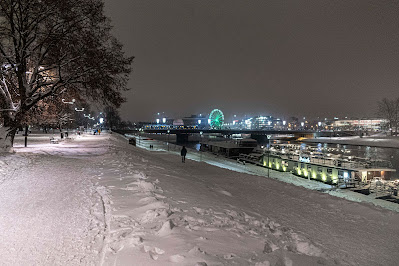
Below: along the Vistula's bank. The same river that passes within 10km of my działka, that flows through Warsaw and Toruń, reaching the Baltic in Gdańsk.
* The train was almost full on the stretch between Warsaw and Radom; I managed to get two seats to myself thanks to a glitch in the booking system. Buying a ticket online, you are given a mere two and half minutes to make the payment. The process includes selecting your discount, choosing your seat, typing in your name, reading the terms and conditions, opening your banking app and authorising the transaction. Two and half minutes - not enough. My first attempt to book is timed out – but when I try again and come to select my seat, I see it’s been taken. By me! But not paid for... so I take the aisle seat next to it, this time manage to make the payment in time. Boarding the train I find I have both seats to myself for the whole journey, which makes sleeping easier! Note to InterCity’s IT team – do you honestly think two and half minutes is adequate to make the payment? Make it five. Until then I'll use this trick to book myself an additional seat adjacent to the one I've paid for.

This time two years ago:
Solar promise dashed

This time five years ago:
Meditations on West Ealing and Change.

This time seven years ago:
Warwick University alumni meet in Warsaw

This time eight years ago:
Pluses and minuses of PKP InterCity

This time nine years ago:
When transportation breaks down

This time 14 years ago:
Full moon closest to Earth

Saturday, 9 October 2021

All together, saving our planet

To Kraków for the 2nd Carbon Footprint Summit. A nice idea which shows me where the social problems lie in persuading humanity to give a shit about the planet we live on...

The idea is great - bring together everyone that cares, to discuss what's needed to be done. Turning up at the venue, I was struck by the large number of young activists, full of fervour, and a business crowd that were there to talk about what's actually being done.

I came by train emitting 8.1kg of CO2; by car, would have been 29.6kg; plane 70.8kg.

I had come all the way (an 03:20 alarm to catch the 04:56 train from Jeziorki via W-wa Zachodnia) mainly to hear Olga Malinkiewicz, co-founder and chief technology officer of Saule Technologies. Dr Malinkiewicz is famous for having invented a way to ink-jet print perovskite, a translucent crystal with photovoltaic properties, onto plastic film. The implications of this are huge. Unlike conventional silicon panels - heavy and clunky rectangular slabs - perovskite can be wrapped around irregular shapes, it can be applied to windows, it can even be applied to silicon panels boosting their combined efficiency. Looking at the potential, I believe that Dr Malinkiewicz will one day be seen as the greatest Polish scientist since Marie Curie-Skłodowska.

The event was organised along the greenest of principles. I am irked at going to a big conference and getting a visitor ID badge that's printed onto a sheet of laminated plastic and hung around one's neck on a lanyard with metal clasp, bearing the sponsors' logos. One day, and then all that waste... Here, the badges were made of recycled cardboard and suspended from a length of jute string. There were no programmes or brochures - again, a waste of resources. Instead, we have the programme in our phones. Signage at the event was hand-written on recycled cardboard, rather than printed on plastic and mounted on polyurethane. 

The event felt like a mashup between a normal business conference, the sort of thing I'd go to two or three times a month before the pandemic, mixed with a trendy hippy-hipster happening. Girls dressed as butterflies wearing gasmasks would flutter around Making a Point. A jumble-sale of recycled clothes sat in one corner of the arena, between stands for Porsche and Ford. You could get composting starter kits and advice on recycling, or watch films about the damage being done to our planet by the meat industry. The volunteers who ran the event were friendly and earnest about the Cause. A Cause which is literally the life or death of our planet as a habitable ecosystem for humanity.

Note the recycled pallets and social distancing. Good stuff!

The presentations and panels were generally interesting - good stuff about food waste, hydroponic plant production, green investment and capital markets, ESG reporting, the future of hydrogen, green redevelopment of buildings - very encouraging to hear so much positive messaging from businesses in Poland about the changes being made to hit ambitious decarbonisation goals ahead of deadlines. But where's Dr Olga?

After a while, it struck me that something wasn't right. I couldn't get online via my phone (I guess there wasn't enough bandwidth locally) but remembered from reading the programme at home online that Dr Malinkiewicz was due on at 11:40. That time came and went... there was instead an interesting panel with a lady from the United Nations and the deputy chairman of Grupa Azoty... I popped over to the Saule Technologies stand to ask a representative where his boss was. I was told that she was onsite, but that she'd already spoken - "Impossible - I've been here since the opening speech..." I asked one of the guys on the mixing desk. He didn't know either; he made a phone call. "She's already spoken..." It turns out that there were two conferences going on simultaneously! On was on the main stage, a conference in Polish (which I don't recall reading about online), while the international conference was tucked away in a small room a few corridors away from the arena, the signage for which was poor.

Left: This way... It is easy to see how I missed the sign saying Międzynarodowa konferencja ('international conference'). Click to enlarge. Please understand that at this international conference would be speaking the woman whose invention is about to transform the photovoltaic industry for the benefit of our entire planet.

And so I'd missed the very speech I'd come for, even though I heard some compelling content from a series of interesting speakers. Yet the one thing that struck me most was the Extinction Rebellion stand (below). It was unmanned. The point that the environmental pressure group was making was "we don't talk to business because business is destroying our planet". Right on, man. Business also happens to be feeding, housing and clothing you. This Pol Pottist, neo-Kropotkinite movement is so utterly counterproductive. In refusing to hear what business is doing, Extinction Rebellion is painting itself into a corner, it is glueing itself to the asphalt. Extremists. How about coming up with an invention similar in significance to perovskite film instead?

A monologue from nobody.

My key takeaways from the Carbon Footprint Summit - 1) It's all about changing the individual behaviour of billions of people - in particular the wealthiest two billion. Stop being greedy and focused on the acquisition of material possessions. Change your habits with the planet foremost in your mind. 2) Your carbon footprint is one thing, your water footprint is just as important. How much water do you literally piss away? Even by pushing the 'small flush' button on your WC, it's three litres of cleaned, potable water per wee, seven wees a day, that's 21 litres down the drain (with a full flush toilet, it's 42 litres a day). I'm smug here because for the past several years, I've been storing my urine, allowing it to ferment into ammonia, then using it as fertiliser (or mole deterrent) in the garden. But then I live in a house with a garden... 3) Business and activists need to be talking to each other non-stop about climate change. The danger of extremism can sparking counter-extremism, as is explained in this excellent piece from The Economist.

This time three years ago:
W-wa Zachodnia Platform 8 to reopen

This time four years ago:
Learning to fly (swan pics)

This time six years ago:
Scotland's answer to the Hoover Building

This time eight years ago:
In which I don't vote in the mayoral referendum, thus helping to save HG-W's job

This time nine years ago:
Gorgeous cars from Czechoslovakia

This time ten years ago:
Donald Tusk and Co. get re-elected 

This time 11 years ago:
Poland's wonderful bread

This time 12 years ago:
An October Friday in Warsaw


Saturday, 23 November 2019

Photo round-up, London, Warsaw and Kraków

From Ealing to Warsaw to Kraków and back to Warsaw, pics from last week that I haven't got round to uploading, all in one post.

Below: three double-deckers on Scotch Common, West Ealing. I have a thing about buses moving around this part of Ealing after dark, especially the double-deckers. Lit up, few people inside, and so frequent. During the rush hour, Argyle Road is choked up solid with traffic, but this photo was taken around 9pm, and the buses come all at once.


Below: Kensington Olympia station, now served by London Overground and Southern trains. To my surprise, I found I could get from Ealing to Balham by Tube via Shepherd's Bush, changing here for a Southern National-Rail train that uses the West London line passing through Kensington Olympia and Clapham Junction. Very useful!


Left: the Polish church in Balham, not far from the White Eagle Polish club, venue for the Sixth Congress of Polish Entrepreneurs in the UK. I was moderating the first panel discussion of the event, and was grateful that thanks to this link. Getting to Balham from Ealing so quickly rather than going all the way into town and changing for the Northern Line at Tottenham Court Road was a pleasant transportation surprise.

Below: from my last visit to London in October, a shot of British Airways' Airbus A319 in 1960s British European Airways retro livery at Heathrow. Lovely!


Below: taking off from Heathrow this Monday, I managed to snap this Boeing 747 in 1970s British Overseas Airways Corporation retro livery. British Airways has four aircraft painted in retro liveries for its centenary year.


Back in Warsaw, I catch the daily Air China service to Beijing taking off from Okęcie. It's an Airbus A330, one of the largest airliners to use the airport.


Below: a late (1920s) Ford Model T Tourer, being transported through the centre of Warsaw.


The number plate says it's an exhibit from the national technical museum (Narodowy Muzeum Techniki) based in the Palace of Culture, not far from where the photo was taken.


Left: above and below ground, the pavements of ulica Świętokrzyska, looking down into the entrance to Metro Line 2 at Świętokrzyska station.

Last month Line 2 was extended three stops further north-east towards Bródno; next year the line will be extended westward too. The interchange station here connects Line 2 (red line) with Line 1 (blue line).

Below: Trasa Łazienkowska looking west, busy with rush-hour traffic. Note bus lanes in both directions.

Below: W-wa Zachodnia station, evening rush hour, looking east towards the city centre.


Below: a PESA Dart train passes W-wa Ochota on its way to its destination, W-wa Wschodnia.


Below: a day trip to Kraków on Wednesday to take part in a panel discussion about Brexit (along with Michel Barnier's chief advisor). I had time to walk from the station to the new conference centre on the south bank of the Vistula, venue for the Open Eyes Economic Forum. This is ul. Starowiślna.


Below: Wawel Castle by night. I haven't been here for over 40 years, but somehow don't feel attracted by guided tours.


Final shot - on the wall of ul. Smocza 10, Kraków, an exhortation to do less. A bit like the graffiti I spotted in Warsaw in early 2016 which read 'The only sustainable growth is degrowth'. Maybe we do too much and think too little?


This time three years ago:
Poland's North-West Frontier

This time four years ago:
Cars must fade from our cities

This time six years ago:
Unnecessary street lighting wastes money

This time seven years ago:
Warsaw's heros on the walls

This time eight years ago:
Tax dodge or public service?

This time ten years ago:
Warsaw's woodlands in autumn

This time 11 years ago:
Still here, the early snow

This time 12 years ago:
Another point of view


Friday, 23 August 2019

Best and worst railway journeys in one day

Kraków - there and back in a day on business not too difficult... I left home at 05:15, by taxi (using the FreeNow ride-hailing app), arriving at W-wa Centralna with 15 minutes in hand for my 05:50 Pendolino train.

Below: sunrise over Warsaw from W-wa Centralna station.


The journey to Kraków was comfortable and, just 2hrs 18mins, the shortest and fastest I'd ever undertaken between these two cities. Indeed, counting check-in time, it's much faster than flying for a city-centre to city-centre journey. Or driving. Below: outside the shopping mall that flanks Kraków Główny station's to the west. New buildings in the distance; our new office is to the right.


Below: view of the Camaldolese Hermit Monastery, Bielany, Kraków, a closed monastery (women admitted 12 times a year). Built in 1630. Sadly, this view from the Kraków Technology Park will soon disappear as new offices and flats will appear in the intervening fields.


Another building that's visible from the Kraków Technology Park is Kraków's legendary Szkieletor (below), a building that's stood in skeletal form since the early 1980s, and is finally being completed. Standing 30 floors high, its opening will take some pressure off the city's requirements for office space. Kraków gives the impression - as does Warsaw - of a boom town with a dynamic economy reaching the limits of available manpower.


Heading out to the south-east of the city, and here's a tram (below) with an advert in English - a recruitment company is looking for recruiters to recruit people for other companies!


Below: returning to Kraków Główny station. Outside stands a bus with an advert in Ukrainian, giving me a similar culture shock to that of seeing a London bus with an advert in Polish on the back.


Below: one more Kraków tram shot - this is the underground tram station directly beneath Kraków Główny railway station. The railway tracks run at 90 degrees to the tramlines.


Finally, I turn up to Kraków Główny to find that my train back to Warsaw will be delayed by 20 minutes. Then 40 minutes. Then an hour. Then a hundred minutes. Then 120 minutes. The inbound Pendolino services from Gdynia is advertised as arriving 185 minutes late. Total chaos. The explanation is simple - 300m of overhead electric cable has been stolen from the main trunk line between Sztrałki and Idzikowice. All express trains between Warsaw, Kraków, Katowice and Wrocław that use the CMK trunk line are diverted via Skierniewice and Piotrków Trybulanski.

Below: the delayed arrival of the Pendolino service from Gdynia to Kraków. It was due at 13:15; it arrives at 18:20. The train is turned around in 18 minutes, and we depart at 18:38, nearly two hours after the scheduled time of 16:40.


Below: sunset from the train.


Below: arrival back at Warsaw Central, 22:50. Three and half hours late. For a journey scheduled to take two hours and 40 minutes.


My travel woes were not over. I elected to return home using the FreeNow app to hail a taxi. I tried five times, each time giving up as no driver was picking up my hail. But I was walking south - I made it all the way to Pole Mokotowskie Metro station, before reasoning that at around 23:30 most taxis had left central Warsaw taking late-night revellers home to the suburbs. The taxis are all out there! So I jumped on a Metro train, got opf at Wilanowska, hailed a FreeNow taxi from there - and had one within minutes. Home at 23:45, 18 and half hours after setting ofp.

The big question remains - how on earth did thieves manage to steal 300m of overhead powerlines from on of Poland's busiest and fastest railway lines? I reckon it's an inside job - someone who knew when the trains were running, who knew about the remont of the line around Idzikowice, someone who could pass unnoticed along the track. Where were the SOKiści - the railway watchkeepers?

I am an opponent of capital punishment, but in favour of corporal punishment for such crimes, 99 lashes, each administered by someone who'd been put out by the thieves' actions. Like the lady sitting opposite me in the Wars restaurant carriage, who'd gone to Kraków to visit a medical specialist; arriving three hours late, she merely stayed on the same train to head back home without having seen the professor with whom she'd missed a long-awaited appointment.

Flogging is too good for overhead powerline thieves. Broken bones all round. Robust retribution.

UPDATE 10.10.2019: Pendolino service from Wrocław to Warsaw has to do a detour between Opole and Częstochowa Stradom because of a derailed freight train. Delay: one and half hours. Shit happens all too often.

This time last year:
What's new around Jeziorki

This time four years ago:
Hydrology - droughts, floods and sandbanks

This time six years ago:
Radom air show - Part 1

This time seven years ago:
Restricting passenger movement and safety

This time eight years ago:
Seasonal fruit - eat it in bulk, while you can!

This time ten years ago:
Russia-Polish 'unification', 1939-style
