Showing posts with label architecture. Show all posts

Sunday, 5 July 2026

Miscellaneous Gdańsk vistas and views

Plenty of things to do and see as well as visiting those world-class museums. Gdańsk is a marvellous city.

Below: the Tri-city's own rail backbone is served by Szybka Kolej Miejska, with trains linking Gdańsk, Sopot, Gdynia and beyond running every seven minutes. I was delighted to see an unmodernised EN57 electric multiple unit (these disappeared from the Warsaw-Radom line four years ago) in original 1960s livery! This particular unit (EN57-1100) entered service in March 1976, so a good innings and still plenty of life left in it.


Below:
a yacht moored by the Sunreef shipyard. Gdańsk has moved on from building freighters for carrying Soviet coal to building pleasure craft for the hyper-rich. This one proclaims that it is registered in George Town, capital of the Grand Cayman Islands, which has a tax rate on income and storage of funds of zero per cent. At least these folk create work for Gdańsk's skilled shipbuilders.


Below: magic hour, on the Motława river, the clouds scud by at high speed driven by strong winds.


Below: Gdańsk's famous żuraw (crane), built in 1445. The winches were operated by a pair of human-powered treadmills, each six metres in diameter, capable of raising loads of up to four tonnes to a height of 11 metres.


Visible from afar once night falls, one of the highest points in the Tri-city area is the 77m-high tower of St Mary's Church, the 'crown of Gdańsk'. I had long imagined that the tower was topped by a neon cross. So, I walked up the 406 stairs to check (20zł/10zł for the over-65s and a defibrillator waiting at the top). It's not neon; it's a metal cross that shines in the reflected lights of the church's external illumination system.

Once up top, you can look down and marvel upon the works of mediaeval town planners who built Gdańsk's main town (główne miasto).


Below: the Great Armoury, housing exhibits from the Gdańsk Academy of Fine Arts.


If I were to have my time, my choices again, I'm sure I would choose to live in the Tri-city/Pomerania rather than in Warsaw/Mazovia. But maybe that's just the holiday mood talking... Below: Gdańsk's Golden Gate (Złota Brama Długouliczna), its restoration nearing an end, and above it the Prison Tower.


This time last year:
Reflections upon the Road, Eastern Poland

This time two years ago:
Britain changes course

This time three years go:
Lawn to meadow, meadow to forest
[two years on, the re-wilding has taken hold]

This time six years ago:
Town and country in summer

This time seven years ago:
Across the Pilica to Strzyżyna

This time eight years ago:

This time 19 years ago:
Lublin and the Road

Sunday, 23 November 2025

First snow, three abstracts (and a fourth with no snow)

Below: bicycle-storage sign on window of Koleje Mazowieckie train arriving at Zalesie Górne station.


Below: modernist architecture along ulica Wołoska. I felt a strong xenomnesia flashback witnessing this from the tram. Scandinavia in the mid-1950s?


Below: ul. Madalińskiego. Pasteloza-style facade with tree in foreground. Again, familiar, recognised.


...and one from last week, before the snow fell. Socialist Realist architecture along Aleja Solidarności.


This time last year:
The snow and sun


This time nine years ago:
Poland's North-West Frontier

This time ten years ago:
Cars must fade from our cities

This time 11 years ago:
Unnecessary street lighting wastes money

This time 12 years ago:
Warsaw's heros on the walls

This time 14 years ago:
Tax dodge or public service?

This time 16 years ago:
Warsaw's woodlands in autumn

This time 17 years ago:
Still here, the early snow

This time 18 years ago:
Another point of view

Monday, 14 July 2025

The Aesthetic Attention Span, or How Long Before We Need The New?

Life moves in cycles; optimally, these are spirals, we return to where we were but one notch higher up. We learn, we understand, we evolve. Sometimes, however, the cycle spins downwards. History, a series of events that have a tangible effect on our lives, moves erratically, but does tend to echo, repeat, rhyme. Anacyclosis. What goes round comes around.

But the aesthetics of our times? Architecture, design, fashion, literature, music, cars, graphics – yes, things change, the quest for novelty and innovation is limitless and it shapes the spirit of our age, indeed any age. This is the zeitgeist. 

We tend to label the look-and-feel of our built environment, our surroundings, by decades, book-ending them conveniently. In my mind's eye I can scroll through my memories of Britain from the early 1960s, still emerging from postwar austerity, drab colours and clothes, through the colourful '70s to the mid 1980s in distinct phases, each defined by music, clothes, car designs, high-street logos, typefaces and indeed colours. And then, sometime around around the mid-1990s, aesthetic change starts to become change for change's sake, not for the sake of modernity. Form and function, that sort of thing.

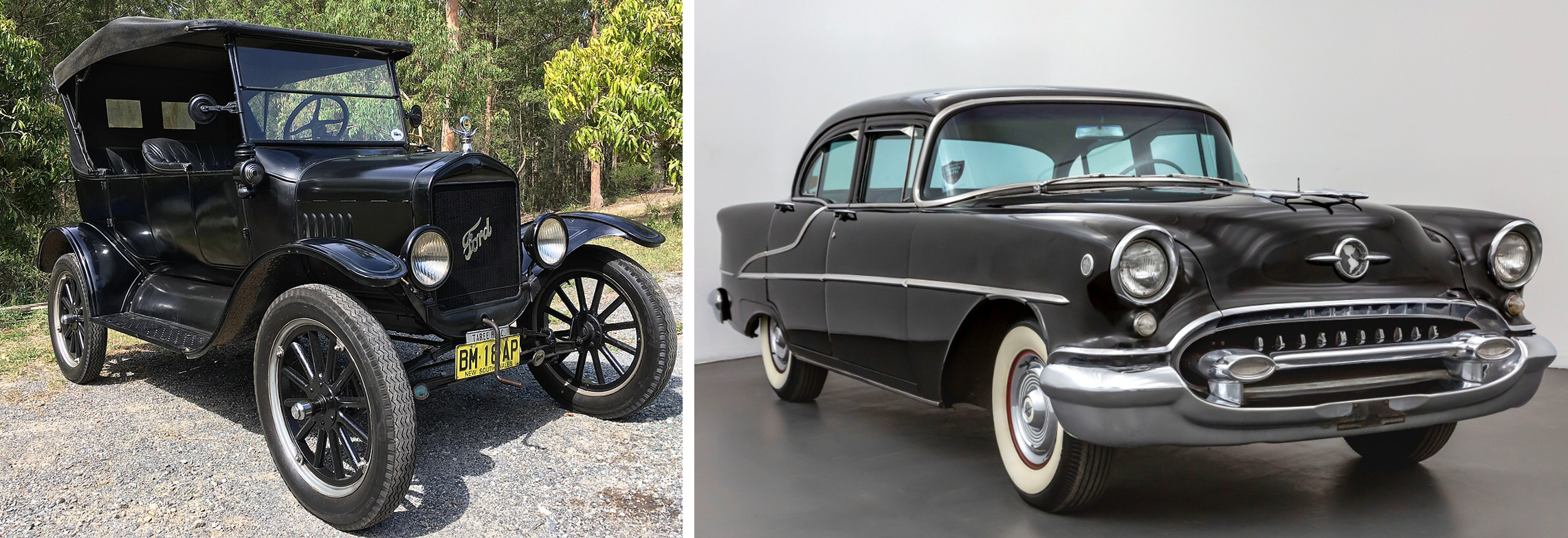
Look at a car from the 1920s, and compare it to one from the 1950s. An infant could tell you which looks more modern. But look at a car from the mid-1990s and compare it to something off the production line today... Does it really look more modern... or just different?

Below: thirty years of automotive design progress, 1925 to 1955.


Below: thirty years of automotive design progress, 1995 to 2025.


If I were to have my pick of the above four, I'd go for the 1955 Oldsmobile. And stay with it until the end of my life. Because I like its looks more than the more recent designs. One reason why the automotive industry has failed to prise any money out of my bank account over the past quarter century has been its inability to design a car I'd actually like. The crumpled-tin look of contemporary car design turns me off. Just look at the grotesque 'face' of the current Toyota Whatsit (above right). It looks like a whale feeding on krill.

Music, clothes, typography – has that much changed since 1995? The technology obviously is quite different, as is the political vibe. But visually, aurally, aesthetically, 1995 is far closer to today than 1955 was to 1925. Aesthetic change for the sake of aesthetic change – built-in obsolescence – is a driver of economic growth and a wasteful one at that. How can you possibly be seen to be driving a 1959 Cadillac in 1962, by which time the fins had shrunk and men wore pleatless slim-line pants and pork-pie hats rather than broad-brimmed trilbies and trousers featuring acres of pleated cloth. Just a few years, and what a difference. From Humphrey Bogart to Steve McQueen. Cool change. But what's changed in men's fashions since the mid-1990s?

One of the first films I watched on my own in the cinema (and the first film I bought on DVD) was American Graffiti (George Lucas, 1973). A film that wallows in nostalgia – the music, the fashion, the trends, the cars – from an era just ten years before it was shot. Do you feel nostalgic about 2015? I could name you a hundred songs from 1975, for example, but not one from 2015. Did we wear different clothes in 2015? Did people go around with different hairstyles?

Access to the tools of design was once hard-won; a draughtsman's drawing board and all the instruments needed to turn a concept into a sketch into plans for a working prototype. Today, software makes possible professional-level design to anyone who has a desire and a knack to do so. The same with music, with movie-making, with any form of creative endeavour. The barriers of entry have fallen. Great, you may say. More democratic. No more closed shops. Everyone can now create.

But what's happened is that the long tail has stretched out towards infinity. A handful of titans dominate each industry at one end, while a vast number of creative people struggle for a handful of page views at the other end. Our blockbuster movies tend to be remakes or franchises, nothing new is breaking out of the underground. Yet surely somewhere in that long tail is a talent or talents that could launch an aesthetic movement to equal Art Nouveau or Art Deco, the New Look or Rock'n'Roll. But it's all too fragmented. That talent needs to be planted in a soil, in a social milieu, aesthetic change does not occur in a vacuum.

While I feel that humanity is indeed in a historical inflexion point, that seismic geopolitical and socio-economic change is afoot, I can't say the same about the arts and culture. Our attention spans, shortening year by year, flick to the default – "I'll stick to what I like". Kitten videos.

The Shock of the New? There are enough shocks out there already, thank you, without introducing any aesthetic shocks.

It will be interesting to return to this post in ten, twenty and thirty years' time. Is an aesthetic revolution around the corner? Or have we emerged out of a particularly creative period in human history, and now have nothing more than algorithm-generated mediocrity and AI slop to look forward to? Are paradigm shifts in aesthetic sensibility caused by the supply side (gifted innovators) or by the demand side (society bored of the old and itching for something new) – or 100% of both? 

I was there in November 1976 when the Sex Pistols, supported by the Clash, visited Coventry with the Anarchy tour. That was one of those aesthetic tipping points. I wait for something similar.

This time two years ago:
Wałbrzych, Książ and Riese


This time 11 years ago:
How the other half lives - a Radomite's tale

This time 12 years ago:
On guard against complacency

This time 13 years ago:
Ready but not open - footbridge over Puławska

This time 14 years ago:
Dusk along the Vistula

This time 15 years ago:
Mediterranean Kraków

This time 15 years ago:
Around Wisełka, Most Łazienkowski, Wilanowska by night

This time 16 years ago:
Summer storms

This time 18 years ago:
Golden time of day

Monday, 22 July 2024

Łódź for the Weekend

Back to Łódź for the fourth time this year (the first three times were on business). A mere one hour and 20 minutes by train from Warsaw*, the city has much to see and I can highly recommend it for a weekend break. Over the quarter-century since my first visits to Łódź, it has improved like no other Polish city, having dragged itself up from a depressed, grey, crumbling place, full of people without hope. [See my impressions from 2011 here to see how much has changed.] Today, a dynamic tourist attraction, a booming economy, a city in a continual state of reinvention. 

Łódź's renaissance was driven by the city's authorities on a mission to rebuild a city that had been built on textiles into one with a broad and deep economic base – foreign investment in manufacturing, FMCG and shared services, the creative arts, IT and tourism. A virtuous spiral was initiated; new investments, new jobs, local taxes, renovation, gentrification, more investment, falling unemployment, more jobs, more visitors – it's been going well. 

At least Łodź never had to rebuild itself from the ashes of war. Other than the complete destruction of the city's synagogues by the Germans in WW2, the vast bulk of its architectural treasures survived unscathed, scarred only by time and neglect.

Below: the north end of ulica Piotrkowska, the main north-south axis around which the city arose. At 4.2 kilometres (2.6 miles) in length, ul. Piotrkowska is one of Europe's longest shopping streets. Subtle changes in character, from small shops to a preponderance of bars, cafes and restaurants, and then small shops again, ensure the street's variety. It has been pedestrianised for most of its length; electric delivery bicycles, however, hurtle past in near-silence at frightening speeds.


Below: corner of ul. Piotrkowska and ul. Zielona. Europe – but south, west, north or east? Or as centrally European as you can get? I'd say the east predominates in the typical 19th century architectural styles that Łódź shows off.


Left: Piotrkowska 86, the Gutenberg mansion, with its eclectic mix of Neogothic, Baroque and Art Nouveau styles, historically home to the editorial offices of local Jewish, then German newspapers. Renovated in 2011.

Below: OFF Piotrowska, a mixed-use development in the former cotton mill built in 1889 for German-Catholic entrepreneur Franciszek Ramisch. Nationalised by the communists in 1945, the factory went bankrupt in 1990, and in 2014 it was converted into what it is today: one of Łódź's more famous attractions. As well as bars, cafes, restaurants, showrooms, night clubs, barber shops and rehearsal spaces, there are lofts where fashion designers and architects operate. 

A major project about which I've written here before is the railway tunnel under the city centre that will turn the current terminus station, Łódź Fabryczna, into a city-centre hub, as trains will be able to pass through from Łódź Kaliska station to the west right through the heart of the city. Currently, trains passing through Łódź stop at Łódź Widzew station, 5.4km from the centre.

In the meanwhile, the city is doing itself up, tenement by tenement. On any given street, shabby buildings covered with nets to protect passers-by from falling stucco stand next door to beautifully restored mansions. The process will take time, but a critical mass has already been reached; tourists have started to come. From Gdańsk, from Poznań, from Warsaw they come, "but not so many from Kraków," said the waiter in an OFF Piotrkowska cafe. Gentrification is under way. The tipping point will make it easier. There's much to see, but once the city's all properly done up, Łódź will truly shine.

Left: the Leopold Kindermann villa (1903), a gem of Art Nouveau architecture on ulica Wółczańska; romantic nationalism, a rejection of Russian influences – clear links to what was happening north of the Baltic at the time. Dour yet ornate.

Below: the neoclassical town hall at the top end of Piotrkowska, the first brick-and-stone edifice erected in Łódź, dates back to 1827, under the Russian partition. The town was only just beginning to grow; an administrative centre was needed. The building contained the meeting room for the town council, the police station and prison.


Left: the old town hall's facade, from Plac Wolności. In November 1914, it was damaged by a bomb dropped from a German plane; the next month, German forces occupied Łódź and stayed until the end of WW1, when the city became Polish. I won't say 'again', because its transformation from a small village to major manufacturing centre occurred under Tsarist administration.

Below: a reminder that not all of Łódź has been renovated. And yet, and yet. Look closely at the building and you'll see the words 'Acta est Fabula' and the name 'Fifi Zastrow'. This is an art installation referring to the 1930s and '40s Jewish-German actress, Fifi Zastrow, who played in the Jewish theatre in the Litzmannstadt ghetto. You can see her name above the middle window on the top floor. She survived the war, but had been subjected to medical experimentation by Nazi doctors. She lived the rest of her days in seclusion, mentally scarred. 'Acta est Fabula ('The play has ended') were the final words spoken in ancient Roman plays, before curtains were introduced to the theatre.

Below: beautifully renovated vintage tram, dating back to 1929, running through Łódź streets. Built in Sanok, the tram is in the original livery of the Kolej Elektryczna Łódzka (KEŁ) – Łódź electric railway – which had been serving the city since 1899 under, variously, Russian, German, Polish, Nazi German administrations before communist Poland nationalised it. Łódź's trams run on narrow gauge (1,000mm) tracks; visitors will notice that the trams rock and sway more than standard gauge trams in most other cities. [Bydgoszcz, Toruń, Grudziądz and Elbląg also have narrow-gauge tram networks, but all four together total less than Łódź's extensive network.]


Tomorrow: the Importance of Izrael Poznański

* In 2008, the fastest InterCity trains between Warsaw and Łódź made the journey in two hours and 24 minutes; one hour and four minutes slower than today.

This time last year:
Wes Anderson's Asteroid City

This time two years ago: 
Quarter of a century in Poland

This time five years ago:
22 years on the 22nd

This time five year:
A tale of two orchards

This time seven years ago:
My 20 years in Poland

This time eight years ago:
PiS, Brexit, Trump and cognitive bias

This time 11 years ago:
Portmeirion, revisited, again
[My last summer holiday - not had one since!]

This time 12 years ago:
Beach day, Llyn Peninsula

This time 13 years ago:
Down with cars in city centres!

This time 14 years ago:
8am and 26C already

Tuesday, 21 May 2024

Szczecin in the morning

Early morning is the best time to visit. Before the rush hour. And so it was today; arriving in Szczecin at half past five, ahead of an event that started at 10am, I had lots of time for further exploration. Other than two brief trips in 1995 and another in 2016, it's only been recently that I've had the time to get to know the centre of Szczecin well. And the quickest and best way to get to know any place well is on foot. And without too much boasting, I'd add that my knowledge of the city is vastly greater than the typical Pole's, as most of whom have never visited Szczecin – and more's the pity - there's much to see.

My sightseeing yesterday focused on the waterfront and the Oder river boulevards, which I've not previously seen.

Below: seen in dawn's light from the railway station, the Szczecin skyline looking towards the ports.


Below: half an hour later and nearer the port; a skyline of wires, towers and cranes.


Below: Szczecin goes to work. The vehicle in the foreground is a regular bus rather than a trolleybus, but it sharing the tram stop, rather as in Warsaw along aleja Solidarności. In the background, Szczecin Cathedral, dating back to the 12th century.

Below: the 'Red Town Hall' – or new town hall – this one was built in 1879 to replace a smaller building; today it's home to the Maritime Office and Inland Navigation Office, the city hall itself is located in an even bigger building (that from 1933 to 1945 served as the headquarters of the local branch of the NSDAP).


Below: the 'Bastion of the Seven Coats', rebuilt after WW2 in its original form (cylindrical rather than octagonal). The name come from a legend of a tailor, who had been asked to sew seven coats for a princess. He stole some of the material to make his wife a coat too – and for this he was imprisoned in the bastion. It has been allowed to become overgrown with ivy in recent years
 

Below: the half-kilometer-long Chrobry Embankment (Wał Chrobrego), built along the river's escarpment, completed in 1921. Originally named after Stettin's late mayor, Hermann Haken, it was renamed after Poland's first crowned monarch, Bolesław Chrobry (968-1025), son of Mieszko I, first ruler of a unified Polish state. The return to Poland after 1945 of territory up to the Oder and Neisse rivers was followed by a re-naming of many geographical places after the Piast dynasty (of whom Mieszko I was the first). Under the Piasts, Poland extend this far west.


Below: the building of the national museum in Szczecin, which dates from 1913; it was built to house the city's museum.


The national museum building is flanked on either side by a pair of rotundas. Below: this is the one to the left of the museum building (as seen from the front); the other one, its architectural mirror, houses a coffee shop. 


Below: at the north end of the boulevard, beyond the national museum lies the office of the West Pomerania voivodship office.  It's now around half past seven, and a large queue is already forming outside; mostly women, some older men – Ukrainians legalising their stay in Szczecin.


Left: look closely at its weathervane; N-O-S-W – Nord, Ost, Süd, West. Before the war, the building served in a similar role as a German regional administrative headquarters. 

A magnificent maritime structure with lookout tower, observation gallery, and beneath the weathervane, there used to be a time-ball that dropped at midday, so mariners could set their chronometers. [To this day, a time-ball clock is still in use in Edinburgh]

After the conference, I return to Szczecin Główny station. Not, I must add, to catch a train back to Warsaw, no – for the next train from here to Warsaw departs at 22:56. (Would you believe there's not a single direct train for Warsaw from Szczecin between 12:29 and 22:56?) However, I will be on that 22:56 train – except I will have boarded it in Świnoujście where it starts its journey from. More about that in the next post. Below: a local train belonging to Deutsche Bahn, about to set off for Lübeck Hauptbahnhof. Incidentally, the Hanseatic port city of Lübeck, formerly Liubice, was originally a Slavic town, despite lying nearer to Denmark than to the current Polish border. The retaining wall and the building atop it have a Bricktorian Britain vibe to them!


A big thanks to my hosts, the kind folks from Agencja Rozwoju Metropolii Szczecińskiej, in particular for the book Szczecin krok po kroku by Małgorzata Duda, illustrated by Edyta Przystupa, from which I gathered much information about the places I'd visited earlier in the day. A lovely book that I recommend whether you've been to Szczecin or not – yet!


This time five years ago:
Electric cars for hire by the minute

This time eight years ago:
Mszczonów - another railway junction

This time 12 years ago:
The Devil is in Doubt - short story, part I

This time 13 years ago:
Stormclouds are raging all around my door

This time 14 years ago:
Floods endanger Warsaw

This time 15 years ago:
Coal line rarity

Wednesday, 1 May 2024

Prague, Central Europe (2)

Two days and three nights in Prague, so many photos; here's the next batch. I'll start with a view that is most associated with the city; Hradčany castle, as seen from across the Vltava river. The scale, the magnificence of this complex of castle, palace and cathedral, is hard to match.

Below: rather like London's Routemaster bus, Prague's Tatra T3 trams (built by ČKD Tatra between 1960 and 1989) are kept running because tourists love them. And they are reliable. Their one drawback is lack of low-floor access, though modernised three-unit versions have a new low-floor centre section. Warsaw retired its fleet of Konstal 13N trams of similar vintage at the end of 2012.  

Below: a better form of transport for the well-heeled tourist, certainly one up on a horse-drawn carriage – a Škoda Felicia Super (1962-65). The 'Super' differed from the Škoda Felicia (1959-1962) by the bolt-on tailfins and a more powerful 1.2-litre engine. Although designed for five, actually carrying such a load is exerting undue pressure on the rear suspension!

Below: an even more unusual form of transportation that's largely disappeared from the world's cities is the paternoster lift. Named after the movement of rosary beads, this type of elevator moves non-stop, and careless users may suffer a gruesome fate. The accident rate for these is 30 times higher than with normal lifts. Carrying only two persons per platform, the wait for the next one is never long, but you need to judge getting on and getting off – timing is all. After Germany, Czechia is home to the largest number of paternosters in the world. Prague alone has four. (4. patro = IV piętro = 4th floor)

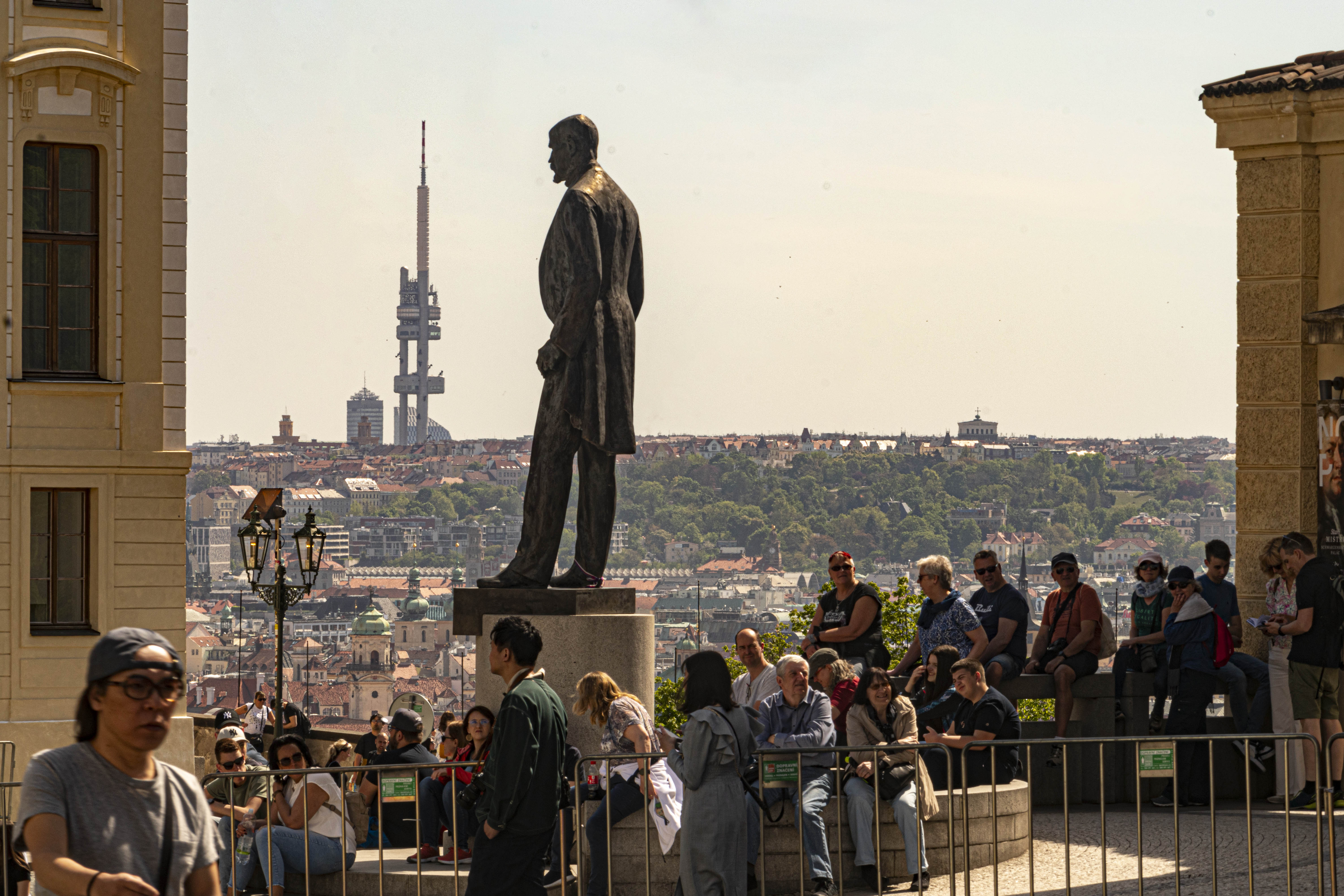
Below: view of the Prague suburb of Žižkov and its TV tower, as seen from Vitkov hill. Note the complete lack of high-rise blocks of flats; as far as the eye can see, the architecture is mainly 19th and early 20th century. This makes the boulevards, streets and squares of Prague's inner suburbs most attractive; and tourists tend not to stray out that far.

Below: statue of Jan Žižka, leader of the Hussite army (proto-Protestants) who defeated a Catholic crusade against them in 1420. The equestrian statue, one of the largest in the world, is central to the National Monument on Vitkov Hill, an inter-war complex celebrating the rebirth of Czechoslovak statehood. 


Left: the Žižkov TV tower, like any newcomer to a city's skyline, it is becoming increasingly accepted as decades pass. Work started in 1985 and was completed in 1992. It stands 216m (709ft) tall, so not quite as high as Warsaw's Palace of Culture (231m), but being on top of a hill it is just as prominent. An artefact of the late-communist era, this example of high-tech architecture has become the more iconic since the ten crawling babies (with barcodes for faces) by Czech artist David Černý were added in 2000. The current ones date from 2017 and weigh quarter of a tonne a piece.

Below: atop Hradčany castle, one of several epicentres of tourist magnetism. The monument is to Tomáš Garrigue Masaryk (1850 –1937) progressive political activist and philosopher who served as the first president of Czechoslovakia from 1918 to 1935. The Žižkov TV tower once again dominates the skyline.


This time last year:
Under azure, Jakubowizna

This time two years ago: 

Łady roadworks

This time three years:
S7 extension works

This time four years ago:

This time five years ago:

This time six years ago:
New roads and rails

This time seven years ago:
The Gold Train shoot - lessons learned

This time eight years ago:
The Network vs The Hierarchy in politics

This time nine years ago:
45 years under one roof

This time ten years ago:
Digbeth, Birmingham 5

This time 11 years ago:
Still months away from the opening of the S2/S79 

This time 12 years ago: 
Looking at progress along the S79  

This time 14 years ago:
Two Polands

This time 15 years ago:
A delightful weekend in the country

This time 16 years ago:
The dismantling of the Rampa

This time 17 years ago:
Flag day

Wednesday, 13 December 2023

Mixed impressions from Zielona Góra

I have mixed feelings about Zielona Góra, which with Gorzów Wielkopolski, is one of the twin capitals of the Lubuskie province. From the time of the administrative reform of 1999, Lubuskie and Opolskie made little sense to me, neither historically, geographically or logically. (About Opolskie I wrote here). It seemed the Polish legislators, who had been working on this reform for the best part of a decade, didn't want to return to the Stalin-era administrative split (14 voivodships), and party-political horse-trading ended up creating a further two. Opole was a sop to Poland's German minority. Living too far east to qualify for wholesale deportation, to this day around a fifth of the voivodship's population self-identifies as German (i.e. having German as their first language). So I can kind of see that.

But Lubuskie is weird. It has two capitals, Zielona Góra, where the elected provincial authority meets, and Gorzów Wielkopolski, seat of the centrally-appointed provincial governor. Note the name - Gorzów Wielkopolski, suggesting it's proper place is neighbouring Wielkopolska voivodship. Also, I'm sure many foreigners are confused by one province of Poland called Lubelskie in the east and another called Lubuskie in the west of the country. Lubelskie is named after Lublin (pop. 330,000) - Polish as far back as history records, a royal city of the Crown Kingdom of Poland. But Lubuskie is named after Lubusz or Lebus across the Oder River in Brandenburg. Lebus/Lubusz is a German town with a population 100 times smaller than Lublin's. So why Lubuskie province even exists is a mystery to me, unless the answer is indeed some sort of compromise that results from political horse-trading.

Anyway - Zielona Góra. Founded by the Piast dynasty in the 13th century, it became part of Habsburg Bohemia in the 16th century, taken by Prussia in the 18th century, incorporated into Germany with unification in 1870 - and so it stayed until it was ceded to Poland in 1945. The bulk of the city centre consists of Germanic architecture from the 19th century, when the city was called Grünberg in Schlesien.

Today Zielona Góra has a population of around 140,000, making it Poland's 24th-largest city; if you lump the Katowice metropolitan area as one vast agglomeration (which it is) then Zielona Góra rises to 19th place. It is bigger than its rival Gorzów Wielkopolski (pop. 120,000 / Poland's 30th largest or 22nd with all those Silesian cities rolled into one). Yet other than a successful special economic zone, home to Patak's, Rajah and Blue Dragon sauces manufactured there by Associated British Food, Zielona Góra is not a foreign investment hotspot. There are no high-rise modern office buildings in which business-process outsourcing and shared-service centres thrive. The population of Zielona Góra and indeed the entire region are mainly descendants of Poles who had been ethnically cleansed - deported from their homes in what was pre-war eastern Poland. So – as in Szczecin, though close to the German border, there are few people here who speak German – something that foreign investors don't understand.

Because Grünberg in Schlesien surrendered to the Red Army without a fight, the city was spared widespread destruction, leaving its centre more or less untouched. And so, there is plenty of historic architecture. Some has been tastefully restored. Some is dilapidated – falling down. Some has merely been patched up, hanging on, awaiting more thoroughgoing modernisation.

Let me start with the town hall and market square – nicely done, nicely maintained. Zielona Góra offers some interesting shops – ones that in most Polish cities have been done for by specialist e-retailers. I like shops run by their owners; their wares are likely to be more interesting and diverse that in corporate chain-stores.

Below: the actual town hall – the Urząd Miasta - from which Zielona Góra is run.

Below: just outside the main station stands the Hotel Retro*** – a wonderfully European structure. Interwar, I'd guess, a regular haunt of mitteleuropäisches commercial travellers with their suitcases full of samples and wares.

Below: the Nysa cinema on Aleja Niepodległości. In the foreground, a statue to local speedway legend, Andrzej Huszcza. Speedway is big in Zielona Góra – the local team being Falubaz (named after the now-defunct cotton-carding-machine manufacturer – FAbryka LUbuska BAwełnianych Zgrzeblarek).


Left: this is stereotypically German. Multi-story, individual, yet forming a contiguous body. These poniemieckie kamienice (post-German tenement houses), are solidly 19th century, without traces of fin-de-siècle Art Nouveau (or secesja) styling.

Below: today, as before the war, the region had some minor fame for viticulture. In this 19th century room in which we had our conference, the ceiling cornices show off the city's pride in growing grapes and making wine. It suggests that wine traders would have had a prominent position in local society.


The culture of the vine, connecting this region to Europe's pleasure-seeking south, rather than the dour, beer- and spirit-drinking north, is made much of in the city's marketing. Below: fragment of a fine mural near the old market.


Just as one of Wrocław's tourist draws is its army of brass gnomes dotted around the city centre, so Zielona Góra has adopted Bacchus - pot-bellied, spindly legged and garlanded, clutching a wine goblet and bunch of grapes. Brass figurines (such as the one on the left) are there to be tracked down and ticked off along the main tourist trail. This depiction of the Roman god (Dionysus in Greek mythology) suggests a rather down-to-earth relationship between Man and Alcohol.


Below: as in most cities, there's a right side and a wrong side of the tracks; in Grünberg in Schlesien/Zielona Góra, the right side lies to the south. And just to the north, ulica Towarowa ('Goods Street' or 'Cargo Street') is this building. The shop on the corner (open? closed?) is called 'Złoty Róg', which can mean 'Golden horn' or indeed 'Golden corner'. Orange VW van lends some much-needed colour to the scene.


Below: also on ul. Towarowa, a dental clinic. Judging by its location (facing the railway line) and its appearance, I'd guess this building originally fulfilled some function related to the transportation of goods. 


Left: uncovered pre-war German ghost signs are evidence that today's western Poland no longer has any hang-ups about history (I snapped some in Wrocław and Gliwice). Anfertignung von modern Küchen = Production of modern kitchens. Below: there are still eyesores like this in the city centre, suggesting a lack of profitable projects that could tempt developers.


Left: there are plentiful signs of rising civic pride. Unveiled this September, this sculpture, Generacje, by Oscar Zięta is about technology, generational change, and dreams come true. It is also about "research and development in the area of stainless-steel stabilisation". A shame I didn't see it on a sunny day!


Below: I double-take – a bus to Chynów? Why, that's 460km due east, via Leszno, Kalisz and Łęczyca... No, this Chynów is a suburb of Zielona Góra. However, take a look at the bus and the bus stop. A modern fleet, partially electrified, e-tickets available from your phone, proper electronic signage – a big plus in the city's favour.


Just outside the railway station is the clinic for railway workers (though the sign outside suggests that it's part of the national health fund). The top floor looks like a post-1945 addition. "Don't just put a new roof on that bombed-out building – add an extra story to it."


It didn't take too long to get back to Warsaw. Half an hour on a local train, the Gęsiarz ('goose-herd') to Zbąszynek and the Berlin-Warsaw main line, and now just over three hours back from there.

Despite the dismal December weather (a damp, overcast 10C) I enjoyed my visit to Zielona Góra – and as with Szczecin and Świnoujście, these cities are places that most Poles have never stepped foot in, but are certainly worth going to. Though I must say I was quite unimpressed by Gorzów Wielkopolski.

This time two years ago:
Frustration for the local wozidupek community

This time three years ago:
Small local milestones, Chynów station

This time four years ago:

This time six years ago:
Kick out against change - or accept it?

This time eight years ago:
Warwick University alumni meet in Warsaw

This time nine years ago:
Pluses and minuses of PKP InterCity

This time ten years ago:
When transportation breaks down

This time 15 years ago:
Full moon closest to Earth