Showing posts with label Warsaw exurbs. Show all posts

Tuesday, 30 May 2023

No longer the place to live

Twenty years ago, life in Jeziorki was sweet - an ideal place to live, close enough to travel to work in central Warsaw every day, to be in the office by nine am, yet a quiet, green area. Quite the place to raise children. Since then, 'Zielony Ursynów' ('Green Ursynów' - the part of the Warsaw district of Ursynów lying to the west of ulica Puławska and the Las Kabacki forest) had been developing slowly, but that pace has accelerated rapidly in recent years.

The opening of the S7 extension (to Lesznowola last August, and all the way to Grójec last month, thus linking the northern and southern bits of the S7) has vastly increased the amount of traffic pouring through Jeziorki. 

Below: ulica Karczunkowska, peak morning rush hour. See where that tanker is in the middle of the photo - on either side of the road, you will see... no pavement. Traffic is up maybe tenfold, maybe more, but there is still no f*cking pavement. This road is not scheduled for an upgrade until 2026. Meanwhile, there is a vastly greater risk of pedestrians or cyclists being killed or injured along this stretch, not to mention the extra noise and pollution. Just behind that tanker is the junction with ul. Nawłocka (to the left), and access to the Biedronka supermarket and W-wa Jeziorki Park+Ride (to the right). Trying to turn into Karczunkowska is a nightmare, so the local residents have petitioned for a roundabout to be placed here - I hope it happens, as it will have the additional benefit of slowing down traffic as it comes charging down from the viaduct. Reminder - the speed limit here is 50km/h.


That's just the through traffic. Jeziorki is also growing organically, with developers moving in to build new estates. A new house generates one and half new cars for the neighbourhood. Below: land for sale, Jeziorki - 2.1 hectares, enough to build 24 to 30 terraced houses; once sold and developed, another 36 to 45 new cars for ul. Trombity. They paved paradise, put up a parking lot.


Below: one of four new estates on ul. Trombity, this one of ten houses, just completed, and up for sale. 


Talking of through traffic - I feel very sorry for the residents of ul. Pozytywki and ul. Cymbalistów; these two roads are used as rat-runs by motorists wanting to avoid the traffic lights at the end of ul. Karczunkowska to turn right towards Mysiadło, Nowa Iwiczna, Piaseczno and all points south. Despite the 30km/h speed limit, there's a constant stream of cars charging down these streets, heedless of the speed-bumps, tearing past the kindergarten and the new housing estate on Cymbalistów. The answer here is to create a Woonerf - the Dutch solution to the problem of through traffic tearing through quiet residential areas. My solution - the działka, 26km to the south, 24 minutes by train from W-wa Jeziorki to Chynów. From Chynów station I can walk to the działka without fear, often without being passed by a single car. And above all, peace, quiet, clean country air*.

Below: elegy for a lost suburb - Karczunkowska in 2007, five years after we moved to Jeziorki, 12 years before the viaduct crossed the tracks, 16 years before the S7 extension was completed. This is the reverse angle of the shot in the top photo. As busy as it got back then, I had to wait a bit to get the cars into the composition.

The inexorable lava flow of development will take time to reach Jakubowizna; it is happening. Three new houses have appeared on my street since I bought the działka in 2017, but each one is detached, and two of them are bungalows. I cannot see the same kind of development that blights Jeziorki - or worse, Zgorzała, Zamienie and Nowa Wola on the other side of Warsaw's city limits - whole fields being turned into row after row of terraced houses with no asphalt or amenities.

* Country air pollutants: diesel fumes from tractors, chemicals used to spray orchards, and smoke from wood- or coal-fired domestic heating. But at least there's a thousand times less traffic on the roads.


This time last year:
Textures of Childhood

This time two years ago:
Stupendous sunset, Sułkowice

This time seven years ago:
Politics - the importance of fact.

This time eight years ago:
Rural Mazovian toponyms

This time nine years ago:
Carrying the weight on both shoulders

This time ten years ago:
Railway history - the big picture

This time 12 years ago:
A new lick of paint for W-wa Powiśle

This time 13 years ago:
The ingredients of success

Sunday, 16 October 2022

Cottagecore typology - a manifesto


[Third in a short series of posts, this one inspired by a conversation with Aga P]

Typology: "In planning and architecture, typology is the classification of characteristics found in buildings and places, according to their association with different categories, such as intensity of development (from natural or rural to highly urban), degrees of formality, and school of thought (for example, modernist or traditional). Individual characteristics form patterns. Patterns relate elements hierarchically across physical scales (from small details to large systems)" - from Wikipedia.

In writing about my ongoing move to a more rural environment, I would like to expand upon the 'why' and the 'where' and how this could be part of a trend that reshapes the way we live. A way of life that rebalances human priorities.

Where

I started looking for a place outside the capital's economic orbit. Beyond the exurbs, beyond what is normally considered commuterland. Two and only two criteria mattered, and mattered equally. One - I had to fall in love with the landscape, the spirit of place. Two - it had to be within easy reach by train to the centre of Warsaw.

Spirit of place is crucial to me - I am highly sensitive to it, to the lie of the land, how it changes across the seasons. I spent three years to November 2017 scouting for a place that would appeal to my emotions. I feel that suburban life in Jeziorki has reached a tipping point - traffic has become unacceptably heavy now that the S7 extension runs through, bisecting my rambles across fields that are in any case filling up with new housing developments and logistics centres. Yearning for peace and quiet beyond the farthest fringes of Warsaw, I began my search.

I found what I was after in Jakubowizna, surrounded by apple orchards and pine-and-beechwood forests, a gently undulating landscape on sandy soil that reminded me of two favourite places from childhood, Oxshott Common, Surrey, and Stella-Plage in northern France.

Proximity to the railway line is key. On Thursday, after our big gala dinner, I left the centre of Warsaw, catching the last train from W-wa Śródmieście to Chynów at 23:34 to be back on my działka at 00:45. An entirely acceptable witching hour. 

Now, W-wa Jeziorki is around halfway from the city centre and Chynów (nine stations from Śródmieście to Jeziorki, eight stations from Jeziorki to Chynów). My search for a działka began closer to home - around Ustanówek, four stations from Jeziorki. Yet the spirit of place at Ustanówek failed to click with me. It's a hugely personal thing, this. You can aesthetically prefer one road home to another, parallel road, choosing it even though it's slightly longer. The lie of the land, the effect a given landscape has on our consciousness, is hard to quantify - but I feel it. It's about wanting to be there. There is a spiritual aspect to this, metaphysical almost - that sense of atavistic familiarity and preference. And it was around Chynów that I deeply felt that sense of place. "All that's missing is the sea" - or indeed any water feature (the Vistula is 10km from my działka - too far for a casual stroll there and back, there are no lakes or even ponds nearby). That's the only aesthetic drawback for me - not a major one. Otherwise - here's a place I won't get bored of, and that's unlikely to be drowned by a wave of development as Warsaw inexorably spreads outward.

How

This is not a return to the land. This is not even the move of a suburban child to the countryside of his father - for my father grew up within a mile and half of the centre of Warsaw. If anything, this is a move to the countryside of my paternal grandmother, who was born some 20 miles south-west from Chynów. 

This is a move enabled by technology. Without the 'information superhighway' (as today's online world was first envisaged), I would not be here in Jakubowizna. In daily life, I am instantly connected to the global pulse; I do 90% of my work online (if I don't have to have a physical meeting I won't); I have typically around ten Teams or Zoom or Skype calls a week. I am in touch, up to date, despite being far from the urban centre. This is revolutionary; I have spent nearly all of my life (with the exception of four student years) within ten miles of a capital city, and have commuted into to its centre every working day for 40 years. Until the pandemic - and that sudden realisation that for many categories of work, physical presence is not a prerequisite. And now - time to take stock.

The online world has transformed many aspects of human life, but the geographic transformation effect will be enormous. Distance no longer has meaning. Full-remote workers take their laptops to the Canary Islands or Tenerife and work from there. For those not tied to a factory, building site or surgery, service-sector work has been liberated from the tyranny of having to show up at the office from nine to five, Monday to Friday.

A crucial aspect of life on the działka is my regular walk to Chynów and back to buy food. Shopping at Top Market means buying what I can carry (in practice up to 11kg in my rucksack). It's a five-kilometre round trip, so there's no food waste, as I don't like carrying stuff all that way that will end up as compost. This means planning meals, keeping tabs on what's in stock, what's about to run out and what's urgently needed. Yes, I could ride into town on one of my motorbikes - but that's not the point. Walking 10,000 paces a day is central to my way of life, and the 8,000 paces or so to buy food is an intrinsic part of my lifestyle.

What

The minimum of house, the maximum of land. A big house means big maintenance and heating costs. So the answer is a small house, powered exclusively by solar-generated electricity. The eight panels (maximum power 3.4kWh) have been calculated to balance out over the year, giving enough power for light, hot water, oven, fridge, laptop, device chargers across the year plus heating from late September to early May. No gas other than an 11kg propane-butane cylinder for cooking. My house is connected to the sewage system, so there's no septic tank. Also important is the fact that my street is paved - I have asphalt all the way to the station, freedom from muddy feet.

Finally, the aesthetics of the land. Here, I'm going wild - literally. I am opposed to the petrol-powered lawnmower, chainsaw or leaf-blower. An entirely organic approach to gardening - let it grow. With the exception of the lawn immediately surrounding the house, the rest of the grassland is returning to meadow; new trees are sowing themselves, giving me the chance to decide which to leave and which to prune back or remove. Meadow means meadow flowers which means bees and butterflies in profusion. Longer grass, greenery, means I am allowing more photosynthesis to occur than had I kept a neatly-mowed lawn. We will all have to get used to this - unkempt gardens will develop as an aesthetic unto themselves.

Surrounded by trees, by nature, I have rebalanced to a calmer existence where focus on spiritual matters can be achieved more readily.

This time last year:
Ego, Consciousness and Soul

This time two years ago:
Samopoczucie, Joy and the Sublime Aesthetic

This time four years ago:
Autumn, with a railway theme

This time five years ago:
A few words about coincidence

This time eight years ago:
Hello, pork pie [my week-long pork-pie diet]

This time ten years ago:
The meaning of class - in England, in Poland

This time 11 years ago: 
First frost 

This time 15 years ago:
First frost 
[no frost forecast for at least the next seven days]

Saturday, 20 November 2021

Zamienie and Nowa Wola - changing fast

I learned early on that it makes little sense googling 'Zamienie' because the search engine ignores Polish diacritic marks and capital letters. As such, Google mistakes this Warsaw exurb with the word 'zamienię', which means 'I will exchange' or 'I will swap'. Or at least it used to. Indeed the first search result that appears on Google offers me an XBox 1S in exchange for an XBox 360. But the search engine has becoming cleverer in the intervening 20 years since I first tried looking for Zamienie online. The next two results are both links to the Wikipedia pages in English and Polish respectively for "Zamienie [zaˈmjɛɲɛ], a village in the administrative district of Gmina Lesznowola, within Piaseczno County, Masovian Voivodship, in east-central Poland." And only then do we get back to the small ads: "Swap BMW E36 for a motorbike."

While local residents wait for the new footbridge to connect Zamienie to Jeziorki and thus to Warsaw, I take a stroll to see the latest development, heading down towards Nowa Wola, before returning via Nowa Iwiczna and Mysiadło to Jeziorki.

Below: emblem of the old Zamienie, the remains of what was once a dwór - a landed estate with outbuildings in parkland; nationalised after WW2, turned into a vaccine plant, sold in the early years of this century, now partially abandoned, on its fringes new housing developments are rapidly springing up.


Highways running through communities split them apart; mentally, Zamienie will become 'across the S7' in the mind-maps of Jeziorki residents, more remote. Below: completion of the S7 is but one winter away. Local motor traffic will soon be directed across the viaduct in the distance, while pedestrians will have no alternative but to use the footbridge which is being built immediately behind this viewpoint.

And in Zamienie, just outside Warsaw's borders - new blocks of flats, below. I wonder what the attraction is. Surely it's better to live in a flat in Warsaw proper, in a suburb like Ursynów or Gocław, well connected to the city centre by public transport, and forego car ownership?

I walk through Zamienie, crossing ulica Raszyńska to reach Nowa Wola, a village that's turning into an full-blown exurb as new housing developments take over from fields. At least the infrastructure is catching up. Ul. Płonowa (lit. 'crop street', below) is no longer full of crops, but it is now asphalted from end to end. And it is busy, being the only way in or out of this development of new estates (with a further three under construction). But where are the shops?

If there's a new Nowa Wola, there's also the old one, strung out in typical Polish-village fashion along one road (ul. Krasickiego), which runs into Piaseczno via Nowa Iwiczna. Traditional rural housing.


Marian shrines along ul. Krasickiego speak of local devotion to the Blessed Virgin Mary. The one to the left is on the corner of ul. Płonowa, the one on the right is on the corner of ul. Postępu.


Nowa Wola has a fair-sized pond, an attractive water feature when all around is flat fields. Across the water looking east is the local voluntary fire service (OSP) station.


Below: looking north across the pond towards ul. Krasickiego. A nicely maintained park with exercise equipment and swings. I fear this pocket of rural quiet will soon be subsumed to the roll-out of exurbia as further estates spring up in nearby fields. And the roar of the S7 extension, muffled and hidden by acoustic screens, will remind residents that they have been cut off from Nowa Iwiczna to the east.


Here it is - the march of progress. Four-story townhouses emerging from fields once full of cabbage, carrot or potato. High-tension power lines strung out across the sky. Before too long, this will all be housing. But will there be the local amenities - the shops, cafes, restaurants? Public transport?


Back in Jeziorki, the fields between Mysiadło and ul. Karczunkowska. I fear these too will be filled with new homes before too very long. It is a sobering thought that the same percentage of Poles (68%) live in Poland's towns and cities as British people lived in British towns and cities 150 years ago, according to the census of 1871, when 32% of the population was still rural - as in Poland today. There's still much urbanisation ahead for Poland - and I fear that this is where it will be happening.


16,000 paces (12.8km) walked today - I made the most of the weather. Rubbish yesterday, rubbish tomorrow.

This time two years ago:
My father's last (written) words

This time four years ago:
Kolej Grójecka

This time six years ago:
PIS, thinking wishfully about the village

This time eight years ago:
An unseasonably warm autumn in Warsaw

This time nine years ago:
Shedding light on an unused road

This time ten years ago:
S2-S79 Elka from the air 

This time 11 years ago:
Fish and chips in Warsaw

This time 12 years ago:
Spirit of place - anomalous familiarity moments 

Sunday, 20 December 2020

A symbolic collapse

My daily walks involve various routes centred on Jeziorki, heading off on different compass points each day to avoid monotony. Today I headed south-west; crossing the tracks to ulica Gogolińska to pop by Zgorzała before checking the stretch of the S7 extention between Zgorzała and Zamienie. On my way, just across Warsaw's southernmost borders, I passed the hunters' stand (in Polish ambona, literally pulpit), which to my surprise is no longer upright. Was it brought down with or without Man's agency? If with - is this the work of hunt saboteurs? Landowners looking to clear space for new development? The result of a well-attended party involving grubasy and tłuste kiełbasy? Or did it just collapse on its own as a result of rotting timbers and neglect, aided by a strong southeasterly wind? 


My suspicion is that it just collapsed. Compared to other hunters' stands I have seen, this one was rather shoddily built, and on my visits up top, I didn't spy any sign of human presence - either hunters, or teenagers or local devotees of feldalkohol. 


Since the development of the fields between ul. Gogolińska and ul. Postępu in Zgorzała, wildlife has moved on, some up to Jeziorki and its lakelands, the majority no doubt in the opposite direction, further away from Warsaw, towards Lesznowola and beyond. I have seen hare, deer and wild boar around here, the former being most common. Those that remain will no longer need to worry about being blasted by hunters. Below: the stand as it looked in May.


Its collapse is sad; it stood as a relic of an earlier age, when Warsaw ended abruptly and where rural life began. Today, beyond its boundary, the exurbs continue marching outward, swallowing peripheral towns like Piaseczno and Pruszków and Otwock as the sprawl develops.

Hunting gives way to dog-walking, and I must say, I'm rather glad.

This time six years ago:

Wednesday, 11 November 2020

Zamienie is changing

It's been a while since I last visited Zamienie, much has changed. The threat of a new distribution centre that would have seen hundreds of trucks rolling through has lifted - in its place will be something called 'KampusPlus', which will emerge behind the chipboard fencing to the left in the photo below. A Żabka convenience store offers some retail opportunities to shoppers that have newly moved in. Skips are full of cardboard boxes that once contained fridges, cookers and flat-pack furniture.


In the fields full of poppies that gave their name to Osiedle Polnych Maków ('estate of the poppies of the fields'), the campus, a mixed-purpose development led by the Politechnika Warszawska, will appear. The street leading up to it is named after Thomas Alva Edison. This is no longer Warsaw; this is part of the gmina (municipality) of Lesznowola. So Warsaw's city authorities don't have to give a stuff about how many new estates get built here, or how the people living here should get into and out of the city centre.


Below: cryptographer Jerzy Różycki, one of the Polish team that cracked the original Enigma code is commemorated in the name of this new street, running off ul. Arakowa.


The new bits of Zamienie are architectually more attractive and more functional than the earlier blocks, like this one below on ul Waniliowa ('Vanilla Street' - metaphorically too). Estate agents outnumber food shops. Note the cars. Zamienie is served by just two bus routes, the 715 and 809, the bus stop being almost a kilometre from this point. And W-wa Jeziorki railway station is over 2km from here (a whole kilometre further than my house across on the other side of the railway line in Warsaw, in Jeziorki).


And so most households have to be two-car families. This, below, is ul. Arakowa and the Osiedle Polnych Maków, completed in 2009. Some of the houses have been occupied for over a decade. Note: there's no pavement. The drives outside these terraced houses lead to garages big enough for a VW Polo circa 2004, but way too small for a modern SUV. So one car's parked on the drive, the other outside. Nowhere for pedestrians to walk. So pedestrians have to brave the street. Mums with baby buggies. Shit planning. All the shittier when the extra traffic associated with the KampusPlus - first the construction plant, then the thousands of workers - start driving down this way.


You can see the problem in this photo, below. Too big car. Teensy-weensy garages. Now, I don't know the individual circumstances of these folk, but I guess that owning two cars means you can't afford a house in Warsaw proper. How about dumping the big car and buying a house closer to public transport and to the amenities? Arguments about "it's nice to live among fields" cut no ice as the fields around here will soon be developed. Far from shops, far from schools, far from the city centre, wholly dependent on the car. There are just two junctions connecting the ever-growing Zamienie to the main road; early-morning rush hours must be hell for drivers trying to get out of here.


Things will improve once the S7 extension is complete. Below: looking down from a temporary hill of soil onto the new bridge that will link Jeziorki (on this side) with Dawidy Bankowe and Zamienie (on the other). The bridge should be wider than the viaduct over the railway line at W-wa Jeziorki station. So even if the traffic if flowing easier here, it will jam up once it gets around the corner.


How will Covid-19 affect where we chose to live? Will people trade the convenience, amenities and attractions of urban life for the lower population density of the far suburbs and exurbs? To early to say.


This time three years ago:
Globalisation in retreat

This time seven years ago:
Leeds, a city made uglier by crooked developers

This time eight years ag0:
Węzeł Lotnisko (now Węzeł W-wa Południe) - works continue

This time 13 years ago:
Its Independence Day

Saturday, 9 June 2018

Warsaw-Radom

I live in Jeziorki, a stop on the Warsaw-Radom railway line just within Warsaw's administrative borders. My bedroom overlooks a functioning arable farm, growing rye or oats. My nearest station, W-wa Jeziorki, is 18km from W-wa Śródmieście, Warsaw's main station for suburban lines. Further south, at Kilometre 42 from W-wa Śródmieście lies Chynów, the nearest station for my działka in nearby Jakubowizna. Beyond Chynów is Warka, at Km 56; the line continues single-track over a bridge that crosses the Pilica river, then onward to Radom, 102km from Warsaw.

Radom (pop. 220,000), is a city that Progress has not smiled upon. Unlike any other Polish city I've visited, it has no charm, no character, no direction, no idea how it is to develop. Łódź, another city where communist-era industry vanished in just a couple of years, now has unemployment at half of Radom's level. Łódź knows where it's going - it has done wonders in attracting inward investment, it has made a name for itself as a creative centre, and the ongoing refurbishment of its centre make it a city that people want to visit. Graduates of its universities are increasingly opting to stay in Łódź to work there (as indeed has my daughter).

But Radom, which underwent a similar implosion as Kalashnikovs and typewriters became less sought-after items, failed to reinvent itself. As a result, one in eight adults in Radom are registered as jobless, whereas in Warsaw it's one in fifty. So people from Radom and surrounding districts travel to Warsaw to find work; they come in large numbers, taking the train. The fastest time for the journey is just over two hours; the slowest train takes nearly two and half. The early-morning trains (two an hour, starting at 03:35) are full of sleeping people heading for Warsaw's insatiable labour market.

Yesterday, I took the 14:30 train from W-wa Śródmieście to Radom, alighting at Chynów to see how work on my działka is coming along. To my surprise, this mid-afternoon train was almost full as it left central Warsaw. By the time it stopped to pick up passengers at W-wa Służewiec ('Mordor Południowy'), the aisles and gangways were packed with people standing. I expected that much of this traffic would get off at Piaseczno, a dormitory suburb 23km south of W-wa Śródmieście. But I was wrong - more people got on the train than got off it (it was by now quarter past three). Piaseczno itself draws in labour from the south.

It was a jolly crowd. The weekend was here, the working week done. Many of my fellow passengers had come to Warsaw or Piaseczno to sell strawberries or cherries, and returning home with dozens of empty punnets; they were talking about prices, wholesale and retail, about the mushroom season. Others were office cleaners or canteen staff, working the early shift.

There was much cheerful banter, and because there was a mixture of women and men, the language  not too salty, nor did I see any drinking or smoking going on. This tends to occur in the back of the third and sixth carriages and front of the fourth carriage (of a six-car set, counting from the front), in the compartments for bicycles and oversized baggage. It is here that the inveterate smokers and drinkers congregate, to while away their two-hour plus journey home.

The drinking set tend to leave Warsaw later, mainly cash-in-hand builders from the many construction sites around the capital. Drinking on suburban electric trains puts me in mind of Venedikt Yerofeyev's 1970 prose-poem, Moscow-Petushki. However, the ready availability of vodka in małpi (100ml and 200ml bottles) and beers at 7%-9% abv means that Polish drunks do not have to make do with what Yerofeyev and his pals had to imbibe - cocktails of nail varnish, hair lacquer, brake fluid, insecticide and eau-de-cologne.

The time-honoured practice of the hard-drinking Radomites entering their compartment, shaking hands with all the other (male - for no females travel here) passengers - is coming to an end as the old EN57 rolling stock is being successively modernised. The refurbished EN57-AKM stock has no walls between that compartment and the rest of the carriage, which means that any smoke carries right through the train. CCTV cameras monitor passenger behaviour. The toilets are the only refuge for desperate smokers, but social pressure is slowly making this practice unacceptable.

Over the past six months or so, I have come to know the Radom line down as far as Chynów much better than before; the rhythm of life, the inexorable economic pull that Warsaw exerts beyond its outermost exurbs.

It's a hot afternoon, the train - an unmodernised EN57 set, has all its windows open in lieu of the air conditioning found on the newer EN57-AKM trains. It's pleasant. Less so in mid-winter, when the journey to town and home again takes place in darkness, passengers are carrying heavy coats and the temperature outside is well below zero.

A large woman, who had been dozing, asked whether we'd passed Warka yet, a landmark (half-way from Śródmieście to Radom). No, explained her neighbour, we're still half an hour from Warka. The journey is long.

Below: W-wa Wschodnia to Radom service calls at Chynów, 22 May 2018. Served by a six-car set, the front three being an early EN57 unit - the classic with three windows in front and the 'rippled' sides. There's still a handful of these on the Radom line, usually paired up with a newer units, like later, unmodernised EN57s with two windows in front and slab sides.


The lime-green, white and yellow livery looks resplendent against a cloudless sky.


This time three years ago:
Civilising Warsaw at the local level

This time four years ago:
Rustic retreat rained off

This time six years ago:
Thunderstorm over Jeziorki

This time seven years ago:
Getting lost on top of Łopień

This five nine years ago:
Regulatory absurdities in Poland

This time ten years ago:
Czachówek and Alignment

This time 11 years ago:
Joy, pain, sunshine, rain

Monday, 14 May 2018

Zamienie and Nowa Wola - unplanned exurbs

It's been a while since I last walked around these exurbs across the tracks - I went for a walk with Moni on Sunday to see how the largely unplanned development is sprawling out into fields that until recently were agricultural.

Below: these cranes are visible from ul. Dawidowska; this is a brand-new estate of flats going up in the grounds of the former vaccine plant in Zamienie. Address - ul. Waniliowa (lit. Vanilla Street). Moni asks what the point is of moving right out to the very edge of town to live in a flat rather than in a house with garden. Indeed.


Outside the old Zamienie complex, out in the fields, is the estate called Osiedle wśród pól (lit. 'Estate amid Fields'), complete with that phantom bus stop that appeared a year ago, still not served by any Warsaw bus route. From this point it is two an half kilometre walk (or 3km drive) to W-wa Jeziorki station. When the S7 extension is built, these new estates will effectively find themselves cut off from Jeziorki by a major expressway junction, Węzeł Zamienie.

When this development was started, it was indeed, an Estate amid the Fields. Very soon it will become an Estate amid Estates (Osiedle wsród osiedli). Doesn't sound so appealing.


Below: this is ul. Polna, Nowa Wola. No asphalt, a dirt track that's dusty in summer, muddy in late winter/early spring and in late autumn. And yet the car is literally the only way out of this place. We are 3.5km by foot/4km by car from W-wa Jeziorki station. Once the S7 has cut these houses off from the east, from the railway line, from the shops on Puławska, residents will find their lives seriously inconvenienced. The developers, no doubt, will deny all knowledge of plans to take the S7 south down to Grójec when they dreamed up this scheme. But the architecture I like, it puts me in mind of Taos, New Mexico in the mid-1950s.


Below: this neoclassical effort at the southern (asphalted) end of ul. Polna will pass without comment.


Below: an access road in what was the old Zamienie vaccine plant; bit by bit the old character is disappearing. Before long, the S7 will be roaring past, just a couple of hundred metres from here.


Warsaw's outward sprawl continues. Despite the availability of derelict land for building (post-industrial developments are happening close to the city centre), there's still an appetite among developers and buyers for facility-free estates in featureless fields just outside Warsaw's borders, where there are no zoning plans.

"Build it, and they will come?" Probably.

This time last year:
Long-term memory, awareness and identity

This time two years ago:
Language and politics

This time three years ago:
Trafalgar Square, then and now

This time five years ago:
GM's city car for Europe fails to wow me

This time six years ago:
A biblical sky

This time eight years ago:
The parable of the Iron-Filings Factory

This time 11 years ago:
Got to get ourselves back to the Garden

Sunday, 6 November 2016

Dawidy Bankowe, Łady, Zamienie and back

After two days during which I only managed around an average of 7,000 paces, a good long walk was in order. So I set off through Jeziorki, crossed the tracks and headed to Dawidy Bankowe, thence to Łady (pron. 'Wuddy') to hook round towards Zamienie and Zgorzała before returning home.

Below: ul. Miklaszewskiego snakes around from Dawidy Bankowe to Łady, taking a zigzag route. The road is narrow with hardened verges for passing.


I've commented many a time about how the flatness of the landscape and the overhead cables and wires give Warsaw's exurbs an American Mid-Western feel.


Below: further along ul. Miklaszewskiego, looking towards Łady. I get to the corner and turn left, into the fields.


Below: this is farming country. Many small fields lie fallow, but there are increasing numbers of larger, consolidated fields on which cabbage, potatoes, carrots and beetroots are grown. Sad to see, however, many potatoes dumped by the side of fields - maybe the wrong calibre for the demanding supermarkets. This field is in Łady.


The last few weeks have been very wet. This morning I was awakened by the sound of rain on the roof - which surprised me, as I'd checked the weather forecast on Meteo.pl before going to sleep - no rain was meant to fall today. The fields are sodden and this kind of walk can only be done in wellies.


Below: looking south-west towards Podolszyn and Janczewice on the horizon. It's around here that Warsaw gives up the ghost in trying to develop; it's still solidly agricultural, with pockets of exurbia like Lesznowola and Magdalenka between here and the deep Mazovian wieś that lies beyond.


Below: looking from the fields of Podolszyn towards Zamienie, and the new housing developments that have sprung up around the old BioMed vaccine plant that closed in 2004. The new streets are named after spices and flavourings; ul. Arakowa, ul. Waniliowa, ul. Bakaliowa, ul. Szafranowa, ul. Karmelowa.


Below: the white building is a block of flats, almost empty. If you're going to move out of town, you might as well live in a house. This development is not my cup of tea - neither architecturally, nor in terms of its town planning.


Below: the path that leads from the new housing estate into Zakłady Zamienie. Note the hexagonal paving slabs. Very little remains of the plant, to see it two years after it closed (in a scandalous state, given the biologically hazardous materials inside) click here.


Below: the abandoned checkpoint at the entrance, on ul. Zakładowa. A strange atmosphere pervades the place; to the west and north of it, new housing estates, but inside - silence, emptiness.


Below: the same checkpoint back in January 2009, five years after the vaccine plant had closed. There was still a guard on duty here.


Left: a drainage ditch runs right around Zamienie, like a moat. This is the section from ul. Dawidowska marking the southern boundary of Zakłady Zamienie. The house in the distance and everything to the left of the ditch lie in Zgorzała. Across ul. Dawidowska (behind me) are the Action and Pommier warehouses. One day, the S79 will be extended south this way.

Below: bonus shot from near the end of my walk - an EN57 electrical multiple unit - one of the increasingly rare unmodernised stock - approaches the 'up' platform at W-wa Jeziorki. To the left, you can see the new 'down' platform being built, and the gap that awaits the new 'down' track.


Good long walk achieved. Around 15,000 paces /12km/ eight miles.

This time five years ago:
Town planning and the Sublime Aesthetic

This time six years ago:
On the long road from Zero to One

This time seven years ago:
Łódź Rising

Saturday, 13 June 2015

Another long walk to Czachówek

Not a 03:50 start; this time I left home at 14:00, bound for Czachówek, on foot, a different, more direct way. It's hot and sunny, over 30C in the afternoon, and the stormclouds had yet to start building ahead of the heavy downpour that would hit Jeziorki 12 hours later.

But first, a word of warning. This is the prime season for ticks, and they are out in force this year. Ticks are nasty, evil little beings. They have adapted to drop from foliage onto passing mammals, and then suck their blood. And often as not, the ticks carry parasitic or bacterial diseases that all too easily enter the human bloodstream.

2015 is a boom year for ticks. Everyone says so. Pan Wiesław and his wife and dog went into the forest and came out to count 20 ticks upon themselves. Our cat Czester has brought back several this season, all dead thanks to his anti-tick collar.

So it's long sleeves, long trousers, long socks, stout shoes and a bush hat for me whenever I'm out and about in the countryside at this time of year, despite the heat. Below: here's a tick I found on my white shirtsleeve, between the elbow and the wrist (click to expand photo). It had not yet managed to make its way to my armpit (a favourite place for ticks to screw their snouts into human skin) or gorge itself on my blood. Light-coloured clothing makes it easier to find them when you emerge from the woods. Niepozorny, isn't it?


It's not just ticks you need to worry about in rural Mazovia at this time of year: adders are around too. You'll need to recognise the difference between an adder (poisonous) and a grass snake (non-poisonous). I came across three snakes on my walk, all were grass snakes. Two were road-kill, the third (below) looks like it had shed its skin on a railway sleeper.


Anyway, on to the walk. My route this week took me more directly south, following as close as I could to the Warsaw to Radom railway line. Jeziorki - Mysiadło - Nowa Iwiczna - Piaseczno, then on down to Zalesie Górne, Ustanówek and my destination. Below: the line crosses two rivers between Warsaw and Czachówek; the Jeziorka and the Zielona; this is the Jeziorka. It's 15:58. As I cross, I come across a group of students (at least 12 of them in six canoes) paddling eastwards towards the Vistula.


Onwards, south toward the sun. South of the Jeziorka, south of the level crossing at Żabieniec, a cobbled road leads to Zalesie Górne. Below: many cyclists are out and about; cycling on cobblestones not easy unless your bike has fat tyres and suspension. It's 16:21.


Just before Zalesie, at 16:31, I come across this courtyard containing two classic Polish-designed Żuk delivery vehicles (samochody dostawcze). In the background, smoke emerges from a chimney. Wędzarnia? 


At Zalesie Górne, I stop for a large lamb kebab na ostro w cienkim cieście. I've been walking for over two and half hours. At five pm, I get going again. I pass through Zalesie Górne, an exurb of działki and dworki many of which are getting a bit shabby; the owners seem to put a bigger store on owning a big new SUV than keeping their houses looking impressive. People who commute here to town by car each day must experience frustration and a sense of a life wasted (25km to Centrum via Piaseczno or 32km via Konstancin). Below: a life-size Tyrannosaurus Rex stands guardian to a house in Zalesie Górne. It's 17:37.


Onwards to my favourite bits. Having passed beyond Exurbia, Mazowsze shades into its rural self. Here I am, approaching Ustanówek. This stretch of road gives me those strong 1950s USA vibes. Below: it's 18:06 and a Radom-bound train heads south.


Further on down the road, across the level crossing and heading out of Ustanówek, towards my destination. It is 18:27, my train home's due in less than an hour (the one scheduled after this one, below).


Below: I enter the forest, which is criss-crossed with railway lines. To get to Czachówek Górny station I need to cross the north-to-east spur. This line is in the throes of maintenance; old rails badly hammered by heavy goods wagons are being replaced by new rails (lying between the tracks waiting to be installed). It is 18:57.


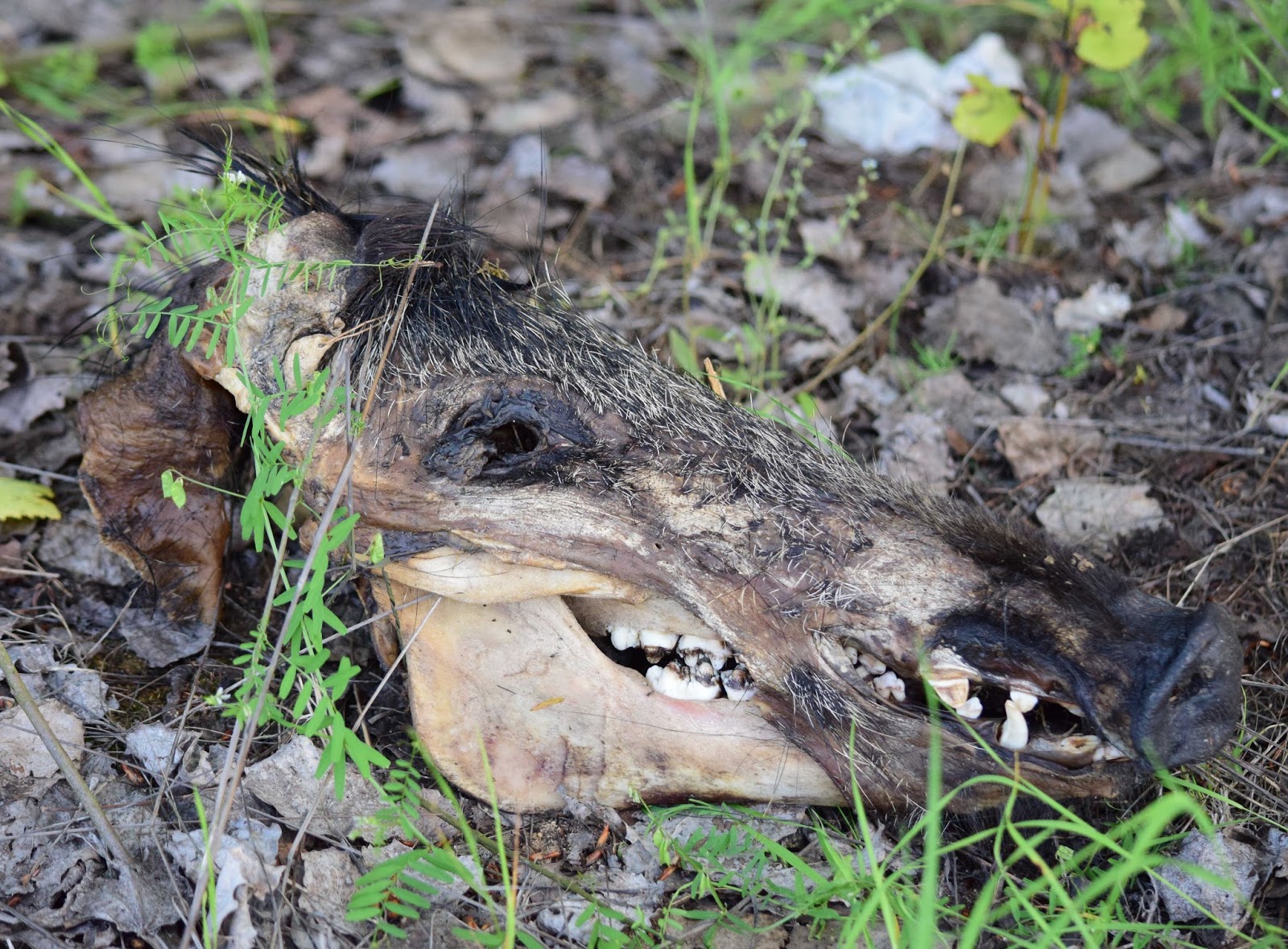
Into the trees. I scramble down the embankment and come across a boar's head, below. Not a Shakespearean tavern but the real thing; the cycle of life, death and decay. It is exactly 19:00.


I've made it in good time to Czachówek Górny station. Surrounded by forests and train tracks, a place of interest. Between the main line and the west-to-south spur is a garden with columns and horses. In the background, a railway signal. From time to time an occasional oil train rumbles through. A place, I think, O. Winston Link would have liked to have photographed.


I'm on the platform at Czachówek Górny. I can hear in the forest a train to the east of me. It it westbound? Northbound? Or southbound? I cannot immediately tell, not being able to see it. The low rumble through the trees is getting louder... where will it emerge? Below: it's a Koleje Mazowieckie passenger train from Góra Kalwaria to Warsaw. According to the timetable, it's running half an hour late. As a result, my train back to Jeziorki is delayed by a few minutes.


Below: my journey; just over 20km in five hours' walking with a half-hour stop for supper en route. Nearly 30,000 paces in total. Click to enlarge.


June is Mazowsze's finest month in terms of weather; one should make the most of every sunny day!

This time last year:
Half a mile under central Warsaw, on foot

This time two years ago:
Dzienniki Kołymskie reviewed

This time three years ago
Russia-Poland in Warsaw: the worst day of Euro 2012

This time five years ago:
Thirty-one and sixty-three - a short story

This time six years ago:
Warsaw rail circumnavigation

This time seven years ago:
Classic Polish vehicles

This time eight years ago:
South Warsaw sunsets