Showing posts with label Lower Silesia. Show all posts

Sunday, 16 July 2023

Wrocław's Hala Stulecia (Centennial Hall)

I was eight when I first saw this building; it made an impression upon me as did the steel spire towering outside. However, back then I didn't grasp its historical significance. Back then in communist times, it was called Hala Ludowa - the People's Hall ('Volkshalle' in German) - and the original name, Jahrhunderthalle somehow morphed in my mind as the Jahrtausendhalle - 'Thousand-Year Hall', as in 'Thousand-Year Reich'; in other words - the negative ideological connotations of communism and Nazism. A place associated both with Sieg-heiling Nazis and ranting communists.

Only later did I come to realise that the Jahrhunderthalle predated National Socialism rule by two decades, and was actually built before the First World War. Commemorating the hundredth anniversary of the defeat of Napoleon by the Prussians at the Battle of Leipzig in 1813, the building was a striking example of Germany's industrial prowess. Built out of reinforced concrete, its structure encompassed what was at the time the largest space under a roof without supports. Today, a UNESCO-listed building.


View from the inside of a scale model of the building, itself situated inside the building. With its purity (no screens, speakers, cabling or spotlights), this view reflects the genius design of the place better than the real thing. 


Below: looking messier in real life, but still very impressive. Refurbished in 2011, the hall now seats 10,000, with extra seating below the false floor (designed by British architects Chapman Taylor).


Below: the hall as seen from the giant pergola that extends in a semi-ellipse, taking in Poland's largest fountain, built in 2009. To the right, the spire ('Iglica'). It's mid-July, but the ground is already looking parched.


Left: this space-age structure actually predates the space age by nine years; built in 1948 for the opening of an exhibition celebrating Poland's postwar westward expansion into its regained territories. It's unsupported by guy lines or anchors, standing only on its three legs. For its periodic refurbishments, it is gently laid down on its side. Today, it's just 90m tall; originally, it was 106m, but twice it needed shortening.

It's worth putting the hall into historical context - 35 years after the original opening that celebrated Prussia's defeat of Napoleonic France, the same building hosted an exhibition celebrating the Soviet victory over Nazi Germany and Poland's new western borders. Below: if you have a spare half-hour, this communist-era documentary is fascinating. Disinformation, half-truths, omissions, distortions and outright lies - same playbook as Russia uses today.

Below: laid out at the same time as the hall was built, the Japanese Garden was designed according to the precepts of traditional Japanese aesthetics and philosophy. It was renovated in 1995, then badly damaged during the Wrocław flood of 1997 and reopened again two years later. I must say, after visiting it, I felt in great need of a sushi supper - sadly the nearest Japanese restaurant was nowhere near.


This time two years ago:
New phone, new laptop

This time three years ago:
Longevity and Purpose

This time five years ago:
New bus stop for Karczunkowska

This time 11 years ago:
Who should pay for railways?
[How America built an electric railway line over the Rockies - over 100 years ago!]

This time 13 years ago:
Grunwald - the big picture

This time 15 years ago:
"Take me right back to the track, Jack"

This time 16 years ago:
The summer sublime

Friday, 14 July 2023

Wałbrzych, Książ and Riese

Europe's night trains are a great institution. Go to sleep in your home city and wake up in an entirely different landscape. Warsaw Gdańska depart 22:06; arrive Wałbrzych Główny at 06:36; in good time to explore one of the most fascinating places in Poland - Książ castle (09:00 opening).

Below: waking up to this! Next stop, Wałbrzych Główny. Passing Kilometre 75.4 - some 10km beyond the legendary Kilometre 65, where the Nazi Gold Train turned out not to be. They scanned, they planned, they held press conferences, the world came - they cleared the ground and dug - nothing.


Below: approaching Wałbrzyska Fabryczna station, one of Wałbrzych's five stations, strung out along 13km of serpentine track that winds between the hills. Summer lightens the atmosphere somewhat; but abandoned factories and mines still haunt - the past abides.


Wałbrzych was an important railway hub with several lines branching off the main line, serving local communities, coal mines and factories. Some lines have been closed, others are being refurbished.


Książ castle is a phenomenal slice of European aristocratic history - from feudalism to the Third Reich - and it's also an integral part of the great unsolved historical mystery that continues to be Projekt Riese.

A castle that morphed, like many did, from a fortification against armed attack (a castle) to the projection of status hierarchy (a palace). Built in the 13th century on a hard-to-assault hilltop by Bolko I Surowy ('the Strict' or 'the Raw'), a Silesian duke. Książ castle - by then Schloss Fürstenstein - came into the hands of the Hochberg family after 1509. It flourished until the family tipped into bankruptcy, dragged down by the wild spending of Daisy, Princess of Pless (née Mary Cornwallis-West), the British-born wife of Prince Hans Heinrich XV von Hochberg. The castle was seized by the Nazis during WW2, where it was to become a part of the mysterious complex known as Riese ('giant'). The oldest part of the castle is the left; the newer palace building stuck onto it on the right.


To this day, no one knows for sure why the Third Reich invested so heavily - and so desperately - until the very end - in the project. Too large to be just a bunker for Hitler and his accomplices, out of range of Allied bombers; to late in the war to be a megafactory for wonder-weapons - there has never been any documentation discovered pertaining to what Riese was for. A project that soaked up vast amounts of cement and steel at a time when it was desperately needed on the western and eastern fronts.  [Whistleblower David Grusch's mention of a UFO crash retrieval in Mussolini's Italy revives a rumour that Riese may have been intended to be a Nazi Area 51.]

Below: an extensive tunnel network extends in all directions under the castle. In the distance, the old lift shaft that would have connected the castle. After the war, the local authorities wanted to seal it off, and used it as a dump for rubble from the heavily damaged town. No one today knows the full extent of the tunnels. The Polish Academy of Science has a chamber down here used for seismographic equipment, deep in the rock, sensitive enough to detect small earthquake on the other side of the planet. To conduct any serious exploration of the the tunnel network would mean having to switch off the seismometers and stop all experiments. Also, exploration would mean no conducted tours of the network - and tourists are money. But questions remain. Is there a tunnel from here to the main railway line? Was Książ meant to have been connected to other parts of the Riese complex?


Below: roof detail. Blasted out of solid gneiss by slave labourers, the walls and ceiling were to be reinforced with concrete. In the foreground, rock. Deeper in - concrete. Note the mounting for electrical cables and ventilation pipes. Now here's part of the mystery. In February 1945, with the Red Army drawing near, the prisoners were evacuated from the site and force-marched westward. But in April, with Berlin surrounded and Lower Silesia within range of Soviet artillery, part of the construction team was herded back to Riese installations and made to install the concrete reinforcements. Why? The war was almost over, the work was not even one-eighth complete. What could have drove the Nazis to desperately continue tunnelling?


Left: one of the narrower corridors. There is a feeling of security down below - nothing is likely to cave in - the solid gneiss, the concrete reinforcements, the quality of the civil engineering. Much safer, I felt, than old coal mines now opened up to tourists.

The thing with Książ is that there's much to see above ground too. Below: the front elevation of Książ castle - the palace side. Above the entrance, two stories high, is the ballroom, magnificently decorated. In the room above, under the floor, is the winding mechanism for the ballroom candelabra, allowing them to be lowered and lit up before they ascend to operational altitude. The castle had a staff of three hundred, and in winter was kept warm by two wagon-loads of coal a day.


Below: the reverse angle, looking down from the third floor toward the gate house. Note the parched lawn - meadow would be better for the environment, if not keeping with the aesthetic of the period.


Książ castle is one of those places that strikes me as quintessential Europe; a long and rich history. Today a complex of hotels, restaurants and cafes ring the main building. I am reminded of Sir Clough Williams-Ellis's whimsical Portmeirion, but Książ has history. All that's missing is the sea.


The sides and rear of the castle are surrounded by ornamental terraced gardens. Above the terraces, a café serving craft ale on tap (just the thing of a hot lunchtime).


Left: portrait of Frederick the Great. Supervised the first partition of Poland, so not many fans of him around here today. His head is directed at the viewer, but his gaze is detached; those characteristic large eyes looking down. His right hand appears to be pointing at the viewer, but is actually grasping the chair. Unsettling. Painted by Oskar Begas, around 80 years after Frederick the Great's death. Painting on loan from Germany, which I think is telling about cultural and historical ties within the EU. A shared history, not altogether comfortable, but one that we're now open to.

Below: exceptionally beautiful location gives rise to magnificent views from all four sides of the castle. 

Below: the Palm House, quite a way from the castle, but on the same ticket, so worth dropping in. Part of Princess Daisy's expensive investments.


Wałbrzych has really come on as a town since I first visited 16 years ago. It has reinvented itself as a centre for advanced manufacturing... and history.

This time eight years ago:
Something new in the skies over Okęcie

This time nine years ago:
How the other half lives - a Radomite's tale

This time ten years ago:
On guard against complacency

This time 11 years ago:
Ready but not open - footbridge over Puławska

This time 12 years ago:
Dusk along the Vistula

This time 13 years ago:
Mediterranean Kraków

This time 14 years ago:
Around Wisełka, Most Łazienkowski, Wilanowska by night

This time 15 years ago:
Summer storms

This time 16 years ago:
Golden time of day

Friday, 22 October 2021

Dramatic evening, disrupted travel

And as in Travel as in Life, the Unexpected happens when one gets complacent - quantum luck. Willing a trouble-free journey to Wrocław, all went well (a mere six minutes delay). But the way home... On leaving the conference venue, the wind was whipping up; it hadn't occurred to me to discount the possibility of travel disruptions. On arriving at Wrocław station, the arrivals and departures boards were both showing several trains with long delays. Again, I had not causally linked the two concepts of 'strong winds' and 'long journey home'... The Warsaw train didn't leave for some ten minutes after the appointed time, then it crawled towards Opole. The conductor told us that indeed, power lines had been torn down and that diversions were in place.

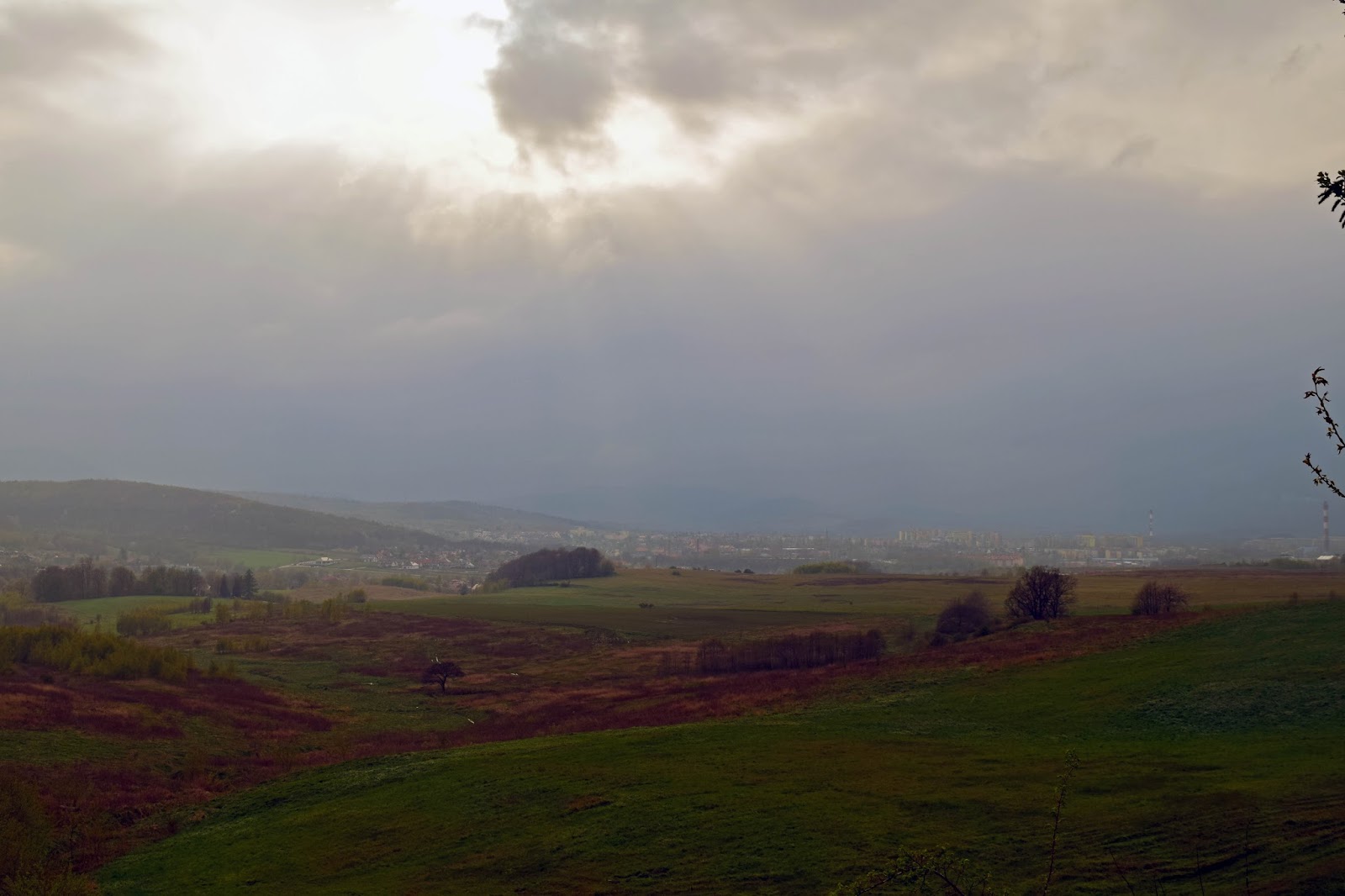
Still, the dramatic weather made for some good photography - dark clouds flying north-eastward at speed, lit by a low, late-afternoon sun.

Agriculture in western Poland (former German lands) was collectivised to a far greater extent than in the Polish heartlands. As a result, such prairies are a more common feature of the Lower Silesian landscape. Below: maize awaits harvesting. Soon after, we would see a heavy goods vehicle attended by three fire engines and a police car after having been blown over sideways by the wind.
 

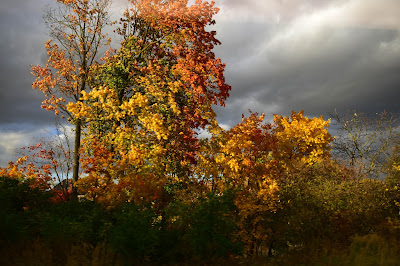
Below: straight out of the box, no fiddling with the sliders, the natural colours of trees in autumn, untouched by Photoshop.

Below: approaching Opole, crossing the Odra river - the left bank...

...and the right bank below. The low clouds, long shadows and strong sunlight on the tall trees remind me of the landscapes of Rowland Hilder.

Below: having departed from Opole station, some track-side tenements lit by a low sun, with dark clouds racing east, driving by strong winds. 

Below: somewhere west of Częstochowa, traffic streaming out of the town under a setting sun.


Yesterday was a Bad Day for Polish railways. Across the country, over 360 trains were seriously delayed due to strong winds. Our train, due into W-wa Zachodnia at 18:23, arrived at 20:25, two hours late. Beyond Opole, it was a stop-start ride, slowing down to cycling speed for some of the time. 

My train home to W-wa Jeziorki was due to depart W-wa Zachodnia at 21:00; as that time approached, the indicator board described the train as running 25 minutes late. As 21:25 approached, the indicator board showed the delay had extended to 60 minutes. So I boarded a train headed for the airport and caught a taxi home from there (58 złotys). Below: delays of up to five hours shown here.


Poland's trees are unused to coping with such fierce winds; old trees were uprooted or snapped in half. New trees will adapt to the changing climate; along with flash floods, droughts and snow-free winters this is the cumulative price we pay for our environmentally irresponsible lifestyles.

This time last year:

This time four years ago:
I found it!

This time six years ago:
Ogórek by the Palace of Culture

This time ten years ago:
Autumnal dusk, Jeziorki

This time 14 years ago:
Autumn sun going out
 

Monday, 1 May 2017

The Shoot - Day Three

The Gold Train legend is usually linked to the nearby location of the Projekt Riese complex - the massive Nazi construction site, of unknown purpose, which - had it been completed - would have covered over 30 square kilometres under the Sowie Góry (Owl Mountains). According to Hitler's architect Albert Speer, this project was consuming half of the Third Reich's cement at a time when the Red Army was pushing westward and the Allies had just landed at Normandy. It makes sense that a project of such such size would have a railway link - hidden from allied reconnaissance aircraft.

We visit one of several known Projekt Riese sites - Włodarz (Wolfsberg), one of three that are open to the public, and the largest. With 3.2km of tunnels, all excavated by slave labour, Włodarz is a frightening monument to Nazi inhumanity.

Below: one of eight underground guardhouses. It is believed that behind this wall there is a another tunnel. To the left, Krzysztof Szpakowski, who runs Włodarz; he has been exploring the area for many years and says there's still many parts of the complex still waiting to be explored.


Mr Szpakowski points out that the tunnels were built to be eight metres from floor to ceiling; two shafts were dug in parallel, one directly above the other. Then the rock between the two would be blasted out to create one massively high tunnel. For what purpose?

Below: one-third of Włodarz's tunnels is under water. Visitors to Włodarz can move about in boats. The rock is gneiss - particularly hard and difficult to mine. Hardhats are crucial, the ceiling is low here.

Below: looking down seemingly endless corridors, one gets the sense of the horror of working down here, shovelling rock into wagons and pushing them towards the open air. Some 5,000 slave labourers are said to have died on this project, of disease and exhaustion.


The scale of the work astounds at every turn. I've been to Wieliczka, the Llechwedd Slate Caverns, the Queen Luiza coal mine in Zabrze - but this place projects a sinister awesomeness I've not experienced before. Below: making our way back up from the lowest levels.


Below: a map of the known tunnels at Włodarz (source: Wikipedia)

After filming in Włodarz, we returned to Wałbrzych to interview the legendary gold train hunter, Tadeusz Słowikowski (below). Since 1974, when he took early retirement from the coal mine, he had doggedly pulled together strands of the gold train story - all the more difficult in the days before the internet, when maps were top secret. Mr Słowikowski first became aware of the story in a refugee camp in Dresden in 1948, hearing from eyewitnesses from Lower Silesia as to what had been going on in these parts during the war. I ask Mr Słowikowski - "Is there a gold train?" "Not necessarily a gold train, but train - trains - certainly," he replies.


Next up:Wałbrzych to talk to local people about the gold train legend. Most had heard about it many years ago - the story about a train-load of treasure, evacuated from Festung Breslau in the spring of 1945, disappearing somewhere around here was common currency.


Final 'GVs' (general views) of the town of Wałbrzych, to show its position nestling among hills.


I shall return to this part of Poland. It fascinates, draws me in; there is so much still to be discovered around here.

This time two years ago:
45 years under one roof

This time five years ago:
May Day in the heat (it was 31C in Warsaw!)

This time seven years ago:
Bike ride across rural Poland

This time ten years ago:
Mazovian landmark from the air

Sunday, 30 April 2017

The Shoot - Day Two

It's all starting to get interesting! Naturally, I can't divulge too much, save to say that the programme will be aired in the autumn, part of Discovery Science channel's What on Earth? series. One of the elements of the hour-long show will be my search for the Nazi Gold Train. Today's shooting was conducted close to the Wałbrzych-Kłodzko railway line, where I believe the train could well be hidden. Full health and safety was observed, the upshot of which was - no filming within three metres of a live line, which this one most certainly is.

We set off in the morning to meet the guys from PKP who were supervising the shoot - both of them, local men, told me interesting stories about the legend from the perspective of people they had met. It's clear that something was going on here after the war - the stories of military trucks driving around these parts in the dead of night during the late 1940s and early '50s suggested a top secret and intensive search for something. Was it found back then? Had the Soviets discovered something - would we know about it today?

Below: Marcin, Oscar and Rory set up the kit for filming the line off the bridge. This reinforced concrete bridge is visible in pre-war German maps.


Below: by the reinforced concrete bridge - this reinforced concrete structure. What was its purpose? A storage tank? For what? With such thick walls?


Below: this is a live railway line, with trains running through both bores of the tunnel under the hill. Not somewhere you want to go filming, even with all the permits. This story, of how a crew member was killed by a train in the US three years ago, shows how (rightly) sensitive the film industry is about filming on live lines.


We filmed on top of the hill under which the tunnel goes. In the distance, the Sowie Góry (Owl Mountains), where Hitler's Silesian redoubt, codenamed Projekt Riese ('giant') was under construction when the war ended. More on this tomorrow.


Drone taking off. Stunning aerial footage can now be obtained for a tiny fraction of what a helicopter with crew would cost. It is very battery-hungry; in practice, little more than seven minutes of flight (and filming) can be achieved per battery load. So you need to take five loaded batteries to shoot anything meaningful. In the distance, the snow-covered peaks of the Sowie Góry.


The outdoor footage having been shot, we returned over the highest peaks of the Sowie Góry to our hotel to shoot an interior sequence (in which I explain how I used satellite imagery and pre-war German maps to work out a possible - though logical - location for the Gold Train). Up here in the morning it was just 1.5C.


This time last year:
Semi-automatic (short story)

This time four years ago:
Jarosław Gowin quits as justice minister

This time five years ago:
So good to be back in Warsaw

This time six years ago:
At the President's

This time eight years ago:
Summer's here, and the time is right...

This time ten years ago:
Why I'm staying in Warsaw

Saturday, 29 April 2017

The Shoot - Day One

Back to Wałbrzych in search of you-know-what, this time with film crew. I have a plausible idea of where a Nazi gold train could possibly be hidden...

We fly to Wrocław, pick up hire car and drive to Książ castle; the timing was unfortunate, as it's the first day of the long May holidays, and the castle is overrun by visitors, crammed with booths odpust-style. Additional car parking is in a field; it had been raining heavily; our car gets stuck in the mud - by the end of the day, hundreds of cars will be in the same mess. Next location - the town of Walbrzych. We pass the site of Kilometre 65, now debunked as containing neither gold nor train nor tunnel. Though there was a carnival atmosphere around the castle, the town itself exuded a sinister atmosphere as night fell. And finally, on to the wonderful Hotel Dębowy in Bielawa, our base for the three-day shoot.

One thing that struck me after a 30-plus year absence from filming is how technology has dramatically lowered the cost and increased accessibility to broadcast-quality footage. Back in the 1980s, each camera would have three or four people fussing around it. Today, each person on the shoot has several cameras to operate, including a drone, a helmet-mounted Go-Pro, an Osmo gimbal-mounted camera, DSLRs shooting 4K video, as well as handheld smartphones. Each camera has different applications. There is also, compared to 30 years ago, a rigorous yet common-sense attention to health and safety on the shoot.

Below: producer, director, driver, camera operator, clapper/loader, focus puller, soundman, lighting engineer, key grip, best boy, runner - all in the shape of two people - Rory (right) and Oscar, behind the Canon EOS5 MkIII. After Poland and the Gold Train story, they're off to film further episodes in Romania, Barbados, Texas, Canada and Argentina, returning to London in early June. The downside of filming like this is the vast amount of baggage - two guys, seven cases packing cameras, tripods, lighting rig, plus five weeks' worth of clothing. The heaviest load is the ammunition case used to store all the lithium batteries needed. As these can (rarely!) spontaneously combust, they travel in the passenger compartment should anything go wrong, not in the baggage hold. Seven heavy cases/bags, just four hands to carry them all.


Below: overlooking Wałbrzych, and to the left of frame, the foothills of the Owl Mountains (Góry Sowie), one of the presumed locations of the legendary train.


Wałbrzych looks grim and foreboding in the rain. Traces of snow still to be seen here and there. Looking down towards the hills overlooking Wałbrzych; abandoned coal mines stand at their foot, now a museum.


Kino Górnik, a splendid example of Bauhaus protobrutalism from the 1930s, sharing much architecturally with the superstructure of the Bismarck. The cinema closed in 2015.


Wałbrzych's market square and town hall. With a population of 120,000, Wałbrzych is the second-largest town in Lower Silesia after Wrocław. The local special economic zone has lowered local unemployment spectacularly, while Gold Train fever boosted tourist visits to the town by 44% last year over 2015. Below: "Run to the cathedral of Santa Maria Christiana in Brucknerplatz. Buy one of the plain, half-length candles and take back four klubecks in change. Light it in the sacristy, say a brief rosary, then go to Mendl’s and get me a Courtesan au chocolat. If there’s any money left, give it to the crippled shoe-shine boy." This part of Poland just reeks of Wes Anderson's Grand Hotel Budapest.


Bielawa - post-German, post industrial. Round the corner and up the hill to our base, the Hotel Dębowy (recommended). Fabulous food, and a memorable craft ale - Browar Świdnica's Daisy AIPA (7.3% alc.), named after Daisy Cornwallis-West, wife of the last owner of Książ castle.


In Bielawa, we meet up with Marcin, our 'fixer' who's been busy getting all the permissions and lining up the interviews on the ground. Tomorrow we start the search in earnest.

This time four years ago:
Jarosław Gowin quits his post as justice minister

This time eight years ago:
The cycle-to-work season starts

Wednesday, 7 October 2015

I visit Wałbrzych in search of the Gold Train site

Explore Wałbrzych is the town's new advertising slogan, so I set out to do just that. My night train from Warsaw arrived at Wałbrzych Miasto at 07:14. (I slept well the whole night, thanks to two shots of pigwówka - quince vodka - before boarding the train.) Now, Wałbrzych has four stations (from south to north - Główny, Miasto, Fabryczny and Szczawienko) strung out like pearls along 12.5km of winding railway line that meanders through the town.

I'm on my way to a conference for Polish exporters at the HQ of the Wałbrzych Special Economic Zone. It's on the northern edge of town near Szczawienko station. I've got to be there at half past nine, so I've got over two hours to explore. I walk from Wałbrzych Miasto to Szczawienko, and then reaching the latter, I take off into the hills in search of the Gold Train.

Below: I approach Szczawienko station. That Germanic architecture lends an air of quiet menace to the place.


It's at this station that things start getting interesting. There's an abandoned spur from the main Wałbrzych-Wrocław railway line which then runs parallel to it northwards for a while before swinging off to the east to the former site of a ceramics factory. The rails have long been pulled up. However, between the spur and the main line is an interesting hump of land, towering over both (to the right of the picture below), within which a third railway line containing the fabled train could quite feasibly be buried.


Below: I cross over the high ground and the possible gold train tunnel to find the disused line. Now just wooden sleepers remain of the track bed.


Ventilation shafts? I peek inside and take a few snaps. More like sewerage. Smell like drains. The Gold Train could be directly in front and down several metres.


Below: the roped-off area, between the disused track and the main line, north of ul. Uczniowska has been thoroughly searched by army sappers. The army has finished checking the area out and found nothing except six rounds of rifle ammunition from WW2. No land mines, no chemical weapons – but then the Polish army's kit for scanning beneath the surface of the earth only 'sees' as far down as one metre. The radar location device that was used to 'show' the location of the Gold Train is good for 70m. But then there's only one of these devices in Poland, and the Polish army doesn't have it.


Right by the taped-off area is a large billboard promoting the town as #wAUbrzych (that's AU as in the chemical symbol for gold). On the one hand, visitors are invited to explore Wałbrzych. On the other, you are forbidden to go into the trees beyond. Smaller posters bearing the same message adorn nearby bus stops.


Below: a good view of the likely Gold Train site. It would be right here, centre of the pic. Note the flattened land on top - this is where the army sappers did their bit.


After the conference, I had an hour and half before my train home, so I set out to outflank the police cordon from the north. I made my way down to the track take a look. Look behind the train (click to enlarge) - this is where the line would have entered the tunnel under the raised hump of land. And note too the police car to the right of the frame.


So - here we are on a Google Earth map, rotated so that North is to the right to fit better. The main area in the yellow box is where the train is currently suspected to be. I took the above photo from the right-hand edge of the map, towards the taped-off area. 


When will the official search start in earnest? Will the Gold Train ever be found? Human curiosity and one of the greatest stories in Poland in recent years come into conflict with the dull reality of the Polish State. Poland has yet to discover the efficiencies that come from joined-up government. This is 'Polska resortowa', 'Polska silosowa' – a state of incommunicative fiefdoms and information jealously hoarded in silos. It is the state of 'spory kompetencyjne' – disputes of competencies – between organs. These are either negative (“This is not our agency's/ministry's/office's business – it's yours”) or positive (“It's not your agency's/ministry's/ office's business – it's ours”).

In the case of the Gold Train, we have the following actors involved: the Ministry of Culture and National Heritage. The Ministry of National Defence. The Ministry of Administration and Digitisation. The Lower Silesian Marshal's Office. The Lower Silesian Voivode's Office. The Office of the Mayor of Wałbrzych. Polish state railways' infrastructure arm, PKP PLK. The police, and finally the Straż Ochrony Kolei (SOK – the railway protection service). 'Twas on the Monday morning the gasman came to call. All these bodies will be having a stake in the game. They will be making suggestions, criticising others' suggestions, coming up with plans, finding allies for their plans, altering the plans, drawing up timetables that stretch into an indefinite future – and all this before we consider the political dimension – this month's parliamentary elections, local party politics, rivalries, jealousies etc. The Premier's office is too busy worrying about re-election to get involved (evidently no political party can see any capital to be made from either a) hurrying up the search or b) delaying the search c) saying anything about the search.

Within weeks the leaves will turn an even more gorgeous shade of gold and will drop off the trees, making the site more exposed to scrutiny (the bridge on ul. Uczniowska will become an even better vantage point). By Christmas, snow should fall, making incursions into the zone difficult as footprints will be traceable. Nothing much will happen this side of next spring. Heavy excavating plant should be brought in, preceded by careful soil analysis and army sappers. Media and popular pressure should be exerted on the authorities to proceed with a dig once the election is out of the way.

The Gold Train might be there, it might not be. If it is – this will be the biggest thing since the Titanic was found on the ocean floor. If not – well, let me take another look. It's down there somewhere.

Just as the Loch Ness Monster, which has generated (I'd guess) billions of pounds in tourism revenue for the lake and surrounding towns and villages since the 1930s, the legend of the Gold Train can become a huge draw for Wałbrzych and vicinity. Książ castle and the sites associated with the mysterious Projekt Riese around Walim. But the promotion needs to be carefully thought through. The balance needs to be right. Not Disneyfied and sanitised – but then on the other hand we don't want freelance explorers doing dangerous things to themselves and others with sticks of dynamite or falling down holes. People should be encouraged to get involved in the mystery, come up with their own pet theories, go on long rambles from Point A to Point B, calling in on cafes and restaurants before falling asleep, happy, in agroturystyki which offer simple but clean accommodation and hearty fare for tired explorers. Enterprising Wałbrzych householders will hopefully expand the baza noclegowa rapidly in coming years to be able to welcome curious tourists from around the world.

I've had a small sample today of the potential of Wałbrych as Town of Legend. The atmosphere in early autumn (a light mist would have been nice); the gloomy brick of this former German mining town, the rolling hills, the eternal mystery of what happened around these parts between 1943 and 1945. Why did the Nazis – fighting total war on all fronts – divert so many resources to dig so many tunnels and caverns into the mountains to the south-east of Wałbrzych? What did happen to the treasures looted by the Nazis in the East? What else is hidden in this complex? This is all fascinating stuff.

A final point about Wałbrzych. I was last here in 2008. Since then, the town has really come on – mainly as a result of its thriving Special Economic Zone. Ul. Uczniowska which was then nothing more that a dual carriageway lined with street lights running through empty fields is now flanked with factories providng jobs to thousands of people for scores of kilometres around. Gold Train or not, it's a city rising from its knees after the collapse of its coal mining industry. But with the Gold Train legend, Wałbrzych has the potential to become a great city.

This time last year:
Return to Scotland, still a part of the United Kingdom

This time two years ago:
Warsaw's Plac Unii opens - and changes colours

This time three years ago:
Tatra time (worth another watch and listen!)

This time four years ago:
The passing of Old Poland

This time five years ago:
A glorious week

This time six years ago:
Trampled underfoot: Sobieski and the Turks at Vienna

This time seven years ago:
The first, spontaneous signs, of a Park + Ride at Jeziorki

This time eight years ago:
Early autumn atmospheres, Jeziorki