Showing posts with label Wałbrzych. Show all posts

Friday, 14 July 2023

Wałbrzych, Książ and Riese

Europe's night trains are a great institution. Go to sleep in your home city and wake up in an entirely different landscape. Warsaw Gdańska depart 22:06; arrive Wałbrzych Główny at 06:36; in good time to explore one of the most fascinating places in Poland - Książ castle (09:00 opening).

Below: waking up to this! Next stop, Wałbrzych Główny. Passing Kilometre 75.4 - some 10km beyond the legendary Kilometre 65, where the Nazi Gold Train turned out not to be. They scanned, they planned, they held press conferences, the world came - they cleared the ground and dug - nothing.


Below: approaching Wałbrzyska Fabryczna station, one of Wałbrzych's five stations, strung out along 13km of serpentine track that winds between the hills. Summer lightens the atmosphere somewhat; but abandoned factories and mines still haunt - the past abides.


Wałbrzych was an important railway hub with several lines branching off the main line, serving local communities, coal mines and factories. Some lines have been closed, others are being refurbished.


Książ castle is a phenomenal slice of European aristocratic history - from feudalism to the Third Reich - and it's also an integral part of the great unsolved historical mystery that continues to be Projekt Riese.

A castle that morphed, like many did, from a fortification against armed attack (a castle) to the projection of status hierarchy (a palace). Built in the 13th century on a hard-to-assault hilltop by Bolko I Surowy ('the Strict' or 'the Raw'), a Silesian duke. Książ castle - by then Schloss Fürstenstein - came into the hands of the Hochberg family after 1509. It flourished until the family tipped into bankruptcy, dragged down by the wild spending of Daisy, Princess of Pless (née Mary Cornwallis-West), the British-born wife of Prince Hans Heinrich XV von Hochberg. The castle was seized by the Nazis during WW2, where it was to become a part of the mysterious complex known as Riese ('giant'). The oldest part of the castle is the left; the newer palace building stuck onto it on the right.


To this day, no one knows for sure why the Third Reich invested so heavily - and so desperately - until the very end - in the project. Too large to be just a bunker for Hitler and his accomplices, out of range of Allied bombers; to late in the war to be a megafactory for wonder-weapons - there has never been any documentation discovered pertaining to what Riese was for. A project that soaked up vast amounts of cement and steel at a time when it was desperately needed on the western and eastern fronts.  [Whistleblower David Grusch's mention of a UFO crash retrieval in Mussolini's Italy revives a rumour that Riese may have been intended to be a Nazi Area 51.]

Below: an extensive tunnel network extends in all directions under the castle. In the distance, the old lift shaft that would have connected the castle. After the war, the local authorities wanted to seal it off, and used it as a dump for rubble from the heavily damaged town. No one today knows the full extent of the tunnels. The Polish Academy of Science has a chamber down here used for seismographic equipment, deep in the rock, sensitive enough to detect small earthquake on the other side of the planet. To conduct any serious exploration of the the tunnel network would mean having to switch off the seismometers and stop all experiments. Also, exploration would mean no conducted tours of the network - and tourists are money. But questions remain. Is there a tunnel from here to the main railway line? Was Książ meant to have been connected to other parts of the Riese complex?


Below: roof detail. Blasted out of solid gneiss by slave labourers, the walls and ceiling were to be reinforced with concrete. In the foreground, rock. Deeper in - concrete. Note the mounting for electrical cables and ventilation pipes. Now here's part of the mystery. In February 1945, with the Red Army drawing near, the prisoners were evacuated from the site and force-marched westward. But in April, with Berlin surrounded and Lower Silesia within range of Soviet artillery, part of the construction team was herded back to Riese installations and made to install the concrete reinforcements. Why? The war was almost over, the work was not even one-eighth complete. What could have drove the Nazis to desperately continue tunnelling?


Left: one of the narrower corridors. There is a feeling of security down below - nothing is likely to cave in - the solid gneiss, the concrete reinforcements, the quality of the civil engineering. Much safer, I felt, than old coal mines now opened up to tourists.

The thing with Książ is that there's much to see above ground too. Below: the front elevation of Książ castle - the palace side. Above the entrance, two stories high, is the ballroom, magnificently decorated. In the room above, under the floor, is the winding mechanism for the ballroom candelabra, allowing them to be lowered and lit up before they ascend to operational altitude. The castle had a staff of three hundred, and in winter was kept warm by two wagon-loads of coal a day.


Below: the reverse angle, looking down from the third floor toward the gate house. Note the parched lawn - meadow would be better for the environment, if not keeping with the aesthetic of the period.


Książ castle is one of those places that strikes me as quintessential Europe; a long and rich history. Today a complex of hotels, restaurants and cafes ring the main building. I am reminded of Sir Clough Williams-Ellis's whimsical Portmeirion, but Książ has history. All that's missing is the sea.


The sides and rear of the castle are surrounded by ornamental terraced gardens. Above the terraces, a café serving craft ale on tap (just the thing of a hot lunchtime).


Left: portrait of Frederick the Great. Supervised the first partition of Poland, so not many fans of him around here today. His head is directed at the viewer, but his gaze is detached; those characteristic large eyes looking down. His right hand appears to be pointing at the viewer, but is actually grasping the chair. Unsettling. Painted by Oskar Begas, around 80 years after Frederick the Great's death. Painting on loan from Germany, which I think is telling about cultural and historical ties within the EU. A shared history, not altogether comfortable, but one that we're now open to.

Below: exceptionally beautiful location gives rise to magnificent views from all four sides of the castle. 

Below: the Palm House, quite a way from the castle, but on the same ticket, so worth dropping in. Part of Princess Daisy's expensive investments.


Wałbrzych has really come on as a town since I first visited 16 years ago. It has reinvented itself as a centre for advanced manufacturing... and history.

This time eight years ago:
Something new in the skies over Okęcie

This time nine years ago:
How the other half lives - a Radomite's tale

This time ten years ago:
On guard against complacency

This time 11 years ago:
Ready but not open - footbridge over Puławska

This time 12 years ago:
Dusk along the Vistula

This time 13 years ago:
Mediterranean Kraków

This time 14 years ago:
Around Wisełka, Most Łazienkowski, Wilanowska by night

This time 15 years ago:
Summer storms

This time 16 years ago:
Golden time of day

Sunday, 27 August 2017

The Journey There And The Journey Home

The journey there; by motorbike to Wrocław, dropping it off at Unikat 1/1 Motorworks for a new two-into-one exhaust pipe and pair of side-lights; and thence by train to Wałbrzych for local exploration (see yesterday's post) and back by night train to Warsaw.

So - the journey out...

The DW 710 heading west out of Łódź is an interesting road, followed along its way to Konstantynów Łódzki by a semi-rural tram line (below). Łódź's exurban light-rail routes are now sadly being trimmed back; this line until recently used to run even further out of town to Lutomiersk.


There's a quaint charm about a tram line that runs through fields and villages; below: between the main road and a field of corn, the tracks visible through the grass.


Near to where the line ends now (it was truncated earlier this year) in Konstantynów Łódzki stands a vintage tram, marking the historical importance to this area of its links to Łódź.


Below: onward towards Wielkopolska; still in Łódzkie province, this is the picturesque village of Rossoszyca, built astride a long pond. The wooden church of Św. Wawrzyniec (St Lawrence) dates back to 1783.


Below: more picturesque rural Poland; this is Grabów nad Prosną in Wielkopolska (as opposed to Grabów nad Pilicą which is in Mazowsze). Quite the film-set for a WW2 drama!


Onward from Wielkopolska into Dolnośląskie (Lower Silesia). Having dropped off the bike, it's time to change transport modes at Wrocław. I pop by the old Świebodzki station, now partially abandoned. A lovely old Ty-2 loco rusts away exposed to the open sky and vandals.


On by rail to Wałbrzych. Though there has been much new investment in Wałbrzych, there are still many signs of post-industrial decay. It's this mix that makes the town so fascinating.


The line just outside Wałbrzych. Built in the 1870s, it was originally intended to link Berlin and Vienna; the Austro-Hungarian authorities viewed the whole project with suspicion, and it was never completed. Still, there are some magnificent views (below)


Below: arrival by train at Wałbrzych Główny (as opposed to Wałbrzych Miasto, 6.1km away). Looking up from the Line A bus that links the two stations at the railway viaduct, with its underslung arches. 


... and looking down from the railway viaduct  From Wałbrzych Miasto (as opposed to Wałbrzych Główny), I'll take the night train back to Warsaw.


I bought my ticket home via W-wa Wschodnia, so I wouldn't have to be woken at 6am. Sleep on to Wschodnia, have a Scottish breakfast, and return to Jeziorki by Koleje Mazowieckie - that's the plan. I needn't have worried - my night train arrived three hours late. At some stage, a goods train on the line ahead broke down. I was vaguely aware of my train standing still for an awfully long time, but being in a sleep state this didn't bother me a jot. This view below of two communist-era murals 'advertising' (!) stuff - photographic film and wrist watches - that was unavailable anyway may soon become history as the plot in the foreground is being cleared for the construction of a new building.


Left: back in Jeziorki with two my small rucksacks, hard hat, explorer's kit and photographic gear. A thoroughly worthwhile three-day jaunt, lots of tales to tell. Once again, the klimat of the journey has been processed into my long-term memory; I already feel the need to return to Wałbrzych.

Bonus shot: an SM42 pulls an overhead power line engineering train, heading south out of Skierniewice.

This time last year:
Sandomierz - another outstanding Polish town to see

This time three years ago:
Food hygiene and lies as Russian foreign policy tools

This time four years ago:
Asphalt for ul. Poloneza (to Krasnowolska at least)

This time five years ago:
A welcome splash of colour to a drab car park 

This time six years ago:
To Hel and back in 36 hours

This time eight years ago:
Honing the Art of the Written Word

This time nine years ago:
Of castles, dams and brass bands

Wednesday, 3 May 2017

The Shoot - lessons learnt

Back in Warsaw to sum up the past few days. On the most basic level - a sense of pride in Poland. Poland works. We flew into Wrocław, hired a car, drove to Wałbrzych along good roads, drove back to Warsaw via Łódź along motorways, the hotels were excellent, the food exemplary. Poland has come a long way from being a drab ex-communist country that I felt obliged to make excuses for in front of foreigners. The whole Polska w ruinie narrative just doesn't play - not even in the towns and villages of Lower Silesia. Wałbrzych's special economic zone, factories strung out along ul. Uczniowska. Below: Uczniowska, July 2007. Today, it's a 4km-long strip of activity. The last ten years has seen improvements in Poland's quality of life that cannot be denied.


The Gold Train story is good for business. In three days' filming in Poland, the production company bought 11 hotel-room nights, eight three-course dinners, 11 two-course lunches, hired a large car, topped up a tank of fuel, spent cash on coffees, mineral waters and snacks. I'd guess that in total, some 20,000 złotys were left in Poland's economy - as a direct result of the Gold Train story. And then there's the multiplier effect. The programme will air on Discovery Science in December; it will be seen globally and repeated regularly just as people are making their holiday plans. Thousands of tourists will be thinking - "if we're doing Europe this summer, let's pop by Wałbrzych and catch some of that Gold Train fever." We'd be looking at tens of millions of złotys being brought into the region this way.

What should Poland do about the legend? Tadeusz Słowikowski's last words to me as we left his house were "Try to persuade the Polish government to spend more resources to find the train." Should it though? Surely, individual hunters, armed with satellite images and old maps, poring over hundreds of documents and interviews online, can come up with hundreds of plausible ideas as to where the train(s) could be. I have one - it has yet to be disproved. It can be disproved easily - and a process of elimination is what's needed. Let a hundred gold train hunters present a hundred well-researched, cogent, logical suggestions - open them up to peer review - and then, with the full blessing of the Polish state, conduct a thorough search of the most promising ones. It may take decades, but in the meanwhile, the legend will linger. "This is the West, Sir. When the legend becomes fact, print the legend."

Film-making. As I wrote earlier, the impact of technology on the process of recording images over the past thirty years or so is incredible. Film crews are smaller, nimbler, more efficient, able to get stunning shots far cheaper. Instead of canisters of unexposed film, the results of all the work is now digital. At the end of every shooting day, the producer disappears to do [data] wrangling - transferring the raw files from the data cards on the numerous cameras to a hard drive that can be sent back by courier. There is nothing more disastrous that can befall recorded footage than lost or corrupted files.

The upshot of all this technological change is the plethora of TV channels that can be set up on a shoestring. Competition that the founding fathers of CBS, ABC, NBC, ITV etc could not begin to imagine. So to attract the viewers in such numbers as to make advertising to them worthwhile, the content must be strong.

This time three years ago:
Digbeth, Birmingham 5

This time four years ago:
Still months away from the opening of the S2/S79

This time five years ago:
Looking at progress along the S79 (how little has been achieved!)

This time six years ago:
Snow on 3 May

This time seven years ago:
Two Polands

This time eight years ago:
A delightful weekend in the country

This time nine years ago:
The dismantling of the Rampa

This time ten years ago:
Flag day

Monday, 1 May 2017

The Shoot - Day Three

The Gold Train legend is usually linked to the nearby location of the Projekt Riese complex - the massive Nazi construction site, of unknown purpose, which - had it been completed - would have covered over 30 square kilometres under the Sowie Góry (Owl Mountains). According to Hitler's architect Albert Speer, this project was consuming half of the Third Reich's cement at a time when the Red Army was pushing westward and the Allies had just landed at Normandy. It makes sense that a project of such such size would have a railway link - hidden from allied reconnaissance aircraft.

We visit one of several known Projekt Riese sites - Włodarz (Wolfsberg), one of three that are open to the public, and the largest. With 3.2km of tunnels, all excavated by slave labour, Włodarz is a frightening monument to Nazi inhumanity.

Below: one of eight underground guardhouses. It is believed that behind this wall there is a another tunnel. To the left, Krzysztof Szpakowski, who runs Włodarz; he has been exploring the area for many years and says there's still many parts of the complex still waiting to be explored.


Mr Szpakowski points out that the tunnels were built to be eight metres from floor to ceiling; two shafts were dug in parallel, one directly above the other. Then the rock between the two would be blasted out to create one massively high tunnel. For what purpose?

Below: one-third of Włodarz's tunnels is under water. Visitors to Włodarz can move about in boats. The rock is gneiss - particularly hard and difficult to mine. Hardhats are crucial, the ceiling is low here.

Below: looking down seemingly endless corridors, one gets the sense of the horror of working down here, shovelling rock into wagons and pushing them towards the open air. Some 5,000 slave labourers are said to have died on this project, of disease and exhaustion.


The scale of the work astounds at every turn. I've been to Wieliczka, the Llechwedd Slate Caverns, the Queen Luiza coal mine in Zabrze - but this place projects a sinister awesomeness I've not experienced before. Below: making our way back up from the lowest levels.


Below: a map of the known tunnels at Włodarz (source: Wikipedia)

After filming in Włodarz, we returned to Wałbrzych to interview the legendary gold train hunter, Tadeusz Słowikowski (below). Since 1974, when he took early retirement from the coal mine, he had doggedly pulled together strands of the gold train story - all the more difficult in the days before the internet, when maps were top secret. Mr Słowikowski first became aware of the story in a refugee camp in Dresden in 1948, hearing from eyewitnesses from Lower Silesia as to what had been going on in these parts during the war. I ask Mr Słowikowski - "Is there a gold train?" "Not necessarily a gold train, but train - trains - certainly," he replies.


Next up:Wałbrzych to talk to local people about the gold train legend. Most had heard about it many years ago - the story about a train-load of treasure, evacuated from Festung Breslau in the spring of 1945, disappearing somewhere around here was common currency.


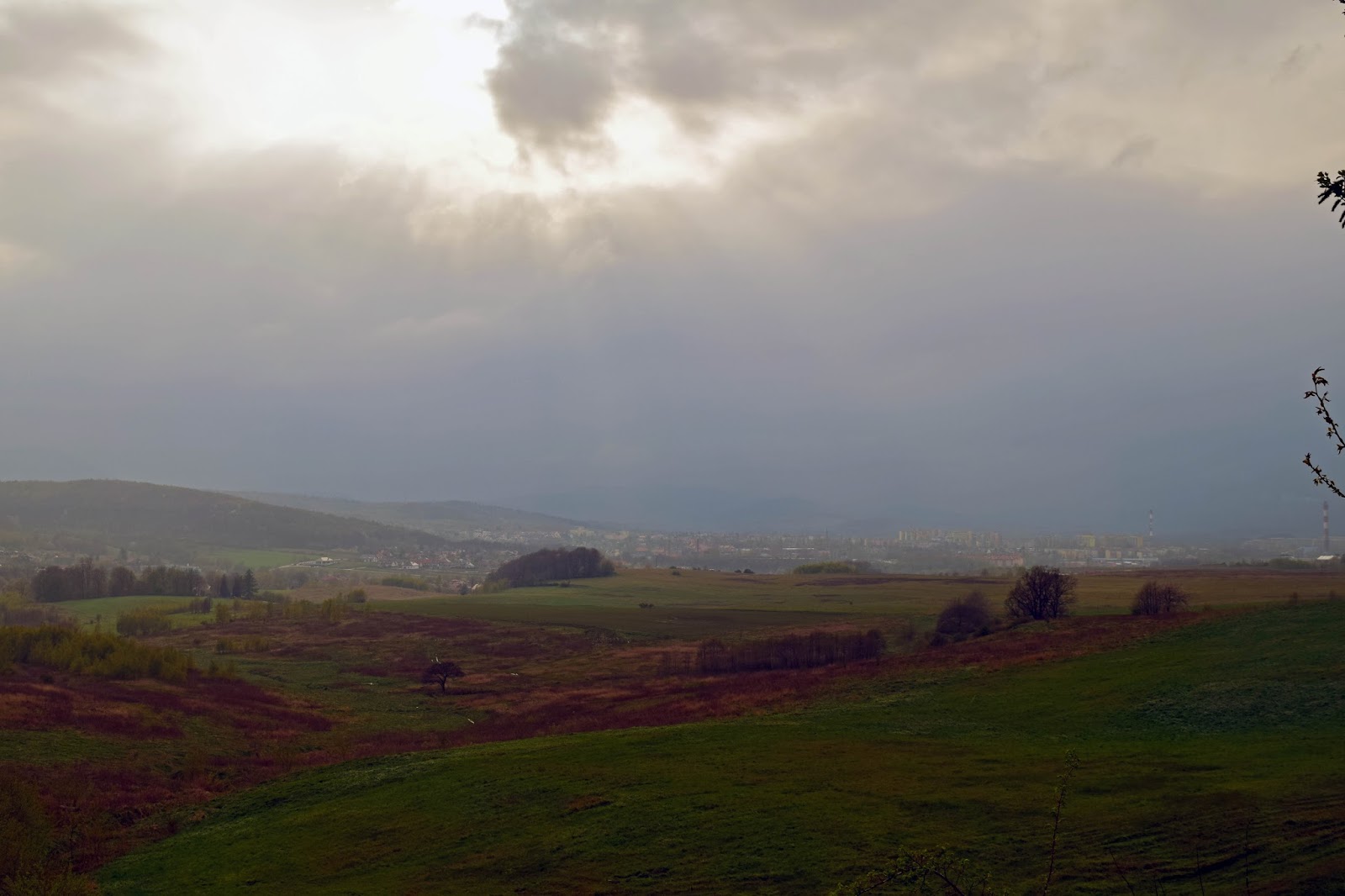
Final 'GVs' (general views) of the town of Wałbrzych, to show its position nestling among hills.


I shall return to this part of Poland. It fascinates, draws me in; there is so much still to be discovered around here.

This time two years ago:
45 years under one roof

This time five years ago:
May Day in the heat (it was 31C in Warsaw!)

This time seven years ago:
Bike ride across rural Poland

This time ten years ago:
Mazovian landmark from the air

Saturday, 29 April 2017

The Shoot - Day One

Back to Wałbrzych in search of you-know-what, this time with film crew. I have a plausible idea of where a Nazi gold train could possibly be hidden...

We fly to Wrocław, pick up hire car and drive to Książ castle; the timing was unfortunate, as it's the first day of the long May holidays, and the castle is overrun by visitors, crammed with booths odpust-style. Additional car parking is in a field; it had been raining heavily; our car gets stuck in the mud - by the end of the day, hundreds of cars will be in the same mess. Next location - the town of Walbrzych. We pass the site of Kilometre 65, now debunked as containing neither gold nor train nor tunnel. Though there was a carnival atmosphere around the castle, the town itself exuded a sinister atmosphere as night fell. And finally, on to the wonderful Hotel Dębowy in Bielawa, our base for the three-day shoot.

One thing that struck me after a 30-plus year absence from filming is how technology has dramatically lowered the cost and increased accessibility to broadcast-quality footage. Back in the 1980s, each camera would have three or four people fussing around it. Today, each person on the shoot has several cameras to operate, including a drone, a helmet-mounted Go-Pro, an Osmo gimbal-mounted camera, DSLRs shooting 4K video, as well as handheld smartphones. Each camera has different applications. There is also, compared to 30 years ago, a rigorous yet common-sense attention to health and safety on the shoot.

Below: producer, director, driver, camera operator, clapper/loader, focus puller, soundman, lighting engineer, key grip, best boy, runner - all in the shape of two people - Rory (right) and Oscar, behind the Canon EOS5 MkIII. After Poland and the Gold Train story, they're off to film further episodes in Romania, Barbados, Texas, Canada and Argentina, returning to London in early June. The downside of filming like this is the vast amount of baggage - two guys, seven cases packing cameras, tripods, lighting rig, plus five weeks' worth of clothing. The heaviest load is the ammunition case used to store all the lithium batteries needed. As these can (rarely!) spontaneously combust, they travel in the passenger compartment should anything go wrong, not in the baggage hold. Seven heavy cases/bags, just four hands to carry them all.


Below: overlooking Wałbrzych, and to the left of frame, the foothills of the Owl Mountains (Góry Sowie), one of the presumed locations of the legendary train.


Wałbrzych looks grim and foreboding in the rain. Traces of snow still to be seen here and there. Looking down towards the hills overlooking Wałbrzych; abandoned coal mines stand at their foot, now a museum.


Kino Górnik, a splendid example of Bauhaus protobrutalism from the 1930s, sharing much architecturally with the superstructure of the Bismarck. The cinema closed in 2015.


Wałbrzych's market square and town hall. With a population of 120,000, Wałbrzych is the second-largest town in Lower Silesia after Wrocław. The local special economic zone has lowered local unemployment spectacularly, while Gold Train fever boosted tourist visits to the town by 44% last year over 2015. Below: "Run to the cathedral of Santa Maria Christiana in Brucknerplatz. Buy one of the plain, half-length candles and take back four klubecks in change. Light it in the sacristy, say a brief rosary, then go to Mendl’s and get me a Courtesan au chocolat. If there’s any money left, give it to the crippled shoe-shine boy." This part of Poland just reeks of Wes Anderson's Grand Hotel Budapest.


Bielawa - post-German, post industrial. Round the corner and up the hill to our base, the Hotel Dębowy (recommended). Fabulous food, and a memorable craft ale - Browar Świdnica's Daisy AIPA (7.3% alc.), named after Daisy Cornwallis-West, wife of the last owner of Książ castle.


In Bielawa, we meet up with Marcin, our 'fixer' who's been busy getting all the permissions and lining up the interviews on the ground. Tomorrow we start the search in earnest.

This time four years ago:
Jarosław Gowin quits his post as justice minister

This time eight years ago:
The cycle-to-work season starts

Tuesday, 15 December 2015

The end of a beautiful dream? Or not?

Today's press conference in Wałbrzych, at which various teams announced the findings of their search for the Gold Train, ended in typical Polish style - the clash between swashbuckling romanticism and tedious empiricism, and the world ended up none the wiser.

Below: screenshot from Google Earth of the site, a little north of Wałbrzych Szczawienko station, the area of interest lies between the main line that runs left to right and the disused siding that runs to the bottom of the pic. Click to enlarge.


According to the two chaps who first claimed to have discovered the alleged whereabouts of the train, Piotr Koper and Andreas Richter, the train is there, 10 metres underground, 92m long, in a tunnel five metres high.

According to Professor Madej of AGH (the mining and metallurgy university in Kraków), badania grawimetryczne (God knows what this is in English, as the Wikipedia page is available only in Polish), there may be a tunnel, but there's no train.

But then according to Dr Adam Szynkiewicz from the University of Wrocław, who's worked on the Pyramids of Giza, there is an anomaly down there - metal elements with very strong electromagnetic field. A train? Maybe. "It is necessary to find out," he says.

Why not look for it?

What? And disrupt the railway service between Wrocław and Wałbrzych?

I get the feeling that it is in the State's interest to keep the issue in abeyance. Maintain the mystery. Digging it up to find nothing would burst the bubble. The wonderful tourist attraction would disappear - no one wants to come to place that used to be shrouded in a legend that has now been disproved. But leave the question unanswered - and they will come. The longer you leave it unanswered, the better.

I disagree. The legend is alive. There are several sites, all of which are accessible by rail, where the legendary train may still be, even if not in alte Nieder Salzbrunn. "It's uh, it's down there somewhere.  Lemme take another look."

There's no better Polish way of pouring cold water on something than to get an boring old professor singularly ungifted with communication skills to blather on in lengthy sentences, using jargon that  to the layman sounds comfortingly learned. "I defer my opinion to his unquestioned authority".

So - what's next? Today's press conference was a total let-down, an anti-climax. It took us nowhere new, it answered no questions - and the world's press are waiting. Three voices - a 'yes', a 'maybe' and a 'no'. Next, then, is the creation of a working group, to study in detail, the three studies, and to prepare a recommendation to the authorities of the city of Wałbrzych.

Having been to the site, I really cannot see why digging can't begin, starting from the top - the roof of the tunnel - rather than horizontally, which would indeed interfere with regular rail traffic. Boring down several metres using the type of drills used for wells would not be difficult or costly. It would quickly reveal whether or not there is a tunnel in the hump of raised ground between the main line to Wrocław and the siding that used to run to the ceramic factory. The cost is the of the order of magnitude that private individuals could easily raise. Drill four or five holes, and you'll have a quick yes-no answer as to a tunnel's existence. Or dig laterally into the hump of ground from the east side (away from the main line).

If not - end of story. If there is - the next steps need to the more carefully planned, to avoid damaging anything down there. According to Piotr Koper, the tunnel mouth is blocked to a distance of 10 to 12 metres. Surely it's not beyond the wit of the authorities to allow some exploratory digging or drilling? The typical Polish problem is finding someone brave enough to take the decision.

"Typically Polish?" you ask. There's an interesting parallel right now, off the coast of Colombia. A US treasure hunter has allegedly found the wreck of a sunken galleon with billions of dollars worth of gold and silver coins. Now, is the treasure hunter entitled to 50% - or just 5% - of the find? Whose law applies? What about the owners of the treasure - the rightful heirs of King Philip V of Spain? Read the whole story here.

Previous Gold Train posts here.

This time two years ago:
Kitten football

This time three years ago:
The drainage of Jeziorki

This time four years ago:
The Eurocrisis - what would Jesus do?

This time five years ago:
Orders of magnitude

This time six years ago:
Jeziorki in the snow

This time seven years ago:
Better news on the commuting front

This time eight years ago:
I no longer recognise the land where I was born

Tuesday, 13 October 2015

Mapping Wałbrzych's Gold Train

Many thanks to Matt Padden for sending me a link to a high-resolution scan of a 1936 map of the area to the north of Wałbrzych, where the alleged Gold Train awaits its discovery.

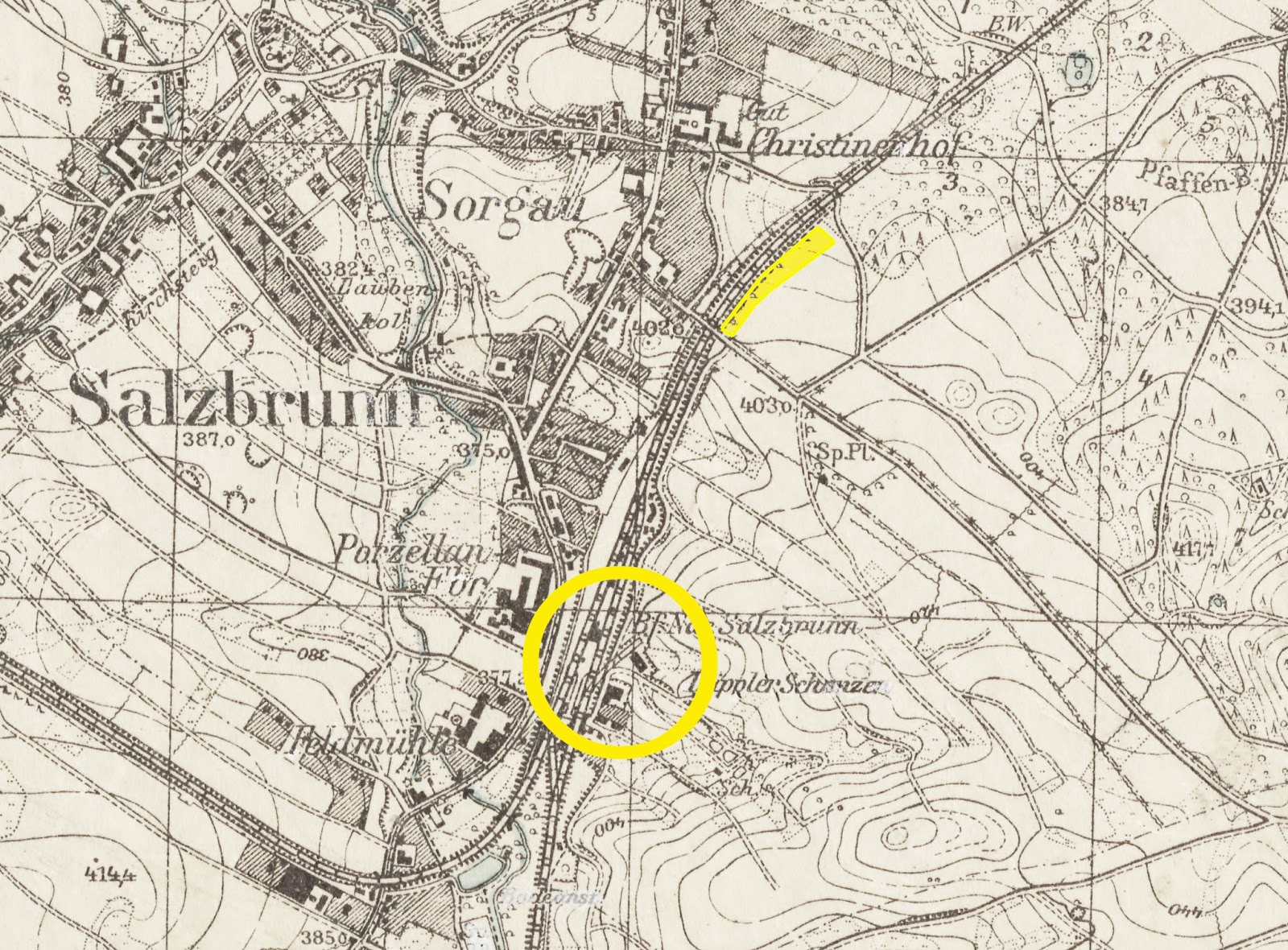
Here's the area around Wałbrzych Szczawienko station, or Nieder Salzbrunn as it was before WW2 (below) The yellow area is where the train is reputedly hiding. The yellow circle highlights the junction from the Waldenburg-Breslau main line from which ran a short spur, leading, in 1936 - nowhere. It ran just 100m or so from the main line before coming to a stop. The main line cuts through a finger of higher ground, rising to a maximum of around 15m before falling away again. This suggests that an artificial hillock was not built over the suspected Gold Train, rather a tunnel would have had to have been excavated between two cuttings. Question is - why. Click to enlarge.


Now here's a composite map with the current Google map of the area superimposed over the 1936 map. Look at the area within the yellow ring above, and compare it with the same area below. I've marked two yellow lines - one which is the 1936 spur, the other being the same spur but on the current map. Different - greater - angle from the main line. Some time after 1936, this spur was extended to run parallel to the main line as far as ul. Uczniowska, before swinging east to what was a communist-era ceramics factory (now the site of a Toyota showroom).


Finally the current Google map on its own. The ceramic line is clearly visible. The tracks have been ripped up, the sleepers remain in place. The question is - was the short spur visible on the 1936 map extended before 1945, or after the war? And most importantly - was a third line built between the main line and the spur? If so - it may well hide the Gold Train.


Any more clues greatly appreciated!

[Update, 31.10.2015 - thanks to Anon for a link to Polish military map prepared in 1956 and published in 1959.] Again, I've marked the positions of the siding and the putative Gold Train site. This suggests that the ceramics factory was built later, and the siding extended to it then. Meanwhile, the 1956/59 map shows an interesting cutting/embankment to the west of Szczawienko station.


This is marked as an eleven-metre drop - enough to hide a train in!


This time last year:
Respect the pedestrian at crossings
[Poland's senate voted this down last week - keep slaughtering pedestrians, o lazy, murderous motorists - the law is still on your side!]

This time two years ago:
Autumnal gorgeousness in Warsaw

This time three years ago:
The genius of Donald Tusk

This time four years ago:
Tragic road accident kills 18: Has Poland learnt anything from it?

Wednesday, 7 October 2015

I visit Wałbrzych in search of the Gold Train site

Explore Wałbrzych is the town's new advertising slogan, so I set out to do just that. My night train from Warsaw arrived at Wałbrzych Miasto at 07:14. (I slept well the whole night, thanks to two shots of pigwówka - quince vodka - before boarding the train.) Now, Wałbrzych has four stations (from south to north - Główny, Miasto, Fabryczny and Szczawienko) strung out like pearls along 12.5km of winding railway line that meanders through the town.

I'm on my way to a conference for Polish exporters at the HQ of the Wałbrzych Special Economic Zone. It's on the northern edge of town near Szczawienko station. I've got to be there at half past nine, so I've got over two hours to explore. I walk from Wałbrzych Miasto to Szczawienko, and then reaching the latter, I take off into the hills in search of the Gold Train.

Below: I approach Szczawienko station. That Germanic architecture lends an air of quiet menace to the place.


It's at this station that things start getting interesting. There's an abandoned spur from the main Wałbrzych-Wrocław railway line which then runs parallel to it northwards for a while before swinging off to the east to the former site of a ceramics factory. The rails have long been pulled up. However, between the spur and the main line is an interesting hump of land, towering over both (to the right of the picture below), within which a third railway line containing the fabled train could quite feasibly be buried.


Below: I cross over the high ground and the possible gold train tunnel to find the disused line. Now just wooden sleepers remain of the track bed.


Ventilation shafts? I peek inside and take a few snaps. More like sewerage. Smell like drains. The Gold Train could be directly in front and down several metres.


Below: the roped-off area, between the disused track and the main line, north of ul. Uczniowska has been thoroughly searched by army sappers. The army has finished checking the area out and found nothing except six rounds of rifle ammunition from WW2. No land mines, no chemical weapons – but then the Polish army's kit for scanning beneath the surface of the earth only 'sees' as far down as one metre. The radar location device that was used to 'show' the location of the Gold Train is good for 70m. But then there's only one of these devices in Poland, and the Polish army doesn't have it.


Right by the taped-off area is a large billboard promoting the town as #wAUbrzych (that's AU as in the chemical symbol for gold). On the one hand, visitors are invited to explore Wałbrzych. On the other, you are forbidden to go into the trees beyond. Smaller posters bearing the same message adorn nearby bus stops.


Below: a good view of the likely Gold Train site. It would be right here, centre of the pic. Note the flattened land on top - this is where the army sappers did their bit.


After the conference, I had an hour and half before my train home, so I set out to outflank the police cordon from the north. I made my way down to the track take a look. Look behind the train (click to enlarge) - this is where the line would have entered the tunnel under the raised hump of land. And note too the police car to the right of the frame.


So - here we are on a Google Earth map, rotated so that North is to the right to fit better. The main area in the yellow box is where the train is currently suspected to be. I took the above photo from the right-hand edge of the map, towards the taped-off area. 


When will the official search start in earnest? Will the Gold Train ever be found? Human curiosity and one of the greatest stories in Poland in recent years come into conflict with the dull reality of the Polish State. Poland has yet to discover the efficiencies that come from joined-up government. This is 'Polska resortowa', 'Polska silosowa' – a state of incommunicative fiefdoms and information jealously hoarded in silos. It is the state of 'spory kompetencyjne' – disputes of competencies – between organs. These are either negative (“This is not our agency's/ministry's/office's business – it's yours”) or positive (“It's not your agency's/ministry's/ office's business – it's ours”).

In the case of the Gold Train, we have the following actors involved: the Ministry of Culture and National Heritage. The Ministry of National Defence. The Ministry of Administration and Digitisation. The Lower Silesian Marshal's Office. The Lower Silesian Voivode's Office. The Office of the Mayor of Wałbrzych. Polish state railways' infrastructure arm, PKP PLK. The police, and finally the Straż Ochrony Kolei (SOK – the railway protection service). 'Twas on the Monday morning the gasman came to call. All these bodies will be having a stake in the game. They will be making suggestions, criticising others' suggestions, coming up with plans, finding allies for their plans, altering the plans, drawing up timetables that stretch into an indefinite future – and all this before we consider the political dimension – this month's parliamentary elections, local party politics, rivalries, jealousies etc. The Premier's office is too busy worrying about re-election to get involved (evidently no political party can see any capital to be made from either a) hurrying up the search or b) delaying the search c) saying anything about the search.

Within weeks the leaves will turn an even more gorgeous shade of gold and will drop off the trees, making the site more exposed to scrutiny (the bridge on ul. Uczniowska will become an even better vantage point). By Christmas, snow should fall, making incursions into the zone difficult as footprints will be traceable. Nothing much will happen this side of next spring. Heavy excavating plant should be brought in, preceded by careful soil analysis and army sappers. Media and popular pressure should be exerted on the authorities to proceed with a dig once the election is out of the way.

The Gold Train might be there, it might not be. If it is – this will be the biggest thing since the Titanic was found on the ocean floor. If not – well, let me take another look. It's down there somewhere.

Just as the Loch Ness Monster, which has generated (I'd guess) billions of pounds in tourism revenue for the lake and surrounding towns and villages since the 1930s, the legend of the Gold Train can become a huge draw for Wałbrzych and vicinity. Książ castle and the sites associated with the mysterious Projekt Riese around Walim. But the promotion needs to be carefully thought through. The balance needs to be right. Not Disneyfied and sanitised – but then on the other hand we don't want freelance explorers doing dangerous things to themselves and others with sticks of dynamite or falling down holes. People should be encouraged to get involved in the mystery, come up with their own pet theories, go on long rambles from Point A to Point B, calling in on cafes and restaurants before falling asleep, happy, in agroturystyki which offer simple but clean accommodation and hearty fare for tired explorers. Enterprising Wałbrzych householders will hopefully expand the baza noclegowa rapidly in coming years to be able to welcome curious tourists from around the world.

I've had a small sample today of the potential of Wałbrych as Town of Legend. The atmosphere in early autumn (a light mist would have been nice); the gloomy brick of this former German mining town, the rolling hills, the eternal mystery of what happened around these parts between 1943 and 1945. Why did the Nazis – fighting total war on all fronts – divert so many resources to dig so many tunnels and caverns into the mountains to the south-east of Wałbrzych? What did happen to the treasures looted by the Nazis in the East? What else is hidden in this complex? This is all fascinating stuff.

A final point about Wałbrzych. I was last here in 2008. Since then, the town has really come on – mainly as a result of its thriving Special Economic Zone. Ul. Uczniowska which was then nothing more that a dual carriageway lined with street lights running through empty fields is now flanked with factories providng jobs to thousands of people for scores of kilometres around. Gold Train or not, it's a city rising from its knees after the collapse of its coal mining industry. But with the Gold Train legend, Wałbrzych has the potential to become a great city.

This time last year:
Return to Scotland, still a part of the United Kingdom

This time two years ago:
Warsaw's Plac Unii opens - and changes colours

This time three years ago:
Tatra time (worth another watch and listen!)

This time four years ago:
The passing of Old Poland

This time five years ago:
A glorious week

This time six years ago:
Trampled underfoot: Sobieski and the Turks at Vienna

This time seven years ago:
The first, spontaneous signs, of a Park + Ride at Jeziorki

This time eight years ago:
Early autumn atmospheres, Jeziorki