Showing posts with label Warsaw Uprising. Show all posts

Sunday, 1 August 2021

A meaningful anniversary

Today marks the second 1 August without my father here in Warsaw. For the last four years of his life, he'd visit the city of his birth to commemorate the outbreak of the Uprising. Until my mother died in 2015, he'd never leave her side, and because of her claustrophobia, she could not fly. So after her death, my father was at last able to return to Warsaw - for the first time in 43 years. His last visit, in 2019, was the most poignant, not least because it was the round 75th anniversary. The City of Warsaw paid for his travel and accommodation, my daughter's fare flying out with him from London, and my fare flying back home with him - for what would be his last flight. It was such a special week, just three months before his death. 

For many people, the Warsaw Uprising remains controversial. Should it have happened? My father was clear. The people of Warsaw, who'd endured four years of German occupation, had simply had enough. He had himself personally witnessed a street execution; he had narrowly escaped a round-up, he had endured the day-to-day humiliations at the hands of the 'master race'. Like many young men of his generation, he was itching to get even with the occupier as the Eastern Front pressed ever closer to Warsaw.

Chance would have it that Colonel Antoni Chruściel - 'Monter' - gave the order to launch the Uprising from the very same building in which my father lived before and during the occupation - ulica Filtrowa 68. As a result, each 1 August would begin here, at the laying of wreathes in front of his house. My father was unaware that 'Monter' was operating from the building; he suspects it was from the flat belonging to his former scout master. Asked by the Polish media if he knew, my father replied that he didn't know that both his brothers were in the Conspiracy, and neither of them knew that he was in the Conspiracy, so deep was the secrecy.

Below: my father kneels at the grave of his brother Józef, who died during the uprising, aged 19.


These annual pilgrimages to Warsaw were extremely important for my father in his last years; a chance to reflect upon his own personal journey through life, meet family, friends and old comrades - and to see how his dear city had so vastly improved since his infrequent visits in the 1960s and '70s.

Each year, I accompanied my father, the last two years in a wheelchair it must be said, as well as the official events, we spent time visiting the places where he fought during the Uprising - from ul. Filtrowa 8, where his unit waited for the orders to commence, to the Pole Mokotowskie park where he'd made his way across to the Polish barricades by moonlight, under German machine gun fire, to the building of the architectural department of the Politechnika, where he was briefly taken ill with gastric fever, and where legendary singer Mieczysław Fogg sang to the insurgents on 15 August 1944; to the building on ul. Noakowskiego 18 where he saw out the last weeks of the Uprising, holding the line that the Germans never breached.

Each of the four visits were recorded in detail on this blog - you can see them all by starting from the 'this time last year' links below, although because 1 August falls on different days of the week, the programme of the commemorations varied from year to year. You can also click on the label 'Bohdan Dembinski' for more posts about my father.

Finally, we moved offices last year, from the 9th floor to the 4th floor - and from the new extension of the building, to its original historic heart. This is the PASTa building, which was built before WW1 by the Swedish firm that operated Warsaw's telephone network. Not only is it where our office is now located (in the south wing), it is also home to the association of Home Army veterans (in the north wing). The photo below was taken on 3 August 2016 - my father (seated) and his comrades from Batalion Odwet. 


Here's how the building looked during the Uprising. My window is just to the left of the main tower, above the dense, dark plume of smoke.


This time two years ago:
W-Hour on the Big Day

Tuesday, 11 May 2021

Pfizered for the second time

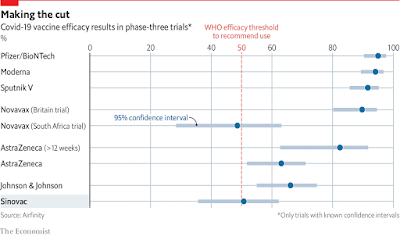
All good, I hope - today I got my second jab of the Pfizer/BioNTech vaccine, 36 days after my first one. I'm lucky to get it, given that it's the best performing of the Covid-19 vaccines currently in use.

Source: The Economist

As with my first appointment, everything went smoothly. I turned up 45 minutes early, waited no more than five minutes before being ushered into a room to fill in a form to state that I didn't have any of a long adverse reactions to my first jab. With that done, I found myself in a queue of one outside the door of the room where the vaccinations were taking place. 

Shirt off, needle in - over in a second, got my Comirnaty (the brand name of the Pfizer vaccine) card stamped and dated - proof that I've had both doses. The doctor who vaccinated me told me that I would gain full immunity within between 21 and 28 days. And that's that! I thanked everyone involved, waited a few minutes to ensure no sudden funny turns - and off I went. A lovely sunny evening, I got off the train from town a station earlier and walked home from W-wa Dawidy via the lakes.

I still need to take care during the next four weeks. Mask and alcoholic disinfectant I shall still take with me on leaving the house, and I shall avoid crowded trains and buses and continue to work from home, although by the end of the month some work-related travel will see me in Wrocław and Poznań.

Looking at my exercise log for the two days after my first jab, I see that I did no exercises involving my arms (no press-ups, pull-ups, planks or weights), only sit-ups, squats and back extensions. Walking was curtailed for two days - I didn't venture out. Then I got back into it with a vengeance. This serves as a benchmark for my recovery this time round.

The vaccination programme is picking up speed - more and more people I know have had at least one jab, many more have appointments for the coming weeks. Numbers of new cases are generally falling, though a post-Majówka spike is likely (as people got together over the May holiday long weekend and because the weather was crap, spent time indoors rather than outside over a grill as planned).

Mindful of last year, when Poland saw a huge and deadly first real wave striking in autumn, I can only hope that by early October enough people will have been vaccinated and/or had Covid to ensure genuine herd immunity. It will be interesting to see how many of the vaccinated will go on to develop Covid, and how many people who've recovered from it will go on to get it a second time.

Because the clinic where I had my jabs is very close to my office, I popped by to take a look, and to retrieve two bottles of wine which were Christmas presents! I've not been in since 1 October, since when we moved from the modern 9th floor (built in the 1990s behind the structure visibile in the foreground of the wartime photo, below, to the less prestigious but more historic 4th floor. My window is above the one with the grey plume of smoke emerging from it.

PASTa - A building that will always be associated with the Warsaw Uprising.

Update: side effects of second jab more mild than first - ache in arm has almost past after a day and half. Nothing else to report.

This time two years ago:
Another railway bridge over Puławska is replaced

This time seven years ago:
Thoughts about life occasioned by the birth of kittens

This time nine years ago:
Waiting for the footbridge on Puławska

This time ten years ago:
Lost in the wonder of it all

This time 11 years ago:
Bicycle review

This time 12 years ago:
A Celebration of the Garden


Saturday, 1 August 2020

One photo for the Warsaw Uprising anniversary

From the batch of photos so kindly sent by my cousin Teresa from Canada. Dated October 1996, captioned in my mother's hand "Kolacja w naszym domu. Panowie to koledzy Bohdana z Powstania Warszawskiego". (Supper at our house. The gentlemen are Bohdan's comrades from the Warsaw Uprising.) My father, then 73, raising a toast across the table to Albert Jarosz and Józef Malinowski, their wives and my mother (right).


The date suggests a gathering commemorating the end, rather than the beginning of the Uprising.

On a personal note, I am sad not to have attended this year's commemorations, but I feel that keeping away from mass events (even if wearing a mask!) makes sense at a time of pandemic and rising numbers of new infections.

This time last year:
'W' Hour on the big day

Tuesday, 29 October 2019

Death of my father

My father, Bohdan Dembinski, died today aged 96. Active to the end. Less than three months ago he was in Warsaw for the 75th anniversary of the Uprising, in which he took part. Below: on 31 July 2019, outside the tenement on ulica Łucka 16 where he'd spent the first three years of his life.


Below: my father laying a single flower at the grave of his brother Józef, who died during the Uprising at the age of 19.


A few weeks ago, my father was telling me of a dream he'd had that night - his brother Józio had survived the war and had made it to London, where he lived with his family. But they worshipped in a different Polish church to the one where we did. One Sunday, my father drove Józio to that other church, dropped him off, then drove back to our church. And then he realised that the clocks had just gone back for autumn and that Józio would be waiting outside that church for an hour! My father was in a quandary - should he drive back to Józio, or just leave him?

This dream felt so real, he said... Maybe in a parallel universe, Józio did survive the Uprising and lived in London after the war, and we'd had an uncle and aunt and cousins.

Somewhere soon, a little boy will be born. He will have anomalous memories, strange familiarities of things of which he cannot know - Poland in the 1920s and 1930s, the Nazi invasion and occupation of Warsaw; the Uprising; post-war London, austerity, the happy years from the 1950s to a new Millennium and then a strange souring of societies... He will want to return to another place and another time.

UPDATE 14 MAY 2021: I have this dream: "A festyn or odpust; there are many people milling around, stands selling sweets and toys... A small baby boy, about 18 months old. He is running around, curious about everything and energetic. Dziadzio is patiently explaining things to him - a bicycle, a puddle - and here, the boy is thinking that he has emerged from out of water (memories of birth?); we are talking to him about his toys that he's playing with. I get the feeling that the boy is physically small for his age. Clouds are getting darker, rain is due. We move indoors, into a galeria handlowa (Galeria KEN in Ursynów or Galeria Ursynów on Al. KEN?)." In the dream there's a posh house on the skarpa, but we don't live there - visiting friends? a rich banker, maybe. Although this is not happening in the action, I can tell the following things about the boy. His mother works - she has a well-paid job in a foreign corporation (maybe the bank where the owner of the posh house lives, although the family lives in a typical Ursynów flat). She is active in politics and has been in the Strajk Kobiet protests. His father stays home and looks after him. Only after I wake up does this occur to me that this might be a signal that Dziadzio had reincarnated - that his consciousness resides within the body of a boy living in Ursynów! Certainly felt like it! Look for him among boys born in November 2019

More posts about my father here.

My father's death leaves me orphaned at the age of 62.

This time two years ago
Recent Jeziorki update

This time three years ago:
Autumn in Jeziorki

This time four years ago:
A driving ban for developers and architects

This time five years ago:
Do you keep coming back, or do you seek the new?

This time six years ago:
In praise of Retro design

This time seven years ago:
First snowfall in Warsaw 

This time eight years ago:
Of cycles, economic and human 

This time nine years ago:
Why didn't I read this before? Grapes of Wrath

This time ten years ago:
Małopolska from the train

This time 11 years ago:
Grading ul. Poloneza

Saturday, 3 August 2019

Heading home

We checked out of the Golden Tulip hotel at midday and set off on foot with our bags, Dziadzio on wheelchair, and made our way towards Pole Mokotowskie via Aleje Jerozolimskie and aleja Niepodległości. On the corner of al. Niepodległości and ulica Wawelska, we spend a few moments by the plaque which marks the murder of 56 Poles by "Hitlerites". My father narrowly escaped this particular massacre, thanks to a local civilian resident, who spoke Russian and talked these RONA soldiers out of further murders by offering them food.


We enter the Pole Molotowskie fields, a beautiful and huge park, 65 hectares of it, properly landscaped, an attractive amenity for local residents.


My father remembers that the fields served as Warsaw's first airport (before Okęcie was built). He'd come here with his brothers to watch the biplanes and balloons taking off and landing. He mentioned seeing the start of the Gordon Bennett Cup in ballooning (which was hosted by Poland in 1934, 1935 and 1936, and won by Poland in 1933, 1934, 1935 and 1938). Here he is reading a plaque commemorating the field's role in Poland's aviation history.


My father remembers when the whole field was just flat and featureless. Today, it has hillocks and ponds, cycle paths and cafes.


As we left the park, a Brazilian guy (custom and e-bike blogger BK42) and his girlfriend came up to us to shake hands with my father - he'd seen the moving footage on the Paddy Ney's #Rising44Live coverage on YouTube (from 9hrs 10mins in) of my father laying flowers on his brother Jozef's grave. A really cool bike.


On our journey on foot to the airport, we passed the Soviet war memorial on ul. Żwirki i Wigury; empty, forlorn. Commemorations of the anniversaries of the liberation of Breda and Ancona by Polish forces, or indeed any major Western European city by British or American forces, has been warm, spontaneous and heartfelt. I don't think a single Eastern European city will ever show 'gratitude' to the Red Army for their 'liberation'.


We make it to the airport, where the many more people approach my father to wish him well. The manager of the airport McDonalds adds another item to our meal, which my father ate with appreciation on the flight; the purser on the BA plane home offered us complimentary drinks. Lovely to see my old dad treated so well by so many people. Below: my father, like my brother and I, we like studying maps.


Below: almost back in London. I ask my father whether he remembers the 75th anniversary of the 1863 January Uprising, which would have occurred in 1938 when he was a 15 year-old. No, he didn't. This makes my glad that his Uprising has not been forgotten. It was a wonderful, magical week; unforgettable.


This time three years ago:
From my father's historic return to Warsaw

This time four years ago:
Country life in a capital city 

This time six years ago:
My ogród is my działka

This time seven years ago:
Poland's 'lemmings' will sink the Right

This time eight years ago:
Mazowieckie province tempts with mini- and micro-breaks

This time nine years ago:
Pride and anger

Friday, 2 August 2019

Some 75th Anniversary reflections

People like to bask in the reflected glory of others, none more than politicians. It struck many of us, the ageing children of elderly veterans, as we made our way to our places at the main commemorations, that the seats at the front were not for the brave warriors of 1944, but for Party and Government. Behind the great and the good, roped off and protected by a cordon of security men in suits and dark glasses, sat the nonagenarian veterans, most in wheelchairs. Few of them could see over the heads of ministers, under-secretaries of state and other senior functionaries sitting with their backs to the very people they claim to be paying tribute to.

Mobile phone clamped to the ear, briefcase in the other hand, they paraded importantly to the fore as Mass began. Then came the speeches, praising the veterans fulsomely; speeches written with an eye on the forthcoming election campaign. Because the main events were attended by the president and/or the prime minister, airport-style security screening was deployed - entirely understandable - but the toilet facilities were placed outside the scanners and body-search stations. Each visit to the loo required a scan before being allowed back in. And this event lasted four hours. And the real guests of honour were in their nineties.

Everything dragged on. A novelty (introduced I believe for the centenary of Poland regaining independence last November) is the singing of all four verses of the Polish national anthem, each one followed by the chorus repeated twice. Including that rather dumb second verse about Poland learning from Bonaparte's example how to to triumph. Extending the Polish national anthem in this way, to my mind, dilutes its impact - it is a vastly more stirring tune than the placid, stately God Save The Queen. But once you've sung złaczym się z narodem for the eighth time, that initial emotional punch has gone out of it. For me, it was best done on the morning of 1 August at the 'Monter' wreath-laying ceremony on ulica Filtrowa - baczność! one verse, one chorus - spocznij.

The wreath-laying at the Uprising memorial was intensely long. Wreathes were laid by "just about everyone with a vested interest in the status quo", to quote from Life of Brian. As yet another group of functionaries laid their wreath, the veterans had reached the limits of their endurance, having sat on one place for well over three hours for the Mass, followed by the roll-call of the dead, followed by the wreath-laying. One by one, they were wheeled out to awaiting transport. Because everything had gone on so long, they were no longer able to stay for the communal song-singing which is said to be the real high-point of the event, held on the eve of Uprising. It's clear that whoever organised it was thinking about the needs of high officialdom before that of the veterans.

Similarly with the Gloria Victis event at Powązki wojskowe cemetery on 1 August. My father has never been able to actually see this in any of the four occasions at which he's been present. We all stand to attention at Godzina 'W', listening to the sirens, staring at the tall trees that surround the monument, but unable to hear or see the actual ceremony. My father was finally able to catch it on the 11pm news back in his hotel room. Party politics prevail.

But once the politicians and the functionaries and the pamphleteers had all departed, the evening turned sublime. The low evening sun filtered through the trees, the candles lit the graves of the fallen, families with a real sense of belonging walked from grave to grave to remember grandparents, great-grandparents, uncles and aunts; this was our time, the time of those who really own the Uprising commemorations. Those who were there, whose families where there, who experienced it first hand, those who, like me, heard about the Uprising in their earliest childhood, from one who was there.

This was the culminating moment of the whole anniversary for my father, the 90 minutes or so in which children, young adults, older folk, scouts, soldiers and civilians all thronged around him to shake his hand, to thank him, to present him with flowers and home-made cards - spontaneous, human, heartfelt. It was beautiful.

A huge thank-you to the Warsaw Uprising Museum and the City of Warsaw for organising and paying for my father's flight over to Poland, and paying for our hotel rooms and free taxi travel around the city. But please, in future, whoever is organising the big events - remember who they are about.

This time last year:
In praise of Polish mineral waters

This time two years ago:
Going back to my roots - Mogielnica

This time three years ago:
My father's walk around Jeziorki

This time five years ago:
What's the Polish for 'sustainability'?

This time seven years ago:
Last chance to see Amber Gold's billboards in Warsaw

This time eight years ago:
The Twilight Rambler

Thursday, 1 August 2019

'W' hour on the big day

Today, the 75th anniversary of the outbreak of the Warsaw Uprising was especially significant for my father. On this day, 75 years ago, he left his home on ulica Filtrowa 68 at three o'clock in the afternoon - and was not to return for another 17 years, as a visitor from another country. And it was in this same building that Colonel Antoni Chruściel - 'Monter' - gave the order to launch the Uprising.

Left: The laying of wreaths outside what was my father's prewar and wartime home has come to mark the first of the day's official events; the officials and guards of honour have gone, the flowers remain, including wreathes from Poland's president and prime minister.

Below: the first of many media interviews that my father gave today. Afterwards, we visit my cousin Marynka, who still lives in Filtrowa 68 (though a floor down from the family's prewar flat, as the entire building lost one floor).


Below: another friendly face; Juliette meets us at the gates of Powązki wojskowe (military) cemetery to conduct another interview, this time in English.


Below: first port of call during our visit to Powązki wojskowe each year is the Batalion Odwet memorial by the grave of its leader, Col. Juliusz Sobolewski, ps. 'Roman'. This year, for the first time, two soldiers form a guard of honour. This year, only four members of Odwet are present at this annual event. Last year there were six, two years ago, nine.


Below: a very moving moment; my father kneels at the grave of his brother, Józef Dembiński, who died in early September 1944. Józef, a senior sergeant at the age of 19, fought with Batalion Miotła, first in the hell that was Wola, then in the Old Town, then making his way through the sewers to Czerniaków, where again the fighting was intense. Here he was hit; he died of his wounds in a field hospital five days later. My father only learnt of his brother's death after the war, in the first exchange of mail with his surviving family.


Below: after the Godzina 'W' sirens, after the politicians had left, time for reflection. So many people come up to my father to thank him for his service; soon, a small crowd has gathered to ask hims for his recollections from those days of battle 75 years ago.


Below: the small crowd gets bigger, people of all ages - children, teenagers, adults young and old, scouts, soldiers and civilians, gather around my father, asking questions. People thank him and move on, others join the group. For nearly two hours, my father is the centre of attention - so much heartfelt interest and gratitude.


My father makes them a promise - he will come again next year!


This time last year:
My father at the 74th anniversary of the Uprising

This time two years ago:
73rd anniversary of the Warsaw Uprising with my father

This time three years ago:
Godzina W remembered with my father - a day of emotions

This time six years ago:
Godzina W commemorated in a more civilised way

Godzina W seven years ago (2012)

Godzina W eight years ago (2011)

Godzina W ten years ago (2009)

Wednesday, 31 July 2019

Uprising commemoration - excitement on Day 3

After breakfast, we are joined by Eddie for another three-generation day. We set out to find where my father lived for the first four years of his life before his family moved to ulica Filtrowa 68 (more on this tomorrow), and then onto the Uprising museum. Below: Warsaw's transformation continues to amaze my father, who remembers little more than street names and how the streets connected before the war. This is ul. Prosta, looking east towards ul. Świętokrzyska.


Left: here we are in Plac Europejski, Warsaw Spire in the background. My father is impressed by the urban planning - the wide boulevards, the amount of greenery and the new buildings. He quips that along with the ul. Złota, Żelazna, Miedziana, Srebrna etc there should be an ul. Szklana - so much glass is on these new buildings.

Below: we find the house of my father's childhood. This is ul. Łucka 16. It still exists! (it's set back from the road - I assumed that it had already been demolished, but it's still here, albeit it will be demolished soon.) My father doesn't remember it from the 1920s, but does remember revisiting it with his older brother Zdzich in later years; their flat was on the fourth floor. As they opened the window, a cat that was resting on the ledge was pushed off and it fell into the courtyard. They rushed down fearing the worse - but the cat was fine, having landed on all fours.


Below: on to the Warsaw Uprising Museum for a very special celebration organised by Peter Chudy, a great supporter of Polish military history (and historians). Peter had persuaded Representative Marcy Kaptur, a congresswoman with Polish-American parents, to arrange for U.S. flags flown over the Capitol to be presented to veterans of the Warsaw Uprising, including my father, by members of the U.S. military stationed in Poland


My father poses with U.S. military personnel in the library of the Warsaw Uprising museum, clearly delighted! Diplomatically symbolic, very important to strengthen the ties between NATO members.


Dziadzio wants to show his grandson where he what on Godzina W ('W' hour - the moment the Uprising began). It was here, in a first-floor room on ul. Filtrowa 7, visible in the photo below. Here, 20 soldiers from Batalion Odwet awaited their orders and weapons - they never came.


And so, to fight on, the soldiers had to make their way across Pole Mokotowskie to the Polish-held barricades along ul. Polna, defended by Batalion Golski. My father made it across, traversing first the cabbage fields (now buildings of the Politechnika Warszawska) and then through what was coincidentally his secondary school from 1935 to 1937, on ul. Śniadeckich. By a further coincidence, that building now hosts Cafe Krem, where we ate lunch today.


Below: looking for the rooms where my father manned the barricades along ul. Noakowskiego from 18 August to the end of the Uprising. Somewhere up there on the first floor, between staircase A and staircase B. Right across the road from the main Politechnika building, which was in German hands.


Below: we attended a commemoration in the Politechnika grounds. In the background, the white walls of ul. Noakowskiego 16. The Batalion Golski memorial is a sheet of armour penetrated by six shells and a section of tank track. Golski managed to destroy and disable a few German tanks early on in the Uprising, as a result, the Germans were wary of launching a headlong attack on the unit, fearing it was well-armed.


Finally, the last (and very lengthy) event of the day was a field Mass followed by a roll-call of the dead and a laying of wreathes at Plac Powstania Warszawskiego.


This time two years ago:
Ahead of the Big Day

This time three years ago:
Once in a blue moon

This time five years ago:
A return to Snowdon - Wales' highest peak

This time seven years ago:
On the eve of Warsaw's Veturillo revolution

This time eight years ago:
Getting ready for the 'W'-hour flypast

This time nine years ago:
A century of Polish scouting

Tuesday, 30 July 2019

Warsaw Uprising 75th Anniversary - Day Two

Day Two of my father's visit. The fourth year in a row now that he's flying over for the commemorations, each year is essentially similar but slightly different. The main difference this year is that there's no Sunday in the week's calendar, so my father is missing his weekly Mass. His unit, Batalion Odwet, celebrated Mass together on the morning of Sunday 28 July as he was on his way to Heathrow with my daughter (driven there carefully by Cousin Hoavis). We fly back on Saturday 3 August, so no Sunday Mass in Warsaw this year.

We arrive an hour and fifteen minutes ahead of the big event outside the Warsaw Uprising Museum, during which Poland's president Andrzej Duda presents medals and awards – an important but not too symbolic occasion, though at a highly symbolic location. To get the best seats, one must be early! I can hear around me people talking French, German and English; veterans and their families have come a long way to be here for the 75th anniversary.


The president arrives. The military band strikes up the Polish national anthem. We stand to attention, the soldiers salute. I wonder what is going through my father's mind as the band plays...


A few words from the president of Poland (below left) and the president of Warsaw (below right). Then a great many people coming forward to receive medals.


The ceremony, around an hour and 45 minutes long, is somewhat longer than it should have been given the summer heat and the fact that most of the honoured guests are nonagenarians. The speeches etc come to an end and the crowds make a bee line for the buffet.

Left: the volunteers and scouts are all very helpful. Before long, my father has a solid plate of food in front of him - braised pork, boiled potatoes, surówka and bigos. Something is missing though... A volunteer asks my father whether he'd like something to drink. Water - fruit juice, maybe? "No." he replies. "I'd like a beer." "I'm sorry, we haven't any beer..."

My father eats up his food and we set ofp down ulica Grzybowska - the part of Warsaw he spent the first six years of his life, past Plac Grzybowski and the church where he was christened, and to the iconic PASTa building, a central battleground in the Uprising. Down in the basement, there's a craft beer bar called Piętro Niżej (which boasts 160 different beers).

Here I buy my father a beer that really takes his fancy; it's called Relaks Pils, and its from the Zodiak brewery, slightly sour, quite bitter and served cold, the very thing to quench a summer's thirst. Moni joins us, and we pop by my office, from where my father can look down upon the massive building works that are going on all over Warsaw. The city is unimaginably different to the one he left at the end of the Uprising.

We have passed so many construction sites, around Rondo Daszyńskiego, along ulica Grzybowska, south of my office – as we did so, my father's eyes would gaze upwards at the new buildings – the Hub, the Spinnaker, Mennica Legacy Tower, and marvel at Warsaw's phenomenal progress.

UPDATE: My father and I had just finished dinner at our hotel and were on our way back up to our rooms when we intercepted by two lady volunteers who wanted a chat with my father about his Uprising memories. Once my father started recounting his story, he continued for over an hour and a quarter. Another volunteer, a young lad, joined us, and my father kept recalling new details that I've never heard about (and well-known facts too). Such clarity of mind – he suddenly became about 20 years younger – and his listeners didn't want him to finish or go, kept on asking more questions. We felt like we were all there, in Warsaw, 75 years ago.


The two-hour-long interview my father gave to camera yesterday for Muzeum Powstania lacked the spontaneity and warmth of this evening's impromptu event. It might have been aided by a small bottle of Żywiec Przeniczny.

One episode I never heard before I'll share: my father was recounting the final days of the war, when the Germans were herding prisoners-of-war and forced labourers away from the advancing allied forces. My father said he saw a narrow-gauge train heading south, a loco hauling tipper wagons, the sort used to convey ballast or building materials. As the train approached its destination (Westertimke), it stopped, and Germans hurriedly started running down the length of the train, getting the wagons to tip out their loads sideways beside the track. The load was human beings. These were forced labourers from a penal camp, barely alive, almost naked, tumbling out onto the ground. My father noted that even in these, the very last days of the war, the Germans had not lost their inhumanity.

This time last year:
Karczunkowska viaduct takes shape

This time two years ago:
My father's return to Warsaw, 2017

This time three years ago:
My father's first visit to Warsaw in 40 years

This time four years ago:
What's worse - unemployment, or a badly-paid job?

This time five years ago:
A return to Liverpool

This time seven years ago:
Too good to last (anyone remember OLT Express airline?)

This time eight years ago:
Poland's Baltic coast as a holiday destination

This time ten years ago:
The Warsaw they fought and died for?

This time 12 years ago:
Floods, rainbows and hope

Monday, 29 July 2019

Getting ready for Warsaw's Big Week

Sunday evening, back from the działka to meet my father and daughter off the London flight. A group of volunteers are also waiting to greet Warsaw Uprising veterans who are flying in from around the world to take part in the commemoration of the 75th anniversary of its outbreak.


This year, being a round anniversary, the City of Warsaw is paying for return flights for each veteran wishing to attend, plus carer, and hotel stay for the week for veteran and carer (in adjoining rooms). All very well organised. Here we are, just arrived in Dziadzio's room at the four-star Golden Tulip. It's very well located for the Uprising museum and ul. Filtrowa, where Dziadzio lived before the war and during the occupation.


My father had been asked to do a piece to camera for the Warsaw Uprising Museum (below). This ended up lasting two hours. The questions were posed by a historian rather than a journalist, so the questioning was less directed, more archival in nature, recording his memories in unfiltered form.


This morning, we set off on foot to the first major event of the week, the opening ceremony officiated by the mayor of Warsaw, Rafał Trzaskowski. My father insists on pushing his wheelchair the first kilometre and half. Here we are, crossing Aleje Jerozolimskie. Everything along this stretch of road has changed since he was a boy - literally nothing prewar has survived from Plac Zawiszy to Plac Starynkiewicza.


We walk past the entrance to Warsaw's water filtration plant, from which the area (Filtry) gets its name; my father never realised before the war just what a huge area of the city the plant occupies.


We arrive in Teatr Nowy on ulica Madalińskiego for the grand opening, the music is from a Most excellent band, Warszawski Combo Taneczny. The music was so emotionally powerful that both my father and I shed many tears; this is authentic Warsaw street music from before and during the war played with great intelligence and period detail.


Below: my father's friend and fellow Ealing resident, Pan Ryszard, exchanges a few words with mayor Trzaskowski. Behind them, the band relaxes after their performance.


Cheers! Let's hope everything goes well.


This time two years ago:
What makes scenery scenic?

This time three years ago:
Theresa May flies into Warsaw

This time four years ago:
Announcing the start of the Radom railway line modernisation

This six years ago:
In praise of the (Polish-built) Fiat 500 

This time seven years ago:
Llanbedrog Beach and a farewell to North Wales

This time eight years ago:
To the Polish seaside, by night train

This time nine years ago: 
Accounting for the past - 20 years on from PRL's fall

This time ten years ago:
An introduction to fine British cheefef

This time 12 years ago:
Over the Peaks by bus