Showing posts with label Konstancin. Show all posts

Tuesday, 3 May 2022

Return to Konstancin-Jeziorna coal sidings

Hunting the railway vibe, the klimaty kolejowe; going where the coal trains go. A long walk across the southern edge of the Las Kabacki, then on to the railway sidings at Konstancin-Jeziorna

Below: looking down at the sidings from the slight rise at the western end. The middle line runs straight through with two set of sidings on either side, all of them long enough to accommodate the longest rake of coal wagons (typically 40 in one set). Full trains (2,000 tonnes of coal) go from here to Siekierki power station; empties come here from Siekierki to be picked up and returned to the sidings south of W-wa Okęcie station, 14km away. 

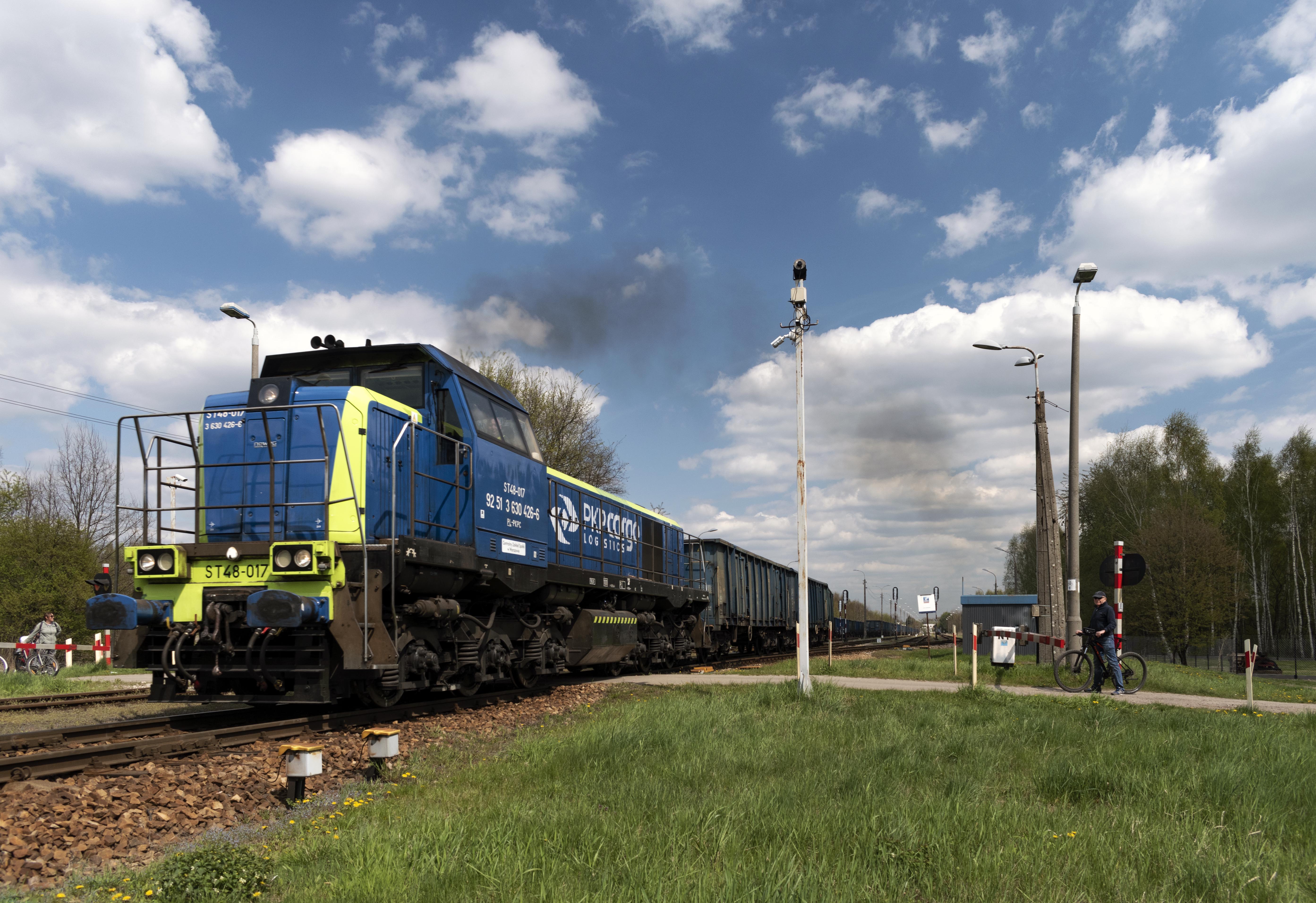
Below: a rake of empties has just arrived on the second track, the engine the brought them in has been uncoupled, it ran forward, changed onto the middle track to run back to Siekierki. With summer on the way, there's fewer full coal trains heading to the power station. The manoeuvre done, the level crossing gates rise, and many cyclists crosses the tracks, heading to Konstancin (right of pic) or Powsin and Las Kabacki (left of pic). Click to enlarge.

Below: the train standing on the first track in the pic above is pulling out of the sidings and onto the single track towards Okęcie via Piaseczno and Nowa Iwiczna. Level crossing with barriers on ulica Wąska ('Narrow Street') and on the other side of the tracks - ul. Saneczkowa ('Toboggan Street).

Below: heading up hill, a gentle ten-metre rise over 1.7km as the line approaches - but does not enter - the Las Kabacki forest. The level crossing on ul. Głowackiego in Kierszek is close to the border of Warsaw and the forest. Foreshortening effect of telephoto lens zoomed out to 300mm makes the hill look steeper than it is .


Below: looking back towards the sidings from the end of the disused siding, that can be seen on the right of the photo above.


Below: the way things were, April 2008. View from the other end of the sidings, from the level crossing on ul. Warszawska. The train on the middle track is moving away; it has one engine at the back, pushing, and another at the front, pulling. These days, the modernised SM48 locos can pull a whole loaded train unassisted.


There are plans to upgrade this line to a passenger line, which I must say would be a splendid idea (offering a new connection across Warsaw's southern suburbs). It's been talked about for ages (usually just before local elections - see this PR visit), but at last there's a master plan being drawn up, which in February last year was said to be three and half years away. So a reality by 2030? One can but hope... The line won't be a part of the government's Kolei Plus programme, which will be restoring 34 disused and partially disused lines to passenger service, rather this line will be part of a metropolitan project devised by the City of Warsaw. 

I returned by 710 bus from Klarysew, mainly to see the new route linking Konstancin and Kabaty - ul. Stefana Korbońskiego, a sorely needed thoroughfare for local residents. When I say 'new', it opened to traffic in December 2017 (!) this was my first visit here! Below: before boarding the bus - busy scene in Konstancin. Flags out for the 3 May public holiday, the red-and-white repeated on the level crossing barriers and road signs. In the absence of a direct Jeziorki-Konstancin train, I took the 710 bus to Kabaty, Metro to Stokłosy, then 715 bus home. Total walking today: 18,500 paces.


This time three years ago:
A review of the second part of Hillier's Betjeman biog.

This time four years ago:
New roads and rails

This time six years ago:
The Gold Train shoot - lessons learned

This time eight years ago:
Digbeth, Birmingham 5

This time nine years ago:
Still months away from the opening of the S2/S79 

This time ten years ago: 
Looking at progress along the S79  

This time 11 years ago:
Snow on 3 May

This time 12 years ago:
Two Polands

This time 13 years ago:
A delightful weekend in the country

This time 14 years ago:
The dismantling of the Rampa

This time 15 years ago:
Flag day


Sunday, 21 September 2014

By train from Warsaw to Konstancin and Siekierki

Local elections must be just around the corner, as this public transport suggestion is being raised once more, as it has done every four years. Yet - could it be different this time? pociąg

The idea is to use part of the coal train line from W-wa Okęcie to Siekierki power station to provide a passenger service between Konstancin and the city centre, calling at Piaseczno on the way. To promote the concept, SSKS, an association of friends of the railway, have put on two special trains from W-wa Zachodnia to Siekierki.

Once on board, passengers had the chance to lend their support for the idea, which had fallen flat after past local government elections. Why could this idea happen this time after having failed previously? Several reasons.

Firstly, the coal line has been re-nationalised; four years ago Swedish utility operator Vattenfall owned Siekierki and its railway line. Today it's owned by PGNiG Termika. It is undoubtedly easier to make the case for the public good when the railway operator Koleje Mazowieckie (owned by the voivodship) talks to state-owned PGNiG under the auspices of the Ministry of Infrastructure and Regional Development. Secondly, over the past four years there's been a large increase in the number of people living in Piaseczno and (to a lesser extent) in Konstancin, while places such as Julianów and Józefosław have burgeoned into veritable suburban dormitories. Most of the residents have jobs in Warsaw - which leads to Point Three - the growth of the office district around Służewiec in recent years. The new line, passing W-wa Służewiec, would be an ideal way to get people from Warsaw's southern exurbs into work. Fourthly - the opening of the spur from W-wa Służewiec to W-wa Lotnisko Chopina station makes it convenient for those wanting to fly from the airport to use a railway connection.

Below: the light green line shows the route of the coal train once it branches away from the main Warsaw-Radom line at Nowa Iwiczna. The proposition is that the line terminates at Mirków, a little to the east of Konstancin. New stations would serve Konstancin-Jeziorna, Kierszek, Julianów, Piaseczno Puławska and Piaseczno Mleczarska; 29 services each way would run daily between Mirków and W-wa Służewiec (in the top-left corner of this map, courtesy of Google Earth. Click to enlarge).


So - on to the photos of today's journey. Below: an opportunity for a press conference to discuss the potential of running passenger trains over the coal line from Nowa Iwiczna to Mirków.


Below: here's the train between W-wa Jeziorki (it is unlikely Jeziorki will be served by these trains as the station has no platform on the coal train line) and Nowa Iwiczna. The train has to be diesel, as there's no electrical traction on this line - in the foreground is the electrified Warsaw-Radom line.


Below: the two-car diesel multiple unit, which usually serves the eastern fringes of the Koleje Mazowieckie network, seen today between Julianów and Kierszek.


Below: looking down towards the sidings at Konstancin-Jeziorna. Two rakes of coal trucks await collection in the two left-hand sidings; the diesel railcar takes a break on the right hand track.


Below: photo opportunity by the bridge at Bielawa. Passenger trains pass this way once every four years, so it's worth recording this event. The plan does not foresee passenger trains going beyond here onwards to Siekierki.


Below: view from the cab, approaching Okrzeszyn (city każdy obcy będzi bity). Out here, between Konstancin and Siekierki, development is sparse, with the occasional new housing estate and scattered farmsteads. Quiet, surprisingly close to the centre of Warsaw, yet the threat of flooding is ever-present.


Below: 500km from where the Vistula rises in the mountains, snapped from the train. The railway line runs parallel to the Wał Zawadowski, the flood protection wall that lines the Vistula's west bank between Siekierki and Konstancin. Ideal for gentle off-road cycling.


Below: not far from Siekierki. We are just a few kilometres from the centre of Warsaw, yet the landscape is quite rural. Passenger trains out here will always be a total rarity.


Below: approaching the power station - chimneys and coal heaps. Passing under the rail bridge a 163 bus heading for Sadyba. The surrounding area has the klimat of the Zone in Tarkovsky's Stalker.


Below:  end of the line, Siekierki, and time for another photo opportunity. Here we are, 29km from W-wa Okęcie, having completed a 'U'-shaped journey.


Below: time to re-board the train at Siekierki and head back towards town. I get off the train on its return journey at Konstancin and walk back alongside the track to W-wa Jeziorki - exactly 10km.


I hope this time the plan prevails. Having this rail infrastructure and keeping it for just a few coal trains a day, while ul. Puławska is choked with traffic, is nonsensical. These rails should be serving commuters as well as the power station. If you live in Konstancin or Piaseczno, or anywhere in between, and wish to get into town quickly and without jams - here's the solution.

This time last year:
Summer's end, Jeziorki

This time three years ago:
Ząbowska, Praga's newly-hip thoroughfare

This time five years ago:
Catching the klimat

This time seven years ago:
Road to Łuków - a road trip into the sublime

Saturday, 25 June 2011

What's the English for tężnia?

This (below), dear readers, is a tężnia (pron. 'TENZH-nyuh'. Something that's well known to Poles, entirely unknown to Brits. This one is in Konstancin, a posh(-ish) exurb of Warsaw, which were it situated in England would be known as a spa*. The town of Konstancin was set up in 1897; before WWII, there was a sanatorium here as well as many villas belonging to the well-off.


Central to Konstancin is the spa park; central to the spa park is the tężnia, and central to the tężnia is a device (in Polish grzybek - lit. 'little mushroom'), left, that vaporises mineral water coming up under pressure from deep underground, creating a salty mist. The tężnia itself is a wooden construction that reminds me of Shakespeare's Globe Theatre stuffed with twigs. Mineral water, rich in bromide and iodine, trickles down the twigs and evaporates in the sun, leaving salt deposits on the twigs. Now, abiding in this environment is supposed to be healthy.

The interesting thing is that Polish doctors actually prescribe fortnightly stays at sanatoria such as Konstancin - paid for by the national health fund.

The park and the tężnia is open to one and all, and people of all ages come to enjoy the tężnia. You are only supposed to be in the vicinity of the grzybek for 15 minutes at a time, and within the tężnia itself for an hour. Entry is 9 zlotys (two quid), concessions for the young, old and infirm, open from April to October.

View from the outside of the tężnia, looking in. Note the lightning conductor running along the top. If you think this tężnia looks cool, you should visit Ciechocinek, 20km south south-east of Toruń; the sanatorium there has three tężnie (plural), in total 1.7km long and 16m high - these are the world's largest.

OK, so what is tężnia in English? Well, in German, it's gradierwerke (the Germans invented them in the 17th C.). There are several in Germany. In English, then? According to Wikipedia, it's graduation tower. But I don't think that makes any of my UK, US, Canadian or Australian readers any the wiser!

*Think of Royal Bath Spa or Harrogate Spa transplanted to Croydon to get an idea of Konstancin's place in Warsaw's consciousness. And to my Polish readers: the word 'spa' should not be capitalised (SPA) - the letters are not initials!

This time last year:
Literature and biology

This time two years ago:
Kraków air museum

This time three years ago:
Crumbling neo-classicism in Grabów

This time four years ago:
Little boxes, Mysiadło