Showing posts with label suburbs. Show all posts

Wednesday, 1 May 2024

Prague, Central Europe (2)

Two days and three nights in Prague, so many photos; here's the next batch. I'll start with a view that is most associated with the city; Hradčany castle, as seen from across the Vltava river. The scale, the magnificence of this complex of castle, palace and cathedral, is hard to match.

Below: rather like London's Routemaster bus, Prague's Tatra T3 trams (built by ČKD Tatra between 1960 and 1989) are kept running because tourists love them. And they are reliable. Their one drawback is lack of low-floor access, though modernised three-unit versions have a new low-floor centre section. Warsaw retired its fleet of Konstal 13N trams of similar vintage at the end of 2012.  

Below: a better form of transport for the well-heeled tourist, certainly one up on a horse-drawn carriage – a Škoda Felicia Super (1962-65). The 'Super' differed from the Škoda Felicia (1959-1962) by the bolt-on tailfins and a more powerful 1.2-litre engine. Although designed for five, actually carrying such a load is exerting undue pressure on the rear suspension!

Below: an even more unusual form of transportation that's largely disappeared from the world's cities is the paternoster lift. Named after the movement of rosary beads, this type of elevator moves non-stop, and careless users may suffer a gruesome fate. The accident rate for these is 30 times higher than with normal lifts. Carrying only two persons per platform, the wait for the next one is never long, but you need to judge getting on and getting off – timing is all. After Germany, Czechia is home to the largest number of paternosters in the world. Prague alone has four. (4. patro = IV piętro = 4th floor)

Below: view of the Prague suburb of Žižkov and its TV tower, as seen from Vitkov hill. Note the complete lack of high-rise blocks of flats; as far as the eye can see, the architecture is mainly 19th and early 20th century. This makes the boulevards, streets and squares of Prague's inner suburbs most attractive; and tourists tend not to stray out that far.

Below: statue of Jan Žižka, leader of the Hussite army (proto-Protestants) who defeated a Catholic crusade against them in 1420. The equestrian statue, one of the largest in the world, is central to the National Monument on Vitkov Hill, an inter-war complex celebrating the rebirth of Czechoslovak statehood. 


Left: the Žižkov TV tower, like any newcomer to a city's skyline, it is becoming increasingly accepted as decades pass. Work started in 1985 and was completed in 1992. It stands 216m (709ft) tall, so not quite as high as Warsaw's Palace of Culture (231m), but being on top of a hill it is just as prominent. An artefact of the late-communist era, this example of high-tech architecture has become the more iconic since the ten crawling babies (with barcodes for faces) by Czech artist David Černý were added in 2000. The current ones date from 2017 and weigh quarter of a tonne a piece.

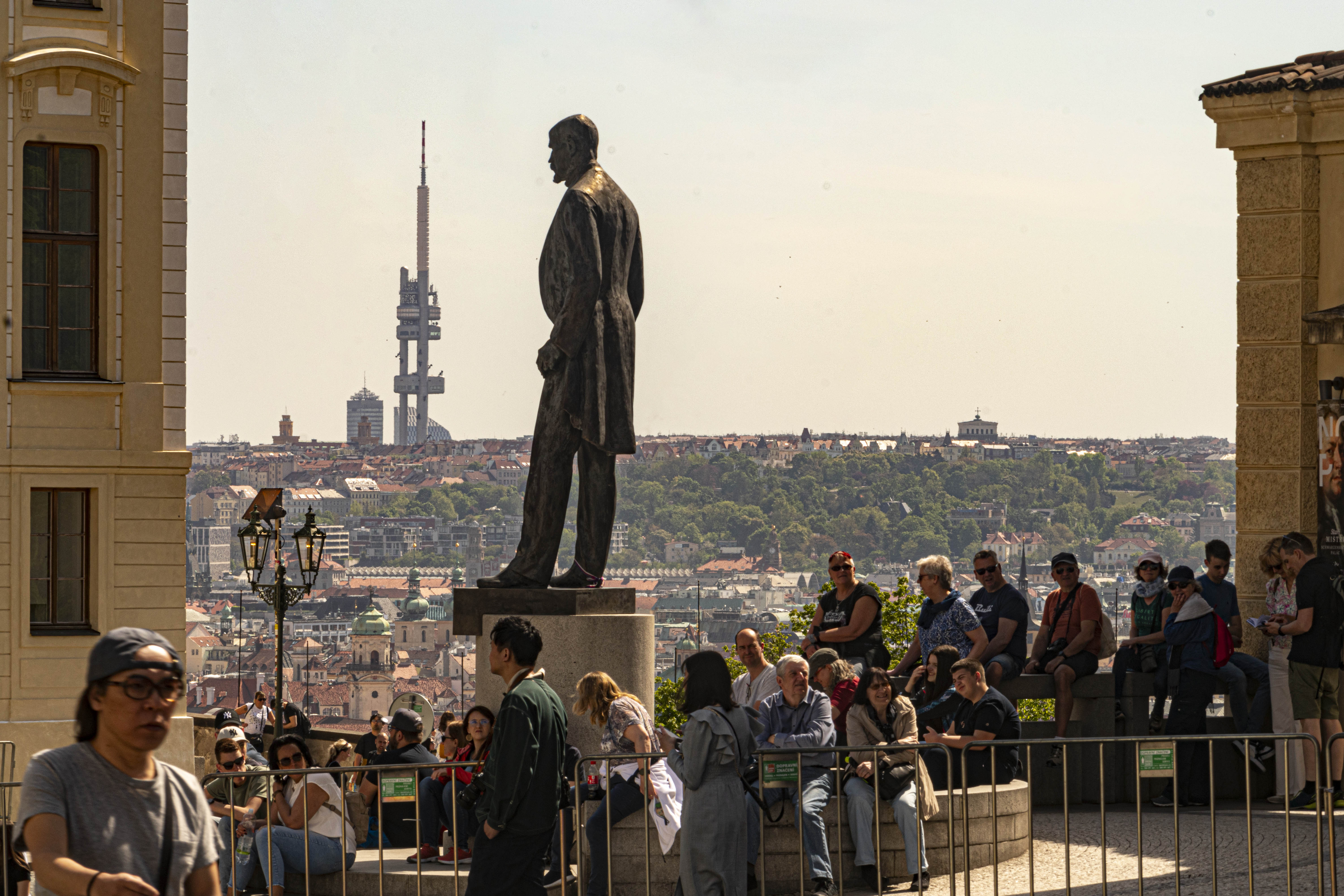
Below: atop Hradčany castle, one of several epicentres of tourist magnetism. The monument is to Tomáš Garrigue Masaryk (1850 –1937) progressive political activist and philosopher who served as the first president of Czechoslovakia from 1918 to 1935. The Žižkov TV tower once again dominates the skyline.


This time last year:
Under azure, Jakubowizna

This time two years ago: 

Łady roadworks

This time three years:
S7 extension works

This time four years ago:

This time five years ago:

This time six years ago:
New roads and rails

This time seven years ago:
The Gold Train shoot - lessons learned

This time eight years ago:
The Network vs The Hierarchy in politics

This time nine years ago:
45 years under one roof

This time ten years ago:
Digbeth, Birmingham 5

This time 11 years ago:
Still months away from the opening of the S2/S79 

This time 12 years ago: 
Looking at progress along the S79  

This time 14 years ago:
Two Polands

This time 15 years ago:
A delightful weekend in the country

This time 16 years ago:
The dismantling of the Rampa

This time 17 years ago:
Flag day

Tuesday, 30 May 2023

No longer the place to live

Twenty years ago, life in Jeziorki was sweet - an ideal place to live, close enough to travel to work in central Warsaw every day, to be in the office by nine am, yet a quiet, green area. Quite the place to raise children. Since then, 'Zielony Ursynów' ('Green Ursynów' - the part of the Warsaw district of Ursynów lying to the west of ulica Puławska and the Las Kabacki forest) had been developing slowly, but that pace has accelerated rapidly in recent years.

The opening of the S7 extension (to Lesznowola last August, and all the way to Grójec last month, thus linking the northern and southern bits of the S7) has vastly increased the amount of traffic pouring through Jeziorki. 

Below: ulica Karczunkowska, peak morning rush hour. See where that tanker is in the middle of the photo - on either side of the road, you will see... no pavement. Traffic is up maybe tenfold, maybe more, but there is still no f*cking pavement. This road is not scheduled for an upgrade until 2026. Meanwhile, there is a vastly greater risk of pedestrians or cyclists being killed or injured along this stretch, not to mention the extra noise and pollution. Just behind that tanker is the junction with ul. Nawłocka (to the left), and access to the Biedronka supermarket and W-wa Jeziorki Park+Ride (to the right). Trying to turn into Karczunkowska is a nightmare, so the local residents have petitioned for a roundabout to be placed here - I hope it happens, as it will have the additional benefit of slowing down traffic as it comes charging down from the viaduct. Reminder - the speed limit here is 50km/h.


That's just the through traffic. Jeziorki is also growing organically, with developers moving in to build new estates. A new house generates one and half new cars for the neighbourhood. Below: land for sale, Jeziorki - 2.1 hectares, enough to build 24 to 30 terraced houses; once sold and developed, another 36 to 45 new cars for ul. Trombity. They paved paradise, put up a parking lot.


Below: one of four new estates on ul. Trombity, this one of ten houses, just completed, and up for sale. 


Talking of through traffic - I feel very sorry for the residents of ul. Pozytywki and ul. Cymbalistów; these two roads are used as rat-runs by motorists wanting to avoid the traffic lights at the end of ul. Karczunkowska to turn right towards Mysiadło, Nowa Iwiczna, Piaseczno and all points south. Despite the 30km/h speed limit, there's a constant stream of cars charging down these streets, heedless of the speed-bumps, tearing past the kindergarten and the new housing estate on Cymbalistów. The answer here is to create a Woonerf - the Dutch solution to the problem of through traffic tearing through quiet residential areas. My solution - the działka, 26km to the south, 24 minutes by train from W-wa Jeziorki to Chynów. From Chynów station I can walk to the działka without fear, often without being passed by a single car. And above all, peace, quiet, clean country air*.

Below: elegy for a lost suburb - Karczunkowska in 2007, five years after we moved to Jeziorki, 12 years before the viaduct crossed the tracks, 16 years before the S7 extension was completed. This is the reverse angle of the shot in the top photo. As busy as it got back then, I had to wait a bit to get the cars into the composition.

The inexorable lava flow of development will take time to reach Jakubowizna; it is happening. Three new houses have appeared on my street since I bought the działka in 2017, but each one is detached, and two of them are bungalows. I cannot see the same kind of development that blights Jeziorki - or worse, Zgorzała, Zamienie and Nowa Wola on the other side of Warsaw's city limits - whole fields being turned into row after row of terraced houses with no asphalt or amenities.

* Country air pollutants: diesel fumes from tractors, chemicals used to spray orchards, and smoke from wood- or coal-fired domestic heating. But at least there's a thousand times less traffic on the roads.


This time last year:
Textures of Childhood

This time two years ago:
Stupendous sunset, Sułkowice

This time seven years ago:
Politics - the importance of fact.

This time eight years ago:
Rural Mazovian toponyms

This time nine years ago:
Carrying the weight on both shoulders

This time ten years ago:
Railway history - the big picture

This time 12 years ago:
A new lick of paint for W-wa Powiśle

This time 13 years ago:
The ingredients of success

Saturday, 10 December 2022

City centre notes

Most of my life has been spent living in the suburbs - 36 years in the West London suburb of the Borough of Ealing; four years in the suburbs of Coventry (including two on the campus of Warwick University) and 25 in the Warsaw district of Ursynów - it's 'green' parts - Pyry and Jeziorki. And of those years, 37 have been spent living in detached houses. No one living on the other side of my four walls. The past few years have seen me spending more and more time in the countryside, which I am coming to prefer over suburbia. I used to think suburbia was the best place to live; today - I'm not so sure, as housing density and traffic increases.

The past four days I have been cat-sitting at Moni's flat just off Warsaw's New Town (Nowe Miasto) - that's 'new' as opposed to Warsaw's Old Town - 15th century rather than 13th (rebuilt after the war). Below: looking at ulica Freta from the New Town market square, rush hour.

This is an entirely new experience to me - staying for more than a single hotel-night in a city centre -  being in my daughter's flat, with kitchen, pet, routine, office work online - and city-centre life. Strange.

Left: just 400m from Moni's front door, the Barbakan marks the border between the New Town (ahead) and the Old Town (behind). Built in 1540 and rebuilt after WW2. Fewer tourists penetrate the New Town, preferring the more commercialised Old Town, its market square and the castle square. Those that make it beyond the Barbakan tend to be more curious and less prone to boozy excesses.

So it's quiet - but not silent. On the działka, the only things that make any noise are the fridge and my bedroom radiator as they cool and warm; other than that, there are no 'bumps in the night'. In the flat, however, I have the impression of being in a hotel or student halls of residence - beyond these four walls, there are people - things going on. 

Through my sleep, I dimly hear somebody's alarm clock going off. People are walking up and down the stairs. Someone's hoovering - where? there's a flat upstairs, downstairs, to the left and to the right right. Little boxes all around. People separated from me not me hundreds of metres, but by the thickness of a wall.

The flats are are of various sizes (Moni's is very small - one room, tiny kitchen, tiny bathroom), the building's just four floors high - so no lift. But for one person - entirely adequate, cheap to heat and light.

In the country, I can go for a 90-minute walk and literally not encounter any other human being during that time. I can revel in the solitude, the peace, the luxury of uninterrupted trains of thought.

But here, I am a stone's throw from a UNESCO World Heritage Site. My evening strolls - either through dark, cobbled backstreets that could be from an Expressionist film-set, or else along brightly lit, car-free thoroughfares decorated for Xmas and full of tourists and revellers - are quite magical. A different magic to that of silent misty forests and orchards in the encroaching dusk. 


Neither forms of magic are on offer in suburbia, all rushing cars, muddy puddles where pavements should be.

Living so close to a street full of excellent restaurants, cafes and bars, living one minute rather than 30 minutes walk from the nearest grocery shop, a Carrefour Express, however, is costly. The temptation to live it up is great. Crisps and a beer? Don't mind if I do. Good bottle of wine?

After a few days' city-centre living, I must say I can see the appeal. Massively. A great counter-balance to rural life, but so much better than suburban life which has little of the civilisation of the city, and little of the comforting calm of the countryside. Suburbia is not what it was.

This time two years ago:
First snow for ages!

This time three years ago:

This time four years ago:
Consciousness, memory and spirit of place

This time five years ago:
Polish Perivale

This time six years ago:
Power in the vertical

This time ten years ago:
And still they come [anomalous flashbacks that is]

This time 11 years ago:
Classic glass

This time 12 years ago:
What's the Polish for 'pattern'?

This time 14 years ago:
"Rorate caeli de super nubes pluant justum..."

Sunday, 6 February 2022

Twenty years in Jeziorki

On 6 February 2002, I returned from a day-trip to Kraków with the children to our brand new house. We had just moved in that day, some two and half years after buying the land and having the house built. It was not yet ready - for the first few weeks, the builders were still living downstairs finishing the kitchen and bathroom.

Twenty years... the longest under one roof ever. Here's where I have lived - with the exception of my student days at Warwick University (and off-campus in Coventry), I have lived around ten miles (16km) from the centre of a European capital city.

  • Croft Gardens, Hanwell - 12 years 7 months
  • Cleveland Road, West Ealing - 6 years 5 months
  • [Warwick University, on campus and off - 3 years 9 months]
  • Cleveland Road, West Ealing - 2 years 4 months
  • Ribchester Avenue, Perivale - 14 years 9 months
  • ul. Gajdy, Pyry - 4 years 6 months
  • ul. Trombity, Jeziorki - 20 years today [including three summers in Jakubowizna]

This milestone is spiritually significant; for me, it shows the depths of roots, and my attachment to place. Five-eighths of my life in the UK, three-eighths of it in Poland. In my dreams, the two become blended; Pitshanger Park with Warsaw's skyline beyond, the other night, or taking a bus from Ealing to Jeziorki with my dad, via Acton and Shepherd's Bush. I'm from here and I like it here.

Below: photos from above - spring 2011, summer 2021. Note photovoltaic panels on the roof, one car less.


After 20 years in Jeziorki, the house feels comfortable. There was a small remont in 2017, mainly focused on the attic (much thicker insulation). Kitchen appliances - fridge, freezer (Bosch) and clothes dryer (Miele) still OK, washing machine (Bosch) replaced by an LG two years ago, and Bosch dishwasher replaced by another Bosch at Christmas. The new appliances are far more economical on energy than the old ones. The central heating boiler (Junkers) is due for replacement soon. No other problems to report. Furniture - most of the Ribchester Ave stuff has gone (with the exception of the sofa bed, beautifully refurbished in cream leather by Verson of Nowa Iwicnza). Kitchen chairs, scratched to pieces by cats, will remain (as any replacements are also likely to be scratched to pieces by cats).

The garden's still lovely, the moles still at bay.

Jeziorki itself has changed over 20 years but not radically; no major housing developments - either small estates of up to 12-15 houses, or individual detached-house builds. We now have town sewers (since 2013) but still lack a pavement along ulica Karczunkowska. Public transport is decidedly better, but the rapid expansion of Warsaw's exurbs, beyond the city's borders, mean traffic jams are just as bad as they were.

The planned development of some 2,500 flats under the government's Mieszkanie Plus scheme seems to have come to nought; I worry that its scheme to build a massive airport a third of the way between Warsaw and Łódź in Baranów might mean that Okęcie is closed, and with it the reason for the special zoning of Jeziorki (no buildings over 12m high) will disappear. Still, this is in the far future, and this government's track record on major infrastructure projects is poor. I hope that in 20 years' time, Jeziorki will be as green as it is today.

This time last year:
Winter walk around Jakubowizna

This time two years ago:

This time three years ago: 

This time five years ago:
15 years under one roof

This time seven years ago:
Białystok: Ipswich of the East 

This time eight years ago:
Sadness at the death of Tadeusz Mosz 

This time nine years ago:
Interpreting vs. translating vs. explaining

This time ten years ago:
More than just an Iluzjon 

This time 11 years ago:
Oldschool photochallenge

This time 12 years ago:
Warsaw's wonderful nooks and crannies

This time 14 years ago:
Viaduct to the airport at ul. Poleczki almost ready


Wednesday, 11 November 2020

Zamienie is changing

It's been a while since I last visited Zamienie, much has changed. The threat of a new distribution centre that would have seen hundreds of trucks rolling through has lifted - in its place will be something called 'KampusPlus', which will emerge behind the chipboard fencing to the left in the photo below. A Żabka convenience store offers some retail opportunities to shoppers that have newly moved in. Skips are full of cardboard boxes that once contained fridges, cookers and flat-pack furniture.


In the fields full of poppies that gave their name to Osiedle Polnych Maków ('estate of the poppies of the fields'), the campus, a mixed-purpose development led by the Politechnika Warszawska, will appear. The street leading up to it is named after Thomas Alva Edison. This is no longer Warsaw; this is part of the gmina (municipality) of Lesznowola. So Warsaw's city authorities don't have to give a stuff about how many new estates get built here, or how the people living here should get into and out of the city centre.


Below: cryptographer Jerzy Różycki, one of the Polish team that cracked the original Enigma code is commemorated in the name of this new street, running off ul. Arakowa.


The new bits of Zamienie are architectually more attractive and more functional than the earlier blocks, like this one below on ul Waniliowa ('Vanilla Street' - metaphorically too). Estate agents outnumber food shops. Note the cars. Zamienie is served by just two bus routes, the 715 and 809, the bus stop being almost a kilometre from this point. And W-wa Jeziorki railway station is over 2km from here (a whole kilometre further than my house across on the other side of the railway line in Warsaw, in Jeziorki).


And so most households have to be two-car families. This, below, is ul. Arakowa and the Osiedle Polnych Maków, completed in 2009. Some of the houses have been occupied for over a decade. Note: there's no pavement. The drives outside these terraced houses lead to garages big enough for a VW Polo circa 2004, but way too small for a modern SUV. So one car's parked on the drive, the other outside. Nowhere for pedestrians to walk. So pedestrians have to brave the street. Mums with baby buggies. Shit planning. All the shittier when the extra traffic associated with the KampusPlus - first the construction plant, then the thousands of workers - start driving down this way.


You can see the problem in this photo, below. Too big car. Teensy-weensy garages. Now, I don't know the individual circumstances of these folk, but I guess that owning two cars means you can't afford a house in Warsaw proper. How about dumping the big car and buying a house closer to public transport and to the amenities? Arguments about "it's nice to live among fields" cut no ice as the fields around here will soon be developed. Far from shops, far from schools, far from the city centre, wholly dependent on the car. There are just two junctions connecting the ever-growing Zamienie to the main road; early-morning rush hours must be hell for drivers trying to get out of here.


Things will improve once the S7 extension is complete. Below: looking down from a temporary hill of soil onto the new bridge that will link Jeziorki (on this side) with Dawidy Bankowe and Zamienie (on the other). The bridge should be wider than the viaduct over the railway line at W-wa Jeziorki station. So even if the traffic if flowing easier here, it will jam up once it gets around the corner.


How will Covid-19 affect where we chose to live? Will people trade the convenience, amenities and attractions of urban life for the lower population density of the far suburbs and exurbs? To early to say.


This time three years ago:
Globalisation in retreat

This time seven years ago:
Leeds, a city made uglier by crooked developers

This time eight years ag0:
Węzeł Lotnisko (now Węzeł W-wa Południe) - works continue

This time 13 years ago:
Its Independence Day

Thursday, 8 August 2019

Back in Warsaw for a proper summer

Five days in London; early August and each day's weather forecast starts with the word 'unsettled'. Back in Warsaw, the August vibe is continental; warm days with risk of thunderclouds in the late afternoon, which clear the air and water the crops. I take the long way home from W-wa Jeziorki station to make the most of the sunshine and warmth.

The cereals have been gathered in; many fields are now stubble. Goldenrod (nawłocz) and mugwort (wrotycz) shine yellow amid the greenery. I'm watching the hop cones take shape and mature.


On the horizon, the chimneys of Siekierki power station...


Below: 30 to 40 minutes a day of extra commuting takes you from here (ul. Grenadierów, Grochów, Warsaw) out to the fringes of the city, where buses and trains are still plentiful, but where the landscape is more conduicive to a happy life.


This time last year:
Poland's trains failing in the heat

This time two years ago:
"Learn from your mystics is my only advice"

This time three years ago:
Out where the pines grow wild and tall

This time six years ago:
Behold and See (part V) - short story

This time seven years ago:
Syrenki in Warsaw

This time eight years ago:
What's the Polish for 'impostor'?

This time nine years ago:
Running with the storm on the road to Mamrotowo

This time 11 years ago:
St Pancras Station - new gateway to London

This time 12 years ago:
Mountains or sea? North Wales has them both

Sunday, 30 December 2018

Explorations of a largely unknown Ealing

Today I directed my walking south of the Uxbridge Road, between Northfields and South Ealing stations, discovering local streets and footpaths that I have never walked along, despite them being little more than a mile from where I spent a significant part of my life.

Some of the streets around here are well known to me; there's Elers Road - on the corner with Northfields Avenue, Pan Rozwadowski had his Polski Sklep here back in the 1960s and '70s; there's Walpole Park, backing on what used to be the main Ealing Public Library until the shopping centre opened in the 1980s; there's Lammas Park between Northfields Ave and Walpole Park. These two adjacent parks allow one to walk all the way from Northfields station to Ealing Broadway through greenery, away from the traffic's incessant roar. However, I had many streets to explore around here.

I turn off the main thoroughfare to seek out the paths less trodden. Mattock Lane yields the sight of St John's church, built in 1876 to accommodate the newcomers to West Ealing as working-class housing expanded into fields and orchards. Click to enlarge - look at the seagulls on the ridge of the church roof.


From Mattock Lane, I turn down a footpath named Radbourne Walk, separated from the busy Northfields Avenue by allotment gardens. And here I chance upon a row of Victorian 'model cottages' (below) - they are tiny (two small rooms on a single storey, another row on top). Built in 1869.


Below: corner of Carew Gardens looking into Lyncroft Gardens and an Edwardian pillar box - note royal cypher E VII R - serving Edwardian housing. "It's grand to be an Englishman in 1910 - King Edward's on the throne, it is the age of men", to quote the Sherman Brothers' libretto to Mary Poppins. For the reasonably well-to-do who lived here in those days, it was a splendid place; electric Central Line tube trains could take them to the City from Ealing Broadway in a little over half an hour, and the surrounding parkland gave a semblance of countryside.


Below: north-east corner of Lammas Park; note the turret feature on the house across Elers Road; many Ealing houses at ends of roads have turrets to this day. So much greenery, even in midwinter. British gardeners were always adept in choosing evergreens to give year-round verdure.


Below: cheaper late-Victorian or early-Edwardian housing across the road from Lammas Park, its gates protected by a small lodge house.


Below: St Mary's church, dating back to the 12th century, was Ealing's original parish church. Falling into disrepair in the 18th century, it was rebuilt in its current shape in the 1870s. In the foreground, the Rose & Crown; the atmosphere here resembling a village rather than a suburb.


Below: corners of quaintness are still to be found in Ealing. This is St Mary's Square, the building to the left being the old fire station. Reminding us of times when Ealing was still a village, before the railway came and began to turn it into a suburb from the 1840s on.


Left: how many lifelong residents of Ealing can say where this row of almshouses is located? South of St Mary's church, Little Ealing, it was built at the very end of the 19th century to house the elderly of the parish. These replaced mid-18th century almshouses that were knocked down to build a parade of shops, one of which features in the next photo...

Below: looking like it might have done 80 or 90 years ago, the North Star pub and next to it, a restored 'ghost sign' above the side of Flight Centre, a travel agent's shop on the Mall, where it meets the Broadway, on the Uxbridge Road.


The area around South Ealing and Lammas Park often appeared in Monty Python sketches. In 1999, Michael Palin (now Sir Michael) shot a short documentary entitled Pythonland, in which he revisits the locations of several well-loved sketches. The sketches were filmed nearly half a century ago, Pythonland was made nearly 20 years ago - interesting to see how this part of Ealing has changed since then.


Well worth watching - and proof is offered to those who doubt me, that 'the Uxbridge Road' is always preceded by the definite article.

Bonus quiz: two old(ish) cars, one a classic, the other less so. Name them (winner is the person who provides most details). One looks longer than its owner's house is wide!


This time last year:
Eric Ravilious

This time three years ago:
Dark thoughts at 2015 comes to an end
[Got that one right then, eh!]

This time four years ago:
Shots from the sky

This time five years ago:
One-millionth of a zloty 

This time seven years ago:
Random year-end thoughts

This time eight years ago:
Beery litter louts

This time nine years ago:
Miserable grey London

This time ten years ago:
Parrots in Ealing

This time 11 years ago:
Xmas lites, Jeziorki

Friday, 15 June 2018

Under the Sodium

Plato said: "it is to no purpose for a sober man to knock at the door of the muses,” and maybe he's right. For after two litres of Metropolis India Pale Ale (5.7% abv = 11.4 units), my journey home from W-wa Jeziorki station takes on mystical dimensions, immersed in the quantum reality of deserted suburban streets illuminated by sodium light that emit packets of orange photons.

Below: ul. Nawłocka looking towards ul. Trombity.


Below: ul. Nawłocka from the junction with ul. Karczunkowska


Below: ul. Trombity looking north towards the junction of ul. Dumki (in the distance)


Below: ul. Trombity looking south; fields to wheat to the left, beyond that, my window overlooking them. The digging up of the road for the new sewers have turned the road into a dusty, sandy track; the feel of 1930s America returns with a searing clarity.


Below: the deserted house on ul. Trombity. A letter from the local authorities suggests it may not be here very much longer...


Below: home, home again... outside, the night, the beating of insect wings.


Perhaps if I drank a bit more alcohol, I'd become more productive!

This time last year:
"Further progress? Hell yes!"

This time ten years ago:
The 1970s and the 2000s

Friday, 23 March 2018

Edge of town


The field between Nowa Iwiczna and Zgorzała is filling up with housing, new units are appearing each time I walk over there. This photo (click to enlarge) is from last Sunday; an azure sky, fading to midnite blue at the zenith thanks to the polarising filter that also whitened the snow. Low-voltage power lines and a rutty track converge at infinity. Crisp shadows from the sun that's getting stronger by the day. A brief moment of anomalously familiar memory; how could I have witnessed such a scene in my West London childhood? And yet I've had this feeling before. 1950s USA or Scandinavia; housing on an airbase in the far north - Alaska? Greenland?

This time two years ago:
The Name of God, Consciousness and Everything

This time four years ago:
The clash of narratives

This time five years ago:
The Church and democracy

This time six years ago:
Prime lens or zoom?

This time seven years ago:
Warsaw's failed bid as City of Culture, 2016

This time eight years ago:
Stalinist downtown at dusk

This time nine years ago:
The End of an Age of Excess?

This time ten years ago:
Snowy Easter in England

Tuesday, 13 March 2018

Perivale Tryptych

Perivale! Where I left to go to Poland in 1997. Unremarkable 1930s suburban sprawl, sliced through by the railway (Central Line and Great Western Railway), by the road (the A40 Western Avenue), and, more gently, by the River Brent.

Below: looking westward towards Greenford station, an eastbound Central Line approaches Perivale. Above the train some rare relics of the GWR, some semaphore signals.


Below: the footbridge over the Western Avenue. In the distance gleams white the Hoover building, a gem of Art Deco architecture. On the horizon to the left, Wembley Stadium


Below: the River Brent dissects the Ealing Golf Club, the right bank (to the left in this photo) being in Perivale, the left bank (right) being in Ealing.


It might look pretty in the sun, but Perivale had lost its semi-rural charm to urban sprawl back in the 1930s. As far from the centre of London as Jeziorki is from the centre of Warsaw, I know where I'd rather live!

This time seven years ago:
Cycling and recycling

This time eight years ago:
Winter still holding out in the forest

This time nine years ago:
Little car, huge price

This time ten years ago:
Old school Łódź