Showing posts with label cars. Show all posts

Monday, 14 July 2025

The Aesthetic Attention Span, or How Long Before We Need The New?

Life moves in cycles; optimally, these are spirals, we return to where we were but one notch higher up. We learn, we understand, we evolve. Sometimes, however, the cycle spins downwards. History, a series of events that have a tangible effect on our lives, moves erratically, but does tend to echo, repeat, rhyme. Anacyclosis. What goes round comes around.

But the aesthetics of our times? Architecture, design, fashion, literature, music, cars, graphics – yes, things change, the quest for novelty and innovation is limitless and it shapes the spirit of our age, indeed any age. This is the zeitgeist. 

We tend to label the look-and-feel of our built environment, our surroundings, by decades, book-ending them conveniently. In my mind's eye I can scroll through my memories of Britain from the early 1960s, still emerging from postwar austerity, drab colours and clothes, through the colourful '70s to the mid 1980s in distinct phases, each defined by music, clothes, car designs, high-street logos, typefaces and indeed colours. And then, sometime around around the mid-1990s, aesthetic change starts to become change for change's sake, not for the sake of modernity. Form and function, that sort of thing.

Look at a car from the 1920s, and compare it to one from the 1950s. An infant could tell you which looks more modern. But look at a car from the mid-1990s and compare it to something off the production line today... Does it really look more modern... or just different?

Below: thirty years of automotive design progress, 1925 to 1955.
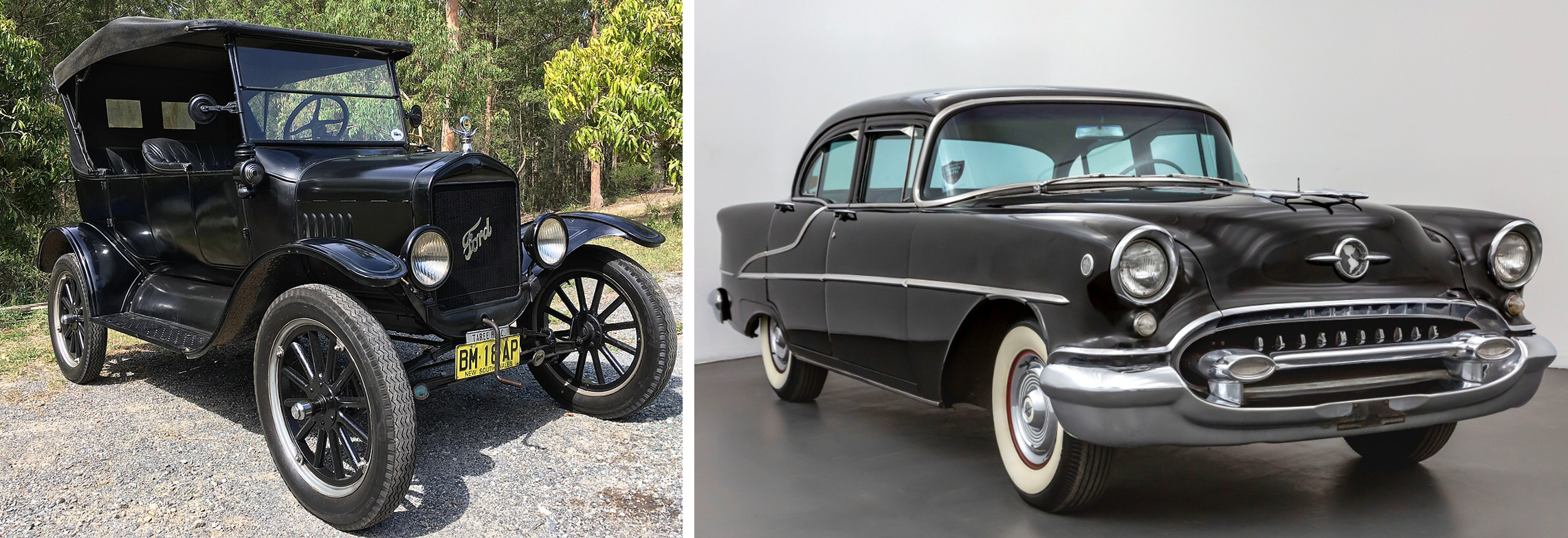

Below: thirty years of automotive design progress, 1995 to 2025.


If I were to have my pick of the above four, I'd go for the 1955 Oldsmobile. And stay with it until the end of my life. Because I like its looks more than the more recent designs. One reason why the automotive industry has failed to prise any money out of my bank account over the past quarter century has been its inability to design a car I'd actually like. The crumpled-tin look of contemporary car design turns me off. Just look at the grotesque 'face' of the current Toyota Whatsit (above right). It looks like a whale feeding on krill.

Music, clothes, typography – has that much changed since 1995? The technology obviously is quite different, as is the political vibe. But visually, aurally, aesthetically, 1995 is far closer to today than 1955 was to 1925. Aesthetic change for the sake of aesthetic change – built-in obsolescence – is a driver of economic growth and a wasteful one at that. How can you possibly be seen to be driving a 1959 Cadillac in 1962, by which time the fins had shrunk and men wore pleatless slim-line pants and pork-pie hats rather than broad-brimmed trilbies and trousers featuring acres of pleated cloth. Just a few years, and what a difference. From Humphrey Bogart to Steve McQueen. Cool change. But what's changed in men's fashions since the mid-1990s?

One of the first films I watched on my own in the cinema (and the first film I bought on DVD) was American Graffiti (George Lucas, 1973). A film that wallows in nostalgia – the music, the fashion, the trends, the cars – from an era just ten years before it was shot. Do you feel nostalgic about 2015? I could name you a hundred songs from 1975, for example, but not one from 2015. Did we wear different clothes in 2015? Did people go around with different hairstyles?

Access to the tools of design was once hard-won; a draughtsman's drawing board and all the instruments needed to turn a concept into a sketch into plans for a working prototype. Today, software makes possible professional-level design to anyone who has a desire and a knack to do so. The same with music, with movie-making, with any form of creative endeavour. The barriers of entry have fallen. Great, you may say. More democratic. No more closed shops. Everyone can now create.

But what's happened is that the long tail has stretched out towards infinity. A handful of titans dominate each industry at one end, while a vast number of creative people struggle for a handful of page views at the other end. Our blockbuster movies tend to be remakes or franchises, nothing new is breaking out of the underground. Yet surely somewhere in that long tail is a talent or talents that could launch an aesthetic movement to equal Art Nouveau or Art Deco, the New Look or Rock'n'Roll. But it's all too fragmented. That talent needs to be planted in a soil, in a social milieu, aesthetic change does not occur in a vacuum.

While I feel that humanity is indeed in a historical inflexion point, that seismic geopolitical and socio-economic change is afoot, I can't say the same about the arts and culture. Our attention spans, shortening year by year, flick to the default – "I'll stick to what I like". Kitten videos.

The Shock of the New? There are enough shocks out there already, thank you, without introducing any aesthetic shocks.

It will be interesting to return to this post in ten, twenty and thirty years' time. Is an aesthetic revolution around the corner? Or have we emerged out of a particularly creative period in human history, and now have nothing more than algorithm-generated mediocrity and AI slop to look forward to? Are paradigm shifts in aesthetic sensibility caused by the supply side (gifted innovators) or by the demand side (society bored of the old and itching for something new) – or 100% of both? 

I was there in November 1976 when the Sex Pistols, supported by the Clash, visited Coventry with the Anarchy tour. That was one of those aesthetic tipping points. I wait for something similar.

This time two years ago:
Wałbrzych, Książ and Riese


This time 11 years ago:
How the other half lives - a Radomite's tale

This time 12 years ago:
On guard against complacency

This time 13 years ago:
Ready but not open - footbridge over Puławska

This time 14 years ago:
Dusk along the Vistula

This time 15 years ago:
Mediterranean Kraków

This time 15 years ago:
Around Wisełka, Most Łazienkowski, Wilanowska by night

This time 16 years ago:
Summer storms

This time 18 years ago:
Golden time of day

Saturday, 10 May 2025

Campaign for Real Motoring

Since Moni moved to Prague, I've been looking after her Nissan Micra. Built in 2005, its first owner was the mother of a classmate from Moni's school, from whom she bought it in 2020. Living in Warsaw, Moni didn't put many miles on the clock, and since leaving it with me in December 2023, the car is used minimally. One round trip a week to Lidl in Warka, about 40km. As of this morning, 143,106 kilometres on the clock (88,921 miles), of which I did about 3,200 km over the past 12 months. This means I need to fill the car up at the petrol station four or five times a year, once every 750 km.

Electric front windows (rear windows are hand-wound) is the only concession to modern motoring to be found in the car. No air-con, manual gear change, old-school radio. Ah! It does have keyless locking (what happens when the battery expires? Then you prise off the cover of the door handle, and put the key in the lock...)

My social-media feeds bombard me with ads for new cars. But I will not buy a new car. Now, let's consider what would happen if eight billion people were to suddenly say that 1.5 billion cars is enough for our planet and would stop buying new cars. If Europeans were to say that 260 million cars is more than enough for the European Union (of 450 million people). There'd be enough cars to keep us all motoring for a long, long time. Those existing cars could keep going for decades (just look at Cuba). Their value would go up as supplies of new cars begin to run dry. Scrapyards would empty as parts get cannibalised to keep existing cars roadworthy. Job losses in the factories would be replaced by new jobs in remanufacturing.

I don't need a car that's a stuffed full of electronics, with touchscreens, maps and other gizmos that beep. I need a speedometer, odometer/trip meter, petrol gauge and indicator lights. Even a rev counter is optional. Mirrors and seats – manually adjustable. Manual gear change (or course). A simple, basic car with an emphasis on sustainability – extreme long life, modular design so elements that wear out can be easily swapped.

The Micra passed its MOT last summer but with a note of caution that rust is beginning to take hold of the undersides; so 2,000zł-worth of welding had that sorted out. I'd rather keep piling money into an old car than buy a new one. 

Car aesthetics are immensely important to me. The way cars look influence the visual appeal of the built landscape. They are as important as architecture. But a question for myself: do I simply like old cars because they remind me of my childhood? Or was car design intrinsically better in the 1960s than it is today? Safety is important; how much of today's automotive aesthetic is the result ot safety considerations (crash-proof cages, bonnets shaped to minimise injuries to pedestrians etc) and how much is that 'creased-tin' look that car makers consider to be in vogue?

This is what I like. On my way from Kraków Główny yesterday to the Schindler's Factory museum, I passed a superb collection of historic Mercedes-Benz vehicles in the shopping mall by the station. These included replicas of the first Benz motorcycle and car, pre-WW1 Benzes, interwar cars (including the only small, rear-engined Mercedes-Benz, and postwar classics. Don't know whether my favourite was the 'gullwing' 300SL or the 'pagoda' 230 SL (below). Could I see myself owning one and driving to Warka to do the weekly shopping? "Jeez, what a waste of machinery!"

I'm not a mechanic; can't find my way around a screwdriver; under my ownership, entropy would take hold; things would fail, bits would break – and rust never sleeps. I don't dream of owning a classic car, but I do waste an inordinate amount of time ogling CarandClassic.com looking at them and simply imagining what it would be like to own one. It's the same with toy cars. Corgi, Dinky and Matchbox – from my childhood – remembering the qualia of playing with them, opening their little doors, tipping forward the little seats... But while I get the Corgi Club newsletter and read excitedly about the new releases of 1960s toys, complete with replica boxes, perfectly made, I know that actually getting one would disappoint and would not bring back those exact qualia memories. I can conjure them up in my mind better. Same with a classic car. I can smell the interior of a classic British car of the 1950s and 1960s. I can perfectly picture the engine bay under the bonnet, the exact shade of green of a BMC cylinder head, the air filter in black (with rust colouration), and hear the sound of a Morris Minor changing down from third gear to second.

And at the wheel of the Nissan Micra, I can be driving anything I imagine. Sedately. Taking it easy for all the sinners on the roads. Like the chap in the black SUV who overtook me at 90+ km/h in a 50km/h zone with double white lines in the middle of the road today. Below: my 1932 Deuce Coupe, my 1949 Dodge Power Wagon, my 1953 Chevrolet Thriftmaster 1⁄2-ton truck, my 1956 Oldsmobile 88. As I drive from Chynów to Warka through Wygodne, Michalczew and Gośniewice. Orchards, crossroads, warehouses, electricity cables stretched above the road, the two-lane blacktop ahead of me, it's all in the mind.

The automotive industry has lost its way. A good time to turn from making ego-boxes for the insecure to building armoured fighting vehicles to boost Europe's defences in an age of Putin and Trump.

This time last year:
Gdynia

This time two years ago:
Covid is over; what did we learn?
[Covid finally caught up with me seven months later]

This time three years ago:

This time four years ago:
Blossom time in Jakubowizna

This time five years ago:

This time six years ago:
Busy doing nothin'

This time 11 years ago:
Springtime pictorial

This time 12 years ago:
Kitten time!

This time 12 years ago:
Warsaw-Centrum to Jeziorki by train with super-wide lens

This time 14 years ago:
Loose Lips Sink Ships - part II

This time 15 years ago:
Jeziorki in the infra red 
[Photos by the late Rysiek Szydło]

This time 16 years ago:
Some rain, at last!


Saturday, 24 July 2010

The new Toyota Yaris - driving impressions

Driving to Dobra and back gave me the chance to assess our new Toyota Yaris and compare it against the previous one (written off on the way to Dobra last November).

The engine of the new one is rougher - to be expected given that it's a new three-cylinder unit, and three-cylinder engines will always sound rougher than fours, which will sound rougher than straight-sixes, which will sound rougher than V12s. But given the near-silence in which the old 1-litre unit worked, the harsher engine note was an immediate, if only slight disappointment.

In the UK, we'd often hire 1-litre engined Vauxhall Corsas, and the name 'coarser' seemed highly applicable when compared to our refined old Yaris and Micra. A shame, then, that the new Toyota's engine delivers a rougher sound than the old one.

On the sounds front, the relative racket is more than compensated by a proper sound system that takes MP3s. Instead of being limited to 20-30 track .wav format CDs, I can now create music on the go that contains 150+ tracks on a single CD. Enough music to get from home to Dobra and back without having to listen to any piece of music on it twice.

When specifying the car, my wife insisted on air-con, and I must admit (grudgingly) that she was right. At dual-carriageway speeds when it's +35C outside, having the air-con set to 1 or 2 is enough to stop the car being uncomfortably hot without having to wind down the windows.

The real Achilles' heel of the old Yaris was its ventillation. With a bit of rain outside, two people inside, external temperature below +15C, the windows would mist up terribly, and the only remedy was to blast the (noisy) ventillation at full power, temperature cranked up to max, to clear the condensation. Which was very uncomfortable. The new Yaris, however, isn't prone to condensation quite so easily, but when it does appear, the ventillation system clears it effortlessly, without having to either blast away so noisily or having to heat up the interior so much.

Electric window opening I don't like; it's an unnecessary gadget and lacks the precision of a manual winder.

My biggest gripe with the new Yaris is with the instrument display. Whenever the headlights are switched on, the the brightness of the display is dimmed. Given that in Poland it is obligatory to have your lights on during daylight - even in summer - this means the instrument panel display is dim by default. In the old Yaris, there was a mode setting that allowed you override this and have a bright display even when headlights are on (which is always). Now, in summer, one tends to drive with sunglasses on. This means - you can't read the instruments. Especially the smaller digits (range, fuel consumption, odometer etc).

Best part of the new Yaris was the price. 42,000 zlotys on the road compared to 48,000 złotys for its predecessor. [This comes from shopping around, waiting to buy the last of last year's models]. And overall a better car. Better build quality. Until the old Yaris was shaken down, there'd be a fair amount of minor rattling coming from doors and windows. The new one feels more solid.

The size of the car is fine for four adults on day trips of up to 150km each way. Luggage space I'd say is OK is you want to take three adults on holiday - four plus four suitcases will simply not fit. Two adults and two children - we've done this many times in the similarly-sized Nissan Micra.

If you look at what driving schools use, you'll see it's Toyota Yaris. Never mind the fleet discounts that other 'B' Segment car manufacturers offer - when total reliability is called for, a driving school business counts on the Yaris, which I think means something when it comes to potential longevity. This, for me, as I've explained, is a key factor in choosing a car. I hope (fingers crossed) the Yaris will serve us as long as our wonderful Nissan Micra - 17 years old and still working well.

UPDATE 27 JULY 2026: The Yaris, now driven by our son, is 16 years old, and still working well. My daughter's 21-year-old Nissan Micra (she's the second owner) is still working well.
