Showing posts with label W-wa Okęcie. Show all posts

Monday, 15 May 2023

Big new railway project for southern Warsaw

This project has been talked about for many years, but finally plans have been announced and public consultations are under way. 

I'm referring to the idea of turning the Siekierki coal-train line into a proper, electrified, suburban commuter railway, all the way to Konstancin-Jeziorna. [I wrote about this back in 2014!] Now, this project also involves doubling up track from Warsaw all the way down to Czachowek Południowy, to increase throughput capacity for suburban traffic. This therefore means four tracks all the way to Czachówek, meaning that Zalesie Górne, Piaseczno, Nowa Iwiczna and all suburban stations from W-wa Jeziorki northwards will need new platforms. Eight brand-new stations are proposed, with a further two in reserve.

This is how the project, as currently proposed, will look... [Full documentation in Polish –  Dobudowa torów aglomeracyjnych na odcinku Warszawa Al. Jerozolimskie – Piaseczno wraz z połączeniem do Konstancina-Jeziornej is here.] Below: a schematic representation of the proposed project.

At the Warsaw end, a new connection to the Radom line will be built from W-wa Włochy, allowing trains approaching Warsaw from the west to swing south directly without having to change direction at W-wa Zachodnia.

This means that W-wa Aleje Jerozolimskie will get two new platforms with three new platform edges. A new station, W-wa Instalatorów, will be built between W-wa Aleje Jerozolimskie and W-wa Rakowiec stations. Extra (island) platforms will also be have to be built at W-wa Rakowiec and W-wa Żwirki i Wigury stations. At W-wa Służewiec station, the current island platform will be removed and replaced by two new island platforms, and (at last!) a new passage under the tracks will be built allowing access to the station from the south (at the moment you either have to walk a 700m detour or cross the track illegally and jump up onto the platform). Several new footbridges are also planned along this stretch, also something to be praised.

W-wa Okęcie, rebuilt in 2016-17, will be demolished yet again and moved further north of its current location, in the form of a pair of island platforms, linked by an underground passage. Something else that's sorely needed is a new station, W-wa Poleczki, between W-wa Okęcie and W-wa Dawidy. This will be built on the north side of the viaduct carrying ulica Poleczki over the tracks and the S79 expressway, and will be hugely useful to folk working in the numerous offices and warehouses that have sprung up around here in recent years.

Another brand-new station that's being proposed is W-wa Krasnowola, on ul. Zatorze, with one island platform; this will be located north of the S79/S2/S7 expressway junction. At present, this will just be a reserve, with a planned option for building it at an unspecified later date. Four new railway viaducts will be needed to cross over the S2 just south of this location.

W-wa Dawidy and W-wa Jeziorki stations, which as long-term readers of this blog will remember were once served by island platforms, will once again become island platforms, straddled this time by not one but two tracks on either side. Ulica Baletowa will go under the railway line; a new viaduct will be built some 400m to the south connected by a new road parallel to ul. Kórnicka and joining the S7's eastern service road on the other side.

A similar story at Nowa Iwiczna, which also reverts to an island platform, and the good news for local residents is that a viaduct is in the plans for ul. Krasickiego, replacing the infamous level crossing there.

It is south of Nowa Iwiczna that the coal-train line swing off towards Piaseczno and Konstancin. This will run double-tracked (and electrified) all the way to a final stop, Konstancin-Jeziorna-Mirkowska. En route, trains will stop at the following new stations: Piaseczno Mleczarska, Piaseczno Energetyczna (adjacent to ul. Puławska - brilliant solution!), Piaseczno Julianowska (serving Julianów), Piaseczno Śniadeckich (the eastern end of Julianów) with a reserve stop at Konstancin-Jeziorna Głowackiego (for the south-west corner of the Las Kabacki forest), past the coal-train sidings, then on to Konstancin-Jeziorna, serving the town centre (on ul. Warszawska), over a new junction where the new passenger line bids farewell to the coal train, which heads off north to Siekierki power station, and finally on to the end of the line, at Konstancin-Jeziorna-Mirkowska. 

So that's the new passenger line to Konstancin. Meanwhile, on the Warsaw-Radom line, before it gets to Piaseczno station, there will be another station, Piaseczno Północ, south of ul. Słoneczna, along the route of the new DW721 bis (that phantom road from the stump-end of the new S7's Węzeł Lesznowola that will one day run to Piaseczno. This was once mooted as Stara Iwiczna station, but the DW721 bis made that plan obsolete.

At Piaseczno, a station newly rebuilt and now serving as the end of the SKM lines S4 and S40, the current platforms will be dismantled and replaced with two new island platforms serving the four tracks, and a new footbridge built at the station's southern side.

The level crossing in Żabieniec will be replaced with a viaduct. At Zalesie Górne, the current platforms will be replaced with a pair of island platforms, and the level crossing on ul. Pionierów will be replaced by a viaduct.

The same will happen at Ustanówek and Czachówek Górny, with island platforms replacing the newly built platforms that now lie on either side of the tracks. The Czachówek diamond will remain as is, with just single tracks connecting west to north, north to east, east to south and south to west spurs.

At Czachówek Południowy station, which already has two island platforms serving four tracks, the existing platforms will be extended to the south. The existing level crossing will be replaced by a viaduct 200 metres further south. And here, the four tracks will merge into the two that will carry trains local and express on to Radom via Chynów, Warka and Dobieszyn as they do today.

The upshot of all this track-doubling is that once done, during the rush hours, the line will be able to accommodate one local train every five minutes (!) and one InterCity train every 15 minutes. Excellent!

Public consultations are taking place up and down the line until early June. The full timetable of dates and venues here. (My nearest one will be in Uwieliny, near Zalesie Górne, on 29 May). My fear is an outcrop of BANANAs (Build Absolutely Nothing Anywhere Near Anything), the radical wing of the NIMBYs (Not In My Back Yard). I can see this around the project to link the Radom line from Warka to Grójec. Of the 12 variants put up for discussion, all 12 have been shouted down the local communities, including here in Chynów. 

Even if the whole Konstancin rail project goes ahead, my experience (S79, S2, S7, Warsaw-Radom modernisation, all covered on this blog) suggests that it might be 2033 at the earliest before we actually see this completed. The tender for the detailed design is not to be announced until the second half of 2025. From then, another five years could pass before construction work begins in earnest, so provided there are no delays, 2033 is possible.

This time last year:
Prime spring, Jakubowizna

This time seven years ago:
Classic car show, Nadarzyn

This time eight years ago:

Sunday, 30 May 2021

Keeping the line dry and running fast

Next month will see the reopening of the rail link between Warsaw and Radom, work that began in September 2015. Nearly six years to modernise a 100km-long line that took just 20 months to build in the mid 1930s. There will be a separate post soon to celebrate the reopening, but today I'd like to focus on just one aspect of this investment - the drainage.

The modernised line offers significant improvements in journey time. Looking at an old timetable from before the work started, the fastest time between W-wa Śródmieście and Chynów was 1 hour and 1 minute; from next month it will be down to 41 minutes to cover the 43km. This means trains will be averaging 60 km/h including station stops, hitting maximum speeds of 100km/h. There is potential to improve that much further in future. However, this can only happen if the tracks remain as smooth as when they were laid; the biggest threat to that is erosion by rainwater.

Climate change brings with it a new meteorological certainty: uncertainty. Severe weather events - in particular droughts or floods - will become more common and less predictable. The railway engineers and designers who planned the modernisation did so taking into account the likelihood of flash floods and droughts. Intense downpours can suddenly dump vast torrents of water into trackside ditches, which, if not properly managed, will over time carve away the underpinnings of embankments and wash away cuttings. If these come interspersed with dry periods, hard-baked topsoil that doesn't soak up rainwater leaves the land more vulnerable to sudden surges of water. 

Erosion will result in the track becoming bumpy and uneven, leading, as has been the case, to ever greater speed restrictions. In the years before the modernisation, it took longer to get from Warsaw to Radom than it did before the war by steam train, with speed restricted on much of the line to 60km/h (38mph).

Any upgrade to the Radom line had to be done in tandem with drainage work. And this had to be done in the context of the lands on either side of the line. Beyond W-wa Okęcie and excepting Piaseczno, it's mainly rural land or forest all the way until the line reaches the northern outskirts of Radom. Here in Chynów, its mainly orchards. The railway could not keep itself dry by merely diverting floodwaters into neighbouring agricultural lands. Joined-up planning was needed; the results are expensive. Culverts and ditches cross orchards that empty into trackside ditches, water pumped along to prevent lakes from forming locally; retention ponds built where necessary. None of this flood-prevention infrastructure was present on this line before its modernisation. [Worth taking a look at the Corpus Christi flood of 2010 to see how much damage heavy rain can cause if there's no proper drainage in place.]

Around one-third of all the work on the line has been to do with keeping rainwater from eroding the foundations of the embankments and from washing away the cuttings. New culverts have been dug under the line, pumping stations built at suitable intervals, and drainage ditches cut alongside the line, some buried in pipes, others covered with concrete slabs. Getting the balance right between leaving grassy earth (needs plentiful and expensive maintenance!) and huge concrete gullies (expensive, bad for the local ecosystem!) is difficult.

Below: looking along the line towards Chynów station (just over the brow of the hill). Note the pumping station on the horizon, and the underground channel running alongside the track at the foot of the embankment. It exits by the concrete culvert which allows water on either side of the embankment to find its level.


Below: on the other side of the road running parallel to the tracks, another drainage ditch for collecting water from the orchards and feeding into the same culvert. Note the pumping station, top right. These orchards have been very prone to flooding; after heavy rain the sound of diesel pumping engines syphoning water away could be heard from my działka at the top of the road (to the left). Now, hopefully, the orchards have become self-draining.

Similar pictures can be taken up and down the line all the way from Warsaw to Radom. The work is not over yet. In Jeziorki the east side of the track is now having its drainage ditch fitted with 'U'-shaped concrete inserts to prevent erosion, topped off with concrete slabs to prevent debris blocking the flow of water (below).

It was 91 years between the line's construction and its first major modernisation (excepting of course the post-war reconstruction). I hope that the current works just approaching their end will be good for at least half that time, and that trains will be able to run along the new tracks ever faster, cutting journey time and encouraging more people to abandon their cars in favour of trains.

This time five years ago:
Politics - the importance of fact.

This time six years ago:
Rural Mazovian toponyms

This time seven years ago:
Carrying the weight on both shoulders

This time eight years ago:
Railway history - the big picture

This time ten years ago:
A new lick of paint form W-wa Powiśle

This time 11 years ago:
The ingredients of success

Sunday, 2 December 2018

Autumnal travel woes

Where shall I start? Maybe in Edinburgh, with my search for the Russell Garden. With my Booking.com reservation in hand (which it says I'm to show at reception), I am going up and down, round and round Russell Gardens looking for numbers 1 to 5, the address given for the Russell Garden. Except there is no building spanning those numbers that looks like a hotel. All I see is a development of 1990s town houses, four or five storeys high, within which are flats. I ring the number given on the reservation. No answer.

It's dark, it's raining, the battery on my mobile is down to 13% (Google Maps is very energy intensive), and the buildings are not properly numbered. From number 4 to number 20. I ring again. No answer again. Maybe I'm in the wrong place? I ask a local resident. "No hotel round here. Maybe an Airbnb?" "No," I replied - it's a hotel - the Russell Garden. I broaden my search to take in Roseburn Street and Roseburn Terrace. I phone a third time - still no answer. With my phone down o 9%, I call Booking.com's helpline. The extremely helpful lady talks me through it. The address is Flat 5, number 1, Russell Gardens. It looks like the owner of the flat is trying to big up the place by making it sound like a proper hotel, which it isn't.

Anyway, I find Flat 5, number 1 Russell Gardens. The three-bedroom flat (shared bathroom) is decent enough for the money. Half an hour wasted in the rain. Once inside, WiFi and central heating on, mobile charging, and all is well. But the accommodation gets a bad review from me because of the experience of locating it.

Two days later I'm back in London, flying into Gatwick as the Heathrow flight from Edinburgh was prohibitively expensive. Travel tip: Gatwick Express trains charge £19.90 for a single ticket to London Victoria - Thameslink trains charge £9.00 for a single ticket to St Pancras. Better - if you have a credit/debit card or TfL Oystercard, you can touch in/touch out and get better fares from Gatwick to London (Thameslink or Southern trains both charge £8.30 for a single to town).

My return home from London to Warsaw was an expensive and stressful nightmare. Friday 30 November. Arriving in good time at St Pancras to catch a train up to Luton Airport Parkway station, I find the lower concourse totally jammed with people. It seems that for the past hour not a single train, either East Midlands nor Thameslink has moved an inch up the line from St Pancras. Signal failure between St Albans and Luton. People milling around watching the indicator boards, listening for announcements. Nothing's happening. Minutes tick away. People with holiday flights to catch, with huge suitcases, look anxiously at their watches. No change. Finally, after about 45 minutes, there's news of a train heading to Bedford via Luton. It will be touch and go whether I make the flight.

Meanwhile, I'm checking availability of catching a later flight should I miss my one (17:15 departure). The next WizzAir flight at 20:30 is sold out. Tickets for one the following morning are now showing at over £100. I check BA. Saturday morning flight to Warsaw: £535. Along with a thousand other travellers, I make my way down to Platform B to catch the train to Luton. Boarding takes ages - the train is totally chock-full. Finally we depart, only to stop a minute later in the tunnel. We wait. The driver tells us that we are being allowed up the line one signal at a time, we'll be on the slow line, stopping at all stations along the way. Rather than shooting past all the suburban platforms we'll call in at all of them, starting at Kentish Town. Here, more desperate commuters struggle to squeeze in. We depart, we stop, we start, we stop. We wait. I'm looking at my watch. The odds of getting to Luton Airport Parkway, catching the bus to the terminal and getting through security in time before the gate closes are getting ever longer.

At the next station I make a fateful decision. If I stay on the train, get to Luton - then what? Having missed my flight, I either buy an expensive ticket and sleep in the airport (something I've done twice at Luton - never again) or buy an expensive hotel room. Or head back to London... So I jumped off the train at West Hampstead and took the Tube back to Ealing Broadway. Returning to my father's, I went online to buy a ticket for Warsaw with BA, shunning the "London" Luton Airport experience with WizzAir. The best price was £73, plus £6.00 for the off-peak rail fare from Ealing. I spend an extra £11 to get a window seat. Good. I buy the ticket (seat 37F) and immediately I check in via the app on my phone. All set.

Saturday spent working, Sunday morning (today) I wake up at 05:00, leave my father's at 05:45, walk to Ealing Broadway in good time to catch the 06:20 TfL rail service to Heathrow. Because of engineering works, this was the first train from Paddington to Heathrow via Ealing Broadway this morning. At 06:15 there's an announcement that the train is 'delayed'. Anxiously, I ask station staff what's up. Helpfully, they check, phoning Paddington station. Apparently, the train is faulty and has not yet left. Same situation as on Friday. Clock ticking away to departure time, gate closes at 07:55. It's now 06:30. Will the train arrive? If the next one, scheduled at 06:50, arrives on time, will that get me there on time? Important point - my flight is from Terminal 5. This means changing at the station for Terminals 2 & 3 and waiting for the free transfer train to Terminal 5. The word is that one of the six carriages is defective; the train needs to be separated, the defective carriage removed, then re-assembled as a five carriage set (is this correct train buffs?). Looks touch and go.

MyTaxi app gives an estimated time of arrival of 30 minutes for a cab to reach me at Ealing Broadway station. Luckily, there's a black cab rank outside. There's one cab standing there. Three guys getting in. I have a word with the driver. He says he can take me, because his passengers are going to Brentford, right on my way to the A4 and the airport. And they'll pay the first £10 of the fare, which he says will be £45 to Terminal 5. Off we go. The taxi's radio is playing Easy Like Sunday Morning. Right. The cab makes its way through South Ealing, soon the three guys are at their destination and the driver points us towards Heathrow. But by the time we reach Hounslow, he tells me that not having expected a fare all the way to the airport, he needs fuel. We stop. I wait as he tanks up (mercifully not all the way). He pays, runs back to the cab, and we're off. We arrive at Terminal 5 departures, I make it through a crowded security queue to the gate with eight minutes to spare.

Passengers for Warsaw board a bus. The bus to the plane takes forever... Hang on - we're heading back to Terminal 3, where all the BA flights for Warsaw used to arrive and depart from. We reach the plane - just one set of steps at the front, none at the rear. I board, make my way to row 37... the very last row on a BA Airbus A321 (WizzAir crams in 38 rows). And guess what - there's no window!

I point this out to the stewardess, who says yes, they know, it's embarrassing, happens every flight - apparently when the planes were first specified, they were meant to have two extra toilets at the back (four in total); a late design change and row 37 has no windows. Still, the flight's not overbooked, as soon as everyone's seated I'm given a window seat. And when I'm waiting for the toilet at the rear of the plane, I'm assuming that the wording 'CREW USE ONLY' means the second toilet, currently not engaged, is out of bounds for passengers. Turns out it isn't. "I know, confusing, isn't it?" said the stewardess.

Having said all this, BA now has the edge on WizzAir. Not just the "London" Luton Airport thing; now WizzAir has shrunk (once again) the dimensions of free carry-on baggage. Until last month, it was 55 x 40 x 23 cm, and 10kg maximum weight. Now it's just 40 x 30 x 20 cm, still 10kg. It's not as if the older size didn't fit under the seat in front - it did. Wizz just wants to force passengers to upgrade for 44zł to WizzPlus that allows to take the larger size. I checked with the Samsonite shop in Złote Tarasy - yes, they'd heard about the new Wizz size restriction, no, they do not currently make rucksacks that small. So for this trip, I had to pack my laptop into a satchel with one shoulder strap. As I wrote here, the rucksack with its equal weight distribution on both shoulders is healthier for the musculoskeletal system. Carrying 10kg on one shoulder for 10km (today I walked 16,000 paces with the bag) is not good. So, until I find a small rucksack, it's bye-bye WizzAir.

My journeys across London by Tube were hampered by delays and overcrowding. Here's Bank Station last Thursday (below)...


Signal failure at White City. Trains crawling from station to station, stopping at tunnels. By the time the westbound Central Line train for Ealing Broadway got as far as Chancery Lane, I'd had enough and walked down to Temple station on the District Line to catch a train for Ealing Broadway. It was the first train in! Great! Except that at Earls Court it was announced that this train was now bound for Richmond - sudden change of destination. Hop off at Turnham Green... station announcement - the next train for Ealing Broadway will arrive in 18 minutes time! Crap service, really.

So crap I thought in Poland it must be better. Gdziesz tam. Having flown into Warsaw Okęcie airport, I walked to W-wa Okęcie station to catch the 12:51 train two stops south to Jeziorki. On reaching the platform I hear that the train is delayed by 25 minutes. And the next southbound one after that, by 22 minutes. All rubbish. Flying or going by train - stress, frustration, delay, costs.

Yes, I could have insured my flight against missing it because of stupid old Network Rail. But by not insuring any of my 15 return flights this year, the money thus saved paid for the BA flight home today.

This time three years ago:
Thoughts on Polish hypochondria

This time six years ago:
Blogging resumes as Orange gets its act together

This time seven years ago:
The meaning of Clarkson 

This time eight years ago: 
A bad day on the railway

This time nine years ago:
In which I walk to work

This time 11 years ago:
Act 1, Scene 1, a blasted heath

Saturday, 27 October 2018

Metro rail-link bridge over Puławska: jams ahead

News is that ulica Puławska – that inescapable, unavoidable road into central Warsaw from the south – choked up solid as it is, will get worse. The bridge taking the single track linking Warsaw's Metro to the outside rail network is due for a major remont. Built in 1984 (11 years before the Metro opened!) the line links the Metro depot in Kabaty with the railway sidings at W-wa Okęcie. The bridge, spanning eight lanes of traffic (three plus three and two slip lanes) is in poor condition.

Below: from left to right – the acoustic screen of the S2 expressway; the S2 as it reaches its double-hairpin junction (where the traffic lights are); in the distance the work is under way to extend the S2 under the blocks of Ursynów, and the bridge, spanning Puławska.


Below: the bridge was built with walkways on either side. These have been closed off to pedestrians (indeed in the photo above, you can see a chap vaulting over the barrier). While there are steps at the other end of the bridge, there is no access on this side. The railway line itself is extremely rarely used; these days major movements of Metro rolling-stock are done by road (sadly). The only traffic I've seen on this line has been maintenance draisines, maintaining the track for the sake of keeping it maintained. Question – will the bridge continue to provide pedestrian access after the remont?


Further east, where the Metro rail link approaches the main Warsaw-Radom line, and the parallel coal train line. Below: in the foreground, the Metro line curves north, while in the background a bit of a rarity – a former East German loco developed from the Soviet-built M62 (in Poland known as the ST44). Post-unification, the Germans called this class of diesel freight locos BR232; this one is in the livery of CargoUnit, a rolling-stock rental firm, and is heading a rake of empty coal wagons back to Okęcie sidings from Siekierki power station.


Below: the Metro rail link, having crossed Puławska and skirted around the south-western outskirts of Ursynów, cuts through the edge of the Las Kabacki forest before reaching the Metro depot. This is a popular spot for recreation.


Below: a mountain for bikes – Bike Park Kazoora, one of Ursynów's two artificial hills made from builders' spoil from when the blokowiska were being built.


Below: the S2, meanwhile, heads east towards the Vistula (work on the new bridge is continuing on both banks); to get there, the S2 must dive under Ursynów – and indeed, under the Metro. Cut and cover by ul. Płaskowickiej, looking east.


Back by bus to W-wa Okęcie, I walk back along the Metro rail-link from where it starts. The buffers (below) are the symbolic end of the line; the link itself to the rest of the railway network runs to the right of the photo.


Just before I reach the S2 by Węzeł Warszawa Południe, I see a rare sight – a four-engined plane coming into land – an Airbus A340-300. Owned by Maltese airline Hi Fly (registration 9H-FOX), it is currently on lease to LOT Polish Airlines, and has been recently flying the Warsaw-Toronto route. No livery – just plain white. LOT is experiencing difficulty at present, with a pilots' strike and maintenance issues. Wet-leasing planes from other airlines is a stop-gap remedy for the moment.


Below: a LOT Boeing 787 Dreamliner crosses the S79 on final approach to Okęcie.


Back at W-wa Dawidy, I catch a rake of aviation fuel cisterns heading up the coal-train line towards the airport. No longer are the cisterns taken all the way into the fuel depot by rail – a new oil terminal has been built alongside the main railway line (south of the Poleczki viaduct); the fuel is pumped via an underground pipeline to the airport a kilometre away. The pipeline does away with a three-kilometre-long railway spur from the main line to the airport's fuel terminal.


Hauled by a NEWAG-refurbished SM42 (now known as a 6Dg) in Lotos livery, the train has just passed three signs warning the driver that the train will be passing points that lead onto an electrified section.


Below: a full load of biomass for co-firing with coal at Siekierki, on its way to Okęcie sidings, hauled by an ET22 loco through W-wa Dawidy station.


It is quarter past five and still light; by tomorrow the clocks go back and the sun sets an hour earlier – 16:14. The hammer of darkness is about to come down once more.

This time last year:
We are what we read, what we watch, what we listen to

This time five years ago:
Extraordinarily warm autumn

This time six years ago:
On behalf of the work-shy community

This time seven years ago:
Classic truck cavalcade

This time eight years ago
Suburban back-roads clogged with commuters

This time nine years ago:
Autumn gold, Łazienkowski Park

This time ten years ago:
Quintessential autumnal Jeziorki

This time 11 years ago:
Google Earth updates its map of Jeziorki

Thursday, 6 April 2017

Contemplative imagery


Lent 2017: Day 37

April. With the clocks forward and sunset after seven; the clouds, driven by icy northerly winds, bringing hail like little white machine gun bullets, darken the sky or form a backdrop which the strong low sun can illuminate...

Below: sunlit blocks, Al. Jerozolimskie


Below: Forty - the trees just days away from coming into fresh leaf


Below: early April sunset, Jeziorki


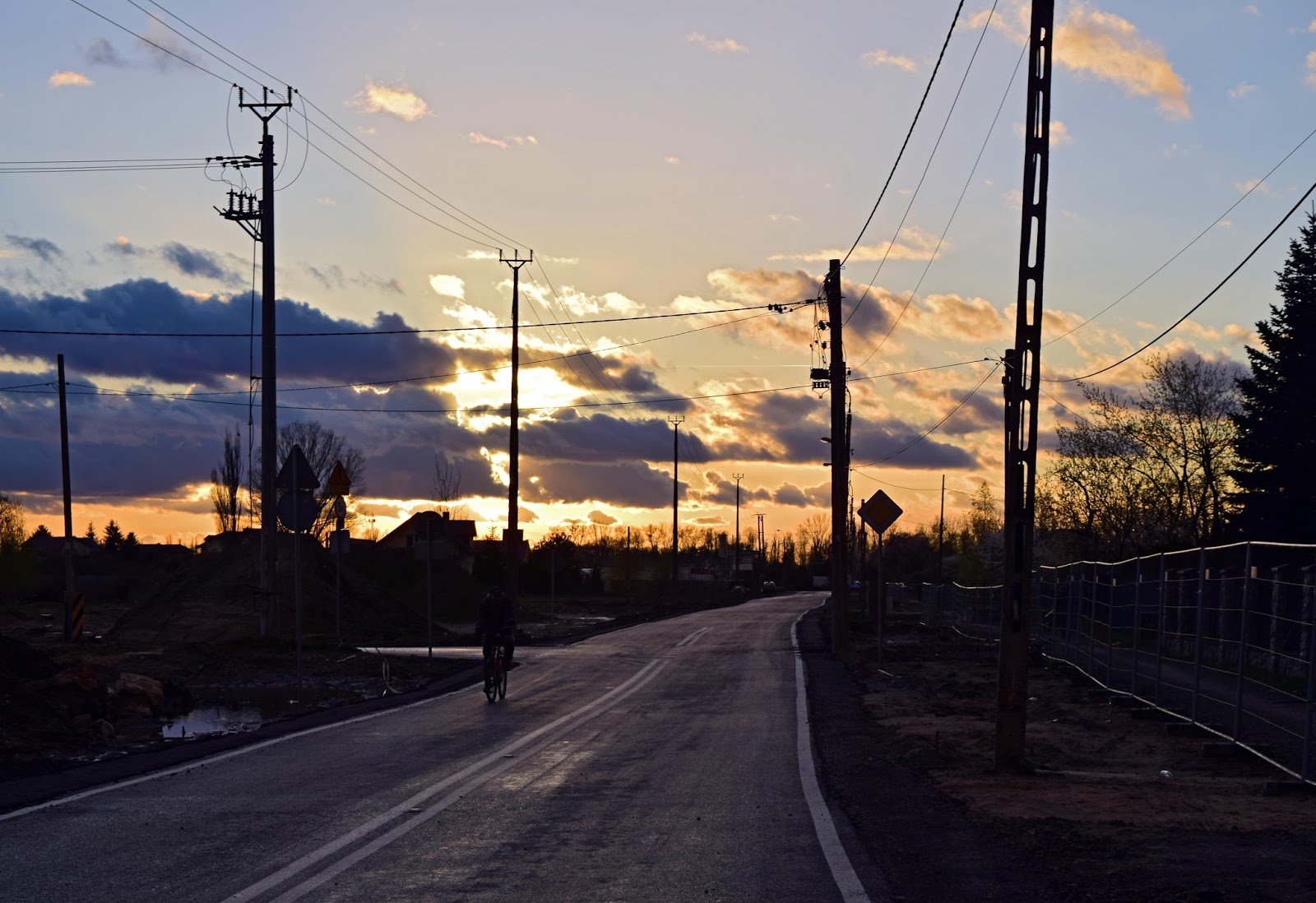
Below: dusk descends on ul. Karczunkowska's temporary asphalt


Below: my train departs in ten minutes


Below: works train stands at W-wa Okęcie station. Half past six. Three months ago, it would have been dark for three hours already at this time.


Below: bowling green sunset, Pitshanger Park.


Below: the sun's gone down over West London, but still illuminates the peaks of the highest clouds.


Click to enlarge; allow yourself to be drawn into the image, sense the klimat...

This time five years ago:
Baffled: my first visit to Jeziorki's Lidl

This six years ago:
In vino veritas?

This seven two years ago:
Are we getting more intelligent?

This eight three years ago:
Lenten recipe: tuna, chickpea and pesto salad

This time nine years ago:
Coal train sidings, Konstancin-Jeziorna

This time ten years ago:
Jeziorki from the air

Saturday, 25 March 2017

"Jeziorki bogged down in railway mud"


Jeziorki made it onto page 5 of today's Gazeta Stołeczna, with a story bemoaning the delays in the rail modernisation works, which are running months behind schedule. This is hardly news for us residents, trudging through mud to get to the new platforms, but the piece did shed light on what's next. [Full text in Polish here for those who've not got to their free three-article limit.]

The works should have been completed in 20 months from September 2015. The 22nd month is now passing. The temporary level crossing which I wrote about last week will be opened, the article says, next week. But of the works on the viaduct taking ul. Karczunkowska over the tracks, no sight.

Below: from the top of a hill of mud, I take this shot looking east along ul. Karczunkowska. Nothing has stirred here in months, apparently because 'the documentation wasn't complete'.


The article suggests that the viaduct will be ready by the end of December, and opened at the beginning of 2018. The chances of that happening are as remote as Trump's chances of completing  full term as president.

Further promises made in the article include the completion of modernisation works from Czachówek to Warka by 2020 and onward from Warka to Radom. And then, it is said, the fastest journey from Warsaw to Radom, a mere 100km (62 miles) from Warsaw, will take 75 minutes, rather than the 2hrs 49mins it can take.

But first the rebuilding of Nowa Iwiczna station, which will involve the demolition of the old island platform, which in turn will involve single-track working again, so that the line can be realigned to fit the new 'down' platform. And work at W-wa Okęcie station and between Okęcie and W-wa Dawidy is as yet incomplete. Finally, a mass of tidying-up all along the tracks is necessary - there's heaps of rubbish left behind.

The single-line working will hit commuters, as if things aren't currently bad enough. On Friday, the 18:16 service from W-wa Śródmieście to Skarżysko-Kamienna was massively delayed; I ended up at W-wa Ślużewiec waiting for the 19:04 to Piaseczno, which - as it was due to arrive - was announced as having been cancelled. So I took a bus, getting home 1hr 40 minutes after reaching Śródmieście.

Commuters' patience with Koleje Mazowiecki would be better, given the scale of the job facing the railways, if it communicated better with passengers.

This time last year:
Ideas, and how they take hold

This time two years ago:
Russian eyes peering down on Jeziorki

This time three years ago:
New road and retail: waiting for Jeziorki's new Biedronka to open

This time five years ago:
Warsaw's Northern Bridge - its name and local democracy

This time seven years ago:
What's the Polish for 'commuter'?

This time eight years ago:
Four weeks into Lent

This time nine years ago:
The fate of urban wetlands?

Sunday, 4 September 2016

Interstices: between the tracks and Kłobucka

To the east of the Warsaw-Radom railway line between W-wa Dawidy and W-wa Okęcie stations lies and interesting no-man's land along ul. Zatorze. Literally 'behind the tracks street' this is a 1 km stretch of unasphalted road that today leads, well, nowhere. Now that the S2 and S79 have been completed, ul. Zatorze is used only by contractors working on the modernisation of the railway line.


At the south end of ul. Zatorze, there's a no entry sign. Nothing like it at the northern end, suggesting one-way traffic. In summer it's a dusty, sandy track. When the rains start, it turns into a muddy morass from end to end.


Left: once, behind these birches, there were numerous działki with neat gardens, summer houses, all fenced in; few are left today. Some have been abandoned and left to the local żul community who come here to drink and sleep.

Below: the strip of działki/former działki is bordered to the west by ul. Zatorze, and to the east by the line linking Warsaw's Metro to the outside world. Not a busy line, but every train on the Metro system has at one time travelled along these tracks.


I walk northwards towards W-wa Okęcie station, passing on from ul. Zatorze to ul. Kłobucka (famous for its prison). Between Kłobucka and the tracks is a new office development under construction, Nowy Służewiec - Mordor South in other words. On the east side of Kłobucka, a new development of flats. So we can see, the nearer we get to the centre of Warsaw, the more valuable the land, and the less likely that these interstices will remain. But there are still around...


Left: ul. Kłobucka, a new building by the footpath to the station. Though it's only some 400m from here to the station, there's no signs. The new building is home to the IPN (Institute of National Remembrance) digital archive. As the illustration shows, files are now accessible via a computer. Dates on the monitor (click to enlarge) are significant: 1939, 1956, 1970, 1980, 1990. There's room for one more file... what year will it be? 2016? 2017? When our government starts locking up judges for daring to say that an independent judiciary is key to the constitutional running of the Polish state? That the judiciary should be separate from the legislature and executive, in a normal system of democratic checks and balances?

Walking towards the station, I catch some more of that interstitial Warsaw, no-man's land abandoned by history; behind the gate (below), through which trains used to run (tracks now lifted) is a derelict 1960s warehouse building; behind it a 1990s office, and behind that, a 2010s office. I wonder when this piece of land will be developed. Maybe this are should be turned into parkland, for the residents of the new apartments on the other side of ul. Kłobucka?


On to the station. W-wa Okęcie is still not ready, a year after work started here. The footbridge has been re-closed. Yes, it was open, as I reported back in July, but now it's closed. So once again, passengers have to risk life and limb clambering over the tracks to get to the platform.


Below: parked up by W-wa Okęcie, a wagon socjalny - a hostel on wheels for the railway workers (who I must say were hard at it today, Sunday, all along the line from here down to W-wa Jeziorki). This made me think. Some people live in trailer homes, others in houseboats. Why not put Poland's large network of railway sidings and stock of wagony socjalne to good use? I for one would love to spend a few weeks travelling around Poland in a camper train, moving from place to place...


Below: looking south from W-wa Okęcie platform. A variety of rolling stock on the sidings - but what's new is that passenger trains are being stabled here. I've never seen this before.


Back to W-wa Jeziorki on the 14:14, which arrives at W-wa Okęcie three minutes early, and dutifully waits until the appointed hour before heading south towards Radom. Below: ul. Karczunkowska without cars. Paradise! People out walking, jogging, cycling. This is how it should be.


A good day's walking myself - 14,000 paces.

This time two years ago:
In which I ride my Brompton to work

This time five years ago:
Bike ride to Powsin as summer fades gloriously

This time six years ago:
Compositions in yellow, blue and white

This time seven years ago:
When the Z-9 used to run, temporarily, to Jeziorki

Sunday, 24 July 2016

Along the airport's eastern and southern perimeters

I set off from W-wa Okęcie station, where the footbridge has been finally been opened all the way. At last it allows pedestrian access from the platform to ul. Narkiewicza, crossing the tracks, crossing six lanes of the S79 and five lanes of ul. Wirażowa. The footbridge is over a quarter of a kilometre long. It has four wheelchair lifts, of which one (along with a set of stairs) serves a bus stop that has never been opened on Wirażowa. Anyway, at last this footbridge stretching all the way, getting to the station with dry feet from the bus the stop in a civilised way is now possible (remember this? Same place, March 2012. Polska w ruinie, panie!)


One of the collateral pieces of infrastructure built alongside the S79 expressway was the new, re-aligned ul. Wirażowa, wider and straighter. Below: the old Wirażowa still remains as an unconnected stump, used by plane spotters to park close to the end of Runway 15. Hard to imagine that just a few years ago this narrow asphalt strip let trucks and buses reach the busy Cargo Terminal.


In between the old ul. Wirażowa and the perimeter fence is an abandoned part of the airport; it's not sealed off, you can stroll right in and look round. Below: one of the old buildings. They are locked and inaccessible.


I proceed further south along ul. Wirażowa, passing a stand usually used by cargo planes. I was last here in early winter; these new viewing ports (below) had not yet been installed. They are great! Just the right size and height - and there's a rubber rest inside to lay your long lenses on. A boon to spotters, it would be good to see more along the perimeter fence.


Interestingly, when the NATO leaders were in town, the viewing ports were closed for the duration. In any case, people were not allowed nearer than five metres from the fence.Below: a shot taken through the port, an ATR 42 belonging to Czech airline CSA.


The policy of being helpful to plane spotters - of whom there are more and more - is beneficial to security, because genuine spotters will be aware of suspicious goings-on around the perimeter, and are likely to alert the authorities.

Below: I spotted this falcon perched on a lighting rig by the cargo stand. The falcons are trained to attack birds that fly across the airport, thereby constituting a bird-strike hazard. There used to be a loudspeaker at the lower end of the airport emitting distress calls of birds, but it seems no longer to be in use.


Further south along the perimeter, there are no more viewing ports. I took the photo below standing on several concrete slabs that someone had placed here for a better view - more are needed to see over the barbed wire! Just to the right of the shot (if you click to enlarge), you can see the bridge taking ul. Złote Łany over the S2.


Between the airport's southern perimeter and the S2 is a four metre-high wall serving as an sound barrier. The purpose of this is entirely questionable - is it to keep the expressway noise from the airport, or airport noise from the expressway? The wall is built of concrete rings, filled with earth that have over the few years sprouted plentiful greenery - much easier on the eye than those acoustic screens that are the norm for the rest of the S2.


Below: photo taken from Dawidy looking across towards the airport, with a LOT Embraer ERJ-170 and the bridge on ul. Złote Łany ('Golden Wheatfields Street').


This time last year:
Polska w ruinie
[starting off at the same places as this post!]

This time three years ago:
Penrhos - a bit of North Wales that's forever Poland

This time four years ago:
On motivation - and being motivated

Thursday, 5 May 2016

W-wa Okęcie modernisation - not long now...

Twice this week I passed through W-wa Okęcie on my way home from the airport, a good chance to update readers as to progress on the modernisation of the Warsaw-Radom line at the top end.

Below: looking north, we can see that the 'down' platform is nearly ready. The 'down' track has been laid and fresh ballast has been spread over the new concrete sleepers. To the far left, the 'down' freight track that bypasses the platform, still awaiting ballast. Fencing separates the 'down' and 'up' platforms, although for the time being both 'up' and 'down' trains use the 'up' platform (to the right).


Below: "Let them read squat." The new timetable boards are in place, along with the timetables and other passenger info. But the fencing that cordons off the unfinished side of the platform is also in place. The timetable, printed in tiny letters, is about a metre and half from the fencing. Only those with acute vision can see what time their train is due. Me? I use the excellent Bilkom app on my smartphone.


Below: the footbridge is complete, but unopened. It will probably remain in this state for weeks until some building inspector can be bothered to come over and give the construction the green light.


Below: rather than let passengers benefit from a bridge which is not safe until a piece of paper deems it is, to get to the platform from either the ul. Wirażowa side or the ul. Kłobudzka side, you have to negotiate an obstacle course of trip hazards including an active railway line. Unlit at night. Still, as you smash your teeth running for a train, you can be happy in the knowledge that no one will be harmed by using an uninspected footbridge.


Below: trip hazards galore. "Had an accident? Not your fault? Let us sue the €€€€s out of PKP PLK for you." UK-style personal injury litigation would soon sort out this lackadaisical attitude to signing off pedestrian infrastructure.


UPDATE ONE YEAR ON: 5 May 2017. it beggars belief that 12 months can pass and the indolent arsehole responsible for this piece of infrastructure has still not passed it fit for use.


Below: photo taken on Tuesday 3 May, Polish national holiday commemorating the Constitution (first in Europe, second in the world after the USA). A national flag is flown on the 18:40 all-stations service to Skarzysko-Kamienna.


Below: standing on a parallel track to W-wa Okęcie is this works train, hauled by a custom-painted SM42 diesel shunter. The yellow coaches up front are for maintenance of the overhead power lines. Further back there are cranes and other assorted machinery.


Below: a little south of W-wa Okęcie station, the sidings begin. This telephoto shot nicely shows the various sets of points. In the distance, the viaduct taking ul. Poleczki over the tracks.


Below: bonus shot. Taken at the pedestrian crossing on ul. Kórnicka, a well-lit shot of a refurbished ST48 engine hauling a rake of empty coal trucks back towards W-wa Okęcie. Note the dust coming off the wagons - not coal dust, just regular dust. Which puzzled me a bit. The 'down' line is still missing; it will be a few months yet. Then, when it is laid, and the new 'down' platforms are opened at W-wa Dawidy, W-wa Jeziorki and Nowa Iwiczna, the whole process will have to be repeated for the 'up' line and platforms.


At least at W-wa Okęcie the end of the modernisation work is in sight.

This time last year:
I buy a Nikon Coolpix A
[A year on, I'm delighted with it.]

This time two years ago:
More about the Ladder of Authority

This time three years ago:
By bike, south of Warsaw

This time five years ago:
Functionalist architecture in Warsaw

This time six years ago:
What's the Polish for 'to bully'?

This time seven years ago:
Making plans

This time eight years ago:
The setting sun stirs my soul

This time nine years ago:
Rain ends the drought