Showing posts with label literature. Show all posts

Saturday, 29 March 2025

Words, music, memories and other mind-altering drugs – Lent 2025: Day 25

Smash, rip, incinerate, crush, suffocate, destroy, annihilate, mourn, despair. [Now read again.]

Has reading this list of verbs changed your mood? Feeling a little more... anxious? Now, how about these –

Flourish, embrace, inspire, open, cherish, rejuvenate, love, marvel, celebrate, hope. [Now re-read.]

– Have these words returned you to a better place?

The simple act of casting your eyes over shapes on a screen – characters or graphemes – that we recognise as letters, placed together to form words, can cause either the levels of cortisol or of dopamine to rise within your body. When released into a living organism, chemical substances that produce a biological effect are, pharmacologically speaking, drugs. Hormones. Signalling molecules that affect the body, produced endogenously. We have been conditioned to respond accordingly. It's what makes great poets great; wringing emotion out of language.

With music, the effect is more powerful. Music plays a significant role in our emotions and moods. Uppers and downers. Specific sequences of notes, tempo, key (major/minor), volume, trance-inducing beat; music has a powerful array of tools at its disposal to alter our mindset.

And so it is for memories. Memories can be of events or of qualia. Events – embarrassing, awkward, painful memories tend to stick around. Summoning them can prompt cortisol release. But qualia memories – memories not of what you did, but what you felt – tend to be more likely to set off a dopamine release. Tiny quantities, but noticeable. Quick to dissipate, but very real.

Below: words, music, memories – pictured by Google Gemini Imagen 3.0


English romantic poet William Wordsworth describes in Daffodils (1804) this experience of a qualia memory flashback, prompted by his memories from a walk along the shore of Lake Ullswater in the Lake District, when he saw a long line of daffodils, "Fluttering and dancing in the breeze." The last stanza runs thus:

"For oft, when on my couch I lie
In vacant or in pensive mood,
They flash upon that inward eye
That is the bliss of solitude;
And then my heart with pleasure fills,
And dances with the daffodils."

Qualia memory events can have powerful pharmacological effects, like words and music.

Tonight the clocks go forward. For the next week I'll be getting through the day with a sense of guilt that an extra hour of daylight has passed and I've done nothing with it.

Lent 2025: Day 25
Dealing with Evil

Lent 2023, Day 25
Intuition and Dreaming

Lent 2022: Day 25
Writing It All Down

Lent 2021: Day 25
Faith and Knowledge

Lent 2020: Day 25
Chances, complacency and gratitude

Wednesday, 15 December 2021

Homeland Elegies by Ayad Akhtar

For Moni

Before I start - a very serious spoiler alert. Proceed no further if this book is on your current 'to read' list. This post will spoil it for you more than me saying that the ocean liner sinks at the end of Titanic.

So. An award-winning playwright of Pakistani parentage writes about his life, his parents, the religion and culture into which he was born, Trump's America, wealth, racism.

But is he Telling It Like It Is, with the aim of Truthfulness of a reporter or autobiographer? 

Or is he spinning a compelling story, with complex narrative plot-twists to draw you in? 

Before engaging my critical faculties too much, before deciding whether or not to accept the narrative at face value, I should really know the answer to this key question. I did not; I found that just a few chapters in, I had subconsciously filed the book into the genre of reportage rather than creative fiction.

I have purposefully avoided reading anything about the book while reading the book. I did indeed approach it at face value. So this, then, is the autobiography of an American, born to parents from Pakistan who migrated to the US as brilliant medical graduates under a special visa program in the 1960s to begin a lucrative career in America's well-funded healthcare sector. The author himself went on to have a brilliant career of his own, as a playwright and author. 

The book is essentially about his troubled relationship with his parents - especially his father - and their troubled relationship with America, Islam and Pakistan. He dwells on two cataclysmic turning points in the arc of his family's history - 9/11 and the election of Donald Trump.

Ayad Akhtar is confronted by a society that is racist to the core, materialist, and configured in such a way to ensure the rich continually get richer. The poor, meanwhile, are systemically kept on a treadmill of debt and unfulfilling labour, as they toil to pass ever more wealth to the rich, so they can live in ever greater luxury. The book is strong on family detail, on growing up with a family in Pakistan, frequent visits to the Old Country, contrasts between the two nations. 

As I progressed through the book, and its essential premise is being unfolded, I found doubts creeping into my mind. 

Is this a true story - or is it a work of fiction? Or a blend of both? 

As character after character is introduced, I'm thinking - the publishers of this best-seller must have access to some pretty good lawyers to ensure to protect themselves against lawsuits. Defamation. As we meet Riaz, the Pakistani-American financier - were such a person reading this about himself - he'd be seeking counsel for how to extract millions for the accusations levelled against him in Homeland Elegies (bankrupting local authorities across the US on purpose, ones that had happened to have blocked planning permissions for the building of mosques). Or the heart surgeon who, on operating on patients' hearts, specially scratched lesions inside their aortas which he knew would turn into more lucrative surgical work for him in years to come. And how his employer, a rapacious healthcare company, settled out of court with his victims rather than let the secret out.

I reach the end of the book and finally, burning with curiosity, I check Wikipedia. Now here comes the spoiler: "The book is fiction, though written to resemble a memoir. It includes some autobiographical elements; the protagonist shares the name, background, and career of the author." The doubt that had been building up in me (did he really narrowly avoid sleeping with his half-sister, about whom he didn't know, the result of a long-term affair his father had?)

The crossing over from truth to fiction is unsettling when the author is trying to make profound criticism of America, his homeland. The legitimacy of his depiction of wealth, luxury, greed, debt - an utterly corrupt healthcare system, a banking system designed to keep large corporations wealthy, a legal system that is driven by racism - boils down to the question: fiction or reportage?

Great art belongs to the ages. How will future readers come to terms with this literary form? Will it become commonplace to blend fact and fiction in our post-truth era? Or will the conceit be seen to dilute or spoil the author's searing social message?

I wrote many years ago about another playwright who goes on to pen an autobiography. Janusz Głowacki, the hero of his own picaresque 'autobiography' that (I surmise) also strays deep into fiction. My main criticism of Z głowy was that Głowacki downplays the hard work and effort that goes into writing successful plays - I wrote: "one night [Głowacki] gets very, very drunk with assorted ne'er-do-wells in a dive on the Lower East Side; the next morning he tosses off a play that gets directed by Arthur Penn and stars Christopher Walken. But what about the endless hours of writing, re-drafting, searching for the right bon mot or delicate allusion, forceful punchline or hilarious gag?" Głowacki suggests that his path to literary success was effortless, all inspiration, no perspiration. Akhtar doesn't do this. He describes his writing technique, taught by his English lecturer at university, Maria Moroni (again - was she real or invented?). She tells him that you should keep a dream diary and pencil by your bedside, and return your spine to the position it was in when you had that dream to recall it. Akhtar describes beautifully how, when transcribing dreams, you should start with the most vivid part regardless of chronology, capture as much detail as possible - before scrolling backwards and forwards to other parts of the dream as you remember them. And this is how he captures scenes from memory, from life.

Głowacki pulls the same trick as Akhar in Goodnight Dżerzi - a seemingly straightforward autobiography of a playwright that morphs imperceptibly into fiction - this time a Pole in America, being asked to write a screenplay about a Jewish Pole in America - Jerzy Kosiński. And another Polish writer known for embellishing his reportage with some fanciful tales was Ryszard Kapuściński (about whom here).

It was an extremely worthwhile read for me - on so many levels. The relationship between two countries and two cultures; the relationship between parent and child; the critique of America; the concept of autofiction. One line stands out above all the others: "America is money-worship and racism." My thanks to Moni for suggesting I read it - I thoroughly enjoyed it.

This time two years ago:
Britain for Christmas

This time five years ago:
IT frustrations

This time six years ago:
Wałbrzych's Gold Train - the dream ends

This time eight years ago:
Kitten football

This time nine years ago:
The drainage of Jeziorki

This time ten years ago:
The Eurocrisis - what would Jesus do?
[Remember - the EU was about to fall apart.]

This time 11 years ago:
Orders of magnitude

This time 12 years ago:
Jeziorki in the snow

This time 13 years ago:
Better news on the commuting front

This time 14 years ago:
I no longer recognise the land where I was born

Friday, 1 October 2021

Droga donikąd, by Józef Mackiewicz

 An important book for me - the first novel in the Polish language that I read of my own volition (before that it was only set texts from Polish Saturday school in London). I was given a copy of the book in the mid 1980s. It had been printed in exile, in keeping with the author's wishes, for distribution to those who opposed Poland's post-war communist regime, On finishing it, I passed it on to the daughter of an opposition leader. Since moving to Poland, I've been looking for another copy. Now, at last, it is freely available...

Written by Józef Mackiewicz in exile in London in 1955, Droga donikąd ('Road to Nowhere') covers the period between the Soviet annexation of Lithuania in the summer of 1940 and the eve of Operation Barbarossa in June 1941. Set in Wilno/Vilnius, the novel is semi-autobiographical, and shows the nature of Soviet repression from first hand.

Pre-war Wilno was Poland's fifth-largest city. It was predominantly Polish and Jewish, with a small Lithuanian minority. On 19 September 1939, it fell to the Red Army, being in the Soviet sphere of interest as a result of the Ribbentrop-Molotov (or more accurately, Hitler-Stalin) Pact. The Red Army ceded the city to Lithuania by the end of October 1939; the Lithuanian state had barely seven months to integrate Vilnius before USSR annexed it along with Latvia and Estonia. 

Droga donikąd begins with the annexation of Lithuania, depicting clearly how a small, ethnically diverse capitalist country is swallowed by the communist system. "Our life today is waiting - waiting in queues, waiting to eat, waiting to be arrested, waiting for the next steps in the implementation of communist society". One by one, freedoms are snuffed out, freedom to speak, freedom to do business, freedom of movement. All is done with a semblance of the people's burning desire for justice and equality. Mass rallies (compulsory attendance). Wild applause for speakers (woe betide anyone reported not clapping and cheering). Red flags, bunting, portraits of Stalin everywhere. And one by one, shops, restaurants and other businesses would be nationalised, goods would disappear from shelves to be replaced by shoddier products with unpredictable supply. 

Smuggling became a way of life, especially across the border between the newly created Lithuanian Soviet Socialist Republic and the longer-established Belarussian SSR. Author Józef Mackiewicz, like his protagonist of Droga donikąd, Paweł, kept his head down by quitting his journalist's job and buying a horse and cart - to be less visible to the Soviet authorities, and to make a living by transporting goods across country.

Each successive turn of the screw is shown. People start wearing their shabbiest clothes lest they be identified as bourgeois counterrevolutionary elements. The new Soviet overlords, arriving in Vilnius, were expecting to find a city full of capitalist riches - instead they were surprised to see people as (outwardly) poor and shabby as what they had in other Soviet republics. Moral decisions have to be made; within families there are schisms as a daughter joins the Komsomol while her father tries to cling on to his business. Fighting the new order seems pointless; melting into the faceless crowd the best option for most.

Deportations are being planned. The local NKVD was instructed by Moscow to begin drawing up lists of families that were to be deported. The date is drawn up - days before Operation Barbarossa is due to begin. Like Titanic, we all know what's about to happen, as the clock counts down. The targets are the Polish and Jewish middle classes, the property owners, the intelligentsia. They suspect this was going to happen to them; Paweł, the novel's protagonist, is tipped off and makes a break. 

There is a sub-plot about a religious mystic and seer who foretells a miraculous event that will happen in small village - again, on the very eve of Barbarossa. Crowds of believers flock to the village to see the miracle - but will it happen at noon (Polish time) or noon (the newly-adopted Moscow time)?

Sadly, the book had never been translated into English - it offers such an excellent view of what Soviet takeover looks like; it had a profound impression on me, reading it during those years between the imposition of Martial Law in Poland and the collapse of communism has very much shaped my thinking. A rejection of political ideologies, left or right, as bringing suffering rather than any improvement to the human lot.

This time last year:
Words that pop into the mind, unbidden

This time three years ago:
Hops there for the taking
[Hops mouldy this year - too wet.]

This time four years ago:
Two weeks and two days of travel

This time five years ago:
Final end to a local landmark

This time ten years ago:
Independence Day

This time 11 years:
Out and about in Jeziorki

This time 12 years ago:
Funeral of Lt. Cmdr. Tadeusz Lesisz

This time 13 years ago:
Puławska by night

Saturday, 13 July 2019

For Reasons Unknown - poems by Nigel Humphreys


Poets should strive for universal applicability - covering themes that resonate with everyone; such is the received wisdom passed on by poetry teachers.

"It's easy to be difficult," said John Betjeman, riposting T.S. Eliot, who suggested that poetry should aim to be difficult. Nigel Humphreys' voice is neither deliberately obscurantist nor is it simple, but it is authentic, and it resonates fully with me. Several threads that run through his fourth volume of poetry, For Reasons Unknown (styled for reasons unknown), published in the Parhelion series imprint from the Arbor Vitae press, which chime with themes I've covered in my blog. These include the role of consciousness in the universe, the reality of the sub-atomic level, Proustian memory, spirit of place, and the eternal. Because Nigel Humphreys' world view is so congruent with mine, I find his poetry elevating and replete with insight.

The marvellous prose-poem Brock - that forms the backbone of the book, speaks of a detached consciousness moving across the face of our planet, an aware observer that never interferes, eyes without a face, born of this world, observing it, yet not engaging with it. Brock, "an individual without home, creed, philosophy or agenda, who through his wanderings, permeates existence and, by doing so, becomes a disinterested observer of what it is to exist," says the author's note. Brock, strung out across 48 parts, becomes a framework to which a further 48 poems are attached, each one thematically linked to the preceding fragment of Brock. This structure suggests a vastly more planned tome of poetry than the usual compendium of loosely-edited poems; assembled thus, the book acquires a narrative tone; the reader is drawn into Brock's world.

Humphreys'/Brock's place in space and time is early 21st century Aberystwyth, a Welsh seaside town reminiscent of the Pwllheli that I've visited so often. I compare the two on Google Maps Street View and am struck by the architectural similarity and their geography. A town built around a mediaeval castle, with Victorian and post-war buildings, car parks and superstores, hospital and charity shops. Brock's world is the Town Surrounded By Country, in the country, fenced and gated hills, horses and sheep on green fields over which circle the hawk, the kite and the eagle; the Town is By The Sea where the eternal natural struggle takes on aquatic form. Intermediate, the coastline, with "the tang of bladder wrack..." words that summon earliest childhood memories of seaside summers on the cold coasts of Britain.

The physical construct of the universe, made of atoms, living in a fragment of the Infinite and Eternal, seeing just that - above the supermarket trolleys, digital signs, mobility scooters, laptops, t-shirts, kiosks and scaffolding yet acutely aware that there is more, far more than "the white water of consumerism", above which Brock manages to hold his head.

Atoms, time, energy, matter, consciousness; the stuff from which the universe is woven. Nigel Humphreys is a poet of our quantum age, accepting the mysteries of the subatomic world and the structure of the gene, "as ruthless as ever, keeping its host body alive for reasons unknown" - I sense towards the end of the book what these reasons are - the evolutionary path of Consciousness, from being aware of Nothing, to being aware of All. Our eyes will experience but a snippet of the journey.

This is a book that elevates one from everyday duties, from automatic action, and invites the reader to gaze again and reflect with a higher consciousness upon that which surrounds us all, and place that into the context of infinite wonder, "time beyond time", "the universal will".

Having read all three volumes of Bevis Hillier's biography of John Betjeman, I have come to appreciated the importance of the long-term relationship between poet and publisher. In the case of Betjeman, it was Jock Murray, fifth-generation scion of publishing family John Murray. In the case of Nigel Humphreys, it is Jonathan Wood, founder of the Arbor Vitae Press, who has also published Humphrey's three previous collections of poetry, The Hawk's Mewl (2007), Flavour of Parallel (2010) and Of Moment (2013). I look forward to more.

This time last year:
Koszyki

This time two years ago year:
It's just an Ilyushin (central Warsaw's plane-restaurant)

This time four years ago:
Marathon stroll (31.5km) along the Vistula 

This time five years ago:
Complaining about the lack of a river crossing between Siekierki and Góra Kalwaria! 

This time six years ago:
S2 update (nearly ready)

This time seven years ago:
Progress on S2 bypass - photos from the air

This time nine years ago:
Up Śnieżnica

This time 12 years ago:
July continues glum (2007 - a rainy summer)

Saturday, 14 December 2013

Why One Writes - the poet's gift

I've written about the link between scientific genius and the autism spectrum - men (mainly) with an incredible ability to focus on detail, on pursuing a theory until its proved correct; men like Isaac Newton, Adam Smith, Albert Einstein or the men who shaped today's world of IT, like Steve Jobs and Bill Gates. Society needs such focused minds, who can apply their minds to seemingly intractable problems. RRBI - repetitive, restricted behaviours and interests - socially not a heap of fun, but when it comes to finding solutions buried deep in the data, it's a gift.

In prehistoric culture, the tribesman who could sit all day knapping the perfect flint, ever honing the sharpness of its cutting edge, would be held in high regard, despite his lack of social skills such as story-telling around the fire. He would be the technologist of the day, his knapped flints a prized tool for killing and then skinning the hunted beasts.

The prehistoric tribe would also hold in high regard the story-teller, passing on and embroidering the tribe's shared narrative. A story-teller with added musical and/or poetic abilities would be considered a bard - his (or indeed her) place in the tribe assured.

It is the gift that makes a poet which I wish to consider, in light of my reading of two contrasting works that lead me to a similar conclusion. Polish gypsy poet Bronisława Weis ('Papusza') and Anglo-Welsh poet Nigel Humphreys, whose latest tome Of Moment, I recently received from its publisher, Jonathan Wood.

Though the language is quite different (Papusza never benefited from a day's formal education), one thing strikes me as linking the two minds - the ability to put a complex sensation into words that resonate with the reader. Reading both books, I have been thinking of the phenomenon of synaesthesia - "a neurological condition in which stimulation of one sensory or cognitive pathway leads to automatic, involuntary experiences in a second sensory or cognitive pathway".

There are many forms of synaesthesia - some synaesthetes associate certain sounds with specific colours; others can 'taste' letters or numbers. Poets, men and women in equal measure, I think, have a mild and beneficial form of synaesthesia allowing them to conjure words easily from sensations. Synapses fire away, stimulated by a sight, sound, smell, taste or feeling, and convert the sensations into words that the reader instantly appreciates and associates with.

Reading Papusza's experience as a gypsy child in a forest, sensing the water from a stream, falling leaves, the smell of trees in flower, her description of rushing mountain streams - we've all experienced these sensations - yet she felt them with an extraordinary intensity that forced her to write. Despite her lack of learning and the social pressure on her not to, she jotted down her feelings - complex, full of ambiguity and metaphor - and thankfully enough was preserved and translated to give a flavour of her creative mind.

I am getting a similar flavour from the poems of Nigel Humphreys; a mind that can quick-fire a stream of apt words and phrases in response to situations. His eye - indeed all his senses - are there for the reader, waiting to pounce on a set of circumstances, and turn them into words on a page that match the experience of what he saw and felt at the time.

The first condition of poetry is to have this gift - the second is to know how to edit - edit hard so as to trim the off-target perceptions and the words that failed to give truth to a scene. Poetry must be universally applicable to be able to belong to the ages; if a reader can say - "YES! That's exactly what I felt in a similar situation!" - then it works. There are seven billion of us alive today; a handful of us possess the gift of poetry in its truest sense.

My conclusion - please challenge me if you disagree or wish to nuance my assertion - is that poets are born and not made; something very special is going on in their minds that most of us lack or only possess intimations of. It is a gift, an innate ability and desire to convert sensory perceptions into well-selected words which give of themselves the sense of what the author was feeling at the time, words which then resonate in the mind of the reader.

Whether a poet is educated or not - this is my point - he or she uses words to define a complex reality. Education merely expands the vocabulary that poets have at their disposal. This in effect limits the poet's audience. But the reach of good poetry is not limited by time; it belongs to the ages. It is surely better to be read and appreciated by 1% of the population for hundreds of years than to be enjoyed by millions and be forgotten by the end of the year.

Poetry - more nature than nurture.

This time two years ago:
Advertising H&M on Warszawa Centralna station

This time four years ago:
Jeziorki in the snow

This time six years ago:
Staying Underground: Piccadilly Circus

Sunday, 24 November 2013

Papusza: a key to understanding the Roma issue

With Britain in a state of unease about the full opening of its borders on 1 January to Romanians and Bulgarians, the question of Roma (or 'Gypsies' if you are not of the politically correct persuasion) has come to the fore in the UK media. Romania and Bulgaria are home to the largest Roma populations in the EU, and the opportunity for them to travel freely to the UK strikes fear into the heart of every right-thinking Daily Mail reader - and many others.

For most European citizens, the idea that a nomadic ethnic group several million strong that still exists to this day by begging and busking is difficult to comprehend.

Here in Poland (with a low percentage of Roma within its borders compared to Hungary, Slovakia, Czech Republic or the aforementioned Romania and Bulgaria), some enlightenment has come in the form of a film and a book. Though both have the same title, Papusza, they are entirely different works, though both about the same subject -  the Gypsy (she disliked the term 'Roma') poet, Bronisława Weis.

The book is by Angelika Kuźniak, is a reportage based on interviews, letters and published materials, interspersed with excellent photographs (the best by Jerzy Dorożyński, for the ethnographical museum in Tarnów, taken in the early '60s as the decision to settle Poland's Gypsies was taken). Below: my favourite photo from the book - a tabor (convoy of caravans) winds through a poor Polish village, 1963 (click to enlarge).


The film - made by husband-and-wife team Joanna Kos-Krauze and Krzysztof Krauze - is beautifully shot in black and white and tells basically the same story, though with minor differences. The film took six years to make - most of the time spent in painstakingly researching the subject to achieve a true story that looked authentic on screen. We travel from pre-war Wołyń to post-war Gorzów Wielkopolski, touching upon the Porajmos - the Roma holocaust in WW2. Like the book, the film was meticulously researched. Below: a still from the film. Many of the scenes are carefully framed tableaux, set against beautiful Polish countryside.


Papusza was clearly a powerful voice in 20th Century Polish poetry; her writing was no primitive folklore but multi-layered, intense and deeply original. The film mirrors this beautifully. The scene showing Papusza's birth, in a forest; a young woman is lying in the undergrowth, calling for her mother... in the foreground, things are stirring... a thousand butterflies? No... it is the wind picking up fallen leaves - a magical scene.

The natural beauty of the forests, the streams, the sky, the wild animals; I think that Papusza, like many poets, was born with a form of synaesthesia - cross-sensory hypersensitivity to stimuli which in her case would be readily transformed into words.

A second factor marking Papusza as outside of the ordinary was that she refused to take illiteracy as her predestined condition. As a child, she taught herself to read, aided as we see in the book and in the film by a Jewish shopkeeper. Her family would try to stop this foolishness, tearing up scraps of newspaper from which she was teaching herself.

And then there was the coincidence which brought her into the public eye. Jerzy Ficowski, a Polish writer and former AK soldier, hiding from the communist security services in the late 1940s, just happened upon her tabor (group of caravans travelling together). Meeting Papusza, he recognised her rare talents; they kept in touch; she sent him poems which he translated and had published in Polish literary magazines. The great Polish poet Julian Tuwim persuaded Ficowski to publish a major work on Poland's gypsies, which appeared in 1953. This book caused Papusza a great deal of grief, as it was believed that she had betrayed to Ficowski the secrets of Gypsy laws and customs to the gadzios - everyone who was not Roma.

Papusza was ostracized and lived apart from her people until her death in 1987, having endured several spells in mental hospitals.

The book and the film show Roma life in realistic terms - the superstition, the patriarchal nature of their society (Papusza is shown to have been bought as a 15 year-old bride by a man 22 years her senior, who was often abusive towards her), the way that Gypsy women and children would go into towns to beg, tell fortunes and steal what they could (chickens, sweets, purses). The men would earn their way by playing Gypsy music (very well shown in the film) and horse-trading; then drinking (always vodka), while pouring scorn on the settled lifestyle that revolved around work. Women do the work - the washing, the feeding, the child-care - after a long day's begging or chiromancy in the gadzio towns. Education was frowned on; a waste of time.

And yet much of lyrical beauty of a bygone way of life  is captured in Papusza's poetry and in the film. Poland's Gypsies were forcibly made to settle by the communist government in 1965 after a long campaign to encourage voluntary settlement.

While the book and the film go a long way to increase understanding of the Gypsy way of life, they do not offer any solution to the problem - of a people that do not wish to be integrated into mainstream society, yet needs that society in a parasitical way for alms, and now increasingly, EU money.

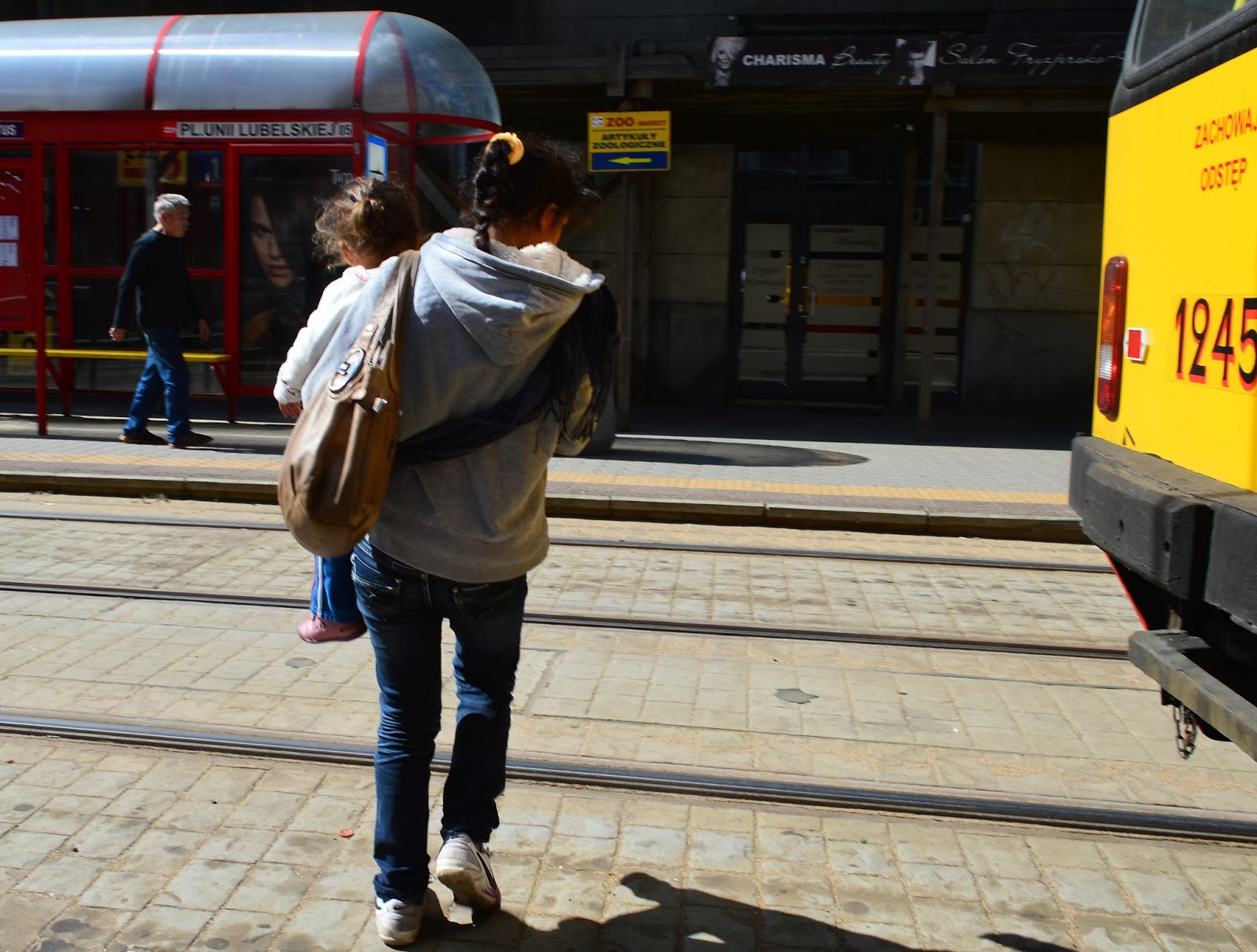
Below: Roma beggars abuse people's sympathy and basic human kindness. A girl, around 17 or 18, hoiks her three year-old daughter /sister /niece from one tram to another, extracting alms from the soft-hearted. Really, this is no way to support ones' family. Photos taken two months ago.


Below: limping with a crutch, or (again on the tram routes up and down Puławska much favoured by Roma mendicants) falling to one's knees and pathetically singing a tuneless song. We don't need no education, indeed. What is society to do? It's not so much of a problem in Poland (most Poles are too stony-hearted and inured to Roma ways), but Britain fears that scenes such as these will suddenly become commonplace after 1 January.


The Roma remain their own worst enemy. Denying their own children a right to education (many of the beggars are of school age) perpetuates their plight, retarding them further in comparison with a society that's rapidly getting richer and ever more technologically enabled.

These problems could be seen from the outset of Papusza's story, the pre-war scene where a Gypsy encampment is burnt down by a group of Poles taking revenge for a beating one of them received from Gypsies he'd insulted at a local tavern; the Jewish storekeepers taking extra care of their merchandise when the Gypsy women and children came to town begging. The situation has hardly changed in a hundred years, yet the gadzio community has moved from agriculture via industry to an IT-driven economy while the Gipsies are still reliant on begging.

I thoroughly recommend the book and the film, and suspect that the film will go on to have a great career in art-house cinemas around the world for its lyrical beauty and profound story. Below: the final shot of the film. One to see.


This time three years ago:
London travel notes - from Luton to Ealing

This time four years ago:
Silent and Unseen - at your bookshops now
(today, sadly, long out of print)

This time five years ago:
Rat-run absurdity

Saturday, 5 October 2013

Book review: Good night Dżerzi by Janusz Głowacki

I've written about playwright and author Janusz Głowacki before having read his autobiography, Z głowy (2004). Good night Dżerzi (2010) is a more serious work, based on the life of Jerzy Kosiński, the Polish-American novelist. The book's structure is exceptionally interesting, being a seamless blend of autobiography, biography and fiction. The trouble is with spotting where one genre ends and another begins.

For those who've come to the book familiar with the jocular tone of Z głowy, Good night Dżerzi opens as autobiography. Janusz Głowacki (Dżanus) is in New York. He's talking to a pair of Broadway producers about writing a play about the life of Jerzy Kosiński, who had committed suicide in 1991. Kosiński had achieving critical and popular acclaim with his books Painted Bird and Being There, the latter becoming an Oscar-winning film starring Peter Sellers. The former was about a boy wandering around wartime Poland, subjected to horrendous cruelties by Polish peasants. Kosiński left America thinking that Painted Bird was autobiographical; in fact he and his family were saved from the Holocaust by a Polish family.

Good night Dżerzi takes us into Kosiński's world. To what extent is it based on fact (Głowacki knew Kosiński well from his sojourn in New York in the early 1980s), and to what extent is it fiction, we can only speculate. For example, there's a scene in which Kosiński is asked to present awards at an Oscar ceremony. The producer's name is invented, as is probably much of the dialogue; but the event did happen. (Click here to see Kosiński at the 1982 Oscars.) What we don't know is how much of Głowacki's dialogue was based on conversations he may have had on the subject with Kosiński, and how much Głowacki just made up.

But hey, it's a novel, so Głowacki can be creative... But to what extent? The drifting between genres is unsettling at first, but after a while, begins to intrigue. The book follows Kosiński's fall from grace, encircled by a growing number of critics who are accusing him of plagiarism, of passing off fiction as autobiography, of manipulating editors and translators for his greater glory, and  - the central thread of the novel - his callous exploitation of the women in his life.

The two Broadway producers we meet in the novel's opening have been approached by the husband of a woman that Kosiński has seduced. He is a wealthy German businessman and wants the story of the (now dead) Kosiński turned into a play. And Głowacki is the man to write it, being a) a playwright, b) a fellow-Pole and c) someone who knew Kosiński well.

Głowacki's novel about a play (to be turned into a film) he's writing about the life of a well-known author is set largely in New York City, largely among it's Russian immigrant community (the German's wife is Russian). This allows for many scenes, some with Kosiński, some with Głowacki, getting very drunk and in the depths of their drunkenness unearthing the deepest secrets of the creative soul.

Russia intrudes heavily in this book. Masha, the wife (and Kosiński's lover) is from Russia and through her we are shown a debased nation lacking in morality, drunken, debauched, lacking human values. The virus spreads with its emigrants to New York, its Little Russia on the Atlantic coast battered by storms, waves, high winds and pelting rain.

An ingenious book that questions the price that creative artists pay for achieving and clinging on to fame, Good night, Dżerzi would work well in English. The book was well received and well read in Poland; it could do well outside Poland too.

If I were to have any reservations about the book, it is with its ending; it lacks circularity; we don't return to the original premise and our two Broadway producers; it drifts away and ends somewhere else.

This time last year:
More serious setbacks on Second Metro line construction

This time three years ago:
Leonard Cohen in Katowice

This time five years ago:
The short-term future of suburban development (How right I was!)

Thursday, 13 June 2013

Dzienniki kołymskie by Jacek Hugo-Bader

Sometimes you finish a book and you're thankful it's out of the way. It bored you, it frustrated you (whatever the reason - style, vocabulary, tone), it was over-long, it was self-indulgent... But today I got to the end of Dzienniki kołymskie ('Kołyma Diaries') by Jacek Hugo-Bader and felt a sense of loss. Indeed, the past few days, aware the last page of the book was approaching, like the last day of a wonderful holiday, I felt sad each time I picked it up, knowing my enjoyment of it was coming to an end.

The book, a Christmas present from Moni, has been my travelling companion on my commutes to and from work for the past six weeks. It is the key to understanding the soul of Russia.

Many years ago, my friend Andrzej Poloczek visited Moscow, then still the capital of the Union of Soviet Socialist Republics. Standing in Red Square, he thought to himself that he was indeed in the heart of darkness. Having read Dzienniki kołymskie, I can say that Russia's heart of darkness lies 6,000 miles/10,000km further east - a frozen Golgotha - a land where, for the duration of Stalin's dark reign, humanity ceased to exist. The Gulag system, where the slave labour of Soviet Union's political prisoners, made to work for handfuls of dark bread excavating gold, diamonds, uranium and other precious metals, is where today's Russia is from.

That brutal and unthinking system, that boot stamping down on the face, with its prison hierarchy of vory and blatniy, where the strong exploit the weak to survive, is mirrored in Putin's Russia. Today's Russians, and the peoples of Siberia who are still subjects of Moscow, are the product of those decades of terror.

Jacek Hugo-Bader is the true heir to Ryszard Kapuściński in the journalistic sub-genre of reportage. This is his third book about Russia (the second one, Biała gorączka, I reviewed here). Hugo-Bader is above all a fearless writer, someone willing to put themself into harm's way to get an insightful story for his readers. His stories in Gazeta Wyborcza had always impressed me with the direct questions he'd ask difficult people; here is a man putting his life on the line to tell us the truth.

And the truth about Kolyma is not easy to digest. An inhospitable land, closed off from the Eurasian continent for much of the year; a land rich in natural resources - gold, diamonds, oil, caviar. A land far from the rule of law - if there be any rule of law than the fiat of whatever ruthless, face-stamping megalomaniac is in the Kremlin. Kolyma is a land to which unusual people flee their past; a land from which usual people escape.

Hugo-Bader hitch-hikes over 2,000 kilometres from Magadan, the capital of Kolyma, to Yakutsk, just as merciless winter falls. Travelling by way of Debin, Susuman, Ust-nera and Chadyga, he encounters a memorable procession of characters. Much drinking goes on. Thirty-six days on the road with 19 massive vodka-drinking sessions along the way, without which the window to the Russian soul would have remain tightly shuttered. Each one offers us plentiful insight; on the extraction and trade in gold, that drives the economy of the Russian Far East. On the plight of the Yakut and other native peoples, without a head for alcohol, who are being exterminated slowly by vodka (a main theme in Biała gorączka). On the bottomless corruption, the stupid, venal, primitive, brutal local oligarchs (wealthy beyond comprehension, yet lacking the nous to move to somewhere civilised). And at the heart of it, Stalin's Gulag system that gave this part of the world its infrastructure, its first settlements - penal colonies that would become today's sad, depopulated towns.

I tracked Hugo-Bader's voyage on Google Earth, studying carefully the satellite imagery of Kolyma, the photos on Panoramio, reading the Wikipedia articles about the settlements along the way from Magadan to Yakutsk. Well worth doing. To get an idea of the insane geography of the place; where temperatures can oscillate between -60C and +30C; where permafrost means that normal sanitation is impossible; where people's fatalism is so deeply rooted that there's no future for most of them.

If you live in Kolyma, 'the continent' is the outside world, the normal world - is difficult to reach. Yakutsk, a city of over a quarter of a million people, lacks a bridge between the two banks of the River Lena, and taking a heavy goods vehicle across on a ferry costs €4,000.

There are so many fascinating snippets of knowledge in this book. Twice, Hugo-Bader's interviewees mention the ONTOTs - a chain of Stalin-era tanks buried hull-down into the hillsides overlooking the Amur River and the border with China with just the turrets showing. Red Army soldiers were supposed to man these outposts until death - there was no way out, should the Chinese invade. Then the are the shatun - the man-eating bears that are a constant threat to humans towards the end of hungry winters. The devil-may-care attitude of the paputchniki (truck drivers) of the Trakt Kolymski - that partially-asphalted, slender thread that links Kolyma to the outside world, built by the zeks of the Gulag system. Seldom sober, the paputchniki are friendly, human - but liable to tell the tallest tales, from the very depths of their souls - or somebody else's soul.

Hugo-Bader rarely had to wait long for his next lift. At truck-stops, where drivers would pop in to the store for a couple of half-litre bottles of vodka, he'd catch a ride a dozen, a hundred, a few hundred kilometres further on up the road. Once only he had to pay for his travel - 500 roubles, 50 zlotys, £10, to join five other men on a suicidal journey across the Aldan in a tiny motor-boat, dodging massive ice-floes in a swiftly-moving and broad river.

The people he'd meet - Yezhov's daughter; faith-healers and shamans, gold-diggers, blind-drunk surgeons, nomads, hermits - out here, no one is normal.

The landscape is littered with ghost-towns, where the lights went out after the last of the gold or coal was excavated, where the people left as soon as they could. What will happen to Kolyma? My guess is that Kolyma - and much of the Russian Far East - will become Chinese by the end of this century. The Chinese will buy it or conquer it by force; Moscow has neither the will nor the wherewithal to maintain  this resource-rich but depopulated piece of real estate (see this post).

I hope that Dzienniki kołymskie will make their way into English; this is one of the most significant books about the world we live in I've read in a long while.

This time last year:
Russia-Poland in Warsaw: the worst day of Euro 2012

This time two years ago:
Thirty-one and sixty-three - a short story

This time four years ago:
Warsaw rail circumnavigation

This time five years ago:
Classic Polish vehicles

This time six years ago:
South Warsaw sunsets

Wednesday, 19 December 2012

Biała gorączka by Jacek Hugo-Bader

Once again my daughter Moni put me onto a winner; books that she suggests I read always turn out to be good ones. Jacek Hugo-Bader is a name I know from the pages of Gazeta Wyborcza; his reportage engenders in me respect for his sheer courage. He writes from tight spots, often surrounded by dangerous and unpredictable people from society's lower depths. Comparisons with Ryszard Kapuściński often come up when discussing Hugo-Bader. More on this later.

Biała gorączka ('White Fever') is a lower-depths travelogue across the former USSR and comes in two parts; the first is an account of his 2007 journey by road across Russia, from Moscow to Vladivostok in 55 days, while the second is a collection of shorter reportages from Ukraine, Moldova, Transdniestria, Siberia and Moscow. The latter were written between 2004 and 2009.

Essentially, its about a world gone wrong, a world that went wrong centuries ago, so badly broken, that though it's not as bad as it was, is so exhausted by the wrong that it has become too indifferent to fix it. The book dives into a world of alcohol, drugs, prostitution, HIV, sale of human organs, of human bodies, entrenched corruption - a wretched catalogue of woes visited on Russia and upon the lands it touched.

Hugo-Bader sets off to cross Russia overland. In a four-wheel drive. He turns down the offer of a fully-loaded Audi Q7 from Polish billionaire Jan Kulczyk in favour of a 12 year-old UAZ-469 on Moscow plates, which would render him less conspicuous on the asphalt-free Siberian roads. The vehicle is suitably kitted out for a 13,000 km trans-Siberian voyage in mid-winter. And his guidebook for the journey is the 1957 popular-science text, Reportage from the 21st Century, in which Soviet scientists proclaim the fantastic country which the USSR will have become by 2007. Hugo-Bader contrasts the glowing visions of the future - electric vehicles gliding over ice-free roads, metre-long carrots, a nuclear sun lighting the dark Siberian winter, cancer a terrible memory of the past - with the current state of Russia.

Along the way, he describes the people he meets and the sheer awfulness of their lives. One exception is a religious commune he visits. "There are six people currently claiming to be Christ," he writes, "three of them live in Russia." The cooperative, alcohol- and drug-free villages inhabited by the disciples of Vissarion, the reincarnation of Christ, is in part strange, part uplifting (here there is no crime or other social evils that plague Russia) but ultimately depressing (yet another control-freak imposing his will on weak people), and yes, they believe that Jews control the world etc etc.

Hugo-Bader's heart of darkness lies in Siberia. He visits the Evenk people, an indigenous race being slowly wiped out by alcohol. Like Native Americans, the Evenk's diet of meat, fish, mushrooms and berries has left their bodies incapable of metabolising alcohol normally, so they get drunk very quickly. They will binge-drink for days, after which they get white fever, and when it takes them, they will do wild and life-threatening things, such as run naked in the snow for tens of kilometres.

He visits the village of Bamnak in the Amur region, and catalogues the deaths of 21 reindeer shepherds from a collective farm. Pretty much all of them. And all alcohol-related.

Like Ryszard Kapuściński in Africa, Jacek Hugo-Bader has some close shaves himself. This is a dangerous land. He is forced to drive hundreds of kilometres over icy roads in Siberia with no brakes, he witnesses a murder by car-thieves, his UAZ-469 crashes at night, it's -40C outside, no one will stop to help him...

Russia is a pitiless land, and fast becoming a trendy holiday destination for thrill-seekers who want to go somewhere 'authentic' so they can impress their friends at dinner parties in the rich world. Biała gorączka will show just how bestial a nation can get after centuries of a boot stamping down on its face.

Other reportages include accounts of life in a Ukrainian coal mining community, touched by frequent disasters; Yalta, where a corrupt elite is brazenly helping itself to Tsarist-era buildings, destroying them and building awful monuments to bad taste; Moldova - what people will do to quickly make a few hundred bucks - and the price they pay for it; Transdniestria - how a bunch of Soviet army officers managed to make off with a whole country; Tyumen - what became of the Soviet elite; and back to Moscow to spend a few days with homeless alcoholics.

Not a chink of hope, not a ray of sunlight. A country that's bad, bad, bad. Well, I won't be visiting in a hurry. Maybe when Russia joins the EU!

Why is Jacek Hugo-Bader not the Ryszard Kapuściński de nos jours? In a word, the internet. It has made any part of the world accessible, via Google Earth, Wikipedia and Panoramio - want to see what Ethopia or Iran or Guatemala or indeed Transdniestria or Yakutia look like - you don't need to spend more than a few minutes assuaging your curiosity. It's all there; a few taps on the keyboard are all that's necessary. Had Kapuściński been writing today, he'd have found his voice much harder to be heard. Having said that, White Fever: A Journey to the Frozen Heart of Siberia has appeared in English, and was indeed shortlisted for the Dolman Best Travel Book award 2012.

This time last year:
The world mourns the death of Kim Jong Il

This time two years ago:
Global warming or climate change?

This time three years ago:
Progress along the S79

Wednesday, 23 May 2012

A post about a book about a film about a journey to a room

My brother, who saw Tarkovsky's Stalker when it first came out back in the 1980s, recommended that after I watched the film myself (finally!) I should read Geoff Dyer's book about the film, Zona. So when in London last month, I bought the book, and read it - twice.

If a book grabs me particularly, if it be so replete with insight and memorable quotes, I'll read it a second time as soon as I finished it, pencil in hand. The last time I re-read a book this way was Bill Bryson's A Short History of Nearly Everything.

The trouble with reading Zona like this was that my pencil finds itself underlining about half of the text.

Some of my copious underlinings are there because Geoff Dyer's observations about the film are so dazzlingly perceptive, some because his world view (born like me in late 1950s England, bright boy, liberal arts education) squares with mine, and some because his appreciation of film and literature rings so true that I find myself learning some essential truths about cinema and art itself.

The book is a scene-by-scene dissection of the film, interspersed by a continual flow of witty asides, personal memories, details of the film's troubled production and historical digressions. The informal, chatty format draws you in. Were there more books in this style about the films I love!

Dyer is well-versed and has done his homework; he understands the Soviet Union that spawned Tarkovsky and Stalker, he understands the Gulag and the Bolshaya Zona outside it.

Essentially, Dyer is interested in why the film resonates with him the way it does. What is the Room? Is it Cinema itself? Does it even exist? What are our most innermost wishes, that the Room may - or may not - fulfil? We run into philosophy and ontology - Dyer is convinced that through Stalker,  Tarkovsky poses mankind's most eternal questions.

Ars longa, vita brevis est. There are so many great books, great films, great works of art - and only so much time in which we have to appreciate them. Should we try to cover as much ground as we can, in the time we have left, or should we concentrate, as Geoff Dyer has, on watching and re-watching (or reading and re-reading) that which we hold to be the very best?

Stalker deals with a powerful meme or trope - the zone - a forbidden area, abandoned post-industrial space left to nature, within which the human spirit finds something - freedom, expression, detail, aesthetic wonder. It is a meme that clearly resonates with me; it is a reason why I find so much delight living in Jeziorki, in Warsaw, in post-communist Poland.

Dyer makes one glaring mistake - he calls the Coen Brothers 'witless' - suggesting that he's only seen Raising Arizona or Ladykillers and both with a bad hangover and overfull bladder. A couple of viewings of The Big Lebowski, O Brother, Where Art Thou or A Serious Man should convince him otherwise.

If you are a regular visitor to this blog, I would heartily recommend watching Tarkovsky's Stalker; if it holds your soul, if you can relate to it - watch it again - and then read Geoff Dyer's book. You shall join the Enlightened.

This time last two years ago:
Mr Pheasant trumpets his presence

This time three years ago:
Balancing on the Edge of Chaos

This time four years ago:
Zamienie and the encroaching tide of Development

Wednesday, 20 July 2011

Holiday culture campaign

The use/misuse of public money is always a sensitive issue particularly in these fiscally-constrained times. Alongside the so-called 'information' billboards posted by PiS and SLD ("Electioneering? Heavens forfend!") a spate of ads from Poland's Ministry of Culture and National Heritage have popped up in the past week, urging Poles to 'take culture on vacation' (weź kulturę na wakacje), be it a woman taking a book on her seaside holiday, or a man taking his guitar into the mountains.

Very worthy - may the campaign indeed have the desired effect; may the billboards get through to a wider target audience than those who read or play music all year round. But I do have some slight niggles; how much taxpayers' money has the Ministry spent on this campaign? Will more holidaymakers load up with a stack of paperbacks before setting off for the beach than would otherwise have been the case?

Niggles excepted, I like this campaign - I can't imagine such billboards in the UK (even in the good times); I guess it would be construed as slightly condescending. Having blasted through a couple of hundred pages of John Steinbeck's East of Eden while in Dobra the other week, the billboard certainly resonates positively with me.

André Gide, anybody?

This time last year:
Last pics from last year's Dobra holiday

This time two years ago:
Conservatism, UK and Polish-style

This time three years ago:
Wheat and development

This time four years ago:
Beautiful July sunrise

Saturday, 9 April 2011

Literary flavours of PRL

I'm currently reading (and greatly enjoying) Z Głowy by Janusz Głowacki, a Polish author, playwright and screenwriter; a very funny and insight-laden book. Below: a photo of Głowacki (circa 1985; Miami Vice style-white jacket with rolled-up sleeves over T-shirt), currently on display on Al. Ujazdowski, part of an exhibition of portraits of Poles who became famous in America.


I find Głowacki at his best describing the middle period the the communist years, from the mid-60s to the late 70s. As well as the acerbic observations into everyday life of that period, Głowacki's autobiography gives some poignant insights about the moral decisions made by creative people when facing the all-powerful censorship apparatus of the totalitarian state.

The Regime needed talented writers yet talented writers were well aware of the brutal absurdity of the Regime. But talented writers needed the Regime to get to reach their audience, so an uncomfortable accommodation was reached, with authors' self-censorship balancing the censor's judicious application of a blind eye. Głowacki describes many encounters with the censor (and other filters along the way - editors, publishers, directors). Criticism of the system had to be allowed - but only that criticism which the system deemed to be Constructive.
"In [communist] Polish theatre, there was never any good Comedy. Things that you were allowed to laugh at, no one found funny. Things that did make people laugh would never get past the censor. It was even worse with Tragedy."
Some writers, editors, publishers and directors were more pliant vis-a-vis the Regime; the more unruly ones were pushed to the far fringes and would often leave Poland to write abroad. Głowacki found himself in London when Martial Law befell Poland, and then moved to New York where he lived and worked until the fall of communism.

Głowacki describes the writer's block he experienced in New York City when, free of the censor, he could write anything he wanted. At first, he found he couldn't. His mind had been so conditioned to finding ways of smuggling messages around the censor. Freedom, when first sampled, was a heady wine.

His portrayal of life in New York for Polish immigrants was uncompromising. Their families back home imagined them to be living the lives of millionaires, while the reality was holding down two poorly-paid jobs and sleeping on a mattress in a tiny room in a cockroach-infested flat in a bad part of town. And yet the family in Poland would demand money; the immigrant would send it to show how successful he or she was, having made it in the American Dream. Greenpoint, the Polish district of New York is shown as a hopeless place.

The chronology of the narrative switches from 1980s USA to his childhood; as a six year-old he was caught up in the Warsaw Uprising; cutting backwards and forwards to ensure that contrasts within the rich life he led are prominently exhibited. But he is in his element among the low-life and literary elite in various Warsaw bars and restaurants; the ever-present informants, children of top politicians and semi-legal entrepreneurs, secret policemen, ladies of easy virtue and clients of the Regime. Spicy anecdote follows spicy anecdote (many of which have had the effect of making me laugh out loud on buses and trains). He portrays himself as a hard-drinking Jack-the-Lad type, equally at home with famous writers and actors as with dodgy types from Bazar Różyckiego.

Leopold Tyrmand, whose Dziennik 1954 r. (Diary for 1954) and Zły I read, also captures those same flavours of PRL-era seedy night-life centred on bars and restaurants. The drink of choice here is usually the seta (augmentative form of setka, 100g of vodka - a quadruple measure by UK pub standards). If this is not enough, there's the lorneta (lorgnette), consisting of a pair of sety, together looking like opera glasses. And for a bigger session, a połówka (half), being a half-litre bottle of vodka, typically to share with some down-on-his-luck literary type. And when Głowacki's down on his luck, an author whose star is in the ascendant will no doubt get him drunk. He describes in great details the dives and drinking-holes where the once-famous or soon-to-be-famous borrowed money off him or bought him beers.

To give you a flavour of his style, I've translated a paragraph, at random (the current position of my bookmark...)
"From my student days I'd been trying to wangle [kombinować] a way out of my parents' flat on ul. Bednarska. I wanted my own flat, but never had the money to buy one. I belonged to a housing cooperative and waited, as did everyone, for decades. I submitted numerous applications. Once, attempting to gain the sympathy of the city authorities, I wrote that I live with an alcoholic mother and a mentally-ill father. My mother was indignant, because she couldn't stand alcoholics, and ordered me to change it so that she was mentally ill, and my father the alcoholic. When a committee came round, my mother played the part well. "It's a scandal," she ranted, "that a young writer should not have a flat of his own!", so they believed that she was mad. But my father, for whom I bought a half-litre of Żytnia vodka, even drank some, but then refused to lie on the floor singing. And so the processing of my application for a flat of my own was not speeded up."
If I have one serious criticism of Głowacki's autobiography, it is that there's almost no discussion of the creative process; it's a though one night he gets very, very drunk with assorted ne'er-do-wells in a dodgy dive on the Lower East Side, then the next morning tosses off a play that gets directed by Arthur Penn and stars Christopher Walken. But what about the endless hours of writing, re-drafting, searching for the right bon mot or delicate allusion, forceful punchline or hilarious gag? Not a bit of it. Like a grade 'A' pupil who tells his less gifted and lazier classmates that he never revises ahead of all those exams, Głowacki suggests that his path to literary success was effortless, all inspiration, no perspiration.

But then all autobiography, there's a fair element of self-mythologising here; Głowacki likes to present himself as a hard-drinking, hard-loving bon viveur and man of letters. Showing the workshop side of creativity would not sit comfortably with this image.

A priceless book for anyone who missed out on life in communist times; a translation into English would be useful - though an incredibly difficult challenge to catch the humour in the language.

This time last year:
The drug of the nation

This time two years ago:
Needs and wants

This time three years ago:
On the road from Łódź

This time four years ago:
Aerial views of the ground

Friday, 29 October 2010

Why didn't I read this before?

John Steinbeck's The Grapes of Wrath, as pertinent today as it was when it was written in the late 1930s, is a book that somehow managed to escape my prior reading. How this happened, given that a) I studied the Great Depression as part of my History 'A' Level course, b) I did Comparative American Studies at University and c) I have been fascinated by mid-20th C. America for as long as I can remember, is beyond me. But then I only watched Citizen Kane and The Wild Ones recently too.

It was Moni who persuaded me to read it, quite amazed that I've not read the novel before. She'd just finished it; a battered Pan paperback from 1978 (left). Given that the last three novels I read were all her selections - and I enjoyed all three - I had no hesitation. An absolute must-read.

The novel is set in the Great Depression and tells of the Joad family, sharecroppers from Oklahoma, forced off their land by the bank that owns it because of a succession of crop failures brought on by the dust storms. The land is in flux; the small farmer being replaced by agri-industry; one man and a tractor doing the work of twenty men each feeding his family.

The description of the dust-bowl clicked with me immediately on a spiritual level, bringing to mind dreams and flashbacks I've had of 1930s Kentucky. Interestingly, the later California settings did not have the same emotional effect.

Steinbeck's depiction of the hand-to-mouth existence of the sharecroppers, the circumstances of their birth, their lives, their deaths (so often needless, nearly always premature), resonates throughout pre-industrial mankind. The Joads' displacement mirrors that of the peasants being thrown off the land for more profitable sheep farming in Industrial Revolution England; it is a process more slowly taking place in Poland today as smallholders' children move to the cities in search of more profitable labour than tilling their tiny fields.

The Joads migrate to California, where the work is meant to be plentiful and the climate benign. They arrive to find far more dust-bowl refugees than jobs waiting for them, ruthless employers exploiting the desperate hungry families. After a spell in a government camp with showers and flushing toilets, the Joads move on in search of work and inevitable exploitation, and then come the floods. Steinbeck captures the language of the Okies, the simple humanity within the family unit trying to hold together through hard times, and contrasts the strength of Ma Joad with the occasional fecklessness of the men-folk.

Arousing fierce criticism when it was published on account of its critique of American capitalism, protected by gun-toting deputy sheriffs and farmer vigilantes, The Grapes of Wrath does have a heart-felt message about the people banding together to stand up to the system. Proto-collectivism or basic human urge to defend one's tribe?

The book's impact in popular culture was immediate; John Ford's film version appeared in 1940, the year after the book was published. Folk singer Woodie Guthrie's synopsis of the plot, Tom Joad Pt 1 and Pt 2, appeared that same year on his album Dust Bowl Ballads. Bruce Springsteen's The Ghost of Tom Joad released in 1995 dips into the legacy of the book, the film, and the songs, reminiscent in style to Nebraska, one of my all-time favourite albums.

Afterword: It's been two weeks since finishing the book. I'm now well into Dostoyevsky's Crime and Punishment, a gripping read, yet I'm not connecting at all with 1856 St. Petersburg. Grapes of Wrath is still on the window ledge by my bed; I look at it and smile as though it were an old familiar friend. The Joads had also become friends to me.

Friday, 25 June 2010

Literature and biology

The last two books I've read and the last film I watched have one thing in common - they were recommended to me by my own daughter. A gratifying point to have reached in one's life when one's own flesh and blood can point out to me glaring gaps in my literary experience, but discovering that a) I like the books very much and b) they are edifying. Moni has been recommending books, films and music to me since last summer when she suggested I read Anthony Burgess' A Clockwork Orange.

The books and latest film (I'll come on the titles later) have a common thread; the state of mind of the protagonist. Literary criticism of the second half of the 20th C. would often dip into psychology and psychoanalysis using Freudian tools to determine why the protagonist acted as he or she did.

Art describes life as the artist sees it; the science follows. And so looking at Albert Camus' L'Étranger in the light of current understanding of the human mind as well as advances in genetic science gives us new insights into how minds differ from one person to the next. The film, based on L'Étranger, is the Coen Brothers' The Man Who Wasn't There. I'm baffled as to why I've not seen it before, given my obsession with late '40s - early '50s USA and the fact I've seen every other Coen Brothers' film except the very latest one. An exquisitely filmed neo-noir movie, The Man Who Wasn't There is also about a man who kills yet is not a murderer yet is executed for murder. In both cases the protagonist/narrator is a deeply introverted man who ends up being the victim of keeping his thoughts to himself and demonstrates an extremely limited set of emotional responses to what's happening around him.

Putting the two into a clearly clinical context is Mark Haddon's 2003 novel The Curious Incident of the Dog in the Night Time. Here, the protagonist/narrator is a 15 year old-boy with Asperger's Syndrome - an autism spectrum disorder. Because we know so much more today than we did in the 1940s, Haddon's protagonist has been diagnosed, and being highly intelligent, he understands the limitations of his own mind. Tomorrow's writers will be armed with the science that explains the behaviour. Shakespeare's protagonists have all been psychoanalysed. Soon we'll they'll have their genetic code unravelled. Will literary critics debate whether Lady Macbeth's obsessive behaviour was brought on by the codons in her mRNA being charged covalently with amino acids at their 3' terminal CCA ends?

Thursday, 27 May 2010

Poet's Corner

The flavour of parallel: poems by Nigel Humphreys


This collection of sixty poems is the second published by Arbor Vitae Press by this poet (the first being The Hawk's Mewl). His poems work on me because Nigel Humphreys shares my view that the essence of the universe resides at the interface between science and spirituality. Too many scientists deny the spiritual; too many people of religion eschew science. Poets' vision is often way ahead of conventional wisdom; centuries later their vision is proved to be correct.

Humphreys' poems click with universal themes; the human condition - ageing, love; nature, the arts - Tchaikovsky, Coleridge and Van Gogh - things we should be able to identify with, and then the poetry works. Spirit of place is another thread that runs through this collection; Snowdonia, Shetlands, London, Madrid; a few words that conjure a sense of awareness of being there.

He has a memorable turn of phrase: "a full cream afternoon", "an invasive rash of tenderness", (a dragonfly's) "hairgrip picklock legs", "the first crisp sky of Spring", "agonising over each stroke/as to a young queen's neck"; essential in any poet's armoury, a mind in restless search for a new understanding of our reality through metaphor.

The human condition, meat to any any poet's scalpel:
last week or the week before he had visitors: his own genes
hosted in matryoshki figures,
he worried them back to their remote controls.

since then
no one
[from Sunday afternoon on Barry Island - Chapelview Residential Home]

Or, from Embers, where Science steps in:

molecular drift? did the magnet
dull with distance and new
polarity reverse the old one?

He asks of an old flame.

but we're those other people now
who never danced

His appreciation of the universe as both scientific and spiritual is what I admire most about Humphrey's works. Tomorrow's zeitgeist. Words such as gene, atom, proton, quark, molecule rub shoulder with saints, churches, cardinals, baptism and angels. This I like. Here, from the physics of degeneracy:
the fine tuning of all those
physical constants
masquerading as
coincidences
and just for
we?
Haven't you often thought just that, yet been unable to put into such eloquent words?
The flavour of parallel is available from Arbor Vitae press, BM Spellbound, London WC1N 3XX, price ₤7.99, plus ₤1.25 postage & packing. Thanks to Jonathan Wood for sending me the book.
[And while on the subject of literature, a joke for my bilingual readers: Moni's current set text (lektura) for Polish is Dostoyevsky's Zbrodnia i kara. Eddie, thinking it was a translation of a book originally written in English, asked: "So what was the crime of Icarus?"]

Friday, 11 December 2009

Another book launch

To another book launch this week! This time, the book in question is Piotr Frączak's Przypadki Anatola F. A book about the worldview of an ineffectual intellectual, failed by communism, a failure in capitalism, who dislikes the state and the market, who is insufficiently assertive to get the world he believes he deserves for himself. An unhurried dreamer; a bit of a loser. A Polish Everyman. Based on notes taken down by the author since 1984, the painful transition from one system to another, the dreams and disappointments are painfully and comically recorded.

Moni and I attend the packed launch as the book's illustrator is none other than our neighbour, Kamila Wojciechowicz, who provided 50 illustrations that give the book its quirky, offbeat character. Like Ronald Searle, Nicholas Bentley, Willie Rushton or (in particular) John Glashan, whose cartoons gave dozens of humorous British books a specific character, Kamila's illustrations have the potential to turn Przypadki Anatola F. into a Polish cult classic. And this is her first book!

Above: Kamila (left) signs a copy of Przypadki Anatola F. for Moni. In the bookshop where the launch takes place, Moni discovers a copy of Owadzie opowieści, written by her classmate at primary school, Jan Sienkiewicz. It seems the people she grew up with are all making names for themselves - and at such youthful ages!

Later, Moni and I met up in town with Eddie and had dinner at the Hard Rock Cafe. The children ate themselves into a state of immobility - the portions were huge. As we left, it started to snow. Left: A pause to snap the Palace of Culture with the Hard Roc (missing its 'k') neon in the foreground. A clash of communism and capitalism that Anatol F. would be familiar with.