Showing posts with label Polish architecture. Show all posts

Wednesday, 24 July 2024

The Importance of Izrael Poznański

Izrael Poznański was a serious man. Was he born into poverty? He'd liked us to have us believe that, but it's doubtful. He took over the family business at the age of 19 in 1851; by 1877 he had built one of the three largest cotton mills in Łódź, enterprises that had turned this nondescript village into the fifth-largest city of the Russian Empire (after Moscow, St Petersburg, Warsaw and Kiev). Together with his great rivals, the German industrialists Karl Scheibler, Louis Geyer and Louis Grohman, he contributed to the transformation of Łódż into a powerhouse of textile manufacturing.

The three Germans had already established their factories in 1840s and 1850s, and these drew in tens of thousands of people eager for regular work and wages. Łódź expanded rapidly; by the outbreak of WW1, its population was nearing half a million.

Poznański was a ruthless and exploitative employer with a 16-hour working day (5am to 9pm). Pay was among the lowest in Łódź. But later in life, he turned philanthropist; his charitable works included the financing of a city hospital, Orthodox and Catholic church architecture, as well as support for Jewish charities.

The Poznański Palace is open to visitors; it is the family home of the Poznański family; below ground level it is also the museum of the city of Łódź, with excellent displays showing the city's growth, its history from a village in the Russian partition, German occupation in WW1, Polish independence, more German occupation, the communist era, and the city's current rebirth. One of the best museums I have been to.

Below: are we in Chambord? Is this Paris? View of a terrace overlooking the courtyard at the Poznański palace. Just visible through the trees to the right, the red brick of Manufaktura, the former Poznański textile factory that's now a retail and entertainment complex.

Below: the ballroom. Whilst not quite as big or grand as the ballroom in its contemporary palace in Książ castle, Wałbrzych (visited last year), it still makes an impression. Note the two-level bandstand/stage to the left.


While wandering through the palatial rooms that once belonged to this Jewish family, I was struck by a parallel with another stately home; one I knew well, having visited it several times in the previous century. Waddesdon Manor, home to fourth-generation scion of another Jewish family, Baron Ferdinand de Rothschild.

Built around the same time, both palaces, around the same size, are in the Neo-Renaissance style, and modelled on French chateaus. The interiors are similarly decorated and furnished, with oriental touches to the Art Nouveau decor; I wondered whether Baron Ferdinand would ever have socialised with the new-moneyed parvenue Poznański, in Monte Carlo or some other fashionable resort. 

Despite the similarities, there's one glaring difference between the Poznański palace and Waddesdon Manor – location. Whilst the latter stands in agreeable countryside some 50 miles (80km) from the financial institutions of the City of London, Poznański built his palace right next door to his factory, its belching chimneys and its oftentimes fractious workforce. The ground-floor windows of the southern and eastern facades of Poznański's palace open up onto the pavements of ulica Ogrodowa and ul. Zachodnia – passers-by can literally peer in, standing the width of a brick wall from a world of unimaginable opulence. Quite unlike the privacy enjoyed in rural Buckinghamshire; Waddesdon Manor stands half a mile from the nearest public thoroughfare.

The basement of the Poznański palace is divided into two major exhibitions. One tells the story of how Łódź rose and fell to rise again; the other portrays social life across the centuries. Below: a recreation of a Protestant German kitchen from the late 19th/early 20th century. The work-ethic, tidiness, and investment in labour-saving gadgets, come across. Other interiors depict the day-to-day lives of Jews and Poles – but interestingly – not of the Russian colonisers. This has been a city of three – not four – cultures.


Poznański died in 1900, three days after attaining the age of sixty six and two thirds. He is buried in the New Jewish Cemetery in Łódź, alongside his wife Leonia, who outlived him by 14 years.

In death, we are all equal, but Izrael Poznański's mausoleum, is, according to Wikipedia, "perhaps the largest Jewish tombstone in the world and the only one containing decorative mosaic." Below: the mausoleum from the rear, illuminated by the late-afternoon sun.


Below: the tombs of Leonia (left) and Izrael (right). The inscriptions are in Polish rather than Hebrew or Russian; the dates of death, however, accord with the Hebrew calendar (20 Shevat 5674 and 1 Iyar 5660 respectively).


Below: the mausoleum features a rare occurrence in Jewish funerary architecture of a mosaic, the work of Compania Venezia Murano from Venice. (Google Gemini refutes Wikipedia's assertion, stating that there are mosaics in some early-20th century mausoleums in the Jewish cemetery in Budapest.)


Below: the Beit Tahara (funeral home) of Łódź's New Jewish Cemetery. On either side of this hall, which houses the cemetery's museum, are two smaller rooms in which bodies were prepared for burial.


The cemetery is a long walk from the centre of Łódź, through the part of the city that was the Jewish ghetto, demolished and replaced with generic 1960s blocks of flats. There is, however, a good tram service, and tram tickets can be bought with (and stored on) credit/debit cards.

Izrael Poznański stands as a symbol of the city's rise to prominence, the story of how many faiths and cultures could have got on together to create a new value. His practices as an employer would not be tolerated today; the loss of Łódź's preeminence as a textiles centre is not mourned by those who recall spitting out blood from their lungs, a symptom of byssinosis, a disease caused by exposure to cotton dust.

Łódź has moved on, but it does have a tremendous amount of history jammed into the two centuries since the Russian administration earmarked it as a centre for the manufacture of textiles in 1821.

This time two years ago:
Adventures in speech recognition

This time four years ago:
A Short Pilgrimage to Bid Farewell to the Day

This time eight years ago:
Thoughts, trains set in motion

This time ten years ago:

This time 11 years ago:
Up that old, familiar mountain

This time 12 years ago
More from Penrhos


Monday, 22 July 2024

Łódź for the Weekend

Back to Łódź for the fourth time this year (the first three times were on business). A mere one hour and 20 minutes by train from Warsaw*, the city has much to see and I can highly recommend it for a weekend break. Over the quarter-century since my first visits to Łódź, it has improved like no other Polish city, having dragged itself up from a depressed, grey, crumbling place, full of people without hope. [See my impressions from 2011 here to see how much has changed.] Today, a dynamic tourist attraction, a booming economy, a city in a continual state of reinvention. 

Łódź's renaissance was driven by the city's authorities on a mission to rebuild a city that had been built on textiles into one with a broad and deep economic base – foreign investment in manufacturing, FMCG and shared services, the creative arts, IT and tourism. A virtuous spiral was initiated; new investments, new jobs, local taxes, renovation, gentrification, more investment, falling unemployment, more jobs, more visitors – it's been going well. 

At least Łodź never had to rebuild itself from the ashes of war. Other than the complete destruction of the city's synagogues by the Germans in WW2, the vast bulk of its architectural treasures survived unscathed, scarred only by time and neglect.

Below: the north end of ulica Piotrkowska, the main north-south axis around which the city arose. At 4.2 kilometres (2.6 miles) in length, ul. Piotrkowska is one of Europe's longest shopping streets. Subtle changes in character, from small shops to a preponderance of bars, cafes and restaurants, and then small shops again, ensure the street's variety. It has been pedestrianised for most of its length; electric delivery bicycles, however, hurtle past in near-silence at frightening speeds.


Below: corner of ul. Piotrkowska and ul. Zielona. Europe – but south, west, north or east? Or as centrally European as you can get? I'd say the east predominates in the typical 19th century architectural styles that Łódź shows off.


Left: Piotrkowska 86, the Gutenberg mansion, with its eclectic mix of Neogothic, Baroque and Art Nouveau styles, historically home to the editorial offices of local Jewish, then German newspapers. Renovated in 2011.

Below: OFF Piotrowska, a mixed-use development in the former cotton mill built in 1889 for German-Catholic entrepreneur Franciszek Ramisch. Nationalised by the communists in 1945, the factory went bankrupt in 1990, and in 2014 it was converted into what it is today: one of Łódź's more famous attractions. As well as bars, cafes, restaurants, showrooms, night clubs, barber shops and rehearsal spaces, there are lofts where fashion designers and architects operate. 

A major project about which I've written here before is the railway tunnel under the city centre that will turn the current terminus station, Łódź Fabryczna, into a city-centre hub, as trains will be able to pass through from Łódź Kaliska station to the west right through the heart of the city. Currently, trains passing through Łódź stop at Łódź Widzew station, 5.4km from the centre.

In the meanwhile, the city is doing itself up, tenement by tenement. On any given street, shabby buildings covered with nets to protect passers-by from falling stucco stand next door to beautifully restored mansions. The process will take time, but a critical mass has already been reached; tourists have started to come. From Gdańsk, from Poznań, from Warsaw they come, "but not so many from Kraków," said the waiter in an OFF Piotrkowska cafe. Gentrification is under way. The tipping point will make it easier. There's much to see, but once the city's all properly done up, Łódź will truly shine.

Left: the Leopold Kindermann villa (1903), a gem of Art Nouveau architecture on ulica Wółczańska; romantic nationalism, a rejection of Russian influences – clear links to what was happening north of the Baltic at the time. Dour yet ornate.

Below: the neoclassical town hall at the top end of Piotrkowska, the first brick-and-stone edifice erected in Łódź, dates back to 1827, under the Russian partition. The town was only just beginning to grow; an administrative centre was needed. The building contained the meeting room for the town council, the police station and prison.


Left: the old town hall's facade, from Plac Wolności. In November 1914, it was damaged by a bomb dropped from a German plane; the next month, German forces occupied Łódź and stayed until the end of WW1, when the city became Polish. I won't say 'again', because its transformation from a small village to major manufacturing centre occurred under Tsarist administration.

Below: a reminder that not all of Łódź has been renovated. And yet, and yet. Look closely at the building and you'll see the words 'Acta est Fabula' and the name 'Fifi Zastrow'. This is an art installation referring to the 1930s and '40s Jewish-German actress, Fifi Zastrow, who played in the Jewish theatre in the Litzmannstadt ghetto. You can see her name above the middle window on the top floor. She survived the war, but had been subjected to medical experimentation by Nazi doctors. She lived the rest of her days in seclusion, mentally scarred. 'Acta est Fabula ('The play has ended') were the final words spoken in ancient Roman plays, before curtains were introduced to the theatre.

Below: beautifully renovated vintage tram, dating back to 1929, running through Łódź streets. Built in Sanok, the tram is in the original livery of the Kolej Elektryczna Łódzka (KEŁ) – Łódź electric railway – which had been serving the city since 1899 under, variously, Russian, German, Polish, Nazi German administrations before communist Poland nationalised it. Łódź's trams run on narrow gauge (1,000mm) tracks; visitors will notice that the trams rock and sway more than standard gauge trams in most other cities. [Bydgoszcz, Toruń, Grudziądz and Elbląg also have narrow-gauge tram networks, but all four together total less than Łódź's extensive network.]


Tomorrow: the Importance of Izrael Poznański

* In 2008, the fastest InterCity trains between Warsaw and Łódź made the journey in two hours and 24 minutes; one hour and four minutes slower than today.

This time last year:
Wes Anderson's Asteroid City

This time two years ago: 
Quarter of a century in Poland

This time five years ago:
22 years on the 22nd

This time five year:
A tale of two orchards

This time seven years ago:
My 20 years in Poland

This time eight years ago:
PiS, Brexit, Trump and cognitive bias

This time 11 years ago:
Portmeirion, revisited, again
[My last summer holiday - not had one since!]

This time 12 years ago:
Beach day, Llyn Peninsula

This time 13 years ago:
Down with cars in city centres!

This time 14 years ago:
8am and 26C already

Sunday, 30 June 2024

TriCity miscellany

Little more than a fishing village before it became Poland's access to the Baltic in the inter-war years, Gdynia was filling up with modernist architecture by the time Germany invaded. Below: public-sector building currently hosting the local tourist-information office on the ground floor and social security offices above.

Below: angular modernist apartment building on the corner of ulica Armii Krajowej and plac Grunwaldzki, nearer the beaches.

Below: modernist apartment building, on the corner of ul. 10 lutego and ul. 3 maja.


On from Gdynia to Gdańsk by train. Below: passing through Gdańsk Oliwa station. The original waiting room today serves as a bistro – hot food and drink available on the platform. Opened in 1870 and refurbished in 2014, leaving many original features such as the tiling and the wooden platform roof, the station is served by InterCity trains from Warsaw. As such, it is well located for the beach (just over 2.5km, served by trams to Jelitkowo).

In Gdańsk for the sights. Below: the Baltic Sea Cultural Centre, formerly the old town hall. Designed by Antonis van Obberghen as the Spanish Armada was sailing to England (1588). The Flemish architect was also responsible for Gdański's Old Armoury (now the Fine Arts Academy, as seen in this post), and the extension of Toruń's Gothic town hall.


Below: ulica Piwna (lit. 'Beery Street'), looking north. The holiday season is already in full swing.


Below: the Court of the Millers' Guild. Visible behind it to the left is the Great Mill of Gdańsk, dating back to the 14th century.


Below: a slice of northern Europe. I reiterate the words of Jonathan Meades – Europe's real divide is not east-west; it is north-south. Gdańsk has more in common with Amsterdam, Hamburg and Helsinki than with Varna, Constanta or Split. 


Left: the Basilica of the Assumption of the Blessed Virgin Mary, one of the largest brick-built churches in the world. Interestingly, the church hosted both Lutheran and Catholic services for decades before becoming entirely Lutheran in 1572 – and reverting to Catholicism in 1945.

Below: seen outside a Gdańsk shop a Nefryt TV set, manufactured in the mid-1960s by Warszawskie Zakłady Telewizyjne. Its insides are filled with toys representing children's TV shows of that era. We see, for example, Bolek i Lolek, Koziołek Matołek, Reksio and Tytus.


This time last year:
Footpath between Widok and Chynów station is opened

This time two years ago:
Summertime, and the living is lazy

This time five years ago:
First half of 2019 - health in numbers

This time six years ago:
Key Performance Indicators - health - first half 2018

This time seven years ago:
Three and half years of health and fitness data

This time eight years ago:
First half of 2016 health & fitness in numbers

This time nine years ago:
Venus, Jupiter – auspices

This time ten years ago:
Down the line from York

This time 11 years ago:
Cider – at last available in Poland

This time 12 years ago:
Despondency on Puławska

This time 13 years ago:
Stalking the stork

This time 15 years ago:
Late-June lightning

Monday, 22 April 2024

Michalczew and its murder-mystery church

The Church of the Holy Family, Michalczew, halfway between Chynów and Warka. The shape, the setting, the surroundings... are moft unusual. Note the painting of Jesus in the foreground; He is looking up at the Holy Grail, floating in a beam of light from the heavens. [Click to enlarge, then right-click to open image in new tab, then click again to enlarge further for detail.]


An unusual structure that has long piqued my curiosity, I visited it on Sunday afternoon. The gates surrounding the church were all shut fast, the grounds deserted. Clearly not your average Mazovian place of worship. What secrets hide under the Cone and Cross? (It looks like it's lifting off, leaving a trail of bubbles behind it...)


It transpires that indeed there is a mystery – and it's a dark one.

Father Tadeusz Stokowski was parish priest in Michalczew since October 1957. Born in Łowicz in 1923, Tadeusz Stokowski received Holy Orders in 1955, and was assigned to create a rural parish for the nine villages between the existing parish boundaries of Warka and Chynów. Despite a significant number of faithful, the communist authorities blocked the construction of a proper parish church for over 30 years, so Holy Masses were held in a makeshift wooden hut. Permission was finally given in 1978 after the election of Cardinal Wojtyła as Pope led to a thaw in relations between communist state and Catholic church.

Designed by Fr Stokowski, the church was built by parishioners with their own efforts during the materially challenged years of the late communist era. The parish church finally opened in 1982. Built on raised ground to resemble the Jasna Góra monastery in Częstochowa, the building has two levels, ramps leading to the upper one; each level has its own altar; there's also an altar in the grounds, along with statues at all the Stations of the Cross in the grounds. 

******

On the morning of Sunday 3 June 1990, parishioners were gathering for the Confirmation ceremony of local teenagers. The church had been specially decorated for the occasion. A bishop from the Warsaw diocese had just arrived – but where was Fr Stokowski? 

People started to search. Within minutes, inside the presbytery, across the road from the church, they discovered the dead body of his housekeeper, Marzanna Kubiak, 59, lying in a pool of blood. And no sign of  the parish priest. The search widened, but Fr Stokowski was nowhere to be seen. The Mass went ahead, officiated by the bishop, but without the Confirmation.

That afternoon (according to one account, according to another, three days later), while feeding the flock of sheep that Fr Stokowski kept in a barn behind the presbytery, neighbours found his dead body under a pile of hay. The police determined that he had been strangled.

Money and commemorative coins were found lying around on the floor; there was no sign of anything stolen from the presbytery. Nor were there any signs of a break-in; the housekeeper seems to have let in the murderers. Fingerprints were taken, but despite extensive efforts to find the killer or killers, no suspect has ever been arrested. And so – a mystery endures.

I should like to return to Michalczew to see the interior(s) of the church, though without camera, using only my phone to take photos. Is there a clue in the church decorations?


This time last year:
Spring explodes in Jakubowizna

This time seven years ago:

Litter makes me bitter

This time ten years ago:
Lent's over - now what?

This time 11 years ago:
Completely in the dark

This time 12 years ago:
Ruch Palikota - a descent into populism

This time 13 years ago:
I cross two unfinished bridges

This time 14 years ago:
What's the Polish for 'grumpy'?

This time 15 years ago:
Do not take this road!

This time 15 years ago:
Seated peacock, Łazienki Park

This time 17 years ago:
Spirit of place: 1930s Kentucky - or Jeziorki?

Friday, 19 April 2024

Pics from Poznań

To Poznań for my third business trip of 2024. As with my two January trips to Łódź, I have been focusing on architecture, as it is a city's architecture that most impacts its klimat. Poznań's period under German rule is still visible in its older buildings. Below: Ulica Bukowski 31.


Below: ul Bukowska 32, the building next door, catching some intermittent sunlight between passing clouds. Fancier in style, some Art Nouveau decoration, recessed balconies. Overhead, planes are coming into land at Poznań's Ławica Airport (officially named after some musician or other; can't be bothered to check), which is at the far end of ul. Bukowska.


Below: built in 1902 for Adam Jeski, the sołtys (village elder) of Święty Łazarz, when it was a separate village rather than a part of central Poznań. It's falling apart now, as the developer and the city authorities can't agree as to the provision of car parking. [My view: sod the cars, install bicycle racks.]

Below: plinthed steam locomotive, standing forever outside ... an H. Cegielski Poznań-built Ty51 2-10-0 engine stands outside the Enea stadium. (For a side view, plus photos from Poznań's old town, click here.)


Left: Poznań's most iconic landmark? From the point of view of the city's visitors, it is – my first visits to the city after moving to Poland were all involved with the international trade fair (Międzynarodowe Targi Poznańskie, MTP). The tower at the eastern end of the complex dates back to 1928. The trade fair premises were used as a Focke-Wulf factory during WW2, which led to its bombing by the allies. Rebuilt after the war, MTP remains Poland's premier trade-fair venue. 

Below: Poznań's old post office; as with Szczecin, Opole, Gliwice and other cities of the former Reich, the building was meant to be imposing and project administrative efficiency to the local populace.


Below: the western end of Poznań's sprawling main station, Poland's busiest. Whilst the eastern side of the tracks is now a giant shopping mall, the original entrance to what was Poznań Zachodni station has been retained and renovated. Note the winged wheel on top. This is the Flügelrad, a symbol denoting the railway in common use across German (and then Central and Eastern) railway systems from their earliest days, regardless of operator. 


In September 2022, Poznań Główny had its platforms renumbered in the interests of clarity. Platform 1 is the easternmost; Platform 11 the westernmost. It used to be a confusing jumble (from east to west, the numbers used to run 3, 2, 1, 4, 5, 6, with Platforms 3A, 2A, 1A, 4A and 4B thrown in to make the whole thing more confusing still). Twice I missed connecting trains here, rushing for Track 4 Platform 5 rather than Track 5 Platform 4 or something like that. But still infrastructure operator PKP PLK persists in using track numbers, rather than platform-edge numbers. Below: logically, these should be Platforms 22 and 21, rather than Track (tor) 58 and 56 on Platform (peron) 11. Still confusing. Track numbers are only of value to railway workers.


Below right: the new-style digital timetables dispense with track numbers, on the basis that it's more important to guide passengers to the right platform; once there, they can work out from which track their train will depart. Below left: traditional printed timetable still tells you the platform (top) number, with the track number beneath it. The trouble is, station announcers still state the track number before the platform number. Track numbers must die. They only serve to confuse passengers. 


My trains are all on time in both directions; PKP has improved greatly over the past 26 years since I moved to Poland. The interchange at Warsaw West could be easier (it will be once the new station is completed); and punctually I'm back at Chynów. The evening sun is streaming in. It's good to be back, even after just one night away. The brief sunshine brings a touch of warmth to an otherwise chilly spell. April's like that – see next post – summer one day, winter's return the next. Last year, I also visited Poznań at this time; on my walk from the station to my hotel, it was so warm I have to take off the thin Gore-Tex cycling jacket I had on over my suit; the next morning walking from my hotel to the conference venue, I was shivering in suit and jacket and walking fast to keep warm. An overnight fall in temperature of around 20°C. This year, it was cold when I set off, so my parka rather than anything thinner!


This time two years ago:
Post-Lenten photo catch-up

This time three years ago:
Qualia memories – Edwardian railways

This time eight years ago:

Thursday, 18 January 2024

Łódź in winter (and Radom bonus)

Twice in two weeks business has taken me to Łódź. Walking from meeting to meeting gives me a chance to capture the city's unique atmosphere which is created by fascinating late-19th century architecture in various states – from sad dilapidation to thoroughly renovated and all points in between.

Below: tenement (kamienica) on ulica Kilińskiego - neither a ruin, nor yet renovated, just getting on with providing local folk with housing. 


Below: the impressive Poczta Polska buildings on the corner of ul. Tuwima and ul. Kilińskiego (right). Further on up Kilińskiego (far right), two new office blocks, Brama Miasta ('City Gates') A & B.


Below: there's not enough time or money to make Łódź perfect… But one day, one day… 

Below: street corners yield new perspectives. Architecture from the time when Łódź was the westernmost (and fifth-largest!) city of the Russian Empire. (Larger than Łódź were only St Petersburg, Moscow, Warsaw and Kiev.)


Below: night falls on Łódź, and with it a light sprinkling of snow. Most Poles are aware that Łódź's ul. Piotrkowska is Europe's longest shopping street, but ul. Płk Jana Kilińskiego is even longer at 6km (3.75 miles) – though lacking in the retail experiences of which the better-known thoroughfare can boast. However, something tells me that once the railway tunnel under Łódź is complete, Kilińskiego will get a huge boost. But first, city authorities will need to give the unrestored tenements, shops and offices the necessary facelift to attract buyers and tenants. "Build it, and they will come."


Below: a short walk from TVP 3 Łódź studios, where I was interviewed about Polish-UK trade., to Łódź Fabryczna station. [With TVP Info now out of PiS hands, it's no longer a bash-the-opposition party propaganda outlet, so I feel entirely comfortable to return to the air on this channel.] At the station, I check train times and discover that my journey from Łódź Fabryczna to Chynów will only take a minute longer if I go via Radom rather than Warsaw. In either case I'd have to change trains at Łódź Widzew... As I've never travelled to Łódź to Radom (via Tomaszów Mazowiecki, Drzewica and Przysucha), I decided to do just that.


Below: the eastern end of the platforms at Łódź Widzew station. Now properly modernised, with the old footbridge replaced by a tunnel, a full-width canopy over the central sectors of the platforms, and refurbished waiting rooms. Not a bad place to change trains - even in the snow and frost. It's a 19-minute wait for the Kociołek InterCity express, which runs from Poznań to Lublin via Łódź Widzew and Radom. Ideal. [Kociołek - literally, 'small cauldron' or 'cooking pot'.]


Below: Radom station's modernisation included a new name (Radom Główny, to distinguish it from a slew of brand-new stations with the 'Radom' prefix), new platform canopies and a Scottish Restaurant. I must say I'm a fan – I shouldn't be, but I like ordering from a touchscreen, paying by card, having the meal delivered to my table, and having a standardised menu across Poland. Having said that, I gave it a miss, having eaten a hot meal with craft ale in the Wars buffet car on the InterCity train from Łódź.


Below: it's still there! Plener – no longer an alcohol shop, as it was back in 2016, but now a 24-hour shop. That happens to sell alcohol. [The English language lacks words distinguishing 'day' and '24-hour period' – in Polish these are dzień and doba respectively. So - sklep całodobowy can't be rendered by a simple English phrase.] 


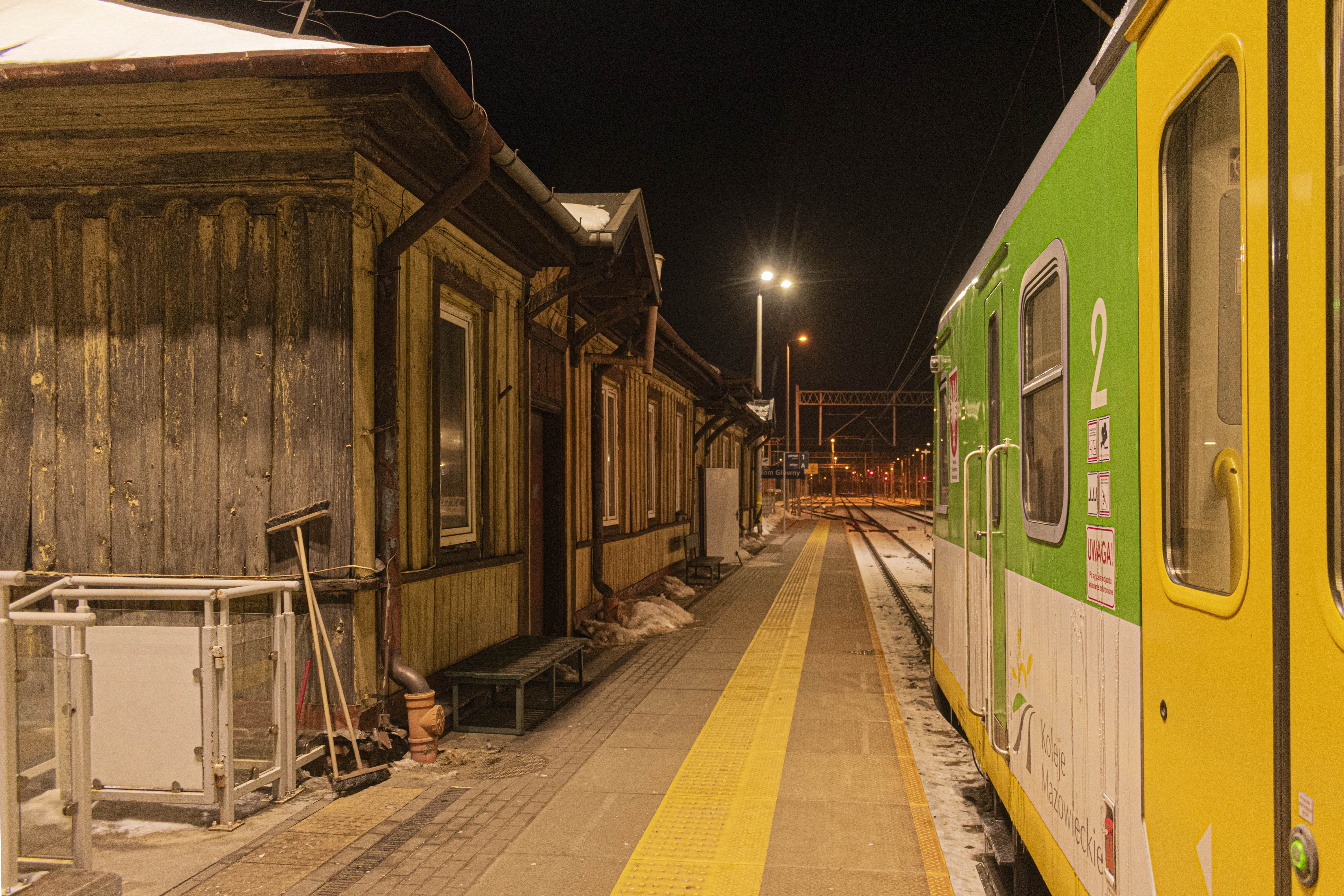
Below: Warsaw-bound Koleje Mazowieckie train on Platform 1, Radom Główny station, waiting for the off. The old Tsarist-era wooden building has been left in place as is and is at odds with the rest of the modernised station.


The train reaches Chynów… and I've not seen the southbound train passing. Turns out it was late - I was almost home as it passed the end of my road. So a double win of returning via Radom rather than Warsaw! [However, it must be said that because of my annual Warsaw travel card, the journey via Radom ended up costing me 7.13zł (£1.40) more than with a change at W-wa Zachodnia. And a propos of small sums of money, my annual land tax for Jakubowizna for 2024 will be 272zł (£53.23) - for a house on an acre of land. Not enough! I'd happily pay more to Gmina Chynów for the services it delivers!]

This time last year:
We're all on one spectrum or another

This time last year:
Qualia Compilation - playing with Lego

This time three years ago:
Onto the frozen pond

This time four years ago:

This time five years ago:
Mid-Jan pictorial round-up

This time nine years ago:
UK migration and the NHS

This time 12 years ago:
Miserable depths of winter

This time 13 years ago:
From - a short story (Part 1)

This time 14 years ago:
A month until Lent starts

This time 15 years ago:
World's biggest airliner over Poland

This time 16 years ago:
More pre-Lenten thoughts


Tuesday, 12 December 2023

The little railway town on the (old) border

On my way to Zielona Góra in western Poland, I change trains at Zbąszynek. I am greeted by unusual (for Poland) railway architecture, and discover some interesting history. Below: Zbąszynek station from Rondo Św. Katarzyny Aleksandryjskiej Patronki Kolejarzy.

Below: Zbąszynek station at platform level. This is not your usual former-German railway station. Clearly built in the 20th century, it has none of the Gothic-wood-glazed-tile-and-wrought-iron look that I usually associate with railway architecture across Lower Silesia or Pomerania, usually dating back to the 19th century. Note concrete lamp standards, for example, and the shape of the platform shelter roof - the breadth of the platform with a lawn inset with decorative bushes.


Below: the booking hall - sadly, no longer selling tickets in person as of the end of October 2020, just a couple of ticket machines. 


I have half an hour before my connecting train - just long enough to venture gingerly into Zbąszynek to have a nose around. It's not just the station - the entire town was built around the railway. The history is fascinating. 

Zbąszyn (formerly Bentschen), 6km down the line to the east, was a major German railway junction prior to World War I. As a result of the border changes following the Treaty of Versailles, Bentschen became part of Poland with an important border station, with many platforms and customs sheds. Through here steamed trains from the Soviet capital, through Poland and on to Berlin and Paris. Neu-Bentschen was built by the Germans in 1923-24 as a replacement for the old railway junction that Germany had lost, and it served as the border station (grenzbahnhof) on the German side.

It was necessary to house the railway workers and customs officials and their families - several hundred in all - in the new junction town, and so Neu-Bentschen became a settlement built for the needs of the new station. Designed along modernist principles of a model garden city by architect Friedrich Viel, Zbąszynek looks and feels highly atypical for Poland. This is town planning done right


Below: here is the railwaymen's house of culture, built in the late 1920s or early '30s - I sense quite a Home Counties vibe here, a bit of Welwyn Garden City. It's certainly a long way from the typical Germanic architecture of western Poland.


...and across the road, a narrow-gauge steam loco rusts away, neglected... Interesting to note that narrow-gauge never passed through this part of Poland (nor indeed, prior to 1945, of Germany).


Heading back to the station, I am struck by the symmetry of the architecture. Conspiracy theorists might bridle at the notion of fifteen-minute cities, but it's not a new idea; town planning goes back to Ancient Athens, revived by town planners and architects in the late-19th and early-20th centuries. Everything for the Deutscher Eisenbahner within a short stroll of his modern haus.


Zbąszynek merited another visit on my return from Zielona Góra. With half an hour in hand before my connection on to Warsaw, I did another tour, taking another route to catch more of this little town's unique atmosphere. Below: the modernist church, built for railwaymen and their families. Bungalows across the cobbled street - not the usual multi-story tenement housing one associates with Silesia or Pomerania, to the left, the church of the Apostles Peter and Paul.


Below: are we in the Netherlands? Is this Delft? No, Neu-Bentschen, now Zbąszynek - quite a remarkable Polish town. Ulica Kościelna.


Below: snapped from across the street, rows of bungalows with dormer-windowed attic rooms.


Below: the town hall which, as the Alte Rathaus, served its builders briefly. The Red Army entered Neu-Bentschen just 22 years later, without fight for it, so architecturally Zbąszynek has been well preserved, with no post-war fillings-in (plomby) to replace buildings destroyed by war.


Below: Pre-war railway map of western Poland. Zbąszynek/Neu Bentschen is the large dot on the border; Zbąszyn is the smaller dot to its east.


Below: Zbąszynek serves as an important junction, with rails radiating north, east, south and west. The lines to the south of the station serve as a bypass route for freight trains.


Below: so farewell then, Zbąszynek. Waiting for the Berlin-Warsaw express to arrive; on Platform 3 Track 5 a local all-stations service to Poznań is about to depart. Note the width of the platform, punctuated by a lawn and bushes. The building on Platform 2 served as a customs hall, where passengers had to open their suitcases. An attractive station, but one that needs an upgrade to bring it into line with the facilities expected in modern PKP stations.


A charming and, I daresay, unique Polish town with an interesting back story. 


This time three years ago:
Solar promise dashed

This time six years ago:
Meditations on West Ealing and Change.

This time eight years ago:
Warwick University alumni meet in Warsaw

This time nine years ago:
Pluses and minuses of PKP InterCity

This time ten years ago:
When transportation breaks down

This time 15 years ago:
Full moon closest to Earth