Showing posts with label England. Show all posts

Saturday, 22 December 2018

Betjeman and spirit of place

A lifetime during which my favourite poet has been and will be John Betjeman; the poet of suburbia and social insecurity, transience of life, nostalgia, and yes, spirit of place.

My introduction to the works of Betjeman came in September 1972; I had just started the fourth year at grammar school, and English literature classes kicked off in the autumn term with an anthology of poetry entitled Poets of our Time (edited by F.E.S. Finn). The first poem by the first of the ten poets was Betjeman's Upper Lambourn, and it immediately resonated with me in the way that no poet before had ever done (and by then, we'd covered Wordsworth, Keats, Byron, Tennyson etc).

Here was something tangible, familiar, a sense of being there, having not been there... from the first very lines I'd read;  "Up the ash tree climbs the ivy/Up the ivy climbs the sun..." I liked all the Betjeman poems in the book and only a handful of the rest (by Charles Causley, Ted Hughes, Laurie Lee).

A month later, in October 1972, Sir John Betjeman was appointed Poet Laureate of the United Kingdom, and was considered at the time the nation's favourite poet. Certainly by then, mine too.

And on 26 February 1973, the BBC showed Sir John Betjeman's Metro-land, a televisual poem. This took Betjeman up to another level for me. Metro-land, his exploration of the Metropolitan Railway, from Baker Street all the way out to remote villages in deepest Buckinghamshire, was a revelation. It prompted a long series of journeys - by family car, by train, by bicycle, later in my own car, to seek out the spirit, the mood, the atmosphere of place that Betjeman had captured.

As I wrote yesterday, the qualia, those moments of subjective experience of consciousness, are of vital interest to me in terms of who we are, our place on earth, associations of where we are from.

Betjeman could conjure up those feelings with a run of a few words, like a great painter bringing to mind the experience of being there with a few brush strokes, or a great musician painting a picture with a short series of notes. Betjeman was more about place than people; and so am I (in contrast to my daughter, an avid student of people's stories, soap-opera construction and the human condition. My son, like me, is acutely conscious of spirit of place). Like Betjeman (as you will see in the Summoned by Bells TV programme linked below), I am perfectly happy in the solitude of my own company, moving around the landscape, observing, sensing spirit of place.

And set those words to moving pictures, and as I watched Metro-land for the first time, I wanted to head out there and feel it myself, an atavistic yearning for Edwardian England, the 1910s, an era I could feel in the stones and bricks of the Hanwell and Ealing in which I grew up. Below: Cleveland Park, a view I remember from childhood, long before we moved here (though the bench was different - green-painted wrought-iron frame, darker wood planking). And I remember the aluminium-tubed bus shelter, from where the 65A would set off on its long journey to Chessington Zoo, Copt Gilders Estate or Leatherhead. Which Sir John would have no doubt pronounced with a stress on the head.


Does Poland have a Betjeman? Well, we have our literary reportagistes - Jacek Hugo-Bader, Filip Springer, heirs of the great Ryszard Kapuściński - but poets that revel in the everyday, with a hankering for the near-bygone? Poland's 'near-bygone' is the communist era, and among those who lived through it there's little positive sentiment. True, today's hipster designers draw on the visual styling cues of 1950s and '60s Poland, but a belief that a golden age has just slipped by and that Poland should draw on the values and culture of the immediate past belongs to a rather odd fringe.

But will Poland have a Betjeman? Betjeman was an Edwardian who looked back at the Victorian era with nostalgia, and then, in later life, looked back at the 1930s as a golden age. He saved St Pancras Station, but did not live to see it reemerge in glory. A Polish Betjeman may emerge in 20 or 30 years' time, fascinated by the chaotic jumble that was the 1990s and the great leap forward that followed Poland's EU accession. Spirit of place - yes, it's there to be found, documented, captured in poetry, music and the visual arts.

What would Sir John have made of Brexit? What poems would have poured from his pen? We don't know - his voice today would be irrelevant in this age of social media and instant gratification; we can of course readily knock out some parodies in his style - but that's all they would be, for he is a poet of his age, his time, and his place. "Largely, it was a longing for the past/With a slight sense of something unfulfilled" [Summoned by Bells, 1976].

Watch it, and enjoy being taken back to Edwardian England.


This time last year:
What did YOU do in the First World Cyber War?

This time two years ago:
Solstice sunset, Gogolińska

This time seven years ago
Extreme fixie

This time nine years ago:
Poland's worst railway station

This time ten years ago:
Last Christmas before the Recession?

Wednesday, 27 December 2017

Rural Derbyshire, December sunlight

It's that time of year again, and between a soggy Christmas Day and a rather dismal Wednesday, Boxing Day (drugi dzień świąt) was marvellous, weather-wise. At my brother's in Derbyshire, time to walk off the carbohydrates and booze with two walks each of over 8,000 paces. First was on my own, in brilliant sunshine, the second accompanied by mes enfants and their Cousin Hoavis.

Walk One - from Duffield up Hob Hill then down towards the Ecclesbourne Valley and back along the railway line (no trains running).


Walk two - across the Chevin, cutting across the Hazelwood Road, then once more back to Duffield along the tracks.


England at its fineft.

This time three years ago:
Derbyshire in the snow

This time four years ago:
Is Britain over-golfed?

This time six years:
Everybody's out on the road today

This time seven years ago:
50% off and nothing to pay till June 2016

Sunday, 6 August 2017

Hammersmith, on the Thames

One of my favourite haunts in West London is the stretch of the Thames between Hammersmith and Chiswick. I'd spend many a summer evening here in the pubs and on the riverside paths and lawns; pleasure cruisers would make their way up and down stream, disco music blaring - The Hustle by Van McCoy from 1975 there in my memory. Pints of ale at the Blue Anchor, the Rutland, the Dove, the Old Ship and the Black Lion. And plenty of Brictorian architecture along the way.

From the roofs of these desirable riverfront properties, the views of the Thames - in both directions - must be truly uplifting. Note the raised step and solid wooden gate - a sign that flooding is a risk that householders have to live with. Artist Eric Ravilious lived in a house (marked with a blue plaque) on the corner of Upper Mall and Weltje Road, the next corner down, between 1931 and 1935.


Below: the view westwards towards Chiswick, visible on the bend of the river. Close to this viewpoint is the house, now occupied by the William Morris Society, from which in 1820 Sir Francis Ronalds sent the first electrical telegraph a distance of signal eight miles.


Below: the view eastwards towards Hammersmith Bridge. Note the sprawl of houseboats at anchor on the northern bank of the river.


Below: a floating residence upon the Thames has long been popular alternative to ultra-expensive bricks and mortar. The solid Victorian embankment stands over the river at low tide, exposing its muddy bottom.


Below: quintessentially English view; Georgian architecture, an MG Midget sports car parked outside. The high wall to the left backs onto the river. Down the passage to the left is the Dove, a charming and historic pub, in which it is said the poet James Thomson wrote the words of Rule Britannia!. At the far end of the passage is Furnivall Gardens, a popular park wedged between the roaring traffic of the Great West Road and the placid waters of the Thames.


Looking west down the passage with the Dove to the left. Many's the time I made my way here, the half-way point of the five-pub riverside stroll that starts at Hammersmith Bridge and ends at the Black Lion.

This is London at its best, day or night, summer or winter, if you're in town for several days, this walk is certainly worth it, especially if you call in at the pubs along the way for refreshment.

Below: bonus shot - a Rolls-Royce 25-30 HP Touring Limousine with bodywork by Park Ward, near Scotch Common, Ealing.


Below: bonus bonus shot - a Bentley 4¼ Litre Drophead Coupe with bodywork by Park Ward, near Ealing Common, Ealing.


By the mid-30s, when both these cars (now over 80 years old!) were built, Bentley was owned by Rolls-Royce and was producing essentially sportier versions of a vehicle with similar mechanicals.

This time three years ago:
In search of quintessential English countryside

This time four years ago:
Behold and See - short story, Pt III

This time seven years ago:
Another return to Penrhos

Saturday, 22 April 2017

Litter makes me bitter.

Here we live, o blessed people of Jeziorki, in a beautiful, magical corner of Warsaw, surrounded by nature, birdsong, wildlife - and filth. For some reason (I'd ascribe it to mindlessness) two specific elements of our local community find it impossible to take their litter with them and dispose of it properly. Element One - Pan Ziutek and Pan Heniek, who meet under a clump of trees on ul. Nawłocka (below) to imbibe. Once suitably refreshed, they abandon their bottles and cans in the grass and stagger off to their hovels.


Element Two is more seasonal, and the approaching spring is drawing them into the open air - teenagers who come to have outdoor picnics by the pond (presumably because it is an attractive place); they leave their soft drink and ketchup bottles making the place look less attractive.


This mindlessness requires punishment - corporal punishment such as being placed in stocks outside Ursynów district hall, where the brudasi can be pelted with rotting onions and eggs by laughing crowds.

In last year's participatory budget (to be spent this year), the number one choice of Jeziorki voters was for a set of 12 dustbins to be placed along ul. Trombity, ul. Dumki and ul. Kórnicka. There already are bins out along Kórnicka and the far end of Dumki, evidently more are needed.

Back in Britain, I am sure that among the 1,269,501 voters who swung it for Brexit at last June's election was a fair number of citizens for whom the daily sight of empty tins of Polish beers strewing the parks and gutters of English towns and villages was the last straw, the tipping point at which they decided to vote leave. Below: one Żywiec, one Warka and four tins of Specjal Jasny Pełny to go. Empties in Pitshanger Park, Ealing.


This, from last week's Economist, which has a two-page story called Migrantland, about those parts of the UK with the fastest influx of EU migrants, those parts that voted overwhelmingly to leave the EU in the referendum":
"We estimate that whereas over 40% of the Poles living in London have a higher-education qualification, only about a quarter do in the East Midlands, where three of our ten areas are. One in 20 people in Boston cannot speak English well or at all, according to the 2011 census. Small wonder that integration is hard. Many landlords do not allow tenants to drink or smoke inside, so people sit out on benches, having a drink and a cigarette. “Because they’re young, not because they’re foreign, they might not put their tins in the bin,” says Paul Gleeson, a local councillor."
I disagree with Mr Gleeson. They don't put their tins in the bin not because of their age, but because no one taught them to put their tins in the bin. I remember when Eddie was small, we'd watch TV together, and often see a Public Information broadcast featuring a Afro-Caribbean dad and his son; the son dropped a soft-drink tin, his father told him to pick it up and put in in the bin. And I, who puts the smallest scrap of paper into my pocket rather than drop it on the street, brought up Eddie the same way - you take your litter home with you. You drop nothing. At all. Ever. Eddie shares my intolerance for litter louts.

How do you stop the mindless from littering? They cannot see or feel the aesthetic damage they do. They come to an attractive place, they leave it less attractive and see nothing wrong. I read recently a text by a writer who'd seen a car full of 'patriotic' youths, sporting Polish flags, Armia Krajowa insignias, patriotic slogans - the occupants chucked out empty fast-food cartons and drinks tins. They claim to love their country, they shit on it.

I would certainly like to see public corporal punishment for litter louts. Economically and socially liberal I may be, but when it comes to protecting our environment, I am robustly illiberal.

This time three years ago:
Lent's over - now what?

This time four years ago:
Completely in the dark

This time five years ago:
Ruch Palikota - a descent into populism

This time sixe years ago:
I cross two unfinished bridges

This time seven years ago:
What's the Polish for 'grumpy'?

This time eight years ago:
Do not take this road!

This time nine years ago:
Seated peacock, Łazienki Park

This time ten years ago:
Spirit of place: 1930s Kentucky - or Jeziorki?

Monday, 26 December 2016

Derbyshire at Christmas

The traditional Yuletide pilgrimage around England. Last year, it was 13C on Christmas day, this year it was 14C as we crossed the Peaks. [Looking back over this blog, I can also see snowy Christmas days, but the temperature trends are on the up.] Below: somewhere along the A6 between Buxton and Bakewell. Delightful scenery.


Below: from the same spot, a lay-by on the edge of the Peak District National Park camera turned through 90 degrees, zoomed out a bit.


Back in Duffield, the weather on Boxing Day was sunny though with a strong wind in the west. Time for a short walk with Dziadzio.


The landscape with its many folds and ridges catches the eye in the distance, and my Nikon Coolpix P900's long lens can pull out the compositions


Before a late gammon lunch, time for a second walk, with Moni, Eddie and our local guide, Cousin Hoavis. Along the Ecclesbourne Valley Railway (no trains running today), to Hazelwood, then up Nether Lane to Hob Hill.


And back towards Duffield...


The sun sets behind the ridge along which runs the Wirksworth Road.


Below: abandoned, broken into, vandalised, burnt and partially collapsed; house on Hazelwood Road


This time last year:
Across the High Peaks

This time two years ago:
Derbyshire's rolling landscapes

This time three years ago:
Our Progress Around the Sceptr'd Isle

This time four years ago:
Out and about in Duffield
and
Christmas Break

This time five years ago:
Boxing Day walk in Derbyshire

This time six years ago
This time eight years ago:
This time nine years ago:

Monday, 8 August 2016

Out where the pines grow wild and tall*

Back in London with my father, a few days here before returning to Warsaw. Time to revisit old haunts together.

For as long as I can remember back to my earliest childhood, my family has always been coming to Sandy Lane (as we call it, Oxshott Heath as it is). My father can't recall who first found this weekend leisure venue, but ever since he had his own car, we'd spend many a Saturday or Sunday afternoon on the heath - sometimes, we'd come mushroom picking (earlier start), best in early-autumn, looking for prawdziwki, the brown velvet-capped boletus that's safe and tasty to eat, but hard to find.


From the car park on Sandy Lane it's not too far to the sand pit, a large man-made excavation made during WW1, when sand was needed in large amounts for sandbags destined for the trenches. The sand pit was enlarged during WW2. Today, it was the venue for radio-controlled model dune-buggy racing. This woodland is surrounded by fair exurbia, London's answer to Zalesie Górne, Magdalenka, Izabelin or Konstancin. Beyond the common, detached houses with large mature gardens.


The last time my father and I were at this tree together (below) was more than 19 years ago, with Moni and Eddie just before we moved to Warsaw.


Further on, past brambles bearing ripening blackberries, climbing gently towards an escarpment. As children my brother and I used to race down the path to the bottom. There used to be a large wooden hut hosting a tea room and selling ice cream down here. On the far horizon, the Surrey Hills, Leatherhead and Reigate.


Below: photos taken by my father 52 years ago - May 1964. My brother with, and without, ice cream. In the distance the escarpment, path running down it also visible in the photo above.


Left: war memorial overlooking the escarpment. As is usual across Britain, the majority of the names of the fallen are from WW1, with a smaller number from WW2. Many of the WW1 dead were from the Royal Army Medical Corps.

Below: it was a beautiful day for the trip; not too hot, yet sunny and clear, cooled by a westerly wind. Good walking weather. My father surveys the horizon.

Left: we walk back through the westerly part of the woods, where we'd pick mushrooms. It's been a dry summer, so little to be found here right now - we came across three puffballs, but none of the prized prawdziwki.

The journey from home to Sandy Lane by car took 45 minutes each way; during my childhood it would take half an hour - less congestion, safer speed limits.


Still, it was wonderful to revisit a place that was such a familiar part of our weekends in the 1960s and early 1970s.

* Title of post is a line from My Father's House, from Bruce Springsteen's album Nebraska.

This time three years ago:
Behold and See [Short story, Part IV]

This time four years ago:
A new-found fascination for Mars

This time five years ago:
Rhetorical question: why the fuss?

This time six years ago:
Varsovians! Ditch the car - buy a quarterly karta miejska

This time seven years ago:
The limited interests of mankind's geniuses

This time eight years ago:
Into the fading light

This time nine years ago:
Ar y Ffordd i Pwyl Rhydd

Monday, 14 December 2015

New shoes from old, courtesy of Loake

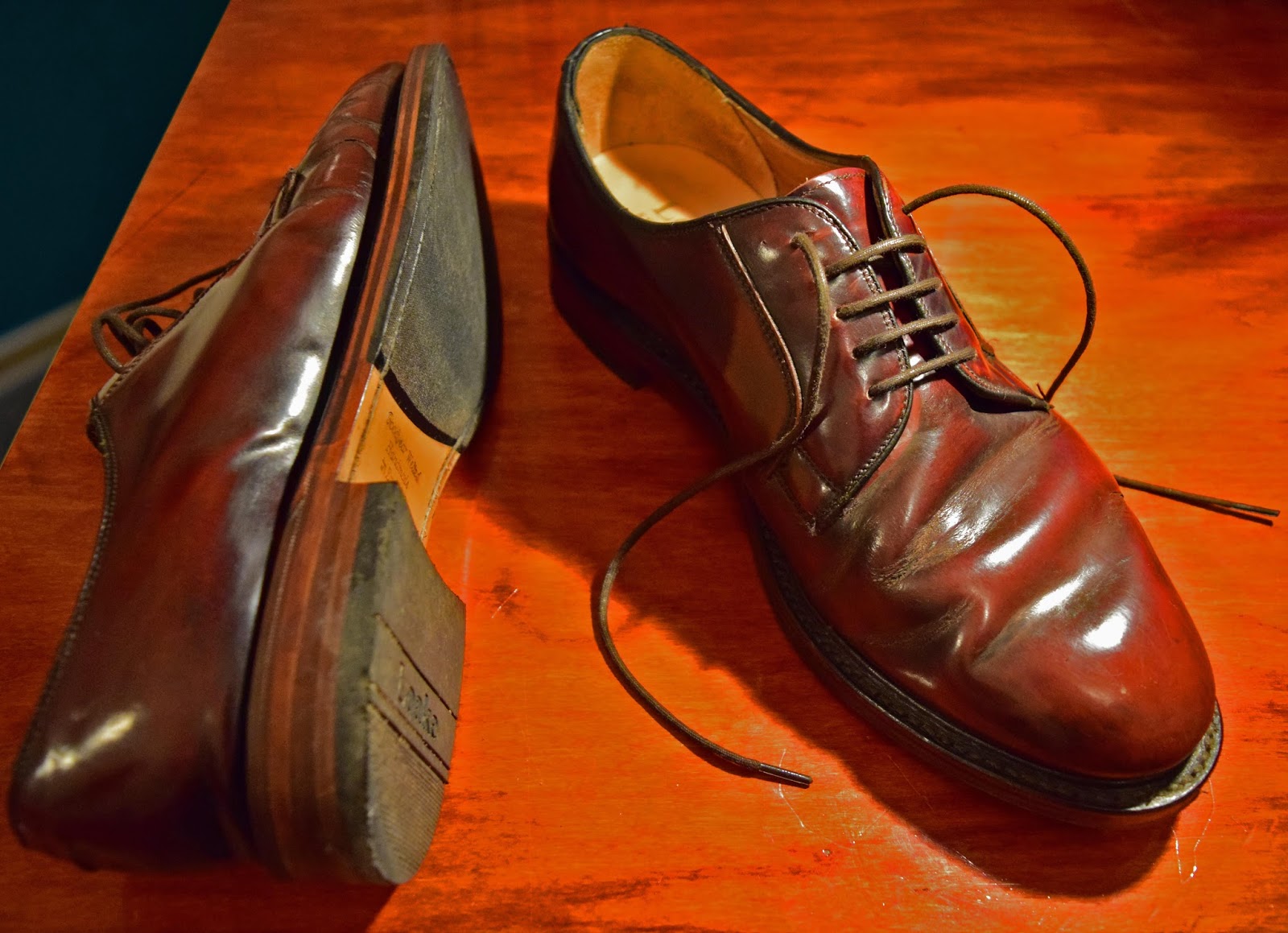
I wrote in June about the appearance of a Loake shop in Warsaw, and the shoe manufacturer's promise to restore old pairs for the equivalent of £50. I took in one of my many pairs of Loakes for a 'long sole' rebuild, and three weeks later, they were ready for collection. Below: how this pair (bought in or around 1996) looked before, having sustained many Warsaw winters of salty snow and ice.


Below: and how they look today. Still the same uppers, but the entire sole and heel has been replaced, as have the shoes' linings, and new laces.


Below: this is the brand - my favourite shoes. Made by shoemakers, in England. Not by robots or children. These shoes will be good for many years; this is sustainable manufacturing.


Below: the key ingredient - a Goodyear-welted leather sole, with rubber finish for those mucky Jeziorki roadsides - pavements have still to reach this far-flung part of Warsaw. This is something no 'Mr Minit' style heel bar can ever provide - a tip-top quality shoe repair, hand-stitched - not merely glued.


Given that a new pair of Loakes cost 1,290 zlotys, spending a quarter of that on a new long sole every few years makes this a long-term investment. No here-today-gone-tomorrow fashions - Loakes are timeless in style and the mark of a gentleman. [Watch this BBC piece about Slow Fashion.] Loake Warsaw, ul. Chmielna 30 (in the courtyard). A stone's through from Kino Atlantic.

Since collecting this pair, I've handed in four more for reconstruction; a further four pairs wait at home.

Tuesday, 10 November 2015

Cultural differences, Poland - UK

Sitting in the Stag and Huntsman in Hambleden, a lovely old pub in a lovely old Buckinghamshire village, one of the essential cultural difference between Poland and Great Britain became clear to me.

It is the village. Cities tend to be similar. But examine the villages in both countries, and you will see the core of what makes Poles different to Brits.

In England, the village is the central repository of essential English values; decency, politeness, community - and privacy. 

It is here in Hambleden, not far from Henley-on-Thames, that W.H. Smith, newspaper vendor and bookseller - who made his fortune placing kiosks in stations as Britain's railways boomed - retired to. The village - like many around it - Fingest, Turville, Skirmett, Frieth - is extremely picturesque (it often appears in films and TV series). Its topography bears some examination, for it is here that lies the heart of the difference between Poland and England.

Hambleden is a largish group of cottages and a manor house clustered around a village green, a village church, a village hall, a village store and a village pub. Fields are regular in shape, interspersed by woodland and divided by hedgerows. Roads run off in all directions - down towards the river, up into the wooded heights, east and west to neighbouring villages. The terrain undulates; villages nestle cosily in the folds of hills. Below: the Village Hall, Hambleden.


It's a Sunday lunchtime, and the Stag and Huntsman is packed. Poles would look through the window, and remark that these people would be better off saving money by cooking their own food and eating it in their own homes - it's cheaper. It occurred to me that what these English rural folk are doing as they spend their money on roast beef and Yorkshire pudding is investing in their community. It's not just about creating local jobs for bar staff, kitchen staff, farmers and brewers. It's about building trust and friendships between people in the village.

Below: beyond the butcher's shop, Hambleden's village inn, the Stag and Huntsman. Note how all cars are obediently parked on one side of the road. Porządek, Panie.


The Polish village, in contrast, is typically strung out along a long, straight road, with no discernible centre. This makes sense as the landscape's table-top flat. Ideal for mobile warfare. Left: ribbon-thin strips of land run off at right angles from this road, each farmed by different farmers (click to enlarge), the sons of sons of sons who had too many sons. I've also mentioned the importance of primogeniture in defining the difference between Poland and England - and in particular the countryside. In England, custom and law had it that the eldest son inherited the entire landed estate - as a whole. Younger sons joined the army, the church, the civil service. Or went off to conquer an empire, invent steam engines or football. In Poland, a father would divide his estate between sons, with each son ending up with ever-smaller strips of land, just enough to subsist on.

Other than the church on Sunday, there's no social focus. Yes, there's the shop, and outside it Pan Heniek and Pan Ziutek will while the afternoon away supping tins of Warka Pstrąg. And indeed, they bring with them to the UK the habit of outdoor drinking and depositing their empty tins of Lech, Tyskie and Żywiec around Britain's parkland, rather than paying the premium for sitting down in a pub to imbibe one's ale, as is the British wont.

And so, roaming around the Polish countryside, I yearn for those village hostelries where a pork pie (what's that in Polish!?) and a pint can be consumed in agreeable surroundings while resting weary legs.

The result of primogeniture is that the British aristocracy is numerically a minute percentage of the population. The Polish szlachta, or nobility, watered down by split inheritance, numbered some 8%-10% of the population at its peak. Better to be a somebody with a tiny parcel of land and a noble surname than a nobody forced to invent stuff like steam engines, telegraphs, mechanised looms, or blast furnaces.

As I have written before, the English countryside is where one wants to retire to, the Polish countryside is where one wants to escape from. The Polish wieś seethes with zawiść - jealous hatred or hateful jealousy - neighbours cannot countenance the fact that others are doing better than they through harder work, more judicious crop rotation, earlier (or later) planting (or reaping) - or just better luck.

But back to Hambleden. I doubt if all but the smallest number of villagers living here actually makes a living from the land. The large landholdings are efficiently and industrially farmed; here and there some organic farming takes place, but generally this is arable and livestock country, well maintained and managed. The majority of its 1,500 villagers are recent arrivals who have bought picturesque properties with monies earned or inherited or both; I'd guess the village is 50%+ retired City folk, entrepreneurs who've exited their businesses or inherited wealth, with the minority being people connected to the village through their kin. The influx drives up property prices.

In Poland, I get the sense that the majority of Varsovians are only one or two generations removed from the land. In 2001, I remember going for a walk with my children, then aged eight and six, and seeing a slaughtered pig being drained of blood, its throat slit, lying on a large wooden table in the middle of a farmyard. At work the next day, I mentioned this to my colleagues Beata and Joasia. Both laughed and said they could still remember seeing the same scene as children on their grandfathers' farms. Most of urban Britain is five or even ten generations removed from the land. And with that comes learned dependence - on the mill-owner or the state - but that's another story. In January 2006, on my way to a conference in Sandomierz, I noticed on the thermometer it was -26C outside. I glanced at the landscape; an elderly woman was carrying a bundle of firewood from the forest to her house. It occurred to me that at minus twenty-six there's no such word as mañana - rural life is hard, and one takes full responsibility for one's fate. You don't outsource it to a welfare state. 

Rugged individualism can become pathological individualism, however.

Poland needs its villages to get more connected, to discover a sense of community, of win-win, of public-spiritedness, building trust between neighbours. The pub is essential to that process. Village pub teams - bowling, darts, cricket, quiz - compete with one another in English. Nothing like this happens in Poland.

But to get things kick-started, there's no better way to do it than by opening small cafés, bars, restaurants, pubs. Maybe in a generation or two's time, the Polish village is where wealthier Poles will want to retire to.

[UPDATE NOVEMBER 2017: I buy a działka in Jakubowizna, a village 40km south of Warsaw.]

[UPDATE JULY 2022: I find I'm spending more time in Jakubowizna than in Jeziorki.]

This time last year:
Schadenfreude! The downfall of Hofman & Co.

This time two years ago:
From the Mersey to the Tyne

This time three years ago
Autumnal Gdańsk

This time four years ago:
What Independence Day means for Poles

This time five years ago:
Words fail me: what's the Polish for 'to fail'?

This time six years ago:
Autumn in Dobra

This time eight years ago:
Autumn ploughing

Tuesday, 30 December 2014

Shots from the sky

Some aerial shots to share - taken from the BA flight from Warsaw to London, then from London to Warsaw. Flying on the left side of the plane (an 'A' seat) both ways. Below: Crossing the English coast; in the centre of the photo is Foulness Island; the Thames Estuary glinting gold in the distance. "Cabin crew prepare for landing."


Below: on final approach, over Wimbledon. Running through the frame is the London and South West railway line with its depot between Wimbledon and Earlsfield. "Please ensure your seatbelt is fastened, your tray table is in the upright position and your armrests are down."


Below: flying home to Warsaw, with the sun on the other side this time. A circular rainbow preceded the plane for much of the way back. In fact two - and you can just make out a third - and even fourth rainbow, projected over the blanket of cloud covering central Germany.


A rarer phenomenon, below. Looking like the massive stationary ripples of a rainbow explosion in 2D, the multiple circular rainbow flares out towards the bottom as it merges into the clouds over north-west Poland. Contrast and saturation enhanced with Photoshop.


Below: approaching Warsaw, with Puszcza Kampinoska to the left, and in the distance the steam from the power stations at Żerań (centre) and Siekierki (right). That's Al. Jerozolimskie heading into town from the bottom right of the picture.


Below: now the plumes from Siekierki are on the centre of the horizon as the plane turns south to make a north-westerly landing on Runway 33, which means some good aerial views of Jeziorki...


Below: and indeed, there's ul. Trombity, the lakes frozen over. Snow and ice had not been forecast before we left for England a week ago, but a light dusting coats the land, with temperatures steadily falling below zero since Christmas Day and hitting a low today of -8C.


Good to be back in Jeziorki!

This time two years ago:
One-millionth of a zloty

This time three years ago:
Random year-end thoughts

This time four years ago:
Beery litter louts

This time five years ago:
Miserable grey London

This time six years ago:
Parrots in Ealing

This time seven years ago:
Xmas lites, Jeziorki