Showing posts with label Wrocław. Show all posts

Tuesday, 18 July 2023

Faith, construction and history in Wrocław

Humanity's innate draw towards the numinous, the supernatural and metaphysical - the spiritual aspects of life - has long been exploited by organised religion. The bigger, the more splendid your place of worship, the better.

Wrocław is a city of a great many cathedrals, abbeys, basilicas and churches, reflecting diverse faiths. It is also a city that has changed hands over the centuries and witnessed the Reformation, the Enlightenment and the Holocaust. All this becomes clear when visiting the city's many holy places.

Below: the Cathedral of St Mary Magdalene, and its famous Penitents' Bridge linking the two towers at a height of 45m above the ground. Photo taken from the viewing galery around the tower of St Elizabeth's church, the highest such point of any Wrocław church.


Below: looking down and across from the Penitents' Bridge. Now here's the thing about this cathedral - it is not Roman Catholic - it is linked to the Polish National Catholic Church (and so unaffiliated with the Vatican)! Despite the name, its beliefs (as set out on a placard in the nave) seem more liberal than the Radio Maria end of Polish Roman Catholicism. The PNCC was set up in the US in the late 19th century in response to Polish Catholics unhappy with German and Irish bishops. I had no idea!


Below: side chapel, St Elizabeth's Church. Culture clash. To the left and right, baroque altars erected in honour of patrons from the 17th and 18th century Prussian aristocracy; in between modern stained glass remembering the formerly Polish cities of the Kresy - eastern borderlands that Poland lost after the war in exchange for Lower Silesia and West Pomerania.


Below: the interior  of Wrocław's White Stork synagogue, the only one that survived the Holocaust. On the first floor, an exhibition outlining the history of Wrocław's (and before that Breslau's) Jewish community - centuries of persecution, right up to  the expulsion of Jews from communist Poland in 1968. I was particularly fascinated by the story of Jewish rationalism during the Enlightenment; balancing tradition and belief with the scientific method.


In contrast with Protestant and Jewish places of worship, the Orthodox Church assails the senses. Here we have St Cyril & Methodius in Wrocław. Below: looking at the iconostasis.


Below: looking up at the ceiling. All that's missing are heavenly multipart harmonies and incense.


Left: totally Tridentine - the Cathedral of John the Baptist on Ostrów Tumski. Latin Masses! No screaming kids! No taking Holy Communion in the hand while standing! Like the Second Vatican Council had never happened! Nowhere else in Wrocław!

Below: elevated corridor bridging two parts of the Sisters of St. Elizabeth convent, Ostrów Tumski.

This time three years ago:

This time four years ago:


Sunday, 16 July 2023

Wrocław's Hala Stulecia (Centennial Hall)

I was eight when I first saw this building; it made an impression upon me as did the steel spire towering outside. However, back then I didn't grasp its historical significance. Back then in communist times, it was called Hala Ludowa - the People's Hall ('Volkshalle' in German) - and the original name, Jahrhunderthalle somehow morphed in my mind as the Jahrtausendhalle - 'Thousand-Year Hall', as in 'Thousand-Year Reich'; in other words - the negative ideological connotations of communism and Nazism. A place associated both with Sieg-heiling Nazis and ranting communists.

Only later did I come to realise that the Jahrhunderthalle predated National Socialism rule by two decades, and was actually built before the First World War. Commemorating the hundredth anniversary of the defeat of Napoleon by the Prussians at the Battle of Leipzig in 1813, the building was a striking example of Germany's industrial prowess. Built out of reinforced concrete, its structure encompassed what was at the time the largest space under a roof without supports. Today, a UNESCO-listed building.


View from the inside of a scale model of the building, itself situated inside the building. With its purity (no screens, speakers, cabling or spotlights), this view reflects the genius design of the place better than the real thing. 


Below: looking messier in real life, but still very impressive. Refurbished in 2011, the hall now seats 10,000, with extra seating below the false floor (designed by British architects Chapman Taylor).


Below: the hall as seen from the giant pergola that extends in a semi-ellipse, taking in Poland's largest fountain, built in 2009. To the right, the spire ('Iglica'). It's mid-July, but the ground is already looking parched.


Left: this space-age structure actually predates the space age by nine years; built in 1948 for the opening of an exhibition celebrating Poland's postwar westward expansion into its regained territories. It's unsupported by guy lines or anchors, standing only on its three legs. For its periodic refurbishments, it is gently laid down on its side. Today, it's just 90m tall; originally, it was 106m, but twice it needed shortening.

It's worth putting the hall into historical context - 35 years after the original opening that celebrated Prussia's defeat of Napoleonic France, the same building hosted an exhibition celebrating the Soviet victory over Nazi Germany and Poland's new western borders. Below: if you have a spare half-hour, this communist-era documentary is fascinating. Disinformation, half-truths, omissions, distortions and outright lies - same playbook as Russia uses today.

Below: laid out at the same time as the hall was built, the Japanese Garden was designed according to the precepts of traditional Japanese aesthetics and philosophy. It was renovated in 1995, then badly damaged during the Wrocław flood of 1997 and reopened again two years later. I must say, after visiting it, I felt in great need of a sushi supper - sadly the nearest Japanese restaurant was nowhere near.


This time two years ago:
New phone, new laptop

This time three years ago:
Longevity and Purpose

This time five years ago:
New bus stop for Karczunkowska

This time 11 years ago:
Who should pay for railways?
[How America built an electric railway line over the Rockies - over 100 years ago!]

This time 13 years ago:
Grunwald - the big picture

This time 15 years ago:
"Take me right back to the track, Jack"

This time 16 years ago:
The summer sublime

Wednesday, 19 April 2023

Wrocław snapshots

A mad rush of a week - Warsaw-Poznań-Wrocław-Warsaw, little time for snapping, but here's a handful.

Below: an tenement on ulica Romana Dmowskiego. Down at heel, in need of a remont - but still inhabited. Take a look at the bottom right of the picture...


Below: ...detail of the uncovered ghost sign, 'lebensmittel' = foodstuff, groceries what have you. As I wrote here, Poles are no longer uncomfortable with reminders that these lands were once a part of Germany.


Below: only the cars give away the fact that we're no longer in the communist era - 1970s blocks of flats, ul. Zachodnia, Wrocław.


Below: the former Linke-Hofmann factory, after the war becoming the PaFaWag factory, now back with its former owners, within the group now known as Alstom. 


Below: some lovely klimat - reeking of industrial history.


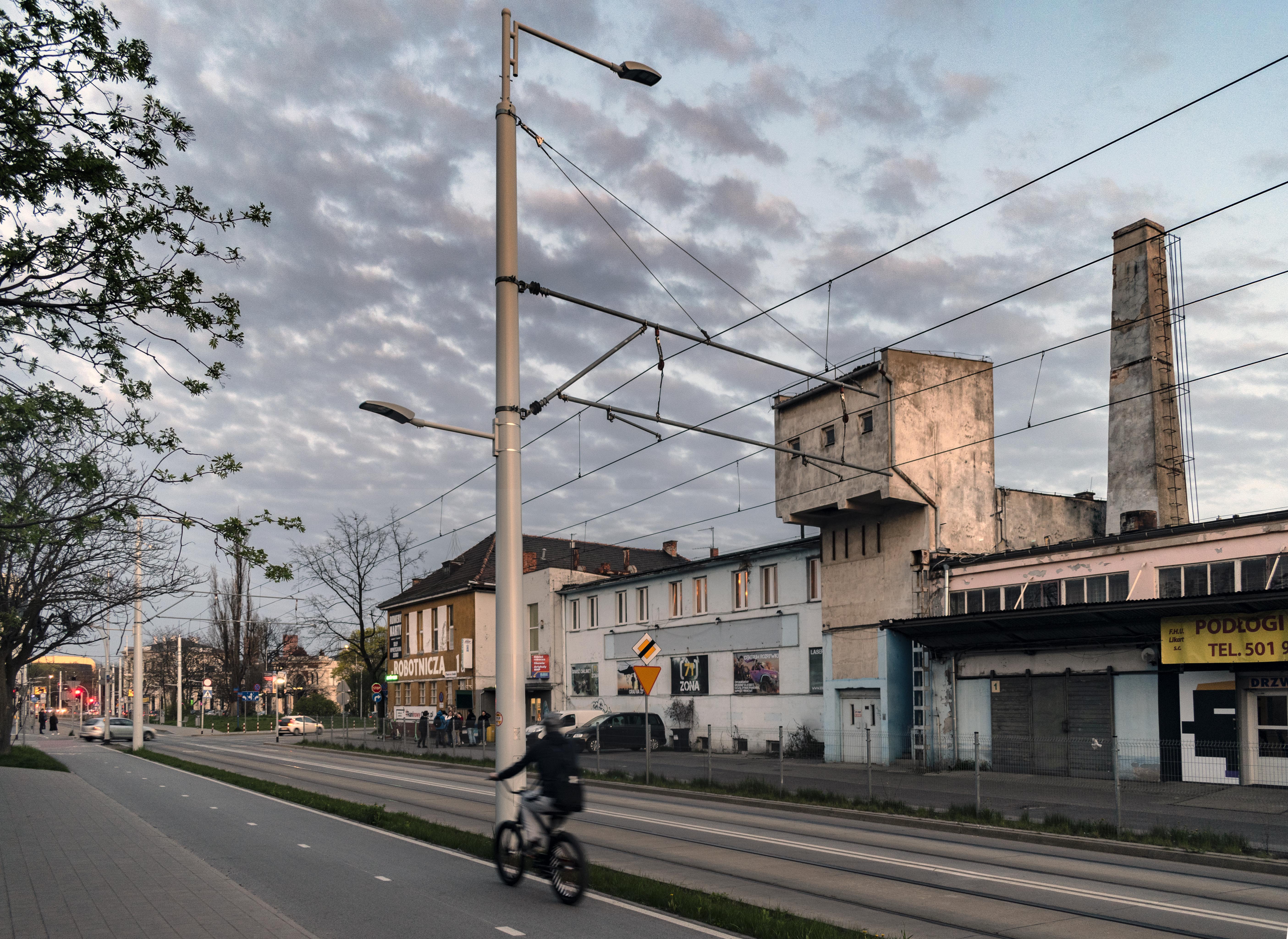
Wrocław's ul. Robotnicza ('Workers' Street'), just ahead of the opening of the new tram route, with parallel cycle path and footpath. No cars. That's the way to plan urban thoroughfares!


Below: round the back of the former (and hopefully future) station of Wrocław Świebodzki - again, great klimat.


This time two years ago:
Greylag geese appear in Jeziorki

This time three years ago:

This time five years ago:
Easter in Ealing

This time seven years ago:
WiFi works on Polish train shock

This time eight years ago:
My dream camera, just around the corner
[No, the Nikon Z6/Z7 don't make the grade]

This time ten year ago:
Longer, lighter lens

This time 11 years ago:
New engine on the coal train 

This time 12 years ago
High time to leave the car at home

This time 13 years ago:
The answer to urban commuting

This time 16 years ago:
Far away across the fields

Sunday, 9 April 2023

Easter and photo catch-up time - Pt 1: Urban

Normal blogging resumes from today; there will be more localist photography and fewer spiritual and philosophical musings. For the time being anyway...

On 21 March, I had the chance to visit the Varso tower for the first time - the EU's tallest building, opened late last year. Below: Warsaw skyline looking west from Warszawa Śródmieście. Skyscrapers from the left: LIM tower, Central tower, Varso Place (centre), the Lumen building by Złote Tarasy, and Złota 44 ('Żagiel', or the Sail).

From the 43rd floor, the views, shortly after nightfall, were spectacular. Impressive city, Warsaw - what you are gazing down upon was nothing but rubble 78 years ago. Below: looking north, along ulica Towarowa/ul. Okopowa.


Below: looking north-east towards aleja Jana Pawła II.


Left: looking down on the Palace of Culture, with Złote Tarasy in the foreground. A long-held dream of mine. My dream was to be able to do this from 360 degrees - Stalin's gift to the people of Warsaw ringed by supertall skyscrapers, each one higher than it, rendering it invisible when looking at the Warsaw skyline from a distance. 

This might never happen - the shift to remote work, resulting from Covid and IT, means that corporates need less floor-space for their offices, and so the rush to build supertalls has slowed right down.

Below: once a familiar sight in railway stations and airports around the world, the flip-over destination indicator board has almost completely been replaced by LCDs. Warsaw's Śródmieście station still has some; they will not be around very long. Known across former communist Europe as the Pragotron (after the city of Prague, where the company that manufactured them, Elektročas, was based). Working off punch-cards, the mechanical complexity of these devices (and lack of spares) means their days are coming to an end. The flik-flik-flik-flik sound of the destinations flipping over as a train departs will soon be history. Make sure you take a conscious note of it before it goes.

Earlier in the month, I got out of Warsaw on two business trips. 

Below: leaving Szczecin station at daybreak, having come up on the night train.


Below: the rising sun colours the distant waters of the River Oder. To the left, the tower of the Pomeranian Medical University.


Left: the same tower, this time in the late afternoon. Szczecin will never allow the visitor to forget its Germanic history - the architecture is so characteristic.

Below: the Urząd Morski (maritime office) building, the neo-gothic former Neues Rathaus (new town hall), opened in 1879. Burnt just after the second world war by Soviet soldiers, it was rebuilt in the 1960s, and renovated in 2008-15. The strong sunlight brings out the colour of the brickwork.


Below: Szczecin's main post office, built around the same time as the Rathaus, and in the same materials, but still serving its original purpose. Renovated in 1995.


On 9 March I had a meeting with the Wałbrzych Special Economic Zone at the Lower Silesian Science and Innovation Park. I travelled to Wrocław by night train, arriving shortly after 5am. A leisurely breakfast in the (mercifully!) open Scottish restaurant, where meat-free food was on the menu, and at 6am I set off on foot for to my destination - 8.2km from the railway station. It rained all the way. By the time I arrived, nearly two hours later, I was soaked through. Still, I did my paces for the day. Below: Much of the route was like this.


Passing the war memorial honouring soldiers of the Polish Army, 1939-45 (erected in 1979), I decided to walk to the top. Until I looked down upon the individual graves, I thought it was going to be a Soviet memorial - that communist aesthetic pervading, the sculpture looking to my contemporary eyes in the wet morning like nothing more than a pile of body-bags stacked high. Somehow it failed to arouse any meaningful emotion in me.


Below: looking down from the summit at the Park+Ride by the Oporów tram loop. The hill was a popular destination for joggers and Nordic walkers. Just 20 cars parked (it's around 7am).


The Wałbrzych SEZ event was very interesting, focused on HR, and attracting HR directors from across Lower Silesia. I returned to Warsaw by car, as one of two passengers (three or more people in a fossil-fuel-powered car = same carbon footprint as doing the same journey individually by train). My longest car journey of the year so far.

Back to Warsaw, the train to town takes a different route; all trains from the Radom line are diverted to Warszawa Gdańska via the mis-named W-wa Zachodnia Peron 9. Below: my train is about to cross over the brand-new bridge that carries traffic over onto the Warsaw bypass route (via W-wa Wola). The old route - the tracks leading into the centre of the photo - was far more convenient for me, but awaits modernisation.


Tomorrow's photo catch-up will be rural in character.


This time three years ago:
A myriad paths to God

This time four years ago:
No God for those who don't believe, a God for those that do

This time five years ago:
Work proceeding around Jeziorki

This time six years ago:
Karczunkowska reopens to traffic

This time ten years ago:
Goodness gracious!

This time 11 years ago:

This time 11 years ago:
Cycling and recycling

This time 12 years ago:
Winter clings on to the forest

This time 13 years ago:
Toyota launches the iQ

This time 15 years ago:
Old school Łódź

Friday, 27 May 2022

Olden times in Wrocław and Gliwice

Travels by train around Poland are somewhat hit-or-miss these days with big delays being commonplace; is our railway infrastructure being hit by hackers from Russia? Opóźnienie może ulec zmianie. Za poniesione niedogodności przepraszamy. ("Delay may succumb to change. For indignities sustained, we apologise."). My return from Wrocław was punctuated by an hour-long transfer at Gliwice, chance for a wander around. 

The railway station (below) is complete, but access to it from front and back is complicated by a mass of reconstruction work from the front, and the building of a new bus station at the rear.


Below: plenty of pre-war architecture to remind one that this was once the German city of Gleiwitz. 


Below: unthinkable that ghost signs in German would have been visible even 20 years ago; with Germany and Poland both comfortable about their present borders, it's not a issue.


The same in Wrocław, 90 miles (145 km) north-west of Gliwice. Below: a pre-war shop sign adorns a branch of Poczta Polska on ulica Kościuszki; tastefully renovated facade, listed building. Google Maps Street View image from 2017 shows the building without the pre-war sign.


Below: I stayed at the Hotel Europejski, which I can highly praise for the price/quality balance. If you're thinking of staying here, choose a room facing the side street; the trams are noisy early in the morning.  


Below: Wrocław Główny station, always worthy of a snap. 


As I crossed ulica Oławska, I spotted this delightful two-door Opel Manta (the pre-facelift B1 version 1975-81); the butt of German jokes in the 1980s, but today a classic. 


Another two-door coupe of similar vintage, the Honda Prelude (1978-81), again in original pre-facelift form. Both these cars will hit their half-century some time this decade! Good to see a thriving classic car scene in Wrocław.


Below: some brutalist architecture from the 1960s, ul. Powstańców Śląskich


This time last year:
Are aliens good or bad?

This time two years ago:
Thoughts - trains set in motion

This time four years ago:
Great crested grebes and swans hatch

This time six years ago:
Jeziorki birds in the late May sunshine

This time seven years ago:
Making sense of Andrzej Duda's win

This time eight years ago:
Call it what it is: Okęcie

This time nine years ago:
Three stations in need of repair

This time ten years ago
Late evening, Śródmieście

This time 11 years ago:
Ranking a better life

This time 13 years ago:
Paysages de Varsovie

This time 13 years ago:
Spring walk, twilight time


Thursday, 21 October 2021

Wrocław klimaty

A journey to Wrocław - however brief - holds much joy. Historic cities should work their magic regardless of time of year or time of day. Arriving in Wrocław on Wednesday evening after dark, I walked from the station to my hotel, not the direct route, but including a detour through Park Juliusza Słowackiego (below) then along Bulwar Xawerego Dunikowskiego following the Odra river. This walk added another 3km to my daily paces, and gave me ample opportunity to soak up those unique Wrocław klimaty.


Below: the entrance to the Most Piaskowy bridge (literally 'sandy bridge', so called because it links Wyspa Piasek, or 'sand island' which lies mid-stream of the Odra river). Cast iron, cobbles and tram tracks, street lamps and bollards create an atmosphere that recalls Imperial Germany; distinct from the Russian architectural influences seen across historic towns and cities of eastern Poland.


The trams that run frequently through Wyspa Piasek lend it much charm. Even the modern ones, still clanging their bells.


Below: clouds scud past a full moon, over the Collegiate Church of the Holy Cross and St. Bartholomew, with the twin spires of the Cathedral of St. John the Baptist behind it. Both are on Ostrów Tumski, a part of Wrocław that's worth visiting in its own right.


I stayed at the three-star Hotel Tumski - perfectly located for Ostrów Tumski. Breakfast was on the Odra, on the barge moored in the photo below, right. Note the provenance of the cars outside the hotel - from left to right: Ukraine, Czechia, Romania, Germany, Luxembourg and two from Poland. Wrocław, a very European city.


The trams are advertising kranówka - literally, tap water. "Drink tap water" is the slogan. "Everything begins with water", plus a list of the minerals that go into it: calcium, sodium, magnesium and potassium. The bridge in the foreground is the Most Młyński ('mill bridge'), connecting Wyspa Młyńska ('mill island') with Wyspa Piasek ('sand island'). The Odra river splits into three around these islands.


Below: more trams plying the main street through Wyspa Piasek. The ochre building is the Wyższa Szkoła Prawa ('higher school of law') implying that somewhere there's a lower school of law ('Niższa Szkoła Prawa').


Work done, it's off to Spiż, the famous (and one of Poland's very first) microbrewery in the old town hall in the middle of the old town square... Beautiful late-Gothic building. 


Below: Spiż is down in the basement. Very much the bierkeller atmosphere.


Spiż brews good beer, which you can also buy to take away. The American IPA (7% ABV) is to be recommended. Warning: don't come to Spiż for a light lunch - portions are huge. And before the main course arrives, you're treated to a complementary starter of pork dripping with skwarki (smalec) on fresh rye bread. Could have done with some gherkins pickled in brine which go together so well with smalec.

Wrocław needs plenty of time to explore; mid-week makes more sense than weekend, off-season rather than on. I have been here many times, and, like Gdańsk, it keeps calling me back. I am awaiting the chance to finally read Microcosm, a history of Wrocław by Norman Davies and Roger Moorhouse. I bought it for my father a few years before he died, it's now in the box of books to be shipped back to Poland.


This time four years ago:
Swans growing up

This time six years ago:
On the eve of Poland's change of government

This time seven years ago:
Bilingualism benefits the brain

This time 11 years ago:
Crushed velvet dusk in my City of Dreams II

This time 12 years ago:
Going North, the quick way

This time 13 years ago:
Glorious autumn dusk

This time 14 years ago:
Last man voting?