Showing posts with label Łódź. Show all posts

Thursday, 27 November 2025

A doctor in the house

Doctor, 1: A physician; a member of the medical profession; one who is trained and licensed to heal the sick or injured. 

Doctor, 2: A person who has attained a doctorate, such as a Ph.D, conferred by a college or university.

From the Latin, doctor, the agent-noun from the verb docere, to teach.

Well, for the first time in family history, there is a doctor in the house – daughter Moni successfully defended her doctoral thesis at the Łódź film school today, 14 years after she began her screenwriting studies there. We are all proud.

The process that took almost three hours and involved three academic reviewers and five members of the PhD commission who cross-questioning her on her 300-page thesis, entitled Autorzy, zawodowcy i  współtwórcy ('Auteurs, professionals and co-creators'). This is the first detailed analysis of the way Polish screenwriters carry out their work.

Moni's thesis includes quotes from a series of 12 interviews with working screenwriters from different generations, and shows how the profession changed over time, particularly with the transformation from communism to market democracy after 1990. She looked at how the market and the opening up of streaming and series had shaped the way screenwriters operate. 

From this, Moni developed the notion that there are three basic archetypes of screenwriters working in Poland, the visionaries who drive the creative process from beginning to end, the 'hired pens' on whom directors and producers can rely to turn out a competent script, and the collaborative partnerships that depend on a shared vision of the final product.

The third model is trickiest to get right; trading ideas to create higher value than one person could do on their own. These often fail because of a lack of leadership and of a shared vision. With nine out of ten scripts failing to make it onto the screen. The professional – who is not emotionally tied to the project – can be relied upon to turn out a commercial hit. The auteur, who doggedly pursues their own vision to the end, often creates an art-house or cult, hit but can sometimes cross over into the commercial mainstream.

Collaboration is trickiest. Getting it right means mutual understanding of each other's roles, openness and honesty, feedback and empathy – as well as the importance of the contract. Who should lead? The writer, the director, or the producer? Whose artistic vision is it in the first place – and what should be the role of co-creators or collaborators? Should they be script-doctors, merely there to tweak and improve, or are they there to lift the work to a higher level?

Moni has the green-light to turn her thesis into a book, which will hopefully serve as a valuable asset for aspiring screenwriters.

This time two years ago:
Szczecin dawn

This time three years ago:
Win-win-win-win-win
(in praise of charity shops)

This time four years ago:
Comfort, discomfort and winter cold

This time five years ago:
Frustration as completion of Chynów station draws near

This time six years ago:
London in verticals

This time nine years ago:
Castro's death divides the world

This time ten years ago:
London to Edinburgh by night bus

This time 11 years ago:
The Regent's Canal, London

This time 13 years ago:
An end to the entitlement way of thinking

This time 14 year:
West Ealing - drab and sad suburb

This time 15 years ago:
To Poznań by train

This time 17 years ago:
Late autumn drive-time

Wednesday, 24 July 2024

The Importance of Izrael Poznański

Izrael Poznański was a serious man. Was he born into poverty? He'd liked us to have us believe that, but it's doubtful. He took over the family business at the age of 19 in 1851; by 1877 he had built one of the three largest cotton mills in Łódź, enterprises that had turned this nondescript village into the fifth-largest city of the Russian Empire (after Moscow, St Petersburg, Warsaw and Kiev). Together with his great rivals, the German industrialists Karl Scheibler, Louis Geyer and Louis Grohman, he contributed to the transformation of Łódż into a powerhouse of textile manufacturing.

The three Germans had already established their factories in 1840s and 1850s, and these drew in tens of thousands of people eager for regular work and wages. Łódź expanded rapidly; by the outbreak of WW1, its population was nearing half a million.

Poznański was a ruthless and exploitative employer with a 16-hour working day (5am to 9pm). Pay was among the lowest in Łódź. But later in life, he turned philanthropist; his charitable works included the financing of a city hospital, Orthodox and Catholic church architecture, as well as support for Jewish charities.

The Poznański Palace is open to visitors; it is the family home of the Poznański family; below ground level it is also the museum of the city of Łódź, with excellent displays showing the city's growth, its history from a village in the Russian partition, German occupation in WW1, Polish independence, more German occupation, the communist era, and the city's current rebirth. One of the best museums I have been to.

Below: are we in Chambord? Is this Paris? View of a terrace overlooking the courtyard at the Poznański palace. Just visible through the trees to the right, the red brick of Manufaktura, the former Poznański textile factory that's now a retail and entertainment complex.

Below: the ballroom. Whilst not quite as big or grand as the ballroom in its contemporary palace in Książ castle, Wałbrzych (visited last year), it still makes an impression. Note the two-level bandstand/stage to the left.


While wandering through the palatial rooms that once belonged to this Jewish family, I was struck by a parallel with another stately home; one I knew well, having visited it several times in the previous century. Waddesdon Manor, home to fourth-generation scion of another Jewish family, Baron Ferdinand de Rothschild.

Built around the same time, both palaces, around the same size, are in the Neo-Renaissance style, and modelled on French chateaus. The interiors are similarly decorated and furnished, with oriental touches to the Art Nouveau decor; I wondered whether Baron Ferdinand would ever have socialised with the new-moneyed parvenue Poznański, in Monte Carlo or some other fashionable resort. 

Despite the similarities, there's one glaring difference between the Poznański palace and Waddesdon Manor – location. Whilst the latter stands in agreeable countryside some 50 miles (80km) from the financial institutions of the City of London, Poznański built his palace right next door to his factory, its belching chimneys and its oftentimes fractious workforce. The ground-floor windows of the southern and eastern facades of Poznański's palace open up onto the pavements of ulica Ogrodowa and ul. Zachodnia – passers-by can literally peer in, standing the width of a brick wall from a world of unimaginable opulence. Quite unlike the privacy enjoyed in rural Buckinghamshire; Waddesdon Manor stands half a mile from the nearest public thoroughfare.

The basement of the Poznański palace is divided into two major exhibitions. One tells the story of how Łódź rose and fell to rise again; the other portrays social life across the centuries. Below: a recreation of a Protestant German kitchen from the late 19th/early 20th century. The work-ethic, tidiness, and investment in labour-saving gadgets, come across. Other interiors depict the day-to-day lives of Jews and Poles – but interestingly – not of the Russian colonisers. This has been a city of three – not four – cultures.


Poznański died in 1900, three days after attaining the age of sixty six and two thirds. He is buried in the New Jewish Cemetery in Łódź, alongside his wife Leonia, who outlived him by 14 years.

In death, we are all equal, but Izrael Poznański's mausoleum, is, according to Wikipedia, "perhaps the largest Jewish tombstone in the world and the only one containing decorative mosaic." Below: the mausoleum from the rear, illuminated by the late-afternoon sun.


Below: the tombs of Leonia (left) and Izrael (right). The inscriptions are in Polish rather than Hebrew or Russian; the dates of death, however, accord with the Hebrew calendar (20 Shevat 5674 and 1 Iyar 5660 respectively).


Below: the mausoleum features a rare occurrence in Jewish funerary architecture of a mosaic, the work of Compania Venezia Murano from Venice. (Google Gemini refutes Wikipedia's assertion, stating that there are mosaics in some early-20th century mausoleums in the Jewish cemetery in Budapest.)


Below: the Beit Tahara (funeral home) of Łódź's New Jewish Cemetery. On either side of this hall, which houses the cemetery's museum, are two smaller rooms in which bodies were prepared for burial.


The cemetery is a long walk from the centre of Łódź, through the part of the city that was the Jewish ghetto, demolished and replaced with generic 1960s blocks of flats. There is, however, a good tram service, and tram tickets can be bought with (and stored on) credit/debit cards.

Izrael Poznański stands as a symbol of the city's rise to prominence, the story of how many faiths and cultures could have got on together to create a new value. His practices as an employer would not be tolerated today; the loss of Łódź's preeminence as a textiles centre is not mourned by those who recall spitting out blood from their lungs, a symptom of byssinosis, a disease caused by exposure to cotton dust.

Łódź has moved on, but it does have a tremendous amount of history jammed into the two centuries since the Russian administration earmarked it as a centre for the manufacture of textiles in 1821.

This time two years ago:
Adventures in speech recognition

This time four years ago:
A Short Pilgrimage to Bid Farewell to the Day

This time eight years ago:
Thoughts, trains set in motion

This time ten years ago:

This time 11 years ago:
Up that old, familiar mountain

This time 12 years ago
More from Penrhos


Monday, 22 July 2024

Łódź for the Weekend

Back to Łódź for the fourth time this year (the first three times were on business). A mere one hour and 20 minutes by train from Warsaw*, the city has much to see and I can highly recommend it for a weekend break. Over the quarter-century since my first visits to Łódź, it has improved like no other Polish city, having dragged itself up from a depressed, grey, crumbling place, full of people without hope. [See my impressions from 2011 here to see how much has changed.] Today, a dynamic tourist attraction, a booming economy, a city in a continual state of reinvention. 

Łódź's renaissance was driven by the city's authorities on a mission to rebuild a city that had been built on textiles into one with a broad and deep economic base – foreign investment in manufacturing, FMCG and shared services, the creative arts, IT and tourism. A virtuous spiral was initiated; new investments, new jobs, local taxes, renovation, gentrification, more investment, falling unemployment, more jobs, more visitors – it's been going well. 

At least Łodź never had to rebuild itself from the ashes of war. Other than the complete destruction of the city's synagogues by the Germans in WW2, the vast bulk of its architectural treasures survived unscathed, scarred only by time and neglect.

Below: the north end of ulica Piotrkowska, the main north-south axis around which the city arose. At 4.2 kilometres (2.6 miles) in length, ul. Piotrkowska is one of Europe's longest shopping streets. Subtle changes in character, from small shops to a preponderance of bars, cafes and restaurants, and then small shops again, ensure the street's variety. It has been pedestrianised for most of its length; electric delivery bicycles, however, hurtle past in near-silence at frightening speeds.


Below: corner of ul. Piotrkowska and ul. Zielona. Europe – but south, west, north or east? Or as centrally European as you can get? I'd say the east predominates in the typical 19th century architectural styles that Łódź shows off.


Left: Piotrkowska 86, the Gutenberg mansion, with its eclectic mix of Neogothic, Baroque and Art Nouveau styles, historically home to the editorial offices of local Jewish, then German newspapers. Renovated in 2011.

Below: OFF Piotrowska, a mixed-use development in the former cotton mill built in 1889 for German-Catholic entrepreneur Franciszek Ramisch. Nationalised by the communists in 1945, the factory went bankrupt in 1990, and in 2014 it was converted into what it is today: one of Łódź's more famous attractions. As well as bars, cafes, restaurants, showrooms, night clubs, barber shops and rehearsal spaces, there are lofts where fashion designers and architects operate. 

A major project about which I've written here before is the railway tunnel under the city centre that will turn the current terminus station, Łódź Fabryczna, into a city-centre hub, as trains will be able to pass through from Łódź Kaliska station to the west right through the heart of the city. Currently, trains passing through Łódź stop at Łódź Widzew station, 5.4km from the centre.

In the meanwhile, the city is doing itself up, tenement by tenement. On any given street, shabby buildings covered with nets to protect passers-by from falling stucco stand next door to beautifully restored mansions. The process will take time, but a critical mass has already been reached; tourists have started to come. From Gdańsk, from Poznań, from Warsaw they come, "but not so many from Kraków," said the waiter in an OFF Piotrkowska cafe. Gentrification is under way. The tipping point will make it easier. There's much to see, but once the city's all properly done up, Łódź will truly shine.

Left: the Leopold Kindermann villa (1903), a gem of Art Nouveau architecture on ulica Wółczańska; romantic nationalism, a rejection of Russian influences – clear links to what was happening north of the Baltic at the time. Dour yet ornate.

Below: the neoclassical town hall at the top end of Piotrkowska, the first brick-and-stone edifice erected in Łódź, dates back to 1827, under the Russian partition. The town was only just beginning to grow; an administrative centre was needed. The building contained the meeting room for the town council, the police station and prison.


Left: the old town hall's facade, from Plac Wolności. In November 1914, it was damaged by a bomb dropped from a German plane; the next month, German forces occupied Łódź and stayed until the end of WW1, when the city became Polish. I won't say 'again', because its transformation from a small village to major manufacturing centre occurred under Tsarist administration.

Below: a reminder that not all of Łódź has been renovated. And yet, and yet. Look closely at the building and you'll see the words 'Acta est Fabula' and the name 'Fifi Zastrow'. This is an art installation referring to the 1930s and '40s Jewish-German actress, Fifi Zastrow, who played in the Jewish theatre in the Litzmannstadt ghetto. You can see her name above the middle window on the top floor. She survived the war, but had been subjected to medical experimentation by Nazi doctors. She lived the rest of her days in seclusion, mentally scarred. 'Acta est Fabula ('The play has ended') were the final words spoken in ancient Roman plays, before curtains were introduced to the theatre.

Below: beautifully renovated vintage tram, dating back to 1929, running through Łódź streets. Built in Sanok, the tram is in the original livery of the Kolej Elektryczna Łódzka (KEŁ) – Łódź electric railway – which had been serving the city since 1899 under, variously, Russian, German, Polish, Nazi German administrations before communist Poland nationalised it. Łódź's trams run on narrow gauge (1,000mm) tracks; visitors will notice that the trams rock and sway more than standard gauge trams in most other cities. [Bydgoszcz, Toruń, Grudziądz and Elbląg also have narrow-gauge tram networks, but all four together total less than Łódź's extensive network.]


Tomorrow: the Importance of Izrael Poznański

* In 2008, the fastest InterCity trains between Warsaw and Łódź made the journey in two hours and 24 minutes; one hour and four minutes slower than today.

This time last year:
Wes Anderson's Asteroid City

This time two years ago: 
Quarter of a century in Poland

This time five years ago:
22 years on the 22nd

This time five year:
A tale of two orchards

This time seven years ago:
My 20 years in Poland

This time eight years ago:
PiS, Brexit, Trump and cognitive bias

This time 11 years ago:
Portmeirion, revisited, again
[My last summer holiday - not had one since!]

This time 12 years ago:
Beach day, Llyn Peninsula

This time 13 years ago:
Down with cars in city centres!

This time 14 years ago:
8am and 26C already

Thursday, 18 January 2024

Łódź in winter (and Radom bonus)

Twice in two weeks business has taken me to Łódź. Walking from meeting to meeting gives me a chance to capture the city's unique atmosphere which is created by fascinating late-19th century architecture in various states – from sad dilapidation to thoroughly renovated and all points in between.

Below: tenement (kamienica) on ulica Kilińskiego - neither a ruin, nor yet renovated, just getting on with providing local folk with housing. 


Below: the impressive Poczta Polska buildings on the corner of ul. Tuwima and ul. Kilińskiego (right). Further on up Kilińskiego (far right), two new office blocks, Brama Miasta ('City Gates') A & B.


Below: there's not enough time or money to make Łódź perfect… But one day, one day… 

Below: street corners yield new perspectives. Architecture from the time when Łódź was the westernmost (and fifth-largest!) city of the Russian Empire. (Larger than Łódź were only St Petersburg, Moscow, Warsaw and Kiev.)


Below: night falls on Łódź, and with it a light sprinkling of snow. Most Poles are aware that Łódź's ul. Piotrkowska is Europe's longest shopping street, but ul. Płk Jana Kilińskiego is even longer at 6km (3.75 miles) – though lacking in the retail experiences of which the better-known thoroughfare can boast. However, something tells me that once the railway tunnel under Łódź is complete, Kilińskiego will get a huge boost. But first, city authorities will need to give the unrestored tenements, shops and offices the necessary facelift to attract buyers and tenants. "Build it, and they will come."


Below: a short walk from TVP 3 Łódź studios, where I was interviewed about Polish-UK trade., to Łódź Fabryczna station. [With TVP Info now out of PiS hands, it's no longer a bash-the-opposition party propaganda outlet, so I feel entirely comfortable to return to the air on this channel.] At the station, I check train times and discover that my journey from Łódź Fabryczna to Chynów will only take a minute longer if I go via Radom rather than Warsaw. In either case I'd have to change trains at Łódź Widzew... As I've never travelled to Łódź to Radom (via Tomaszów Mazowiecki, Drzewica and Przysucha), I decided to do just that.


Below: the eastern end of the platforms at Łódź Widzew station. Now properly modernised, with the old footbridge replaced by a tunnel, a full-width canopy over the central sectors of the platforms, and refurbished waiting rooms. Not a bad place to change trains - even in the snow and frost. It's a 19-minute wait for the Kociołek InterCity express, which runs from Poznań to Lublin via Łódź Widzew and Radom. Ideal. [Kociołek - literally, 'small cauldron' or 'cooking pot'.]


Below: Radom station's modernisation included a new name (Radom Główny, to distinguish it from a slew of brand-new stations with the 'Radom' prefix), new platform canopies and a Scottish Restaurant. I must say I'm a fan – I shouldn't be, but I like ordering from a touchscreen, paying by card, having the meal delivered to my table, and having a standardised menu across Poland. Having said that, I gave it a miss, having eaten a hot meal with craft ale in the Wars buffet car on the InterCity train from Łódź.


Below: it's still there! Plener – no longer an alcohol shop, as it was back in 2016, but now a 24-hour shop. That happens to sell alcohol. [The English language lacks words distinguishing 'day' and '24-hour period' – in Polish these are dzień and doba respectively. So - sklep całodobowy can't be rendered by a simple English phrase.] 


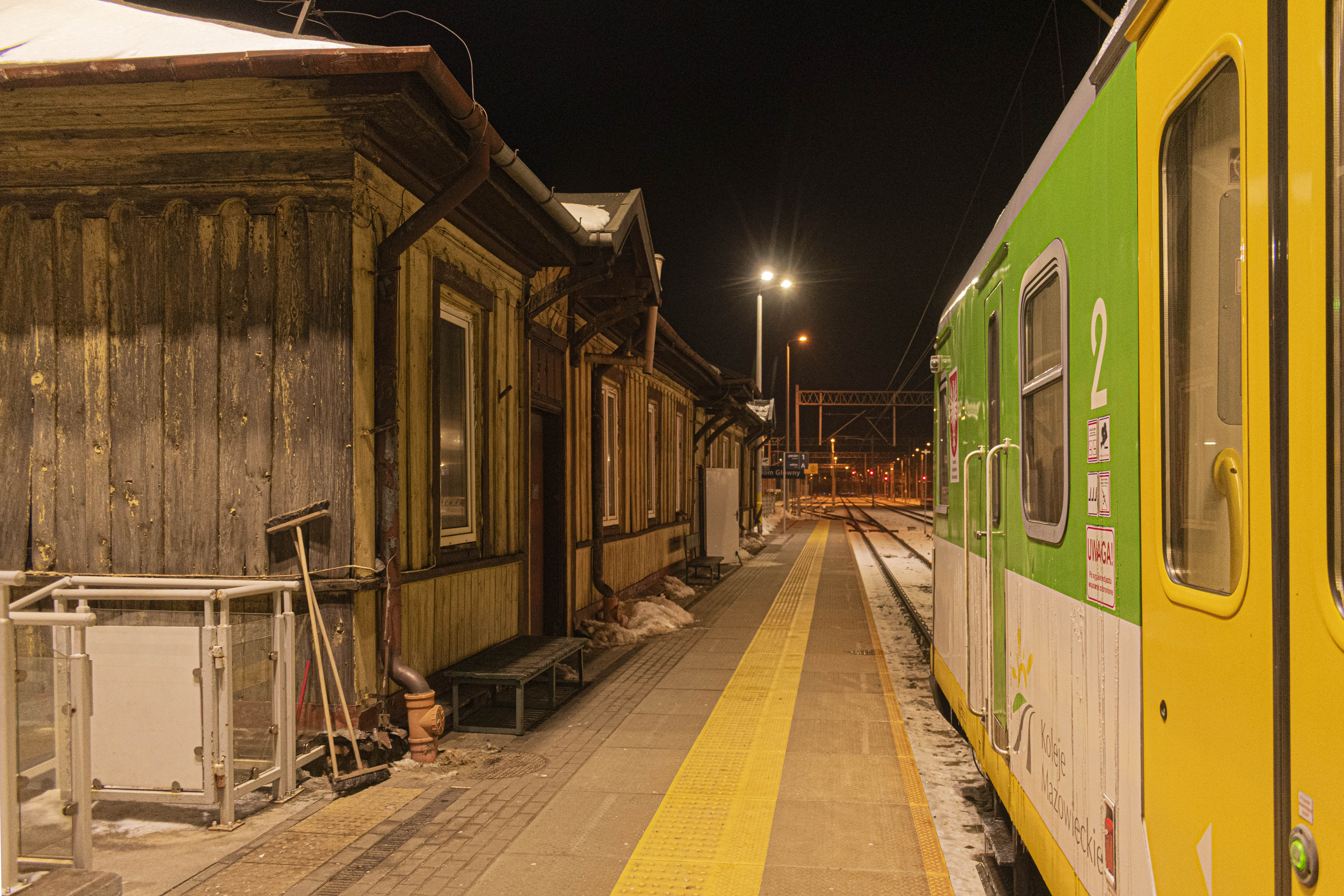
Below: Warsaw-bound Koleje Mazowieckie train on Platform 1, Radom Główny station, waiting for the off. The old Tsarist-era wooden building has been left in place as is and is at odds with the rest of the modernised station.


The train reaches Chynów… and I've not seen the southbound train passing. Turns out it was late - I was almost home as it passed the end of my road. So a double win of returning via Radom rather than Warsaw! [However, it must be said that because of my annual Warsaw travel card, the journey via Radom ended up costing me 7.13zł (£1.40) more than with a change at W-wa Zachodnia. And a propos of small sums of money, my annual land tax for Jakubowizna for 2024 will be 272zł (£53.23) - for a house on an acre of land. Not enough! I'd happily pay more to Gmina Chynów for the services it delivers!]

This time last year:
We're all on one spectrum or another

This time last year:
Qualia Compilation - playing with Lego

This time three years ago:
Onto the frozen pond

This time four years ago:

This time five years ago:
Mid-Jan pictorial round-up

This time nine years ago:
UK migration and the NHS

This time 12 years ago:
Miserable depths of winter

This time 13 years ago:
From - a short story (Part 1)

This time 14 years ago:
A month until Lent starts

This time 15 years ago:
World's biggest airliner over Poland

This time 16 years ago:
More pre-Lenten thoughts


Tuesday, 19 April 2022

Lenten photo catch-up

Lent coincided with the first days of the Russian invasion of Ukraine, days of foreboding and unease. A couple of trips to town, several trips to the działka, and just the one business trip - to Łódź.

Below: the S7 is coming along nicely, but no new milestones since the opening of the viaduct between Jeziorki and Dawidy Bankowe.
 

Below: Łódź - 19th century wooden building, now listed. The centre of Łódź is changing - this is less than 500m from the EC1 and Brama Miasta developments, nearing completion. 


Given a few more years, Łódź will have turned into a splendid city, a mix of the ultra-modern and carefully restored heritage buildings, old factories and palaces. Below: corner of ul. Targowa and Nawrot.


Below: old sign on Platform 3 of W-wa Zachodnia station, mid-modernisation. Platforms 8, 7 and 6 are nearly complete, the suburban platforms will be last to be changed. Sign says 'to alien persons entry is prohibited'.


Below: Zamienie, sunset, approaching equinox. Looking west along the tree-lined ulica Zakładowa that ran through what was the Bio-Vet vaccine plant; after it closed the land was bought by developers, who have built many hundreds of new houses and flats here. As usual, amenities - including proper roads, pavements and public transport - have been neglected.


Back in the garden, Felusia makes a determined run for the garage door and lunchtime. Here I must note the unusually settled fine weather - between 10 and 26 March, there was hardly a single cloud in the sky.


On the działka, my Ukrainian guests, just about to set off to a new life in London after a fortnight in Jakubowizna. Maxim, his mum and grandmother behind him. 


First of April for some fresh snow, which fell heavily through the night, giving a thick cover the next day.


Below: by the 3rd, the snow clouds had passed, a gorgeous day. I visited the działka, and walking from the station the long way via Machcin II, became the first human to tread in this virgin snow. Deep and hard to talk through! Plenty of hare tracks though.


Below: my first stork sighting of this year, 10 April, Jeziorki.


This time last year:

This time six years ago:

This time seven years ago:
Lublin - pearl of Poland's East

This time nine years ago:
70th anniversary of the Warsaw Ghetto Uprising

This time ten years ago:
Tarkovsky's Stalker: a zone of my own

This time 11 years ago:
Warsaw's big billboards

This time 13 years ago:
Pace of development falters

Friday, 1 March 2019

Łódź and the Flat White Economy

For those who don't know the term, 'Flat White Economy' is an extension of the tech economy; it is the ecosystem that surrounds the IT industry in its broadest sense - from the baristas that make flat-white coffees that drive the IT workers through to the co-working spaces that host a myriad start-ups and the financial muscle - the business angels, venture capitalists and private-equity funds - that makes it all happen. The concept of the Flat White Economy was thought up in London, about London, by Professor Douglas McWilliams, founder and president of the Centre for Economic and Business Research (CEBR). It is the title of his book, first published in 2015.

Back in the 1980s, I worked with Doug at the Confederation of British Industry, where he was chief economic advisor, while I edited CBI News. Doug was in Łódź today speaking at an seminar organised by the Łódź University MBA course, focused on the city's future.

I have written about Łódź on this blog many a time - both my children studied here (daughter at the world-famous film school, son at the fine art academy - ASP); my daughter continues to live in Łódź working in the film sector; I bought a flat in the centre of town, just 400m from the newly-opened Łódź Fabryczna station. Over the years, I have witnessed the rebirth of a city that 17 years ago was a dump, mired in corruption (remember Pavulon, anyone?), with 20% unemployment and major social problems. Block after block after block of crumbling tenements, Łódź was how Westerners imagined the entire post-communist world must looked, grey, depressed, without hope. Today unemployment is 5.6%, still way above Warsaw's 1.5% or Poznań's 1.2%, but still below the national average (6.1% - figures are registered claimants rather than economically inactive).

Yet so much has changed over the past 15-20 years. The city's leaders adopted a wise strategy based on attracting inward investment in sectors such as white goods (Siemens-Bosch, Merloni-Indesit), fast-moving consumer goods (Procter and Gamble, Gillette), computer hardware (Dell) and clothing (Wrangler Jeans); this was supported by shared services centres such as Infosys (serving Phillips and Akzo-Nobel), Accenture or Citibank, and R&D centres such as Samsung. But there are also large home-grown firms such as Grupa Atlas that makes adhesives for the construction market (I remember one of the firm's three co-founders, Grzegorz Grzelak, visiting my house in Perivale in the mid-1980s and explaining convincingly how free enterprise will pull Poland out of the mire it was then in - how right he was!). Last year, Grupa Atlas turned over 560m złotys (nearly £120m). There are also three major shopping galleries, including the amazing Manufaktura.

Where's the Flat White Economy in all of the above? It's there too, and visible in all the hipster bars and cafes along (and off) ul. Piotrowska - all the creative young people with laptops sipping their lattes and energy drinks. Film and fashion - this is where Łódź excels; many start-ups have emerged offering services in advertising, public relations, social media and indeed film-making - in today's digital world, demand for corporate videos embedded in websites is booming. You can see this is spaces such as Off Piotrkowska, where cafes and co-working offices jostle side by side in renovated post-industrial buildings.

Below: Doug McWilliams explains how London's workforce has changed from champagne-guzzling, Ferrari-driving 'Loadsamoney' types from the post-Big Bang financial sector to flat white-sipping, cycling hipsters earning much less but enjoying a higher levels of job satisfaction. Seated in the front row, taking great interest in the presentation, the deputy mayor of Łódź, Wojciech Rosicki.


A very important point made in Flat White Economy is the need for immigrants to make it all happen - a diverse workforce will be more creative; an open labour market is more responsive to employers' needs, and it is proven that extra economic growth more than compensates any tendency of wage rates to lower because of the presence of migrant workers.

The book is easy to read with a coherent narrative, with a solid backbone of rigorous economic analysis backed up by plenty of statistics. It's a book to buy now and read now, then to leave on the bookshelf for ten or more years - to return to it to see how the predictions made for cities of the future based on London's experiences in the 2010s work out.

One of the interesting conundrums raised concerns the point at which many start-up entrepreneurs sell their businesses in the UK - it's around £50m. When you have this kind of money in your bank account, you and your family are financially secure pretty much in perpetuity. But in other countries - the US in particular - entrepreneurs don't slack off to clip their coupons - they keep pushing on to build far bigger businesses. Doug poses the question - why. My answer is that the UK has (since the 1850s) drawn a clear line between money and power; governance has been the preserve of a professional, apolitical civil service, guided by politicians (far more capricious and of mixed quality), but essentially here today, gone tomorrow, with careers doomed to end in failure. In other countries the distinction is blurred - power is the real goal, money the means to the end, gaining more power which translates into more money, and so on.

Flat-whiters are less interested in wealth as in experience; less driven by greed than by the desire for interesting jobs with purpose. Doug's descriptions of ping-pong nights at co-working offices are familiar to many in Warsaw's Brain Embassy. This trend is rising - in Warsaw at least, where one-third of all new office space under development is intended for co-working.

How about Łódź or other Polish cities? Flat White Economy makes the point that the UK economy is dangerously skewed towards London to the detriment of provincial towns and cities. Poland does not have this problem. Yes, Warsaw is a boom-town that's much richer than the national average, but Kraków, Wrocław, Katowice and its agglomeration, Poznań and Gdańsk/Tri-City are all doing well, and Łódź is quickly catching up on its tier-two rivals. And in Lublin (life-sciences) and Rzeszów (aerospace) there are clear signs of provincial cities lifting themselves rapidly into the modern world.

Flat-whiters are very picky as to where they live. Their lives much have meaning, there must be good public transport and cycle routes, there must be good architecture (either renovated brick or hyper-modern). Flat-whiters will not tolerate for any length of time living and working in a mediocre place. It's now an employee's job market - they call the shots, employers are faced with ever-more sophisticated retention packages to hang on to their best workers.

I have been to several seminars about the future of Łódź over the years - one I remember from 2011 in which a senior city planner said that the key goal was to hang on to graduates once they'd completed their studies in Łódź. I was sceptical at the time, but it happened. The hipster bars and cafes have contributed to generating the lifestyle that graduates in their first or second jobs can enjoy - and afford. My daughter's choice to stay in Łódź and not to return to the capital is proof that this strategy has worked.

What of the future? Public transport is getting better - my journey to Łódź and back was smooth, punctual and quick. A journey that took two hours and 24 minutes in 2008 now takes one hour and 20 minutes. You can buy your tram ticket on the tram. But the roads are still clogged with traffic. Drivers need to be weaned off driving wholesale. More trams! More buses! But above all - better tertiary education. More IT courses, better courses, more suited to the needs to tomorrow's job market.

There's no doubt now that Łódź has taken the right course. The question is whether all the factors are in place for a Flat White revolution to happen in Łódź as happened in London.

This time last year:
Subatomic physics and Consciousness

This time two years ago:
Lent begins - the Big Questions

This time four years ago:
How does God speak to us? 

This time five years ago:
Spring makes itself felt in Ealing

This time six years ago:
Waiting for the warmth to return to Warsaw

This time seven years ago:
Remembering Poland's 'Accursed Soldiers'

This time eight years ago:
Getting the balance right between work and play 

This time ten years ago:
Sublime Jeziorki sunset

This time 11 years ago:
Sunrise getting earlier

Friday, 6 April 2018

Łódź is a film set

Back from London, four hours' sleep, and off to Łódź for a conference. And to see Moni after work, to show me the sights of city.

"Take me back, carry back, down to Instagram Alley where I started from." This is Pasaż Róży (lit. 'Passage of the Rose'), where the buildings have been stuccoed with shards of mirror. We were there at exactly the right time - the westering sun was shining right down the alley against a perfectly cloudless sky. Tourists and locals alike were in for a treat.


Łódź - an up and coming city, stranger and more intriguing that most Polish cities. Willed out of the despair that overtook it in the 1990s, it is sprouting new appendages - such as Brama Miasta (lit. 'city gates' - right in the middle of the city), which will be rising skywards right by the new Łódź Fabryczna station.


Is this Liverpool? Are we by a ventilating tower of the Birkinhead Tunnel? No, this is a fragment of the facade of the old telephone exchange on  ul. Tadeusza Kościuszki.


Is this a Punjabi palace? Are we in Guadalajara? No, this is ul. Piotrkowska, Europe's longest shopping thoroughfare, pedestrianised for the main part. One by one, the industrialists' Art Nouveau palaces that line the street are being renovated to their original state.


A kiss at the corner - the weather creates a Mediterranean atmosphere, the strong sunlight pulls the contrast from the stone, the architecture a theatrical set.


Łódź. One big film set. Literally. This is the cinema from Wojciech Marczewski's Escape from the Liberty Cinema (1990).


There's shabbiness, there's flash but above all a sense of a city with many faces which know where it's going.

We ate at Laxmi Indian restaurant (excellent) and imbibed at Piwoteka (excellent, but the Delirium Tremens on tap was off). Łódź impresses me more and more with each subsequent visit.

This time last year:
Contemplative imagery, Ealing and Warsaw

This time six years ago:
Baffled: my first visit to Jeziorki's Lidl 

This seven years ago:
In vino veritas?

This eight two years ago:
Are we getting more intelligent?

This nine three years ago:
Lenten recipe: tuna, chickpea and pesto salad

This time ten years ago:
Coal train sidings, Konstancin-Jeziorna

This time 11 years ago:
Jeziorki from the air

Sunday, 27 August 2017

The Journey There And The Journey Home

The journey there; by motorbike to Wrocław, dropping it off at Unikat 1/1 Motorworks for a new two-into-one exhaust pipe and pair of side-lights; and thence by train to Wałbrzych for local exploration (see yesterday's post) and back by night train to Warsaw.

So - the journey out...

The DW 710 heading west out of Łódź is an interesting road, followed along its way to Konstantynów Łódzki by a semi-rural tram line (below). Łódź's exurban light-rail routes are now sadly being trimmed back; this line until recently used to run even further out of town to Lutomiersk.


There's a quaint charm about a tram line that runs through fields and villages; below: between the main road and a field of corn, the tracks visible through the grass.


Near to where the line ends now (it was truncated earlier this year) in Konstantynów Łódzki stands a vintage tram, marking the historical importance to this area of its links to Łódź.


Below: onward towards Wielkopolska; still in Łódzkie province, this is the picturesque village of Rossoszyca, built astride a long pond. The wooden church of Św. Wawrzyniec (St Lawrence) dates back to 1783.


Below: more picturesque rural Poland; this is Grabów nad Prosną in Wielkopolska (as opposed to Grabów nad Pilicą which is in Mazowsze). Quite the film-set for a WW2 drama!


Onward from Wielkopolska into Dolnośląskie (Lower Silesia). Having dropped off the bike, it's time to change transport modes at Wrocław. I pop by the old Świebodzki station, now partially abandoned. A lovely old Ty-2 loco rusts away exposed to the open sky and vandals.


On by rail to Wałbrzych. Though there has been much new investment in Wałbrzych, there are still many signs of post-industrial decay. It's this mix that makes the town so fascinating.


The line just outside Wałbrzych. Built in the 1870s, it was originally intended to link Berlin and Vienna; the Austro-Hungarian authorities viewed the whole project with suspicion, and it was never completed. Still, there are some magnificent views (below)


Below: arrival by train at Wałbrzych Główny (as opposed to Wałbrzych Miasto, 6.1km away). Looking up from the Line A bus that links the two stations at the railway viaduct, with its underslung arches. 


... and looking down from the railway viaduct  From Wałbrzych Miasto (as opposed to Wałbrzych Główny), I'll take the night train back to Warsaw.


I bought my ticket home via W-wa Wschodnia, so I wouldn't have to be woken at 6am. Sleep on to Wschodnia, have a Scottish breakfast, and return to Jeziorki by Koleje Mazowieckie - that's the plan. I needn't have worried - my night train arrived three hours late. At some stage, a goods train on the line ahead broke down. I was vaguely aware of my train standing still for an awfully long time, but being in a sleep state this didn't bother me a jot. This view below of two communist-era murals 'advertising' (!) stuff - photographic film and wrist watches - that was unavailable anyway may soon become history as the plot in the foreground is being cleared for the construction of a new building.


Left: back in Jeziorki with two my small rucksacks, hard hat, explorer's kit and photographic gear. A thoroughly worthwhile three-day jaunt, lots of tales to tell. Once again, the klimat of the journey has been processed into my long-term memory; I already feel the need to return to Wałbrzych.

Bonus shot: an SM42 pulls an overhead power line engineering train, heading south out of Skierniewice.

This time last year:
Sandomierz - another outstanding Polish town to see

This time three years ago:
Food hygiene and lies as Russian foreign policy tools

This time four years ago:
Asphalt for ul. Poloneza (to Krasnowolska at least)

This time five years ago:
A welcome splash of colour to a drab car park 

This time six years ago:
To Hel and back in 36 hours

This time eight years ago:
Honing the Art of the Written Word

This time nine years ago:
Of castles, dams and brass bands