Showing posts with label trams. Show all posts

Saturday, 3 May 2025

In town and around

Below: tram stop outside Rondo ONZ 1 tower. Modern public transport serving modern offices. A safe, clean, modern, reasonably priced city. Though peeking into an estate agent's window, I'm shocked at what's happened to house prices over the past ten years. From 2002 to 2014, hardly any movement, then a London-style explosion.

Below: Rondo ONZ 1 tower from across the road. All this was brand new not so very long ago; today the centre of gravity of Warsaw's business district is shifting westward towards Wola.

Below: one of my favourite thoroughfares in Warsaw, just around the corner from my office, ul. Świętokrzyska. Across the road from the Palace of Culture. And here's one my favourite shops in Warsaw, Voltarex, a shop selling high-end kitchen equipment. I pop in to buy a stainless-steel vegetable steamer insert for my pan; from now on, steamed broccoli, steamed asparagus, steamed runner beans, healthier and tastier than boiled veg. It's the end of April, and the restaurants have their pavement tables out, creating a wonderfully Mediterranean atmosphere. The long weekend is just beginning...

Below: ulica Grzybowska as it intersects aleja Jana Pawła II, shortly after sunset. The old 1990s Atrium International plaza has been demolished; the crane stands where the 34-story Upper One building will shortly emerge. My father spent his earliest years around here; on his last visit to Warsaw in 2019, he was delighted by how modern Warsaw has emerged from the rubble of Nazi occupation.


Warsaw might have moved forward dramatically, but here and there are signs of past ways of thinking. This one, for example, by a block of flats off Grzybowska, reeking linguistically of Tsarist-communist bureaucratic formalism. "Forbids one from leaving uncleanlinesses by the chute, key to the abovementioned space finds itself in the porter's kiosk". Note use of the agentless passive.

Below: back home in Jakubowizna, flags are out for 3 May, Poland's national day, remembering the world's second (after the USA) and Europe's first written constitution (1791).


Below: shimmering in a heat haze, Warsaw's skyline as seen from ul. Kinetyczna ('Kinetic Street'), on the south side of Warsaw airport.


Below: out by Warsaw Okęcie airport –a US Army Beechcraft C-12F Huron shortly after take off. (This is the basic transport aircraft, rather than the RC-12 Guardrail signals intelligence platform, which I see from time to time on FlightRadar24.com flying around the Baltic.)


Below: a Gulfstream G600 business jet belonging to the Bank of Utah (!) taking off from Okęcie.


Below: SP-LIM, a LOT Polish Airlines Embraer EJ170 in retro livery, passing the radio tower at the airport's edge....


...and this time in focus... 'Flying you since 1929'. 


This time three years ago:
Return to the Konstancin-Jeziorna sidings

This time six years ago:
A review of the second part of Hillier's Betjeman biog.

This time seven years ago:
New roads and rails

This time eight years ago:
The Gold Train shoot - lessons learned

This time 11 years ago:
Digbeth, Birmingham 5

This time 12 years ago:
Still months away from the opening of the S2/S79 

This time 13 years ago: 
Looking at progress along the S79  

This time 14 years ago:
Snow on 3 May

This time 15 years ago:
Two Polands

This time 16 years ago:
A delightful weekend in the country

This time 17 years ago:
The dismantling of the Rampa

This time 16 years ago:
Flag day

Thursday, 23 January 2025

By tram out of central Warsaw

Into town for a couple of meetings, and to get me from A to B and back to the railway station for my return to Chynów – Warsaw's trams. So much better than driving, guys! No worries as to where you will park, or getting stuck in jams (of your own making). The back of the tram is a good place from which to observe Warsaw as it grows. Below: the tram stop by Warsaw Central station. Plentiful trams in both directions. The city skyline has grown beautifully.

Below: two stops south, and the skyline looks different – and older, with the two LIM towers (centre), Stalin's Palace of Culture to their right and Libeskind's Złota 44 tower to their left. The buildings on either side of Aleja Niepodległości were built before the war and would have been familiar to my father, who grew up less than a kilometre and half from here. If you click to enlarge, you will see the new branding of the former Marriott hotel, now the Presidential.

Below: on, on by electrical traction, southwards along al. Niepodległości as it bisects Pole Mokotowskie fields, the two halves connected by a foot/cycle bridge. Now the skyline is dominated by Varso tower, the EU's tallest building (if you include the mast, second tallest if you don't).

Below: Warsaw's tram network is being enhanced. This is ulica Batorego looking east, with Warsaw School of Economics (SGH) to the left. New tram tracks are being laid here, which will link al. Niepodległości to ul. Puławska and the recently opened tramline heading down along ul. Spacerowa towards Wilanów. And heading east along ul. Batorego the either way, the tram will go on to Warsaw West (W-wa Zachodnia) railway station.

Below: a headache for drivers for the time being, but a boon for public-transport users, as a third major east-west tramline south of the city centre will emerge, sometime this year (they say). By next year, this will connect W-wa Zachodnia with Wilanów.

Below: some modest modernism on ul. św. Andrzeja Boboli, shortly before it becomes ul. Wołoska. Overlooking some urban działki on the other side of the road. Let's hope these recreational plots don't fall prey to developers.

Below: this is ul. Woronicza, home of Poland's state-run television station, TVP (further along on the right). In the picture on the right you can see the spiral ramp of Poland's first multi-level car park, completed in 1958, and a listed building since 2023. Woronicza itself is an important east-west link in the tram network; behind me is the tram depot. Other than the horizontal road markings, the scene here pretty much unchanged since the 1960s.

Below: end of the line - the tram loop at Służewiec, where the 17, 18 and 31 routes terminate. Connecting with PKP W-wa Służewiec for Koleje Mazowieckie, SKM and InterCity trains (for Warsaw-Olsztyn, Radom-Kielce-Kraków, and now Radom-Rzeszów-Przemyśl). Passing overhead is the viaduct carrying ul. Marynarska over the railway line, where it becomes ul. Sasanki. Convenient interchange for local bus services. Note the road snaking round from the left; this is new and connects ul. Suwak (lit. 'slider' or 'zip' street) to ul. Cybernetyki ('cybernetic street'). Opened to traffic last month, the road is so new that neither OpenStreetMap nor Google Maps show a name for it yet. 


And here, at PKP W-wa Służewiec, I catch the train back to Chynów, just 33 minutes away on the normal all-stations stopping service, or a mere 21 minutes on the przyspieszony (accelerated) service that skips more than half the stations along the way. 

Below: on my way home. The Polish countryside today – it's good to know it's such a short way from town. I like it here.

This time last year:
Base Twelve (why decimalisation speeded up Britain's decline)

This time two years ago:
Memories of Seasons

This time three years ago:
Pictures in the Winter Sun

This time four years ago:
Magic sky

This time five years ago:

This time seven years ago:
The Hunt for Tony Blair
[Apologies to UK readers - the YouTube link is geo-blocked there]

This time nine years ago:
Lux Selene

This time 12 years ago:
David Cameron, Conservatism and Europe

This time 13 years ago:
Citizen Action Against Rat Runners

This time 14 years ago:
Moni at 18 (and 18 months)

This time 14 years ago:
Building the S79 - Sasanki-Węzeł Lotnisko, midwinter

Tuesday, 29 October 2024

Warszawa Zachodnia takes shape underground

Changing trains at Warszawa Zachodnia (Warsaw West) railway station this week, I was in for a pleasant surprise. No longer must passengers making the connection to Peron 9 (platform 9) trudge (or sprint) a kilometre or so on a zigzag route along the length of Platform 8, down steps, over tracks, between corrugated metal fences and under more tracks; we are now sent underground to experience what will be the new subterranean parts of the station.

Reminder: part of the modernisation of what was once Poland's Worst Station is the construction under the railway lines of a new tram tunnel. This cuts north-south, one day it will conduct trams from Wilanów to Wola. [The brand-new tramline to Wilanów opened yesterday; I will have to go there and have a look at some stage.]

Trams don't serve as yet Zachodnia station; a new line will lead them from ul. Grójecka along the wonderfully named ulica Bitwy Warszawskiej tysiąc dziewięćset dwudziestego roku (can anyone name a London thoroughfare consisting of 18 syllables?), then dive under Al. Jerozolimskie and the plethora of railway tracks to resurface on the other side then bifurcating (one line heading north-west to Wola, the other north-east towards the tram depot on ul. Młynarska. This new tram infrastructure is expected to be ready in April 2026. And with that, the modernisation of Warszawa Zachodnia will be complete. More than five years after work started.

In the meanwhile, changing trains at Zachodnia can now be done through a series of underground spaces and passages to the north of the main station. Below: the path to Platform 9 now leads from the bottom of the footbridge, across what will be the taxi drop-off lane to the steps leading down into liminal spaces where reality bends back upon itself...


Below: ... but where do we go from here? There's too much confusion. Into the Zone. All is silent and still. Digital timetable indicators stare blankly; many passages are blocked off. Familiar destinations (ul. Tunelowa) are now accessible via new and unfamiliar paths. Which way now?


Below: one day, this concourse will be thronged with passengers from Kraków, Katowice, Wrocław, Poznań and Gdańsk, Berlin, Prague and Budapest, changing from the trains up there for trams down here to all points in Warsaw. But today, post-futuristic scenes like this have been opened up to the public, speaking of transition. Tomorrow as perceived from the far future.

Below: somewhere between the main body of the station (Platforms 1-8) and Platform 9. Otherworldly. We, the human lab(yrinth) rats. No one around; the next train from Platform 9 does not depart for another 20 minutes.


Below: emerging at Platform 9. Still much work to be done here, despite the recent modernisation which saw a canopy over the platform, but no electronic display boards or other amenities. The escalators down to the new tunnel are not yet in service. And at the other end of the platform, the pedestrian crossing to the footbridge and to the Expo XXI centre has still to be re-opened.


Passing through Zachodnia, as I do frequently, the changes appear slow week to week, but over the years, as can been seen on this blog, progress is visible and when complete, with all the lifts and escalators and indicators working, the improvement will be massive. Click on the label 'W-wa Zachodnia' to the left to see just how much this station has changed since the first decade of this century.

This time time three years ago:
Two years without my father

This time four years ago:
Death of my father

This time six years ago
Recent Jeziorki update

This time seven years ago:
Autumn in Jeziorki

This time eight years ago:
A driving ban for developers and architects

This time nine years ago:
Do you keep coming back, or do you seek the new?

This time ten years ago:
In praise of Retro design

This time 11 years ago:
First snowfall in Warsaw 

This time 12 years ago:
Of cycles, economic and human 

This time 13 years ago:
Why didn't I read this before? Grapes of Wrath

This time 14 years ago:
Małopolska from the train

Wednesday, 22 November 2023

An afternoon and evening in Katowice...

A quick in-and-out job, made possible by fast electric trains. Around two and half hours, time to edit articles, read The Economist from the front to the back, and grab a meal in the Wars restaurant wagon.

Arriving in Katowice, it is a short stroll through the city centre to get to the venue of our event today, the KTW office complex. On my way, I note that Katowice's trams have names - a nice human touch to public transport! The one facing the camera is called 'Heniek' (I checked online - there's no 'Ziutek', but there is a 'Zyguś'). Behind the trams, I see that the Christmas fair is already in place, and traders are busy trading.


Left: view from the 30th (and top) floor of the second KTW tower, the highest point in Katowice (133m), looking west. This is an excellent vantage point to witness the fantastic growth potential of the Silesian conurbation. Note the tram interchange at the foot of the the office complex. A dynamic city, Katowice is rapidly accelerating from its coal-mining roots.

Below: heading back to the station for the train back to Warsaw, I pass the Christmas market, now fully illuminated. Billboards advertise festive visits to Brno, which is actually closer to Katowice than Warsaw. And indeed, here and there I could hear Czech spoken by groups of middle-aged tourists, here for the Christmas shopping.

Below: Katowice does neon well. Note the vertical light poles, in the Ukrainian colours. Katowice has not forgotten!


Back in Warsaw, Central station. My return train was the Polonia Vienna-Warsaw express, which called at Ostrava and Katowice on the way. I was hoping the train would consist of Austrian or Czech carriages, so I could sample the in-train dining experience offered by the respective operators, ÖBB or České dráhy, and compare them to PKP's Wars. Sadly, the rolling stock was made up entirely of Polish carriages, although it was hauled by a Czech locomotive (below). I had to make do with Wars for the second time in a day (thought this time only for Polish cider, and peanuts). The train departed and arrived on time, and was profitably full. Hurrah for rail travel!


My second visit to Katowice this year; the city continues to impress with its sheer economic dynamism.

This time four years ago:
Karczunkowska viaduct opens to cars, but not to pedestrians

This time five years ago:
Edinburgh's Polish statues

This time six years ago:
Edinburgh - walking the Water of Leith

This time seven years ago:
Poland's north-west frontier

This time eight years ago:
Cars must fade from our cities

This time ten years ago:
Unnecessary street lighting wastes public money

This time 11 years ago:
Warsaw's heros on the walls 

This time 12 years ago:
Tax dodge or public service? 

This time 14 years ago:
Warsaw's woodlands in autumn

This time 15 years ago:
Still here, the early snow

This time 16 years ago:
Another point of view

Friday, 23 August 2019

Best and worst railway journeys in one day

Kraków - there and back in a day on business not too difficult... I left home at 05:15, by taxi (using the FreeNow ride-hailing app), arriving at W-wa Centralna with 15 minutes in hand for my 05:50 Pendolino train.

Below: sunrise over Warsaw from W-wa Centralna station.


The journey to Kraków was comfortable and, just 2hrs 18mins, the shortest and fastest I'd ever undertaken between these two cities. Indeed, counting check-in time, it's much faster than flying for a city-centre to city-centre journey. Or driving. Below: outside the shopping mall that flanks Kraków Główny station's to the west. New buildings in the distance; our new office is to the right.


Below: view of the Camaldolese Hermit Monastery, Bielany, Kraków, a closed monastery (women admitted 12 times a year). Built in 1630. Sadly, this view from the Kraków Technology Park will soon disappear as new offices and flats will appear in the intervening fields.


Another building that's visible from the Kraków Technology Park is Kraków's legendary Szkieletor (below), a building that's stood in skeletal form since the early 1980s, and is finally being completed. Standing 30 floors high, its opening will take some pressure off the city's requirements for office space. Kraków gives the impression - as does Warsaw - of a boom town with a dynamic economy reaching the limits of available manpower.


Heading out to the south-east of the city, and here's a tram (below) with an advert in English - a recruitment company is looking for recruiters to recruit people for other companies!


Below: returning to Kraków Główny station. Outside stands a bus with an advert in Ukrainian, giving me a similar culture shock to that of seeing a London bus with an advert in Polish on the back.


Below: one more Kraków tram shot - this is the underground tram station directly beneath Kraków Główny railway station. The railway tracks run at 90 degrees to the tramlines.


Finally, I turn up to Kraków Główny to find that my train back to Warsaw will be delayed by 20 minutes. Then 40 minutes. Then an hour. Then a hundred minutes. Then 120 minutes. The inbound Pendolino services from Gdynia is advertised as arriving 185 minutes late. Total chaos. The explanation is simple - 300m of overhead electric cable has been stolen from the main trunk line between Sztrałki and Idzikowice. All express trains between Warsaw, Kraków, Katowice and Wrocław that use the CMK trunk line are diverted via Skierniewice and Piotrków Trybulanski.

Below: the delayed arrival of the Pendolino service from Gdynia to Kraków. It was due at 13:15; it arrives at 18:20. The train is turned around in 18 minutes, and we depart at 18:38, nearly two hours after the scheduled time of 16:40.


Below: sunset from the train.


Below: arrival back at Warsaw Central, 22:50. Three and half hours late. For a journey scheduled to take two hours and 40 minutes.


My travel woes were not over. I elected to return home using the FreeNow app to hail a taxi. I tried five times, each time giving up as no driver was picking up my hail. But I was walking south - I made it all the way to Pole Mokotowskie Metro station, before reasoning that at around 23:30 most taxis had left central Warsaw taking late-night revellers home to the suburbs. The taxis are all out there! So I jumped on a Metro train, got opf at Wilanowska, hailed a FreeNow taxi from there - and had one within minutes. Home at 23:45, 18 and half hours after setting ofp.

The big question remains - how on earth did thieves manage to steal 300m of overhead powerlines from on of Poland's busiest and fastest railway lines? I reckon it's an inside job - someone who knew when the trains were running, who knew about the remont of the line around Idzikowice, someone who could pass unnoticed along the track. Where were the SOKiści - the railway watchkeepers?

I am an opponent of capital punishment, but in favour of corporal punishment for such crimes, 99 lashes, each administered by someone who'd been put out by the thieves' actions. Like the lady sitting opposite me in the Wars restaurant carriage, who'd gone to Kraków to visit a medical specialist; arriving three hours late, she merely stayed on the same train to head back home without having seen the professor with whom she'd missed a long-awaited appointment.

Flogging is too good for overhead powerline thieves. Broken bones all round. Robust retribution.

UPDATE 10.10.2019: Pendolino service from Wrocław to Warsaw has to do a detour between Opole and Częstochowa Stradom because of a derailed freight train. Delay: one and half hours. Shit happens all too often.

This time last year:
What's new around Jeziorki

This time four years ago:
Hydrology - droughts, floods and sandbanks

This time six years ago:
Radom air show - Part 1

This time seven years ago:
Restricting passenger movement and safety

This time eight years ago:
Seasonal fruit - eat it in bulk, while you can!

This time ten years ago:
Russia-Polish 'unification', 1939-style


Saturday, 24 November 2018

Tram tips for Edinburgh

Edinburgh's tram network resembles Warsaw's Metro system prior to March 2015 - just one single line. It is a boon to tourists arriving at Edinburgh Airport, whisking them into the city centre without being bogged down in the heavy traffic of the A8 Corstorphine Road. The modern stock is comfortable, has free (and fast) wi-fi, and as befits a line serving an airport, plenty of luggage space.

Below: the tram terminus at Edinburgh Airport. Trams to town every seven minutes (every ten minutes in the early morning and evening).


However, there are points to be aware of, especially when using the tram for the first time. The fare structure is designed to ensure that tourists pay more their fair share for using the system, in effect subsidising local users. Nothing wrong with that, but if you travel light as I do, and want to save money, heed my tip. There are but two zones in Edinburgh's tram network. The Airport Zone - and the rest of the line. A ticket from the airport into town costs £6.00*. The next stop - Ingliston P&R - is less than a mile away (1.4km or 1,750 paces/15 minutes walk). And from Ingliston P&R, the ticket costs not £6.00 but £1.70 - a saving of £4.30.

BUT! There is a catch... If you want to pay cash, the ticket machines will not give you change. Drop a £2 coin in, and you've lost 30p of your £4.30 saving. And if you want to pay by card, there's a minimum payment of £3.00. So here you lose £1.30 of your £4.30 saving. Unless you buy a return ticket (£3.20) or an all-day ticket (£4.00). Now, given that the all-day ticket including the Airport zone costs £8.50, that's an even greater bargain.

Below: alight at Ingliston P&R and take a walk from there to the airport to get some exercise and save money.


Below: the in-scale map displayed at the airport terminus puts the whole network into perspective.


Below: Gogarburn, the next stop after Ingliston P&R, alight here for Royal Bank of Scotland's HQ. One advantage of trams and light railways over a main line is that the track radii can be short to accommodate tight curves, as seen here. The curve here is so tight I couldn't fit the whole thing into one shot (even with a 10mm lens) so a panorama had to be stitched together - and hence two trams within a short distance of one another - actually the same tram.


I have another tip. You cannot buy your ticket on the tram; you can buy from ticket machines which are located at each tram stop. Remember to have the exact fare - no change. And be ready to select the ticket you need in advance - no time for umming and ahhing when there's a queue of people behind you and the next tram's due any minute.

The problem I had this year and indeed last year is that the touch-sensitive screens are not very sensitive. You touch and nothing happens. The tram conductor on the tram I (finally) caught - after missing one because I couldn't buy a ticket in time - told be to be hit the screen hard with my finger. Which I did the next two times I was buying tram tickets. Two sharp jabs - one to hit the '+' button by your choice of ticket, and one for the 'confirm' button. Contactless card payment doesn't confirm immediately - you have to wait a couple of seconds before you get the message that your ticket(s) are being printed.

All in all, the system is clunky and no longer state-of-the-art. For that, visit Wrocław. The trams there have the simplest system of all; no cash, no tickets, only card payments - the virtual 'ticket' stored in the chip of your credit/debit card, which you present to the ticket inspector.

Without doubt the best way from the Edinburgh Airport to the city centre is the tram; my tips will save you money and spare you frustration at the ticket machine.

[2022 update: tram price fare rise since last year: £6.50 for airport zone, £1.80 for the rest of the line, so the 20-minute walk from the airport to Ingliston P+R will save now you £3.70! Have the right coins ready...]

This time last year:
Warsaw to Edinburgh made easier

Saturday, 18 November 2017

Poznań's Stary Rynek

Many's the time I've been to Poznań on business, but I've not been to the Stary Rynek (Old Market) for many years - last time was about ten years ago or more, and at night. Given Poznań's status as one of Poland's great cities, it's high time to pay some attention to its historic centre.

Below: magnificent centrepiece of the Rynek is the Renaissance town hall, designed by Giovanni Battista di Quadra (who also worked on the cathedral in Płock). Built between 1550 and 1560, it was restored after WW2 having sustained serious damage.


Below: taking in the town hall looking east along the northern side of the square. Wrocław's old market square is similar in layout, but bigger.


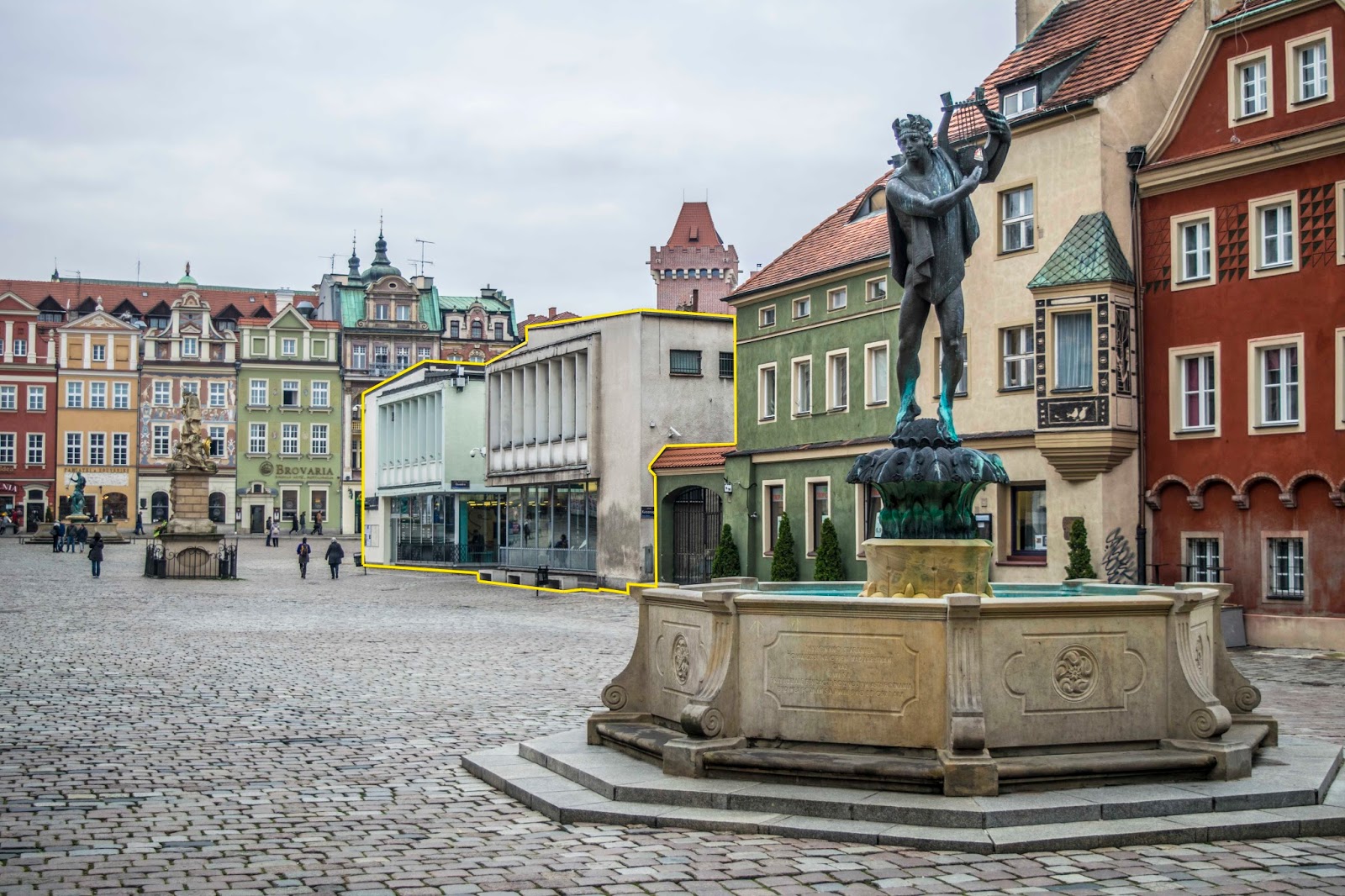
Below: unfortunate... the Old Arsenal, destroyed during WW2, was replaced by a modernist building in the 1950s (outlined in yellow). It does not fit its surroundings at all and should be torn down. Better to have empty space that this ugliness, unlike many of Warsaw's post-war modernist buildings, it lacks any redeeming features. It screams 'provincial drabness'. Note also the three fountains that line the western edge of the square.


Left: on the corner of ul. Paderewskiego and ul. Sieroca. Lime green and white, this building has been tastefully restored, colours contrasting yet fitting in with surrounding architecture. Poznań seems to be a few years behind Wrocław, Gdańsk or Kraków when it comes to remonting its kamienice; quite a few are still behind scaffolding and nets.

Below: looking along ul. Świętosławska towards the Basilica (former parish church) on ul. Gołębia.

Below: the Royal Castle rises above ul. Zamkowa, linking it to the old market. The castle has been subject to a lengthy restoration, partially opened in April this year.


I must say that Poznań's historic centre feels slightly scruffier than Wrocław, Gdańsk, Warsaw or Kraków. Grafitti, peeling stucco, damp patches suggest that the city should do a bit more to clean up its act. The recently re-cobbled thoroughfares are particularly nice.

Economically, Poznań is a boom town, with local unemployment standing at 1.6% (end September); many shops and cafes have job ads in the doors; many businesses are seeking staff.

Below: although the heritage tram line has ceased working scheduled journeys for the winter, this one has been hired for a organised tour group. This is the Konstal N tram, manufactured between 1948 and 1956, once a common sight in many Polish cities.


Below: heritage loco, sadly stationary... an H. Cegielski Poznań-built Ty51 2-10-0 steam engine stands outside the Enea stadium, on ul. Bułgarska (not far from the GlaxoSmithKline factory and IT centre). The Enea stadium was one of four Polish hosts of the Polish-Ukrainian EUFA2012 championships (along with Gdańsk, Wrocław and Warsaw). The EUFA championships brought huge civilisational and infrastructural benefits to the cities.


Poznań certainly deserves a place on the tourist map of Poland, a great city of interest. For shopping, the award-winning Stary Browar mall is one of the finest in the country, built on a huge scale and architecturally stunning. Below: picture from a previous trip to Poznań. Using the original shell of the late 19th century Hugger brewery, the mall is now home to 210 stores and restaurants.


This time last year:
Brexit, Trump and negative emotions

This time six years ago:
Premier Tusk's second exposé

This time seven years ago:
Into Poland's former Heart of Darkness

This time eight years ago:
Powiśle - synchronicity of shape

This time nine years ago:
The last of the rampa na kruszywo

This time ten years ago:
Airport zoning to halt development in Jeziorki?