Showing posts with label ghost signs. Show all posts

Wednesday, 19 April 2023

Wrocław snapshots

A mad rush of a week - Warsaw-Poznań-Wrocław-Warsaw, little time for snapping, but here's a handful.

Below: an tenement on ulica Romana Dmowskiego. Down at heel, in need of a remont - but still inhabited. Take a look at the bottom right of the picture...


Below: ...detail of the uncovered ghost sign, 'lebensmittel' = foodstuff, groceries what have you. As I wrote here, Poles are no longer uncomfortable with reminders that these lands were once a part of Germany.


Below: only the cars give away the fact that we're no longer in the communist era - 1970s blocks of flats, ul. Zachodnia, Wrocław.


Below: the former Linke-Hofmann factory, after the war becoming the PaFaWag factory, now back with its former owners, within the group now known as Alstom. 


Below: some lovely klimat - reeking of industrial history.


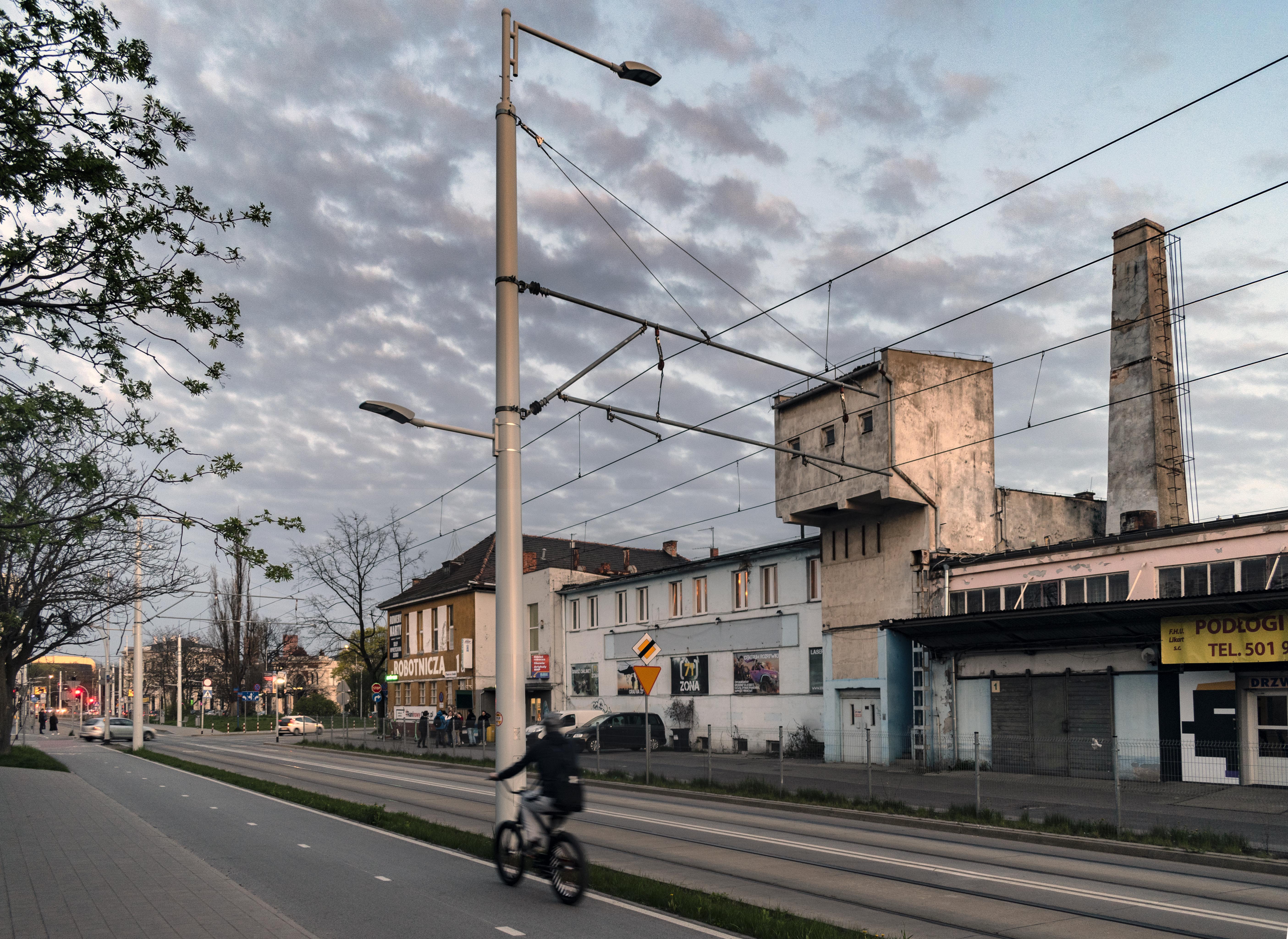
Wrocław's ul. Robotnicza ('Workers' Street'), just ahead of the opening of the new tram route, with parallel cycle path and footpath. No cars. That's the way to plan urban thoroughfares!


Below: round the back of the former (and hopefully future) station of Wrocław Świebodzki - again, great klimat.


This time two years ago:
Greylag geese appear in Jeziorki

This time three years ago:

This time five years ago:
Easter in Ealing

This time seven years ago:
WiFi works on Polish train shock

This time eight years ago:
My dream camera, just around the corner
[No, the Nikon Z6/Z7 don't make the grade]

This time ten year ago:
Longer, lighter lens

This time 11 years ago:
New engine on the coal train 

This time 12 years ago
High time to leave the car at home

This time 13 years ago:
The answer to urban commuting

This time 16 years ago:
Far away across the fields

Saturday, 3 December 2022

"From Stettin in the Baltic"

"From Stettin in the Baltic to Trieste in the Adriatic, an iron curtain has descended across the Continent. Behind that line lie all the capitals of the ancient states of Central and Eastern Europe. Warsaw, Berlin, Prague, Vienna, Budapest, Belgrade, Bucharest and Sofia..." Winston Churchill's words, uttered in Fulton, Missouri, in March 1946, come back to me whenever I visit Szczecin. Poland's post-Yalta location, hundreds of kilometres west of its prewar borders.

Incidentally, Szczecin is not actually in the Baltic, nor on the Baltic nor even by the Baltic; it lies on the south side of the Szczecin Lagoon (zalew Szczeciński) and is 66km (41 miles) by navigable waterway from the open sea. That's further inland than the Canary Wharf is from the North Sea.

The architects of the postwar order drew up Poland's western borders along the Oder (Odra) and Neisse (Nysa) rivers. Stettin, which had for centuries served as Berlin's port, found itself in postwar communist Poland. Yet the city stands on the other side of the Oder. Any residual German irredentism is now history; the 1990 Final Settlement with Germany made that clear. Stalin had gifted Stettin for Poland in exchange for keeping Königsberg (now Kaliningrad) as an ice-free port for the Soviet navy.

Today's Szczecin has many reminders of its history. The building below, now an educational facility, had served as a reception point of the state repatriation office (Państwowy Urząd Repatriacyjny). Poles from the east of prewar Poland, having been forcibly resettled in an act of ethnic cleansing, were moved west to replace the German population that had itself been ethnically cleansed. However, this building served less typical cases... (Click to enlarge to see the ghost sign)


Below: zooming into the ghost sign above the side gate: "Reception point for repatriates from the West - Stage 2". "Repatriates from the West" would have been members of the Polish armed forces in the UK as well as Poles released from PoW and forced-labour camps in Germany, all of whom had lost their homes in eastern Poland. 


In the immediate aftermath of war, the Germans who had not fled the advancing Red Army were forcibly ousted from lands that had been given to Poland in the Yalta and Potsdam settlements. The Polish repatriates were shipped into empty cities and given the choice of prime properties - few chose Szczecin, and those that did were initially reluctant to invest it its future, "in case the Germans ever came back." And so a city of almost 400,000 in 1939, had a population only half that number well into the 1960s. To this day, Szczecin's population density is far lower than other Polish cities - nearly three times lower than Warsaw's, for example. Yet Szczecin (now back up to its pre-war population) is more populous than Bydgoszcz, Lublin or Białystok.

Szczecin has improved massively in recent years as a result of large public- and private-sector investment. It is still under construction, with many roads in the centre closed for refurbishment. Wide avenues designed by Haussmann (he of the Paris renovation of the 1850s and '60s) give the city a prosperous air; large villas line the avenues, there are plenty of trees and lawns and parkland. Today, investors tend to be from Scandinavia or Germany, focusing on manufacturing and logistics (massively). There's little going on by way of shared services or business-process outsourcing here. And few office buildings.

After an investment conference at the new football stadium on the edge of town, I took a train to the port of Świnoujście, just 66km away from Szczecin by river, but by train, the two are separated by journey times from 1hr 21mins (the fastest InterCity connection) to 1hr 40mins on the all-stations local service. All trains stop at Goleniów, for Szczecin's international airport, and at the seaside resort of Międzyzdroje. My local train arrived over 20 minutes late; it was held at Goleniów to let a massively delayed InterCity service through.

Świnoujście itself is another geographical oddity served up by the postwar settlement. The port town straddles the river Świna; in English, it would be called 'Swinmouth'. The two parts of Świnoujscie are connected only by pair of ferries that shuttle across the strait every 20 minutes. Car traffic is restricted to local vehicles on ZSW number plates (or with permission from the local authority) between 4am and midnight. The only alternative to this journey of 675 metres is a 235km (145 mile) international jaunt, all the way around the Szczecin lagoon, through Germany and back into Poland. Or cross at night (the ferry offers a 24-hour service).

Fearing that I might be stranded on the far shore and would miss my night train back to Warsaw, I decided not to cross into Świnoujście proper, but just to explore the port that lies on the eastern bank of the Świna strait. The ferry will be augmented by a road tunnel (to be opened next year). Sadly, it won't be for pedestrians or cyclists, who will have to take a bus or stick with the ferry. 

Below: the ramp onto the Bielik ('white-tailed sea eagle') II, one of four vessels (named Bielik I to IV) serving the route. Between 04:20 and 23:40, two ferries shuttle backwards and forwards every 20 minutes, between 00:00 and 04:00 they go once every 40 minutes and will take all cars for free, wherever they're from.

I walked from Świnoujście station to Świnoujście Port, the final station along the line. Actually, the two can be considered one station, joined by a very long platform. Only local trains run into the Port station; InterCity trains terminate at the main Świnoujście station, and if you want to take a ferry to Scandinavia from the port having arrived by InterCity, you have to walk to the Port station. It's just seven minutes on foot, two minutes by local train, but there are only five pairs of trains a day serving it (really timed for the convenience of the port's employees). Below: the last train of the day sets off from Świnoujście Port back to Szczecin. Behind the station and its limited, bus-stop like facilities, stands the ferry terminal. The place reminded me of a modern version of Boulogne-Maritime and Boulogne-Ville stations back in the 1960s.

More unusual still is the station across the Świna in the main part of town - Świnoujście Centrum. The only station lying within Poland's borders that is connected to no other Polish station, and the only one to be served exclusively by a foreign rail operator - in this case, UBB. Below: image from Google Maps Street View showing the station in the tourist season. The station is located at the end of the built-up part of town, on the edge of a forest belt that stretches up to the border itself. It's 1,500m from here to the border. An hourly local service connects Świnoujście Centrum with Züssow, calling at several German seaside resorts along the way. 

Back to Świnoujście's main station to catch my night train back to Warsaw. The carriages arrive with 40 minutes in hand, so good time to settle in, change into me jim-jams and be lying comfortably in bed as the train sets off. Below: the rake of coaches making up the train arrives at the platform; the electric loco that will haul it stands to the right, in retro PKP livery. Sleeper cars at the rear.

Below: the diesel shunter that has lined up the coaches departs. The rear coach, visible in this photo, has full sleeper facilities (a bed with bedding); the penultimate coach has just couchette sleeping (nothing more than a surface to lie down in your day clothes; no bedding, six berths to a compartment.). Every other coach is standard - and I can tell you that trying to sleep while seated is no fun whatsoever. I would recommend paying the extra for a two-berth compartment rather than one for three - this train was full despite it being December.


Here's my train's itinerary on the timetable (click to enlarge). Departs Świnoujście at 21:04, due to arrive in Warsaw (Gdańska - as W-wa Zachodnia's being dug up) at 06:25. Plenty of time to sleep. This is a named service, the Uznam (lit. 'I will recognise' or 'I will acknowledge') - actually, Uznam is the name of the island upon which the main part of Świnoujście is located - Usedom in German. My train arrived just nine minutes late. And W-wa Gdańska is perfectly connected with the Metro.


If nine and half hours aren't enough, how about taking Poland's longest rail journey? From the country's extreme north-west corner right down to the south-east - the Przemyślanin ('a citizen of the town of Przemyśl') takes 13 and half hours, calling at Szczecin, Zielona Góra, Wrocław, Katowice, Kraków and Rzeszów along the way. Linking six of Poland's 17 provincial capitals! There's a dining car, so you can have dinner before going to sleep, as well as breakfast on waking up - all on the same train.


My visit to Szczecin - only my fourth or fifth ever - certainly deserves a repeat, and I would very much like to see the main part of Świnoujście. Both in summer next time!

This time last year:

Wednesday, 22 June 2022

Warsaw: midsummer's day, midsummer's night

Midsummer's Day - the middle of summer, or the astronomical start of summer? A busy day in town today, to the office, a conference call, a trade workshop, an economic conference and a business mixer. On my way from the workshop to the conference, I walked along ulica Prosta, popping through the completed Norblin complex (which I last visited before work here started in earnest). Below: looking towards Norblin from the plaza outside the mBank building.


Below: walking along Pasaż Ludwika Norblina. Quiet for the time of day. But it's so nice - a blend of old brick and modern architecture.


Below: looking back at the mBank building along Pasaż Ludwika Norblina. A stone's throw from where my father lived as a small child.


I wrote recently about pre-war German ghost signs in Silesia, here's a sign from Poland's more recent Stalinist past - a health and safety slogan from the early '50s by the look of the typeface that was uncovered during the reconstruction and preserved. 'On each job, take care not only of your own safety, but also equally of your work comrades.'

Below: from the 32nd floor of the Warsaw Unit, looking east along ul. Prosta (lit. 'Straight Street'); the mBank building to the left, the narrow black building is Skysawa tower; beyond that the (shorter) Central Point that sprang out of the ground outside my office during the pandemic; to its right, Rondo ONZ tower, further right is the Intercontinental Hotel. The Palace of Culture is hidden from this view.


Below: looking at the same skyline from street level. Plenty of cyclists and e-scooterists using the cycle path. Build it, they will come.


Below: plac Grzybowski, standing there a vintage Jelcz 043 coach.


I reach the Bristol hotel to see to my delight a whole lot of classic cars (including three Jaguar XK140s, three E-Types, two '65 Ford Mustangs) outside - participants in the Imperial Rally, from Oslo to Lisbon.


Below: looking north along Krakowskie Przedmieście towards the Bristol hotel. Tourist season hasn't yet begun in earnest.


Below: waiting for the train home, W-wa Zachodnia station. This view will soon be history, as work will soon start on the modernisation of the suburban platforms.


Below: the new long-distance platforms as seen from an old suburban platform. Note the difference in lighting. Sunset (the year's latest - 21:01 in Warsaw today) leaving light in the sky nearly an hour and half later.


This time two years ago:
Rural rights of way

This time three years ago:
Not a whole lot going on...

This time seven years ago:
Dreamtime supernatural

This time nine years ago:
Baszta - local legend round these parts

This time 11 years ago:
Downhill all the way to December

This time 12 years ago:
What do I want for Poland

This time 13 years ago:
Summer holiday starts drizzly

This time 14 years ago:
Israeli Air Force Boeing 707 visits Okęcie

Friday, 27 May 2022

Olden times in Wrocław and Gliwice

Travels by train around Poland are somewhat hit-or-miss these days with big delays being commonplace; is our railway infrastructure being hit by hackers from Russia? Opóźnienie może ulec zmianie. Za poniesione niedogodności przepraszamy. ("Delay may succumb to change. For indignities sustained, we apologise."). My return from Wrocław was punctuated by an hour-long transfer at Gliwice, chance for a wander around. 

The railway station (below) is complete, but access to it from front and back is complicated by a mass of reconstruction work from the front, and the building of a new bus station at the rear.


Below: plenty of pre-war architecture to remind one that this was once the German city of Gleiwitz. 


Below: unthinkable that ghost signs in German would have been visible even 20 years ago; with Germany and Poland both comfortable about their present borders, it's not a issue.


The same in Wrocław, 90 miles (145 km) north-west of Gliwice. Below: a pre-war shop sign adorns a branch of Poczta Polska on ulica Kościuszki; tastefully renovated facade, listed building. Google Maps Street View image from 2017 shows the building without the pre-war sign.


Below: I stayed at the Hotel Europejski, which I can highly praise for the price/quality balance. If you're thinking of staying here, choose a room facing the side street; the trams are noisy early in the morning.  


Below: Wrocław Główny station, always worthy of a snap. 


As I crossed ulica Oławska, I spotted this delightful two-door Opel Manta (the pre-facelift B1 version 1975-81); the butt of German jokes in the 1980s, but today a classic. 


Another two-door coupe of similar vintage, the Honda Prelude (1978-81), again in original pre-facelift form. Both these cars will hit their half-century some time this decade! Good to see a thriving classic car scene in Wrocław.


Below: some brutalist architecture from the 1960s, ul. Powstańców Śląskich


This time last year:
Are aliens good or bad?

This time two years ago:
Thoughts - trains set in motion

This time four years ago:
Great crested grebes and swans hatch

This time six years ago:
Jeziorki birds in the late May sunshine

This time seven years ago:
Making sense of Andrzej Duda's win

This time eight years ago:
Call it what it is: Okęcie

This time nine years ago:
Three stations in need of repair

This time ten years ago
Late evening, Śródmieście

This time 11 years ago:
Ranking a better life

This time 13 years ago:
Paysages de Varsovie

This time 13 years ago:
Spring walk, twilight time


Wednesday, 21 November 2018

Wider-angle London...

I usually travel with my trusty (and really excellent for the money) Nikon D3300 with its kit 18-55mm lens; a mildly wide to (very) mildly telephoto lens. Knowing I'd be in two cities that amaze with their architecture, I elected for this trip Kingdomside to take the superwide 10-24mm Nikkor zoom. So here's a bit of London...

Below: I love every bit of St Pancras station. It has been so beautifully restored; the grimy brick of my childhood also had its charm (I remember when Scammell Scarabs plied the Midland Road). I can imagine Victorian railway officials at work, poring over forms, in those windows to the left, as smoke billowed over the turreted rooftops.


Below: hidden behind London's main streets are the mews - the stables in which rich folks' horses were kept, and above them stables for coachmen, grooms and ostlers. These days mews, with their historic character and cobblestones make for desirable residences for many a million.


Below: Regent Street, looking south. There are 12 days of Christmas, but none of them fall in mid-November. The Xmas lights are up, reminding us to part with our money to buy things we don't need. I mean for Christ's sake, Black Friday's still four days away...


Below: into the City of London, Bishopsgate (one of the Seven Canonical Gates of London - Aldgate, Ludgate, Moorgate are the ones that most readily spring to mind). Bricktorian Britain jostles with the New.


Ah now! This is interesting! The corner of the Old Brompton Road; a grocery store goes out of business, the shopfront is taken down, and a ghost sign appears - and what an interesting one! Borgward was a postwar German car brand that itself went out of business (in 1961), not before producing some nice cars (the Borgward Isabella coupe was particularly attractive). The sole concessionaire for the UK market was Metcalfe & Mundy Ltd. All history now - worthy of note.


This time last year:
First snow. first frost of the year

This time eight years ago
Childhood memories of Warsaw