Showing posts with label Covid-19. Show all posts

Wednesday, 10 May 2023

Covid is over - what did we learn?

Three years ago, we were locked down amid the first wave of Covid-19, uncertain of what would follow. Would we survive? Would our loved ones survive? Because of a promptly announced lockdown in Poland, the first wave of Covid - the wave that surged across the planet before any vaccine could be rolled out - largely spared us here. But the second wave, in spring 2021, was far deadlier, with over 600 deaths a day at the peak. 

Last week, the World Health Organization declared the pandemic over; 6.9 million deaths connected to the disease. This compares to 17m dead during the Spanish flu pandemic of 1918-1920. The pandemic, as predicted, has become endemic, and will return in waves from time to time, likes colds and flus. Unless there's a new mutation that will come and get us, we'll get used to Covid-19 waxing and waning like the moon. Booster jabs and masks will no doubt be back some time - this autumn? Who knows?

Back in 2020, I wrote three posts in which I set out how I thought the world would change as a result of the pandemic (here, here and here). Written at a time of deep uncertainty, of living through something no one alive ever remembers living through before, I can now see today how resilient we are as a species, how we're able to adapt, evolve, move on - and yet how stupid - wilfully stupid - we can be at the same time.

What did I get right?

Above all, the world of work has changed for good. A survey conducted by corporate real-estate advisors JLL reveals that the average office worker goes into the office 2.6 days a week. The direct consequence of this is that most companies don't need as much office space as they once did. A CEO of one firm I talked to in January said that their 1,000m2 of floor space was occupied by an average of just ten employees - and with nearly three years until the current lease contract expires, he's looking for someone to sublet half of that space. This experience can be multiplied hundreds of thousands of times across the global economy. Warsaw's skyline is no longer full of cranes erecting super-tall structures - projects started before the pandemic are all being completed, after which there will be a pause as the market determines how much office space will be needed going forward - and where. Meanwhile, flex-space and co-working offices are all the rage, especially with new IT businesses starting up or moving into Poland.

Traditional retailing is being hammered by e-commerce. I cannot recall the last time I walked into a non-food store (other than buying a second-hand shirt and cardigan from a charity shop in December). Lockdown spurred the acceleration of e-commerce in Poland, the value of which more than doubled between 2019 and 2023 (from 70 to 154 billion złotys, according to PwC). 

Covid is one of several reasons why China is looked at with growing mistrust by the West. A result of this is phenomenon of  'friendshoring' - nearshoring (itself the reverse of 'offshoring') to friendlier countries. This is an area in which Poland can gain. Example - a British firm with a long and proud tradition, household-name brand, ceased all UK manufacturing in the1990s, offshoring it to the Far East. After several consolidations, it ended up relying on just five factories - all in China. Came the pandemic, and the delivery time rose to 15 months. So this firm approached me to see if it could find a partner in Poland. We shall see. This story is being repeated by a great many businesses from the Western world seeking to make their supply chains more robust.

What did I get wrong?

The civil aviation sector is returning to normal - at least for tourism, despite higher fares. Business travel, though, is still some 25% down on pre-pandemic levels, largely as companies realise how much money can be saved from holding meetings online. Never mind Jet Zero - never mind that passenger planes criss-crossing our heavens are emitting vast amounts of CO2 and other greenhouse gasses - folks still feel entitled to fly off on holidays.

Restaurants, cafes and bars are generally doing well (at least in Polish towns and cities). Those that survived the lockdowns have put up their prices significantly, improved service, tweaked the menu and are filling up nicely.

Mask-wearing has ceased to be common practice and is now unusual even on crowded trains or buses - it seems the average Pole isn't afraid of colds, flus or the now largely non-lethal SARS-CoV-2 virus. I stopped wearing one towards the end of March as the daily data showed the rate of new infections falling quickly. But do masks work? To my non-technical eye, the chances of infection of a non-mask-wearing person by an infected non-mask-wearing person must be far greater than in the case where both are masked - deflection or absorption of virus-laden water droplets from the respiratory system. But then who am I to judge empirically. 

The stream of ill-informed opinions, malicious disinformation and ideologically motivated pronouncements  made it extremely difficult for most people to know what to do. Stay in? Go out? Wear a mask? Don't wear a mask? Get jabbed? Avoid the jabs? In situations like this, I go along with Blaise Pascal and his wager: if mask-wearing isn't effective, and I'm wear a mask, I've lost nothing. If it is effective and I'm not wearing a mask, there's a greater risk of catching Covid. If the vaccine isn't effective, I've suffered no more than soreness in my left arm for 24 hours. If it is effective, it has probably spared me from Covid and who knows - death. Back in April 2020, if you caught Covid, you'd have a 7.5% of death. Today, after three rounds of vaccinations and with the herd immunity effect kicking in, that risk has fallen to 0.9%. Risk of death is now eight times lower.

What worries me most is the muddle of public-policy response, vindictiveness towards public-health authorities (the demonisation of US chief medical advisor Anthony Fauci in particular), and above all the fact that we still don't know whether the outbreak was a lab-leak and if so was it a biological weapon under development. The number of overlapping conspiracy theories (Chinese Communist Party, World Economic Forum's Agenda 2030, New World Order's chip-carrying vaccines etc) have clouded many people's reasoning. Social media was full of voices saying "the Chinese are trying to kill us" while at the same time the same people were refusing to wear a mask and mocking those who did. 

If we - as a species - as 200 or so sovereign nations - cannot get our act together and learn quickly, I am filled with pessimism. If a new virus were to emerge tomorrow (or a more virulent and deadly variant of the SARS-CoV-2 virus) - how would the world respond? 

What did governments get wrong?

Compare the deaths from Covid during the first wave, Poland and the UK. Poland got it right - rapid and thorough lockdown. Johnson vacillated and got it wrong. Result - peak death-rate per day in the UK during the height of the first wave was around 60 to 70 times higher than in Poland. Click to enlarge. Source: Our World in Data. That's 55,000 human lives cut short because of bad policy. That was just the first wave. In total, Covid claimed the lives of over 225,000 Britons before the WHO declared the pandemic over - more than three times the number of civilian deaths in the UK in the whole of WW2.

But it's not that simple. This was but the first wave. Poland might have dodged it, but the second and third proved deadly, with deaths peaking at over 600 a day in the late autumn of 2020 and late spring of 2021. The second wave in the UK was even deadlier than the first, again exceeding 1,300 deaths a day.


Successive lockdowns would have hammered the economies. Policymakers had to balance public health against the risk of a major economic depression. Looking at the chart (above) and GDP for 2020 (the UK suffered a 9.8% contraction of GDP, Poland a mere 2.7%), I'd say that Poland did much better with this balancing act than the UK. Not only did Johnson screw the country with Brexit, he also contributed to tens of thousands of unnecessary deaths. Vile, narcissistic piece of dogshit. May he rot in hell. I despise him with a loathing reserved only for Putin and Trump.

What did we learn?


This time last year:

This time two years ago:
Blossom time in Jakubowizna

This time three years ago:

This time four years ago:
Busy doing nothin'

This time nine years ago:
Springtime pictorial

This time ten years ago:
Kitten time!

This time 11 years ago:
Warsaw-Centrum to Jeziorki by train with super-wide lens

This time 12 years ago:
Loose Lips Sink Ships - part II

This time 13 years ago:
Jeziorki in the infra red 

This time 14 years ago:
Some rain, at last!

Friday, 10 March 2023

Intuition - Precognition - Divination - Lent 2023: Day 17

Today, I want to focus on precognition - being able to see into the future, being able to predict events that have not yet happened. Generally, I am sceptical of people advertising such powers, but I sense that on some small level they do exist. 

I see it this way: no one, but no one, in late summer 2019 was predicting a pandemic. No budget planner, no strategic forecaster had taken into their financial models or assumptions the fact that one would break out. By mid-autumn there was a possibility - especially since the first rumours were beginning to emerge from Wuhan in November of that year. By the end of January 2020, however, the probability of a pandemic was being taken seriously by governments and business. And by some astrologers who are now pointing out how prescient they were to predict a pandemic in January 2020. I would have been more impressed had they said that three months earlier.

Here, on the micro-scale is a little test. The time - 13:26 today, I'm in my kitchen clearing up after lunch, and happen to glance up through the window at the snowy scene in my garden and forest beyond. Unbidden, into my consciousness intrudes the following thought: "This is the last snow that will settle this winter." I check my phone weather app. Snow is forecast for Saturday night to Sunday morning, and from Sunday night to Monday morning; it is meant to be -2C on both nights. We shall see whether my pure intuition - perhaps guided by 25 winters' worth of experience in Poland - is right or wrong.

On the macro-scale, one intuition I recall from May 1979; it was General Election day. An intuitive moment flashed through me, again unbidden: "If the Tories win today, they will be in power for ages". They did and they were, winning four general elections and remaining in power for 13 years. Yet I cannot say that as a 21-year-old who did not follow party politics I had any kind of intellectual basis on which to have made that prediction - it was pure intuition, not the result of calculation.

One macro-scale intuition to test. When Putin launched the invasion of Ukraine on 24 February 2022, I was naturally extremely worried, very concerned - yet my intuition told me that when it's all over, a better world will emerge.

These precognitive intuitions need to be felt as being pure, untinged by wishful thinking; they require sensitivity to receive, recognise and interpret. They cannot be called for or sought out - they come unbidden.

We humans live in a four-dimensional world; three spatial dimensions plus one temporal dimension. I've posited this before, but imagine a five-dimensional world where the three spatial dimensions are augmented by two dimensions of time rather than the one. Time can run left or right, as well as forward. While still a one-way arrow moving from past to present, it could loop around and come back on itself. Now imagine three temporal dimensions, where the arrow of time can move forward, left or right, and up or down. Again, with the possibility of looping around upon itself. Without having to call on time to run backward.

Extra temporal dimensions, should they exist, would theoretically give us the ability to experience the future from out of our past - a fascinating concept. Physically possible?

Let me now turn to divination - the practice of soothsaying. I turn to Wikipedia: "Divination (from the Latin divinare, 'to foresee, to foretell, to predict, to prophesy') is the attempt to gain insight into a question or situation by way of an occultic, standardised process or ritual. Diviners ascertain how the person asking the question should proceed by reading signs, or directly through alleged interaction with a supernatural agency."

Assume that someone has a gift, even weakly, in a hit-or-miss manner, but still more likely to be right than wrong in most cases. The next question will relate to process or ritual. In the Western world, we are familiar with card readings, palm readings and crystal-ball gazing. Each method has its rules and guidelines, but at the heart of these forms of fortune telling is the diviner. Some are skilled entertainers, able to draw on cues, using intellect and instinct rather than intuition. But I would not dismiss those who genuinely - sincerely - feel an awareness of different manifestations of the future. Those who quietly practice, ideally with no motivation of material gain, but do so for people's good, because they feel they have a gift.

I believe that over time, they can hone their sixth sense, and not only feel what possibilities might happen, but to be able to draw out of the future the better outcome for the person for whom they are divining.

This is all very tentative; it is not a supernatural power that I would claim to have to any significant degree. It is weak, but strong enough for me to recognise from time to time. Practice can improve performance, but I also hold that each successive incarnation of an 'old-soul' consciousness strengthens such skills from one lifetime into the next. I'd like to think that thousands of millennia from now, precognition, telepathy, remote viewing and telekinesis will become well developed in our descendants. Indeed, I intuit so. Prove me wrong!

Lent 2022: Day 17
Defining God

Lent 2021: Day 17
Karma - more than just social control?

Lent 2020: Day 17
Religion and Feeling Good

Wednesday, 28 December 2022

The Long Review of 2022 (Pt. III)

Climate change is creeping up on us, still far too many are in denial, far too many are who do accept the science are complacent. Yesterday, 27 December, Warsaw's daytime high temperature was 10C, on Sunday 1 January it is forecast to be 13C. The creaking frosts of yesteryear are but a memory. 

At least we had several days of deep snow - coupled with the rains that have washed it away, the water-table should rise and there won't be a repeat of this spring's mild drought, which affected early fruit crops like strawberries and cherries. And the warm weather means less need to heat our houses.

Russia's invasion of Ukraine has led to scores of millions of tonnes of extra carbon dioxide gas being emitted into our planet's atmosphere (by the autumn between 30 and 100 million tonnes according to various estimates). The year's UN climate-change summit, COP27, saw the establishment of a mechanism to pay for climate damage wreaked on poor countries by emissions caused by polluting countries - but there were no new targets set, no reckoning of emissions made over the past year. 

It's not getting better, it's getting worse. Extreme weather events will be getting more common. This year we saw Pakistan hit by major floods that had a third of the country under water, and right now, North America is being hammered by winter storms of exceptional ferocity. Floods, droughts (and with them forest fires) will plague the world, rich and poor, with increasing frequency. Poland is well located to avoid the worst heatwaves and flood events, which makes its people more complacent. Britain - frequently lashed by Atlantic gales - is readier to accept the new reality. 

But will people take action, or leave it to government and business to react?

Anyone doing one of those carbon-footprint calculators online will be shocked as to how much personal responsibility they should be taking. Climate change has dramatically altered my outlook on life and consumption. Despite not owning a car for 11 years, riding small-engined motorbikes rarely (only on sunny summer days, and then not far!), having 100% of my electricity usage covered by solar power, recycling all my waste (and composting any fruit and veg peels etc), working from home as often as possible, I'm STILL in a position whereby we'd need 2.5 Earths if everyone on the planet lived my lifestyle. But it's not the seven, eight or 13 Earths that many of my readers will require.

What more can I do? Eat less meat and dairy products is about the only thing with which I can make a big advance in terms of cutting my carbon footprint.

This year we passed the moment in human population when our population exceeded eight billion - just 11 years since it passed seven billion. When I was born, it was not yet three billion. However, there are clear signs that the curve is flattening. The nine billionth human being is expected in 2037 - 15 years from now, the ten billionth in 2057, in time for my hundredth birthday, 20 years after the last milestone.
As humanity is getting wealthier and wiser, family sizes will continue shrinking; China will be the third -most populous nation on earth after India and Nigeria by the end of this century. 

I believe that by the middle of the next century, the number of humans will stabilise at a sustainable five billion - will a richer, more longer-lived and fulfilled population - if all goes well.

We've become more used to reading doomsday scenarios. This year's NASA's successful DART mission to crash a spacecraft into an asteroid's moon to see how it can deflect its course suggests that with enough advance warning, mankind has proved that it is able to prevent a cataclysmic asteroid strike on our planet. 

Pandemics - we're not over it yet. This is our third Christmas with Covid, and its only now starting to impact China as it emerges from nearly three years of draconian lockdown. Here in Poland, it's clearly on the wane - but for how long? Today's seven-day rolling average of reported new cases is 459, and deaths at 6; this time last year it was 12,345 new cases and 406 deaths. This time two years ago it was 7,871 new cases and 246 deaths. Will we see a new mutation next year?

Nuclear war? Supervolcano? Don't know. Climate change remains the number one threat to us all, yet here we all are doing precious little about it. 


This time four years ago:
2018 - a year in journeys

This time ten years ago:
Wise words about motoring

This time 11 years ago:
Hurry up and wait with WizzAir at Luton

Monday, 18 July 2022

A better tomorrow - human and economic geodiversity

I was lucky as a child to have travelled several time to the continent in the 1960s, holidays in Poland and France - with glimpses of life in Belgium, Germany and Czechoslovakia along the way. The differences were vast, even for a child, to see and feel and experience.

Just 22 miles across the Channel, France was entirely different to England; the smells (cigarette smoke from Galoises and mais Gitanes; the coffee-and-newsprint aroma of the café-tabac, wine cellars, fresh peaches, rotting fish in Boulogne and rural sewerage); the cars, (Citroëns, Panhards, Peugeots and Renaults driving on the other side of the road), the architecture of course - the typefaces even. Poland was even more exotic - though central Warsaw was relatively affluent, rural Poland was glaringly poor. Czechoslovakia was from another planet - huge red stars on the front of trams and trains, grim industrial town bereft of colour (Warsaw had bright neons), wet cobblestones and black Tatra cars scuttling about like gigantic trilobites. The things you could buy in shops in one country were completely different to those available in another - toys, for example. Warsaw's Centralna Składnica Harcerska was full of toys from across the Soviet bloc (mostly East German or Polish, as I recall); French shops stocked Norev toy cars, British shops had Corgis and Airfix.

Today, you can stroll through any European shopping mall (as I did through Galeria Mokotów) and without looking at the signage, it's hard to tell what country you're in, let alone what city. There's an Adidas, a Carrefour, a Chanel, an H&M, a Reserved, a Zara. The layouts are identical, driven by footfall algorithms. This homogeneity has been caused by globalisation and European integration, but I suspect that the future will see a reversal of this trend outside of our biggest cities, where corporations will hang on. Local character, local colour, local history and traditions and authenticity will be on a returning tide. The idea of going shopping in, say, Bydgoszcz and finding different shops selling different products to those sold in Białystok is appealing. A return to diversity - but within a borderless economic bloc. Will the same happen in the US - a nation of identical strip-malls coast to coast?

Here are my forecasts for how 2050 might well look across three sectors. Barring nuclear war or another deadly pandemic, or any other black-swan event. 

Food:
Locally grown, regionally traded. Artisan cheeses from French and Italian regions have long shown the way. Unique local tastes enjoyed across the continent. New specialities will emerge as a new generation of entrepreneur experiments with ingredients and techniques, seeking genuine innovation in taste. As meat becomes a luxury to be enjoyed sparingly, the gap it leaves behind will be filled by products as yet unknown - but far more likely to come from a local gastro start-up than from a corporation.

Produce will be as organic as possible, though with the knowledge that some pesticides are needed now and then. Human urine will make a comeback as a commonly-used fertiliser (lant - fermented urine, diluted one part to five with water). Brewing will return to being a local activity, with far less space for international brands that need transporting over long distances and mega advertising budgets. Same for mineral waters! New cultivars of fruit and veg will appear, products of human manipulation; old, forgotten ones will return. People from 2050 will look back at our time and wonder how we managed with so few varietals of the produce we ate. Regional distinctions, based on soil and climate, will be exacerbated.

Clothing:
Haute couture and fast fashion will be marginalised. Clothes will be designed to be durable and practical. Again, regional differences will begin to re-establish themselves. Old fabric, worn, but loved, shall be repurposed, authenticity and local provenance will win out over brands and labels. Clothes shall be washed less regularly - to save electricity, water and wear and tear on the fabric. Greys and browns, natural hues, will dominate - loud colours will be shunned as being 'old fashioned'. Craft skills will command premium prices, attracting more young people to acquire mastery in them. And tailors will mend and alter clothes, keeping them going longer. We shall still strive to have our own 'look' - but this will be less homogenous than it is today. 

Transport:
People will travel less, and walk more. Flying, in particular, will be seen as a shameful activity. Rail travel will become dominant mode of travel for inter-regional and shorter international trips, with massive investments in the infrastructure. Light rain and trams will make a comeback. Bicycles, electric bikes and scooters, will be the norm in cities, milder winters will help with this. There will be a strong classic car movement, dedicated to preserving surviving cars from history - but few amateurs will be interested in vehicles from the 2020s.

More predictions soon (healthcare, construction, energy, IT)!

This time last year:
Warka - small-town Poland's moving up

This time two years ago:

This time three years ago:

Saturday, 16 July 2022

A better tomorrow - the lie of the land

Here are my predictions as to the medium-term future of (European at least) society in terms of economic geography. My base year is 2050, so only 28 years away - as distant to us today as 1994.

So - here we are, it's 2050. Our cities are hollowing out; populations are finding new a space in which to live - the near countryside. I'd define this as being still within comfortable reach of the city, a ring beyond today's exurbs - the ring's shape defined by rail networks radiating from each city. The more lines out of a given city, the broader the area that will experience this effect.

Covid-19 has served to accelerate the move towards remote work, working from home, and e-commerce with home delivery, parcel lockers and fulfilment centres also ironing out differences between the city and the sticks.

The remote countryside will have its enthusiasts, but this will be a hardy minority that chooses a more challenging life, three or more hours away from the nearest major city and its amenities.

An hour, an hour-and-half's journey time door to door by train into the city centre is sufficiently far away, and yet remains comfortably close for occasional visits rather than daily commuting. 

The city itself will endure - of course it will - but its role will be more focused. Conurbations of 500,000+ will act as governmental and corporate hubs, centres for regional and national authorities and big-business HQ and shared-service centres. Their reason for surviving is above all their role as a creative hub, where people get together to share ideas and generate new thinking. Universities, theatres and concert halls need a critical mass which doesn't exist in smaller communities. Administration itself can be distributed geographically. The experience of working from home suggests that routine tasks (at least the ones which won't disappear because of advancing technology) can be handled from anywhere. Creativity, however, burgeons when people meet in groups.

Business will change. The notion of sustainability will have sustained. While climate change remains humanity's biggest problem, sustainability will not have been eclipsed by more faddish notions. Investors' horizons will stretch further in time. Many large corporations that we know today will have disappeared, many others will have survived - mainly those that focus on the long term rather than on quarterly results. Shareholder pressure for profits and dividends will ease, again; short-term greed will be less powerful as a driver of corporate performance. A new generation will be content to live in comfort rather than striving for luxury, mindful of the environmental cost of a possessions-based lifestyle.

The presence of medium-sized businesses - strong in their local regions - will become more visible. They will take the place of corporations that no longer have a purpose.

 There are things that local enterprises can provide - food and shelter (agriculture and construction are suited to small teams), furniture, clothing. Craft skills will become popular - courses in carpentry, bricklaying, knitting. Making things, mastering tools and techniques. And not just making things - repairing things. The circular economy will have gained a foothold; the first generation to be materially worse off in absolute terms than its parents' generation will be far better off spiritually and mentally, having turned its back on conspicuous consumption and the economics of built-in obsolescence.

Imagine cars, refrigerators, laptops, being designed with a use-life of 100 years; modular construction with parts which wear out can easily replaceable or upgradable. Given that there are still many aircraft in active service with air forces around the world that are 50 or even 60 years old - this is possible from an engineering perspective. I believe that consumers will want to buy products with extremely long life-cycles, even if the purchase price is higher, total cost of ownership will be lower - with less damage to the environment.

There will remain many things that only the largest multinational corporations can provide - semiconductors, gene therapy or arrays of photovoltaic panels for example. Wherever economies of scale kick in, this is where the corporation will remain strong. Advanced manufacturing needs access to huge amounts of capital to develop new technologies. But whilst hardware will remain the preserve of larger firms, software can be written by small teams from anywhere. Corporations processing food - Kraft or Unilever, for example, or brewing, such as AB InBev - will find it harder to compete with nimbler local firms trading on regional traditions and authenticity.

We'll still need our storytellers and entertainers too - not bland, global megastars filling stadiums for hundreds of thousands of dollars a pop, but authentic local acts, relevant to their communities. People will want to go out - expect an upsurge in small restaurants, cafes and bars in small towns that today have few or none.

Tomorrow I'll look at a return to the diversity of human geography that I predict will happen - an antidote to the homogeneity of Europe or North America.

[See also How does a 'better tomorrow' look?]

This time last year:
New phone, new laptop

This time two years ago:
Longevity and Purpose

This time four years ago:
New bus stop for Karczunkowska

This time 10 years ago:
Who should pay for railways?
[How America built an electric railway line over the Rockies - over 100 years ago!]

This time 12 years ago:
Grunwald - the big picture

This time 14 years ago:
"Take me right back to the track, Jack"

This time 15 years ago:
The summer sublime


Wednesday, 22 September 2021

Into darkness

It's that time of year again; brace yourselves (unless you're reading this in the Southern Hemisphere) for six dark months. At 21:22 today, Central European Summer Time, the sun dipped below the plane of the Earth's equator. Equinox. 

Technically, however, night isn't yet equal to day - today, the day's length was 12 hours and 16 minutes - we won't have equilux until Saturday 25 September, when the day will be 12 hours and five seconds long.

Coping with the darkness is a problem, not a debilitating one but certainly it's a factor that adversely affects me. The worst time of year for me mentally is mid- to late-November, when daylength shortens by some three minutes each day. Week by week it's getting noticeably darker; the clocks have gone back at the end of October, and Christmas is still weeks away. Both my parents died at the end of October, as though facing another dark winter was too much for them to bear.

The asymmetry in the way our planet spins means that the earliest sunsets in Warsaw will be between 8 and 18 December (15:23 each day), while the latest sunrises will be between 27 December and 2 January (07:45 each day). I could do with dropping the time change, gaining an hour of evening daylight at the expense of an even later sunrise; it seems this is too difficult to do at national, let alone at EU level. 

From 18 December onwards, sunset starts getting later again; by Christmas Day we've gained five minutes of daylight at the end of the day (though the mornings are still getting darker). By New Year's Eve, sunset is nine minutes later than at its earliest, and from 3 January, the sunrise will start getting earlier. And on 20 March 2022, the sun will cross the equator in a northern direction again.

Summer warmth encouraged me to stay on the działka longer this year. However, as the heat stored in the walls of the house begins to dissipate, initiating the need to heat two houses, so I return to Jeziorki. Sitting indoors wearing a shirt and jumper is OK, but shirt and jumper and outdoor jacket is a bit much. Within the next week or two, instead of popping up to Jeziorki once a week for a beard-trim and change of clothes, I shall be popping down to Jakubowizna once a week to check that all's well. Turn over the motorbike engines (especially in mid-winter), and keep an eye open for signs of mildew or cobwebs.

The laziness of summer is dying away too. I'm piling on more sets of exercise again after taking it easy in June and July, returning to an intensity last seen in April and May. 

Now the evenings are drawing in, I have noticed that my dreams - forgettable over summer - are returning to the vividness and memorability they had in the winter and spring. An interesting phenomenon. Is it location? In Jeziorki and Jakubowizna, I sleep with my feet pointing south, my head towards the north. Both bedrooms are triple-glazed and with roller blinds. I can only posit that temperature or indeed daylength have a role in this.

There will still be several warm, sunny days, a few weeks' worth even. I remember 3 October last year - a gentle wind from the south could still bring relief from the hot sun, walking around Sułkowice. But one cannot expect warmth in late winter, even in late March.

But then the pandemic accelerated; two waves have hit Poland since. The first reached a peak on 11 November for new cases (25,611 a day, rolling seven-day average), and on 25 November for deaths (505 a day, rolling seven-day average), before falling back towards the end of December. In the New Year, they started rising again (from 7,668 cases/239 deaths), hitting the peak of the deadliest wave on 1 April for cases (28,878) and 14 April for deaths (604 in that one day). 

Since then, the pandemic waned over the summer, with another low point on 10 July for cases (77) and 15 August for deaths (just two!). Since then, it's been rising again. Although the number of new cases is roughly similar to this time last year, the number of deaths is about one third fewer than in the third week of September 2020.

Will we get used to the situation in which several hundred people a day lose their lives because of the unvaccinated and those who refuse to wear masks in shops, offices and public transport?

This time three years ago:
Summer's end

This time four years ago:
In which I lose a lot of data from my old laptop

This time five years ago:
Konin - town of aluminium, electricity and coal

This time eight years ago:
Car-free day falls on a Sunday

This time nine years ago:
Vistula at record low level

This time 12 years ago:
Car-free day? Warsaw's roads busier than ever

This time 13 years ago:
The shape of equinox

This time 14 years ago:
Potato harvest time in Jeziorki

Sunday, 18 July 2021

Warka shows how small-town Poland is on the move

Moni drove over to the działka, and we set off to Warka for lunch, and to see how the railway - and the town - is getting on. In brief - Warka station (1.7km from the town square) is ready - job done, platforms, underground tunnel, waiting room - everything complete. Likewise the new, two-track bridge carrying the Warsaw-Radom railway line over the Pilica river. 

Still to do, the new station, Warka Miasto (a mere 700m from the town square). It's taking shape, not a major job (two platforms, access via stairs to the new viaduct taking ulica Lotników over the railway line). 

Once it opens next spring, Warka will face the same question that many towns with their main railway station far from the centre have - why is that station named for the town located further away than a station much nearer the centre? John Betjeman's poem Great Central Railway springs to mind - "And quite where Rugby Central is/Does only Rugby know"... On the other hand, Warka gets upgraded to one of those Polish towns that has more than one station to its name.

Below: Warka Miasto ('Warka Town') station is located on a curve, just before the bridge over the river Pilica, visible in the distance. Two parallel platforms will straddle the two tracks (before the modernisation, there was only the one line from Warka to Radom). Note the huge pile of apple crates to the right. This is the heart of apple country.


Below: the view from ul. Lotników, looking toward the 'down' platform. What will no doubt delay the opening of the new station will be the installation of level-access lifts from the viaduct down to platform level. At W-wa Jeziorki, this took many months after everything else was ready. Putting in the lifts (for 'up' and 'down' platforms) is by far the most complex part of the remaining works.


Below: the new viaduct is open for road traffic, replacing a gated level crossing that had been here before - a similar situation to that at W-wa Jeziorki. All the ungated crossings on the line to Radom will disappear.


Below: the classic view of the two new bridges, replacing the single-track bridge that had been built here in 1934 (destroyed in WW2 and rebuilt after the war). While the new bridges were under construction, a replacement bus service linked Warka and Radom, meaning journey times from Warsaw to Radom were typically over three hours. Now the work's done, it's an hour and 20 minutes.


The new bridges are of the same design as the old bridge, but with more attention paid to flood prevention. Note the concrete buttressing to the right.


Below: the Pilica is a popular river for canoes, which in Polish are called kayaks. [In UK English, a kayak can be a canoe, but a canoe is typically open from bow to stern.] Today - a sunny Sunday in July - the river was full of small boats heading downstream in the direction of the Pilica's confluence with the Vistula, 17km/10.5 miles to the east.


Below: kayaking down the Pilica has become a big thing. All along the river bank, new hotels and tourist infrastructure has sprung up to cater for the sport. Along the road parallel to the Pilica you can see minibuses with special trailers that can carry ten or so kayaks; they travel empty downstream, and laden with kayaks upstream. Good to see so many people making the most of the weather and the river!


Below: a double-decker Koleje Mazowieckie train on its way from Radom to Warsaw approaches the bridge at Warka.


On the bridge itself - I assume we were not trespassing, as there were no signs prohibiting pedestrians from using the walkway on the western side. In the distance, the tower of the voluntary fire service station in Warka.


Below: I wrote about Warka station in June of last year - since then, the pedestrian tunnel has been completed, the station is ready. The waiting room has a machine serving hot drinks, including rosół (chicken broth), but no small bottles of chilled mineral water for summer. On the west side of the tracks, the tunnel is ready. Like at Chynów station, there are no lifts to platform level from the tunnel, only a set of long and gentle ramps, a more robust solution than lifts which are prone to malfunction. On the other side of the tracks from the station, there's no paved footpath, just muddy puddles. But then access from here to ul. Grójecka is the remit of the town, not of the railway.


We ate at a restaurant called Kociołek, located at the foot of a block of flats some way from the market square. The food was excellent, but what a bill! For two main courses, one prawn starter and two half-litres of 0.0% beer, the bill came to 95 złotys (£17.82). Four years ago, my father, Moni and I lunched in Mogielnica, a small town 32km/20 miles west of Warka, where cold beer, half-litre, two sparkling mineral waters, two soups and three massive main courses came to 52 złotys (£11.17). Inflation is letting rip in Poland, made worse by the effect of the pandemic. Google Maps was still showing us restaurants in Warka that are no longer in business.

This time last year:

This time two years ago:

This time three years ago:
New Nikons on the way!

This time nine years ago:
Work continues on S2, going under the railway lines

This time ten years ago:
Stand Easy! - a short story

This time 13 years ago:
God Save The Queen - I mean it, Ma'am

This time 14 years ago:
Legoland, Dawidy Poduchowne

Saturday, 22 May 2021

Town & Country

In town yesterday for my first face-to-face business meeting of the year, lunch at the courtyard patio of the Bristol Hotel. This time, I afforded myself the luxury of a stroll around Śródmieście. My third visit to central Warsaw since last autumn - the first two being for my jabs. A mere three visits to town, compared to regular visits and stays on the działka, maybe 20 times so far this year. I suddenly realise that my perspective has become more rural than urban. I'm far more used to walking along footpaths between fields and orchards than along the main streets of a capital city.

The greatest shock was the people. A girl with pink hair, pink leather jacket and rainbow badge. A girl with long hair in a plait hanging down her back hunched over the handlebars of her racing bicycle. A guy dressed like a late-1970s punk, complete with nose piercing, Crass tee-shirt and spiky hair. Young folk on electric scooters rule the pavements. Man-buns. Black wet-look yoga pants. A bleached-blond guy driving a classic open-top sports car. Loud motorbikes costing as much as as a large second-hand SUV. These are people that one simply does not see in Chynów! 

Back to Chynów then, I'm on my way to Top Market for provisions and then onto the hardware store to buy a wheelbarrow. An instant visible contrast between town and countryside (the Polish wieś) is obesity. The queue at the smoked-meat counter was some 20 people long; most of them were overweight or indeed obese; a sign of a well-to-do farmer who can provide for the family. Food is about quantity rather than exotic provenance. Clothing is more homogenous; no one stands out from the crowd in terms of what they're wearing. Mass still draws crowds to the church. Dads in suits, mums tottering around on high heels - it's big social gathering, a chance to don one's finery. 

The city is a refuge for individualists; the countryside is for conformists. Individualists stand out less in a city in which individualists are nothing unusual, each in their own individual way.

This difference between town and country is visible in Poland's political make-up, the countryside being more conservative (zachowawczy) than its cities. The young people in the countryside - late-teens to early 20s, are making some attempt to look different by taking on the fashion of young urbanites, but in doing so, they all seem to be going about it in a similar way. Peering into a smart phone is the common factor that unites the young in town and country.

Am I an individualist or conformist? I've spent nearly all my life living ten miles from the centre of a capital city. Externally, I'm as conformist as possible, trying to be inconspicuous. As a consciousness moving about the face of the planet, I seek to be no more than a platform from which to observe - rather than wishing to be observed; as invisible as possible.

Krakowskie Przedmieście, and the Hotel Bristol

Ulica Nowogrodzka, centre right my old offices (2011-13)


This time last year:
Covid and economy recovery

This time two years ago:
Electric cars for hire by the minute

This time five years ago:
Mszczonów - another railway junction

This time nine years ago:
The Devil is in Doubt - short story, part I

This time ten years ago:
Stormclouds are raging all around my door

This time 11 years ago:
Floods endanger Warsaw

This time 12 years ago:
Coal line rarity

Wednesday, 19 May 2021

Does it All Come Right in the End?

A short but profoundly philosophical post. 

Ah, vanitas vanitatum, 
Which of us is happy in this life? 
Which of us has our desire, 
Or having it, is gratified? 

This quote looks familiar - indeed - it's the spoken section in Ian Dury & The Blockheads' This is What We Find (from their 1979 album Do It Yourself). It also happens to be the last-but one sentence of William Makepeace Thackeray's 1848 novel, Vanity Fair. Also name-checked by Ian Dury in another song from Do It Yourself, Inbetweenies. ("Oh Vanity Fair, with a capital V").

Back in January - with Covid raging all around my door, with winter's early sunsets, the cold, the darkness and the damp - spring and hope seemed a long way off. I longed for the warmth of spring, long days - and for an end to the fear that has kept us all house-bound for so long.

Now, having had both my jabs (Pfizer - the most effective one) and with cases of Covid in full retreat in Poland (down 88% on the first week of April), things should be should be looking up. 

There were a few days last week culminating in last Thursday when the sun shone all day, just after my second jab; I felt absolutely ecstatic. A readjustment to a new, and longed-for reality - and having had my desire - I was indeed gratified - temporarily. The ecstasy waned, short-lived, this week has proved rainy and overcast.

Things always change, but never resolve. Our destinies - fate or will, our individual narratives - is everything working out the way it should be - or is it all random? 

I think back about my father's final days - was everything resolved for him, or did he die, aware that there were still issues awaiting resolution?


This time last year:

This time two years ago:

This time three years ago:
Heavenly Jeziorki

This time seven years ago:
Why are all the shops shut today? 

This time eight years ago:
Jeziorki at its most beautiful

This time ten years ago:
Useful and useless in my wallet

This time 11 years ago:
In search of the dream klimat - remote viewing made real

This time 12 years ago:
Zakopane to Kraków in 3hrs 45min

This time 13 years ago:
The year's most beautiful day?

Tuesday, 11 May 2021

Pfizered for the second time

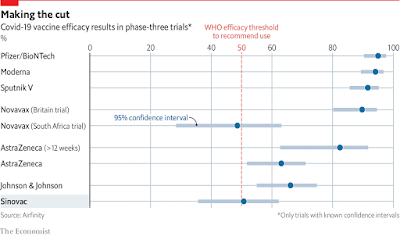
All good, I hope - today I got my second jab of the Pfizer/BioNTech vaccine, 36 days after my first one. I'm lucky to get it, given that it's the best performing of the Covid-19 vaccines currently in use.

Source: The Economist

As with my first appointment, everything went smoothly. I turned up 45 minutes early, waited no more than five minutes before being ushered into a room to fill in a form to state that I didn't have any of a long adverse reactions to my first jab. With that done, I found myself in a queue of one outside the door of the room where the vaccinations were taking place. 

Shirt off, needle in - over in a second, got my Comirnaty (the brand name of the Pfizer vaccine) card stamped and dated - proof that I've had both doses. The doctor who vaccinated me told me that I would gain full immunity within between 21 and 28 days. And that's that! I thanked everyone involved, waited a few minutes to ensure no sudden funny turns - and off I went. A lovely sunny evening, I got off the train from town a station earlier and walked home from W-wa Dawidy via the lakes.

I still need to take care during the next four weeks. Mask and alcoholic disinfectant I shall still take with me on leaving the house, and I shall avoid crowded trains and buses and continue to work from home, although by the end of the month some work-related travel will see me in Wrocław and Poznań.

Looking at my exercise log for the two days after my first jab, I see that I did no exercises involving my arms (no press-ups, pull-ups, planks or weights), only sit-ups, squats and back extensions. Walking was curtailed for two days - I didn't venture out. Then I got back into it with a vengeance. This serves as a benchmark for my recovery this time round.

The vaccination programme is picking up speed - more and more people I know have had at least one jab, many more have appointments for the coming weeks. Numbers of new cases are generally falling, though a post-Majówka spike is likely (as people got together over the May holiday long weekend and because the weather was crap, spent time indoors rather than outside over a grill as planned).

Mindful of last year, when Poland saw a huge and deadly first real wave striking in autumn, I can only hope that by early October enough people will have been vaccinated and/or had Covid to ensure genuine herd immunity. It will be interesting to see how many of the vaccinated will go on to develop Covid, and how many people who've recovered from it will go on to get it a second time.

Because the clinic where I had my jabs is very close to my office, I popped by to take a look, and to retrieve two bottles of wine which were Christmas presents! I've not been in since 1 October, since when we moved from the modern 9th floor (built in the 1990s behind the structure visibile in the foreground of the wartime photo, below, to the less prestigious but more historic 4th floor. My window is above the one with the grey plume of smoke emerging from it.

PASTa - A building that will always be associated with the Warsaw Uprising.

Update: side effects of second jab more mild than first - ache in arm has almost past after a day and half. Nothing else to report.

This time two years ago:
Another railway bridge over Puławska is replaced

This time seven years ago:
Thoughts about life occasioned by the birth of kittens

This time nine years ago:
Waiting for the footbridge on Puławska

This time ten years ago:
Lost in the wonder of it all

This time 11 years ago:
Bicycle review

This time 12 years ago:
A Celebration of the Garden


Friday, 16 April 2021

Climate vs. weather

Rain, incessant rain, day after day. The will to do, to go out and conquer the world, is mightily subdued right now. For the third day in a row, I'm not going for a walk - no fun getting soaked, and the fields have turned to mud. At the same time, my motivation to exercise has dampened; I'm doing three sets rather than ten, my drive to write is similarly weak. 

The day's length is precisely governed by the progress of our planet, tilted at 23 degrees from vertical, around our sun. So while I know that 16 April 2022 will be 13 hours, 58 minutes and 35 seconds long (between sunrise and sunset in Warsaw), I have no idea what the weather will be like this time next year.

I do know that this time last year, April was glorious. Day after day of clear blue skies. Already by 8 April - a week and a day earlier than today - our fruit trees in Jeziorki were in blossom. Today, as I look out over the garden - no sign of any blossom. And tomorrow promises more rain, reaching a climax around lunchtime with off-the-scale rainfall forecast.

But, as my old mother used to say to me when I was small, "If you want flowers, you must have showers" (probably a miss-hearing of lyrics from Pennies from Heaven). Indeed. Gorgeous as last April was - the month was spent in almost total lockdown (daily walks excepted). My Google Maps timeline for the April 2020 shows but three highlights - 'Afternoon at Lidl, April 3', 'Afternoon at Lidl, April 7' and 'Saturday Afternoon at Lidl, April 18'. 

And it was bone-dry last year. The southern pond in Jeziorki shrank at an alarming pace; by late August you could see soil all the way across (though it was still too soggy to traverse on foot). This winter's snow cover was sorely needed, and a top-up of rain too. One result of the extra wetness is the return to Jeziorki of more species of bird life, including (I've heard it several times this spring but not seen it), the bittern (in Polish, bąk - the same word as the Polish for 'bumblebee'). Its characteristic low-frequency 'booming' sound - like blowing over the top of a very large bottle - is unmistakable. It's been several years since I last heard it round these parts.

Once upon a time, weather was something that just happened; weather forecasting reached the general population as mass-circulation newspapers began arriving on the doorsteps of the land and radios were switched on. Generally hit or miss, they'd be accurate for no more than a few hours. These days we have supercomputers calculating the paths of weather fronts - indeed, of individual cloud formations - and producing forecasts that are very accurate for three or four days ahead (less so in summer with convection effects off the land producing erratic cloud build-ups). Looking at our computer screens, we either see row upon row of cloud moving in, bringing rain and blotting out the sun, or a clear, cloudless sky - or, more typically, something in between. We might not be able to affect the weather any more than our ancestors were, but we are far more aware of what the next few days will bring.

While I'm highly concerned about the effects of man-made climate change on the macro scale, when it comes to weather, I prefer cloudless days. The fact that the climate is changing at an uneven rate is visible at times like this. Dense clouds bringing cool, wet weather rather than the bright, warm days of April 2020, do bring hope. Maybe the slide into a runaway, unstoppable climate change that would be a disaster for much of life on earth, is more gentle than thought. Maybe there's still time to alter our habits and launch a thoroughgoing green transformation of our industry, our transportation, our energy generation. Maybe it takes a pandemic to affect such behavioural change.

Apropos the pandemic, the Polish third wave is beginning to subside, though at a far slower pace than seen in the UK. A more effective vaccine roll-out and stricter lockdown (at least on paper) in the UK has meant the tide began to turn in late January, and now, infection rates and death rates per million are 22 times and 32 times higher respectively in Poland. But still, it's clear that Poland has also turned the corner, albeit nearly three months behind the UK. A year ago, the situation in the UK was far worse than in Poland, with one person out of every six confirmed infected with Covid dying of it in mid-April. In Poland, it was one in every 15. (Today in Poland it's one in 36, in the UK, one in 52. Huge difference. (Source: Johns Hopkins University CSSE Covid-19 Data, from Our World in Data.org.).

Meanwhile, my dream diary continues; dreams ordinary and extraordinary are noted down each night. Last night I dreamt of alien abduction!

I hope for some sunshine on Sunday. We need it.

This time last year:
Seven lockdown sunsets

This time four years ago:
Easter everywhere

This time 11 years ago:
Strange days indeed (though less strange than these!)

[link to video of the blog post, courtesy of Nick Morris]

Tuesday, 6 April 2021

Jabbed!

Well, I got my first dose of the Pfizer today, and I must say everything went unbelievably smoothly - an experience at odds with every previous encounter with the Polish state health service! I turned up about 12 minutes early, waited a bit, filled in two forms ("have you had/have you got"/"no, no, no, no"), had my blood oxygen taken (98%), then went in to have the jab - which I literally did not feel ("Have you done it yet?" I asked after the doctor swabbed the area.) And - the best bit - I have an appointment for the second jab on 11 May. Before the doctor had even looked up from her laptop, I got a SMS from the system with news of the second appointment on my phone. And - another good bit - seven hours afterwards, I can honestly say I feel no side effects. But I expect a sore arm in the morning after sleeping half the night on it.

Meanwhile, my first journey into Warsaw on public transport since 1 October - and so much change! W-wa Główna station has finally opened (though the footbridge at the western end of the platforms is still not ready); W-wa Zachodnia (below) is deep in the early stages of its latest remont, with some of the long-distance platforms partially demolished already. You can see where the new footbridge is going to go - the pillars are going up. This will replace the tunnel that currently connects the platforms.


Left: this is Central Point, a hole in the ground a year ago as the lockdown began. It is right outside my office (which I have not been to now in over six months) - but as we've moved from the 9th floor to the 4th, I'm no longer expecting any views. In London, I used to work in Centre Point (also on the 9th floor), but Centre Point has 34 floors, Central Point a mere 21, the same height as the four tower blocks on the Ściana Wschodnia.

Right: I can see it from Jeziorki - now, officially the tallest building in the EU, taller than Stalin's Palace of Culture, taller than London's Shard - Varso tower tops out, the mast now up on its roof. It now dominates Warsaw's skyline, the first - I hope - of many skyscrapers that one day will surround the Palace of Culture, rendering it invisible from the distance. From Jeziorki, I see the other (southern-facing) side of the tower. From here (ulica Emilii Plater), I can see how much there's still to finish. To the right - Daniel Libeskind's Żagiel building.

Below: another skyscraper that's popped up since lockdown - Skysawa tower, at 155m not even high enough to get into Warsaw's Ten Tallest. For a long time, a hole in the ground - then suddenly whoomph! and there it is.

Postscript I - I can now feel an odd sensation - my left (jabbed) arm feels like I've overdone the pull-ups and the weights - usually when I get this, it's in both arms!

Postscript II - 48 hours later the dull ache is easing, taking another day off the exercises and walking to be on the safe side.

Postscript III - Neighbours had the AstraZeneca jab yesterday - today, they are reporting fever, shivers and muscle pain.

This time last year:

This time two years ago:
Działka update 

This time three years ago:
Łódź is a film set

This time four years ago
Contemplative imagery, Ealing and Warsaw

This time nine years ago:
Baffled: my first visit to Jeziorki's Lidl 

This time ten years ago:
In vino veritas?

This time 11 two years ago:
Are we getting more intelligent?

This time 12 three years ago:
Lenten recipe: tuna, chickpea and pesto salad

This time 13 years ago:
Coal train sidings, Konstancin-Jeziorna

This time 14 years ago:
Jeziorki from the air

Wednesday, 17 March 2021

The ups and down of life: Lent 2021, Day 29

I can't really complain, but here's a benchmark from which to look up (or to look down from); today is the fifth day I'm feeling mysteriously under the weather. I've not been out for a walk since Friday, and though I'm not getting worse, neither am I getting better. Outside, the weather is grim (overcast again, temperatures just above freezing, no sign of spring). Social contact is drying up - the general malaise, ennui and Weltschmerz seems to have overcome everyone. People are retreating into their shells, switching on 'survival' mode, going quiet on social media. Motivation is waning, winding down; "Lord, I believe it's rainin' all over the world/I feel like it's rainin' all over the world".

Yesterday marked the first anniversary of the original Polish lockdown. It proved so successful that Poland avoided a first wave, got complacent, opened up, went on holiday, schools and universities came back - and then by 5 November, over 27,000 new cases a day. As many new cases in one day as in three months of lockdown combined. Today, over 25,000 new cases were announced. Since the November peak, 40,000 people have died of Covid and there's no sign of the pandemic relenting, and (unlike the UK), vaccination is going terribly slowly, so we can't even look to that for hope.

Maybe I have a very mild case, or maybe it's something else; general achiness, fatigue, vague cold-type symptoms. Schrodinger's Covid - it is/isn't until you open the box with a test. The word samopoczucie - 'general physical and mental well-being' (PWN-Oxford) - is an example of a useful word having no direct translation into English (a bit like malaise, ennui and Weltschmerz). And here, my samopoczucie is worse than at any time since early February 2019 (five days without a walk).

But things will turn around. They tend to. Bad patches are replaced by better patches; the bad times are there to make you feel gratitude for the good times. Feel gratitude, and you don't get complacent. Get complacent and you fall. Know that good times are followed by bad times - the Wheel of Fortune - but not quite. And here's the trick. To know it's not a wheel, but a spiral. When you end up where you were in the last cycle, you should be one notch up, one meta-level higher - higher in understanding, in a higher state of consciousness, than before.

Funnily enough, since addressing my mind to this post, I've cheered up! 

"This is life. You have to see these things as expressions of God's will - you don't have to like it of course! Things aren't so bad - look at the parking lot, Larry! Just look at that parking lot..." There you go, Rabbi Scott, the First Rabbi from A Serious Man has just come to mind, my spirits raised, I shall go and switch the sauna on.

This time last year:
Seeking a religious symbol with meaning

This time two years ago:
New views

This time three years ago:
Humanity in a Creative Universe: a summary

This time eight years ago:
Always let your conscience be your guide

This time nine years ago:
Lenten recipe with prawns 

This time 12 years ago:
Polish economy - recession thwarted