Showing posts with label Pan Heniek and Pan Ziutek. Show all posts

Wednesday, 22 November 2023

An afternoon and evening in Katowice...

A quick in-and-out job, made possible by fast electric trains. Around two and half hours, time to edit articles, read The Economist from the front to the back, and grab a meal in the Wars restaurant wagon.

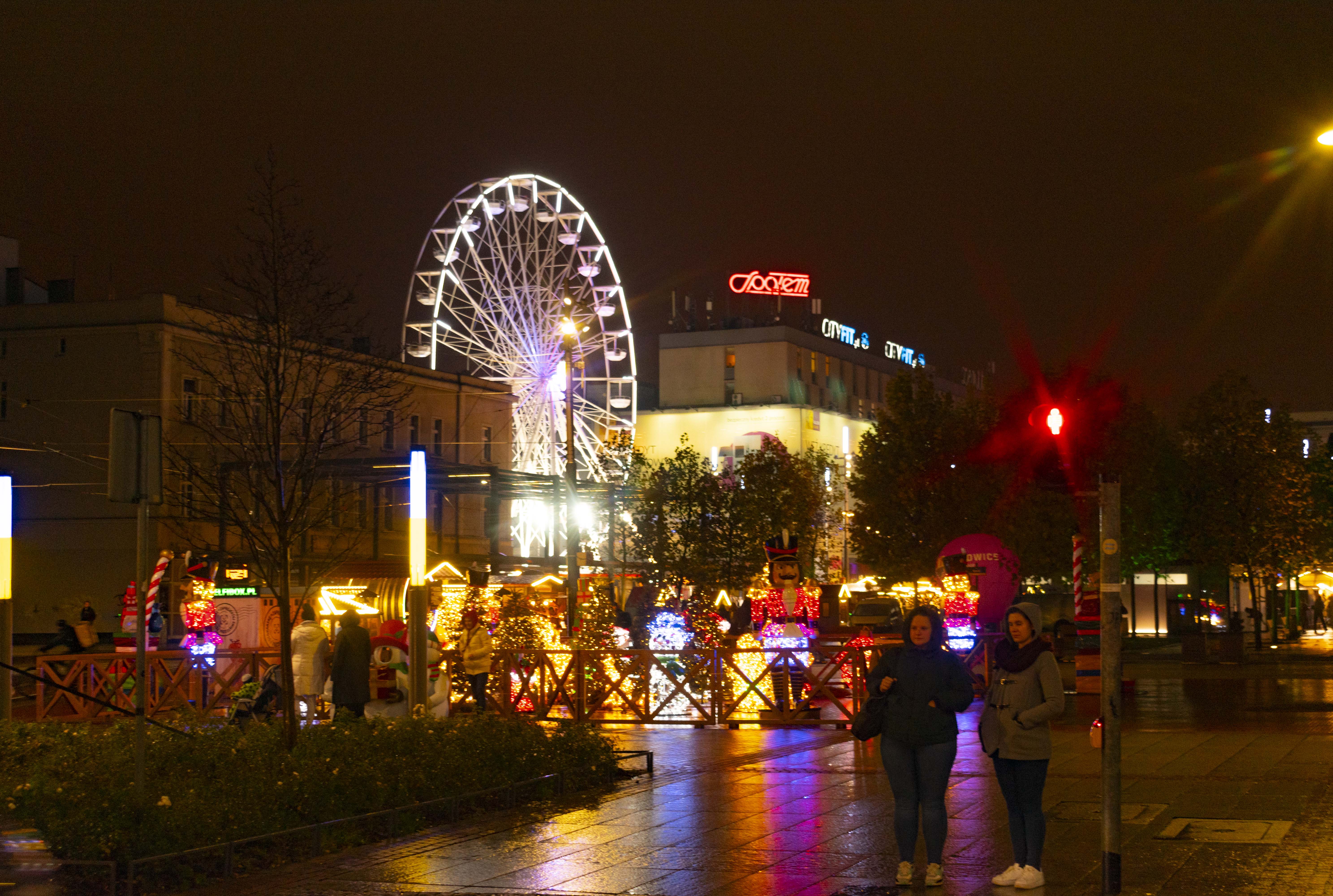
Arriving in Katowice, it is a short stroll through the city centre to get to the venue of our event today, the KTW office complex. On my way, I note that Katowice's trams have names - a nice human touch to public transport! The one facing the camera is called 'Heniek' (I checked online - there's no 'Ziutek', but there is a 'Zyguś'). Behind the trams, I see that the Christmas fair is already in place, and traders are busy trading.


Left: view from the 30th (and top) floor of the second KTW tower, the highest point in Katowice (133m), looking west. This is an excellent vantage point to witness the fantastic growth potential of the Silesian conurbation. Note the tram interchange at the foot of the the office complex. A dynamic city, Katowice is rapidly accelerating from its coal-mining roots.

Below: heading back to the station for the train back to Warsaw, I pass the Christmas market, now fully illuminated. Billboards advertise festive visits to Brno, which is actually closer to Katowice than Warsaw. And indeed, here and there I could hear Czech spoken by groups of middle-aged tourists, here for the Christmas shopping.

Below: Katowice does neon well. Note the vertical light poles, in the Ukrainian colours. Katowice has not forgotten!


Back in Warsaw, Central station. My return train was the Polonia Vienna-Warsaw express, which called at Ostrava and Katowice on the way. I was hoping the train would consist of Austrian or Czech carriages, so I could sample the in-train dining experience offered by the respective operators, ÖBB or České dráhy, and compare them to PKP's Wars. Sadly, the rolling stock was made up entirely of Polish carriages, although it was hauled by a Czech locomotive (below). I had to make do with Wars for the second time in a day (thought this time only for Polish cider, and peanuts). The train departed and arrived on time, and was profitably full. Hurrah for rail travel!


My second visit to Katowice this year; the city continues to impress with its sheer economic dynamism.

This time four years ago:
Karczunkowska viaduct opens to cars, but not to pedestrians

This time five years ago:
Edinburgh's Polish statues

This time six years ago:
Edinburgh - walking the Water of Leith

This time seven years ago:
Poland's north-west frontier

This time eight years ago:
Cars must fade from our cities

This time ten years ago:
Unnecessary street lighting wastes public money

This time 11 years ago:
Warsaw's heros on the walls 

This time 12 years ago:
Tax dodge or public service? 

This time 14 years ago:
Warsaw's woodlands in autumn

This time 15 years ago:
Still here, the early snow

This time 16 years ago:
Another point of view

Saturday, 3 June 2023

Hurry to the forest

The words of a Polish scouting song, which I'd sing over 50 years ago, come to my mind: Bracia skauci, dosyć kurzu, dosyć kurzu łykać nam. Trzeba spieszyć nam do lasu, by wypocząć trochę tam... ("Brother scouts, enough dust. enough dust for us to swallow. We must hurry to the forest, to rest a little there..." A long walk today. Below: following familiar paths, to my jumping-off point. The goal - to get to Rososz, through deep forest, skirting Dąbrowa Duża.

Below: but first, I must skirt Machcin II. My attention is drawn by this field of poppies - the first ones I've seen in any number this season.

Below: this is what I'm after - if there is a beaten track, it's one that's been beaten by hares and deer; this is not marching along a path, this is bending, stooping, clambering, double-backing, jumping ditches - a much slower pace. Although I covered over 14km, I only managed 16 minutes of medium- to high-intensity walking today. This is the kind of progress made when foraging for mushrooms.

In a little shop. I need bread and lentils; as I'm browsing, in pop Pan Heniek and Pan Ziutek. Amiably brusque, Pan Heniek places his order in the voice of a 40-a-day smoker: "Cztery najtańsze." [Four of the cheapest. (beers, obviously).] The shopkeeper, knowing her clientele, reaches for the required bottles and replies "Coś jeszcze?" [Something else?] "Szampon." [Shampoo.] "Jaki?" [Which kind?] she enquires. "Najtańszy." [The cheapest]. And then in pops a boy, obviously sent round by his mum, to buy a jar of mayonnaise. He, too, chooses the cheapest one of the three brands the shopkeeper offered. 

Left: Marian shrine at the convergence of five roads - the unpaved track to Machcin II in shot, to Zbyszków to the left, Dobiecin to the right and two roads into Rososz behind me.

The four people in the shop were the only humans I saw on my walk. Ah - and two tractor drivers seen from a distance.

Wildlife outnumbered humans: I also saw seven cranes; three walked across my path - cranes are massive birds - at first I thought they were runaway emus, but they were just across the way from the wetlands where I've already observed them, though from a greater distance. Further on, I entered a long, rectangular clearing, looked around, and saw a deer, about 80 meters away. It froze - I froze. Slowly my left hand reached for the telephoto zoom in my trouser cargo-pocket, but before I could change lenses, the deer turned, made a near-vertical bound, and disappeared off into the forest. With the long lens on, I could discern at the far end of the clearing another four cranes.

Below: after lunch (sausage, bread, beer) in this relatively less-dense part of the forest, I get on hands and knees to photograph this oak sapling - one of thousands growing here. Few will make it into maturity, destined to be crowded out or cut down.


Below: carved out of the forest of mature cultivated pine trees, a lane designated for the medium-tension power lines running north towards Machcin.


Almost home - the last bit of forest proper from my działka, before it gives way to orchards.


Spending four hours amid the trees, surrounded by nature, by birdsong, away from the traffic and noise and stress of civilisation is supremely good for the old samopoczucie.

Left: bonus shot - yesterday evening; Airbus A320 neo over Jakubowizna, turning into final approach to Okęcie. Play is an Icelandic airline, flying from Keflavik. The red of the plane against the blue and white caught my eye. Today marks the second month of flights of the airline to Warsaw.

This time last year:
Stills from Katowice

This time 12 years ago:
Szmulowizna

This time 13 years ago:
Jeziorki's Storm of Storms

This time 15 years ago:
How to tell you're flying over Poland

This time 16 years ago:
Poppy fields


Saturday, 9 July 2022

Drinking on the move

So here's the plan. I walk 15km from the działka to Warka station, catch an InterCity train with a bar wagon, buy myself a beer - and alight at Piaseczno just 22 minutes (32km) up the line. 

With the modernisation of the Warsaw-Radom line complete, there are now four pairs of PKP InterCity trains linking Kraków and Olsztyn calling at Radom and Warsaw on the way, along with other stations. Among the 23 stops along the route, conveniently, are Warka and Piaseczno. 

The four Kraków-Olsztyn trains are all named (Żeromski, Sienkiewicz, Kolberg and Orłowicz - the first two being famous Polish authors - the second two? Who knows?) and are operated by modern Dart rolling stock - which means there's always a bar. Other InterCity trains formed from conventional carriages pulled along by locomotives may or (more usually) may not have restaurant wagons. 

Below: the bar car of the Żeromski passing the end of my road on its way to Olsztyn, having left Kraków just before 7am. That's where I intend to be... in the bar car of the Kolberg, passing the end of my road.


... And indeed - here I am. Skipping forward four hours, this is the reverse shot - my road flashing by, snapped from the Kolberg's bar car (below). The red dot on the roadway is where I was standing when I took the above shot.


But that's jumping the narrative a bit - back to the walk to Warka. 

I set off from Jakubowizna as the Kolberg departs from Kraków Główny station. This will give me just under four hours; a comfortable stroll without having to hoof it, with time for a sandwich lunch along the way. I check the weather - I should be able to dodge the showers...

Below: leaving Jakubowizna, under a cloud. My journey will be parallel to the railway line for most of the way, preferable to busy roadsides.


Below: new asphalt along ulica Kolejowa, heading away from Chynów towards Krężel, the next station along the line.


Below: fields, orchards and forests, gently undulating landscape all the way to Warka and the river Pilica. Ancestral lands. My roots, man.


Below: a southbound Koleje Mazowieckie train departs from Krężel. Saturday traffic; a handful of people get on, three passengers get off. Bicycles, shopping bags, what have you. 


The trail continues unbroken with the exception of a short stretch that required walking along the tracks to avoid going through someone's backyard before reaching a local level crossing. From then, onward along more new asphalt towards Michalczew (below).


Below: eternal rural Poland, that has for centuries shrugged off invaders, occupants and oppressors. It abides. Michalczew.


Below: Michalczew station. The heavy clouds dropped rain ahead of me, and behind me, but I stayed warm and dry all the way. New asphalt where once was an unpaved farm track, new platforms where once stood little more than a pile of bricks


Below: south of Michalczew, the asphalt runs out, and a reminder of what it was like before the modernisation of the line; mud, puddles and ruts. A new Koleje Mazowieckie Impuls train runs northwards up towards Warsaw.


Below: the main Chynów-Warka road crosses the line at a recently modernised level crossing between Michalczew and Gośniewice stations. The remaining third of my walk will be along the main road between Chynów and Warka.


Below: quiet at the moment, but drivers, they do rush, and there's no pavement. This stretch was, until recently, paved with hexagonal concrete slabs - really unpleasant to ride a motorbike over.


Below: one station north of Warka - Gośniewice. Two staggered platforms set among orchards and fields, a station serving a village of 219 souls. I take a short diversion here from the main road, and have a short break to eat and check Google Maps. From here, it's just 47 minutes' walk from Warka station. No need to hurry. And look! Here comes the Sienkiewicz, right on time, on its way to Olsztyn.


Below: Is this Kansas? Are we in Ohio? No, this is the road into Warka. A town famous for brewing, a tradition that goes back to the 15th century. The modern brewery (right) is part of the Żywiec Group, which is turn belongs to Heineken. A little further along the road and I turn off into ulica Piwna (lit. 'beery street') and the station's just around the corner. But as I wrote recently, Warka station is a long way from the centre of Warka. Visible (just about) on the horizon, the statue commemorating Polish airmen who fought on all fronts during World War Two.


After three hours and a quarter hours of walking including a 10-minute break, I reach Warka station.  Waiting on the platform, I watch the progress of the Kolberg in real time on the Portal Pasażera app.
Punctually, it pulls in to the platform. 

I make for the door of the bar car, hop on, head straight for the counter and order a beer - (Śmietanka - a wheat beer from Browar Jan Olbracht Rzemieślniczy craft brewery in Piotrków Trybunalski). Cheers! Note the small glass - the big ones have all been used between Kraków and Radom and are sitting in the dishwasher. And the brewery's beer-bottle labels are all drawn by Polish cartoonist Andrzej Mleczko. Incidentally, śmietanka means cream, whilst śmietana means sour cream. The landscape comes out better with a glass of cold beer. Cheers.


It slips down a treat - the 22-minute journey is too short for a second, too short for any metaphysical contemplations of passing scenery, but the effect is there. Drinking in trains is a pleasure I first experienced when making my way to university interviews while still at school - to Lancaster, Canterbury, Norwich, Colchester and Warwick. A beer in the buffet car would transport me to ethereal realms of imagination and artistic insights... Alcohol (in moderation of course) and rail journeys go hand in hand.

As I sup up, the guard announces that the next station stop will be Piaseczno; the train starts to slow down. The pleasure is not cheap; the beer cost 15.90 złotys (£2.80), whilst the InterCity ticket cost 10.50 złotys (£1.85) and the train back to Chynów from Piaseczno (19km on Koleje Mazowieckie) 6.76 złotys (£1.20). A grand day out!

While crossing the footbridge to the get to the southbound platform at Piaseczno for the train home, I catch the following snippet of conversation between Pan Heniek and Pan Ziutek, both extremely refreshed:

"Znasz się na malarstwie?" [Do you know about painting?]

"Muszę kurwa coś zjeść." [I have to fucking eat something.]

"ALE ZNASZ SIĘ NA MALARSTWIE?" [repeated in an insistent, aggressive tone]

Just as in English, 'malarstwo' (painting) can mean decorating or art history. I never did find out whether Heniek wanted to know whether Ziutek could help out with painting an old lady's kitchen, or whether he needed a critical eye evaluating a still-life rescued from a skip, or to see whether Ziutek could engage in a meaningful discussion about Cubism with someone whose first reaction won't be "Fidel Castro".

POSTSCRIPT: It has occurred to me that I've walked all the way from my office in central Warsaw to Warka this year - from Świętokrzyska to Wilanowska, from Wilanowska to Jeziorki, Jeziorki to Jakubowizna, Jakubowizna to Warka, from Warka to the far bank of the Pilica river before Warka Miasto was built.

This time four years ago:
Grodzisk Mazowiecki revisited

This time five years ago:
S7 extension - last summer of quiet (not true, as it happened!)

This time six years ago:
Getting out of Mordor

This time 12 years ago:
Ćwilin, conquered

This time 13 years ago:
Sunset across the tracks, Nowa Iwiczna

This time 14 years ago:
The storm the forecasters missed

This time 15 years ago:
Peacocks in the Park

Sunday, 14 August 2016

Popping out for a drink

In one of my local retailers, I chance across a new vodka brand (well, new to me, at least) - Parkowa. The name leaves no room for doubt - it is intended to be drunk in the park. Au plein air. This is Feldalkohol. Not for consumption indoors.  A brand name like this was devised with the Heniek and Ziutek market in mind. No doubt convenience retailers will be selling this stuff chilled. At 7.99 złotys for one-fifth of a litre (£1.62 in post-referendum money), an incredibly cheap way of getting wazzed. The 200ml of 36% alcohol by volume vodka represents 7.2 units; more than half one's new weekly allowance [see below].


And talking of au plein air - the al fresco drinking message is promoted in the name of this shop next door to Radom railway station. Next door, but far away enough to avoid the ban on booze shops in the immediate vicinity of railway or bus stations. Plener (the Polish pronunciation of plein air) 24h, alcohol shop. Calling things by what they are.


I'm not writing this post to get sanctimonious. There's something about a casual drink outside, especially in summer. This evening, I packed a chilled bottle of King of Hop American Pale Ale by Ale Browar in my rucksack, to drink atop my beloved, but soon-to-be removed, mountain of ballast (below). A great place to watch the trains, the planes and the evening sun setting low across the fields towards Dawidy.

A single bottle of hoppy ale helps with the feelings of transcendence, elevating my consciousness to a higher level. Enhanced appreciation to the phenomena all around me; the sun, the wind, the ever-changing cloudscape; I contemplate the relevance of matter.

How much does it take? 500ml at 5% abv = 2.5 units. Peak effect wears off in around half an hour.

And once emptied, the bottle returns to my rucksack, to be taken home for recycling with the glass.


Drinking outdoors: Warsaw's suburbs lack pubs. In their place, informal drinking dens such as this abandoned building between Biedronka and the bus loop; hundreds of beer cans and bottles litter the area. Why can't the open-air drinkers deposit their empties in a bin (there's one by the bus stop, another outside Biedronka) or take it home?


Perła Mocna, Żubr, Żywiec, Łomża... a close look at the photo will also reveal a scrap of English newspaper. Yes, this is London. The towpath of the Grand Union Canal, between Greenford and Southall. Old habits from the Old Country die hard.


Is drinking outdoors a peculiarly Polish or Slavic thing? Is is born out of poverty (no pub culture, or else pub prices)? Don't know. But I certainly enjoy Feldalkohol on my walks. Lidl's 250ml bottles of wine will accompany from time to time, as the 187ml bottles of J.P. Chenet's Colombard-Sauvignon (from Auchan or Biedronka) are ideal. I've occasionally indulged in a małpka - a 100ml bottle of vodka - most recently in midwinter, when the ponds froze over, knocked back with a small portion of śledzik na raz z cebulką (single-shot herring with onion); just perfect at -10C as the sun sets.

[The important thing is to keep alcohol intake under control. Since the beginning of 2014, along with paces walked, diet and exercise, I keep a day-by-day log of how much I drink. The UK Government keeps lowering the recommended guidelines for alcohol consumption (from 28 units a week for men to 21 units and most recently to 14); I'm striving to get down from the old limit to the 21 units, and consider the current 14 units to be a bit exaggerated. Ah - and two consecutive days each week without any alcohol at all.]

This time six years ago:
In search of happiness

This time seven years ago:
Mercenaries and missionaries

This time eight years ago:
Spectacular sunrise, Jeziorki

Saturday, 27 June 2015

The Ballad of Heniek and Ziutek

These guys are a) the backbone of Poland, b) Poland's biggest problem. Pan Heniek (below, left) and Pan Ziutek (below, right) - or indeed the other way round. The background has been heavily pixelated a) to hide the Polish village in which this was taken and b) to give the impression of level of inebriation that our protagonists are experiencing...


Pan Heniek and Pan Ziutek can be found in any Polish village (their presence in Polish cities is thankfully on the wane). Decent, ordinary, straightforward guys with one problem - alcohol.

This pair staggered into the sklep spożywczy ahead of me and went straight to the alcohol counter. They pooled their resources - eight or nine zlotys - and converted it into małpki - 100ml or 200ml bottles of vodka. But not just any małpki - these guys wanted their małpki chilled. From the chiller. It's hot outside.

Poland's spirits manufacturers have a lot on their conscience. In particular the chiller cabinet of małpki. These bottles were never intended for domestic consumption, Lord no. This is feldalkohol, something to be bought and swigged back in the fields. Strong alcohol to be drunk in the open air.

Pani ekspedientka asks her customers what they'd like. They name their preferred brands and engage in easy-going banter with the shop assistant, who's in her early 20s and probably finishing her Master's degree in philosophy. They manage to string entire sentences together without the use of a single expletive. She tells them, politely, that their order is not going to be good for their health. They laugh. It is evident from their gait (above) that these bottles are not their first of the day. They merrily shrug off this well-meant advice, count their grosze and arrive at the right amount of loose change to pay for the małpki. The transaction is complete. And off they go, the two sages of the willow grove.

But for their comedic value, Pan Heniek and Pan Ziutek's alcohol problem leaves human tragedy in its wake - mothers, wives, children. Employers, social security, the health service.

The answer is clearly genetic; some of us can handle alcohol and some can't. A variant of one gene means that we are either prone to addiction to C2H5OH or not. In time, genetic testing will be able to identify those with the wrong variant - and innovative medicines will fix it. But in the meanwhile, we shall have to endure the sight - and the costs (social and economic) of Pan Heniek and Pan Ziutek's unending quest for booze.

This time last year:
Yorkshire's yellow bicycles

This time six years ago:
Horse-drawn in the Tatras

This time seven years ago:
Rain, wind and fire

This time eight years ago:
The Road beckons

Sunday, 20 July 2014

Drifting south with the sun - bicycle hobo

I woke yesterday at 03:30, had a big breakfast, packed some supplies into the panniers and set off from home at 04:55 heading south. I chose that direction to benefit from a north-easterly tailwind. The route would be a mixture of tarmac and off-road, the intention to stay close to the Warsaw-Radom railway line. Sunrise was at 04:39, so it was already broad daylight as I set off for Piaseczno along ul. Puławska. Below: outside the house, ready to go. A gorgeous morning, the air full of the scent of a summer dawn, which evaporates quickly as the sun rises.


Within less than two hours I'd passed Piaseczno and Czachówek, so far almost all of the journey along asphalt. Below: the Radomiak semi-fast train to Warsaw, approaches Czachówek. Above it, an Airbus A320 turns in for its final approach to Okęcie airport.


At Sułkowice, the next station south of Czachówek, I popped by for a baguette to go with my excellent selection of smoked meats, and a newspaper. The small village shop was crowded though it was not yet seven am. Lots of building workers in overalls; in the car park were several pickup trucks with crew cabs. On the platform of Sułkowice station there were about 15 people waiting for the train to Warsaw. Things looked busy - there was still evidence of old rural Poland - under an apple tree across the road from the shop, Pan Heniek, Pan Ziutek and a friend who looked decidedly worse for wear were enjoying a round of early-morning refreshments and commenting on local events using a loud stream of expletives. Other than this trio of lay-abouts, everyone else at Sułkowice looked purposeful and getting down to business.

South of Sułkowice, I cross the DK50, Warsaw's de facto southern bypass, and once clear of the noise of the trucks heading east-west, I find a field in which I can have a second breakfast (ham baguette, plums, dark chocolate, lots of water). I'm surrounded by apple orchards and I watch two hares gambolling about on a neighbouring field.

[LITTLE DID I KNOW THAT IN JUST THREE YEARS AND THREE MONTHS FROM THIS DAY, I'D BUY MYSELF A DZIAŁKA WITHIN A SHORT WALK OF THIS VERY POINT.]

On, on past Chynów. Time to go off-road. I'm zig-zagging - taking a path, crossing the railway track, straying too far from it, turning back towards it, crossing it, etc. I bypass Krężeł, Janów and Michałczew. Every now and then, the track is nicely asphalted, with a sign acknowledging EU funds and the province of Mazowsze as having contributed to the road's improvement. After a few hundred metres, however, the asphalt runs out; a road-sign warns that all good things must come to an end. Beyond the asphalt lie dirt 'roads' of varying quality; some stretches are fine on a mountain bike with fat tyres and deep tread, but other stretches yield up to soft sand - the cyclist's worst nightmare. The bike slows to a halt. You put your foot down; it sinks into the sand up the ankle. You dismount, and push the bike laden with panniers as you would over a dry, sandy beach. At walking pace, the insects, which do not bother you at 15km h, become an annoyance. I must have walked a good few kilometres in total between the more solid stretches.

Below: one of the better stretches of dirt-track. The sand has been compacted down by cars. In the distance comes a car, trailing a cloud of fine dust behind it. But the scenery and weather compensates for the sand. I am reminded of my early childhood 'memory' of how I expected the countryside to be, living among the sprawling brick suburbia that stretched out westward for mile after miles from Hanwell, West London.


Beyond Gośniewice, I turn onto the main road for Warka, still quite quiet at this time on a Saturday morning. I make up the pace, and soon I'm passing through the town, by now quite busy. I turn onto the bridge crossing the Pilica river (below). There's a separate footpath for pedestrians and cyclists, so I can stop to take a photo. Click to enlarge - on the right-hand side of the horizon you can see one of the arches of the railway bridge crossing the Pilica. The morning remains gorgeous.


South of Warka runs the road to Kozienice. It's narrow, heavily trafficked. I feel vulnerable as a cyclist; many drivers going way too fast. I continue along the main road to Grabów nad Pilicą, then turn right towards the railway again, mercifully few cars now pass me. By now, I'm reaching the end of my fourth hour of riding, so time for more ham baguette, water and chocolate.

Left: an idyllic spot for a break. Only one komar (midge/gnat) to bother me otherwise all is good. Time to discuss the pros and cons of using a smartphone on a journey. I'm getting increasingly aware that it's a good idea to be carrying on you as little as possible. Rather than a rucksack - panniers. In here go tools, spare tyre tube, waterproofs, food, water, sun-cream, kitchen paper - everything. Not wishing to carry a half-kilo camera around my neck, I settle for my Samsung Galaxy S3 instead. It has a built-in 8 megapixel camera (my old Nikon D40 has 6 megapixels). However, it's difficult to see the screen when composing in strong sunlight. The bridge photo was taken by guesswork - I couldn't see anything on the screen with the sun directly behind me. But as you can see, the photos taken are entirely acceptable.

The other big problem with the smartphone is battery life. Fully charged at 5am, there was less than 12% charge left at midday. Because mobile telephony coverage is patchy out here in southern Mazowsze, the phone is using power to hunt for signals. Taking photos (I took over 30) also drains power, as does using the Google map facility (extremely useful when there's a mobile signal). Plus, I'm using Strava to record my ride - a very informative app, though not as user-friendly as it could be.

I reach Dobieszyn just before noon, having cycled 83.9km in seven hours, including two rests of around half an hour each. At half past twelve, a Warsaw-bound train takes me back to Jeziorki.

The line back to Warsaw is single-track most of the way up to Warka, doubling at stations. Looking at the map tracing my journey on Strava, I count that I've crossed this line (by bridge or level crossing) no fewer than 15 times.

The journey home costs me 11zł 57 gr. The ticket, bought at a splendid new ticket machine, informs me that the direct rail route is 56km. That's £2.20 for a 34-mile journey. By comparison, the cheapest ticket for a single ticket from Ealing Broadway to Tilehurst, a distance of 33 miles, will cost you £15.40. That's exactly seven times more expensive. Yet average salaries in Poland are only three times lower than in the UK. So are British trains more than twice as good?

The journey from suburban Ealing to Tilehurst, beyond Reading, takes 56 minutes, with the train stopping at 13 intermediary stations along the way. The journey from suburban Jeziorki to Dobieszyn, takes 1hr 17 mins, with the train stopping at 14 intermediary stations. Not bad, considering the appalling condition of the track infrastructure on the Warsaw to Radom line.

[UPDATE 2022:  post-modernisation of the line, the journey from W-wa Jeziorki to Dobieszyn now takes a mere 51 minutes - one-third of the old journey time shaved off!]

This time two years ago:
Royal Parks in the rain

This time three years ago:
Storm clouds over Warsaw, Dolinka under water

This time two years ago:
Round-up of pics from Dobra

This time three years ago:
Conservatism - UK or Polish style?

This time four years ago:
Wheat and development

This time five years ago:
A previous visit to London


Thursday, 30 January 2014

Protecting Poland's railways - or not

Regular travellers on Poland's railway network will have observed the railway guard - Straż Ochrony Kolei - a strange institution - neither police force nor military formation, and you may have wondered - what are these guys doing? Are they protecting the travelling public? Making the railways feel more secure?

I don't really know. To me, it's another Polish institution long overdue for reform, in need of real purpose, a jobs-for-the-boys machine. Trains should feel safe - in general they do (with one exception I'll return to). But I posit that they feel safe because of a general improvement in social trust since communist days, rather than because 3,100 SOKists hang around the network.


Are these guys here to prevent graffiti being sprayed on trains stabled overnight in depots? Or to prevent overhead power lines from being stolen? Or to prevent terrorist attacks on Polish railways? I don't rightly know. From SOK's website, it's hard to fathom what this body is all about.


Below: reminds me of the communist-era joke: why do milicjanci hang around in threes? One who can read, one who can write, and one to keep an eye on the dangerous intellectuals. Back in Cold War days, this force existed to protect the Red Army's railway supply routes safe from NATO paratroopers - and Polish saboteurs. Today, this threat has disappeared, yet these guys still act as though it were 1952. But in hi-vis vests.


Below: why is it that drinking and smoking is tolerated on Polish suburban lines? Each three-carriage unit has a guard's compartment at the front and rear. A six-carriage set will have four such compartments, three of which (not occupied by the guard) form mobile drinking dens for Pan Heniek and Pan Ziutek returning home from work in Warsaw to Radom, Żyrardów or some other distant dormitory at the edge of Warsaw's gravitational pull. In these compartments, smoking and drinking are de rigeur, despite clear notices to the contrary. Smoke wafts into ordinary passenger carriages, the atmosphere is often boisterously aggressive, kurwa this, kurwa that, kurwa. Guards and ticket collectors rarely venture in. This is an everyday occurrence. Where are the SOKists?


The Polish parliament was all set to reform this outdated institution, reducing the number of its ranks and making it fit for purpose for today's needs. That was five years ago - since then - no change. I suspect another PSL sinecure. What's needed is a professional body that will genuinely assess risks to the network and to the traveller and act accordingly. Until the smokers and drinkers are removed from the no-smoking, no-drinking suburban trains (or else the law is amended to permit smoking and drinking in designated compartments), I will not take SOK seriously.

UPDATE FROM 2022: The behaviour above has all but disappeared, mainly due to the introduction of new rolling stock without enclosed compartments at the ends of the multiple units.

This time last year:
The end of winter? So early?

This time two years ago:
How much education for the nation?

This time three years ago:
To the Catch - short story

This time four years ago:
Eternal Warsaw

This time six years ago:
From the family archives

Sunday, 30 June 2013

Cider - available at last in Poland

Arriving in Poland 16 years ago, I was surprised by the lack of cider. A country that's a European leader in apple production, and turns much of that into apple juice; a country that makes alcoholic spirits out of most forms of plant life, seemed incapable of going that step further with the apple juice and fermenting it to make a beverage of beer-like strength*.

And this at a time when a youthful demographic seeking palatable alcoholic drinks would have seemed like the ideal market for cider. And yet the British manufacturers, who'd regularly dip their toes in the water, would never take the plunge here. Year after year, I'd hear newly-arrived expats wondering where the cider was. Poles returning home after a stint in the UK would also express surprise that no entrepreneurial company was bothering to supply the Polish market with cider.

In the meanwhile, the youthful demographic, with its sweet tooth, was being pandered to by brewers adding sugar, fruit syrups and other ghastly flavourings to their beers to appeal to the burgeoning 15-to-25 year-olds. This was the largest age cohort of the Polish market. Stuff like Redds, FreeQ, Gingers. Dog in the Fog (withdrawn from the market in April 2010). To me - absolutely foul concoctions - but they did wean a generation brought up on Frugo and Hipp into the pleasures of alcohol in more gentle way than knocking back vodka shots or quaffing bitter-tasting beers.

But still no cider.

Until 2013. This year, the market has been judged to be ready. I'm not talking about Somersby, an apple-flavoured beer from Carlsberg. (45% beer, 55% apple juice; 4.5% alcohol by volume - sounds hideous - diluting a 10% beer with apple juice!).

Earlier this spring, I chanced upon 330ml bottles of a cider called Joker at Auchan; it was there for a week or two then disappeared. Today, in the same shelf, I found Sherwood Apple Cider Taste of Traditional English Cider (4.5% ABV). On putting on my reading glasses and looking at the small print, I discovered that this is made in Estonia from 'fermented apple juice and natural apple flavours. We tried some with lunch, the pear-flavoured variety too, but it tasted perfumed, lacking in vigour or authenticity.

But what's this? Cydr Lubelski. Again, 4.5% ABV (looks like some kind of limit set by excise law), but now, something more authentic. Made by fermenting apples, this is a real cider. Light, refreshing in taste, medium-dry, none to challenging. Not a great cider by the standards of England's West Country, but for Poland, a start. I guess this will be the moment when cider takes off in Poland; by 2030, cider will have become a 'traditional' Polish beverage.


Above, from the left: two bottles of Estonian 'Sherwood' cider; to the right, Cydr Lubelski. At last, a Polish cider, plain and simple, not apple-flavoured beer. Note the excise bands (banderole) over the bottle tops, something that beers don't need to have, even though they're stronger than these ciders.

And shandy's burst onto the scene. Also known as radler, 50/50 mixes of beer and lemonade are freely available from the Big Three brewers. At between 2% and 2.6% ABV, these do not interfere with the head and, served very cold, are beautifully thirst-quenching. Better than the Top Deck Shandy I grew up with!

Below: while on the subject of alcoholic beverages and their marketing - I'm admiring the current ad campaign for Łomża beer. I've said for a long while that it's advertising copywriters that breathe new life into the Polish language. Pastwing bez krowingu. Simply brilliant.


This ad is not aimed at Pan Heniek or Pan Ziutek, whose tipple of choice must be Argus Strong (6.7% ABV, on offer at 3.59 złotys or around 70p for a one-litre bottle this week at Lidl). No, the Łomżing campaign targets the trendy, educated, urban youth market. 'Łomża. Source of Conscious Łomżing'. Łomżing - Lemming? a source of conscious self-irony?

Another current series of billboards that playfully toys with the Polish language is the re-run of last summer's Bardzo mi Milko campaign, blending English into Polish (MoreLove = morelowe = apricot flavour, or WishNiowe = wiśniowe = cherry flavour). Such plays on words reflect the open-minded, intelligent and fun-loving nature of the target group for these milk drinks.

The Polish market for food and drink is becoming increasingly sophisticated and competitive. This is great news for consumers. It's just a shame that British cider manufacturers did not spot this opportunity a few years ago. Maybe now the market has been opened by local players, they will come over.

* There's always been jabol - a sweet fruit wine made from apples and sold for grosze to the lower echelons of the alcoholic community.

Update, 7 July 2013. The following Sunday I'm back at Auchan for my weekly shop. I'm looking for ciders. Guess what - they've disappeared off the shelves again. None. Not one.

Update, 11 July 2013. I'm looking in the wrong shelf! The ciders - all three mentioned above plus the Joker and a few others (eXcite) - are around one-third of the way down the looooong shelf with beers. On the right as you stand with your back to the check-outs. Such good news I buy a Cydr Lubelski.

This time last year:
Despondency on Puławska
[A year later, still no S2 Southern Bypass]

This time two years ago:
Stalking the stork

This time four years ago:
Late June lightning

Saturday, 22 June 2013

Baszta - a former legend

Once upon a time, Baszta was the place. A point of reference. Older taxi drivers at the rank on Wilanowska still ask me, when I say I'm heading down Puławska to ul. Trombity: "Is that before or after Baszta?" Once, the only restaurant in this part of the world, it was where the Party people who loved to get down would get on down. The Nomenklatura would party here till broad daylight, discussing their invidious plans for Poland between successive half-litre flaszki of chilled vodka. Jane Fonda and Neil Armstrong dined here too.

After 1989, Baszta's fortunes fell prey to the laws of the free market; the Party dissolved, competition popped up amongst the newly-constructed blocks of Ursynów, and restaurant goers sought something more than schab z przysmażonymi ziemniakami i surówkę mieszaną.

During my first five years in Warsaw, living in Pyry, I'd pop by here now and then, and with one memorable exception I'd be outnumbered by the staff. Walking in, I'd be acknowledged with a surly nod by a balding middle-aged barman in white apron, wiping beer glasses; I'd go up to the cloakroom, where a middle-aged woman with bright orange hair would take my coat in exchange for a numerek; I'd then go downstairs to the one functioning restaurant room, where one of the two middle-aged waitresses would take my order. A long wait would ensue, as the five middle-aged kitchen staff would patiently prepare my supper.

I always wondered whether this was an exercise in money-laundering, but in hindsight it was poor management that led to the inevitable end. No attempt at marketing; no mailbox leaflet campaigns around the neighbourhood like the pizza places do. All those rich expats living within walking distance, forced to eat at home because no one told them what culinary delights Baszta could offer them.

Baszta has been closed for four years - since July 2009. It's still a landmark as you drive south down Puławska towards Sand City, on your left, just before the church in Pyry. The main restaurant building itself actually dates back to the late 19th Century.


Above: the corner of Puławska and Łagiewnicka. The bar, a charming annex, was built in 1959 when the main building was turned into a restaurant. But how to compete for Pan Heniek and Pan Ziutek's custom today when Lidl down the road sells litre-bottles of Argus Strong (6.7%) for 3.10 złotys (around 62p)?


The bar, seen from  Puławska. Such a lovely building, echoing the sweeping curves of Mid-Century Moderne, though with a classical touch.


Above: sign on Puławska, in keeping with the guidelines of the 1968 Vienna Convention on Road Signs: 'Information signs indicating facilities or services, shall be in black on a white rectangle on a blue ground.'


Above: the main entrance from Puławska; gatehouse built in the same style. Parking for 20 cars inside.


Above: the main building, designed by Władysław Marconi. If those rounded corners remind you of any Warsaw landmarks - Marconi also designed the Hotel Bristol. And the Bulgarian Embassy on Al. Ujazdowskie.


Above: peering in from the side gate on ul. Łagiewnicka at the back of the main building, and some of the outbuildings, including a dovecote. I don't like the faux stonework appliqued onto the white plaster.

What will become of Baszta? I guess market conditions must improve before an investor can see this as a sensible acquisition. In the meantime, it's yet another stop-off on the rounds of the security guards.

This time two years ago:
Downhill all the way to December

This time three years ago:
What do I want for Poland

This time four years ago:
Summer holiday starts drizzly

This time five years ago:
Israeli Air Force Boeing 707 visits Okęcie