Showing posts with label Rzeszów. Show all posts

Thursday, 16 October 2025

To Rzeszów and back, directly, by train

My tenth visit* to the beautiful and booming capital of Podkarpacie province, Rzeszów. I boarded the train at Warka and got off in Rzeszów three hours and ten minutes later. No need to change trains in Warsaw, or Radom, or Lublin or Kraków or Przeworsk (I have done all of these). No need to transfer onto a replacement bus service at Ostrowiec Świętokrzyski. No longer any need to take a sleeper train – or fly. 

In both directions, I shared a compartment with people who were uniformly praising the massive improvement in Poland's state railways over the past few years. No grumbles.

There are two pairs of InterCity trains a day between Warsaw and Przemyśl, the Witos and the San, calling at Piaseczno, Warka, Radom, Ostrowiec Świętokrzyski and Sandomierz on the way. Those last two stations were linked by a replacement bus service for a couple of years as the tracks between them were relaid. 

I took the San, leaving Warka at 17:49 and arriving at Rzeszów Główny (scheduled at 20:56 but with a few minutes' delay). My ticket (with 30% seniors' discount) cost me 25 złotys – just over £5 for a 265km (165 mile) journey. The compartment had six seats, the journey comfortable. 

And when the train arrives at Rzeszów Główny station – the station is complete! It's ready! The work, which began in 2018, is finished! No more traipsing through mud, leaping over puddles, hauling suitcases over an improvised wooden footbridge, or navigating poorly signposted labyrinths of corrugated-metal fencing. All that's missing is a shop and/or café. Otherwise – job done! 

Below: the facade of Rzeszów Główny station; to the left, as I snapped it in 2017, and right, as it is today. Plainer, simplified, minus the decorative parapet housing the digital clock, and cast in contemporary corporate colorways. Somehow looks more serious, less jolly. But further away from 1990s Polisz Arkitekczer

Below: stepping inside the main entrance (you still have to actually push the door to open it!) the two murals inside the ticket hall were preserved. are right up there along with Gdynia and Gliwice. The one above represents the rolling hillsides of the Podkarpacie countryside, the one below, the city of Rzeszów with its old town square and its warrens of underground cellars and passages, ringed by postwar blocks. In the form of mosaics, the two murals are from the 1960s and were recently restored under the watchful eye of the heritage conservation officer.

Below: a view of the platforms at Rzeszów Główny station taken from Rzeszów Centrum station. The distance between the platform ends of these two stations is just over 300 metres. A single empty carriage is being shunted by a classic EU07 loco. This example was built in 1984, one of a successful series of electric (E), universal (U) locos that began production in 1964, as licence-produced version of the English Electric-built EU06, the main difference between the -6 and the -7 being metric measurements used in the Polish-built engines.


Cross the tracks under the platforms at Rzeszów Główny via the new pedestrian subway and you emerge in a Tarkovsky-like Stalker zone. Signs warn of possible structural collapse of the old engine shed; the area is fenced off. The spray-can community somehow finds its way in.


Below: west of Rzeszów Główny station, the tracks branch off, north towards Sandomierz, and (as here) onwards towards Kraków. Level crossings abound – three within 400 metres – causing major traffic congestion during rush hours.

The journey back on the InterCity Witos Przemyśl-to-Warsaw service is 34 minutes longer than the journey there, according to the timetable. This was due to longer station stops; 11 minutes in Tarnobrzeg and seven minutes in Radom for example. This time, I managed to get a first-class ticket with seniors' discount for an amazing 35 złotys (just over £7). Nice refurbished compartment, with wireless smartphone charging. No restaurant car on either the San or the Witos, although there are two modern vending machines that offer snacks and hot and cold drinks (tap with your payment card).

All in all, the train today makes travelling around Poland quicker and more convenient, and is so much faster than it used to be. Highly recommended – although modernisation of the line between Sandomierz and Rzeszów is due to start soon, so that replacement bus service will be back, after which journey times will be cut further still.

* My previous visits to Rzeszów: 2006, 2014, 2017, 2018, 2019 (twice), 2022, 2023 and 2024. Click on the label 'Rzeszów' to the right.

This time last year:
Under Rzeszów – subterranean inspirations

This time two years ago:
Another canonical past-life dream

This time three years ago:
Cottagecore - a manifesto

This time four years ago
Ego, Consciousness and Soul

This time five years ago:
Samopoczucie, Joy and the Sublime Aesthetic

This time seven years ago:
Autumn, with a railway theme

This time eight years ago:
A few words about coincidence

This time 11 years ago:
Hello, pork pie [my week-long pork-pie diet]

This time 13 years ago:
The meaning of class - in England, in Poland

This time 14 years ago: 
First frost 

This time 18 years ago:
First frost 

Wednesday, 16 October 2024

Under Rzeszów – subterranean inspirations

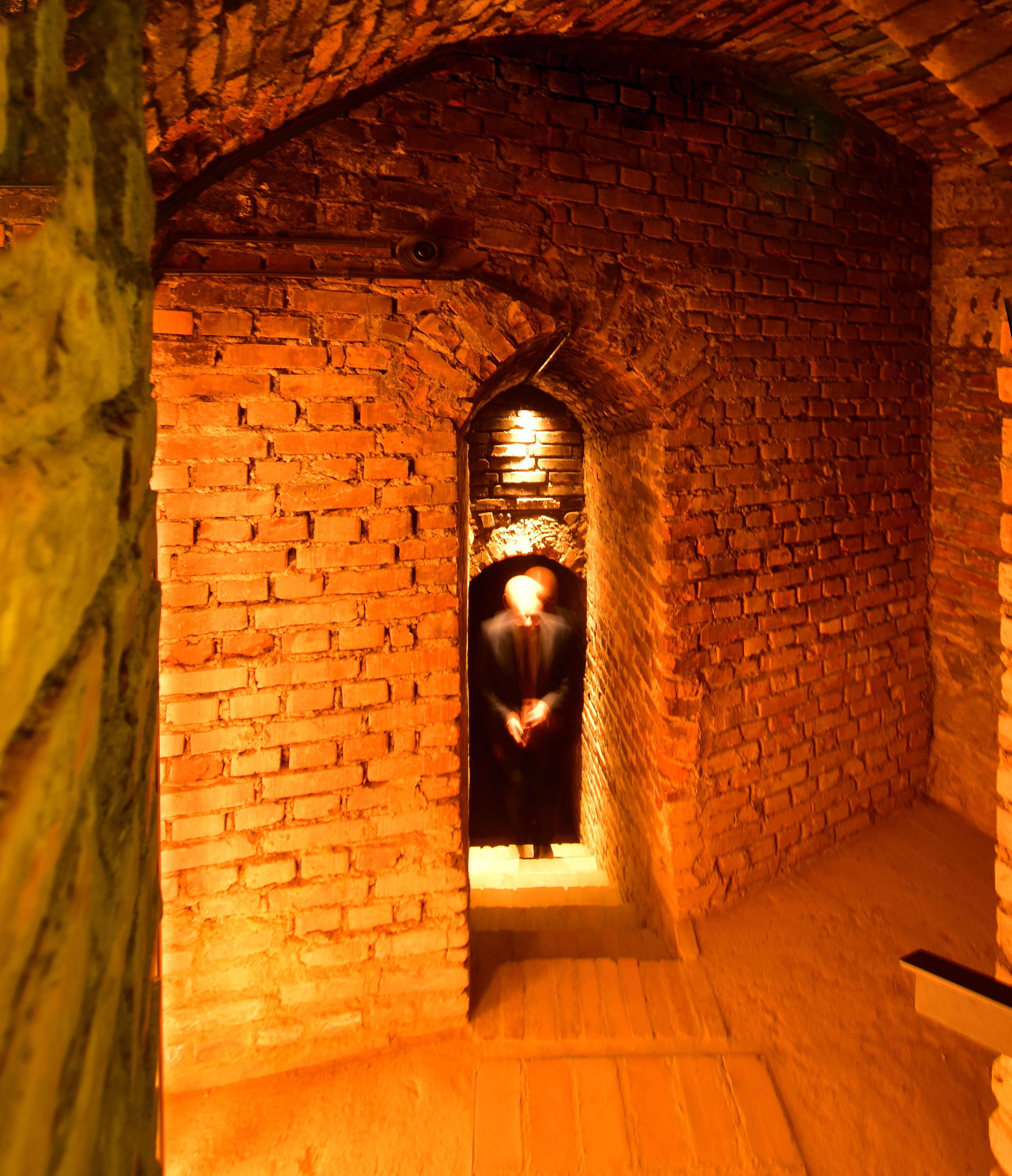
Two weeks ago, I was chatting to my brother about my desire to build a Museum of Entropy in tunnels under my garden. Brick-lined, the tunnels would have enclaves or niches built into the walls in which exhibits would be displayed, illuminated by candle light. Little did I think as I described the place that I'd soon be visiting something that is remarkably similar to that.

Rzeszów is a town I have visited regularly over the years, though I hadn't (until now) been in the extensive warren of underground cellars and tunnels under the old market square. Built in the 14th and 15th centuries to serve as storage areas for the shops above, the subterranean complex has had a thorough renovation and been repurposed as a tourist attraction.


Work on the complex took place in five stages from the 1960s through to 2020, with an initial focus on preserving the structural integrity of the historic buildings around the market square (to stop them from collapsing). Successive stages incorporated more and more chambers and passages into the complex.


Left: the steps go from one level to the next, down to a maximum depth of ten metres below the market square. For those with a taste for mysterious underground passages, this place is hugely atmospheric. The history full of invasions and fires, is told right through to WW2, when Jews sought shelter here from the Holocaust As such, it is a microcosm of Poland's ever-changing fortunes. Display cases, LCD screens and interactive exhibits tell the story. One salient point made is that religious tolerance was insisted upon by the city's 17th century owners (and rulers), the Lubomirski family; if Catholics, Jews, Protestants and Orthodox Christians were to co-exist peacefully, trade would flourish and the city would prosper.

Below: the city's story is told in graphic and textual form as one passes from chamber to chamber. [Apologies for the picture quality – hand-held at two seconds with an ultra-wide lens.]


Below: Rzeszów town hall, the following morning. The entrance to the underground complex is at one end of the market square; you emerge in a different place, which can be a bit disorientating.


I must say. it would be great to have such a complex under my garden – a maze of brick-lined tunnels running hither and thither. A bit like the Mole Man of Hackney!


This time two years ago:
Cottagecore - a manifesto

This time three years ago
Ego, Consciousness and Soul

This time four years ago:
Samopoczucie, Joy and the Sublime Aesthetic

This time six years ago:
Autumn, with a railway theme

This time seven years ago:
A few words about coincidence

This time ten years ago:
Hello, pork pie [my week-long pork-pie diet]

This time 12 years ago:
The meaning of class - in England, in Poland

This time 13 years ago: 
First frost 

This time 17 years ago:
First frost 


Friday, 27 October 2023

Cross-country train-travel tales

It would seem simple enough - to get from Chynów to Rzeszów without having to go up to Warsaw, then down to Kraków, then across to Rzeszów. I consult rozklad-pkp.pl. Indeed - there is an alternative - I could go Chynów-Radom-Lublin-Rzeszów. Not bad. Except I'd have to waste a hour and half waiting in Radom for the Lublin train and over two hours in Lublin waiting for the Rzeszów train. 

And then, by accident while waiting for a train home on Wednesday, I glanced at a printed timetable on the platform at Piaseczno station... I could get from Warka all the way down to Przeworsk, and from there it's just a short hop on a local train to Rzeszów. And I'd be there three hours earlier. And the ticket is cheaper - so why isn't the PKP website showing such a possibility?

And so, having bought my tickets online, I leave home at quarter past six, catch the local 06:31 Koleje Mazowieckie train from Chynów to Warka (on time), then jump on the Witos InterCity service from Warsaw to Przemyśl, due in Warka at 07:03. All good. Below: here is the Witos drawing into Warka station, three minutes late, having left W-wa Gdańska at 06:16. The train is just three carriages long.

Is there a catch? Well, two, catches actually. The first is that he old-school loco-hauled rolling stock (clean, I must say) lacks a buffet car. So sandwiches, fruit, and a thermos of tea from home were needed for the journey. Not a proper alternative to a lunch cooked on the train and served with a craft ale. The second is that the track modernisation works between Ostrowiec Świętokrzyski and Sandomierz, meant to have been finished in early September, are still ongoing - which mean a replacement bus service between those two towns. 

The train passes through Radom, then swings round Skarżysko-Kamienna, diverting off the main line to Kielce and Kraków to head south-east. Below: view from the back carriage of the junction outside Skarżysko-Kamienna. The main station is off to the left, the line to Radom and Warsaw off to the right.

Below: the Witos ends the first part of its journey - everyone out! Many passengers were Ukrainians heading home with heavy bags - dragging them over the footbridge wasn't convenient.

Below: the front of Ostrowiec Świętokrzyski station, with the second bus being prepared for departure (photo taken from the first bus which has just pulled out). 

Below: crossing the Vistula by (railway replacement service) bus. Lovely moody landscape.

Over the Vistula, in the industrial part of Sandomierz well away from its charming old town and castle, lies its railway station. And here, our two railway replacement buses arrived, an hour or so after leaving Ostrowiec Świętokrzyski. Below: another loco-hauled set - this time with just two carriages - waiting for passengers to make their way from the buses. 

The rest of the journey passed without hitch, though progress was slow - the standard of track is well below that now enjoyed by the Warsaw-Radom line. I popped out at Przeworsk to have a look around (a pretty nondescript town, to be honest), and then returned to the station for onward travel to Rzeszów. Below: the town hall; the modernised square is already starting to look drab and the public free wifi doesn't work.

Below: a big centrally-funded project in progress at the moment involves stopping the town sliding down the escarpment. Here, the job is done, but there's still much building work going on behind me and round the corner in the distance. 

Interestingly, Przeworsk has a narrow-guage railway station next to the main line one, though this is tourist-traffic only, and out of seasons runs Sundays only.

Another little rail bonus in Przeworsk is this Ol49 steam loco, standing outside the main-line station.

I return to Przeworsk station to catch a Podkarpacka Kolej Aglomeracyjna train a few stops west into Rzeszów. Just over half an hour's journey and I arrived at my destination. In good time for our event. Alighting from the train at Rzeszów Główny, I find that the station is still in the midst of renovation work, just as it was a year ago and four years ago. Will it never end?

Once the connection between Ostrowiec Świętokrzyski and Sandomierz is complete, the journey will be quicker and more convenient - but will PKP's online timetable apps be smart enough to suggest this route in future? The Witos (Warsaw-Przemyśl calling at Warka) service opens up new possibilities of exploring the south-east corner of Poland - into the Bieszczady by train.

This time two years ago:
Mother of Invention

This time three years ago:
Autumnal lockdown walk

This time four years ago:

This time five years ago:
Remont of Metro bridge over Puławska

This time six years ago:
We are what we read, what we watch, what we listen to

This time ten years ago:
Extraordinarily warm autumn

This time 11 years ago:
On behalf of the work-shy community

This time 12 years ago:
Classic truck cavalcade

This time 13 years ago
Suburban back-roads clogged with commuters

This time 14 years ago:
Autumn gold, Łazienkowski Park

This time 15 years ago:
Quintessential autumnal Jeziorki

Saturday, 24 September 2022

To Rzeszów and back by rail, Part II

Arriving at Lublin, I had about 20 minutes before my train for Rzeszów. Long enough to have a look around the station. Below: this is the most absurd station in Poland when it comes to platform numeration. In the UK, it's simple; one platform edge, one platform number. In Poland, there are platforms (perony) and tracks (tory), which correspond to platform edges. These are not numbered for the passenger's convenience, but according to some arcane practice known only to railway workers. How can it possibly be that Track 52 is next to Track 82? This kind of 'sod-the-passenger' bollocks has caused me to miss more than one tight connection, especially in Poznań Główny, where this happened twice, with me being unable to navigate through a morass of stupid track and platform numbers. This is compounded by the printed timetables referring first to the peron number then the tor number (1-5), while the station announcers do it the other way round (pociąg osobowy odjedzie z toru piątego przy peronie pierwszym). 

Below: my train from Lublin to Rzeszów happened to be a Czech one - with a Polish name. The Roztocze runs from Lublin all the way to Bohumín in Czechia via Rzeszów, Kraków and Katowice, with České dráhy rolling stock pulled by a PKP loco. Again, like the Skarżysko-Lublin leg, the ticket was Super Promo and laughably cheap - just 19.00zł  for 213km (£3.65 for 130 miles - an advance London-to-Birmingham Super Off-Peak single is five times more expensive at £16.50). Note the platform number - Platform 3, Track 55. Track 51 is visible on the right.


There's a certain linguistic frisson about boarding a foreign train in one's own country, and the Czech language sounds slightly comical to the Polish ear (and vice versa, it is said).

For some reason, cross-border trains have carriage numbers in three digits. Domestic InterCity carriages use numbers 1 up to 16; I'm not sure what this is all about. Signage on train is in Czech, so I can only guess. "Výstraha" sounds like 'wystraszyć - to scare - so therefore 'warning'; "Svítí-li červené světlo" sounds like 'Świeci się czerwone światło' - the red light is on, the next word I guess means 'door', but the rest I can't work out. Sadly, no buffet car.

The train stopped at many stations along the way; some were towns know to me, (Stalowa Wola, Leżajsk or Łańcut) - some were tiny unknown places (Zaklików or Nowa Sarzyna). Still at this price, one can't complain about the slow ride - three hours, so 70km/h (38mph average).

At last, the train arrived at Rzeszów station, which I visited last three years ago.  OK, so we had Covid and the full-scale Russian invasion of Ukraine, but the station is still half-way through a major remont. Very little had changed over the intervening years – the footbridge had gone, the new tunnel was partially open, the forecourt was a total muddy mess and pedestrian signage piss-poor. Below: ready in another four years? Progress is dismal.


The next day, my return to Chynów was more straightforward - the Kochanowski express from Rzeszów to Warsaw (an electric Dart InterCity train no more changing locomotives at Lublin at least, just a change of direction of travel!) Being a Dart, the Kochanowski has a dining car, so I could enjoy the classic schabowy served hot and fresh, with a Jan Olbracht craft ale. Below: this is Polish rail travel at its best.


I toyed with the idea of alighting this train at Dęblin, and rather than going all the way into Warsaw and the out again, simply taking the shortish trip from Dęblin to Radom and then another shortish trip from Radom to Chynów. But looking at the timetable apps on my phone, I could see that the Warsaw way would get me back to the działka 20 minutes earlier than via Radom, despite being 40km longer.

And so, there we have it. Polish trains are cheap, clean, comfortable, relatively punctual (only one of the five trains I caught was delayed - the Morcinek, which arrived in Lublin 22 minutes late). Only a motorbike ride in high summer (avoiding main roads) would have been preferable. Below: pylons, somewhere between Łańcut and Leżajsk, through the window of the dining car. The dream-state of rail travel.


This time five years ago:

This time seven years ago:
What's the biggest threat - Putin or ISIS?

This time eight years ago:
Scenarios for change in Russia

This time nine years ago:
A new bus for Jeziorki - the 809 to Bobrowiec

This time 11 years ago:
Bunker in Powiśle

This time 12 years ago:
Sunshine brings out the best in everything

This time 14 years ago:
There must be a better way (3)

Thursday, 12 September 2019

Back in Aviation Valley

I flew into Rzeszów Jasionka airport yesterday morning for a meeting with our members in Aeropolis about how to cope with rising energy prices. The flight was superb - from leaving home at 06:15 to entering the science and technology park at 08:45, door to door two and half hours. But nine and half hours to get home... (see below)


The major failing of this (otherwise good and efficient) airport and of the  Special Economic Zone that surrounds Jasionka is the lack of good public transport to town, compounded by poor signage and lack of clear passenger information. Below: scheduled flights to Rzeszów are infrequent, but there's a fair number of charters flying in and out.


Below: a Bücker Bü 131 Jungmann - WW2-era German basic-trainer biplane, the equivalent of the ubiquitous De Havilland Tiger Moth, which first flew in 1934... Or so it seemed at first sight... Checking the reg (it's from Austria), it looks like a Czechoslovakian Tatra T.131 licence-built version of the Jungmann. But it's not even that! It's a Polish-built replica of a licence-built Czechoslovakian version of a Bücker Bü 131 Jungmann! This is a SSH T-131PA, about to take off...


It was a short flight, as it crossed over my head after I'd walked around the corner from the airport...


Over the fence and about to land after completing a circuit north-east of the airport.


Below: another over-the-fence shot - I thought this was a PZL-20 Mewa, a licence-built version of the Piper Seneca. But I was wrong - this is a US-built Piper Seneca (220-V), belonging to Rzeszów University of Technology's flying club. This university is one reason why Rzeszów has built such a strong cluster of aerospace businesses.


Below: a lovely PZL-104 Wilga, gate guardian on the corner by the turn-off to the airport. A lovely looking plane - like some giant insect. Because there's no bus from the airport to the railway station for another hour, I decide to walk for about half an hour to a place along the main road where there's a bus stop with more frequent services to town.


Below: back to Rzeszów station, still a work-in-progress hole-in-the-ground. Waiting for the wretched TLK train to Warsaw, which takes a scheduled five hours including a 30 minute wait in Tarnów and a further 20 minute hiatus in Kraków during which the engine is put round the other end of the rake of elderly carriages. Despite travelling first class, there were no power sockets or no wi-fi; a sparse snack trolley was put on between Kraków and Opoczno. The crowded train arrived in Warsaw an hour late after waiting at Opoczno to let an international express pass and then after breaking down just outside of Grodzisk Maz. Crap. If more passengers are to be weaned off short-haul flights for the good of the environment, there must be better, faster, more reliable and comfortable trains made available.


UPDATE: Friday 13 September - A much better train journey today - Warsaw-Wrocław on a Pendolino with... wi-fi! Amazing - I could actually work the whole journey! And just a three-minute delay. Really no longer any point of flying to Wrocław. Three and half hours from W-wa Zachodnia to Wrocław Główny. Ver, very good rezultat!

This time last year:
My flight to Rzeszów - delayed!

This time four years ago:
English as she is used in Europe

This time five years ago:
Where asphalt's needed - Nowy Podolszyn to Zgorzala
[five years on it's still not there]

This time ten years ago:
I cycle to work along the cyclepath along ul. Rosoła

This time 11 years ago:
First apple 

This time 12 years ago:
Late summer spiders webs

Wednesday, 17 July 2019

Two days in Rzeszów, heart of Poland's aviation industry

Lack of sleeper-train space three weeks (!) before date of travel meant that I had to fly to Rzeszów on Monday. Very good visibility on approach to Rzeszów's Jasionka airport (below), the A4 motorway visible lower left.


My first four meetings of the day were all in or around the Aeropolis Science and Technology Park, home to many global aerospace companies and their supply chain. These include several UK businesses that have recently moved into the area.


The area around the airport is a boomtown. New buildings appearing at an incredible pace, older ones (like, three-four years old) being extended. The BorgWarner gearbox factory has been extended five times since the original site was opened. Below: the G2A Arena, just across the road from the airport terminal, is a popular conference and exhibition venue.


An excellent example of a British manufacturer in Poland's Aerospace Valley - McBraida (established in Bristol in 1954) specialises in the precision machining of aircraft engine parts from extremely hard materials such as titanium. The firm has been present in Rzeszów since 2013 and currently employs over 70 people. Other British firms here are Bodycote and Poeton (heat-treatment and coating respectively), and Rolls-Royce joint venture, Aero Gearbox International.


The day's last meeting was in Rzeszów's Old Town, so a chance to walk around and take in the summer atmosphere (last time I was in the Old Town was in March 2017 on a sunny but cold day).


A very attractive part of Rzeszów, well catered for with bars and restaurants. The Stary Browar Rzeszówski, where we pitched by, brews its own craft beers. A 'deska konesera' of four quarter-litre mugs on a wooden board costs but 20zł (£4.23). Each was excellent, the American Pale Ale the best.


Below: the Old Town square in the late evening.


Below: the 1890s juxtaposed with the 1990s. How will the 2090s look?


Below: Rzeszów's main railway station is undergoing a massive remont, likely to go on for a long time. There's no direct link between the ticket hall and waiting rooms in the station building and the platforms; the only way is across the footbridge in the foreground, as the underground passages are closed. The train back to Warsaw took five and a quarter hours, with long (planned) waits in Tarnów (25 minutes) and Kraków (21 minutes to change direction of travel). The line via Lublin is currently being modernised, so the more direct rail route home is not an option.


Below: awaiting entry into Kraków Główny station, 318.3km from Warsaw Central.


This time last year:
Hala Gwardii, Hala Mirowska

This time two years ago:
Four stations between Piaseczno and Czachówek

This time five years ago:
A tragedy foretold 


Friday, 15 March 2019

Rzeszów and Poznań

Apologies for not posting much - I have been travelling and doing TV and radio appearances (about Brexit, what else?). Before returning to blessed Lenten topics, a quick round-up of snaps from my trips to Rzeszów (Tuesday) and Poznań (Friday). First, Rzeszów. A 40-minute hop from Warsaw. Unlike Wroclaw and Tri-City where the rail modernisation means you can do a day's business there from Warsaw leaving and returning the same day, Rzeszów and Szczecin remain beyond the range of the railways. One way from Warsaw to Rzeszów by train (change at Kraków) is around five hours. But by air, from home, two and half hours.

Below: my seat on the way out, right at the very back of a LOT Polish Airlines Embraer E175 (20A). Nice to get some sunshine, albeit through thick glass! Note the LOT logo on the winglet - designed by Tadeusz Gronowski in 1929, could this be the oldest airline logo in continuous use (90 years this year!) anywhere in the world?


Weather in Rzeszów - snow still on the ground, sunshine alternating with dark clouds rushing in on strong winds bringing more snow and hail, only to rush past leaving sun before next belts of clouds hurry on.


Rzeszów is the capital of Poland's Aviation Valley - many aerospace manufacturers, large and small, have clustered here. British firms too - McBraida, Poeton, Bodycote - working for the big international players. Not just building planes, but teaching aeronautical skills takes place in Rzeszów; below: a Cessna 152 basic trainer was doing touch-and-goes at the airport.


Today's meeting was at the McBraida factory, which makes made-to-order aeroplane parts from hard-to-machine materials such as titanium. The factory is just a short (but muddy) walk from the airport in the adjacent technology park.The flight back was in a LOT Polish Airlines Bombardier Q400 (below). Take-off was at 18:00; I was home at 19:45 - which included a walk from the airport to W-wa Okęcie station and the walk home from W-wa Jeziorki station (around 3,000 paces / 30mins walking).


On to Poznań, for the opening of GlaxoSmithKline's new global business centre. By next year, it will employ 300 people in high-end accountancy and finance roles serving all of GSK's European operations. The biggest concern is finding and retaining skilled people in a city where the registered unemployment rate is just 1.3%, and the economically inactive rate (strip out the cash-in-hand workers) is around 0.8%. The city of Poznań has the lowest unemployment in Poland... and yet, I can't help noticing that compared to other big Polish cities, it's a bit scruffy...

Below: I seemed to have stopped doing Old School Photochallenge posts around 2011, but - well, look you here! There is literally not a single hallmark that would prevent one from placing this photo back in 1989. And yet. Ul. Konopnickiej, Poznań. Friday 16 March 2019.


Below: more old-school retailing; this is the factory-shop window of Herbapol Poznań.


Below: this is more like the Poznań of my imagination - dour Germanic architecture, modern offices and green trams - looking down ul. Fredry, leading (eventually) to the Old Market.


Below: wide streets, good public transport, yet I'm getting the feeling that Poznań could do with a major wash-and-brush-up. It's a wealthier city than it looks.


Usually, I remove grafitto from my published photos with Photoshop, so as not to give vandals any more undue exposure for their uncivilised behaviour than necessary. But this piece (left), on a historical landmark, the Zespół domów urzędniczych on Ul. Marcelińska, is one for metaphysicists to ponder: never mind that energy = mass times the speed of light squared - here in Poznań we learn the equation that time = joy. Heraldicly crossed in saltire, two Camberwell Carrots (or more likely Marchewki Marcelińskie) rather suggest how the artist prefers to spend their time.

Today, I covered 14km around Poznań on foot - the best way to really get to know a city. It occurred to me a while back that the reason my spatial awareness of Poznań for many years was poor stemmed from the fact that I associate the Warsaw to Berlin railway line as one that runs from east to west. Yet as it passes through Poznań - near enough the midway point, it does a little zigzag; the rails running through the city's main station are aligned north-south. So the Poznań Trade Fair buildings are west of the station - not north, as I'd imagined them. And the old town is north-east of the station - and not south-east. This insight only came to me when I got a smartphone with Google Maps in it; prior to that, I'd never noticed!

This time four years ago:
Spiritual mentors and spiritual leaders

This time five years ago:

This time six years ago:
In memory of me

This time seven years ago:
Cleaning sensors on my Nikons

This time eight years ago:
Changing seasons and one's samopoczucie

This time nine years ago:
Stunning late-winter beauty
[these are among my most gorgeous winter photos ever]

This time ten years ago:
Lenten fare - Jeziorki gumbo

This time 11 years ago:
Digging up Dawidowska