Showing posts with label Transwersalka. Show all posts

Thursday, 7 July 2011

Down the line from Mszana Dolna

Greetings, dear readers, from Dobra (my tenth visit here in three years). Weather has finally improved after six days of heavy rain - the sunshine is very, very welcome. So today, leaving Eddie with Sabina back at base, I set off by bus to Kasina Wielka, and from there I walked the six kilometres to Mszana Dolna along the Transwersalka, the railway built by the Austro-Hungarian empire (of which this part of Poland was once a part) for strategic reasons.


As I posted here, the Transwersalka was the so-called transversal route built by the Austro-Hungarian Empire in the 1880s to defend it (then) northern borders against Russia. Walking these tracks made me ponder Poland's history, especially in the light of the recent death of Otto von Habsburg at the splendid age of 98, the last successor to the throne of Austro-Hungary.

Austro-Hungary! What a strange entity! How difficult for the anglophone world to grasp the concept! A royal family that once ruled Spain managed to make their way across Europe to rule in effect peoples of a dozen or so different nations, glue the whole thing together and keep it going for half a century!

The entire idea is just so bizarre... In England, there was Alfred the Great burning the cakes, 1066 and all that, the Tudors and Stuarts, a great global empire on which the sun has only just set. However, here, in Central Europe, the territory belonged to a divinely-appointed gang of Spaniards-cum-Austrians, who managed to fight or negotiate their way to a huge multicultural empire stretching from the borders of Switzerland to the Balkans and across to Ukraine, taking in Kraków and the southern fifth ofPoland (the Austrian partition).

Now, much as I can appreciate the merits of the Transwersalka as a cycle path (easy gradients, stunning scenery, great tourist attraction), I know full well that once the tracks have been ripped up, they'll never return. Steam-hauled rail excursions are very popular and are a great stimulus to local tourism.

It's good to see that the line is still intact, but on the other hand, not enough is being done with it, especially in light of its history. I'd love to see this line brought back to full use - even if it meant I couldn't walk it any longer.
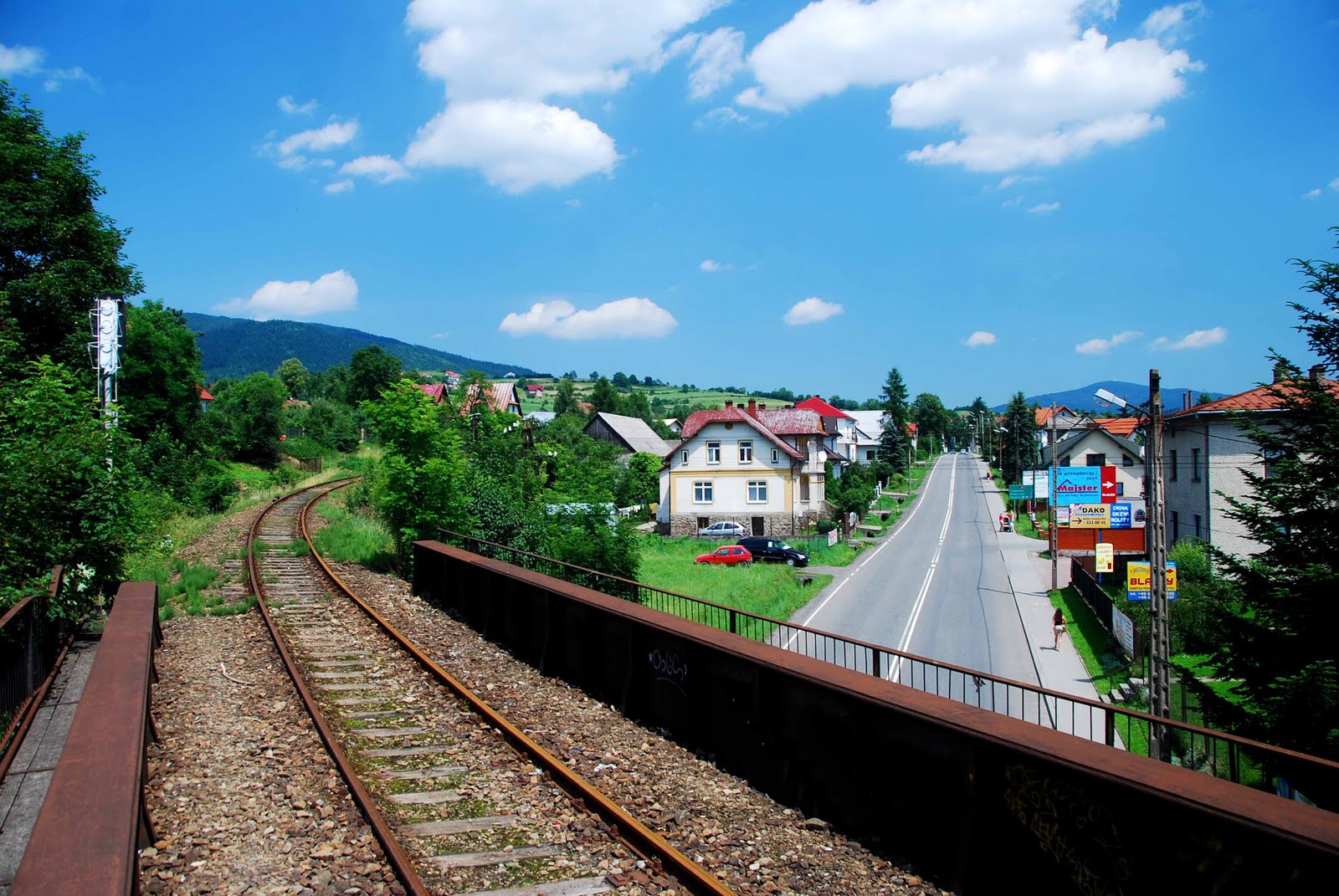
Above: the line crosses the Droga Krajowa 28, which rises towards the Głuszowiec pass, to the south of Śnieżnica, the peak visible to the left.

Above: the river Słomka running behind the main road in Dobra, before it joins the Mszanka. In the distance, Luboń Wielki rises above Rabka.

Above: Mszana Dolna station. The same architectural style as the station buildings at Dobra and at Kasina Wielka.

Right: Mszana Dolna, the church viewed from the main road. I waited for a bus back to Dobra - the local mini-buses are regular and cheap. Unbridled competition between bus companies mean that the timetables are ripped down or sprayed over by rivals. Sad - it helps none of the companies competing on the route.

It feels good to be back in Dobra, a place that's become so familiar to me, part of my DNA almost.

I can really recommend a stay here: Gospodarstwo Agroturystyczna Zofia Nowak 'Dobra Chata' (tel: +48 18 333 0117); you'll find it on Facebook.

This time last year:
Gone is the threat of Państwo Smoleńskie

This time two years ago:
Get on your bike and RIDE!

This time three years ago:
Moles in my own garden

This time four years ago:
Lublin and the Road

Monday, 12 July 2010

Life returns to the Transwersalka

Another day, another peak. The weekend crowds have dissipated; I walk from Dobra down the railway line past Szkrzydlna (highest station on this line at just over 600m) to Kasina Wielka, our favoured local ski resort, and home of Poland's Olympic quadruple medallist skier, Justyna Kowalczyk.

When walking this line in the winter, it was dormant, likely to be torn up and turned into a cycle path. It seems to have a new lease of life. Reading the railway forums, I read that life has returned to the rails from Chabówka to Dobra k. Limanowej; hopefully the retro steam trains will also return here. Indeed, the tracks were shiny, signs of recent use.

Engineers' trains have been seen along the track, and walking it I was aware of the likelihood of trains. And indeed, I was in luck. Sounding its horn a long way off, I found a good place to snap the train. Sadly, only an engine (SM42-761) running light back to Chabówka.

I hope the sighting of this engine presages a full return to use of this line; as I wrote earlier this year, once it's gone, it's gone for good. The benefits of a regular retro train running to Dobra for the local tourism industry are potentially huge.

Sunday, 7 February 2010

Along the Transwersalna again - in winter

A favourite walk of ours, along the disused tracks of what once was the Galician Transversal Railway, built by the Austro-Hungarians in the mid-1880s. Sadly, trains have stopped running here last year; PKP Line 104 between Chabówka and Nowy Sącz is now defunct. The views, the atmosphere, the klimat is quite wonderful. It would be quite tragic to lose this line, but given the understandable situation of PKP finances, a cycle track would be a reasonable alternative to ensure that tourists can continue to enjoy the scenery.

Up from Dobra winds the line, climbing westwards towards Skrzydlna, the highest point on Polish railway. The snow has totally covered the track, making it much harder to walk.

Above: The streams that criss-cross under the line are all hidden under deep drifts. Here, higher up, the trees are covered in szadź, the hoar-frost or rime brought about by freezing fog. Numerous tracks of wild animals can be seen among the trees, mainly hare.

Above: What's round the corner? Beyond Szkrzydlna, the track dips down towards Kasina Wielka. Below: The approaches to Kasina Wielka station, abandoned signal box in the distance. At the station is the ski-slope, which today was packed solid with skiers from Kraków, Wieliczka and Wadowice. We wait with our skiing until tomorrow.

Wednesday, 24 June 2009

On foot to Limanowa

Unlike last year, where we had a wonderful surprise upon climbing the hill to Dobra Station and finding a steam train there ready to depart to the railway musuem in Chabówka, this year the rails are still. I read some months back on the Polishrail blog that the line will not be used for tourist steam specials this season and is likely to be turned into a cycle path. Above: Dobra station, nothing happening.

Heading east from Dobra, we soon come across a bridge over the Łososina river (above), certainly not a walk for those suffering from vertigo.

The Kolej Transwersalna, like many railways running through hilly terrain, offers ever-changing vistas; not knowing what's around the next bend makes the walk all the more interesting. Below: the last bend before Tymbark; two signals are still lit, although a train hasn't run over this line since January.

Below: the track straightens out before Tymbark, the fruit-juice town. Eddie shows amazing stamina; he walks at my pace and it's impossible to wear him out. On a breakfast of six strawberry pierogi and cream, washed down with a coffee and a Pepsi, he managed to cover over 20km today.

Below: Looking back towards Tymbark across another river bridge. The fruit juice company would do well to tidy up the back of its factory; it's not a good advertisement for its products.

Below: Looking towards Piekiełko (literally 'Little Hell') station, between Tymbark and Limanowa. In the window of the station building is a timetable from 2002.

Below: The line runs uphill into Limanowa, which is quite a large town, spread out over a large area. Limanowa itself is a drear town spoilt by poorly-designed advertising hoardings with a plethora of typefaces and colours. Eddie and I had a swift snack at a petrol station before taking the first minibus back to Dobra.

Below: abandoned track, between Kasina Wielka and Mszana Dolna. A nice study in contrasting textures; moss, iron, wood, flowers, stone.

A few days later, Eddie walked another section of the track, from Kasina Wielka towards Mszana Dolna, as far as the DK28 road. Together with the stretch we walked last summer, we've now covered some 22km of this railway on foot; and it's well worth it. Below: Looking back towards Kasina, the track curves across a short river bridge.

Below: the track dips down towards Mszana Dolna. Definitely worth walking this way before either the rails get lifted or train services resume again.

Monday, 25 August 2008

Back to Dobra, back to steam

Couldn't get enough of it! I returned on Friday evening to Dobra, and on Saturday morning Eddie and I set off for another go on the steam train to Chabówka. This time, accompanied by Eddie's friends Sabina and Alex, their cousins and grandparents. So eight return tickets, eight visitors to the museum. And hopefully, six new enthusiasts!

I learned the lessons for getting good pics on this line: back coach out, front coach home. This enables the photographer to get shots of the engine running forward from Dobra, with the curving rails offering many opportunities to catch the engine in three-quarter view. And occupying the same seats on the way home allows you to be right behind the engine, to hear it puffing and panting its way from Chabówka up the incline to Skrzydlna. Only four coaches this weekend, not the five we had last week, so couldn't quite get that 'bend' to work. Still, the engine's the right way round.

Right: An effective composition, if not one for the purist. Steam and electrical traction together at Chabówka. The first three stations are pod drutem ('under wire'), but after Rabka Zdrój, there's no sign of any post-war rail infrastructure other than the occasional signal lights (plenty of old semaphores and manual points still around).

The sound of a Kriegslok steam engine hard at work is awesome, especially when labouring up the steep inclines (2.9m rise in 100m horizontal). The frequent whistles, the whooshes of white steam from the pistons, and the dense black clouds from the chimney make travelling directly behind the engine an unforgettable experience. Soot blown out will speck your clothing, so beware; glasses or goggles will protect your eyes from the pain of something hot and dirty landing in them.

Left: Running down the hill to Dobra. From the summit at Skrzydlna, the engine uses minimal power, so less smoke, less steam, less puff, less drama. We heard a story (from the local media, just two weeks ago), of a less-than-sober mother and her hard-of-hearing six year-old daughter walking along this track, when the steam train came across them unexpectedly. The mother dived out of the way, the child laid flat on the track; the train passed over her and she escaped unharmed! The mother must have been well drunk not to have heard the repeated warning whistles. (Story here, in Polish.)

There's one more steam day this year, next Saturday (30 August), trips down to Zakopane continue into September. Definitely a recommended experience. Timetable in English here. Below: Ty2-953 runs around its train at Chabówka, passing Ty2-911.

This time last year:
Heron spotted over local pondAgricultural scenes in Jeziorki "cause flashbacks"Our garden spiders getting big and fat
Ul. Kórnicka loses dirt track status
Electrical storms continue

Tuesday, 19 August 2008

Serendipity, mountains and steam

I was not immediately delighted at the prospect of a seven hour drive down to the mountains to deliver Eddie at his next summer holiday venue, and less thrilled at an enforced 24 hour prolongation of my stay there. When we arrived it was raining, and the prospect of a wet weekend in the foothills of the Beskidy Wyspowe were not my first choice of spending the long August weekend. However, things turned out nicely!

The place we stayed, an agroturystyka in a large village/small town called Dobra (between Nowy Sącz and Wadowice) was run by really lovely people, great cooking, flexibility at meal times and - at 50 zlotys (around 11 quid) for bed, breakfast, lunch and supper (40 zlotys for children) - a snip. Eddie noted that there was a railway station in Dobra, and given that the weather on Saturday morning was dismal, we thought it would be a good idea to stroll down there to take a look.

The walk through the village (small town really) was long; we got lost, had to ask the way, neared the station (up the hill) and as we neared it... the sound of a steam whistle! Eddie and I simultaneously broke into a jog (I'm delighted to say that this 50 year-old burdened with camera bag can still out-run his 12 year-old son up a steep hill). The whistling continued. Would we catch the train? We made it up to the station - and there it was - a 2-10-0 Kriegslok locomotive, my favourite steam loco of all time ever, manoeuvering around a rake of five two-axle coaches.

To our delight, it transpired that we were in good time for a steam train excursion from Dobra to Chabówka railway musuem. A quick glance at the timetable showed that we were up for a three-hour steam-hauled trip with an hour's musuem visit all for the equivalent of ten quid! The line is spectacular (by Polish standards) for its mountain scenery. It was here that scenes from Schindler's List were shot - both engine and coaches are 100% authentic for the period.

Above: This locomotive (Ty2-953) was one of over 6,000 built in Nazi Germany as an austerity war locomotive, to run over lightly-laid lines (hence the ten driving wheels to spread the axle load). After the war, over a thousand remained in Poland. The design was so good that long after the war, the engines soldiered on across Eastern Europe, both Poland and Romania building more. Poland still has dozens left, only a few still in steam (sadly).

Above: Before the train set off, there was a chance to climb in the cab and see the fireman at work stoking the boiler. Hot work indeed, but on a cool day, a chance to get warm. Our fireman explained in perfect English that it takes eight hours to get this large engine's steam up to working pressures from cold, and that the coal needs to be shovelled evenly onto the firebox floor (not too thin here, not too heaped there).

Below: Closely observed train. The journey to Chabówka took us over the highest point on Polish rails - at the station serving the village of Skrzydlna. From Dobra to summit, our locomotive was puffing and panting for all it was worth, sending up dense columns of black smoke along with the steam. From Skrzydlna it was downhill most of the way to Raba and Chabówka.

Chabówka itself for me was a sorry sight - lots of interesting exhibits resting and rusting, the owners (PKP Cargo) treating the whole thing as a bit of an embarrasment rather than a potential tourist goldmine (the way heritage railways are run in the UK). I did not feel disposed to spend twice the price of adult museum admission to buy a film-and-photography ticket, so put my camera away during the hour's (rainy) visit at Chabówka. Below: The run back to Dobra. The line was built in 1884 by the Austrians as the Transversal Railway, running from Kraków to Żywiec, just south of the Austro-Hungarian Empire's erstwhile border with Russia). From Raba the line climbs all the way back up to Szkrzydlna before dipping down to Dobra.

The train will be making two return journeys next Saturday (23 August), leaving Chabówka at 09:10 and making its last return run from Dobra at 16:50. I certainly hope to be there, if only to catch the 12:00 departure from Dobra for just the one stop up the steepest incline to Skrzydlna, an 11 minute journey. The best shots are from the back of the rear coach, with the engine running forwards to Chabówka. Your final chance this year for this excellent rail journey is on Saturday 30 August.


This time last year:
New housing development springs upBeyond Warsaw's exurbs by bike
Mud yields to paving stone on ul. Kórnicka
Starlings on the wireArmed forces day parade
