Showing posts with label road safety. Show all posts

Wednesday, 8 July 2026

Hurrah for new pavement!

Shortly after the new mayor took office in Chynów municipality, he posted a questionnaire on social media as to which stretches of road most needed a pavement alongside. The answer overwhelmingly one to build pavement to the Dino supermarket, which opened in 2022. At last one can safely walk or cycle there without fear of being hit by speeding traffic.

Below: the newly opened stretch of pavement/cyclepath running alongside the old DK50, ending, for the time being at least, at the supermarket. The new infrastructure was funded exclusively by the municipality.


Below: looking the other way, east towards Chynów from the supermarket exit. Across the road is Hotel Chynów, a popular venue for wedding and first Holy Communion receptions. One can now walk the entire 3.5km from the far end of Jakubowizna to here along decent pavements.


Below: looking once more the other way, west towards Drwalew and Grójec. The municipality plans to extend the path further, which would be a great benefit for local cyclists. Parents with children will be able to safely cycle between Drwalew and Chynów. I've walked this stretch (from Lasopole to Chynów) a couple of times, and although there's not much traffic, it is fast and the walk can get scary.


The municipality is seeking external funding (EU?) for the next stretch of pavement/cyclepath. I look forward to strolling into Drwalew for a pizza! I am also hoping for a bus service that links the Warsaw-Radom line at Chynów station with Grójec...

This time eight years ago:
High summer in Jakubowizna

Saturday, 5 July 2025

Reflections upon the Road, Eastern Poland

It's been a while since I was east of the Vistula by car, but the recent road trip and last week's return from Kazimierz Dolny has provided me with a decent glimpse of how much infrastructure has improved on the right bank of the Vistula, and how much eastern Poland has developed, over the past 20 years.

One positive indicator is the number of food outlets that have appeared in small-town Poland. Once you could breeze through one small town after another and find nothing. Today, be it a kebab shop, pizza place, patisserie, ice-cream parlour or café, an enterprising person is likely to have invested not only in a place to eat, but in creating a hub, a focus for the local community. Below: the centre of Siemiatycze (pop. 14,500). The building in the picture boasts no fewer than four eateries including a sushi bar; however, we popped into a smoked-meat shop (wędliny) out of shot to the right, drawn by the most appetising scent that I shall never forget. Loads of kabanos, kiełbasa and boczek, some of it from wild boar. Wonderful stuff.


Reflections upon The Road...


Road accidents: in 2024, 1,896 people died on Poland's roads, compared to 3,202 in 2014 and 5,712 in 2004. The number of cars per 1,000 people in 2004 was 246; in 2014 was 520; today it's 723 (Poland currently has the highest car density of any EU member state). So upgraded road infrastructure and civilisational advance have made a significant difference. Most villages have pavements alongside the roads. Road signs, and speed radars, road junctions profiled for safety and safer cars all help. Behaviour too; in four days on the road, I did not witness a single example of egregious driving.

Four days on the road – a big thanks to Andy P. for the concept and the driving. Together with Roman P. we enjoyed erudite conversation, popular-culture trivia, a great soundtrack (including classic war-movie themes from the 1950 and '60s) and excellent food and drink wherever we stopped.

This time last year:
Britain changes course

This time two years go:
Lawn to meadow, meadow to forest
[two years on, the re-wilding has taken hold]

This time five years ago:
Town and country in summer

This time six years ago:
Across the Pilica to Strzyżyna

This time seven years ago:

This time 18 years ago:
Lublin and the Road

Monday, 13 September 2021

Pavement comes to Jakubowizna (...but not to Jeziorki)

It was back in May that pallets of paving stones and kerbstones were left along the side of the main street running through Jakubowizna. I wondered when work would start to actually lay them. It was to be nearly four months on. Such is the rate of inflation in building materials that had the contractor who won the tender to lay Jakubowizna's pavement not bought the stones when he did, their new price would have bankrupted him. After four months, some of the pallets had been unwrapped and some paving stones stolen; other pallets had been hit by passing traffic. A propos of building materials inflation, a neighbour told me that he had to put the re-roofing of his house on hold after the price of the roof tiles he had chosen had gone up from 80 to 130zł a square metre.

Anyway, at last they're getting on with it. Below: from outside the Jakubowizna entrance to Chynów station, looking east along the road to Machcin and Rososz. The crew has knocked off for the evening, parking diggers and dumpers in the courtyards of farmhouses happy for the extra revenue.

This EU-funded project will make walking through Jakubowizna safer and more comfortable. It is ironic that here, where traffic is sparse and locals take care not to mow down their neighbours in acts of mindless piracy there is a pavement, whilst in Jeziorki - part of the capital city of Warsaw - a main road along which strangers race their cars and vans with scant regard for speed limits still has no pavement.

Below: farther on up the road. The work is being undertaken thoroughly, with due care taken to health & safety of pedestrians. The total length of pavement is nearly 1.4km. Note the brick shrine to the Blessed Virgin Mary on the right-hand side of the road.


As of today, about one third of the length of the village has been paved. Below: beyond this point, the kerb has been laid, but the pavement is still to come. There will be still be plenty of tidying up to do. An interesting fact about Jakubowizna is that it lacks a single shop, a single café or bar, despite its length. Widok, the next village south to Jakubowizna has two shops, yet there's no direct road or even official footpath between the two. Note the drainage ditch running along the south side of the road.


UPDATE: 27 September - since these pictures were taken two weeks ago - exactly nothing more has happened. The crew, the plant, has all gone. I wonder how long it will be before they're back?

This time last year:

This time 11 years ago:
Time to change gear.

This time 12 years ago:

This time 13 years ago:
Early, cold start to autumn

Wednesday, 7 October 2020

Railway progress, Chynów

 After five days in Jeziorki, I returned to Jakubowizna on Saturday morning, and have remained here since - I am lucky enough not to have to go into the office, so I shall avoid travelling into Warsaw while the Covid cases continue to soar. Working from the działka - especially on sunny autumnal days - is a pleasure. I punctuate conference calls, editing and responding to emails with walks around the neighbourhood, and I'm impressed at the pace of work around the railway, in particular the roads.

During my five days' absence, new asphalt has been laid on both sides of the northern level crossing, which is now officially and finally open. All that's needed is a new pair of barriers. Today, the asphalt received white lines, traffic signs are up and all looks good. Above all, there's pavement, so my walks between the działka and the station have become safer - although there's still much work to go before the underground passage linking Jakubowizna to the platforms (and to Chynów) is opened. 

Below: new asphalt, new road markings - and new pavement. Looking towards Chynów station from the southern end of Jakubowizna shortly before sunset.


Below: once the underground passage is completed, I will be able to walk part of the way home (the busy part) along a pavement. There's less traffic on the other side. No overtaking! 30km/h speed limit! Safer roads, I hope.


Below: the modernised level crossing awaits new barriers. For the time being, the old ones are in use. Like other level crossings along the modernised line, they come down very early - some three minutes before the train passes, which can frustrate drivers. To the right, the road towards to my działka, which has also been finally asphalted all the way to the junction.


Work on the roads on this part of the project nears completion, but the new level crossing at the other end of the station, by Widok, is still closed. I expect it will be ready within a week to ten days at the latest.

Below: bonus shot - a rather alarming cloud hangs over Mińsk... Mazowiecki.


While it's still relatively warm, I shall endeavour to keep out of harm's way and spend as much time working from the działka as possible. This morning, the temperature in the house (without any heating switched on) was 20.5C, while overnight the temperature outside had fallen to 9C, so the thermal insulation applied to the walls is effective!


Sunday, 27 October 2019

End of a warm sunny autumn?

Clocks have gone back, yet outside it's still lovely and warm. Daytime high today 18.9C before the clouds rolled in from the west bringing a change in the weather shortly after midday.

Below: the Road looks flashback-American; 1950s Kentucky in late 2010s Mazovia. Here's the DW683 looking towards Ludwików. One of my favourite road landscapes around these parts.


But take care on those roads - there are fools out there empowered by oversized cars with oversized engines who cause mayhem, injury and death. Ulica Bolesława Chrobrego between Łbiska and Pęchery. Road is straight, sun is high, conditions are fine - and yet the SUV driver took and chance while overtaking - straight into the front of an oncoming Corolla.


The last warm sunset of 2019? Looking west from my działka's rear balcony... No tweaking necessary of saturation or vibrance controls on Photoshop.


...and looking south-west from the front balcony.


Last fine morning, then, 27 October, 2019... Jeziorki.


This time last year:
Remont of Metro bridge over Puławska

This time two years ago:
We are what we read, what we watch, what we listen to

This time six years ago:
Extraordinarily warm autumn

This time seven years ago:
On behalf of the work-shy community

This time eight years ago:
Classic truck cavalcade

This time nine years ago
Suburban back-roads clogged with commuters

This time ten years ago:
Autumn gold, Łazienkowski Park

This time ten years ago:
Quintessential autumnal Jeziorki

This time 12 years ago:
Google Earth updates its map of Jeziorki

Tuesday, 9 May 2017

En marche!

Meaning 'On the move', or 'I'm on my way'. Delighted that Putin's poodles have been soundly routed by the French electorate, I'm on my way from a working lunch about Industry 4.0 with members in Katowice to a meeting with business owners about how to increase the value of their companies in Tarnobrzeg.

Now getting from Katowice to Tarnobrzeg is not easy. By the shortest route, 233km. Via Kraków and the DK79, 255km.  By train (given that our Katowice event finished at 16:15) the first connection would have taken over TEN HOURS, depositing me in Tarnobrzeg at 05:43 and entailing a four-hour wait in Rzeszów between midnight at four am. NO. WAY.

So the alternative had to be bus. PKP seems to have given up on competing on the busy Katowice-Kraków corridor - there are buses leaving both cities headed for the other one every 15 minutes. And they're not expensive - I paid 14zł for a seat in a modern coach that took 1hr 25mins city centre to city centre. The train between Katowice and Kraków would have taken 2hrs 10mins. Stopping at every single station on the way.

A problem I have had with Polish buses is the poor (compared to trains) accessibility to timetables, the state-owned PKS services tend to have timetables consigned to .pdf files; Google searches for specific routes often end in dead links; it's frustrating. Fortunately, enterprising app writers have come up with some good ones. Marta from our Krakow office was on hand to check the times for me, introducing me to busradar.pl; bus connections between Kraków and Tarnobrzeg turned out to be very good, with Jotka and Trans Hans both offering services that depart hourly and linking the two places, 155km apart, with journey times of around three hours.

The connection at Kraków was excellent - I arrived just six minutes before the Jotka service set ofp for Tarnobrzeg. This was not so much a coach as a busik - a Mercedes-Benz minibus similar to the one I took between Szczecin and Berlin last November. Not only that, but the minibus was equipped with wifi that worked part of the way. So the whole journey, from Katowice to Tarnobrzeg, took 4hrs 10mins. Not at all bad. And the cost? 39zł (£8) for 255km/158 mile journey.

Poland has a dense network of privately run minibus companies; the problem is finding which towns are connected by which companies. If you don't know the name of the local, privately-owned company, it's difficult. Type in the town names and 'bus' and Google is less than helpful, But busradar.pl may well be the answer, opening up new travel opportunities.

Motorways and expressways are helping too; new bypasses are being built and by the end of this year a whole lot of new projects will have got under way. Road safety will need to be addressed; the frustration of 'anywhere in Poland is five hours from anywhere else' (as it used to be in the late 1990s) led to stupid and dangerous driving. For several years - in particular since 2012 - the number of fatal accidents in Poland had been falling. Sadly, in 2016 it ticked up over the 3,000 mark once again. Having said that, only 15 fatalities were in buses.

This time three years ago:
Jeziorki spring pictorial

This time four years ago:
Kitten time

This time five years ago:
Warsaw - Centrum to Jeziorki by train with super-wide lens

This time six years ago:
Loose Lips Sink Ships - part II

This time seven years ago:
Jeziorki in the infra red

This time eight years ago:
Some rain, at last!

Wednesday, 23 November 2016

Poland's North West Frontier

Is it just geographic distance that makes Poland's north-west so inaccessible from the rest of the country? I'm on the third leg of a journey that's given me food for thought, regarding the connectedness of Poland and how that affects economic and social progress.

The Yalta and Potsdam agreements shifted Poland 200km further west at the end of WW2. Poland lost vast swathes of what's now western Belarus and western Ukraine, but gained key towns from the Germans such as the provincial capital cities of Wrocław, Olsztyn, Szczecin, Opole and Zielona Góra and Gorzów Wielkopolski. Yet in the seven decades since the war ended, some of these cities remain backwaters because of a lack of decent transport links.

Only recently, thanks to rail modernisation and the completion of the S8 expressway has it become feasible to get to Wrocław and back in a day from Warsaw. And by reason of its relative proximity to Warsaw rather than because of any super roads or railways, Olsztyn is reasonably well connected.

But Szczecin really is the back of beyond. I was here twice in the mid-1990s delivering training to local entrepreneurs courtesy of an American education fund, both times travelling there from London rather than from Warsaw. So other than a brief night-train stop en route to Międzyzdroje, I've not been to Szczecin in all the 19 years I've lived in Poland. During that time, I've visited every other provincial capital (with half an exception, to which I'll return) - but not Szczecin.

Tomorrow I fly to Edinburgh. Now, trying to connect Szczecin to Edinburgh, I discovered that while there's a host of different buses between Szczecin and Berlin's airports - there's not a single direct bus connection between Szczecin and Gdańsk. There is a train - but it takes five hours. So I'm flying from Berlin. Szczecin was, before the war, Berlin's port, the transport connections remain. And road signs for Berlin outnumber road signs for Warsaw in this part of Poland.

There are three direct InterCity train from Warsaw to Szczecin a day, taking five hours, plus another five direct TLK trains (older carriages, fewer comforts) which take around six hours. The trains from Warsaw go via Poznań. Five-hour journey times mean that going there and back in a business day is impossible. But there is the night train, which takes over seven hours, giving you time get a good night's sleep before getting ofp at Szczecin a little before six am.

I took the night train, though to a different destination in north-west Poland - Koszalin - the first leg of my mini-roadshow around this part of the country. The train arrived in Koszalin at 09:40, allowing for a long sleep on the way up. This service, which continues onto Kołobrzeg on the coast, starts in Kraków, and calls in at Kielce, Radom, Dęblin, Warsaw, Gdańsk, Gdynia and Słupsk along the way - and many other places (27 stops in all on the 13 hour-long journey between Kraków and Koszalin). This train, the Mars, is surely one of Poland's great railway trips.

On my last night train trip, to Wrocław, I noted that the sleeper service had become more spartan - no morning coffee, no bottled water, no flannel-and-soap, no muffin or croissant. But to my delight, these were all available on my train. Once again - to all those of you who like to travel by train at night, with a hotel room and travel in one ticket - I urge you to use it, or lose it. Europe's night train services are going out one by one. [See the 'European sleepers' section of the blog of The Man In Seat 61 here]

So anyway, I arrive at Koszalin, pop by for a petit-dejeuner á la Ecosse, then set off on foot through the town to a hotel just outside its limits for the conference. In my ranking of Polish towns, it seems well kempt, without those signs of desperation - the loan-sharks and pawn shops, the employment agencies offering work abroad, and the kantory for when you return home with a fistful of euros or pounds. But sadly there's not much time to nose around Koszalin today.

After the conference there, I took a lift from the organisers onto the next location, Gorzów Wielkopolski. Now this, dear readers, is Poland's only provincial capital that I've never, ever, visited before. Gorzów Wielkopolski shares the capital status with Zielona Góra (which I have visited). Like Kujawsko-Pomorskie province, it has two capitals (Toruń and Bydgoszcz in that case) because of local jealousies and ambitions that could not be reconciled during the administrative reform of 1999.

To get to Gorzów from Koszalin, we took a roundabout route via the Szczecin's eastern bypass. This is 34km longer than the direct route, but it saves 24 minutes, because of the S3 dual carriageway linking Szczecin and Gorzów. It's 212km between Koszalin and Gorzów going the direct (slower) route - which gives you an idea of the distances involved in this part of Poland, given that Warsaw and Lublin are only 169km apart.

Much of the journey was across mildly undulating terrain with huge fields - unlike central Poland, state-owned collective farms were the normal mode of agriculture here in communist times.

Finally, we arrive in Gorzów Wielkopolski.

I contend, and have done so for many years, that Lubuskie province is an entirely artificial construct, and like Opolskie province should be divided up between its neighbours to the south, east and north.

I mean, how can a capital of a province be named after another province? It would be like having Kielce Małopolskie as the capital of Świętokrzyskie, or Olsztyn Pomorski as the capital of Warmińsko-Mazurskie. An absurdity.

The town itself is Not Nice. Plaster falling off damp graffitied walls, huge holes in the roads - this is clearly not one of Poland's better-run cities. The architecture tells of massive destruction during the final phases of the war, with much nondescript housing between tenements that somehow survived; then the 1990s came and with them the worst that that decade's architects could visit upon a town arrived. Those buildings where prisms are juxtaposed with arches, mirrored facades and cheap materials.

Below: one of Gorzów's main thoroughfares, ul. Walczaka. The fact that trams carry advertising for hearing aids says a lot about the city's demographics.


It was good to leave Gorzów Wielkopolski. Soon we're backtracking our way up the S3 to Szczecin in thick fog as it began to get dark. At times like this, one is very thankful for dual carriageways that prevent idiots overtaking across from the oncoming lane.

Anyway - first impressions of Szczecin after 20 something years - very positive. A busy, bright city, full of young people (suspiciously absent in Gorzów), new trams, cycle paths. And broad boulevards with traffic lights timed so pedestrians have a chance to walk across in one go on a green light without having to break into a trot.


Sadly, no time for a proper exploration of Szczecin - only photo I got in daylight was from the 11th floor of the Radisson Blu hotel (above), looking across at the city's new Filharmonia, winner of the Architectural Design of the Year in the 2014 Eurobuild Awards. Beyond it lies the Palace of the Pomeranian Princes. Szczecin certainly merits a return visit some summer's day.

Over the border at 120km/h, heading towards Berlin. A two-and-half hour journey by bus - a small 22-seater minibus based on a Mercedes-Benz Sprinter which could keep up with Germany's autobahn speeds. Below: the landscape of north-east Germany is made awe-inspiring by large numbers of wind farms, generating electricity without having to burn fossil fuels.


But first - tomorrow's conference, bus to Berlin's Schoenefeld airport, then plane to Edinburgh via Stansted. Tomorrow night I'll be in a hotel in Edinburgh. Busy week.

This time last year:
Cars must fade from our cities

This time three years ago:
Unnecessary street lighting wastes money

This time four years ago:
Warsaw's heros on the walls

This time five years ago:
Tax dodge or public service?

This time seven years ago:
Warsaw's woodlands in autumn

This time eight years ago:
Still here, the early snow

This time nine years ago:
Another point of view

Tuesday, 5 January 2016

Road safety in Poland - the trend improves, too slowly

Yesterday's press release from the Polish police with the road accident statistics for 2015 was moderately heartening - the downward trend in numbers killed continues to fall. For the first time since proper records were kept, the death toll fell below 3,000 (2,904). This headline figure is some 10% less than in 2014 (3,202). These are provisional figures; no doubt there are people in hospital today seriously injured in crashes who will succumb to those injuries. The 10% improvement is better than the 4.2% fall between 2015 and 2013.

The latest improvement is welcome, but it needs to be placed alongside the UK figure (for 2014, as the stats for last year will not be published for a few months yet). This is 1,775 - in a country of 64 million people and 32 million cars.

As a pedestrian walking the streets of Warsaw, I can see mercifully fewer examples of outright stupidity among motorists, while measures to stay safe (such as the obligation to wear reflective clothing at night on unlit roads) are contributing to a fall in numbers killed on the streets.

But if Poland were to have the same road deaths per million citizens ratio as the UK, the numbers killed on Polish roads each year would have to fall to below 1,400 - more than half of last year's toll. In 1991, as soon as Poles managed to shake off the shackles of communism and the wealthier ones acquired fast cars, the number of people killed on Polish roads was a staggering 7,900. So progress has been made.

Even so. Two thousand nine hundred and four human lives have been needlessly destroyed on Poland's roads last year. This is still entirely unacceptable.

A parliamentary bill to improve road safety by imposing a UK-style obligation to stop for pedestrians standing by zebra crossings was overturned by the Senate. Had this become law, this would have helped towards reducing the death toll among pedestrians. In 2013, 248 people were killed on Poland's zebra crossings. On British zebra crossings? Eight. That's right - eight (a 60% increase on 2012, when it was just five).

Senator Aleksander Pociej (PO) was the leading figure in overturning the lower house's road safety bill. His main concern was not with slaughtered pedestrians but with poor motorists sitting in urban traffic jams of their own making.

To make Polish zebra crossings as safe as British ones. huge investment in lighting (Belisha beacons), road markings (zig-zag lines) and public information campaigns would also be needed as well as a simple change to the letter of the law.

Below: overtaking on zebra crossings is totally and utterly unacceptable. It is incredibly dangerous. I saw the dead body of a woman killed on a zebra crossing round the corner on Puławska, killed by a driver overtaking a stream of slower-moving traffic on the right. Drivers caught doing something like this should be banned from driving for a few months, to help them reflect on the errors of their ways.


Meanwhile Warsaw's speed cameras have been shut down as responsibility for their operation passes from local authorities to the police.

Our local one on ul. Puławska (Dąbrówka, Kuropatwy) has been covered in black plastic sheeting since the end of last month, yet I notice (to my delight) that most drivers rather than blasting down Puławska at 80-90km/h do actually slow down, aware of the fact that there's a zebra crossing and a tricky road junction there.

Incidentally, while black BMWs remain number one in the headlines when it comes to cars driven by the perpetrators of road accidents, elderly Honda Civics from the 1990s are involved in more than their fair share of egregious driving.

Wishing all my readers - and indeed everyone in Poland - a safe 2016 on the roads.

This time last year:
Convenience and the economics of bottled water

This time two years ago:
Locally, it's the little things...

This time last three years ago:
Warsaw bids farewell to its old trams

This time eight years ago:
Five departures from Okęcie

Thursday, 1 October 2015

Optimising travel to work

The world's cities are changing, technology is advancing. The old model changes yielding place to the new. Driving into the centre of the city from a distant exurb is soooo outmoded, and yet it seems on a day like today that half of Warsaw's working population has driven itself into town, clogging up the capital's arteries for public transport. [And interesting article in Gazeta Stołeczna last week suggested that first-time property buyers in Warsaw seek small - like 20 sq.m. - flats built and equipped to a high standard in good central locations rather than larger flats further out.]

Gone is September, when I could catch the 319 bus from Trombity bus stop at  08:19, arrive at Metro Wilanowska, pursuant to the ZTM's timetable, at 08:41, and thus be able to stride into the office at 08:55. This morning, the 319 pulled into Metro Wilanowska at 08:55. On Monday, this journey took me 20 minutes (ie 50%) longer than in August.

The start of the academic year and the low-temperature morning had a part to play in the jam.

I wrote about the 319 before, a wonderful bus service for me as I'm often the only passenger on board as it picks me up from the bus stop conveniently located 150 seconds walk from home. But by the time it arrives at its destination, Metro Wilanowska, it's nearly full. The bus (only three trips scheduled in each direction, Mon-Fri mornings only) serves to complement the totally overcrowded longer-distance buses running from Piaseczno along ul Puławska, the 709, 727 and 739. At peak times (06:00 to 07:00) there are 23 buses an hour from Karczunkowska to Metro Wilanowska. But between 08:00 and 09:00, there are only 16 buses on this route, three of which are 319s.

Anyway, I get on this bus, pull out my smartphone, and start reading the day's news on Twitter, Poland A.M. and Politico.eu and getting early visibility on overnight e-mails. Time spent on the bus is put to good use. One of the reasons that increasing numbers of people across western Europe are taking to public transport and eschewing the car is the ability to engage with one's mobile device.

Difficult when trying to drive a car at the same time.

"No, the law about not using mobile phones in cars doesn't apply to me because I'm rich so I need to use a 3.5 litre V6 engine to drag me and two tonnes of metal to my office to proclaim my social status. Public transport? It's for the little people."
On the railway, the long-awaited works are well under way. A new platform is being built at W-wa Okęcie, and there's single-track working between W-wa Okęcie and W-wa Dawidy, which is causing some delay as trains have to let one another pass. Once completed, the modernisation of the line between Warsaw and Czachówek will mean that SKM trains will be able to connect the capital to Piaseczno. This will double (at least) the number of trains on this busy commuter line. It will do a lot to take drivers out of their cars and take to the rails. In the meanwhile, my commute between Jeziorki and Śródmieście takes some five to ten minutes longer than scheduled, which is an acceptable trade-off given the promise of better things to come.

Then there's the matter of the bus lane for ul. Puławska. Long promised, Piaseczno, Nowa Iwiczna, Mysiadło, Jeziorki, Pyry and Grabów wait for an announcement that work will start soon. But no news on the horizon as yet.

There has to be carrot and stick to get car users to abandon their lazy ways. Once Piaseczno has a reversing loop for SKM trains, once Puławska has a bus lane, the use of public transport into town will become more attractive. As does the ability to use time on the bus or train to tweet or to connect with friends via Facebook or catch up on office work. And using public transport, one is forced to walk - to the bus stop, to the train station, from bus stop or station to office - and walking is good for you, while sitting in a car in a traffic jam is not. Another carrot is financial. The cost of a quarterly Warsaw Zone 1 travel card is a mere 250 złotys (£45). This works out at 2.90 złotys a day (45p).

You're either part of the problem (sitting one-per-car on your short journey to work, co-creating traffic jams) or you're part of the solution (using public transport or using two wheels to get to town).

This time last year:
My enemy's enemy is also my enemy [Putin and ISIS]

This time four years ago:
Cadillac Eldorado convertible cruises through Jeziorki

This time five years ago:
A whiff of the past

This time seven years ago:
Ul. Poleczki finally finished

This time eight years ago:
Early autumn moods, Jeziorki

Saturday, 7 March 2015

Polish road deaths fall again; still way too high

The number of human lives lost on Poland's roads last year fell once again, to a headline figure of 3,202*, down by 4.6% from 2013's toll of 3,357. My prediction last year that over three thousand people, alive when I wrote those words, would be killed on the roads during the course of 2014 proved sadly, though predictably correct.

Although the annual tendency for the number of fatal accidents on Poland's roads continues to move in the right direction, the pace of improvement is flagging. The 2013 figure represented a 7.8% fall on 2012. Compared to 2004 (5,712 dead), last year's toll represents a drop of 44%. And this as the number of vehicles registered in Poland continues to climb (a 67% increase over the past ten years).

So things are getting better, but are still way behind the UK. The 2014 data is still unpublished, but looking at 2013, the number of people killed on UK roads was 1,713, the lowest since records began back in the 1920s.

Speed remains the number one killer on Poland's roads. For 855 of those 3,202 victims, the principle cause of their fatal accident was excessive speed (27%). This is down from 29% in 2013, but still compares negatively to the UK, where excessive speed was the primary cause of 20% road deaths in 2013.

Drunk drivers were responsible for the deaths of 363 people in Poland last year. Of those fatal accidents caused by drunks, 175 deaths were the result of excessive speed.

While incidents of egregious driving are fewer than they were when I arrived in Poland and the mayhem and carnage on the roads was of a different order of magnitude than today, I still witness cases that beggar belief. Just look at this driver (below). There is a 60 kph speed limit on ul. Karczunkowska and yet driver of the silver Citroen has sailed past a string of traffic at around 90+, ignoring the pedestrian crossing (which my children used for many years on their way to school).


This kind of recklessness behind the wheel deserves punishment such as being deprived of access to a car for one year. The irony is that had I not pixelated out his number plate, I'd have been the one facing legal difficulties, not the driver whom I'd caught in the act earlier this week.

The Polish government has not engaged in the kinds of public awareness campaigns seen over the decades in the UK. Rather it gets worked up in moral panics in the mass media like the one last January when an over-the-limit driver killed six pedestrians prompting a silly argument about alco-locks built into cars.

In the UK, public information campaigns such as Kill Your Speed, Not A Child or Twenty's Plenty, alongside heavy use of speed cameras, has had the effect of significantly reducing fatal accidents to a level which is among the lowest in the world. Road safety has nothing to do with the number of vehicles on the road. It is all about civilisation. Which is in turn about mutual respect for other road users, in particular more vulnerable ones.

Here in Poland, it is the private sector and voluntary organisations that lead the campaigning for safer roads (see this campaign from last year, run by an insurance company's charitable foundation) . Shame on you in government for not taking the lead!

As last year, I end with these official recommendations from the Foreign and Commonwealth Office for British citizens travelling to Poland:
In 2013 there were 3,357 road deaths in Poland. This equates to 8.7 road deaths per 100,000 of population and compares to the UK average of 2.7 road deaths per 100,000 of population in 2013. 
Driving on Polish roads can be hazardous. There are few dual carriageways and even main roads between major towns and cities can be narrow and poorly surfaced. Streetlights, even in major cities, are weak.  
Local driving standards are poor: speed limits, traffic lights and road signs are often ignored and drivers rarely indicate before manoeuvring.

* Full Polish accident stats for 2014 here.

This time last year:
Putin: tactical genius, strategic failure

This time three years ago:
My photos turned into beautiful watercolours

This time four years ago:
Silver birches and blue skies

This time six years ago:
Jeziorki's wetlands in late winter (2009)

This time seven years ago:
Jeziorki's wetlands in late winter (2008)


Monday, 13 October 2014

Respect the pedestrian? Not if Poland's parliament can help it.

One of those great, nation-defining things about Britain is the institution of the zebra crossing. Loiter around one and instantly traffic comes to a halt, allowing you the pedestrian to proceed unafraid of being hurt. As both driver and pedestrian, treating zebra crossings (with their attendant Belisha beacons and zig-zag road markings) as sacred is part of what makes Britain a wonderfully civilised country. It is also one reason why road deaths per million citizens are three times lower than in Poland.

But when deputies from the ruling PO (Civic Platform) party last year put forth the proposition that UK-style rules apply for pedestrian crossings, uproar ensued among their motor-mad fellow parliamentarians, who continue to block any changes to the highway code that would give pedestrians greater security. It's worth noting that last year, 248 Poles were killed on zebra crossings. In the UK? Eight. Yes, eight pedestrians killed on a zebra crossing, according to Department of Transport statistics. If you include all forms of road crossings in the UK, the number of pedestrians killed rises to 47. Five times fewer than on Polish zebra crossings alone.

This makes me really angry. My fellow Poles - let's stop slaughtering one another using cars as lethal weapons. Pedestrians and cyclists are vulnerable; let them live.

In today's Metro newspaper, the lead story on the front page names the parliamentarians who insist that the current law - which states that a pedestrian may only step onto a zebra crossing when they judge that given the speed and distance of an approaching vehicle, it is safe to do so.

It is worth bearing in mind that the bulk of Polish highway regulations date back to communist days, when Party members, chauffeur-driven in their black Volgas, were kings of the road and the underlings walked, cycled or put-putted around in funny little two-stroke engined cars or motorbikes. There was a regulation making it an offence, punishable with a fine, for a pedestrian to slow down while crossing a road in front of a car. How dare the plebeians get in the way of Party business!

Times have changed, but among some Polish parliamentarians the mindset is the same. "We are the rulers - we have black SUVs with darkened windows - you are the plebs, walking to the bus stop." They dare not say this - but this is what they are thinking.

Enough already! Dość już! Pedestrians in Poland should be treated with exactly the same respect by Polish law and Polish drivers as they are treated in the UK. As sacred beings with a divine right to walk as they will across properly signed and illuminated zebra crossings.

Things are getting better in Poland, though slowly. Looking at September's road accident stats, the number of Poles killed on the road fell by 14.5% (from 317 to 271) compared to the same month last year, the number of accidents fell by 11.5% (from 3,525 to 3.121) compared to the same month last year. That's progress - but it should be much faster. Road deaths are completely unnecessary and entirely preventable.

If you wish to keep an eye open for road traffic accident stats for Poland, the Polish police is very good at keeping the score - on a daily basis. Check out www.policja.pl. Today, we learn - on the home page - that yesterday's tally was eight deaths in 73 accidents. That's eight human lives lost for good. One day. Tragic.

This time two years ago:
Autumnal gorgeousness in Warsaw

This time three years ago:
The genius of Donald Tusk

This time four years ago:
Tragic road accident kills 18: Has Poland learnt anything from it?

Saturday, 30 August 2014

Changes to Polish road traffic law as of tomorrow

More people died on Poland's roads last year than have so far died in the fighting in Eastern Ukraine. More than three times as many Poles die on Poland's roads per million citizens (87) than Brits (29) or Swedes (28). A nation is trying to wipe itself out using the motorcar. Within the EU, only Romania (92) is doing so more efficiently than Poland.

As I wrote earlier this year, things are getting better, but one way or another, 65 human lives are lost needlessly on Poland's roads each week. Nine human beings, who were alive yesterday morning, were killed on Poland's roads by the end of the day.

Below: a giant road-safety poster, five storeys high, on the side of a building on ul. Waryńskiego. The campaign, sponsored by insurer PZU, is a message to curtail social acceptance of reckless driving. "If you love (someone), say STOP to road lunatics/ madmen/ idiots/ fools/ nutters".


Speed is the main killer. This is an unpalatable fact to many, proud of their shiny new motor-cars with their powerful engines. Yet human life is far more precious than the right to charge along public highways regardless of speed limits.

More speed cameras please!

The UK experience is that the proportion of fatal road accidents in which excessive speed was the main factor has fallen from 32% to 20% over the past decade. In Poland, however, in 42% of fatal accidents, excessive speed was the main factor. Half as many again. In the UK, speed cameras have played a significant part in changing the mentality of drivers; blasting along the highways at illegal speeds is no longer socially acceptable.

The other main killer of course is alcohol, in particular in rural Poland. Just yesterday, 280 drivers were caught drink-driving. Just think how many others reached their destinations without being stopped. A hundred times more than that? 30,000 - 50,000 journeys made yesterday under the influence of alcohol?

From tomorrow, another one of Poland's trio of major contributory factors to industrial-scale road slaughter will be addressed. Pedestrians moving about rural roads in the dark. It's happened to every driver in Poland. You are driving sensibly, soberly, with total regard for speed limit. You are driving along an unlit stretch of road in the middle of nowhere. Suddenly you realise you've just missed hitting a pedestrian or cyclist by inches. Cyclists already have a duty to have their bicycles lit at night - a white light in front, a red one in the rear, augmented by a red reflector.

Yet from tomorrow, pedestrians using public roads after dark, outside of built-up areas, will have to wear some item of reflective material about their clothing, be it a badge, arm-band or sticker.

From the government's website (krbrd.gov.pl):
The revised rule requires all pedestrians (regardless of age) to use reflective elements when they walk along roads after dusk other than in built-up areas. This does not apply only in cases where the pedestrian is walking along a pavement... Pedestrians not wearing reflective elements may get fined from 20 zlotys up to 500 złotys.
Ironically, inhabitants of Jeziorki can happily stroll up and down ul. Karczunkowska without any reflective element, wearing pitch-black jackets, darkest trousers and hats, without fear of incurring such a penalty. Because our pavement-free road lies within a built-up area.

Let's hope the new rules, which do infringe one's liberty, are followed. And finally - motorists - please stick to the speed limit.

This time three years ago:
Teasers in the Polish-English linguistic space

This time four years ago:
Summer slipping away

This time five years ago:
To the airport by bike

This time six years ago:
My translation of Tuwim's Lokomotywa


Sunday, 13 July 2014

Let us get across our river!

From Most Siekierkowski down to Góra Kalwaria, there's nowhere to cross the river. These days, when Poles are getting more mobile, more active than ever, this is a getting to be a problem. Today, I intended to cycle to Pilawa, south-east of Warsaw, which I did, though crossing the Vistula was not easy. I crossed the Las Kabacki, cycled through Okrzeszyn City (każdy obcy będzie bity)* to reach the river at Obory. Hundreds of cyclists tearing up the asphalt around here.


An article I'd recently read in the local press suggested that at Gassy there'd be a ferry that's now taking pedestrians and cyclists across the river to Karczew. No such luck. I got down to the riverbank to find a lot of people puzzling over why there's no ferry. Apparently, I hear it's because of the ekolodzy, (ecologists) who are blocking the permission to open the service. From here, it's 25km to the other side by road. And it's not a safe road, either.  Below: a sign warns drivers of a Thelma and Louise moment that might befall them in 150m time.


Onward then. From Gassy to Góra Kalwaria, the best part of the trip. The Wał of Silence. No one around but me and the occasional cyclist or pedestrian. No bloody quad riders to spoil the quiet.


Approaching Góra Kalwaria, there's the railway bridge. One or two freight trains an hour at most. Can you get your bike across? Can you stroll across? Not unless you want the SOK (railway police) to slap you with a 50zł mandat for making an unauthorised crossing. Again, lots of cyclists around, below.


Onwards. Beyond Góra Kalwaria (after a kebab and beer), I decide to look for an alternative to the road bridge taking the DK50 across the Vistula. Is there a ferry downstream? Same story as at Gassy. Huge crowds on both banks expecting a boat to take them across. Nothing doing.


So I back-track to the bridge, looking for a route that avoids the dangerous ramp leading up to it. There is none. I'm forced - as anyone on foot or on bike wanting to cross the river - to share a narrow road with international trucks and speed-limit breaking drivers. This is dangerous. Finally, I get to the bridge, where there is a separate bike and footpath. But it's too narrow and too short. Below: the view looking south from the Góra Kalwaria bridge. You can see the two piers that the ferry should be serving in the middle foreground.

At the other end, cyclists and pedestrians are forced to dash across both carriageways to make it to the stairs down from the bridge to the safety of the embankment (when the quads are not howling along it).


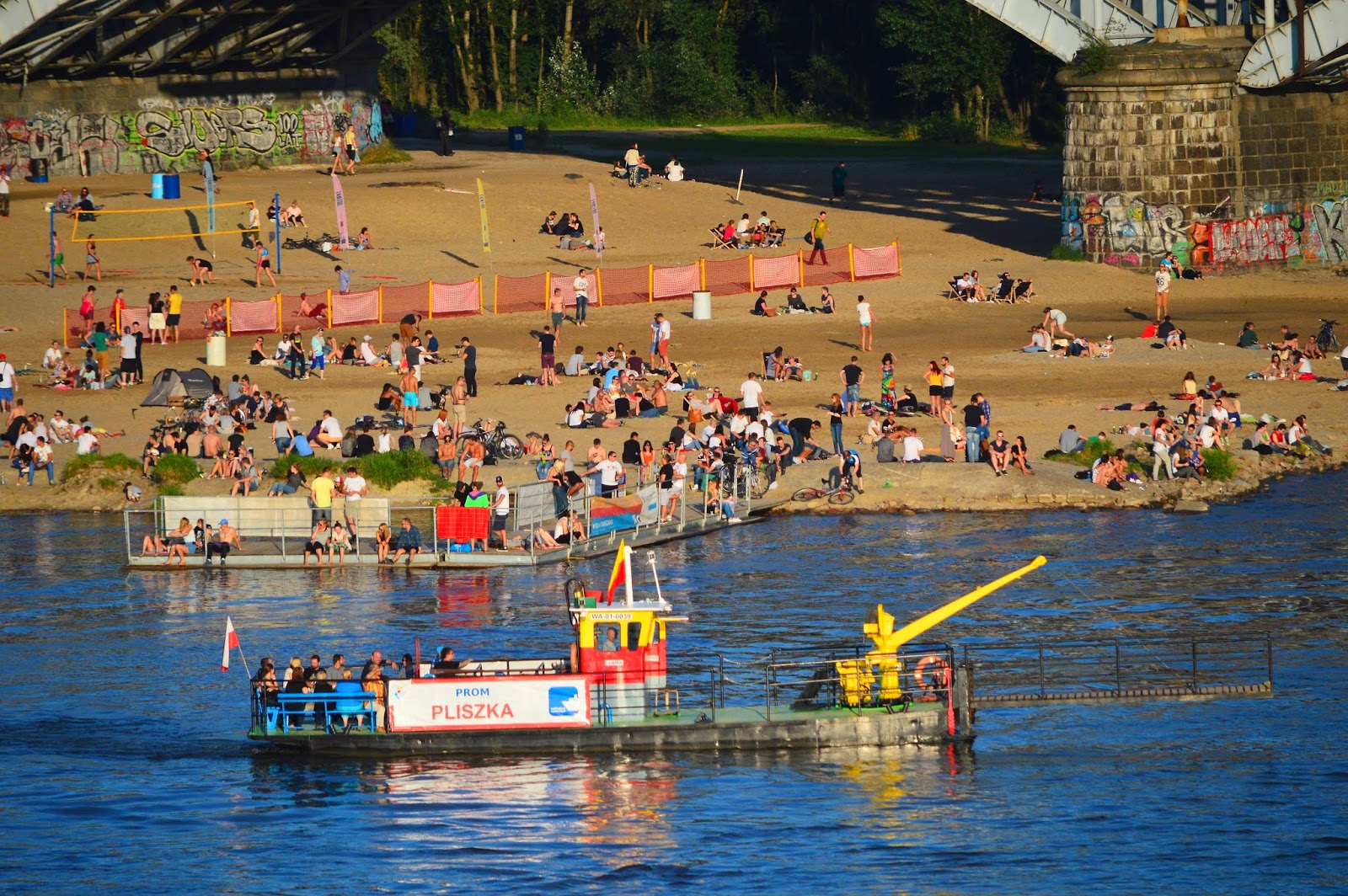
Whoever is responsible for this bridge - it falls a long way short of the safety standards considered the norm in western Europe. If the bridge can't be re-engineered for pedestrians and cyclists - then open the railway bridge for foot traffic and bikes. Or allow ferries to take pedestrians and cyclists from one bank to the other. Like they do in Warsaw. Below: the ferry in Warsaw serving the beaches. Something like this is needed at Gassy and at Góra Kalwaria too. Chewing out a rhythm on my bubble gum/The sun is out and I want some/It's not hard not hard to reach/We can hitch a ride to Rockaway Beach.


Poland's local authorities (outside of its major cities) need to sharpen up their act when it comes to the demands of a fast-changing society and deliver social amenities at low cost. The value to local communities of letting hundreds of cyclists and walkers cross the river using ferries and (safely segregated) rail bridges would be hugely beneficial for communities on both sides of our river.

Sorry - can't get over the Ramones - since hearing of Tommy's untimely demise, it's been full-volume Ramones all weekend. Below: updated lyrics of Commando, from Ramones Leave Home.
They do their best
They do what they can
They get them ready for Vietnam
From old Hanoi to East Ukraine
Commando - involved again
First rule is - the laws of Germany
Second rule is - be nice to mommy
Third rule is - don't talk to commies
Fourth rule is - eat Kosher salami
Those commentators who question the Ramones' talent should listen to the chord progression in this song - complex yet simple, melodic, catchy, heavy, fast - and those lyrics - as true today as at the height of the Cold War.

* Każdy obcy będzie bity = 'Every stranger will be beaten"

This time last year:
S2 update (nearly ready, as it happened)

This time two years ago:

Progress on S2 bypass - photos from the air

This time four years ago:
Up Śnieżnica

This time seven years ago:
July continues glum (2007 - a rainy summer)

Saturday, 5 July 2014

Making Poland's railways safer

The difference in health-and-safety culture between the UK and Poland is clearly visible, nowhere more so than on the railway. Things which in Britain would be deemed unacceptable are normal in Poland. In Britain, railway tracks are fenced off, straying onto a main line - or indeed a branch line - is not easy. The costs of keeping rails secure from trespassers must be huge - but the costs pay off.

It's worth referring to the European Rail Agency's latest safety report, which puts things into perspective. Let's start with level crossings. In Poland, the number of fatalities in level crossing accidents is nine times higher than in the UK (61 deaths compared to seven in 2012). Poland has around 14,000 level crossings, the UK 6,100. Yet the UK's rail network is larger (31,000km compared to Poland's 29,000km), more than twice as busy and with much faster trains.


The photo above, taken today on ul. Baletowa, shows the problem. Gamblers and chancers taking a risk with their lives and their passengers' lives. The coal train gave several loud hoots as it approached this unguarded level crossing (which lacks even signal lights). And yet until the very last moment, cars continued to cross. 

Another category of rail accident is unauthorised persons on track hit by a train. In 2012, 180 people were killed this way in Poland, nearly six times more than in the UK where the death toll was 32.

Below: passengers crossing the track at W-wa Służewiec station to get to the tram loop. A footbridge has been provided (left), but that means walking up and then down a flight of steps.


It would seem from the statistics that Poland has to spend much money on infrastructure improvement and on changing people's attitudes. Polish railways are the second-most dangerous in the EU after Latvia (in terms of deaths and serious injuries per million passenger kms). The UK rail network is the EU's second safest after Luxembourg.

But despite the relatively poor performance of Polish railways as seen in the context of other European networks, Poland's railways are vastly safer than roads. As this document points out, your chances of dying in a car crash are 50 times higher than in a plane crash, and 25 times higher than being killed on the railways.

Poland's rail network is under-invested; I trust that EU funds from the 2014-2020 financial perspective will make their way to where they are most needed to improve the speed and safety of Polish railways.

This time last year:
Along mirror'd canyons

This time three years ago:
Mad about Marmite

This time four year:
Komorowski wins second round of Presidential elections?

This time fiver years ago:
A beautiful summer dusk in Jeziorki

This time six years ago:
Classic cars, London and Warsaw

Saturday, 8 March 2014

What does it take to get a roundabout built?

A big thank you to Marcin Daniecki for spotting this one - a story on a local portal about the Biedronka store currently under construction near W-wa Jeziorki station.

The planned entrance to the store is to come off ul. Karczunkowska - right on the bend of a road along which drivers tend to go far too fast. It would make sense to build a roundabout here (rather like the one by the entrance to King Cross Ursynów). But apparently no - because there are plans to build a viaduct over the railway line 250m away. As we know, these plans are gathering dust on some shelf at PKP PLK and will continue to do so for many years.

But the many drivers turning left into Biedronka from Karczunkowska will expose themselves to a sideways shunt from cars hurtling eastbound along the road. How many serious crashes are needed to convince the authorities that a roundabout here is absolutely essential?

Judging by the volume of traffic turning into Lidl on ul. Puławska, I expect that a Biedronka will attract similar custom. Some of it will come from other other side of the tracks, but I guess much of it will come from Puławska. Unless there is some form of traffic management at this junction, it will be a very dangerous one.

This low shed will become a Biedronka.

Straight ahead for Biedronka - across a bend in a fast road

Turn left for Biedronka - across a lane of speeding traffic

Turn right for Biedronka - watch out for pedestrians crossing
It is evident that some form of traffic-calming measures are needed; a roundabout is the only practical solution. But will the developer/investor want to spend money on it? Better than dead customers.

Judge for yourselves...

[Two years on: I've seen the aftermath of one non-fatal car crash on this junction since then.]

This time last year:
God's own risk

This time two years ago:
A third of the way through Lent

This time three years ago:
Balancing surfeit and shortage

This time four years ago:
Congruent consciousness
