Showing posts with label politics. Show all posts

Friday, 26 June 2026

Entwined Histories by Piotr Wilczek

For anyone living in the Polish-British space, this book is an absolute must-read. A collection of 38 essays written by Poland's former ambassador to Washington (during the first Trump administration) and to London (taking office just as Russia's full-scale invasion of Ukraine began), the book is presented as a 'cultural memory'. It avoids the format of a conventional diplomatic memoire; Prof Wilczek reveals no juicy tittle-tattle. "I shall be taking such secrets to the next world," he said at the book's Warsaw launch. Rather, each essay shows how the histories of Britain and Poland have been interwoven by war, exile, culture, tradition and diplomacy in unexpected ways. 

After a spirited attack on lazy media stereotypes of Poles in an article to The Spectator, Prof Wilczek has become a regular guest on the pages of the magazine, currently edited by Michael Gove. A revised version of the chapter, How London became Poland's second capital, made its way from the book to The Spectator earlier this month.

What makes the book so fascinating is the topics chosen for 38 essays. A few are familiar (such as the stories of spy Krystyna Skarbek or General Maczek); most of them, however, uncover new territory even for readers well-versed in British-Polish relations. These include the story of how the Duke of Kent might have become the King of Poland had he not died in a plane crash in 1942, and the story of Poland’s ambassador to the court of Henry VIII, Jan Dantyszek (Johannes Dantiscus), who arrived in London as envoy of Poland's King Sigismund I in 1522, exactly 500 years before Piotr Wilczek took up the role of Poland’s ambassador to the UK. I also found fascinating the story of Socinianism, a nontrinitarian Protestant movement ('the Polish Brethren'), based in Raków, "a modest town which housed a printing press, a famous academy and some of the sharpest minds of the age." Prof Wilczek writes: "For a brief but incandescent period, Raków was Geneva without the dourness – Reformation thinking at its most open and its least vengeful." The Counter-Reformation got to the Socinians in the end, forcing them into exile. "Socianian thought percolated into the bloodstream of English radicalism. Its fingerprints can be seen in the writings of William Penn, the Quaker founder of Pennsylvania." A trip to Raków (40km south-east of Kielce) is thus in order.

Another noteworthy chapter, A Polish Eye on England's Harbours – with Joseph Conrad in Mind, considers through visits to Southampton, Portsmouth, Liverpool and Hull how the Polish-born writer understood the British Isles as home to a sea-faring nation. Prof Wilczek quotes from Conrad's description of the Thames Estuary in Heart of Darkness, which remains one of the most atmospherically evocative passages I have ever read in the English language.

London is a top posting for any diplomat, so about a third of the book is focused on it. I found the essays on the Warburg Institute and the diplomat's guide to navigating London's gentlemen's clubs the most interesting, as well as the descriptions of its bookshops – and its Polish restaurants.

One thing I would have like to have seen in Entwined Histories is some comparisons between the training and ethos of the British and Polish diplomatic corps. Diplomacy is very much a field in which one needs phenomenally fine judgment and superb people-skills – and above all, knowing when to stay silent. Dealing with the assorted ogres, narcissists and ne’er-do-wells that all too often rise to positions of highest office requires a suspension of normal instinct-based behaviour. "Diplomacy is a balancing act between urgency and restraint," writes Prof Wilczek; I feel that it is something you have to be born to do; most of us would be too quick to snap back with an undiplomatic riposte that would carry with it real-world consequences. How the diplomatic mindset is nurtured across different cultures is of great interest to the general reader.

Entwined Histories reads well and smoothly; it shall end up on my library shelf next to Speeches for Leaders by the former British Ambassador to Warsaw, Charles Crawford.

Entwined Histories is available from Chronos Books (www.chronosbooks.com) for £12.99/$17.95.

This time last year:
The [2025-brood] kittens on their 12th day

This time last year:
A new path to Krężel

This time two years ago:
Mutineers march on Moscow

This time six years ago:
Lifelong brand ambassador

This time eight years ago:
How much for locally grown strawberries?

This time nine years ago:
Zamość – the beautiful, must-visit town of Poland's east

This time 15 years ago:
Israeli Boeing 707 visits Warsaw again

This time 16 years ago:
More interesting aircraft overhead...

This time 17 years ago:
Poland is really short on mountains

This time 18 years ago:
The warmth of the sun
[with noctilucent clouds]

This time 19 years ago:
Full rainbow over Jeziorki

Thursday, 4 June 2026

Politics: An objective assessment of your subjective reality

WRITTEN ON THIS, THE 37TH ANNIVERSARY OF POLAND'S TRANSITION TO DEMOCRACY

So many people today get wound up by things that do not remotely affect their day-to-day lives. Migration is a good example. People living in picturesque English villages that have seen an influx of three foreign workers say they feel “swamped”. Young people with no direct connection to the Middle East drifting into anti-Semitism because of Gaza. The issues may be real enough, but the emotional weight attached to it is often wildly disproportionate to its actual impact on the individual’s actual reality.

This is not to say that migration, war, terrorism or national identity are trivial matters. Of course they're are not! But proportion matters. Russia is an existential threat to Estonians, Latvians, Lithuanians and Poles in a way that Israel is not an existential threat to citizens of South London. Islamic terror is an existential threat across parts of Africa and the Middle East in a way that it is not to people living in rural Poland. 

The closer a threat is, the more materially it constrains daily life, the more rational it is for politics to be organised around it. If you like in Kyiv right now, the prospect of being killed by missiles or drones sent at you by a bloodthirsty madman is very, very real.

National politics should, at root, be about two things: the economy and security, internal and external. Citizens have a right to feel safe. They also have a right to expect that their hard work, thrift and enterprise should be rewarded by growing prosperity. When governments fail on these fundamentals, anger is justified. When anger is transferred instead onto distant symbolic causes over which neither the citizen nor, often, their government has much practical control, politics becomes emotionally satisfying but civically useless.

Sitting here in rural Poland, I see a country on the rise. That rise is not accidental. Macroeconomics are not just a matter of government policy; they're also the aggregate result of habits, incentives and behaviours of millions of people, earning and spending money. If people are entrepreneurial, hard-working and forward-looking, the economy moves in one direction. If too many people become comfortable sitting back on generous welfare benefits, it moves in another.

There is a simple test. If there is something you can do about a situation you dislike, do it. If there is nothing you can do, then moaning is pointless. And 'doing something' does not mean shitposting on social media. It means acting in the real world.

Don’t like massive increases in traffic, density and suburban overdevelopment? Move out to the countryside. That's what I did. Don’t like the direction of your country? Build something, employ someone, stand for office, volunteer, organise, write, teach, invest, persuade. Face to face, not online. [Ditching Twitter/X in November 2024 led to an instant improvement in my mental wellbeing.] Politics should not be a theatre in which people pin their frustration onto remote causes. It should be the practical art of improving the conditions of life where one actually stands. Delivering solutions rather than winning arguments.

We are approaching the tenth anniversary of the Brexit referendum; the UK economy is some 3.5% to 4% smaller than it would have been according to official reckoning. That's a huge difference to the budgets of households on the edge. Diddly-squat to the billionaires who convinced the precariat to vote Leave.

This time last year:
Farewell, beloved grapefruit

This time two years ago:
Sixty-Six and Two-Thirds

This three years ago:
Marching for Openness and Normality
[We have it. Let's not get complacent.]


This time six years ago:
Moonrise, Nowa Wola

Tuesday, 19 May 2026

Plato and politics

The Republic is remarkable for the light it sheds on the human condition. This 2,400-year-old treatise about making society – made up of flawed humans – work remains even more relevant today than when it was written. Its implications are global, rather than concerning city-states of Ancient Greece. 

Reading Plato today in a 19th-century translation is slightly jarring as it casts Victorian shade over a work which is 2,400 years old; but as I discovered yesterday, the version I read had a massive influence on the development of modern Britain, and thus the world.

Benjamin Jowett’s translation entered university libraries almost immediately after its publication in 1871. It became the dominant English-language academic Plato for generations because of Jowett’s immense influence within the Victorian Oxbridge intellectual establishment. This influence is to be felt to the present day, about which, more below.

The Republic's central premise is a thought-experiment. It posits the ideal state as imagined by 'Socrates' (Plato's narrator – the real Socrates didn't leave any writings). 'Socrates' suggests that the state should be ruled by a class of Guardians, whose one aim in life is to rule the state; they should indeed be brought into the world with this express intention. A caste of high-born philosopher-kings, they should not possess wealth, but be provided for by the rest of the state's citizens – the cobblers, the shipwrights, the bakers, the farmers, the builders and everyone else. The Guardians should be the children of renowned warriors, they should be generalists rather than specialists. Controversially, they should share their wives in common, and bring up their children in common.

Did Plato really believe this to be an ideal form of governance? Or was it a narrative device? A conceit designed to provoke thought – in today's parlance... to trigger?

Plato identifies various forms of government: aristocracy, oligarchy, democracy and tyranny. Familiar terms to us today, but Plato uses them slightly differently, attaching different values to them. Tyranny, of course, being the worst, then, as now. But democracy he sees as a form of mob rule, where the majority can hold undue sway over the minority; the free poor can get together and say "there's more of us than there are of the rich – let us pass laws that allow us to seize their wealth." However, avoiding the rule of tyrants was the greatest challenge for society.

Plato identifies the drive for money and power as the key to understanding the motivation of tyrants. Appetite – lust for power, for glory, for wealth – is why rulers slip away from idealised forms of government towards more corrupt polities. You only need to look at contemporary America and Russia to see how true Plato's insights remains some two and half millennia on.

At the heart of politics sits personality and human behaviour. Not ideology. A fucked-up mind within an untiring, driven body, obsessively seeking power, wealth, and in some cases adulation, turning power into wealth and wealth into more power – this is Plato's tyrant. We see this so clearly today. Ideology is merely a means to the end rather than being an end in itself. "Vote for me, because I hate those whom you hate" has replaced "vote for me and I'll give you the rich man's money".

Plato's Republic serves as a timeless warning to societies to watch out for those who seek to rule over us. Plato argues that a decent and stable society can exist only when the qualities of justice, truth and goodness govern both the individual and the state. He commends rule by philosophically educated guardians who subordinate their private interest to the common good. 

Back to Jowett. This ideal filtered through into the British Civil Service (after the Northcote-Trevelyan report of 1854. Its full title was: Report on the Organisation of the Permanent Civil Service, Together with a Letter from the Rev. B. Jowett. Yes, that Benjamin Jowett of Balliol College, Oxford, who would go on to translate Plato's The Republic.

The result would be a close real-world approximation to a Platonic administrative elite, though moderated by parliamentary democracy. Plato set out that rulers should not seek wealth, that rule should belong to the educated and morally disciplined, and that within the ruling class, appetite must be subordinated to the common good. The Victorian reformers believed that public office should not be a source of private wealth or patronage. Entry into the Civil Service should be by ability, not connections, and an ethos of integrity, duty and competence should govern, not avarice or party interest.

Plato's observations about tyrants' appetites squares with modern warnings about the 'dark triad' of narcissism, psychopathy and Machiavellianism. Rising politicians who display these traits (especially if they are capable of masking them!) need weeding out as they gain power, before their innate characteristics – indeed their personality disorders – can turn into tyrants. 

In my next post, I shall turn to what Plato had to say about God, the soul and the afterlife.

This time four years ago:
The speed of life

This time five years ago:
Does it all come right in the end?

This time six years ago:

This time seven years ago:

This time eight years ago:
Heavenly Jeziorki

This time 12 years ago:
Why are all the shops shut today? 

This time 13 years ago:
Jeziorki at its most beautiful

This time 15 years ago:
Useful and useless in my wallet

This time 16 years ago:
In search of the dream klimat - remote viewing made real

This time 17 years ago:
Zakopane to Kraków in 3hrs 45min
[Less than two hours today.]

Monday, 18 May 2026

On Getting to the End of Plato's Republic

Phew! That was hard work. Four hundred and sixteen pages. I finished this morning, having started reading it over two months ago. And this is my second attempt; my first bash (last autumn) ended about a quarter of the way into the book.

BUT IT WAS WORTH IT!!

As Alfred North Whitehead wrote in 1929, "...the European philosophical tradition is ... a series of footnotes to Plato.” Plato posed the foundational questions and set out the conceptual map, over which later philosophers have argued; answering him, modifying him – rejecting him even, but hardly ever ignoring him. And so I set out, determined to read such a crucial text. 

This particular book, my son has reminded me today, spent most of its life in my parents' downstairs lavatory. I guess it served to impress guests, signalling intellectual pretensions, and it might have been something my mother dipped into now and then while seated on the throne. It was neither annotated (as many of my father's science books are) nor even visibly thumbed.

The Republic is part of an anthology, The Essential Plato (with introduction by Alain de Botton), a 1999 reprint of the Victorian translation, by Benjamin Jowett. I now realise that this is not the easiest way into Plato's work. Jowett made zero effort to make the original Greek easy to read, leaving immense sentences that stretch on sometimes for half a page as single chunks. Rather than breaking them down into less ponderous prose, Jowett's text gives off the air of a Victorian mind trying hard to appear lofty. You drift away in successive subordinate clauses, searching for the sentence's principal verb.

Yet Jowett's translation is to Plato what King James Version is to the Bible – it's the version that many generations of Britain's educated elite cut its teeth on while reading the Greats or PPE at Oxford.

So I read the whole book out loud (another reason it took so long – I never took it with me on the train). I read it so that it would make sense to me. If I failed to get Plato's point, I'd re-read the paragraph. Aloud. And as I did so, it dawned on my why my studies at school and university were not as effective as they should have been – I had so often skipped the hard bits. At the meta-level, often while reading Plato, I was conscious of my mind beginning to wander off. So I read slowly, around six pages a day on average, compared to the 20 or so pages a day of previous books I'd read this year. Also, I read it with pencil in hand, making notes in the margins, underlining points I considered important and flagging up with asterisks the key ideas. 

Another thing that irked me throughout was the fact that though ostensibly The Republic is in the form of a dialogue between Socrates (the character through whom Plato speaks) and his followers, the actual 'dialogue' is mostly Socrates' listeners saying things like "Yes" and "True" and "Exactly" and "By all means" to just about everything that Socrates says. With the exception of Thrasymachus, who puts up a vigorous argument against Socrates' (Plato's) point of view in Book 1, everyone else comes across as a cypher, a mere nodding yes-man. The reader yearns for a response such as "up to a point" or "only in some cases" or "that's a bit of a sweeping generalisation, Socrates!" This is no dramatic debate among equals, no challenges, not a true dialogue; rather, it comes across as a narrative device, a framework upon which Plato hangs his ideas.

Having said that, these 416 pages contain ideas that have shaped our world to a remarkable degree. 

In my next post, I shall cover what Plato actually wrote 2,400 years ago, and why his thinking on human psychology, politics and spirituality remains so utterly relevant today. And why I so frequently was writing 'Trump!' and 'Putin!' in the margins.

This time last year:
The platform is in working order (or not)

This time two years ago:
Anatomy of a Moment

This time three years ago:
Ego – self-consciousness – pure consciousness

This time seven years ago:
The Day the Forecasters Got It Wrong

This time eight years ago:
Carlo Rovelli's The Order of Time

This time 12 years ago:
W-wa Wola became W-wa Zachodnia Platform 8 two years ago today 

This time 13 years ago:
From yellow to white – dandelions go to seed
[2026: this happened two weeks ago]

This time 16 years ago:
The good topiarist

This time 17 years ago:
Wettest. May. Ever.

This time 18 years ago:
Blackpool-in-the-Tatras
[My last visit to Zakopane – I've not been back since]

Tuesday, 24 March 2026

Lent 2026: day 35 – religion and social control

I am not sold on the idea of organised religions for two reasons. The first is that I firmly believe, I intuit, that everyone who seeks God shall find God in their own way. There are therefore as many paths to God as people who seek God. This is one of my primary principles regarding human spirituality. I believe that in essence faith is experiential rather than book-taught – esoteric rather than exoteric.

The second reason is that I see religions as all too often straying in their remit from the spiritual into the temporal realm. The temptation for spiritual leaders to appropriate humans' innate longing for the numinous, – the sense of awe – for the purpose of social control is too great. "Believe in what you are told to believe, live according to our precepts, and you will be rewarded in the afterlife" is a simple yet persuasive narrative.

In The Republic, written around 375 BC, Plato (through his narrator, Socrates), engages in his famous mind-experiment of devising the perfect state. Having set up a hypothetical community of mutually interdependent craftsmen (farmers, builders and weavers), which is expanded to include merchants, artists, tutors and warriors, it becomes clear to Socrates and his interlocutors that some form of social control would be required to ensure that the unjust do not end up dominating the just. Socrates postulates the sort of religion that a just state would require to keep  the morale of its citizens high. He is critical of Homer and other authors who portray the gods as morally dubious, and so, introduces censorship to his republic. Strict control of cultural narratives is therefore essential: stories about the gods must be controlled, because they shape the character of the populace. “We must first supervise the storytellers. If they tell a fine story, we approve it; if not, we reject it.” Children absorb stories before they can reason; myths must be filtered at source. The state decides what is acceptable. Plato is saying that rulers need to have systematic control of cultural input.

Seven centuries later, in 325 AD, the Roman Emperor Constantine – who had converted to Christianity eight years earlier – convened the Council of Nicaea, summoning 200 bishops from around Christendom to Nicaea (in modern-day Turkey) to hammer out what it was exactly that Christians believed in. After all, he reasoned, if this is to become the official religion of the Roman Empire, it's important to know what it stands for. And thus was hammered out the Nicene Creed, an imperially approved statement of what the Church believes (and by omission what it doesn't). Of course, this wasn't the end of the matter; debate would rage on for centuries – about the nature of the Holy Trinity in particular – but it was a crucial step in establishing Christianity as a global religion, rather than a loose collection of squabbling cults.

Theological debate in the service of empire-building, the Council of Nicaea highlights how the needs of church and state can overlap. And so they did for the best part of a millennium and a half. The Enlightenment led to a clear separation of secular governments from church authorities; the 'divine right' to rule was over. Theocracies are on the retreat (with a few stubborn exceptions).

Is church-going in general decline in the West because people can see through the social control aspects of religions? Has atheism – based on the notion that there's no God because everything is composed of matter – led to societies losing control? In balance, no. Secular laws by and large work effectively, keep trouble-makers in society from causing too much harm to the rest of us.

I have written about the rising numbers of people identifying themselves as 'Spiritual But Not Religious' (SBNR) in the US, as church-going and religious affiliation is falling. In Europe, this is reflected in the term 'believing but not belonging', with many people retaining spiritual beliefs, but disengaging from church participation and doctrine. And there are also the 'Religious But Not Spiritual', who go to church out of a sense of tradition, duty and order, without feeling any spiritual calling. 

I would posit that a fixed proportion of society has some kind of a spiritual calling; for some, there is the need to belong to a faith community and engage in regular spiritual practice (church-going); for others – this number is increasing as the former decreases – a self-authored worldview with an emphasis on spiritual experiences rather than pre-packaged teachings is preferred.

How will this look in the future? I suspect that the SBNRs will continue to grow in number, and this will be seen in a proliferation of YouTube channels and social-media accounts; a whole new stream of people searching for God in their own way.

Lent 2024: day 35
After death what's next? (Pt II)

Lent 2023: day 35
Into the Afterlife (Pt III)

Lent 2022: day 35
Altered states - caffeine and alcohol

Lent 2021: day 35
The science of coincidence

Lent 2020: day 35
Soul and Body

Sunday, 28 December 2025

The Long Review of 2025: Pt II

Today I focus on geopolitics. Putin's Three-Day Special Military Operation to conquer Ukraine is approaching the end of its fourth year. Trump want nice shiny peace prize medal so his amateur (no experience necessary) 'diplomats' are trying to broker peace between a burglar and the owners of the home he's broken in to. "Look – the burglar's already got your utility room, so why not just sign over one of your bedrooms to him and quit fighting the guy?"

Putin can't stop the war. He doesn't want to stop the war. It is the war and the war alone that keeps him in power – and keeps him from being strung up from the nearest lamp-post. He saw what happened to Gaddafi when his people turned against him. And Ceausescu. And Saddam Hussein. And Samuel Doe. A similar end awaits Vladimir Vladimirovich Putin should he lose his grip on the nation. An end to the war means the return home of hundreds of thousands of veterans, brutalised by their experiences in the army. With no social safety net, these men will terrorise their neighbourhoods. The very chaos and anarchy that Putin's social contract with the Russian people pledged to end. At the same time, it is the war and the total war economy that keeps the billions flowing into the coffers of Putin and his remaining oligarch cronies. Those who protested that they were not getting enough, or who were most brazen in ripping off the army have fallen out of windows. The cake is smaller, sure, but there are fewer cake-eaters in Putin's circle. For them, and for Putin, the war must go on. He will pretend to humour the American 'negotiators'. But he will carry on regardless, sending thousands of Russians a week to their deaths in human meat-wave assaults, and continuing to fly guided missiles into Ukrainian homes, schools and hospitals.

This quote from the excellent Institute for the Study of War website about the situation in Ukraine: "Russian forces are unable to open a new front and cannot expand their recent limited attacks. Constraints on Russia’s available military manpower are a severe constraint on Russian operations and will likely remain so in the coming year. Russian forces are unlikely to change the pace and scale of their advances along the frontlines in 2026 if support for Ukraine continues at current levels. The grinding nature of Russian advances incurs high casualty rates, and Russian forces need incoming personnel to replenish losses in active sectors of the frontlines to maintain their slow rate of advance. Putin has continued to claim that Russian forces are advancing all along the line, which is untrue..."

Remember, Pokrovsk and Kupyansk were the targets for the Russian army's summer 2025 offensive. Neither town is in Russian hands. So what chances does Russia have to attack, for example, Poland? Putin's nuclear sabre-rattling is seen as a hollow threat, one that if anything signals his desperation. When things are looking bad on the battlefield, his minions will shriek: "We have nukes!"

Meanwhile, Trump is disengaging the US from Europe. Europe is belatedly stepping up to the challenge and increasing its defense spending. In the case of Poland this is resulting in a significantly larger budget deficit and public-sector debt, the only macroeconomic indicators to give any cause for concern. However, my worry is that not enough of that cash is going into Poland's home-grown defence industry, and too much is going to buy kit from the US and other countries. Poland should treat this as an opportunity to ramp up domestic manufacturing industry in much the same way as the US did in the 1940s and '50s. The spin-off for civilian manufacturing is clear.

Trump continues on his merry way. The jokes fall thick and fast. Mentally, the guy is utterly unfit for office. Will he be able to keep the Epstein stuff covered up? Will he implode? Will MAGA (and indeed all nativist/populist movements) implode under the weight of their internal contradictions? Is MAGA/Reform etc a broad church – or should "all migrants be deported now"? Somehow the show will go on, wokeism will become diluted, DEI initiatives will be pedalled back and, I hope, common sense will prevail. The photo (below) of Poland's foreign minister Radosław Sikorski and president Karol Nawrocki at the United Nations filled me with optimism. The two guys seem to be getting along... Good!


Will the war be over in 2026? I very much doubt it. Putin has mobilised a further 409,000 reservists and Russia being Russia there will be no change in doctrine (brutal stupidity/stupid brutality the default mode of thinking). 

China is the great geopolitical mystery. Run by one party which is run by one man, with publicly stated views that Taiwan should be incorporated by force if needs be into the Chinese nation. However, I believe that China's real goal is Outer Manchuria – the 900,000 square kilometres of land ceded to Russia in the Treaties of Aigun (1858) and Pekin (1860) along with China's access to the Sea of Japan. The longer the war in Ukraine goes on, the weaker Russia becomes, and the more leverage China will have when it comes to crossing the Amur River and helping itself to what used to be Chinese land. Full of natural resources and living space. The weaker Russia becomes, the cheaper it is forced to sell its oil and gas to China. Xi Jinping looks at the war and smiles. Europe is funding Ukraine to degrade Russia militarily. Nice strategy.

Trump and China? It seems (as of Q4 2025) that the tariff wars are not hurting the US economy, although the dollar is weak. When Trump entered the White House, a dollar cost 4.08zł, today it costs a mere 3.58zł. 


Is this a strong złoty? It's grown against the pound too (reducing the spending power of my UK state pension), from 5.15zł a year ago to 4.83zł today. The euro has held up better (from 4.27zł to 4.22zł). The UK media has been full of articles praising Poland's economy, but frankly, I'd love to see those articles balanced by ones praising the actual UK economy. In the third quarter of 2025, it grew by a mere 0.1% quarter on quarter, while Poland's economy grew by 0.9% – nine times faster. At this rate, Poland is indeed on course to overtake the UK in terms of GDP per capita at purchasing-power parity by 2030.

This time last year:
Radom

This time two years ago:
New bridge over the Czarna

This time three years ago:
The Long Review of 2022 - Pt. III

This time four years ago:
The Person Who Contemplates Not.

This time seven years ago:
2018 – a year in journeys

This time 13 years ago:
Wise words about motoring

This time 14 years ago:
Hurry up and wait with WizzAir at Luton

Wednesday, 10 September 2025

Prophesy

For a species that communicates instantaneously, that has access to the sum of human knowledge accessible at a few strokes of the keyboard, we continue to be absolutely useless at foretelling the future. 

Why can't we just know when the next global war  or pandemic will break out? Or who'll be the next culturally significant rock'n'roller, head of state or iconic actor to pop their clogs*? What will be the value of the dollar at the end of this year? Will we get snow this winter? 

We don't like change, but we like it when things improve. Transitioning from a sub-optimal situation to a better state of things is never easy, but with hindsight, we see that the change had indeed been worth it. And yet the introduction of something good and new often carries with it other changes that are not so good, or ones that no one even considered as that change happened. Think of the end of communism in Poland and its neighbours. 

Because we're so utterly hopeless at predicting outcomes, because the systems and systems within systems in which we live are so incredibly complex, unintended consequences of decisions made to improve things always go awry. Mathematically, the exponential rise of complexity leads to chaos. Human life was so much less complex at the time of the Oracle of Delphi.

As a species, we are actually good at history. We remember, we tell each other stories about our shared past and our heritage. We can grasp narratives, we can shape narratives. With the benefit of hindsight, we know why this war or that war was fought, why this particular economic policy turned out to be a failure, or why some product ended up being a far greater success on the market than anyone had dared predict. We can see past cause and present effect. But we can't see present cause and future effect.

History What-If is a popular genre, but ultimate a waste of time consuming it and a barren activity to produce. Working out what would have happened had, for example, Hitler died in the Wolf's Lair on 20 July 1944 brings no benefit. But Future What-Ifs – gaming out scenarios of possibilities based on the probability of their happening – along with all their possible consequences – is certainly worthwhile. But not obsessively. Finding the balance between gaming future possibilities and just getting on with it is key. Charging ahead into the future heedlessly is as wrong as overthinking every possible scenario and then getting paralysed by indecision.

Things seem to get worse quicker than they get better, or so it seems to us. Poland's improving quality of life is something that one sees clearly over the space of decades; it is harder to observe and quantify from one month to the next.** New infrastructure takes a long time to roll out; Warsaw West railway station being a good example (the underground passage between platforms was meant to have opened on 1 September, is now meant to open in 'September'. What's a few more days after nearly six years on the job? Still, once complete, it will be massively, wildly, better than the old station.

I started writing this blog yesterday, unaware that this morning, I'd wake to the news that multiple Russian drones have flown across Polish territory, an event that no one predicted last night. Once the news cycle gets cranked up, the pundits start to spout. I've come to learn that the best predictor of whether Poland's really in a bad place or whether this will all blow over is to look at the financial markets. The złoty barely budged against the euro, staying at the lower end of the 4.25-4.30 złoty band, where it's been since April. [For worriers: Putin's forces cannot seize Pokhrovsk, so going full-on against NATO is doomed to fail from the outset.]

Pundits are getting worse in predicting the future. Online algorithms mean that wild prediction ('Germany's Economic Collapse Is Inevitable', 'Xi Jinping Will Be Out Of Power By Next Month', 'The AI Bubble Is About To Burst', 'Congress To Disclose Alien Presence On Earth At This Week's Hearing' etc) get more views than more rational forecasts. The pundits offering such clickbait predictions may ruin their reputations in the long term, but in the meanwhile, they get the clicks, sell their books, monetize their platforms and become household names.

If you can't nail down the future empirically, using all the tools of rational logic – deduction and induction, extrapolation and interpolation – coupled with our recent ability to crunch vast amounts of data, then metaphysics – intuition – is the only way forward. And ward off truly bad things from happening by considering them, and then expressing gratitude when they don't happen. And not getting complacent.

* Robert Redford as it happens, six days later.

** Something I wrote in January 2019:

"Walking the same West London streets that I walked over 50 years ago, I've seen old familiar things disappear and new things taking their place. The cars. The Austin A40s and Vauxhall Crestas were replaced by Hillman Avengers and Ford Granadas, then those by Golf GTIs and Toyota Carinas, and now Nissan Jukes and Audi Q5 take their place. Road signs, street lights. High-street shops change. Dolcis, Tru-Form and Woolworth's have gone. The people that inhabit these streets change. Their clothes, even their smell. We've become more hygienic. Newcomers – at first from the former colonies, then from the Continent. Things change; if we're not aware of these imperceptible small changes as they happen, their loss can breed a longing for the past. This subconscious longing, when linked to resentment stemming from the lack of success in one's life, can make one susceptible to false myths peddled by populism. How we deal with the unfamiliar is problematic. Some of us are open to the new, we're curious, we don't feel threatened by change. Some of us are closed to it. And with that come dangers."

This time seven years ago:
Comfort comes in layers

This time eight years ago:
Preference and familiarity

This time nine years ago:
A long day in wonderful Wrocław

This time 11 years ago:
Putin will not heal Russia's tortured soul

This time 12 years ago:
Opole, little-known town

This time 13 years ago:
Raise a glass to Powiśle 

This time 15 years ago:
Mud, rain and local elections 

This time 17 years ago:
There must be a better way (commuting woes)

Tuesday, 2 September 2025

Moral obligation and history

The spectacle of Putin, Xi and Kim Jong Un all chummy in Beijing fills me with revulsion and dread. 'Might is right' has triumphed. The boot stomping down on the human face.

My post-war generation grew up believing that the arc of history tends invariably upward – the 'Whig view of history', the notion that today is better than yesterday, and therefore tomorrow will be better than today. The inhumanity, the barbarism of Nazi Germany and Imperial Japan, had both been crushed; steamrollered flat by the Allies. But then both were helped to rebuild and invited into the circle of decent nations; within 30 years of the war's end, West Germany and Japan had overtaken the US and the UK in living standards.

But the seeds of the resurgence of old-style might-is-right can be traced back to the original sin which was treating Stalin's Soviet Union as another democracy. The founding charter of the United Nations from 80 years ago mandated its member states, including the USSR, "to maintain international peace and security, uphold international law, achieve higher standards of living for their citizens, address economic, social, health, and related problems, and promote universal respect for, and observance of, human rights and fundamental freedoms for all without distinction as to race, sex, language, or religion." 

If only those words carried some weight. Allowing the USSR in as a founding party, as well as one of the five permanent members of the UN Security Council, was clearly a mistake; the original sin. 

As deeply flawed as the Western democracies have shown themselves to have been, at least they are not led by leaders who consider putting human beings to death on an industrial scale as policy. 

Saying to Putin "I want this war to end, so you get to keep what you've stolen; you will not be punished and we can get back to working together" is exactly what the Prisoners' Dilemma tells you not to do. This game-theory thought experiment, played out millions of times, clearly shows that if the other guy defects on you, you hit him and do so repeatedly until he relents. Only then, and instantly, you return to the strategy of cooperation. And do so until the next time he defects. To cooperate with an aggressor is to invite future aggression from him. It is that simple. Look at history.

In 416 BC, the Athenians invaded the island of Melos and demanded that its people surrender and pay tribute to Athens or be annihilation. The Melians refused, so the Athenians laid siege to their city. Melos surrendered; the Athenians then executed its men and enslaved its women and children. In the Melian Dialogue, Thucydides' dramatised negotiations between the Athenians and the Melians, the Athenians offer no moral justification for their invasion. Instead they tell the Melians that Athens wants Melos for itself and that the only thing Melians would gain by submitting was not being slaughtered. The Melian Dialogue is still taught as a case study in political realism; the world is brutal, states are selfish, and that the only rational approach is based on power and advantage. The quote "the strong do what they can and the weak suffer what they must" is taken as founding statement of political realism.

So another 'life-in-balance' slider can be between utopianism and realism. Is it utopian to want Putin's full-scale invasion of Ukraine to end with the full withdrawal of Russian forces behind Russia's 2014 borders, and to see Russia punished for the murder and destruction it has wreaked upon Ukraine? Is it realistic to expect Ukraine to give up territory and its ambitions to join NATO and the EU in exchange for a ceasefire? 

Utopians have unrealistic expectations. Politically, they are naive and foolish. (That's utopians of the left and the right, by the way; Brexit was built upon utopian expectations.) Realists, on the other hand, are too ready to accept grubby compromises, to accept corruption, injustice and barbarism.

In my mind, there is an optimal path; it is guided by the solution to the Prisoners' Dilemma: always get on with your fellow (or nation), until they do the dirty on you. Retaliate immediately. Fight back with ruthless determination, until they return to the path of righteousness. As soon as they cease their egregious behaviour – flip back to cooperation and continue cooperating (until their next defection). The problem will then be how to define 'defection', and selecting the appropriate level of counter-strike.

Trump is not clever, he is weak; a pathological narcissist with ADHD. He will fall. But will America be able to pick itself back up? Europe has to take up the slack; I'm delighted that Poland at least is pulling its weight in terms of defence spending. That is a moral obligation.

This time last year:
Sunset's Trip Revisited

This time two years ago:
The Unbearable Pleasance of Flashedback Familiarity

Saturday, 8 June 2024

Vote for Europe

Poland votes tomorrow in the European parliamentary elections. It's been 20 years since Poland joined the EU, a period of remarkable social and economic progress in Poland. And Poland's governance has improved greatly, at local as well as at national levels, with much best-practice absorbed from other EU states. Tragically, the UK has cut itself off from the EU, to the detriment of its own economy, and for Poland, Brexit has led to the loss of a mentor and a natural ally in Brussels as a counterweight to the Paris-Berlin axis.

We vote tomorrow – but what's at stake? 

One major problem that the EU has when selling itself to the public is its complexity. Complexity is both a feature and a bug. On the one hand, the EU is not a hierarchy led by a single strongman. Billionaires know whom to phone in London or Washington to get things their way. But having distributed centres of power (the Council of the European Union, the European Commission and the European Parliament) makes it harder for corrupt actors to bend the system their way. And harder for the average voter to understand.

This very complexity doesn't sit easily with the uncurious. Simplicity and strongmen is what many crave. Simple answers to intractable problems, simple answers that they can understand; all too often simple answers that are wrong.

Even I, who have travelled to Brussels on business four times to meet with MEPs and lobbyists to get a better understanding of how the EU functions, even I who follow the Politico EU newsletter daily, even I have only the sketchiest understanding of the complex machinery at the heart of the European Union and how it really works. So – question to my Polish readers: do you know (without looking up) your Euro-parliamentary constituency and its boundaries? How many MEPs represent your constituency? Which party are they from? I certainly didn't know, despite having voted in every one of Poland's post-2004 European elections. 

But does it even matter?

Right now, there are three major issues facing Europe; Russian aggression, climate change and the Green Deal, and migration. A further issue is Europe's flagging competitiveness in the global economy.

Russia's military doctrine of using information warfare against the West means that discontent is being weaponised, and social media is proving an ideal conduit. Social media has removed the filter from social discourse. Bad actors can speak directly to the discombobulated, at scale. The result, in terms of democracy, has been that lies can spread through society with devastating economic effects (see Brexit). 

Checks and balances, devolved power, consensus and compromise, may not be sexy, but at the end of the day this form of governance works better than the strongman governance model. By any metric, former USSR republics now in EU membership are wealthier, healthier and happier than those currently under an authoritarian or totalitarian leader. 

We need to learn to look at the big picture, and not focus on the grit in our shoe. Human progress from barbarism and might-is-right towards Western democracy has not been easy or painless. Western democracy could do better. It will evolve, and it will ultimately prove itself superior to totalitarianism.

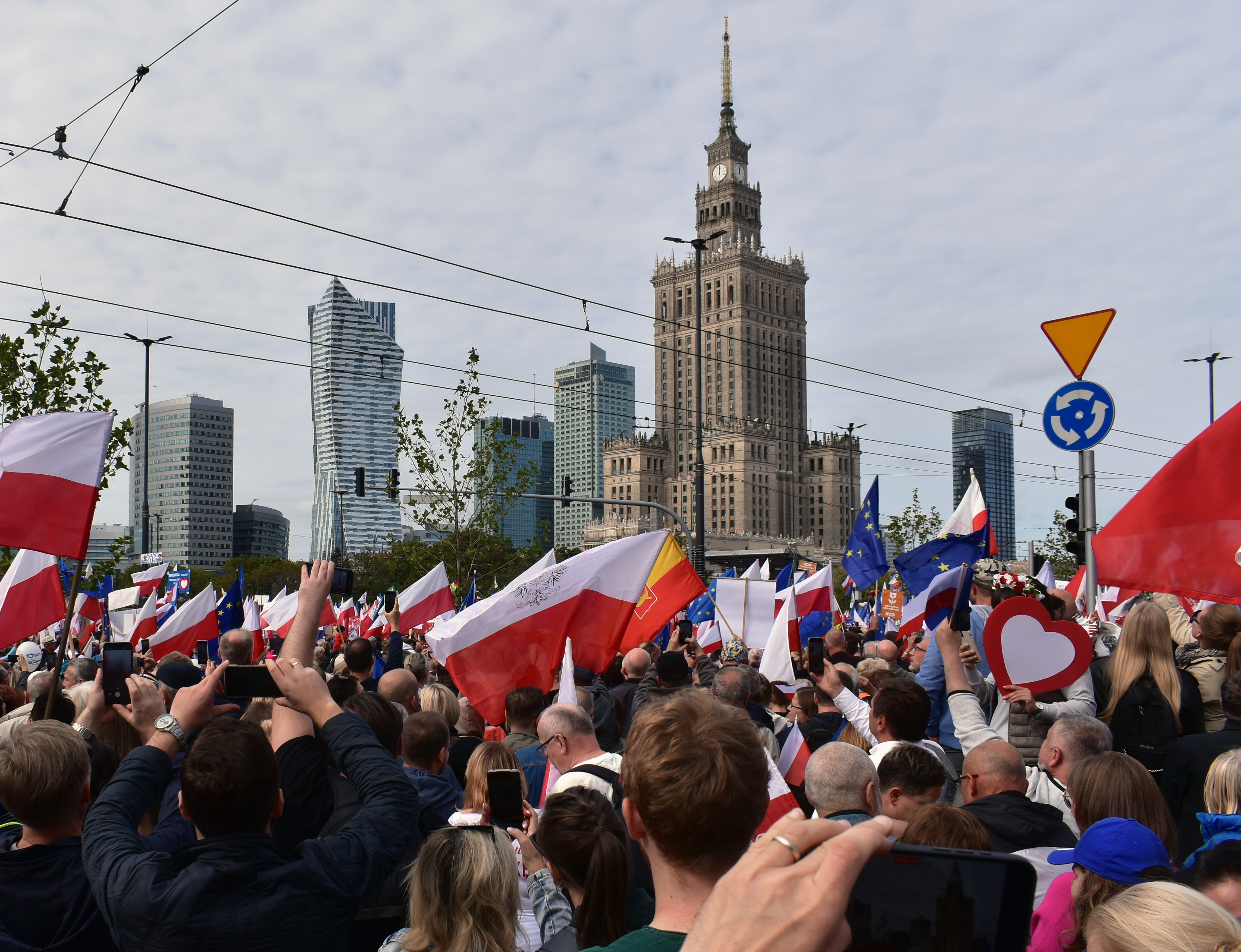
Below: Warsaw, 4 June 2024, on the 35th anniversary of the elections that brought communism to an end in Poland, a rally called by prime minister Donald Tusk. He reminded us that democracy is not a one-way process and can be turned back. Note the singular absence of young people. With no memories of the bad old days of communist dictatorship, they have become complacent. I hope tomorrow's turnout will be higher than the 45.7% in the 2019 European election...

Europe could be governed better. But historically, and looking at its neighbours – and looking at its history – it could also be a whole lot worse. Let's be thankful for what we've got, and vote tomorrow to make sure it gets no worse, by preventing populist wreckers from getting into the European parliament.

This time two years ago:
Savants, UFOs and psychic abilities

This time three years ago:
A proud moment

This time four years ago
Rail progress - Krężel to Chynów

This time nine years ago:

This time 11 years ago:
Fans fly in for the football

This time 13 years ago:
Cara al Sol - part II

This time 14 years ago:
Still struggling with the floodwaters

This time 15 years ago:
European elections - and I buy used D40

The time 16 years ago:
To the Vistula, by bike

This time 17 years ago:
Poppy profusion

Tuesday, 10 October 2023

Why Poland can no longer afford PiS

I won't be voting for PiS - I want this party out of government. It is bad for Poland. Kaczyński's party is modelled on the one political system, the one political party that he knew from his younger days - the Polish United Workers Party - PZPR - the communist party. A one-party system, where the party ran the state and all its institutions. From the judiciary to the media, from the economy to the organs of internal and external security.

PiS has blurred the crucial line between state and party to the detriment of Poland.

Here's the Kaczyński model: put your party's loyalists into key positions in state-controlled enterprises, state regulators and media and use these to further the party's power.

Example:

Rhetoric: "PiS cares about the cost of living - under a PiS government, petrol prices will be lower."

Practice: A week before the election, state-owned PKN Orlen is instructed to cut the retail price of fuel at the pumps, leading to shortages, and photos on social media of military tanker trucks at PKN Orlen stations bringing fuel from army stockpiles to fill up the empty reservoirs.

Response: Private-sector competitors (BP, Shell etc) would expect the state monopoly regulator, UOKiK, to intervene at such blatant infringement of competition law. But UOKiK is run by party placemen - so no reaction.

These interventions cost money. Buying the electorate costs money. Pensioners are being bribed with 13th and 14th monthly payments. "Oh hooray!" they all cheer as they receive their bonuses. But the result is that Poland's inflation is now 8.2% (in the Eurozone, it is 4.3%). Remember, inflation acts exactly like a tax, but one that hurts the poorest in society the most. Economists forecast that it will stick around 6% for most of next year, as a result of all of the ill-judged spending (or electoral bribes as they can also be called). 

Rhetoric: "PiS cares about the cost of mortgage loans - under a PiS government, interest rates will be lower"

Practice: Six weeks before the election, the central bank cuts the base rate by 0.75%, then gets another one (of 0.25%) in two weeks before the election.

Comment: Monetary policy steered by party-placemen on the monetary policy committee meant that Poland started raising rates too late in the cycle and is now cutting them too soon. 

Result: As mentioned above, Poland will have 6% inflation well into 2024, hurting the poorest.

The PiS government's flagship project, 500+, was aimed at boosting Polish demographics; universal child support. In that respect it has failed dismally. In 2014, 391,000 Poles were born - last year, despite the handouts, that number had fallen to 304,000. Over a fifth less children born each year during the time PiS has been in power. So if it's not working - shovel more money at it - in the election year, so now it's 800+. 

The EU is far from perfect. It's still dominated by Germany and France, and it has long been losing competitiveness to the US and China. But as we can see from the UK's dismal fall from grace - leaving the EU is a disastrous policy. What Poland should be doing is professional-level diplomacy, pulling together a coalition of Baltic and Scandinavian nations, the Netherlands and Ireland, to act as a counterbalance to the Paris-Berlin axis. But no. Carping, obstructing and heckling is what 'awkward Poland' is seen to be doing. The EU won't throw Poland out, but it is currently blocking funds earmarked for Polish energy and transport infrastructure projects. 

With a full-scale war going on across borders, many foreign investors looking at Poland have backed off after doing some risk assessment. Another risk is that, with all the euro-sceptic rhetoric coming from the government, Poland will one day vote to leave. Those who remember the UK between 2010 and 2016 will have a comparison to draw upon. Poland needs a stable and predictable environment for business, which leads me to my next big gripe with the PiS government - the way laws are formulated and passed. In a hurry, without consultations and sloppily, requiring amendments as soon as they enter force. 

Using the mechanism of the ustawa poselska (parliamentarians' bill), PiS deputies cobble together legislation and push it through Sejm in a matter of hours if necessary. This is hated by business, especially when these laws concern taxes, the labour code, or other regulations, because not enough time is given to prepare for the changes, and the changes themselves are messy and often incoherent. 

By messing up the business environment, entrepreneurs are thinking twice about investing in their own businesses. The investment-to-GDP ratio has fallen to 16% from 20% at the end of the last government's term of office. And then we had PiS criticising the government that the ratio was 20% and not 25%! [It had once nearly touched 25% in 2006, as a result of the massive influx of foreign direct investment in the wake of Poland's EU accession.]

My biggest gripe with PiS also applies to the Tories in the UK and the Republicans in the US - parties  now operating on the 'closed' end of the spectrum - 'closed' as opposed to 'open'. Hierarchical decision-making rather than building broad consensus. Looking for groups of scapegoats to drive wedges into society over. Erasing nuance. Generating fear and loathing instead. This is no way to do politics.

Like the EU, Donald Tusk & Co are not perfect. But they will be better than a stale, eight-year-old government merely run for the sake of remaining in power, using public money and the public media to retain that power. It is time for Kaczyński & Co to go.

This time last year:
A slower, drabber, greener, more local way of life might yet save us all

This time two years ago:
Warka's bi-weekly market

This time three years ago:
How's your samopoczucie?

This time four years ago:
Pavement for Karczunkowska? What's next?
[Still scheduled for 2025-26]

This time seven years ago
On relevance and irrelevance

This time nine years ago:
Poland gets anglicised as Britain gets polonised

This time ten years ago:
Ale, architecture and city politics

This time 11 years ago:
The pros and cons of roadside acoustic screens

This time 12 years ago:
Moaning about trains again
[have you noticed how rare such moans are today?]

This time 14 years ago:
Warsaw street names - Dolna, Polna, Rolna, Wolna, Smolna. Lost?

This time 15 years ago:
Ditches, landscapes, autumn

This time 16 years ago:
Golden autumn in Łazienki park

Sunday, 1 October 2023

Marching again

I find it impossible how government agencies can claim honestly that number of citizens taking part in today's march was around 200,000. This is the fourth major march I have take part in (the one on 4 June in Warsaw and the two anti-Brexit marches in London in March and October 2019) and today's felt the biggest. I joined from the south around twenty minutes before the midday start; already the whole area around Rondo Dmowskiego was rammed rigid. 

Below: 12 noon, the speeches start. After the speeches, the march will begin, headed north.

After listening to the key speeches, but before the march sets off, I figured that I was in the wrong place, so I dived into the subway under the roundabout - coming out on the northern side, I could see the crowds were thicker still. So trying to get ahead of the march, I took the Metro one stop north to Świętokrzyska. The trains were running at intervals of as little as 1 minute 20 seconds!

From here I walked the route along aleja Jana Pawła II. Both sides of the wide avenue were thronged with flag-waving people - not marching - yet. But column would move very slowly; not so much a march as a shuffle. So I had time to pop into legendary bar Jaś i Małgosia (where my aunt Jadzia worked back in the 1970s!) for a swift IPA. Suitable refreshed, I found I was still way ahead of the front of the march. 

Moving on to Rondo Radosława, the final destination, I took up position in the middle of tram tracks, looking south along al. JP II, watching a slow-motion human tsunami bearing down on where I was standing. 

Below: a rather impressionist image from my phone at 20x zoom...


...and a more conventional photo from my camera. Bear in mind that the crowd was thinnest on the tram tracks, given the ballast being less comfortable to walk on that asphalt or pavement.

Below: the march reaches the end - time for a few more speeches (interestingly, mentions of women's rights drew the most applause), and the national anthem at the end. Then off to catch the train back to Chynów, which was rush-hour full.

However, by the time the train had reached Piaseczno and Zalesie Górne, the flag-bearing passengers were thinning out. In Chynów, PiS banners on fences and walls outnumber PSL banners by three to one and KO banners are nowhere to be seen. It will be a tough race in two weeks' time.

This time last year:
Levels of Detail

This time two years ago:
Droga donikąd by Józef Mackiewicz

This time three years ago:
Words that pop into the mind, unbidden
[This morning's word: contumely]

This time five years ago:
Hops there for the taking

This time six years ago:
Two weeks and two days of travel

This time seven years ago:
Final end to a local landmark

This time 12 years ago:
Independence Day

This time 13 years:
Out and about in Jeziorki

This time 14 years ago:
Funeral of Lt. Cmdr. Tadeusz Lesisz

This time 15 years ago:
Puławska by night

Sunday, 4 June 2023

Marching for Openness and Normality

What pisses me off about Poland's government for the past eight years? Above all, it's this communist-era inability to separate Party from State. The noxious lies that pour out of the publicly funded TV and radio stations, the purchasing of voters' loyalty through social transfers, the brazen use of state-owned enterprises for party-political purposes, all paid for by taxpayers' money, destroys trust in government.

Poland has been drifting in the wrong direction since 2015, and it's really down to one embittered little old man of limited outlook. And people have had enough.

I was amazed at the size of the crowds that turned out today - estimated at 500,000 - a scale that matched the two anti-Brexit demos that I attended in London in March and October 2019. Unlike those, however, held three years after the referendum, this one still is in good time. I can only hope that having a stranglehold on the public media that reach rural voters will not prove sufficient to keep PiS in power this time round.

Listening to the speeches: Rafał Trzaskowski, Warsaw's mayor, proved more popular than either Donald Tusk or dear old Lech Wałęsa, whose ramblings were received with a thunderous and ironic 'DZIĘ-KU-JE-MY!! DZIĘ-KU-JE-MY!' from the crowd as he droned on and on about himself and how important he once was. It took a while for the crowd to move from the meeting point, Plac Na Rozdrożu (Bifurcation of Ways Place), and once moving, en route for Plac Zamkowy, it became obvious just how many people were present. This was judged to be Poland's biggest protest march since 1990.


"Let me thpeak to them, Pontiuth..." "DZIĘ-KU-JE-MY!! DZIĘ-KU-JE-MY!!"


"By the time we got to Piękna, we were half a million strong"


But large crowds in capital cities do not determine electoral outcomes - something I learnt on the streets of London in 2019. Look at Hungary - Budapest was solidly anti-Orban, Orban got back in. Look at Turkey - Istanbul was solidly anti-Erdogan, Erdogan got back in. London was against Brexit - Brexit got done. 

I can only hope for Poland's long-term future that voters bid farewell to Kaczyński and his retinue of pliant party placemen. What will be needed is a de-politicisation of the Polish state; removing parties from the mechanism of administration. I'd ideally like to see Poland as a no-party state, run by a meritocratic technocracy - or technocratic meritocracy - that aims for optimal policy outcomes for society, and not securing yet another election win, hanging on to power for the sake of hanging onto power.

My view of politicians is similar to Groucho Marx's view of clubs - anyone who wants to be elected should automatically be barred from running for election. The most noxious sort of would-be politician being the psychopathic narcissist - or narcissistic psychopath. Barred from public office for life.

Ministries, state-owned enterprises and public media should not be run by people chosen on the basis of party loyalty, but by those best qualified to run them.

Poland is doing well but it could be doing a whole lot better with a government that understands the need for a stable, predictable, transparent legislative and regulatory environment. And run by people who want the best for the nation, not just power for themselves.


This time three years ago:
Moonrise, Nowa Wola