Showing posts with label pollution. Show all posts

Monday, 27 December 2021

Wintery Gorgeousness Tinged with Filth

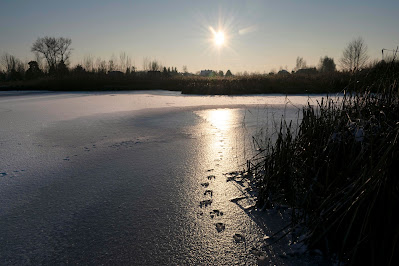
When the temperature falls below -10C, the main task of the power grid is to keep homes warm. Overnight low was -13C, warming to -11C at 11:00 this morning. Below: out on the ice, ul. Dumki.

The ponds have frozen over again; a short thaw turned the surface to slush, which over the past three nights has solidified utterly. No worries about traversing this ice sheet.

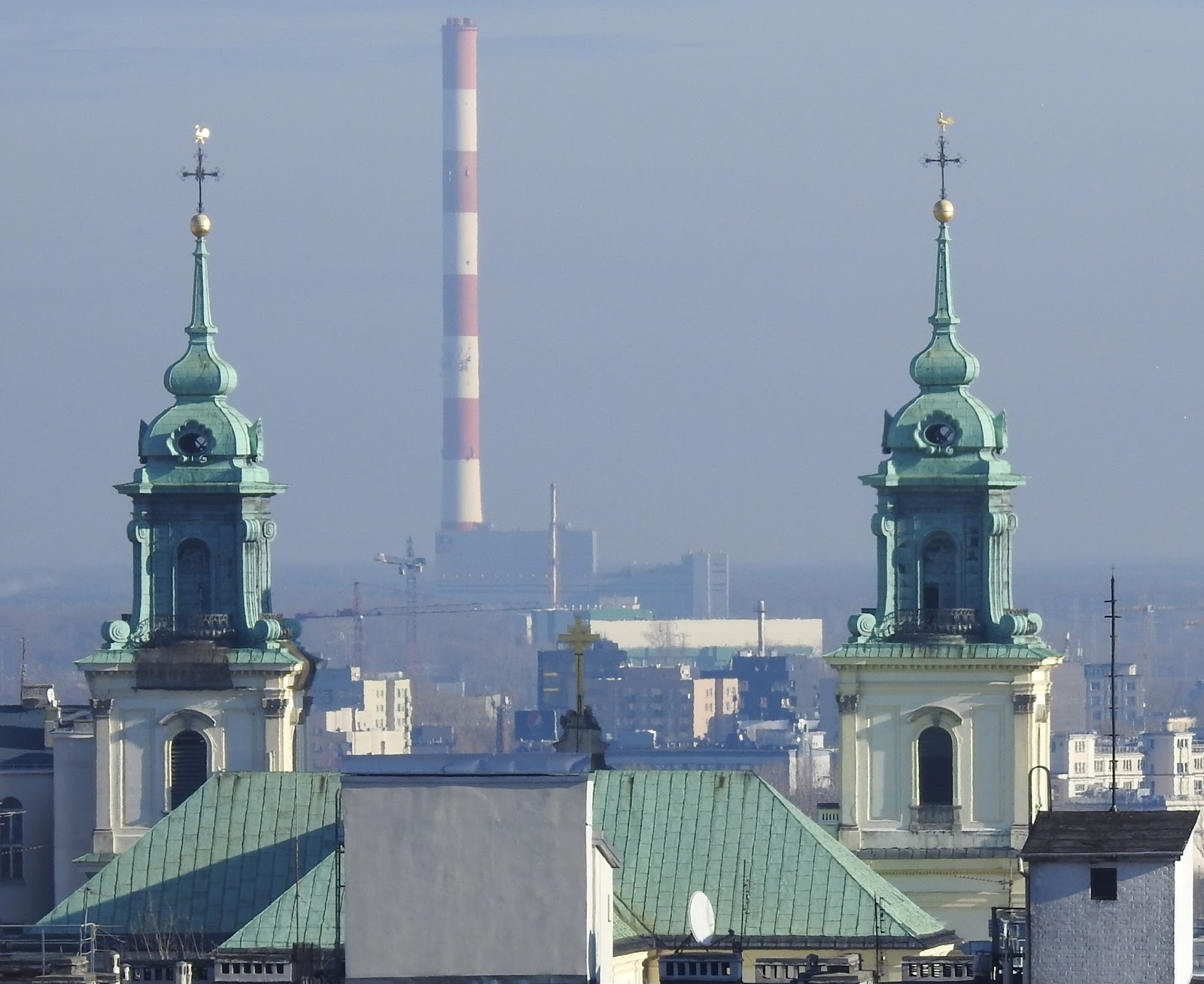
Below: despite the day's beauty, the air quality is execrable. To the left a panorama of Warsaw taken on Christmas Day (-4C); not the best visibility in any case (compare the acuity of the foreground with the horizon). But just look at the picture on the right - taken today.  Varso tower, the tallest in Warsaw (and indeed the EU) is just about visible in the right-hand photo.

The filth belching out of homes (typically older, single-family houses), car exhaust pipes do the damage. Warsaw's coal-fired power stations don't contribute much to the smog, but lots of carbon dioxide. Below: Siekierki power station; with all the sliders maxed out on Photoshop to extract the image of the chimneys out of the smog.

And still they come: another full train-load of coal on its way from the Silesian coalfields hauled by a pair of Newag Dragon 2 locos on the electrified mainline. Trains are typically 40 wagons long, each one capable of carrying 60 tonnes of coal. This train is heading toward Okęcie sidings, from where a diesel loco will take the wagons to the power station back down along the parallel, non-electrified, track swinging off to Siekierki beyond Nowa Iwiczna station. The chimneys of the power station are visible on the horizon, as is a band of filthy air.


Below: a Soviet-built M62 diesel loco with a full rake of coal wagons heading to Siekierki. Photo taken from the other side of the tracks to the photo above with a much wider-angle lens.

Back towards the warmth of home - two hours outside at minus 10C holds no terrors if you're warmly dressed. Below: birch trees along ul. Dumki.


This time last year:
Jakubowizna - moonrise kingdom

This time four years ago:

This time seven years ago:
Derbyshire in the snow

This time eight years ago:
Is Britain over-golfed?

This time ten years:
Everybody's out on the road today

This time 11 years ago:
50% off and nothing to pay till June 2016

Saturday, 31 August 2019

If you're really concerned about global warming - rein in your consumption

The UK's chief environment scientist last week suggested that to halt climate changing emissions, we need to change our lifestyles dramatically. We need to use less transport, reduce our red meat consumption and buy fewer clothes. I entirely agree.

Lifestyle changes must be made according to Professor Sir Ian Boyd, who gave an interview on the BBC, suggesting that every consumer has a part to play to avoid the climate change situation worsening. This graphic (below), prepared by the UK government, shows how CO2 emissions have changed over the past 28 years. It's clear that the two biggest producers of CO2 - industry and energy generation - have made significant progress. Government action - the drive for renewable energy sources and environmental regulation aimed at manufacturers - has had an impact. Buildings are greener too, as is waste - again, regulation has worked.

But look at 'surface transport'. Even though more Britons are taking the train than ever before (1.8 billion passenger journeys in 2018-19 compared to 1.1 billion in 2002-03), CO2 emissions from surface transport have been rising. The passenger car and the delivery truck are the culprits.


[F-gases = Fluorinated gases that stay in the atmosphere for centuries and contribute to the greenhouse effect.]

During the interview, Sir Ian said that polluting activities should be taxed further, and that the government should nudge citizens towards a lower-emission lifestyle by offering rewards to those who go for low-carbon choices. He said: "The way we live our lives is generally not good for the environment…We like to consume things, but the more we consume the more we absorb the resources of the planet. That means we have to grow those resources, or we have to mine them - and in doing that we generate waste. And consumption is going up all the time."

Technology is part of the solution towards reaching the goal: "We need to make major technological advances in the way we use and reuse materials but we ... need to reduce demand overall - and that means we need to change our behaviours and change our lifestyles."

Are you ready to do that?

Well, I have not owned a car for six years, use public transport and walk a lot; I buy used clothing from charity shops; my appetite for consumer goods is low. But one area where I am an above-average emitter of CO2 is in my frequent flying between Warsaw and London to visit my father. A single return flight is responsible for half a tonne of CO2 put into the atmosphere, so my flying (including the occasional business flight) generates some six or seven tonnes of CO2 a year - the equivalent of driving myself around in a petrol car consuming 7.7l/100lm (37mpg) for 24,000km (16,000 miles).

So I should not feel so smug about foregoing a car - my flights generate more CO2 each year than driving an average car over above-average annual mileage. But going by train from Warsaw to London is totally impractical requiring changes at Berlin, Cologne and Brussels, a journey of 20 hours and 39 minutes, as well as being hideously expensive. The Warsaw-Berlin leg alone (2nd class) costs the same as a Warsaw-London flight.

Governments have been effective in reducing greenhouse gas emissions from energy generation, industry, construction and waste disposal, but tacking aviation is a bigger challenge. Massive investment in high-speed rail is needed to shift short- and medium-haul airline passengers to less polluting forms of transport.

A useful (if continental European) website with CO2 calculator can be found here.

We are in a free-rider or 'tragedy of the commons' situation vis-a-vis our less environmentally aware friends, neighbours and colleagues - we all share a common resource - our planet - and where's the individual benefit of acting responsibly towards it if others don't? How can I fly less right now?

This time last year:
The balance between the spiritual and the material

This time two years ago:
End of August, end of summer?

This time three years ago:
Pavement for Karczunkowska... a bit at least

This time four years ago:
Gold Train update (the hope! the expectations!)

This time six years ago:
Poland post the Rubbish Revolution

This time seven years ago:
Poland's most beautiful street

This time eight years ago:
Getting to grips with phrasal verbs

This time ten years ago:
What Putin wrote about Molotov-Ribbentrop

This time 11 years ago:
Summer Sunday in the city

This time 12 years ago:
Last bike-ride to work of the summer

Tuesday, 9 January 2018

Transport news

Last week I noticed a subtle change that few travelling on the Warsaw-Radom line would have discerned... the replacement on certain services of the EN57 rolling stock with EN71 trains...

The non-anoraks using the Koleje Mazowieckie services to and from town may have noticed a bit more space... room to sit where once were sardines... the reason is that the EN71 is not much more than a more powerful four-car version of the EN57 and its three-car units. So a train made of two units now has eight carriages as opposed to six.

Below: this is a modernised EN71, in service with Koleje Mazowiecki since 2010 in this form.


While I was delighted to have got a seat on the 08:11 service from W-wa Jeziorki to W-wa Śródmieście this morning, I was less than happy at the fact that the journey took 22 minutes longer than scheduled, arriving in town at 09:03 and not 08:41 as advertised.

Varsovians may have spotted a new logo on the side of buses, trams and Metro trains that appeared between Christmas and the New Year. Like a lower-case letter 't' with mermaid's tail. This poster, on a bus stop, explains what it's all about - the logo belongs to Warszawski Transport Publiczny a new branding concept of ZTM. A bit, I guess, like the change from London Transport to Transport for London (TfL).
A beautiful though cold (-3C) morning, clear blue sky and frost. By the time I arrived in town, the there was a fine view of the Palace of Culture, with two Jelcz 'ogórek' buses parked outside. The sunshine melted the frost off the south-east facing windows - but not the ones facing north-east.

The cold weather, however, brings out the polluters who warm their houses by burning low-grade coal and other rubbish.

The result is there to be seen in the sky. The photo below, taken just 90 minutes after I snapped the brilliant blue in the shot above, shows the yellowy-grey blanket of smog that enveloped Warsaw today. [Click on the link below and the label 'smog' at the foot of this post to compare this same view with different smog levels.]


Clamping down on polluters - and making examples of more egregious burners of old lino, mouldy rolls of wallpaper, leaking wellington boots and old copies of Gnasz Dziennik coupled with heavy fines and a ban on short-distance one-per-car commuting might help.

This time last year:
Uneasy Sunny Day - smog

This time two years ago:
Public media? State media? Party media?
[another year of not watching a single second of TVP1]

This time three years ago:
Beer, consumer choice and the Meaning of Life

This time four years ago:
What's Cameron got against us Poles?

The time six years ago:
Anyone still remember the Przybyl case?

This time seven years ago:
Wetlands midwinter meltdown

This time eight years ago:
Jeziorki rail scenes, winter

This time nine years ago:
Winter drivetime, Jeziorki

This time ten years ago:
Kraków, a bit of winter sunshine

Monday, 9 January 2017

Uneasy sunny day: Smog returns with a vengeance

View from my office on 14 November. Note the 300m-high chimney of the Kawęczyn heat plant, just over nine kilometres from my office between the twin spires of the Holy Cross church.


View on 16 December, during Warsaw's first major smog alert, when air quality was so bad the authorities offered free public transport to encourage SDOPCCs* to leave cars at home.


View today. No clouds. The chimney stack has vanished in the haze of PM10 particles, generated by the burning of household waste and poor quality coal to heat homes during the freeze.


UPDATE: WEDNESDAY 11 JANUARY 2017 - worse than 16 December but better than Monday. Kawęczyn chimney visible - just.


For the first time in Warsaw, I'm seeing people (other than cyclists mixing it with diesel-powered traffic) wearing masks. Below: Metro Wilanowska.


The same mix of factors as last month: high air pressure (1010 hPa), still air (wind speed less than 3 km/h) and cold (temperatures averaging -8C for the past five days).

It's bad - you can smell it in the air, you can smell it in your clothes when you get home. Yesterday, a charity marathon in Kielce to raise money for a sick child was cancelled because it was considered too risky to let runners exert themselves physically in such polluted conditions.

Solutions? Warsaw's 'nudge' approach to getting people out of their cars is not working. ul. Puławska was as congested today as it ever is. Time to bring in the odd/even number plate system in, as in Paris, sending out more patrols to catch householders burning crap rather than high-grade coal. And move away from coal power - whatever the miners may threaten.

The PiS government remains silent on the matter.

Below: bonus picture - ready-salted bus. The driver of this 209 has made it easier for passengers to find the door-opening buttons and enhanced 'Spot-Your-Bus-Stop' visibility. This is what Warsaw's highly salted roads do to vehicles that use them at this time of year.


*Short Distance One-Per-Car Commuters

This time last year:
Public media? State media? Party media?
[another year of not watching a single second of TVP1]

This time last year:
Beer, consumer choice and the Meaning of Life

This time three years ago:
What's Cameron got against us Poles?

The time five years ago:
Anyone still remember the Przybyl case?

This time six years ago:
Wetlands midwinter meltdown

This time seven years ago:
Jeziorki rail scenes, winter

This time eight years ago:
Winter drivetime, Jeziorki

This time nine years ago:
Kraków, a bit of winter sunshine


Saturday, 17 December 2016

Smog

For the first time in nearly ten years of blogging, of over 2,400 posts, I'm writing about air quality in Warsaw. On Thursday, there was a smog alert for the city; to encourage motorists to leave their cars at home, public transport was made free-of-charge for the day. The cause was high atmospheric pressure coupled with light wind; a temperature inversion in which air closest to the ground was trapped by a layer of warmer air pressing down on it.

Below: view from the office, Friday 16 December. The sky is cloudless, visibility is poor due to particulates in the air, which will neither rise into the heavens nor blow away in the wind. Look at the low contrast on that distant chimney stack at Kawęcznyn (and compare with pic here).


Below: Tuesday 13 December, view from W-wa Dawidy station's new 'up' platform, looking across the fields to the Siekierki power station in the distance. Remember the words of Beata Szydło on her campaign trail last year: "The future of Polish power generation is coal."


The smog comes from fossil fuels being burned at ground level, the smoke from which cannot dissipate into the higher atmosphere, being pressed down by a layer of warm air. What's to blame? Cars, power stations - but to an even greater extent the crap that people in the suburbs burn to heat their houses. Of all Warsaw districts, the most polluted in this smoggy period was leafy Wawer. Here, old detached houses are the main villain, out-polluting everything else.

Same out here in Jeziorki; I step outside, and the smell of smoke fills the air. The indigenous people are heating their houses by burning coal, rubbish, old copies of Gnash Dziennik, linoleum, mouldy rolls of wallpaper from the summer house - anything vaguely combustible that's been stored over the summer with the boiler in mind. I come back from my walk and my coat stinks like I've spent the night in a London pub before the smoking ban.


While the newer houses in Jeziorki are heated with gas (tak źle, tak niedobrze) or bunker fuel, old habits of Warsaw's pre-suburbanites die hard. At least rubber tyres are no longer being burnt, and the acrid smell of burning plastic waste is a rarity. But notice on both photos above, and below, the smoke is not rising. It comes up out of the chimney, to fall back down to ground level thanks to the temperature inversion. Below: photo taken in Jeziorki this morning, 17 December.


The City of Warsaw's offer to let people come into town on Thursday by free public transport did not really work. Who cares about saving 15zł on a dobster* when you can afford to drive a 150,000zł black four-wheel drive with darkened rear windows? "I've got a great big black SUV, I've spent loadsamoney on it, and I intend to use it to drag myself a few kilometres to my city-centre office. So people can see me drive by and be in awe of me. Smog? Not me mister. Not my problem." Below: midday on Thursday 15 December, when we should all be travelling to town on free public transport.


Below: an example of egregious car use by a driver who must know the exhaust is shot. I snapped this miscreant in Wrocław in September. Cars like this should be taken off the road and not allowed back on until the issue is fixed and a strict test passed.


Worth mentioning that Paris, a capital city with a far greater smog problem than Warsaw, lies in a country where 75% of power comes from nuclear (the highest percentage in the world), where dziady don't burn crap to heat their houses, where far more commuters use public transport, and where small-capacity motorbikes and scooters are commonplace. But it's bigger than Warsaw, so those cars are an environmental problem. Warsaw must tame the motorcar (especially the short-distance, one-per-car commuter) before the things get as bad as in Paris.

In my grey-jumper'd childhood in West London, I remember the signs on lampposts reminding residents of the Clean Air Act 1956, introduced in the wake of the Great Smog of London in 1952, which killed thousands of people. The law, revised in 1968 into more comprehensive air pollution prevention measures, made it illegal to burn wood or coal, or anything else other than smokeless fuel such as coke.

I wrote this two and half years ago, in April 2014:
London was hit by some serious air pollution at the beginning of this month, with warnings on TV not to conduct strenuous exercise outdoors, and to keep vulnerable groups of people inside. 
This article on Politics.co.uk suggests that 4,000 Londoners a year die from air pollution, and yet politicians are afraid to tackle the issue. Here's a highlight... 
"Across the UK, more than one in 20 deaths each year are now caused in part by air pollution. That's almost 30,000 people whose deaths could be avoided. But while politicians queue up to warn about the dangers of sugar and passive smoking to children, very few are willing to say anything about the deaths our addiction to cars has caused." 
In London, no doubt here in Warsaw too, air quality will get worse before it gets better. In the meantime, don't drive if you really don't have to.
As I predicted.

Polish citizens evidently don't take to the 'nudge' theory of policy making; more stringent measures need to be taken to avoid smoggy days by banning the burning of anything other than high-grade coal or coke (if at all!) and doing what the Parisians do - only let half of the cars drive into town on smoggy days - based on odd- or even number plates. And this government needs to invest more heavily on wind and solar power. I tyle, i już. I may be an economic and social liberal, but on matters environmental, I am illiberal.

*Dobster = bilet dobowy = 24-hour public transport ticket.

This time last year:
Snow in December: A memory or figment of my imagination?

This three years ago:
A muddy walk along ul. Karczunkowska

This five years ago:
Ul. Trombity - a step closer to dry feet?
[Asphalt yes, but still no pavement]

This time six years ago:
Matters of style

This time seven years ago:
Real winter hits Warsaw

This time eight years ago:
This is not Mazowsze, no?