Tuesday, 11 May 2010

Optimised for long-distance commuting

Out of the garage today came another of my bikes, the fifth and last of my bicycles to be introduced to you on this blog. This bike was designed by me for long distance urban commuting in London in the early 1990s. Built by frame-builder Pete White at Ealing Cycles, this bike is optimised for stop-start traffic, safe yet fast riding through city streets.

The geometry is tight - short wheelbase, like on a criterium racer. Short chainstays, short rake on the front fork (one feels every bump!), steep frame angles. Slightly raised bottom bracket and shorter cranks so as to avoid the risk of a pedal hitting the ground on a tight corner. The frame itself is made from Reynolds 531 alloy tubing, a good compromise between strength, lightness and being easy to fix if broken. Yet the riding position is upright, not crouched, like on a racing bike. This allows optimal visibility. To see what's behind you, merely turn your head, you don't have to look under your armpit. And being more upright, I'm more visible in traffic. There is an aerodynamic penalty here; it took me three minutes longer to get to work on this bike today than on my Holdsworth racer yesterday (42 mins v. 39 mins). Still, I feel much safer.

Handlebars are shortened by 5cm on both sides to reduce the risk of clipping vehicles. Bright yellow, it's meant to be seen. Badge of pride: A London Cycling Campaign membership sticker with 071 area code phone number (pre-1995). Hub gears (Shimano Nexus seven-speed) allow for gear changes while stationary at traffic lights. In urban traffic, lights can catch you out leaving those with derailleur gears to have to get going in a high gear. The hubs also contain the brakes. This means a) improved braking efficiency (slowing the centre of the wheel rather than its circumference) and b) better braking in the rain (wet rims don't respond as well to wet brake blocks as the sealed hub brake). Mudguards are off for summer, they are full-length and close-fitting.

Drawbacks? Warsaw's roads are not as smooth as London's. This is the result of far greater temperature variations between winter and summer; frosts tend to break up road surfaces, which at the same time need to be able to withstand +40C heat. The ideal Warsaw fast commuter bike should at least have front suspension, and a sprung mattress saddle for comfort. This is a bike with just one use. It's no good off-road (the tyres are narrow, pumped up hard for low rolling resistance, but hopeless in soft sand). It's no good touring (there's only one position for the arms). But for urban journeys of 10-20km, it's as close as you can get to optimal.


Above: Holdsworth Triath-Elan, optimised for fast one-day touring and covering ground, though not so hot in urban stop-start traffic.

Right: optimised for multimodal, shorter distance all-weather commuting, the Brompton. Plus it's as chic as a MINI; heaps of style and cachet. Folds and unfolds faster and smaller than lesser fold-up bikes.

Below: optimised for uncompromising purity: my home-built fixed-wheel bike, for blasting up to the end of ul. Trombity and back. Good for winter training too.

Below: if there's one bike that's near universal for Polish conditions, it's a decent mountainbike. Nowadays, they come in a variety of flavours - DH (downhill) - full suspension for hardcore mountain descents. Too heavy for most other types of riding. XC (cross country) is the best all-rounder. My 2007 Cannondale Caffeine F2 has served me well for long rides, urban commuting and just pootling around local byways while whistling show-tunes. If you want but one bike, this is the sort to opt for.

Unusual Hercules over Warsaw


A grainy photo taken this evening of a C-130 Hercules over Piaseczno, just after eight. I saw a Hercules over western Warsaw as I waited at W-wa Zachodnia for my train home at around ten to seven. I checked with EPWA spottaz forum; the plane had been seen yesterday evening too. Apparently, it took off from Minsk Mazowiecki military airport and belongs to the USAF.

To my trained eye, that nose looks bigger than the usual Herc nose. The fuselage does not look long enough to be a C-130K (as used by the RAF), nor does it have an air-to-air refuelling probe above the cockpit. Seems to have four- rather than six-blade propellers (so not a C-130J then). Is it an electronic countermeasures or special forces aircraft? EC-130 or MC-130?

UPDATE: Thanks for the tip-off, Anon!

UPDATE 2: I'm convinced it's an MC-130 after seeing this pic by Michał Franczyk. Look at the characteristic shape of the nose, the bubble under it and the blister on the rear fuselage.

Monday, 10 May 2010

Jeziorki in the infrared

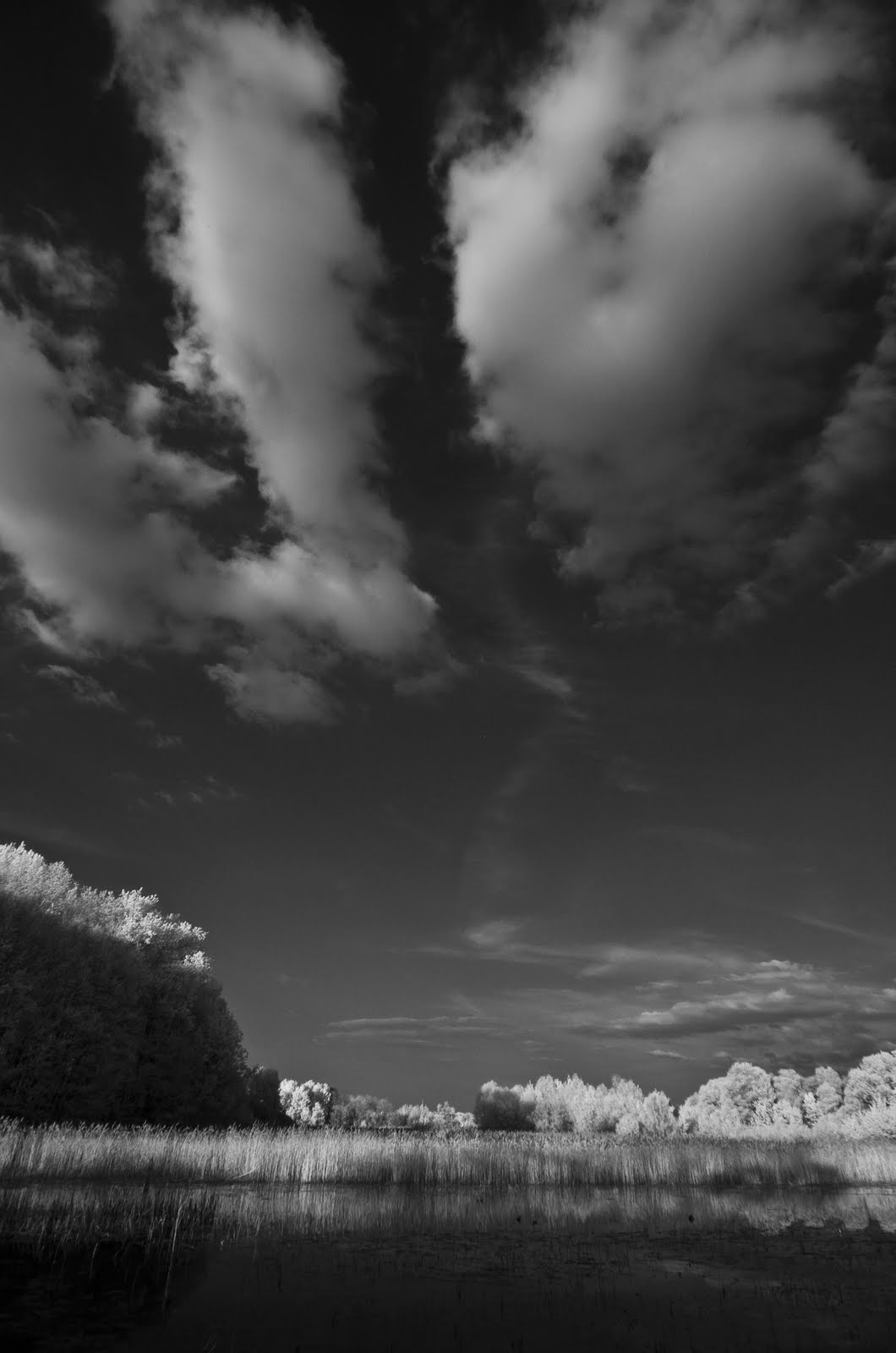
Guest photography from Jeziorki visitor Ryszard Szydło, over in Warsaw for an exhibition. Rysiek has had his Nikon D70 converted to take infrared black and white photographs*. His IR landscapes convey an ethereal and other-worldly vision, a poetry that appeals to the sublime aesthetic. (See more IR works from Rysiek's recent London exhibition here.) Click on all photos for enlarged version.

Above: ul. Dumki, looking towards the wetlands. Shadows from left to right belong to me, Ad the Lad and Rysiek, taking the photo. Strong sunlight and blue skies (which darken in IR light) add to the Wood Effect (which causes foliage to appear white).

Right: the wetlands at the end of ul. Trombity. A similar effect in the sky can be obtained by using a dark red filter when shooting b&w, but without the white foliage. Reminescent of the great landscapes of Ansel Adams, though the IR makes them more dreamlike.
Below: flooded field, corner of ul. Trombity and ul. Kórnicka. The field had only been sown last week; the continual rains and the high water table resulting from the volume of snow this winter have rendered Jeziorki's lower lying fields waterlogged. This time last year, there was a ban on entering the tinder-dry Las Kabacki forest!

Below: looking towards ul. Baletowa from ul. Dumki. The ploughed furrows with their flattened trapezoidal peaks are noteworthy.

Below: looking towards W-wa Jeziorki station (in the distance) from the pedestrian crossing at ul. Kórnicka. Low evening sunlight makes the trees look like they are covered in snow.

* An infrared filter blocks out all wavelengths of light visible to the eye and lets in only light in the infrared part of the spectrum. The filter is placed in front of the CCD sensor, so light meter readings, focusing and all other photographic functions are not disturbed. Digital IR photography, once the CCD sensor has been converted this way, is so much easier than with film, which had to be loaded and unloaded in total darkness.

Sunday, 9 May 2010

Slavic yearnings

Last week, on 3rd May, Poland celebrated the adoption of Europe's first written constitution in 1791. On the 9th, Russia celebrates the defeat of Fascism, VE Day.

Remembering my midnight conversation with Dr Halina, the Radio Maryja listener a week ago, I'm prompted to write about pan-Slavism, a significant undercurrent in Polish society and politics. She had a PhD from the University of Lvov and had travelled the length and breadth of the USSR. Despite her strong anti-communist, patriotic and Catholic stance, she had a clearly sympathetic point of view towards Russia, Ukraine and Belarus, their peoples and their culture.

Scratch a Pole and you'll find a German or a Russian. That one part of the Polish identity that comes from the west is organised, technically-minded and seeks order. That part of the Polish identity that comes from the east is poetic, spiritual, wild and disorderly, sentimental, fantastical in vision, determined and hard.

Genetically, eastern Germany is populated by germanised Slavs, decendents of the Sorbs, Wends and Veleti. Slavic populations have a high percentage of the R1a mutation of the Y-chromosome. To quote from the Wikipedia article:

In Europe, R1a ... is found at highest levels among peoples of Eastern European descent (Sorbs, Poles, Russians and Ukrainians; 50 to 65%).

With genetic science still in its infancy, we do not yet know what personality traits are characteristic of peoples of the R1a haplogroup. They are certain to differ (though by how much?) from peoples of the R1b haplogroup, who are predominant in western Europe.

It is possible to rewrite central and eastern European history, in particular the Drang nach Osten, Grunwald, the Teutonic Knights, the ostfront in WWI and WWII, as the struggle between the R1b and R1a haplogroups.

[Remember, that in any national group there is a significant minority of a haplotype other than the dominant one.]

So if there's a genetic as well as linguistic bond between Slavs - why are they split geopolitically between eurocentric western Slavs, fractured and fractious southern Slavs, and the north-eastern Eurasian landmass dominated by Moscow?

It is because of history. I've already mentioned the religion/alphabet split, but another reason why Poland, the Czech Republic and Slovakia have found it easier to absorb democratic ideas is their distance from oriental despotism. Russia has had a hard history. Under the yoke of the Mongol hordes, Russian people would watch their princes tied up and dragged through the mud for sport; those same princes that had failed to save their people from the random pillaging and raping of Genghis Khan's mounted warriors as they swept westward. And when the Golden Horde finally went home, those princes, humiliated in front of their people, had to somehow reassert their authority. To do so, they used zamordyzm.

Zamordyzm. The strong holding the weak by the morda - the snout. A lack of human respect, a lack of civilisation. Despotic command-and-control, denying dignity to the weaker party. Might is right. The Tsars did not go in for Enlightenment. Serfdom was only abolished in Russia in 1861; its scale far greater than slavery in the USA or British Empire (23 million serfs vs 4 million slaves in the USA and 750,000 in the British Empire at abolition).

Civilisation to me is above all society rising above the biological mammalian hierarchy whereby the alpha puts the others beneath him into the pecking order by force. Civilisation is politeness, manners, rituals. Noblesse oblige. "Hello Mr Jones, how are you, half a pound of lamb chops please, nice day isn't it?" as opposed to "Dawjcie mi pół kilo karkówki, dobra? " (There's less hypocrisy, though).

As human society evolved, so brute zamordyzm has given way to more subtle systems of political control whereby freedom is not taken but traded in exchange for someone else taking responsibility for your welfare. The feudal prince would give way to the mill-owner, the welfare state or the Supreme Soviet. Consenting to servility in exchange for freedom from want.

Radio Maryja listeners yearn (as does their entire age cohort across the former Soviet empire) for the certainties of communism - welfare, pensions, cheap food and housing, free healthcare. None of this could communism sustainably deliver, so the system imploded. The fundamental difference between the elderly veteran with his medals and Stalin badge in Red Square and a Radio Maryja listener in Częstochowa is Catholicism and Polish patriotism. Other than that, there is a bond.

I sense within the Radio Maryja mindset a yearning for some kind of a pan-Slavic union, a return to a simple life of religious observance, tradition, folk-song, crafts, extended families. On the issue of vodka and wild behaviour, I suspect there is ambiguity, although during the era of Soviet hegemony, the vodka bottle was ubiquitously used to cement pan-Slavic bonds.

(Is there something in the R1b haplogroup that makes people more likely to consent to servility in exchange for freedom from want? Probably not. Differences within groups are greater than between them. Could Bolshevism have taken hold in any other country than Russia? Probably not, though for historical rather than genetic reasons.)

Gazeta Wyborcza*, which in the Radio Maryja mindset is a judeo-masonic organ run by anti-Poles with a Brussels agenda, has initiated a campaign to light a candle for the fallen Soviet soldier on 9th May. Promoted by figures such a Andrzej Wajda (who spoke out against burying President Lech Kaczyński in Wawel Castle), the logic of the campaign is entirely human. The Soviet dead (as I wrote here) were primarily peasants and workers herded west at gunpoint to gain territory for the USSR, treated instrumentally as cannon fodder by Stalin. We should mourn them as victims, not as liberators or occupants.

There is ambiguity among Polish social conservatives towards Russia. On the one hand there is deep distrust of Moscow, tsarist partition, Bolsheviks invading in 1920 and 1939, and returning in 1944 to install their puppets for another 45 years. On the other, we are all Slavs, and Slavs should not be drawn, they say, into the clutches of Brussels and the morally bankrupt EU.

Politics aside, Poles need to draw a distinction between the Russian state and the Russian people. In matters artistic, musical and literary, there's so much in common between our souls. It's just that history and politics have got in the way.

* Another campaign currently being promoted by Gazeta Wyborcza and the Civic Platform City Hall is Kręć, Warszawo, aimed at getting people to cycle to work this month. Proof, if any is needed, that there is indeed a conspiracy of Jews, masons and cyclists.

Friday, 7 May 2010

Bleary eyed but well informed

I watched the BBC's UK election night special through to the wee, wee hours. I went to bed at around 3am Warsaw time, waking up just after 6 to carry on.

This is the first time I watched live streaming TV on the internet - it worked without a hitch even on TPSA's sloooow 1.3mb/s connection. Events such as general elections are where the internet beats traditional television hands down. In one window I've got live election video, headline results and a news feed containing tweets and blog links. In another window, I've got detailed results - seats, percentages, gains/losses, for each party. In yet another, I can check results by individual constituencies.

The BBC wheeled out its best-know political commentators and journalists with David Dimbleby as anchor; slick computer graphics presented by Jeremy Vine made a complex electoral system easy to understand, and Jeremy Paxman grilling successive trios of senior politicians in his characteristically brusque style that borders on rudeness.

It has been said in the run-up to the election - especially after the 15 April televised debate won by Liberal Democrat leader Nick Clegg that the new media were over-hyped and that old-tech TV was still the most potent force in shaping politics. To an extent. After Clegg's performance, the LibDems soared in the polls, briefly even overtaking the Tories, and consistently in second place ahead of Labour. On the night, the LibDems faltered, taking not 28-30% of the vote but a mere 23%. So much for the power of TV.

In the end, the exit polls got it right with great precision. At 22:00 UK time, the forecast number of parliamentary seats was Con 307, Lab 255, LibDem 59. The final outcome was Con 306, Lab 258, LibDem 57.

The turnout - 65.1% - was a surprise too. This compares to 61.3% in 2005 and 59% in 2001. And 53.8% in the Polish parliamentary elections of 2007 (and a pathetic 40.6% in 2005).

Final question posed by the pundits this morning - is a hung parliament the will of the British people?

For insight into what happens next, read Charles Crawford.

Thursday, 6 May 2010

Today's missing words

Three commonplace English words that came up in meetings today that don't translate readily into Polish:

Bully [n]. Osoba terroryzująca innych says Getionary. What - like Osama Bin Laden is a bully? Or in the sentence Pani synuś jest osobą terroryzującą innych?

Underwhelming [adj] (as in a politician's wooden manner in public). 'Overwhelming' is przytłacający. So what's 'underwhelming?' podtłaczający?

Fragile [adj]. Getionary gives delikatny (that's 'delicate' in my books), kruchy ('brittle', 'crumbly') and łamliwy ('breakable', 'prone to breakage'). 'Fragile - handle with care' is given as ostrożnie - szkło. Delikatny is the closest - but PWN Oxford gives ten English words for delikatny - but none of them are 'fragile'. 'The fragile peace was shattered by a single violent incident' - delikatny pokój był rozbity przez jedno gwałtowne wydarzenie?

Suggestions please!

Wednesday, 5 May 2010

Where's the sunshine?

I'm worried. Six days in a row now, dull, leaden skies bearing showers. Nothing unusual for London, but for Warsaw in early May - a worry. Having read about the Year Without a Summer (1816), when volcanic ash in the upper atmosphere screened out significant amounts of sunlight leading to failed harvests and epidemic, I worry about a repeat.

Should I worry? 1816's anomalous summer is thought to be caused by the eruption of Mount Tambora in April 1815, which spewed 160 cubic kilometres of ejecta into the atmosphere.

This spring's eruption of Eyjafjallajökull caused major disruption, but the amount of magma and ash spewed out of it was much lower than in the case of Mount Tambora. Still, after six days of unseasonable coolness and rain, I trust that better weather is on its way. It will soon be time for the Ice Saints. Before their arrival, early May is usually very pleasant in Warsaw.

Compare with the weather we enjoyed in May 2009, May 2008 and May 2007.

The bad weather is hitting my cycle commuting. The month is meant to be Warsaw City Hall's cycle to work month. Travelling around town today I've seen but two riders, both looking miserable.

Monday, 3 May 2010

Two Polands. Two anywhere elses?

Today is Poland's National Day. In 1791, Poland's parliament adopted the country's constitution, the world's second (after the USA) and the first in Europe. So national flags are flown; it's a day off work, and a good time to reflect upon what it is to be Polish. Indeed, or to be a national of any country on earth.

What exactly are the ties that bind a nation together? Are they stronger than that which divides it?

Language is key to national identity. It's what allows Pani Ewelina from the nice new house on the edge of town to converse with Pan Heniek in the village grocery store. It was language that held Poland's national spirit alive during the partitions when the country disappeared from the map of Europe for over 120 years. The Slavic word for 'German' is niemiec (or permutations around that). It means, literally, 'dumb one' (as in 'can't speak'). But go too far east, and the defining element is no longer linguistic but religious. Poles are of the Church of Rome. Christianity, introduced in 966, brought the Latin, not Byzantine, rite; more importantly, the written language of Poland uses the Latin, not Cyrillic alphabet.

When our children were born in London, my wife and I took the conscious decision to teach them Polish as their first language - just as we'd learnt Polish at our parents' knees in England a generation earlier. Moni spoke no English until she went to nursury school at the age of three and half; Eddie spoke no English at all until we moved to Poland. Only when the children started going to Polish schools did we revert to speaking English at home, so that they wouldn't lose it. I write in English a) because it was the language in which I was trained to write, b) to explain Poland to non-Poles, and c) so that advanced Polish students of English can read about Poland in English. [On growing up Polish in England. So that you know where I'm coming from.]

Binding a nation together is its music; the songs one learns as a child that one passes on. More than just nursery rhymes (which in PC UK are being sanitised so as to better reflect the diverse nature of British society). National anthems - God Save The Queen reflects a familiar stability, like the chimes of Big Ben. But intrinsically it does not stir me like the Mazurek Dąbrowskiego. The Church has had a vital role to play here. So much of the music that has kept Poland going through the dark decades of partition, Nazi occupation and communism has been been sung in churches. Boże coś Polskę, for example. Taught by parents and grandparents, folk song has also had an important role in binding the Polish nation together.

Other elements of national identity: costume - eroded totally by globalisation; cuisine - heading that way. Much as I enjoyed the excellent pierogi in Kraków on Saturday night, I also loved the prawn vindaloo I had on Wednesday in Saska Kępa. Fusion as a trend in cuisine means that food preferences will become more tailored to personal metabolic choice than where one lives.

National identity is about pride in one's country. I take pride in Poland and its achievements. Sports is an obvious category (Poland does well in individual sports - ski jumping, cross-country skiing, swimming, walking - and team sports like volleyball and handball)* . I take pride when I see Polish surnames achieving greatness in the field of science. (Sadly, Poles invariably do so in American, British or German universities or R&D establishments.) I take pride in Poland's economic achievements - delighting in the fact that it was the only EU member state to record positive economic growth last year. Or a new inward investment, or the development of Warsaw's skyline over the past decade. It gives me great satisfaction when impartial foreigners praise Poland in the international media. And I'm immensely proud that my daughter is proud to be Polish and proud to come from Warsaw.

Now onto the controversial part of this post.

Looking at the Polish nation, there's a clear split. Between those cultured, educated Poles, working hard to create wealth for themselves, their families and society; and those Poles that use the 'k' word with mindless frequency, drink for the sake of getting drunk, dump their old fridges, TV sets and beer bottles in the nearest forest and are generally not much use in a meaningful conversation about Mickiewicz, Chopin or Piłsudski.

But then there are two Britains. Prosperous, sophisticated Middle England and inner city Britain - 'broken Britain' - sprawling council estates, mums with five kids each of a different colour, squalour and hopelessness. The gulf between a middle-class family from picturesque rural Oxfordshire, well-versed in English culture, tradition and history, and a disfunctional family of inner-city council-flat chavs, out of work for generations, congenitally violent and unintelligent, is as great as that between a Kraków intellectual who'd kept Polish traditions alive throughout communism, and the inebriated, incoherent villager for whom life is a day-to-day struggle to find the cash for the next bottle.

I confess to having far more in common with a Polish, English, American, German or Russian intellectual than I do with a boorish uneducated Pole. Does this make me a representative of nie-Polska? Am I too cosmopolitan, too pro-EU, too open to the ideas of global business, too wishy-washy in matters of theological dogma, to be a true Pole? This seems to be the dividing line that Poland's social conservatives are trying to draw up in the wake of the Smolensk tragedy and in the run-up to the presidential election. Between Polska and nie-Polska.

On this, Poland's National Day, the country needs to be looking for commonality not division. Poland's elite need to reach into to countryside, to ensure that in human development terms, rural Poland can enjoy the civilisational benefits that urban Poland has. Access to education, culture, healthcare, broadband, public transport, opportunity. I think there's more hope for the Polish village than for Britain's decaying inner cities. Internal and external migration, investment (domestic and foreign), EU funds and above all, education, can break the cycle of rural despair. 'One Poland' as a slogan will happen when the Polish countryside becomes as rich and contented as Britain's green and pleasant villages.

* Britain's sporting excellence tends to be in bizarre areas of human endeavour where few other nations dabble - underwater wheelchair hockey, rowing (440m coxless nines), welterweight badminton etc.