Friday, 22 May 2015

Three days - three Polish cities

Back to Lublin - second visit within one month. Great! And two hours between the end of the event and my train, so lots of time to wander through an Athens of the er... north. Below: this is a reverse view of this photo taken a month ago.


Back to the Old Town. Here's the entrance to ul. Rybna, below. this time taken from back in the square. Compare to pic taken last month.


Below: I had a burger and a Spitfire ale (from Kent's Shepherds Neame brewery) at U szewca ('at the cobbler's')' and here is the view from outside the pub, looking across at Pl. Po Farze.


Below: time to make my way down the hill to the station, to catch the night train to Wrocław. On one side of the street, the splendour of the Old Town, on the other, early industry and workers' tenements.


All aboard the night train! I love Poland's night trains - I get into my berth in Lublin at quarter past eight in the evening and wake up nine hours later in Wrocław's beautifully restored station. Interestingly, looking at a map of Poland, I notice that Wrocław's only a teeny bit further south than Lublin. The two cities are 385 km apart as the crow flies, but the train does it 660 km in a giant serpentine route going as far north as Warsaw and as far south as Katowice. Still, nine hours from station to station means there's plenty of time for a good night's sleep.

Are you ready for the Night Train?

Puławy Miasto... Warszawa Wschodnia... Opoczno Południe... Dąbrowa Górnicza... Sosnowiec Główny... Kędzierzyn Koźle... Opole Główne... Night Train, Night Train, NIGHT... TRAIN!


Below: quarter past five in the morning, looking up from the passage linking the platforms.


Below: looking at the original platforms, now the booking hall (the tracks are to the left). I'm picked up by car and driven to Oleśnica for an excellent manufacturing event at GKN Driveline's factory.


Below: heading back to Wrocław along the S8 expressway, over the Odra river. A vast amount of new infrastructure has emerged in an around the city.


Below: back at Wrocław station to catch the evening Pendolino service to Warsaw. Third time I've caught this train since the Warsaw-Wrocław service was launched. And each journey was on time.


Back in Warsaw, meetings, preparing more meetings. E-mails by the score. An intensive week's work. Nighttime skyline below shows Poland's progress. Just before the cisza wyborcza, let me make an appeal to vote to secure stability and predictability on Sunday.


Morning, Jeziorki. Below: On my way to the station, dandelions in seed. Less than eight miles from the scene above, Warsaw is a compact capital compared to London. I much prefer living in Warsaw to London!


Half an hour by train from W-wa Jeziorki to W-wa Śródmieście and I'm walking past the Palace of Culture again on my way to the office. A long week made all the more interesting by the change of scenery.


This time three years ago:
Part two of short story The Devil Is In Doubt

This time four years ago:
"A helpful, friendly people"

This time five years ago:
A familiar shape in the skies

This time six years ago:
Feel like going home

This time seven years ago:
Mr Hare comes to call

Sunday, 17 May 2015

A book that explains so much - Poles in post-war Britain

Every now and then a book comes along that changes the way I look at the world. But here, rather, is a book that moved me for another reason. It consolidates many of my thoughts and memories. I feel has been written for me, and for every Andrzej and Rysiek and Basia and Ewa born in Britain in the 1950s and '60s.

Nothing written - in English or Polish - to date has come so close to capturing our generation's unique experience, the children born to Poles washed up on Albion's shores, having survived the horrors of WWII - be it deportation to Siberia by Stalin or living through the Nazi occupation of Poland.

With Blood and Scars, by B.E. Andre, is a story is told in two intermeshing plots. One, is narrated by a ten-year old girl growing up in 'Polskaland' in 1960s Manchester, the other, by the same person, now a middle-aged woman in contemporary Manchester, watching her father, a wartime survivor, dying of cancer.

Before going into the novel's Polishness, there's the 50-year timeshift, from Opportunity Knocks and wrestling on black-and-white TV to SMSs and Facebook, from typewriters to laptops. The way 1960s Britain - all Green Shield stamps, Pick of the Pops, thruppenny bits, ten-bob notes, Kensitas and Woodbines, Morris Minors and Ford Corsairs - is portrayed by the author with attention to detail worthy of a Dutch Master. No item of everyday life goes unnoticed.

Like West London, 1960s Manchester was already experiencing mass migration - the ten year-old narrator's best friends were the children of migrants from Ireland, Jamaica, Italy and Cyprus. And of course Polish. 'Polskaland' in Manchester in those days was quite specific, with social life centred around 'Kombo's' (Dom Kombatantów or kombatanci) and the Polish church. Poles worked in handbag factories, sent their children on kolonia to Penrhos and lived in the near-past, of a Poland overrun first by Nazis, then the Soviets, betrayed by Churchill and Roosevelt at Yalta.

Reading With Blood and Scars, I feel that my generation - Poles born in the UK in the post-war decades - finally have a voice. To date the nearest approximation has been A Short History of Tractors in Ukrainian, by Marina Lewycka, touching on many of the inter-generational issues that UK-born post-war Poles face in common with others from the same part of the world. With Blood and Scars has the bonus of a being wonderful journey down memory lane of childhood in a country beginning to emerge from post-war austerity, as colour came into the drabness in the form of the impending 1970s. But compared to post-war Poland, Britain was paradise.

With Blood and Scars treads with commendable sensitivity in the area of wartime Polish-Jewish relations.

This is clearly a book that deserves to be translated into Polish. It is a testament to the 200,000 Poles - and their children - who lived in Britain while Poland was enduring 45 years of communism. It explains why we UK-born Poles are as we are - shaped by an upbringing in the shadow of Yalta, Saturdays at Polish school in the mornings, Polish scouts in the afternoon, Sunday mornings at Polish church - while our British contemporaries had the weekend off.

What was the point of being brought up Polish? asks the ten year-old protagonist of her father, who bellows at her: "You will go to Polish school! And you will be proud of your legacy!"

It is also a book to any Brit who grew up alongside Polish children - at school, at university. With Blood and Scars explains why we were - why we still are - the way we are. And it is a book for the next generation - the grandchildren of those political refugees who sought shelter and a new life in Britain after the war. It deserves a massive readership of anyone touched by Polishness in the UK.

Youthful memories inspire great art. I am minded of the Coen Brothers' A Serious Man, dwelling on their Jewish-American upbringing in Minnesota, the action set around the same time. First alcohol, first smoke, first snog - rights of passage are just as critical in the process of winkling out the essence of our existence as is facing the death of loved ones. Delving into memories, funny, sad, from one's formative years is a great source of truth about our human lives.

Above all this is the story of what war does to people. And to their children.

You can buy it from Amazon (click here).

This time last year:
We can all take photos like Vivian Maier - can't we?

This time two years ago:
Ethereal and transient

This time three years ago:
Wrocław railway station before the Euro football championships

This time four years ago:
By tram to Boernerowo

This time six years ago:
Food-Industrial Shop, rural USA or Poland

This time eight years ago:
Twilight time, Jeziorki

Saturday, 16 May 2015

More classic cars from London's streets

An old car is more than a means of getting about - it is a moving, working piece of industrial and artistic heritage that should be preserved, fussed over and passed on for The Ages. It is good to see so many lovely classic cars still in use on London's streets. Cars made in Britain, on the Continent, in the USA. Here are a few I captured on recent trips to London.

Below: A late-production Rolls-Royce Silver Shadow. These are still relatively available and affordable (there's a shop in Hanwell that sells nothing but second-hand Rollers).


Below: another Silver Shadow of similar vintage though the personalised number plate obscures the date of manufacture. This stately classic was in production from 1965 to 1976; the Silver Shadow II with cheaper bumpers was built from 1977 to 1980.


Below: rarer, sportier and far more exclusive than the Silver Shadow, more the vehicle of the cognoscenti - the Bristol 410. Dating back to 1969, so concurrent with the Shadow, the Bristol 410 is the gentleman's sporting carriage par excellence. One of just 82 built; I'd hazard a guess that the vast majority have survived to this day.


Below: also from 1969, an early Porsche 911 parked outside the British Museum shows a different approach to sporting cars. The emphasis is on performance rather than prestige.


Below: utilitarian and built for the masses, a 1978 Renault 4 captured on the leafy streets of Ealing. One of eight million (!) built between 1961 and 1992. The Renault 4 has a shorter wheelbase on the left side than on the right because of the staggered torsion bars used in the rear suspension.


Below: a Scandinavian classic, also spotted in Ealing. A Volvo 144 dating  back to 1971, this side view shows the purity of the design, which was in production from 1966 to 1974.


Below: although American car manufacturers didn't bother selling their oversized behemoths to Britain with its quaint mediaeval streets, many enthusiasts of Detroit steel imported them privately. Here in Soho we see a 1967 Dodge Dart. "I got my AM radio on".


Below: Hanwell W7 is the setting for this late-70s muscle car - a Pontiac Firebird. Note that all three American cars have British registration numbers (from which you can date the vehicle), but they have been stamped in the US style for authenticity.


Below: "You traded the microphone for a Caddy?" Jake would not have approved. This 1978 Cadillac Coupe de Ville parked on Russell Square was not in the best of health, with rust bubbling through all over its flanks. But from the front, the massive grille still looks impressive.


I hope in years to come, the streets of Warsaw will be also be full of beautiful old cars, well cared for by their owners. If you want to impress, a stand-out classic does the job so much better than a brand new black SUV.

This time three years ago:
Photography and the Law of Diminishing Returns

This time four years ago:
A night at the Filters (Museum Night 2011)

This time five years ago:
Warsaw's Museum Night

This time six years ago:
Exploring my anomalous memory events

Friday, 15 May 2015

London celebrates VE Day

No vainglorious victory parades staged to boost the popularity of the Leader; rather a celebration by the people. Last weekend I was in London and had the chance to see how the city commemorated the 70th anniversary of the end of WWII in Europe (the war dragged on in the Pacific for another three months). What struck me as I wandered through St James's Park was the fact that much of what was on show was the property of private enthusiasts; collectors and reenactors who volunteered their hardware in a common commemorative show.

London was as packed as ever it is with tourists, but The Mall was drawing them in, walking up towards Buckingham Palace, with smaller numbers filtering through the park to look at the military vehicles on display. Let's take a look at them...

Below: A Bedford QLR four-wheel drive radio truck from 1944. Note the white star on the side, the insignia of all Western Allied forces after April 1944; prior to that, from 1942, used by the US Army alone (sometimes with a circle around the star).


Below: Bren Gun Carrier, the most widely produced armoured vehicle in history, with 113,000 built.


My mother has a photograph of herself (below, left) in a Bren Gun Carrier along with her sister Irena (second left) and colleagues from the Polish Army. Egypt, 1945.


Below: A Canadian Military Pattern truck by Chevrolet. Canada's biggest single contribution to the war effort was producing well over half a million of these trucks that kept Commonwealth, US and Soviet (thanks to Lend-Lease) forces on the move against the fascist foe. Note the characteristic reverse-sloped windscreens; these reflected the sun's glare downwards so that enemy pilots would not see the reflections.


Below: another CMP truck, this time by Ford. Now, before the war, Ford and Chevrolet (General Motors) were deadly rivals in the automotive sector in the Americas and Europe; once the war kicked off the two worked together on maximising production of military vehicles.


Below: a Daimler Dingo armoured scout car. A successful design, in production from before the outbreak of WWII and in service into the late 1960s.


Below: the original SUV? The Humber 'Box' Heavy Utility Car featured four-wheel drive and accommodation for six people. A staff car with excellent cross-country abilities.


Below: a Jeep as used by the Long Range Desert Group, the forerunners of the Special Air Service. Carrying vast amounts of fuel and ammunition, the LRDG would penetrate deep behind Axis lines and attack enemy installations such as fuel and ammunition dumps and airfields.


Another Jeep, below, this time in the markings of a Royal Navy beach master's vehicle at D-Day, a perilous task to undertake, marshalling the invasion forces as they disembark from the landing craft.


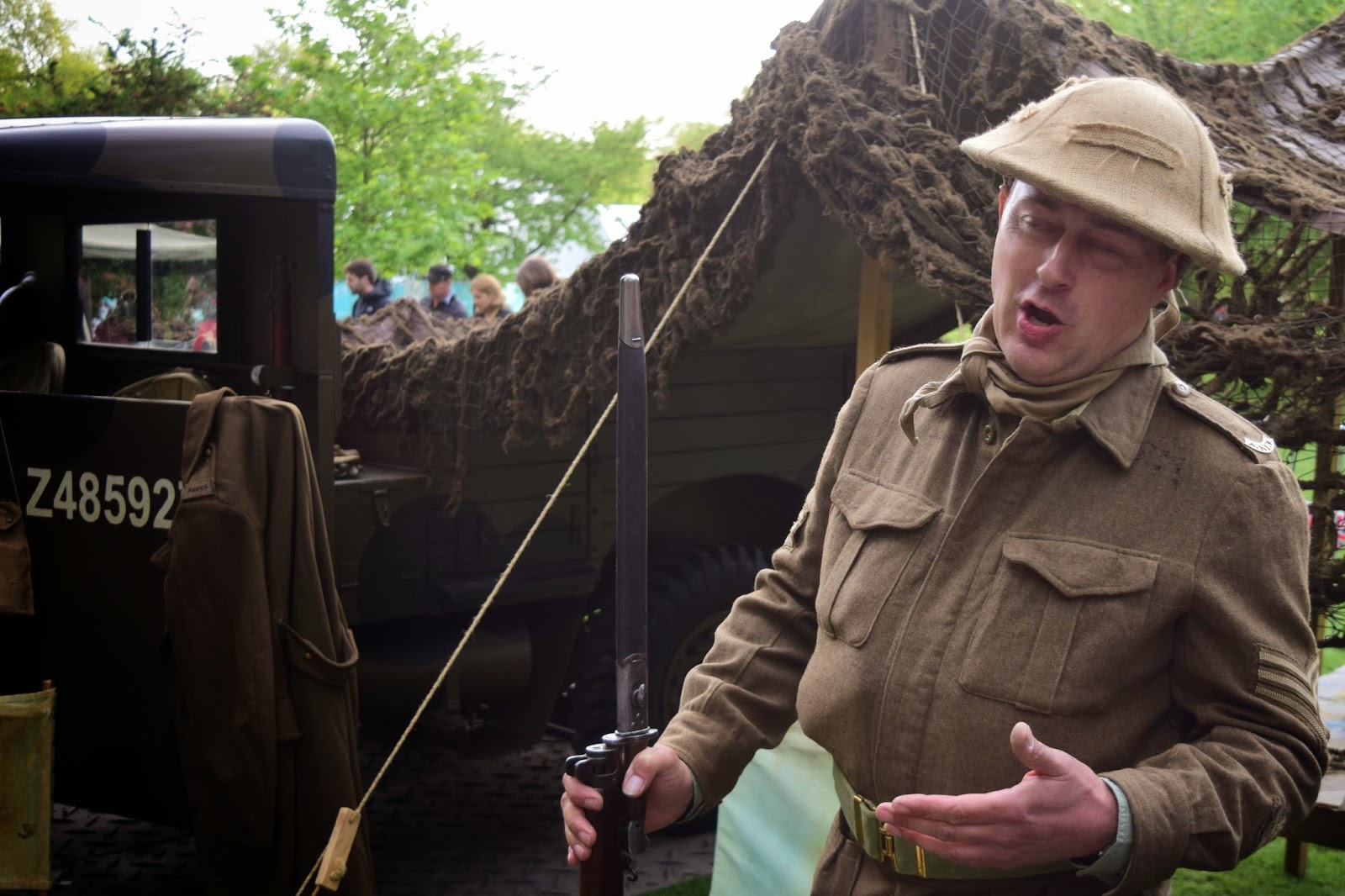
Below: there were plenty of reenactors in period uniform around St James's Park. This chap was explaining to a small crowd of tourists about his weapon, the Short Magazine Lee Enfield rifle.


Below: a Supermarine Spitfire, the legendary aircraft which served as the RAF's main fighter from the beginning of the war right through to Japan's surrender. This is a Mk I, with a 1,030 hp Merlin engine. By the end of the war, Griffon-engined Spitfires had 2,340 hp available.


Below: a Hawker Hurricane, the mainstay of the RAF during the Battle of Britain. Not as fast or glamorous as the Spitfire, the Hurricane was sturdy and manoeuvrable, and in the hands of the Polish pilots of 303 Squadron, could shred German bombers with close-range blasts from a battery of eight machine guns.


And a propos of the Battle of Britain, let us not forget that 119 Polish pilots, whose names (below) are to be found on the Battle of Britain Monument on the Embankment by Westminster Pier, took part in the fight to save Britain from Hitler's Luftwaffe. The memorial has the names of the Polish pilots on an engraved representation of a Hawker Hurricane tailfin. Click to enlarge.


On the other side of the monument is a near-life size sculpture of fighter pilots scrambling to their aircraft. Sculpted by Paul Day (who is also responsible for The Meeting Place at St Pancras Station), the figures emerge with dramatic dynamism from the monument.


As we're at the Embankment, let us now take to the river. Below: museum ship HMS Belfast has been moored by Tower Bridge since 1971 (!). This light cruiser, armed with 12 six-inch guns, served in WWII in the Arctic Convoys to Russia and during the Normandy Landings. The Belfast also saw action during the Korean War.


Below: HMS Ocean, the flagship of the Royal Navy's fleet, (now down to 19 ships and 33 admirals). I wonder whether this ship was named after popular singer Billy Ocean or painter and Royal Academy professor, Humphrey Ocean. Now, HMS Ocean, launched 20 years ago, may look like an aircraft carrier, but it is naught but a helicopter carrier and amphibious assault ship.The Sea King helicopter on the aft deck is a design that first flew in 1959.


Below: searchlights form a 'V' for Victory over St Paul's Cathedral, as viewed from the river.


I was impressed at the way this anniversary was commemorated in London; the right scale, a human focus on remembrance - not on triumphalism.

This time two years ago:
Malodorous passengers on Warsaw's public transport

This time four years ago:
Inside Filtry - Warsaw's waterworks (Museum Night 2011)

This time five years ago:
Warsaw's Museum Night 2010

This time six years ago:
On Transcendence

Wednesday, 13 May 2015

Trafalgar Square then and now

"Icon -n.  a person or thing that epitomises a certain set of qualities or values." Two icons here - Trafalgar Square, one of the must-see destinations for any tourist visiting London; and - at the personal level - a pair of photographs taken by my father before my birth. These photographs, elegantly framed, have always been in my parents' house. One notices them, and one doesn't - the English phrase 'part of the furniture' is apt. But they intrigue me - and so, at the end of a five-day visit to London, I set out to replicate them with a contemporary update of my father's vision. At the time, in the early years of Queen Elizabeth II's reign, he would have been here as a Polish political refugee in his early 30s, washed up on Albion's welcoming shores, armed with a camera, and in awe of the Capital of Empire.

His camera was a wedding anniversary gift from my mother, a Finetta-Werk Finetta IVD with interchangeable 43mm f4 Finetar lens. So then - here we are. North side of the square, the facade of the National Gallery... Note the cars - from the left, a pre-war Ford Model Y, a Ford Consul Mk I, and to the right, a Humber Hawk VI, in production from 1954 (which gives the photo a 'no-earlier-than' date). Click on the image to enlarge.


...And today. The roadway outside the National Gallery is now pedestrianised; the trees lining the road have been removed. As have the pigeons, once a familiar feature of the square, chased away by previous Mayor of London, Ken Livingstone. Trying to copy my father's composition precisely, I move this way and that (with my Nikkor 18-55mm zoom set to emulate a 43mm lens on 35mm film) until I'm (nearly) there.


Below: a view of St Martin-in-the-Field, on the north-eastern side of the square, with South Africa House to the right, and a puissant fountain in the foreground. This picture won my father first prize in the annual photographic competition at his company.


Below: the same scene today? The composition isn't right. Only when comparing the two did I realise why. The plinth bearing an equestrian statue of George IV on the left side of the photo. Was it moved? Were I to replicate my father's composition, I've have had to move round to the left, and the plinth would have blocked the view of the church's facade. And the water pressure in the fountain is a shadow of its former self, while the overhanging tree in the foreground (close to Nelson's column itself), is gone.


We now live in an age of selfie-sticks and iPads, Boris bikes, hi-vi vests, roller blading, trainer-liners, hipster beards and smoothies. But behind the superficial ephemera of our lives is something profound and enduring. It's worth scraping away the contemporaneous flim-flam with the scalpel of consciousness, and learn to appreciate that which abides.

This time two years ago:
Reflection upon the City Car

This time three years ago:
Biblical sky

This time five years ago:
Travel broadens the spirit

This time eight years ago:
On the farm next door

Tuesday, 5 May 2015

Cameras - you gotta justify the buy!

When a blogger buys a new piece of photographic equipment, you can bet there'll soon be a post justifying the purchase, comparing the old to the new and why that new bit of kit just HAD to have been bought.

So then - after writing recently that I'd not buy a Nikon Coolpix A - what did I do?

I bought a Nikon Coolpix A.

Why? The price was so utterly, unbelievably, right, well, I just couldn't walk away from the deal.

When the Coolpix A was launched less than two years ago, it was priced at $1,100. Now this is twice the price of the Nikon D3100, built around the same 16 megapixel sensor BUT - the D3100 is single-lens reflex with a 18-55mm zoom lens with vibration reduction; the Coolpix A doesn't have a viewfinder or any viewing system other than an LCD panel on the back wall. You compose your shot like you do on a mobile phone.

So why did Nikon decide to sell the Coolpix (dumb name) A for $1,100? It's a quality camera, with a metal - not polycarbonate - body, a quality fixed focal lens (18.5mm - equivalent to 29mm on a full-frame or 35mm camera) opening half a stop further than the kit lens of the D3100 to f2.8.

Er - and that's it. Other than the fact that the Coolpix A weighs less than half of what the D3100 does, slips into the pocket and, at 300g, hangs round the neck all day long without being noticed.

The Coolpix A is not a street-shooter's camera. It's too slow for catching people on the move. It's best for landscapes - the traveller's ideal companion. For me, a camera to take on rides, where the weight and bulk of a DSLR is too much, but where my smartphone's camera function is insufficient for reasons I'll go into.

Back to the price. When I saw a Coolpix A (recently discontinued by Nikon) on sale at 2,000 złotys ($550 - exactly half the launch price), I was still not tempted. But with a further 500 złotys rebate, the price tumbled to just over $400. 25% off half-price? Now this is a steal.

OK - justification time. Three pics to show how three camera compare.

Below: Nikon Coolpix A - a pleasing, warm colour cast (white balance on all camera set to auto).


To shoot with the Nikon Coolpix A:
1) Switch on,
2) Compose,
3) Press shutter button down halfway,
4) Wait for autofocus to latch onto subject, and when the little green box on the LCD shows you have a sharp image -
5) Depress the shutter button fully.

******************************************

Below: Nikon D3300 (with 24 megapixel sensor). Neutral hues, larger image thanks to more pixels crammed onto sensor. The D3300 replaced the D3200 in my fleet; it has the same 24MP sensor, but is lighter, has a smaller 18-55mm lens, and has a number of small improvements that got my thumbs up.


To shoot with the Nikon D3300:
1) Hold up to eye,
2) Compose,
3) Press shutter halfway down, wait a millisecond or two for focus and
4) Click. By far the fastest of the three.


********************************************

Below: as seen through my Samsung Galaxy S3's camera function. This is an 8-megapixel image.


To shoot with the Samsung Galaxy S3:
1) Switch on phone (button on the bottom),
2) Swipe screen to unlock,
3) Close whatever app is invariably up on the screen (typically during travel, it will be Google Maps, or Bilkom, or Strava),
4) Select 'camera' icon from among all the app icons on the home screen,
5) Wait for image to come up on screen, then compose (really difficult in strong sunlight),
6) Press the shutter-button icon at the bottom centre of screen.

**********************************************

I've done a few bike journeys equipped with only a phone to take photos with - it's certainly suboptimal. But going for a long ride with a DSLR dangling around your neck - even a lightweight one like the D3300 - is not a viable alternative. A quality mirrorless camera like the Nikon Coolpix A is a good compromise. It has superb battery life. If you're more interested in people than landscapes, the Fujifilm X100T is a better bet than the Nikon Coolpix A. The lens is less wide (equivalent to 35mm on full-frame), shooting is faster, there's a viewfinder as well as an LCD screen. The X100T is the second incremental improvement on the original X100, which I tested a while back.

If you can find a Nikon Coolpix A at a Nikon dealer near you for 1,500 złotys (after cashback rebate), buy it; for the money it's a superb little camera.

This time last year:
More about the Ladder of Authority

This time two years ago:
By bike, south of Warsaw

This time four years ago:
Functionalist architecture in Warsaw

This time five years ago:
What's the Polish for 'to bully'?

This time six years ago:
Making plans

This time seven years ago:
The setting sun stirs my soul

This time eight years ago:
Rain ends the drought

Monday, 4 May 2015

New office, new views

As of the end of April our office has moved again - to the fifth address is less than five years. From ul. Fabryczna in Powiśle we moved in November 2011 to Śródmieście - first to ul. Nowogrodzka, from where we moved to Al. Szucha in November 2012; thence to ul. Marszałkowska in November 2013. Now we are at ul. Zielna (lit. 'Herbal Street'), entrance to the office from the charmingly named ul. Bagno (lit. 'Bog Street'). It's a shame to leave the plushness of the British Polish Business Centre, set up thanks to the generosity of HSBC Polska, not only splendid offices but a superb - and superbly located - events venue, which has played host to several British and Polish ministers and many more VIPs.

Below: the outside of the old British Polish Business Centre. The front door's open - we're about to hold the very last event, before moving up the road to the new office


Below: 15 tons of letters on my desk no more. Desks no more. On the road again. Not far... one tram stop further north.


While the new office is neither as big nor as prestigious, it is modern, spacious and well-located, right by the entrance of Metro Świętokrzyska, the interchange station for the two Metro lines. For me it's a 1,200-paces walk from W-wa Śródmieście station rather than 600 paces so a chance to get a bit more walking in each day. Below: view looking towards the new office from the entrance of Śródmieście station - marked in with a circle of red.


Past Plac Defilad, where the communist bigwigs took the salute from the march-pasts, now a bus terminus. This area is under-utilised; it should be stacked high with 60-story skyscrapers that block out views of Stalin's Palace of Darkness.

One block northward, across ul. Świętokrzyska, the next road parallel to Al. Jerozolimskie. To the right, the PASTA building, with the Polska Walcząca logo on the roof, the site of the some of the fiercest fighting of the Warsaw Uprising. The building was situated over the main telephone links between Berlin and the Eastern Front. We're in the new building to the south of PASTA, up on the ninth floor.


And from the office - what a view, below (click to enlarge). The vastness of Plac Defilad is evident in this photo. Before the road, this area would have been occupied by ul. Złota and ul. Chmielna, both dissected by the land upon which sits the Palace of Culture. Something in the sky...


Looking across from my desk to the east, there's the old Prudential building to the left - Warsaw's highest building before the war, featured in iconic photos of the Uprising as it's being bombed. It survived to become the Hotel Warszawa after the war; a remont of the hotel started in 2010 has stalled; the crane on top has been standing idle a while. Note to the right of the pic, the empty plot where the old Sezam used to stand until recently - gone is the communist world's first Scottish restaurant.


I hope we'll stay here for a while to come; packing one's things every year and a bit gets a bit tiresome!

This time last year:
Workhorse of the Free World's Air Forces over Jeziorki

This time two years ago:
Looking for The Zone, in and around Jeziorki

This time four years ago:
I awake to snow, on 4 May

This time eight years ago:
This is not America. No?

Friday, 1 May 2015

45 years under one roof

It was exactly 45 years today that my family moved from Croft Gardens in Hanwell to the heights above West Ealing by Cleveland Park. On 1 May 1970, from end-terrace to detached house in one jump. Our new home was unique; its atmosphere on the day we moved in remains with me still.

The previous owner was the only child of its creator, a naval architect who specified plenty of Canadian oak - for flooring, staircase, kitchen larders, bathroom cupboards and built-in wardrobes for the house, which is unique. Solid and square, with metal windows by Crittall-Hope, it was built in 1933. The previous family owned it for 37 years; my parents have now occupied the house for the longer part of its history.

When we moved in, the atmosphere was late-Edwardian with Art Déco touches. The bookcases were left with the books from a pre-war childhood; Hugh Lofting, Arthur Ransome, Kenneth Graham. And the smell of hair lacquer from a left-behind can, used as fly-spray. My bedroom, then decorated with eau-de-Nil wallpaper, faced out over a long garden, a beautiful willow and views (now obscured by more recent housing developments and taller trees) ranging from Northolt Airport across to Wembley Stadium. In the summer, from my bedroom window, I could watch the setting sun across distant fields by Ickenham.

Up in the dusty attic, accessible via a slide-out wooden staircase, we found Edwardian trunks containing WWII gas-masks, porcelain chamber-pots, Harrod's tea chests and earthenware hot-water bottles. The electric system in the house was pre-war, with three round-pin plugs rather than the modern square-pin ones. There was also a water-softening system which relied on crystals and a separate tank in one of the kitchen larders. And there were two toilets - the one upstairs had a high-mounted cistern, flushed by a long chain, the loo itself by W.N. Froy of Hammersmith.

To this day, the bathroom has original 1930s tiling, and the bath taps (hot and cold - no mixers!) are by W.N. Froy. Most of the oak features remain, only the solid landing bannister has been lowered to let more light in on the staircase.

In the garden grew plums, asparagus and fennel, the smell of which I still associate with moving home. And at the end of the garden was Robinson's Nursery, soon to be closed and developed as a housing estate. I could sneak in at night and explore the deserted sheds and huts.

And across Argyle Road, Cleveland Park (below), where I'd go with my brother to play with our Action Man toys while our parents unpacked the contents of one house into the new one. The park also offered views of Harrow Hill and Horsenden Hill, as well as the railway line running into town. At this time of year, the park was in bloom. Everything was new and exciting, far posher than Hanwell and its dense terraced housing, and there was so much new to discover.


The house-move was a watershed in my life, coming just months after I'd started grammar school. The sixties - dull, grey, lower-middle class - had ended, and the seventies - a vastly more colourful decade - was just beginning. Black and white 405-line TV yielded to colour TV in 625-line definition, black and white family photographs, painstakingly developed and printed by my father in a blacked-out kitchen darkroom at Croft Gardens, gave way to colour snaps, and within nine months, shillings and pence would be replaced by decimal money. And the next four summer holidays would be spent under tents with the Polish scouts.

West Ealing was far more Polish than Hanwell. A glance through the 1970 edition of Kemp's Directory shows how many Polish surnames there were back then on the streets running off from Cleveland Road towards St Stephen's Road and Gordon Road to the south, and the streets running off from Pitshanger Lane and Brunswick Road to the north. This is essential Ealing, to where aspirational Poles moved houses to.

This is still the desirable part of West London, well-connected to town by public transport (in a few years time the Western Region and Central, District and Piccadilly line tube trains will be joined by CrossRail). There is plenty of greenery all around, with parkland stretching from corner of the road all the way down to the A40 at Perivale and across to Hanger Hill.

The house my parents paid just under £10,000 for in 1970 is valued at around a hundred times as much today - price inflation having pushed the purchasing power of £10,000 then to £126,000 today. So London house-price inflation has been some eight times higher over the past 45 years than general consumer-price inflation. Ah - I forgot to add that in 1978 my father added an extension to the back of the house, perfectly in keeping with the architectural style and using the same building materials as the rest of the house.

My father (below) at the age of 92 still keeps the house in order. Here he is atop a ladder on the top landing of the staircase, fixing the curtain runners.


I spent six and half years living at Cleveland Road as a teenager before going to university; upon my return I lived here for another two and half years doing my postgraduate studies in London, then while saving up for a deposit on my own house in Perivale. So in total, of the 45 years my parents have lived at this address, I spent one-fifth of that time here myself, but it's still home to me, and I feel a deep connection with these bricks and this patch of land.

This time three years ago:
May Day in the heat (it was 31C in Warsaw!)

This time five years ago:
Bike ride across rural Poland

This time eight years ago:
Mazovian landmark from the air