Tuesday, 16 June 2015

Central Warsaw railway update

It's been 170 years since the railway first came to Warsaw... On 14 June 1845, the first passenger train left Warsaw, bound for Grodzisk Mazowiecki. This was less than 15 years after the world's first passenger service - the Liverpool and Manchester Railway - opened. It took three years for the Warsaw-Vienna Railway to reach the border with the Austrian Empire; from 1848 rail travel between the two Central European cities became possible. The opening of the first stretch of the Warsaw-Vienna Railway is commemorated in a piece of officially sanctioned street art (below) on a retaining wall at W-wa Ochota station, and it puts Polish rail travel into a historical perspective.


Today I retraced my steps of a journey I did last year (then to avoid a deluge, today to check what's new at Centralna).

So then. Meanwhile, back at W-wa Centralna, the westernmost underground passage - the only one to have escaped a refit prior to the Euro 2012 football championship - is now being rendered fit for the 21st Century. Gone are the stragany selling burnt casein sandwiches and pączki, flick-knives, paperbacks and second-hand mobiles. I guess once this passage is ready, its new retail residents will be Relay, Victoria's Secret and Starbucks and other global brands, rather than Heniex and Ziutex. Still, it will lift the rather downbeat and oppressive tone that lingered on down here.

Below: The Narrow Way. The builders are in. Not a place to be when dozens of passengers are simultaneously rushing for their trains hither and thither with suitcases, unsure of where they're going.


Below: The place is changing beyond recognition; where are the old stalls, the old booths? The wheelchair ramp makes access easier at this, the northern end at least.


Typical. As ever, whenever Polish railway termini* are being refitted, there's a dearth of passenger information. These two are lost (below); there's no signage telling them which platform they are at, nor which train will be leaving from here. Just acres of plasterboard (gips-karton) and posters. "We're doing a remont. Let's take down the platform number signs from the ceiling six months before we get round to actually doing the ceiling."


Below: how it looked back in March 2012. The rest of W-wa Centralna had by then been refurbished, but the western passage was overlooked in the process. Note the Peron 4 sign.


Below: Ah! My favourite shot. Shoving the camera's snout through a narrow gap in a hoarding to catch a glimpse of what lies behind. Secret passageways, masses of work before this lot's ready!


Below: looking northward along the western passage. The slogan (right) reads: Zmieniamy dworzec dla Ciebie - 'We're changing the terminus* for you. The works will have been completed by the end of this year'. No doubt there'll still be many months before the completed retail units have been leased out to commercial tenants.


And on, out of Dworzec Centralny, and down the ramp to the WKD terminus (below). Warszawska Kolej Dojazdowa - a light railway line linking Grodzisk Mazowiecki and Milanówek, Warsaw's south-western exurbs with the city centre. Using a mixture of modern (hidden in the background, right) and early-1970s rolling stock, the WKD is a cross between a tramway and a proper railway.


Warszawa Śródmieście WKD is a strange station; the single platform is long, passengers disembark at the western end of the platform (below), the train then crosses the track, shunts backwards then forwards to the eastern end of the platform where passengers embark to head off towards Grodzisk.


I exit the WKD station and westward proceed along Al. Jerozolimskie until I reach W-wa Ochota station (below). Now I'm on the main suburban platform; across the track is the W-wa Ochota WKD platform. The main suburban lines and the WKD run parallel until W-wa Zachodnia, and beyond there, they all go their own separate ways.


Warsaw's commuter railways - WKD, Koleje Mazowieckie and Szybkie Koleje Miejskie (SKM), are all experiencing increasing - indeed record - numbers of passengers. It is good to see investment and growth, fewer breakdowns, ever-improving punctuality and reliability. In a civilised world, rail - after nearly 200 years - remains the optimal way of moving people into city centres.

* Dworzec and terminus seem to mean the same and yet don't - the word 'terminus' suggests a termination; in England, the home of railways, the line running into London didn't cross the city - they terminated at a dead end - Paddington, Marylebone, Euston, King's Cross, Liverpool Street etc. In Warsaw, the main railway line crosses through the city centre and does not terminate, but emerges out at the other side. Dworzec means 'courtyard' - different etymology altogether.

This time three years ago:
Poland's night train network

This time four years ago:
On a musical note

This time five years ago:
Standing stones

This time eight years ago:
The year nears its zenith

Saturday, 13 June 2015

Another long walk to Czachówek

Not a 03:50 start; this time I left home at 14:00, bound for Czachówek, on foot, a different, more direct way. It's hot and sunny, over 30C in the afternoon, and the stormclouds had yet to start building ahead of the heavy downpour that would hit Jeziorki 12 hours later.

But first, a word of warning. This is the prime season for ticks, and they are out in force this year. Ticks are nasty, evil little beings. They have adapted to drop from foliage onto passing mammals, and then suck their blood. And often as not, the ticks carry parasitic or bacterial diseases that all too easily enter the human bloodstream.

2015 is a boom year for ticks. Everyone says so. Pan Wiesław and his wife and dog went into the forest and came out to count 20 ticks upon themselves. Our cat Czester has brought back several this season, all dead thanks to his anti-tick collar.

So it's long sleeves, long trousers, long socks, stout shoes and a bush hat for me whenever I'm out and about in the countryside at this time of year, despite the heat. Below: here's a tick I found on my white shirtsleeve, between the elbow and the wrist (click to expand photo). It had not yet managed to make its way to my armpit (a favourite place for ticks to screw their snouts into human skin) or gorge itself on my blood. Light-coloured clothing makes it easier to find them when you emerge from the woods. Niepozorny, isn't it?


It's not just ticks you need to worry about in rural Mazovia at this time of year: adders are around too. You'll need to recognise the difference between an adder (poisonous) and a grass snake (non-poisonous). I came across three snakes on my walk, all were grass snakes. Two were road-kill, the third (below) looks like it had shed its skin on a railway sleeper.


Anyway, on to the walk. My route this week took me more directly south, following as close as I could to the Warsaw to Radom railway line. Jeziorki - Mysiadło - Nowa Iwiczna - Piaseczno, then on down to Zalesie Górne, Ustanówek and my destination. Below: the line crosses two rivers between Warsaw and Czachówek; the Jeziorka and the Zielona; this is the Jeziorka. It's 15:58. As I cross, I come across a group of students (at least 12 of them in six canoes) paddling eastwards towards the Vistula.


Onwards, south toward the sun. South of the Jeziorka, south of the level crossing at Żabieniec, a cobbled road leads to Zalesie Górne. Below: many cyclists are out and about; cycling on cobblestones not easy unless your bike has fat tyres and suspension. It's 16:21.


Just before Zalesie, at 16:31, I come across this courtyard containing two classic Polish-designed Żuk delivery vehicles (samochody dostawcze). In the background, smoke emerges from a chimney. Wędzarnia? 


At Zalesie Górne, I stop for a large lamb kebab na ostro w cienkim cieście. I've been walking for over two and half hours. At five pm, I get going again. I pass through Zalesie Górne, an exurb of działki and dworki many of which are getting a bit shabby; the owners seem to put a bigger store on owning a big new SUV than keeping their houses looking impressive. People who commute here to town by car each day must experience frustration and a sense of a life wasted (25km to Centrum via Piaseczno or 32km via Konstancin). Below: a life-size Tyrannosaurus Rex stands guardian to a house in Zalesie Górne. It's 17:37.


Onwards to my favourite bits. Having passed beyond Exurbia, Mazowsze shades into its rural self. Here I am, approaching Ustanówek. This stretch of road gives me those strong 1950s USA vibes. Below: it's 18:06 and a Radom-bound train heads south.


Further on down the road, across the level crossing and heading out of Ustanówek, towards my destination. It is 18:27, my train home's due in less than an hour (the one scheduled after this one, below).


Below: I enter the forest, which is criss-crossed with railway lines. To get to Czachówek Górny station I need to cross the north-to-east spur. This line is in the throes of maintenance; old rails badly hammered by heavy goods wagons are being replaced by new rails (lying between the tracks waiting to be installed). It is 18:57.


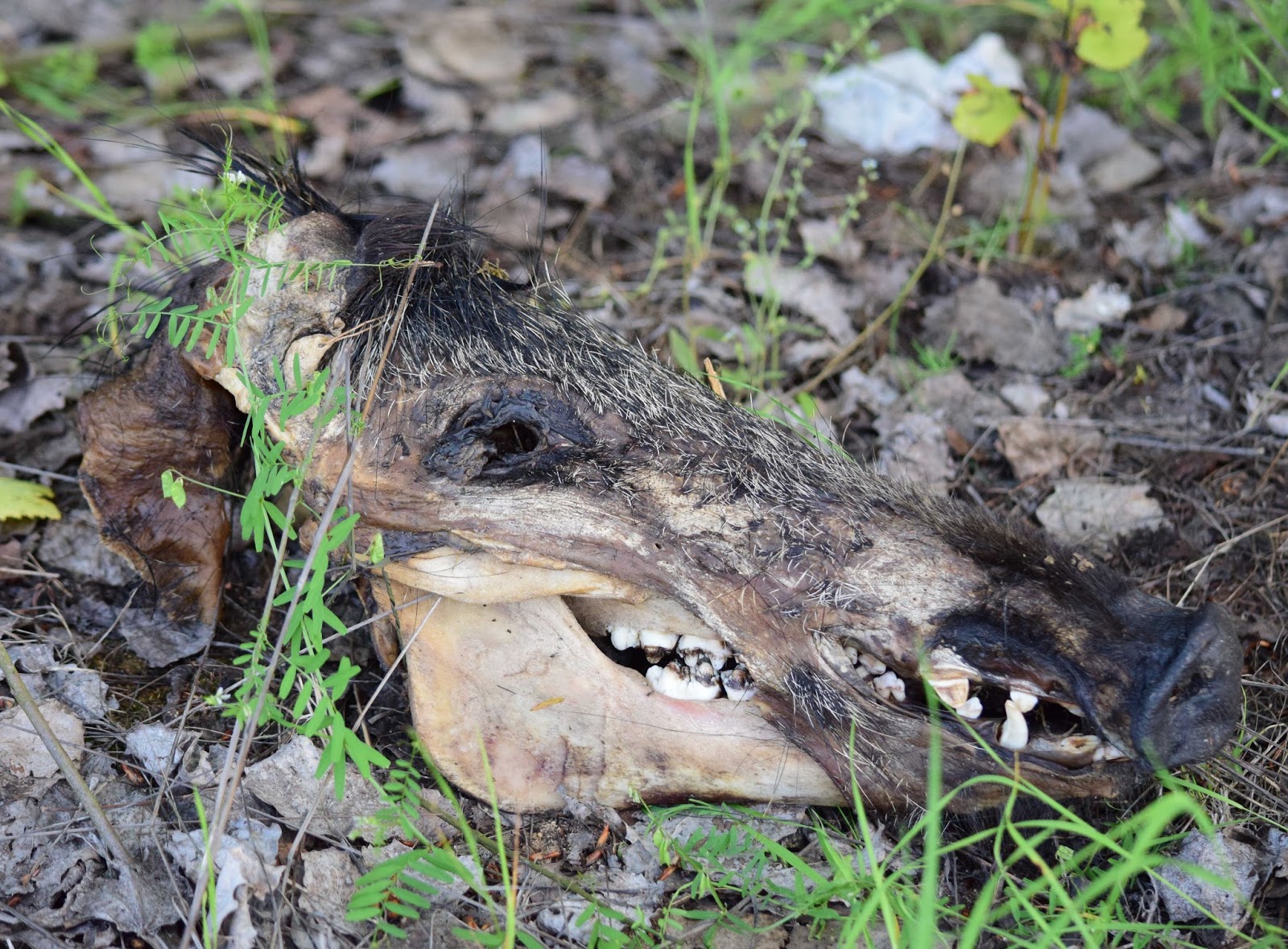
Into the trees. I scramble down the embankment and come across a boar's head, below. Not a Shakespearean tavern but the real thing; the cycle of life, death and decay. It is exactly 19:00.


I've made it in good time to Czachówek Górny station. Surrounded by forests and train tracks, a place of interest. Between the main line and the west-to-south spur is a garden with columns and horses. In the background, a railway signal. From time to time an occasional oil train rumbles through. A place, I think, O. Winston Link would have liked to have photographed.


I'm on the platform at Czachówek Górny. I can hear in the forest a train to the east of me. It it westbound? Northbound? Or southbound? I cannot immediately tell, not being able to see it. The low rumble through the trees is getting louder... where will it emerge? Below: it's a Koleje Mazowieckie passenger train from Góra Kalwaria to Warsaw. According to the timetable, it's running half an hour late. As a result, my train back to Jeziorki is delayed by a few minutes.


Below: my journey; just over 20km in five hours' walking with a half-hour stop for supper en route. Nearly 30,000 paces in total. Click to enlarge.


June is Mazowsze's finest month in terms of weather; one should make the most of every sunny day!

This time last year:
Half a mile under central Warsaw, on foot

This time two years ago:
Dzienniki Kołymskie reviewed

This time three years ago
Russia-Poland in Warsaw: the worst day of Euro 2012

This time five years ago:
Thirty-one and sixty-three - a short story

This time six years ago:
Warsaw rail circumnavigation

This time seven years ago:
Classic Polish vehicles

This time eight years ago:
South Warsaw sunsets

Friday, 12 June 2015

Airside at Okęcie's 'new old' terminal

Here's a belated look at how things look once you've got through security at Okęcie after the (re)opening of the (new) old terminal. [See this post about the groundside improvements.]

The airport gets better and better. Smaller and easier to navigate than Heathrow, larger and more relaxed than 'hurry-up-and-wait' Luton, it's my favourite regular airport.

Firstly: if you've no cabin baggage to check in, simply pass through security at whichever terminal and head to your gate as advised. If you do have cabin baggage, your ticket or e-ticket will tell you where to do this. Sector A is in the new old terminal; Sector B is between the new old terminal and the old new terminal; Sectors C, D and E are in the old new terminal.

But I should get out of the habit of 'old' and 'new' terminals. Officially, the whole ensemble should be considered Terminal A. Which implies that at some point in the future, there will be Terminals B through to Z.

Once you've passed through security (on either side), you'll need to find your gate. The choice has suddenly expanded from Gates 1 to 28 (as was) to Gates 1 to 45. Bear in mind that the low numbers are for Non-Schengen destinations, beyond passport control. These are to the left as you pass through security, at the northern end of the 'pirs' or pier. The Schengen destinations (countries where there's no mutual paranoia about gatecrashers from  other parties to the treaty) are the higher-numbered gates along the middle and southern end  of the pirs.

There are now new bar-code scanning gates speeding up the time it takes to get to security. So far they work fine.

Below: as the airport's website has failed to annotate its otherwise useful terminal plan, I've done so for you. Gate numbers are approximate (I cannot be held responsible for someone missing flights if they guide themselves solely by my plan); north is to the left of the pic, south to the right. The light green area is beyond passport control and is for Non-Schengen flights. The 'new old' terminal, opened last month, is the triangular bit above the number 32; the 'old new' terminal is the square bit above the number 25.


Below: photo taken with lens set at 40mm lens (60mm full-frame equivalent). The photo was taken at the southern end of the pirs looking north past all the gates. From where I'm standing to the furthest gates in the distance is a nine-minute walk (I'm assuming a minimal wait at passport control).


The new gates mean more shopping opportunities to cater to your spending needs. There are plentiful shops selling clothes, electronic gadgetry (there's a Samsung shop, for example) and food. Below: an FSM Syrena pick-up forms a eye-catching centrepiece at a Premium Food Gate, a food and drink store which offers a wide range of regional Polish specialities. There are now lots more shops, so if you've got used to Okęcie having nothing to tempt you with other than a Aelia, a Keraniss and a Relay, come a bit earlier next time you fly as there's now plenty more to look at.


There's even a Scottish restaurant airside! (there's one groundside, I mentioned it in my earlier post about the new old terminal, linked top). However, unlike the groundside one, this restaurant has a bizarre method of ordering, collecting and paying for your food. First, you join a queue to get a card-like voucher. Secondly, you join another queue to order your food. Your order is encoded on the card you have recently received. You then join a third queue as you wait for your order to be prepared. Your meal is served, you then have to join a fourth queue to pay for your meal, handing back your card-like voucher, which is decoded and the correct amount displayed. After full financial reconcilliation between you and the Scottish restaurant, your transaction is deemed to be complete, and you can leave to catch your flight. If it's still there.

Quite why the Scottish restaurant, usually a paragon of business efficiency, has chosen to increase the number of queues you have to stand in from the usual one (or two in drive-thrus and station outlets) to four is beyond me. Unless it's a historical re-enactment of PRL-style queuing, giving international flyers a brief taste of life in communist Poland. My guess is that this clunky and user-unfriendly system will soon be replaced by something more streamlined. Sack the management consultants!

Still, I miss a butchery-and-wine style restaurant serving grilled pork and lamb cuts at Terminal A. I'd like to see something like this called Chop In A Lotnisko.

A propos of airside catering: if you're flying through "London" Luton and the place is heaving with nowhere to sit let alone sit down and eat, go to Gate 10 where there's a place called Bar Ten, and it's always empty. Don't worry about missing your flight, for there's a display showing the gate numbers for flight as they are called.

This time four years ago:
Thirty-One and Sixty-Three (short story about 19th C. Polish uprisings)

This time six years ago:
Jeziorki to Jeziorki - the big rail loop

This time seven years ago:
Automotive miscellany

This time eight years ago:
South Warsaw sunsets

Thursday, 11 June 2015

Loakes in Warsaw!

Hurrah! My favourite shoe brand comes to Warsaw! For 35 years (since April 1980, to be exact) my formal shoe of choice has been Loakes. Over the decades, I've bought no fewer than 13 pairs. The reason? They're hand-made in the traditional way, they last for ages (if well looked after), the style is timelessly elegant and triumphantly British. Not Italian (made from Venezuelan albino bat leather with a silver clasp and tassel, that last one season then fall apart). Or from the Far East (simply fall apart after one season).

Loake is a family business - fourth generation, now led by Andrew Loake. Founded in 1880. History, tradition - things that few footwear brands can emulate. Many of Loake's employees are children or grandchildren of previous generations of Loake employees. This is the antithesis of global corporations exploiting whatever they can get away with exploiting to maximise next quarter's earnings. This is sustainability. I support it.

I was delighted to hear the news that a Loakes shop would be opening in Warsaw - the second in the whole of Continental Europe. So mixing a little bit of business with a whole lot of pleasure, with my son, I set off for the occasion, attended by many Polish fashion journalists.

Below: ul Chmielna 30 - in a courtyard just off the main (pedestrianised) street, not far from ul. Marszałkowska.


Below: Before the store opening, the briefing. Loake's sales director talks us through the product. This shoe, the company's best seller, is the Chester (same name and same colour as our male cat, Czester).


Below: At last, the store opening. Inside, it's beautifully laid out. Up-market, unfussy. The kind of place that makes you want to buy several pairs. Prices from 600 zł to 1,200 zł. For shoes of this quality that last many years, a snip.


Below: Proper. Men's. Shoes. Today. Yesterday. Tomorrow. Not shoes with turned-up pointy toes that will find themselves in sales bins at the end of the season.


Below: My son, in his element.


Below: These will do! A lovely pair of co-respondent brogues.


The best part of the story for me is that Loakes will take their customers' old shoes and fix them back in their Northamptonshire factory with a new long sole and leather lining for 350 zł a pair. I will be bringing them many pairs that I can't get properly fixed in Warsaw. The concept of a szewc (cobbler) who sews soles to uppers has all but disappeared. The guy should call himself a kleik (gluer) who glues bits of rubber to worn-down soles. So if the craft is dying, at least back in Northamptonshire, there's a factory still doing it the way it should be done.

This time last year:
Gdynyer, on the beach, six am

This two years:
Polish doctors in UK offer new healthcare model

This time three years ago:
Football in Warsaw

This time four years ago:
Era becomes T-Mobile

This time five years ago:
Warsaw-Góra Kalwaria-Pilawa rail link closed

This time six years ago:
Marsh harrier, golden airliner over Jeziorki

This time seven years ago:
Bus blaze on way to town

This time eight years ago:
A beautiful, stormy twilight

Saturday, 6 June 2015

The day, seized.

'Carpe diem!,' they say - so I did. I woke up at twenty past three in the morning to find it was already getting light outside. "Why not," I asked myself, "why not set out for a long walk right now. So I got dressed and left the house at ten to four. What a marvellous aroma met my nostrils! At this time of day, as plantlife readjusts from the nocturnal to the daytime photosynthesis cycle, there's a unique, refreshing and entirely wonderful smell in the air that disappears with the sunrise. And of course there's hardly any traffic. It occurs to me that in midsummer, with 17-hour long days at this latitude, there's so much more oxygen in the air than in midwinter, where there's a little over seven hours of daylight for plants to photosynthesise. More oxygen, we feel brighter and more energetic. So it's not just the sun...

Follow my footsteps as I head south towards the sun, in search of the Sublime Aesthetic.

Below: it's 03:54, on ul. Karczunkowska, passing Trombity bus stop.


Below: at 04:14, I leave Warsaw. The old, pre-1999 sign is still there, announcing that outside Warsaw's city limits is a unit of territorial self-government called 'Warsaw Voivodship'.


Below: it's 04.27, ten minutes after sunrise, and the first rays are catching the windows of the housing estate across the tracks from Nowa Iwiczna, as seen from Zamienie.


Below: it's 04:35, and I'm looking across the fields to Nowa Wola. It looks like some kind of petrochemical installation at first glance, but this is the neo-modernist housing estate, which I find aesthetically pleasing. Fit for purpose and to me, far nicer than faux dworki.


Other than two delivery vans that pass me, there's no other sign of human life - until 04:39, when I see this farmer tending his crops, below.


Below: at the crossroads at 04:45. "But where's this road leading me? Where? You're thinking 'Where does this road lead? Where? Have I gone too far?' My God!*" Look at the adverts, the wires in the sky. If this didn't put me in mind of 1950s USA, I'd be minded to call this scene ugly.|


Below: it's 05:23. Nice houses, Jazgarzewszczyzna, photo taken from Bobrowiec. This is now on the other side of the main road from Piaseczno to Magdalenka. Rich people live out here, and their lifestyle is not to be envied (assuming they work in central Warsaw). This is over 8km (5 miles) further out of town than Jeziorki; there's no railway station within walking distance, both car and bus have to wait ages at the lights to cross the main road and then again at the level crossing at Jeziorki. No exurb for busy men.


Below: it's 05:55 and I'm approaching Piaseczno from Bobrowiec, having passed Kamionka. I cross the narrow-gauge railway, now nothing more than a tourist attraction, once the mainstay of public transport south of Warsaw. Again, I'm minded of  1950s USA.


I pass Piaseczno, in great need of a coffee, I pop into the Wadex petrol station on the main road. Me: "Do you do coffee?" Petrol station assistant: "I can sell you a packet of ground coffee..."

At once I identify an issue. BP and Shell make grosze per litre on petrol sales. They make their real money on selling snacks, roadmaps, car accessories etc. Pan Heniek trying to compete with the big guys will have an impressive range of alcoholic beverages, but there's nothing for the tired truck driver other than a tin of energy drink. This is another defining urban/rural divide: in the city, every other newspaper kiosk will have an espresso machine; drinking hot coffee early in the morning while seated, reading your paper or tablet is the very essence of civilised urban morning  life. Not achievable (yet) in rural Poland. A tin of Red Bull or some cheaper napój energetyczny and that's it. Sorry - not the same. Gimme gimme hot coffee!

Below: it's 06:12 and I'm in Jazgarzew, St Roch's parish church (from where the Corpus Christi procession I mentioned in my last post came from). Shops  are open.


Beyond Jazgarzew there's Łbiska, and the rural/urban becomes purely rural. I pop into a grocery story, buy a wholemeal roll and 150g of fineft ham and structure myself a sandwich. Then I turn off the main road to follow a track southwestward towards the railway line. I'm glad to be away from the roads now that rural Poland's woken up. Lots of cars, lots of people at the local stores buying bread and szynka for their breakfasts. It's 07:06 and the long grass is still wet. Ahead of me - the forest.


I enter the forest - the Las Chojnowski which stretches in an arc from Prażmów to Konstancin. In the forest, silence.

On the other side is Ustanów; then Ustanówek and its railway station. I carry on southward and cross the Zielona ('Green') river (below) and am minded of Pink Floyd's Grantchester Meadows. It is 09:21.


Back in the forest heading to my destination - Czachówek. Below: a southbound train headed for Radom. The sunlight dapples the forest floor, the smell of the vegetation is a marvel.


Below: ascending the stairs to Czachówek Górny station. It's 10:01, my train's at 10:23. Time for a rest, eat the rest of my sandwich and sunbathe, while reading today's paper.


Below: My train arrives on time at Jeziorki, I'm not unduly tired, so I take the longer way home via ul. Nawłocka. It's 11:03 and I'm back where I started from, seven hours and 13 minutes earlier.


Below: a map of my route - for the sake of convenience I've rotated it through 90 degrees so that north is to the left. Click to enlarge.


Total distance walked 22.3km (plus another 1.4km from station back home - total 23.7km/14.7 miles/ 29,650 paces). Not bad, and though the sun has been wonderful and hot, I did my walking before the rays became too intense.

The day today is 15 minutes shorter than it is a the summer solstice, which falls on 20 June this year.

* See the Fast Show's Garden Party sketch.

This time three years ago:
Classic British cars for British week

This time four years ago:
Cara al Sol - a short story

This time five years ago:
Pumping out the floodwater

This time six years ago:
To Góra Kalwaria and beyond

This time seven years ago:
Developments in Warsaw's exurbs

Thursday, 4 June 2015

Corpus Christi in rural Mazovia

Today, a day off work. Each year between late May and late June (depending on the date of Easter Sunday), the Catholic Church celebrates Corpus Christi (Boże Ciało). Processions of the faithful visit specially prepared altars (four - one for each Gospel). Heading south out of Warsaw, I try to catch as many as I can. As it happened, I met two processions on the move and passed by another two that had finished and had returned to their parish church.

Riding through Jazgarzew, south-west of Piaseczno, I came across a vast procession (below). This is the back of the procession, which has halted at the first altar...


And below... this is the head of the procession, on the move to the second altar. Note the ZTM bus stop - this is still commuterland. The procession was properly marshalled with police motorcycle outriders to control traffic.


All over my route there were altars, either awaiting the procession or already visited. One way to tell whether the procession had passed was by seeing whether the asphalt was strewn with petals. This altar (below) was near the parish church of Pieczyska.


The weather was perfect today; brilliant sunshine but not too hot; after 31C yesterday, today's temperature at noon was 21C. Comfortable for processions. Below: three more altars. Texts on them from left to right: 'God loves you,' 'Christ the Lord feeds us with his Holy Flesh', and 'Follow Christ'.


Do not confuse altars with shrines. The latter are permanent structures, very common in rural Poland. Many villages have more than one. Below left, a Marian shrine, still decorated for the celebration of the Marian month of May; below right, a traditional wayside crucifix.


I came across my second procession near the village of Stromiec. This one was on a main road, the DK48, which links Tomaszów Mazowieckie with Dęblin taking in Białobrzegi and Kozienice. It was between the last two towns that this truck, which had mercifully slowed down as it entered a built-up area, came head-on with a procession as it rounded a bend. No police escort, just one volunteer fireman in charge of safety. Had the driver been going faster, or drunk, the consequences could have been tragic.


Worth noting the the role of the OSP (voluntary fire service) in rural Poland. After the church, this is the second-most powerful institution across Poland's villages. The remiza strażacka  (fire station) is where christenings and weddings are celebrated; the OSP gives people the chance to wear a uniform and play an instrument in a brass band. In both processions I saw today, there was a sizeable OSP contingent.


This is the rural Poland that voted Duda on 24 May. Here, in the run-up to the second round of the presidential elections, I didn't see one Komorowski poster. Socially conservative Catholic Poland is alive and well in the countryside. While churchgoing might be in decline in the cities, here it is tradition, it is what you do.

The question in my mind as I returned home via Nowa Wola and Zamienie, where entire housing estates are emerging from the arable fields, is whether these new communities will ever become part of the local congregation, or does the spread of the Warsaw agglomeration threaten traditional ways at the metropolis's edges?


This time last year:
25th anniversary of Poland's transition

This time three years ago: This time two years ago:
Poland's infrastructure progress

This time four years ago:
Wetlands in late-spring

This time five years ago:
Jeziorki's flood of floods: Puławska and Pozytywki

Jeziorki's flood of floods: Sarabandy and Karczunkowska

Jeziorki's flood of floods: Trombity and Kórnicka

This time six years ago:
Another time, another place

Tuesday, 2 June 2015

London vs. Warsaw: Part II - demographics.

I see this post has attracted huge amounts of readers (though not as many as my recent review of With Blood and Scars). I'd like to look this time of life at when it makes sense to live in London, and when it makes sense to live in Warsaw. Addressing the point made by Sigismundo in the comments on the previous post, I'll focus less on economics and more on quality of life.

18-33: LONDON. Let's say you are fortunate enough to have the whole of your life ahead of you. Warsaw or London? Without a shadow of a doubt, London. Life here is more intense. Sure, it's more expensive, whether you're a student or a first-jobber; the trick is to work hard and play hard. London offers you the opportunities to do both. But focus on building social capital, on those aspects which will serve you well in future. London is for 24-hour party people; but you have to be able to afford it, which means you work when you're not playing. No space for slacking. London attracts the best young talents from around the world, academically or in any area of professional or artistic endeavour. There are huge opportunities - but they must be grasped. If you have a tendency to be lazy - London's not for you - it will push you to the margins.

33-45: WARSAW. You've settled down. You want to raise children. Let's face it - London's not the best place for doing this. London schools are either expensive or poor. Warsaw schools are internationally recognised as being better (see PISA results) and cheaper. There's less knife crime and less drugs in Warsaw schools. If you've got this far in life on a successful roll, you'll find that quality housing in Warsaw is cheaper too, compared to what you're earning. You're not hemmed in by urban sprawl. The experience you gained in London will get you a premium on the Warsaw job market (I'm assuming you're a professional here.) And these are no longer the years where you're running around from club to club, so Warsaw's quieter (though nonetheless rapidly developing) nightlife is no longer an issue.

45-67: WARSAW: "When does life start? Priest - at conception. Pastor - at birth. Rabbi - when the kids leave home." Old joke, but this time of life is predicated by whether your children will go to study away from home (when I was 18, the further away, the better), or end up like statistical Italians, living with mamma until the age of 38. This is the time for enjoying the finer things in life - the arts, good food, walks in the country. Unless you are a millionaire, in pounds sterling, not zlotys, London is too expensive. A night at the opera for two will cost you around £500 (2,875 złotys) for tickets and a meal. And Warsaw is more easy-going for folk this age; in London, you feel you're past it, swimming in a sea of youth.

67+: WHEREVER YOUR PENSION ENTITLEMENT IS: Don't move back to Poland if you've been paying into the National Insurance system all your working life. The NHS is rightly treasured by Britons. Your medicines and treatments are free. But if you've been living in Poland until this age, it's no time to move. Travel by all means, visit friends and relatives regularly. But stay close to your pension pot, to your doctor. Poland may be no country for old men right now, but in future it will have to adapt to its demographics. Unless populist politicians screw it up with economic policies that win elections today, sending the bill to coming generations, Poland will be forced to be more old-folk friendly in future.

So there we have it. Mr Dembinski's recepta for a happy and fulfilled life across the two countries he knows and loves best.

This time two years ago:
Warsaw wealthier than most of UK shock!

This time three years ago:
Rail link to Okęcie airport opened