Thursday, 3 June 2010

Jeziorki's Storm of Storms

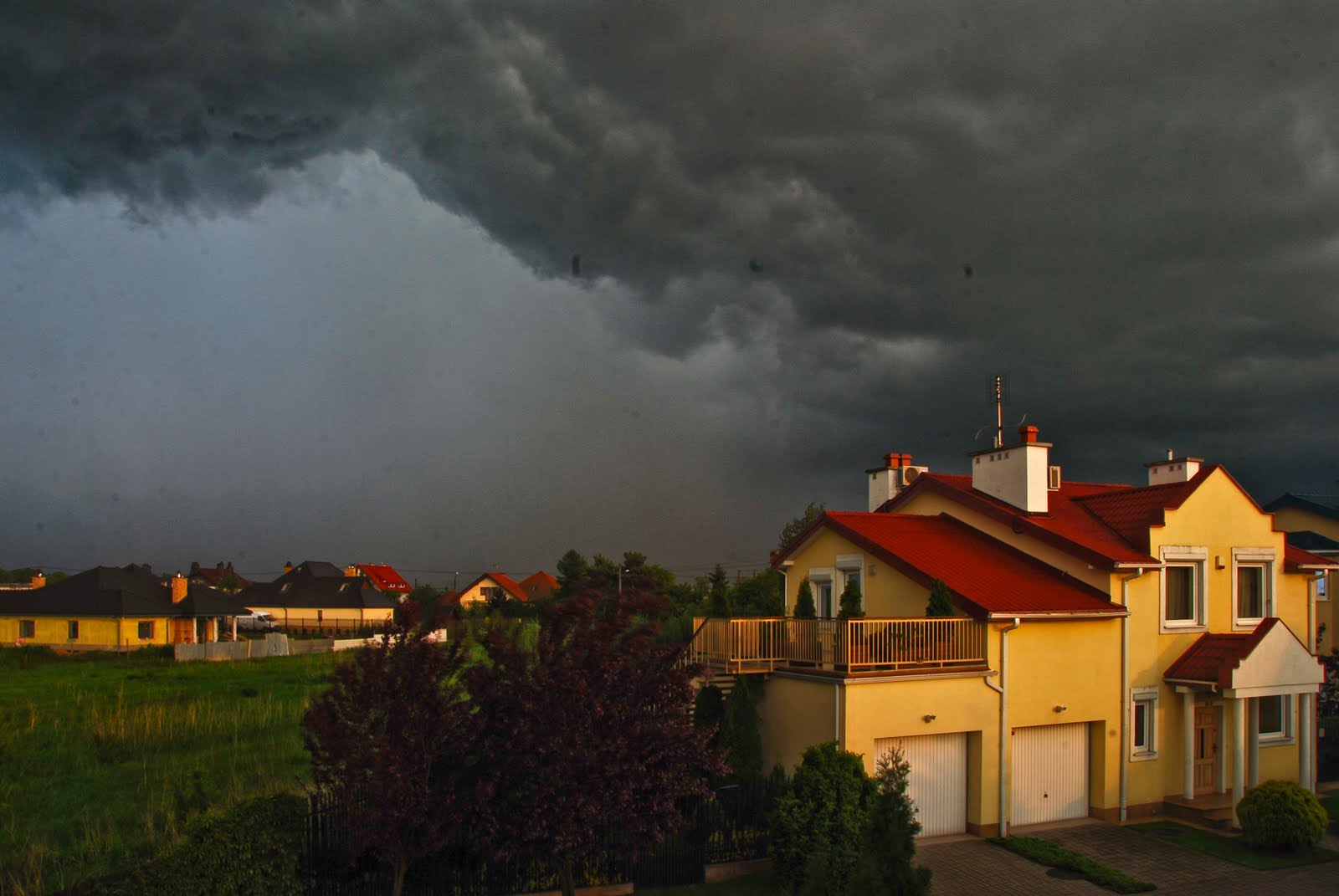
I could see it coming - a whopper of a storm. The previous night's storm was mainly electrical; much thunder and lightning, not much rain. As the clouds deepened and darkened, I put the tripod out onto the balcony at the front of the house to catch the storm as it happened.

Below: the storm (nawałnica - 'squall' or 'cloudburst') at its maximum intensity. The Yaris's alarm has been set off by the thunder as it passed overhead. Lightning flash - BOOM! Thunder followed before I could count to one. The wind was ferocious. I have never seen such volumes of water coming down from the heavens, nor accompanied by such winds. Note the water level - up to the top of the Yaris's rear tyre, entirely flooding the front garden.

Below: the storm has passed. It lasted less than two hours. The drive and front garden are under five inches (13 cm) of water. The ground in any case was pretty much waterlogged as a result of May's abnormally high rainfalls following the winter's abnormally high snowfalls.

Soon after the above photo was taken, the lights went out and would remain out for the next 36 hours. The Corpus Christi storm of 2010 will go down in folk memory of Jeziorki's inhabitants, as we shall see from the next post.

Coal trains in June

Just because it's no longer -20C and nights no longer 17 hours long doesn't mean that Warsaw doesn't need prąd and plenty of it. The coal trains that run from W-wa Okęcie sidings to Siekierki power station via Konstancin-Jeziorna sidings are less frequent and less heavily loaded. Two engines provide sufficient motive power to get the full trains to Siekierki.

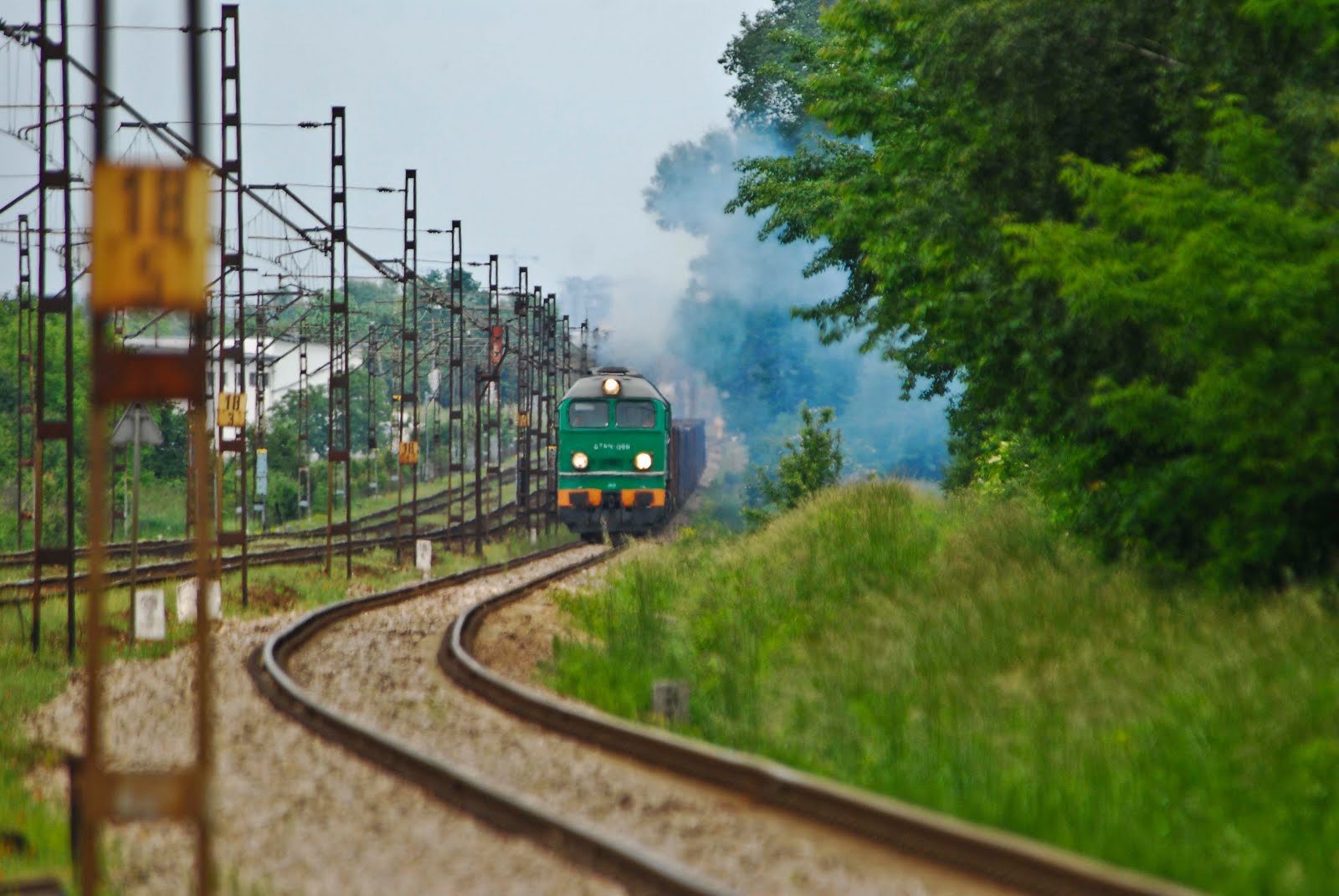
Above: Looking north from the level crossing on ul. Karczunkowska towards W-wa Dawidy. It looks like quite a dip between the camera's vantage point and where the train is; the difference is only some seven metres. The two engines (ST44-089 and SM48-114) are labouring hard up the modest incline, chucking out more soot than the power station itself.

Above: The train reaches the level crossing. It's moving slowly, to the frustration of motorists at the gates. Worth switching engines off while you wait; this is not 30 seconds at red lights.

Above: Nowa Iwiczna, before the single-track coal line reaches the main line at Nowa Iwiczna station. PCC Rail Coaltrans' TEM2-233 bringing a rake of empty trucks back to W-wa Okęcie.

Wednesday, 2 June 2010

Hurting and healing - a certain symmetry

After being cooped up at home for three days with a shoulder sprain, at last I felt well enough to go for a walk this evening... Wait a minute - I've written this before... Here.

Back in July 2008, I suffered a partially-severed rotator cuff in my left shoulder. I achieved this by carrying too much weight in my rucksack while cycling, and having the shoulder straps fastened too tight. Then, rather than taking it easy at the first manifestations of pain, I kept on, making two more return journeys to work by bike and ignoring the symptoms until the pain became unsurmountable.

This time, I've done it again, but in the right shoulder. Exactly the same injury, caused exactly the same way. On Friday, I piled in my rucksack a U-bolt lock, a padlock and chain plus waterproof clothing (one of the immutable laws of bicycle security is that the lighter the bike, the heavier the locks needed to prevent its theft). On Saturday morning, I felt as though I'd merely had a bad night's sleep and did not attribute the slight shoulder ache to an overloaded rucksack. So that afternoon, Eddie and I rode down to the airport to see how the roadworks are coming on. Into that same rucksack went the 80-400mm Nikkor, the D80 around my neck with 18-200mm lens. We cycled down ul. Hołubcowa - muddy, bumpy dirt-track. By Sunday morning, the pain was worse. So then I went for the weekly shop, throwing six-packs of 1.5l bottled mineral water around. By Sunday night, the pain was so bad I knew I'd not be in any state to go to work in the morning...

Should I go and see the doctor?

NO.

There's nothing he could tell me that I didn't already know. Give me some useless cream and a one-a-day painkiller like last time? Then direct me for another appointment to get an ultrasound scan? Two (painful) journeys by car, waiting rooms, examinations, queues at the pharmacy?

Time that could be better spent in bed.

That one-a-day painkiller I got in 2008 was fine for the first 20 hours, then, before I could take the next, the pain would get excruciating. This time, I took a maximum dose of paracetamol and lay down until the pain stopped. There were four long periods when my shoulder hurt even when I was not moving; Sunday night, Monday morning, Monday night, Tuesday morning. By Tuesday afternoon it hurt only when I moved; by Tuesday night I stopped taking painkillers, by this afternoon, I'd have to move it vigorously to feel any pain at all.

I'm letting nature take its course. Last time, the doctor prescribed me another visit "in a week's time" - by when it was all over and fine thank you and not hurting at all. He also prescribed a course of six cryotherapy sessions - I didn't waste my time with this. (Looks like a batch of hokum to me.)

So nature did what it does best; that miraculous feeling of healing, of the body naturally overcoming injury is one to be relished. My left shoulder healed completely - I've not had any twinges or recurrances of the pain in the two years since that injury. The current one, now on the way to recovery, is healing quicker (now I know what to do - simply rest and manage the pain, not tear around from doctor to doctor). And the current injury is, in its own way, a blessing. It balances out the other one. Both shoulders have had exactly the same thing happen to them, and the right one is healing in exactly the same way. What doesn't kill you makes you stronger, as Nietzsche said.

I must look at how to avoid this happening again. New rucksuck, broader shoulder straps. Find some way of carrying heavier items directly on the bike (neither my Cannondale, nor my Pete White, nor my Holdsworth have brazed-on lugs for attaching a carrier rack). A large under-saddle bag would be useful; a frame-bag to carry tools, spare inner-tube etc. And leave only light items, such as clothing, to the rucksack. Ideally, however, I should ride without anything on my back.

And what was I doing while not being able to type at 120 wpm? Watching Jonathan Meades on YouTube. Britain's greatest architectural critic and television intellectual of the late 20th and early 21st Century.

In particular: Soviet architecture - Stalin's legacy and British architecture - Victoria's legacy. Each worth 90 minutes of your time to savour.

Thanks to the website of Owen Hatherley for the link to the Meades Shrine on YouTube. This is how ideas spread and take root.

Does Poland have a Jonathan Meades? Probably. Except we shall never know, for there's no Polish BBC on which he or she may shine. Just the drear, tendentious drivel of party-run TVP.

And a propos of British society, this article by Ben Macintyre about the difference between Cameron and Clegg is a gem.
Sunday, 30 May 2010

My understanding of the ingredients of Success

Well, here it is. What you need to get on in life.

Number One, Drive. Determination, motivation, energy, WILL, focus, courage. The opposite of idleness, indolence, can't-be-arsed-ism. I suspect that you are born with this are you are not, and that environmental factors merely exacerbate or dull one's native drive. This is, I am sure, rooted in mammalian hierarchies. Who is to become Top Dog must be courageous, self-confident, determined. Will science identify a gene for Will? (If scientists do so, will it be ethical of them to let society know?). Successful motivational speakers, successful leaders, ones who can bring about increases in the drive of their workforce (or nation) are in short supply.

Number Two, Intelligence. Smartness. Wisdom. Awareness. Consciousness. The child that instinctively understands without having to swot too hard to remember - and possesses the drive to acquire more knowledge, determined to make the most of the opportunity while it is there. Intelligence in humans has come to replace the antlers of the stag or the feathers of the peacock.

Number Three, Luck. Being born intelligent and willful. Being born rich in a rich country rather than poor in Somalia or Papua New Guinea or Haiti. Being in the right place in the right time - a Malcolm Gladwell points out in Outliers. Bill Gates, the Beatles, Andrew Carnegie - had they come along just a few years earlier or a few years later, would have not made it so big. But then Luck, as Margaret Thatcher pointed out, is an Opportunity Not Missed.

And so. If you consider yourself - and the impact your life has - as a cake-decorating syringe, the factors that determine how much icing comes out of the nozzle are determined by a) the bore [diameter] of the syringe; b) the stroke [length] of the syringe; the force with which the piston is pushed, and the diameter of the nozzle. You are the syringe that you were born with. The force pushing against the piston may often weaken; "I'll just have a sit down, have a cup of tea"; but then, the days are marching.

(Should you need one of these gadgets, you can find them here.)

Saturday, 29 May 2010

Warsaw through the architectural critic's eye

Blogging gets into a stride; patterns become regular - update my blog, then do the rounds of the blogs outlined here on the right, paths well-trodden. But every now and than something new swims into one's ken; today, while Googling info about the architects responsible for Warsaw's railway stations, I came across a outstandingly intelligent British blogger with much of interest to say about our city.

Without further ado, then, I will link you to the [none-to-easy to navigate] blog of Owen Hatherley (below), with vast amounts of well-written insight into Warsaw's architecture. This is how the informed outsider's mind sees our city, our spirit of place.

Warsaw's railway stations
Warsaw's flats and houses
Adverts of Warsaw
Memorials/Stations/Signs/Vitrines

Thursday, 27 May 2010

Poet's Corner

The flavour of parallel: poems by Nigel Humphreys


This collection of sixty poems is the second published by Arbor Vitae Press by this poet (the first being The Hawk's Mewl). His poems work on me because Nigel Humphreys shares my view that the essence of the universe resides at the interface between science and spirituality. Too many scientists deny the spiritual; too many people of religion eschew science. Poets' vision is often way ahead of conventional wisdom; centuries later their vision is proved to be correct.

Humphreys' poems click with universal themes; the human condition - ageing, love; nature, the arts - Tchaikovsky, Coleridge and Van Gogh - things we should be able to identify with, and then the poetry works. Spirit of place is another thread that runs through this collection; Snowdonia, Shetlands, London, Madrid; a few words that conjure a sense of awareness of being there.

He has a memorable turn of phrase: "a full cream afternoon", "an invasive rash of tenderness", (a dragonfly's) "hairgrip picklock legs", "the first crisp sky of Spring", "agonising over each stroke/as to a young queen's neck"; essential in any poet's armoury, a mind in restless search for a new understanding of our reality through metaphor.

The human condition, meat to any any poet's scalpel:
last week or the week before he had visitors: his own genes
hosted in matryoshki figures,
he worried them back to their remote controls.

since then
no one
[from Sunday afternoon on Barry Island - Chapelview Residential Home]

Or, from Embers, where Science steps in:

molecular drift? did the magnet
dull with distance and new
polarity reverse the old one?

He asks of an old flame.

but we're those other people now
who never danced

His appreciation of the universe as both scientific and spiritual is what I admire most about Humphrey's works. Tomorrow's zeitgeist. Words such as gene, atom, proton, quark, molecule rub shoulder with saints, churches, cardinals, baptism and angels. This I like. Here, from the physics of degeneracy:
the fine tuning of all those
physical constants
masquerading as
coincidences
and just for
we?
Haven't you often thought just that, yet been unable to put into such eloquent words?
The flavour of parallel is available from Arbor Vitae press, BM Spellbound, London WC1N 3XX, price ₤7.99, plus ₤1.25 postage & packing. Thanks to Jonathan Wood for sending me the book.
[And while on the subject of literature, a joke for my bilingual readers: Moni's current set text (lektura) for Polish is Dostoyevsky's Zbrodnia i kara. Eddie, thinking it was a translation of a book originally written in English, asked: "So what was the crime of Icarus?"]

Wednesday, 26 May 2010

Biology and spirituality: more questions

I wrote earlier about human intelligence, about how the brains of our species are continually evolving. The use of IQ as a measure is only a snapshot in time, with 100 being the average IQ today. It is believed that our stone-age ancestors had an IQ of less than 50 compared to modern man.

With the advances in life sciences, and education (are the children of well-educated people more intelligent than those of similar native cleverness who've not benefited from education?), there is the likelihood that at some time in future, the average IQ of the human population will be the equal of 200 in today's terms. And therefore the 'gifted' and the 'geniuses' of the future will have IQs of 300 and above - in today's terms. What will they be thinking? How will their consciousness, their awareness, differ from ours? If at all? Will the only difference being that our hyper-intelligent descendants will simply be better at expressing the experience? Or will experiencing life through the lens of higher intelligence be somehow qualitatively better?

I have no proof for my supposition that other living beings are as conscious as we, despite being unable to place their experience into a wider frame of reference or communicate it as clearly to their fellows - the song of birds and whales may be the nearest. [This week we learn that scientists have discovered how to synthesise life, by creating a bacteria's DNA (from scratch) and implanting it into the shell of a bacterial cell. A bacteria, then, with no ancestors. The implications are profound in the extreme. (The story went surprisingly under-reported.) But could mankind ever create artificial consciousness? Artificial intelligence is on the way. But a machine which can describe to us how it feels to exist? To feel sorrow, elation, anxiety, embarrassment, pride, fear, confusion, jealousy? And describe it in such a way as to elicit empathy from the listener/reader/viewer?

As mankind gains in intelligence, we must learn to rise above our biology. We are born, we reproduce, we die. There is no getting away from these biological imperatives. Yet applying one's heightened intelligence to dwell on this can be a depressing and futile activity, focusing on one's impending senility and demise which approaches at an ever-accelerating speed. Physical and mental frailty will come to us all who live to natural old age. To cope with these truths, we must acquire a thorough understanding of our biology - and then, in a spiritual sense - through the richness of the life of the mind, in dreams, in our flashbacks - rise above it. We are part of a universal, eternal whole, a process of consciousness rising, of order rising out of chaos; our wills shape it, and will continue to shape it long after the atoms that currently form our bodies cease to work together as one coordinated entity.

Tuesday, 25 May 2010

Calling International Rescue

EMERCOM - the Russian Emergency Control Ministry - has sent over a plane load of supplies to help with the Polish flood crisis. Below: An Ilyushin Il-76TD Candid of the MChS, RA-76363, over our house. (See also this Il-76 and this EMERCOM Mil Mi-26 - world's largest helicopter)

If you are Polish and have never heard of International Rescue or Thunderbirds - well guys, you are in for a treat! I grew up on this TV series. As a child in the mid-1960s, this was the programme to watch. Not just the gripping race-against-time plots, but the 21st Century technology - in particular the aircraft, rockets, ships, submarines - and the rescue equipment with which International Rescue always managed to save the day.

Above: What will come out of this huge aircraft's cargo hold? Sandbags? Clothing? Bulldozers? Thunderbird 4? The Mole? There is something about the look of the Il-76 that would make it fit in well with Gerry Anderson's vision of the mid-21st century.

(According to Gazeta Wyborcza, it's pumps, boats, and generators. 15 tonnes-worth.)